SUBJECT- FISH AND SHELLFISH PATHOLOGY
TOPIC-NITROGENOUS WASTE, ENOGENOUS
CHEMICAL
Nitrogenous wastes
 Nitrogenous wastes are synthesized by animals from
excess amino acids
 Unlike lipids and carbohydrates amino acids are not
stored in the body
 They are deaminated by the liver tissues and the amino
group has to be excreted.
Deamination

 NH2.CHR.COOH + H2O  NH3 + O
CHR.COOH
Transaminase
Amino
acid
Water Ammonia Keto acid
Toxic, it
must be
excreted
Can be
converted
into glucose
and recycled
Three types of nitrogenous wastes are used
by the vertebrates
 Ammonia
 Urea
 Uric acid
Ammonia is a direct product of deamination. In the liver
Urea is produced from ammonia. This also takes place
in the liver tissues
2NH3 + CO2  CO(NH2)2 + H2O
Uric acid is formed directly from amino acids in a
series of reactions that produces its complex ring
structure.
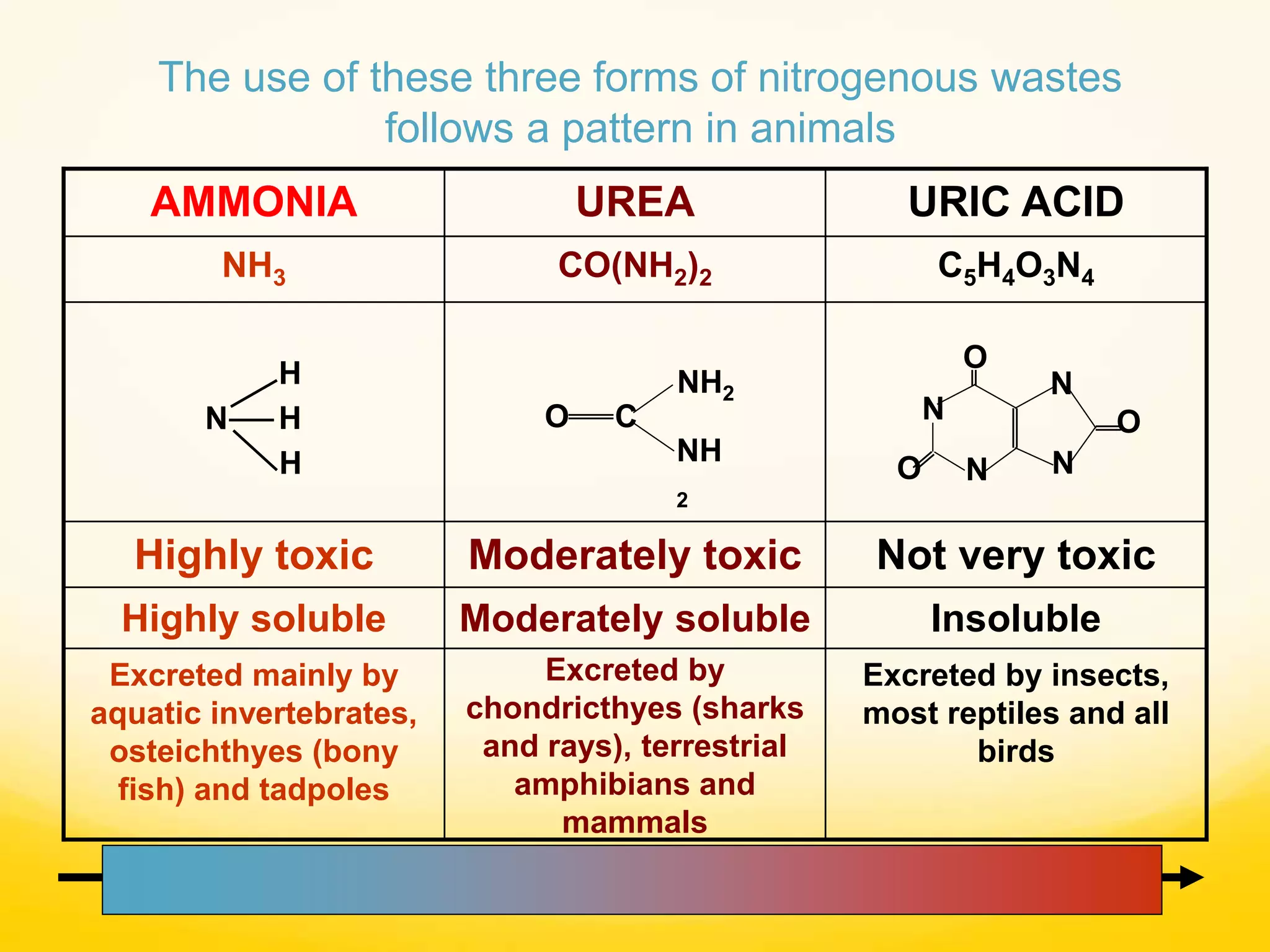
The use of these three forms of nitrogenous wastes
follows a pattern in animals
Excreted by insects,
most reptiles and all
birds
Excreted by
chondricthyes (sharks
and rays), terrestrial
amphibians and
mammals
Excreted mainly by
aquatic invertebrates,
osteichthyes (bony
fish) and tadpoles
InsolubleModerately solubleHighly soluble
Not very toxicModerately toxicHighly toxic
C5H4O3N4CO(NH2)2NH3
URIC ACIDUREAAMMONIA
N
H
H
H
NH2
CO
NH
2
O
O
ON
N N
N
ENDOGENOUS CHEMICALS IN FISH TISSUES
Endogenous chemicals are those chemicals which naturally
occur within
biological organisms. These chemicals such as eicosanoids
which are derivatives of
lipids are involved in many physiological functions. Exogenous
chemicals are found
outside biological organisms. When exogenous chemicals occur
in the environment they
can become a hazard to biological life such as interfering with
natural physiological
processes within organisms. These chemicals can also change
the natural chemistry of
the environment which could facilitate the spread of organisms
which can be hazardous
to biological life including fishes in the surrounding area.
Endogenous Chemicals in Fish
Tissues
• Fatty acids
• Eicosanoids
• Prostanoid biosynthesis
• Leukotriene biosynthesis
• Eicosanoid notation
Fatty acids
Fatty acids. Fatty acids (FA) are found in fish fat and are the main
sources of metabolic energy in fish, as well as being precursors
for a group of biologically active compounds known as
eicosanoids (Sargent et al., 1999; Sargent et al., 2002). FAs are
amphiphilic having a polar section consisting of a hydrophilic
carboxyl group and a nonpolar section consisting of a hydrophobic
hydrocarbon chain (Figure 1.1). FAs usually contain an even
number of carbon atoms in an unbranched chain. A FA containing
only C-C single bonds is considered to be saturated. FAs
containing at least PREVIEW 2 one C-C double bond are
considered to be unsaturated fatty acids (UFAs). FAs containing
one double bond are termed monounsaturated fatty acids
(MUFAs) and FAs containing more than one double bond are
termed polyunsaturated fatty acids (PUFAs). The double bonds
are usually in a cis configuration (Campbell and Farrell, 2002)
FAs are designated using a numbering system. For example,
linolenic acid is designated 18:3n-3. The first number, 18,
designates the number of carbons in the chain, the number to the
right of the colon designates the number of double bonds in the
FA chain, and the n-3 indicates the position of the first double
bond from the terminal methyl group. In older literature, an is
used instead of an n (ex. 18:3 -3) (Campbell and Farrell, 2002;
Sargent et al., 2002)
Essential fatty
acids
Essential fatty acids. Essential fatty acids (EFAs) are FAs
which fish or humans are incapable of producing. The human
body cannot produce n-3 and n-6 FAs, or convert n-3 FAs into
n-6 FAs, or vice versa (Henzl, 1999). Humans, therefore,
acquire EFAs through their diet/nutrition. Linoleic acid (LA,
18:2n-6) and linolenic acid (LNA, 18:3n3) are EFAs. LA is a
precursor of arachidonic acid (AA, 20:4n-6) and LNA is a
precursor of docosahexaenoic acid (DHA, 22:6n-3) and
eicosapentaenoic acid (EPA, 20:5n-3). AA, DHA, and EPA are
precursors of eicosanoid synthesis (Bell et al., 1986; Sargent
et al., 1995).
Eicosanoids.
Eicosanoids. Eicosanoids are 20-carbon chained derivatives of
fatty acids. Eicosanoids are found in many animal tissues and
have many physiological functions. (Buchmann, 1999; Campbell
and Farrell, 2002). Eicosanoids are primarily divided into 4
subgroups: prostaglandins (PGs) and thromboxanes (TXs), which
are sometimes termed prostanoids, leukotrienes (LTs), and the
less biologically active hydroxyeicosatetraenoic and
hydroxyeicosapentanoic acids (HETEs and HPETEs) (Mustafa
and Srivastava, 1989; Sargent et al., 1999; Campbell and Farrell,
2002).
The PUFA requirements for normal growth and development of
fish include DHA, EPA, and AA, which are all precursors of
eicosanoids (Rowley et al., 1999; Sargent et al., 1999). The main
precursor of the biologically active eicosanoids is AA. The
eicosanoids produced by EPA and DHA are usually less
biologically active.
EPA PREVIEW 4 has been shown to inhibit the formation of
eicosanoids from AA and to interfere with the actions of
eicosanoids formed from AA. Eicosanoid actions in the body can
be determined by the AA:EPA ratios. High tissue ratios of AA:EPA
result in enhanced eicosanoid actions, whereas high tissue ratios
of EPA:AA result in decreased eicosanoid actions (Terano, et al,
1986; Sargent et al., 1999).
Prostanoid biosynthesis
Prostanoid biosynthesis. Arachidonic acid (AA) is released
from its storage site in phospholipids where it reacts with
PGH synthase (also referred to as cyclooxygenase). PGH
synthase inserts two oxygen molecules into AA, producing
a 15-hydroperoxy-9,11- endoperoxide containing a
cyclopentene ring (PGG2). PGG2 then is reduced to
PGH2. Both PGG2 and PGH2 are very chemically reactive
and have half lives of ~3 min. at physiological pH. PGH2
then reacts with other enzymes to form the biologically
active prostanoids: Prostaglandin D2 (PGD2),
Prostaglandin E2 (PGE2), Prostaglandin F2a (PGF2a),
Thromboxane A2 (TXA2), and Prostaglandin I2 (PGI2 or
prostacyclin) (Marks,

Nitrogenous waste, enogenous chemical

  • 1.
    SUBJECT- FISH ANDSHELLFISH PATHOLOGY TOPIC-NITROGENOUS WASTE, ENOGENOUS CHEMICAL
  • 2.
    Nitrogenous wastes  Nitrogenouswastes are synthesized by animals from excess amino acids  Unlike lipids and carbohydrates amino acids are not stored in the body  They are deaminated by the liver tissues and the amino group has to be excreted.
  • 3.
    Deamination   NH2.CHR.COOH +H2O  NH3 + O CHR.COOH Transaminase Amino acid Water Ammonia Keto acid Toxic, it must be excreted Can be converted into glucose and recycled
  • 4.
    Three types ofnitrogenous wastes are used by the vertebrates  Ammonia  Urea  Uric acid Ammonia is a direct product of deamination. In the liver Urea is produced from ammonia. This also takes place in the liver tissues 2NH3 + CO2  CO(NH2)2 + H2O Uric acid is formed directly from amino acids in a series of reactions that produces its complex ring structure.
  • 5.
    The use ofthese three forms of nitrogenous wastes follows a pattern in animals Excreted by insects, most reptiles and all birds Excreted by chondricthyes (sharks and rays), terrestrial amphibians and mammals Excreted mainly by aquatic invertebrates, osteichthyes (bony fish) and tadpoles InsolubleModerately solubleHighly soluble Not very toxicModerately toxicHighly toxic C5H4O3N4CO(NH2)2NH3 URIC ACIDUREAAMMONIA N H H H NH2 CO NH 2 O O ON N N N
  • 6.
    ENDOGENOUS CHEMICALS INFISH TISSUES Endogenous chemicals are those chemicals which naturally occur within biological organisms. These chemicals such as eicosanoids which are derivatives of lipids are involved in many physiological functions. Exogenous chemicals are found outside biological organisms. When exogenous chemicals occur in the environment they can become a hazard to biological life such as interfering with natural physiological processes within organisms. These chemicals can also change the natural chemistry of the environment which could facilitate the spread of organisms which can be hazardous to biological life including fishes in the surrounding area.
  • 7.
    Endogenous Chemicals inFish Tissues • Fatty acids • Eicosanoids • Prostanoid biosynthesis • Leukotriene biosynthesis • Eicosanoid notation
  • 8.
    Fatty acids Fatty acids.Fatty acids (FA) are found in fish fat and are the main sources of metabolic energy in fish, as well as being precursors for a group of biologically active compounds known as eicosanoids (Sargent et al., 1999; Sargent et al., 2002). FAs are amphiphilic having a polar section consisting of a hydrophilic carboxyl group and a nonpolar section consisting of a hydrophobic hydrocarbon chain (Figure 1.1). FAs usually contain an even number of carbon atoms in an unbranched chain. A FA containing only C-C single bonds is considered to be saturated. FAs containing at least PREVIEW 2 one C-C double bond are considered to be unsaturated fatty acids (UFAs). FAs containing one double bond are termed monounsaturated fatty acids (MUFAs) and FAs containing more than one double bond are termed polyunsaturated fatty acids (PUFAs). The double bonds are usually in a cis configuration (Campbell and Farrell, 2002)
  • 9.
    FAs are designatedusing a numbering system. For example, linolenic acid is designated 18:3n-3. The first number, 18, designates the number of carbons in the chain, the number to the right of the colon designates the number of double bonds in the FA chain, and the n-3 indicates the position of the first double bond from the terminal methyl group. In older literature, an is used instead of an n (ex. 18:3 -3) (Campbell and Farrell, 2002; Sargent et al., 2002)
  • 10.
    Essential fatty acids Essential fattyacids. Essential fatty acids (EFAs) are FAs which fish or humans are incapable of producing. The human body cannot produce n-3 and n-6 FAs, or convert n-3 FAs into n-6 FAs, or vice versa (Henzl, 1999). Humans, therefore, acquire EFAs through their diet/nutrition. Linoleic acid (LA, 18:2n-6) and linolenic acid (LNA, 18:3n3) are EFAs. LA is a precursor of arachidonic acid (AA, 20:4n-6) and LNA is a precursor of docosahexaenoic acid (DHA, 22:6n-3) and eicosapentaenoic acid (EPA, 20:5n-3). AA, DHA, and EPA are precursors of eicosanoid synthesis (Bell et al., 1986; Sargent et al., 1995).
  • 11.
    Eicosanoids. Eicosanoids. Eicosanoids are20-carbon chained derivatives of fatty acids. Eicosanoids are found in many animal tissues and have many physiological functions. (Buchmann, 1999; Campbell and Farrell, 2002). Eicosanoids are primarily divided into 4 subgroups: prostaglandins (PGs) and thromboxanes (TXs), which are sometimes termed prostanoids, leukotrienes (LTs), and the less biologically active hydroxyeicosatetraenoic and hydroxyeicosapentanoic acids (HETEs and HPETEs) (Mustafa and Srivastava, 1989; Sargent et al., 1999; Campbell and Farrell, 2002).
  • 12.
    The PUFA requirementsfor normal growth and development of fish include DHA, EPA, and AA, which are all precursors of eicosanoids (Rowley et al., 1999; Sargent et al., 1999). The main precursor of the biologically active eicosanoids is AA. The eicosanoids produced by EPA and DHA are usually less biologically active. EPA PREVIEW 4 has been shown to inhibit the formation of eicosanoids from AA and to interfere with the actions of eicosanoids formed from AA. Eicosanoid actions in the body can be determined by the AA:EPA ratios. High tissue ratios of AA:EPA result in enhanced eicosanoid actions, whereas high tissue ratios of EPA:AA result in decreased eicosanoid actions (Terano, et al, 1986; Sargent et al., 1999).
  • 13.
    Prostanoid biosynthesis Prostanoid biosynthesis.Arachidonic acid (AA) is released from its storage site in phospholipids where it reacts with PGH synthase (also referred to as cyclooxygenase). PGH synthase inserts two oxygen molecules into AA, producing a 15-hydroperoxy-9,11- endoperoxide containing a cyclopentene ring (PGG2). PGG2 then is reduced to PGH2. Both PGG2 and PGH2 are very chemically reactive and have half lives of ~3 min. at physiological pH. PGH2 then reacts with other enzymes to form the biologically active prostanoids: Prostaglandin D2 (PGD2), Prostaglandin E2 (PGE2), Prostaglandin F2a (PGF2a), Thromboxane A2 (TXA2), and Prostaglandin I2 (PGI2 or prostacyclin) (Marks,