EXPLOITING
                                       THE
                                   WOW FACTOR


                                                 Michael Coghlan
                                                    eLearning11
Creative Commons (CC) licensed music
                                                         7/12/11
by Lohstana David
found at JAMENDO
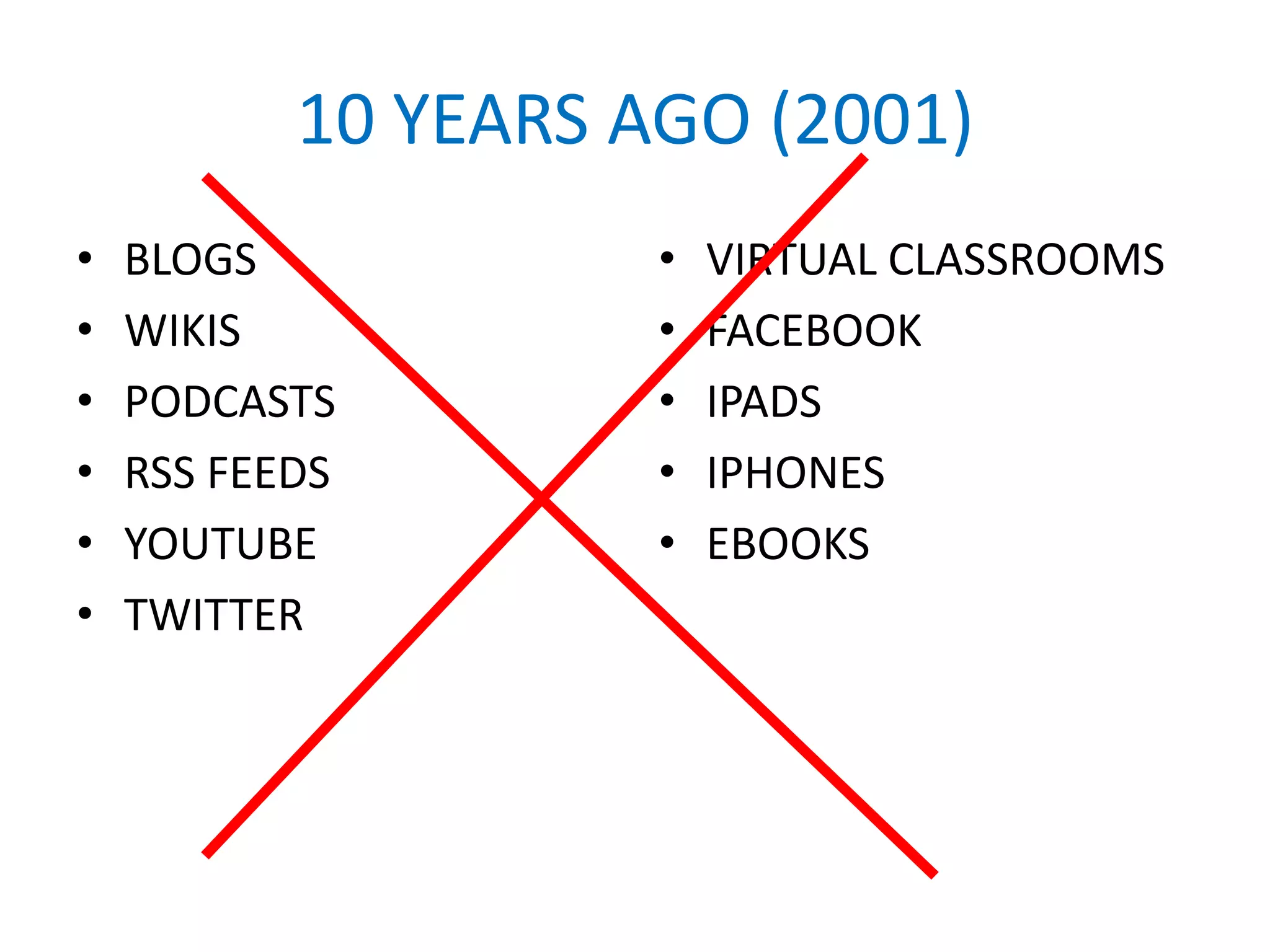
10 YEARS AGO (2001)
•   BLOGS            •   VIRTUAL CLASSROOMS
•   WIKIS            •   FACEBOOK
•   PODCASTS         •   IPADS
•   RSS FEEDS        •   IPHONES
•   YOUTUBE          •   EBOOKS
•   TWITTER
EXPLOITING THE WOW FACTOR TO
  ENHANCE TEACHING PRACTICE
               The WOW factor is very
               much underrated when
               attempting to engage
               people in educational
               technology. I was always
               hearing ' you can't let the
               technology' lead, and yet all
               my most exciting moments,
               and those I observed in
               others, were when that it is
               exactly what we did - we
               followed the technology
               FOR ITS OWN SAKE and
               discovered wonderful
               things!
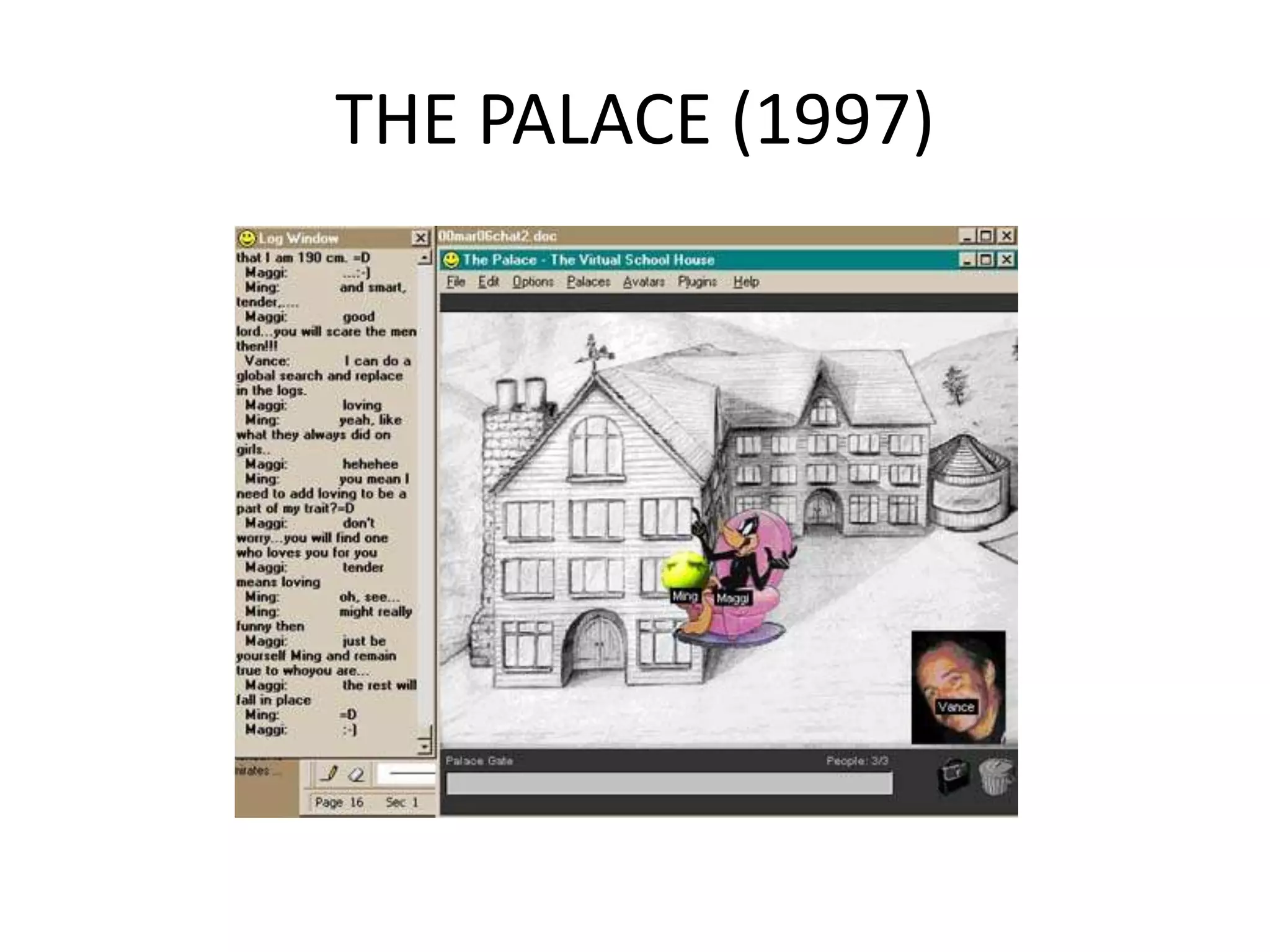
THE PALACE (1997)
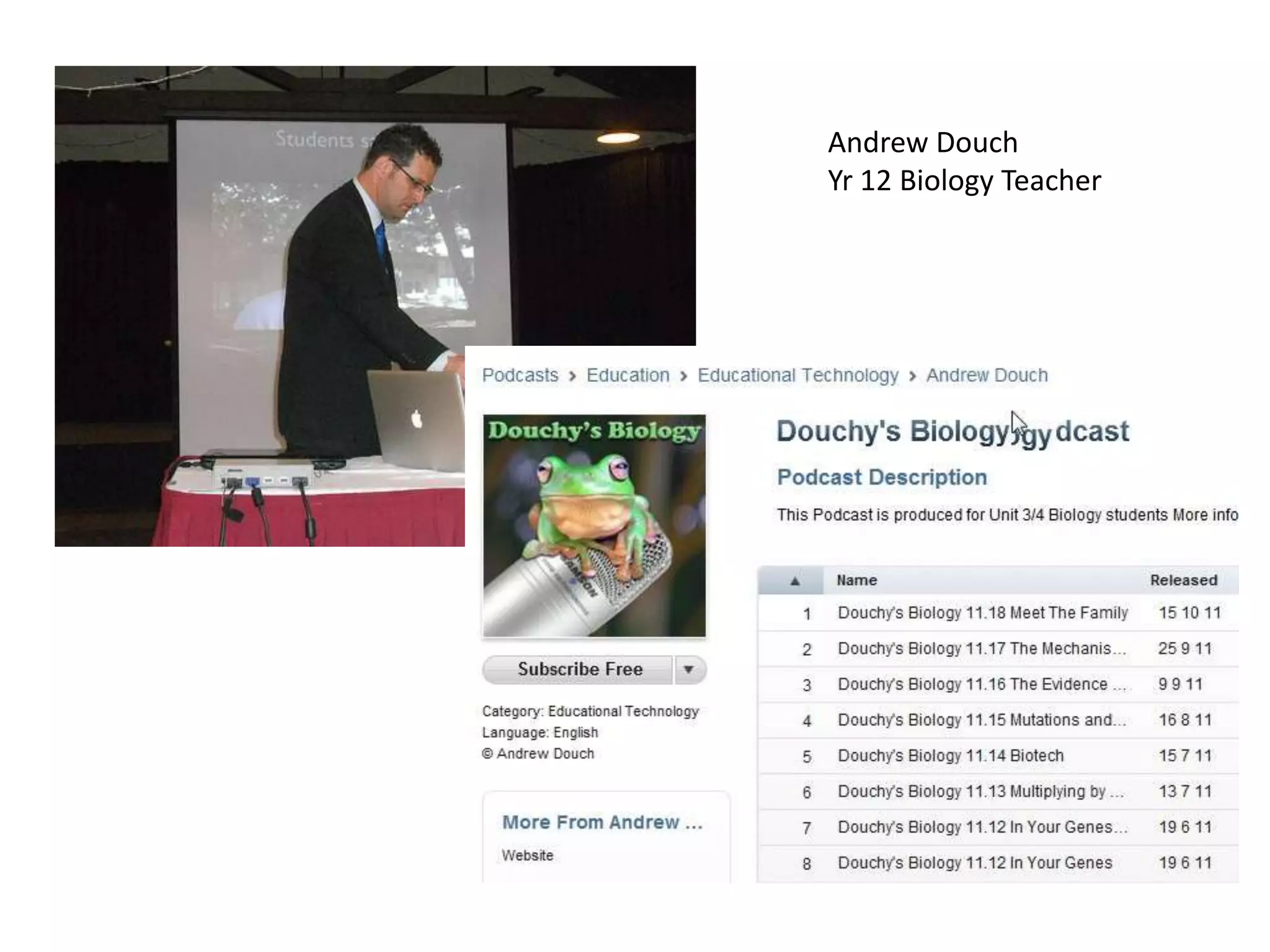
Andrew Douch
Yr 12 Biology Teacher
THEORIES ABOUT TECHNOLOGY
1. Technological determinism: technology is an external
   agent that acts upon people and changes society.
2. Social construction of technology (SCOT): it is human
   decisions and processes that create the technologies we
   have, and that the prevailing social milieu has an
   influential role in the decisions we make about how we
   use that technology.
3. A middle ground between people and machine is the
   theory of Social Shaping. Nancy Baym refers to
   technologies having ‘logics’ that influence how we use
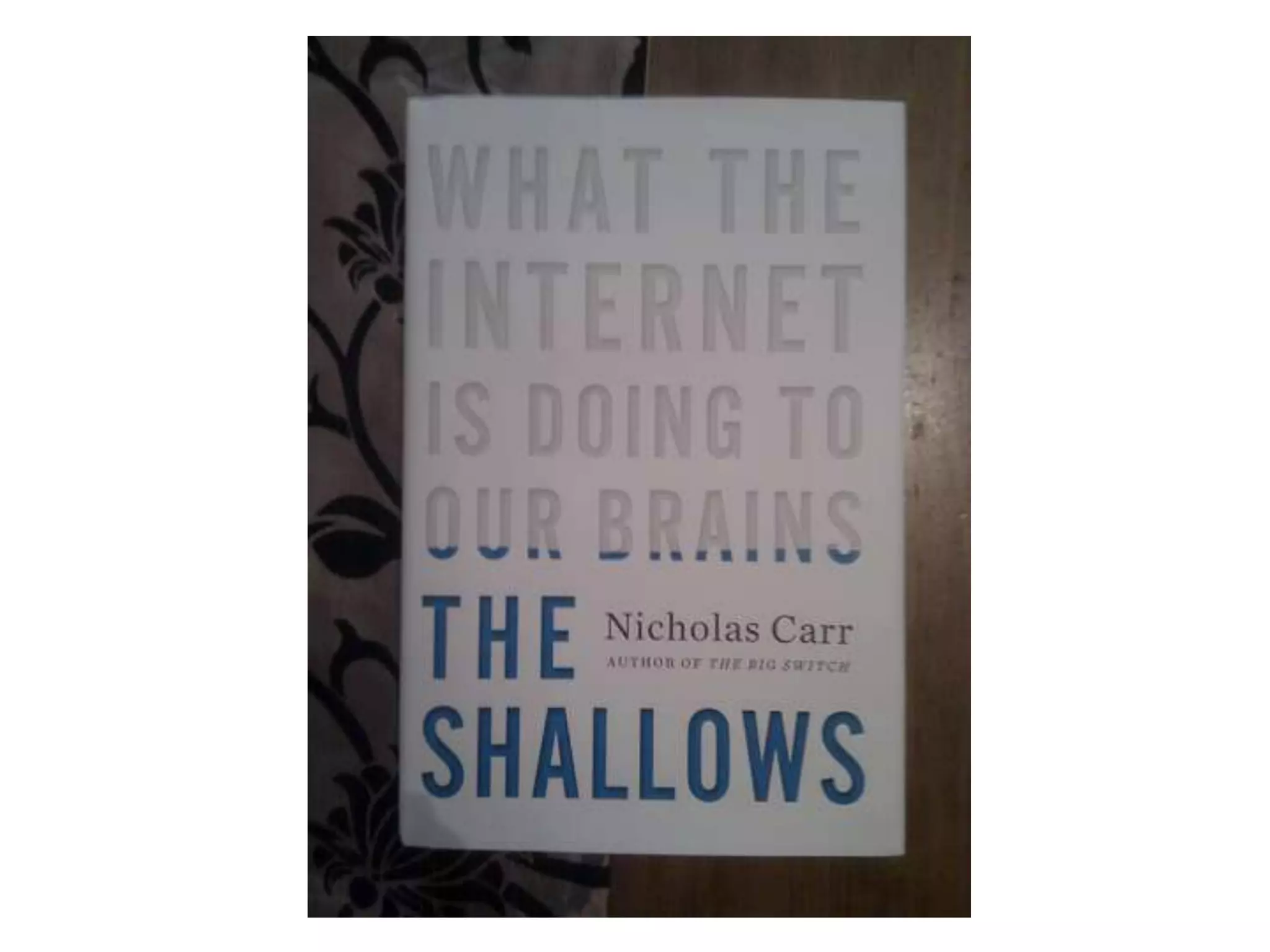
   them. Nicholas Carr calls them ‘ethics’:
       “the message that a tool or medium transmits into
       the minds and culture of its users”
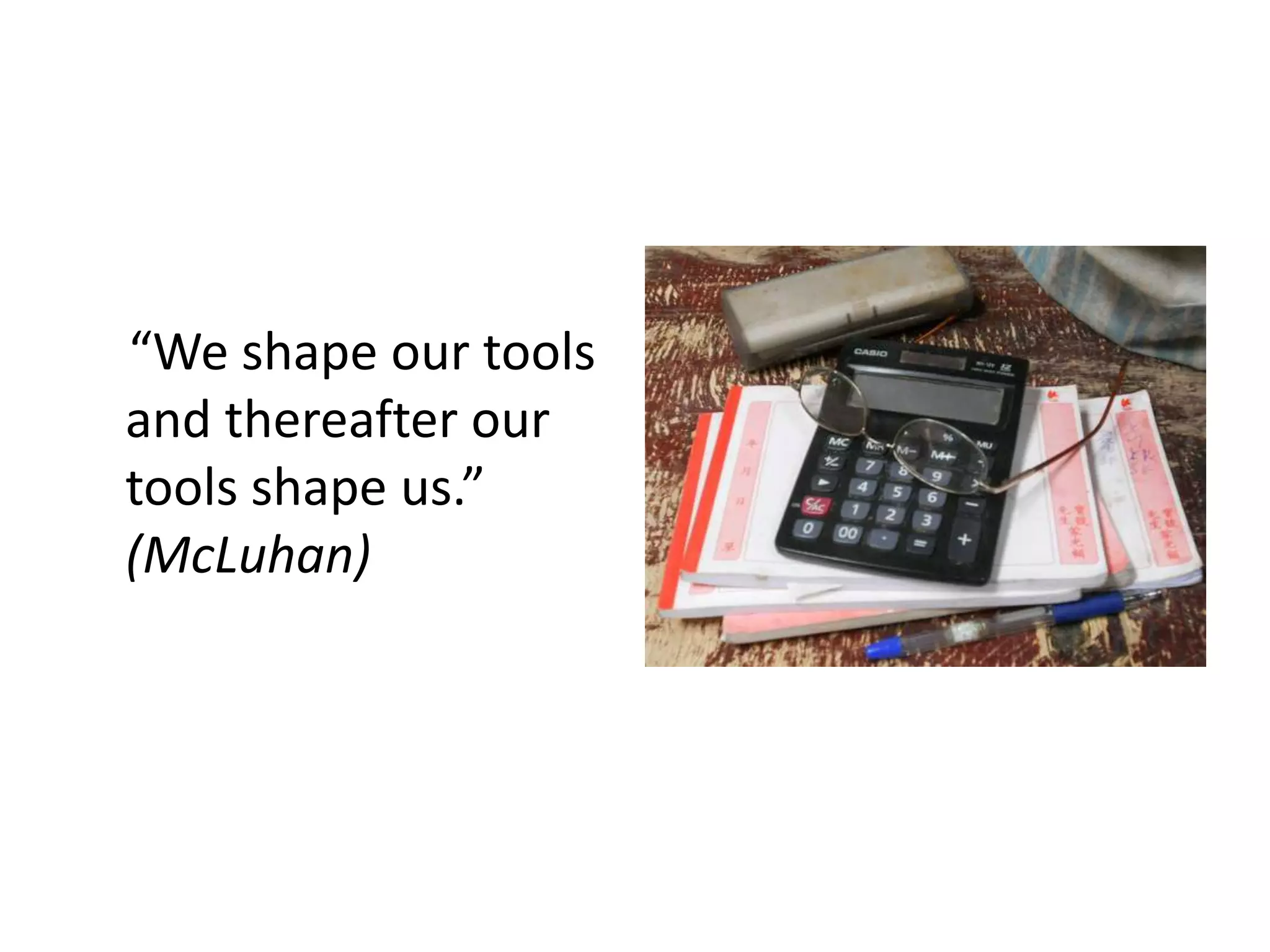
“We shape our tools
and thereafter our
tools shape us.”
(McLuhan)
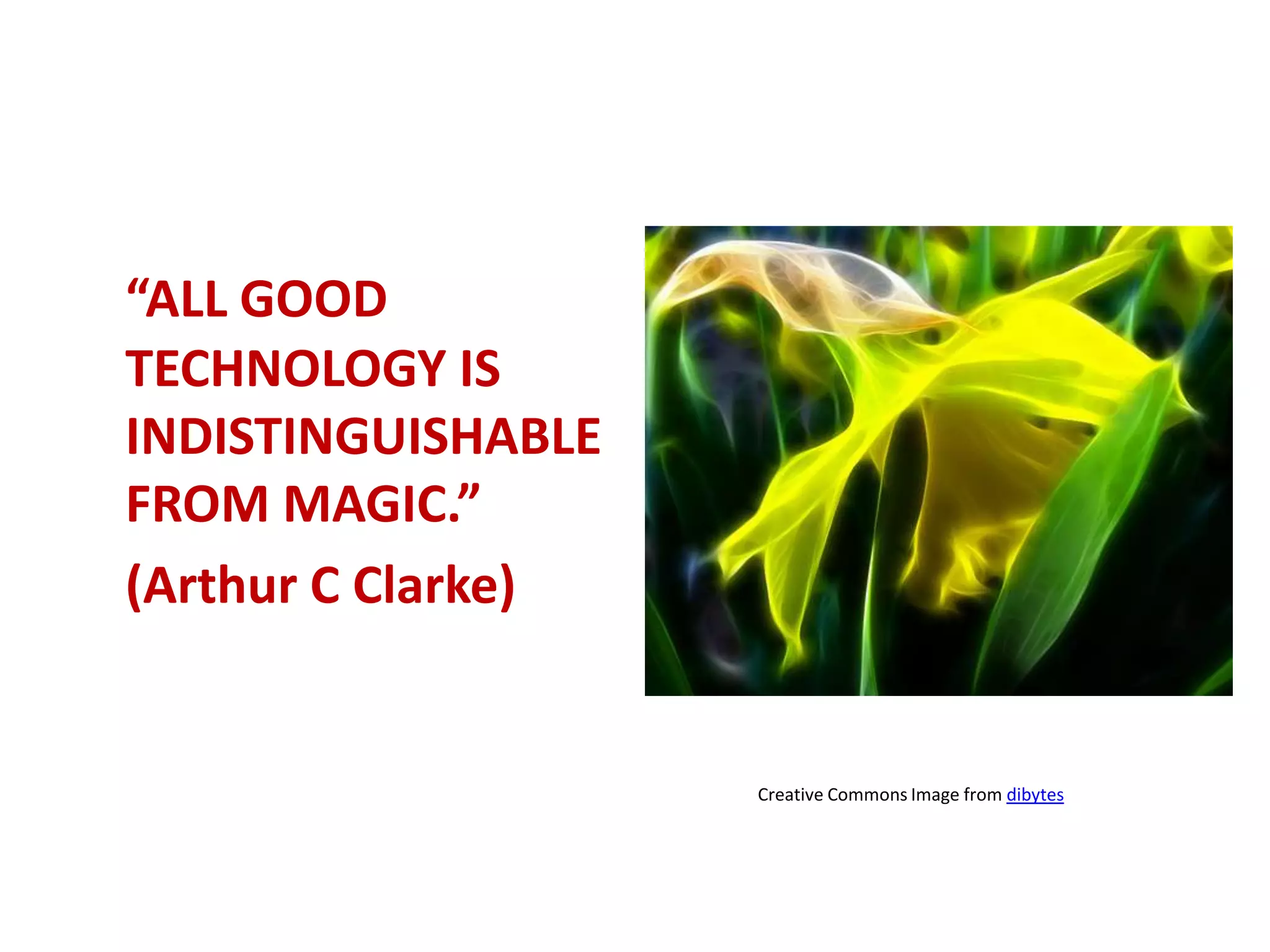
“ALL GOOD
TECHNOLOGY IS
INDISTINGUISHABLE
FROM MAGIC.”
(Arthur C Clarke)


                    Creative Commons Image from dibytes
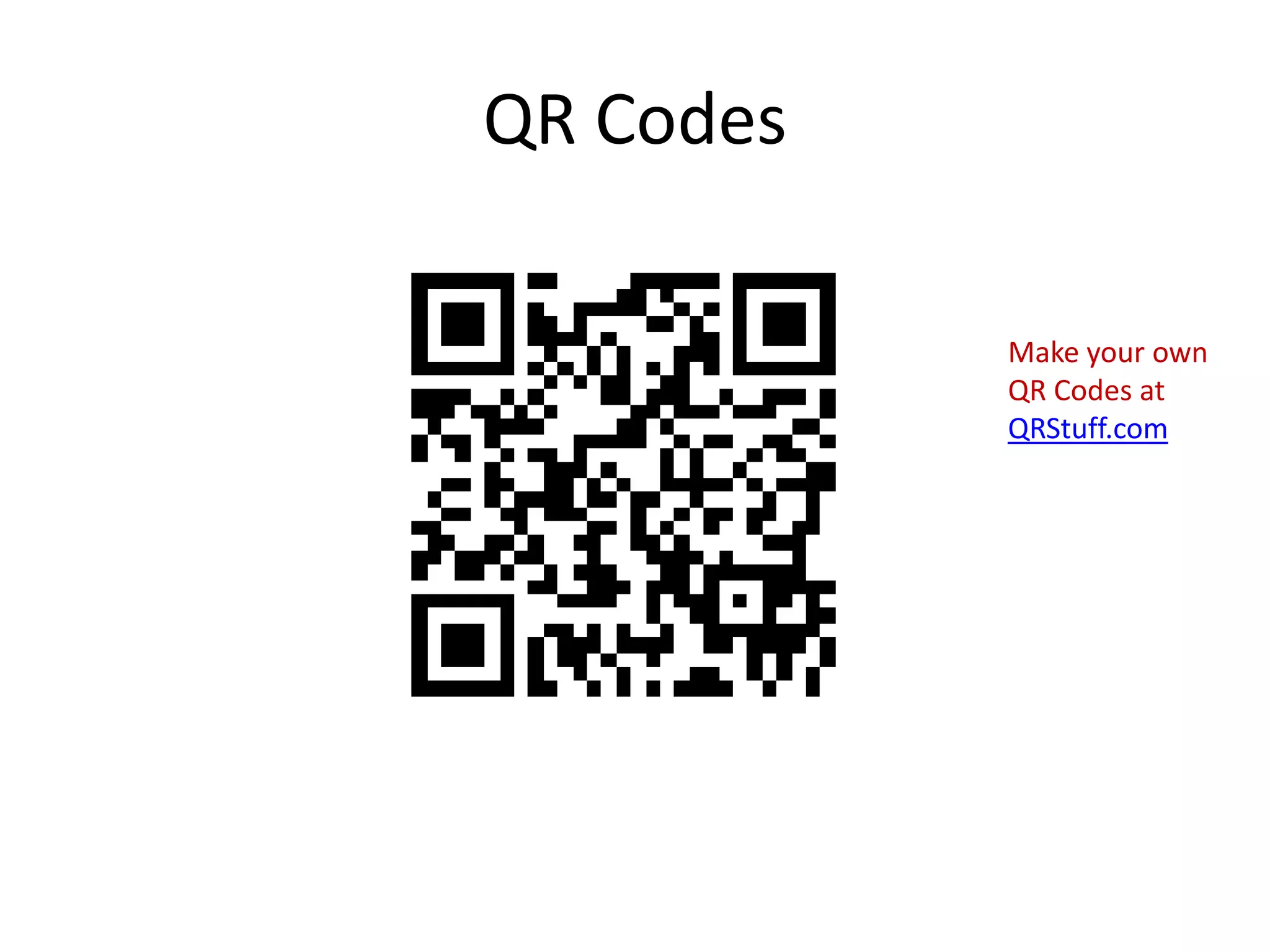
QR Codes

           Make your own
           QR Codes at
           QRStuff.com
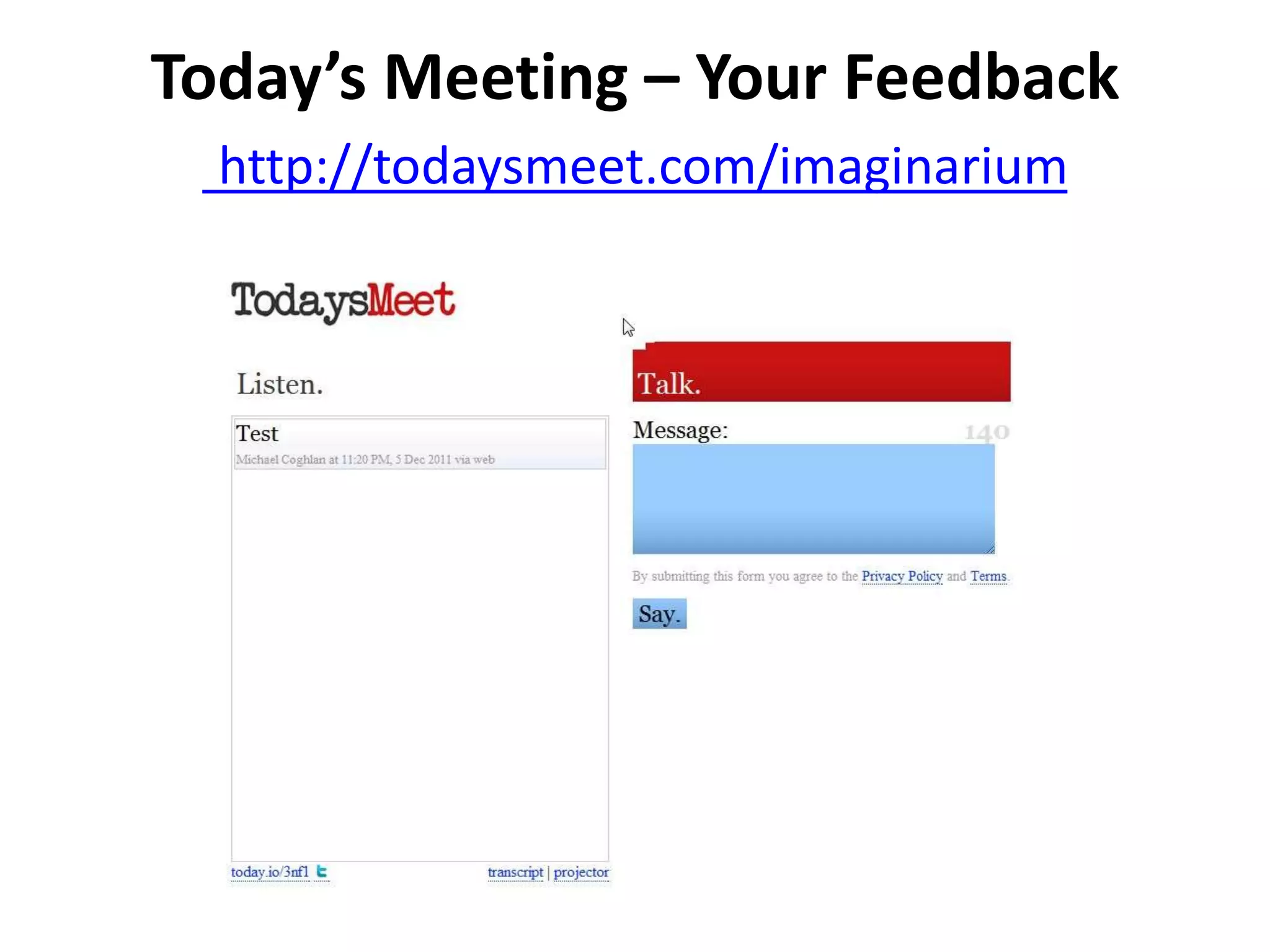
Today’s Meeting – Your Feedback
  http://todaysmeet.com/imaginarium
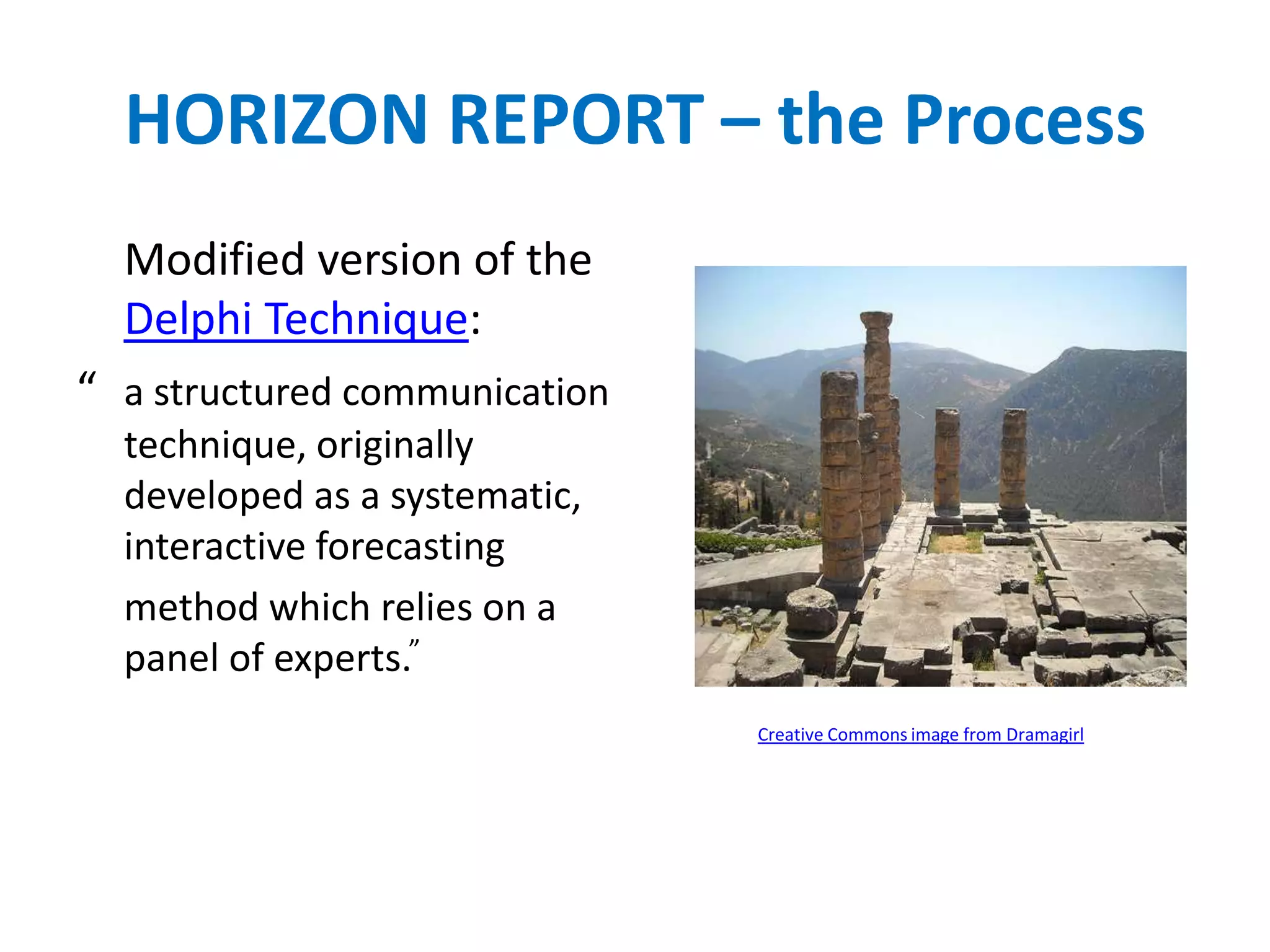
HORIZON REPORT – the Process
  Modified version of the
  Delphi Technique:
“ a structured communication
  technique, originally
  developed as a systematic,
  interactive forecasting
  method which relies on a
  panel of experts.”
                               Creative Commons image from Dramagirl
HORIZON REPORT – the Process
• WIKI - List of Emerging Technologies prepared
  in advance by the New Media Consortium
  (NMC)
• Advisory board members invited to
  add/annotate list items
• This list then summarised into major headings
  that group similar technologies
• Further discussion to ensure clarification
  (note: not justification)
HORIZON REPORT – the Process
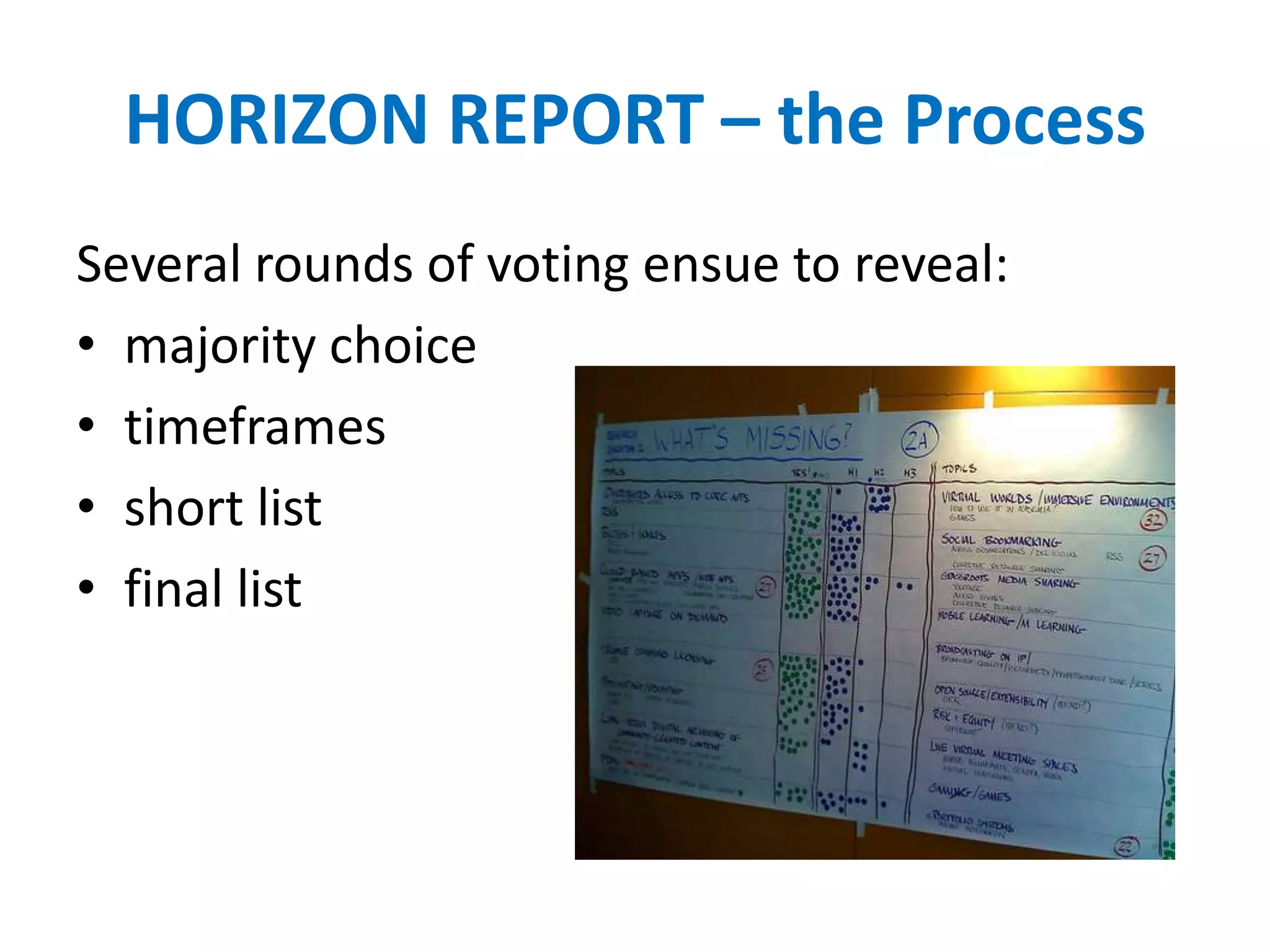
Several rounds of voting ensue to reveal:
• majority choice
• timeframes
• short list
• final list
WHAT’S ON THE HORIZON?

  a summary of recent Horizon
      Reports 2010/2011
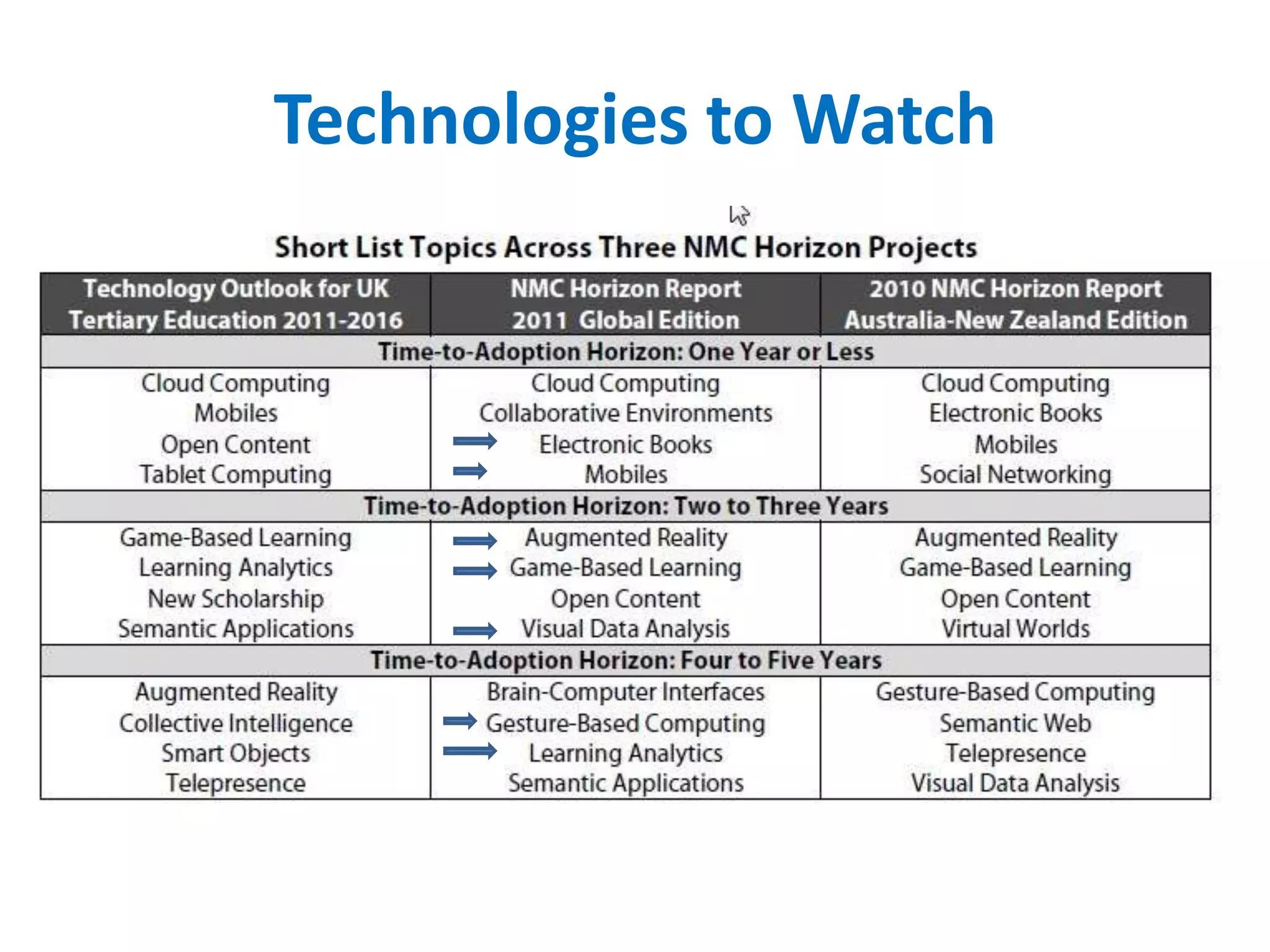
Technologies to Watch
TIME TO ADOPTION – 1 yr or less
Mobile Devices
Examples include:
• Google Sky Map for Android platforms, which
  serves as a mobile planetarium
• History: Maps of the World, containing full-colour, historical
  maps
• iSeismometer - capable of measuring vibrations and tremors
• Reference works such as the Australian Oxford Dictionary and
  the Aussie Slang Dictionary, featuring more than 700 common
  Australian phrases.
• Forklift Driving Course (SA)
TIME TO ADOPTION – 1 yr or less
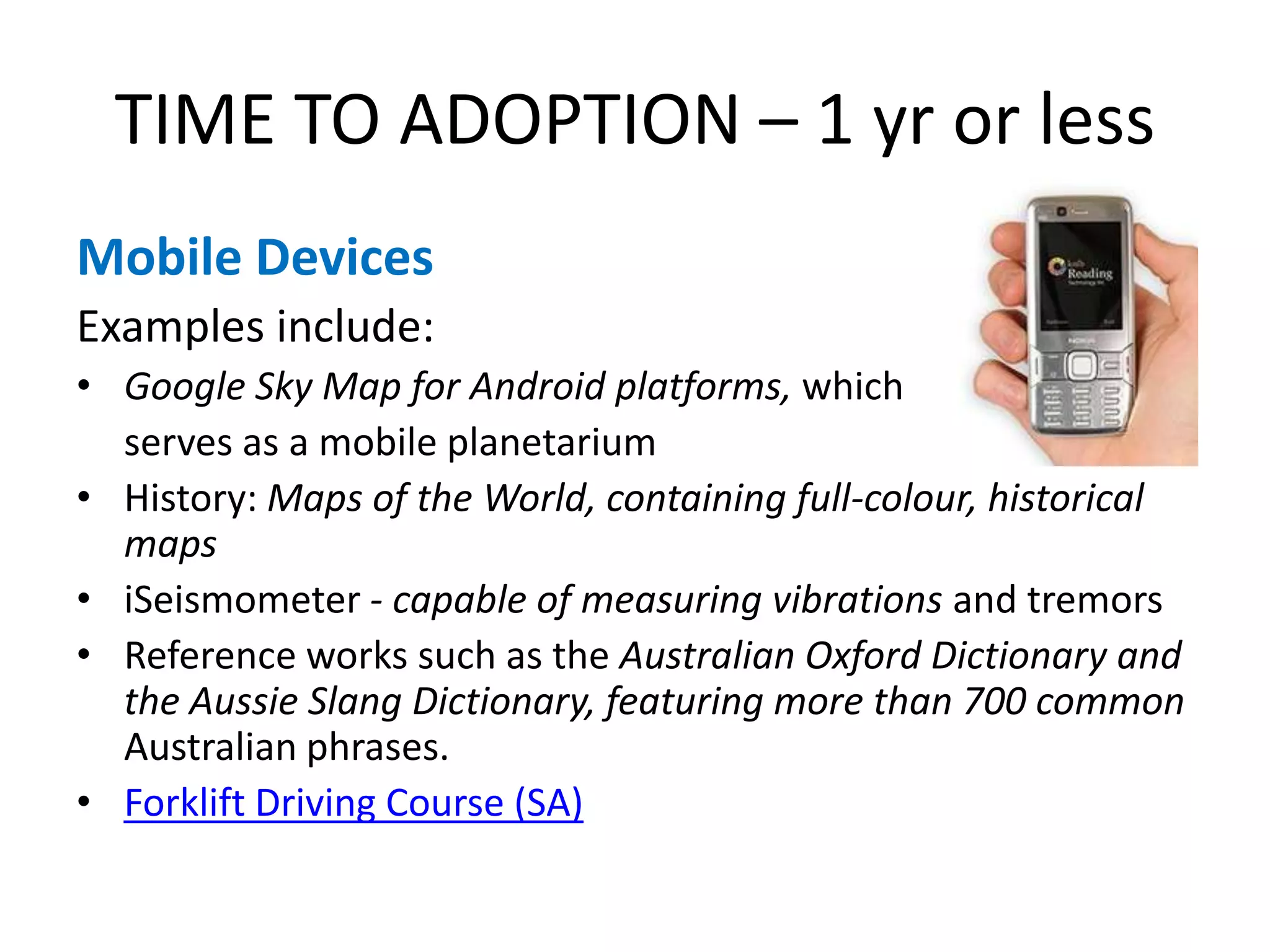
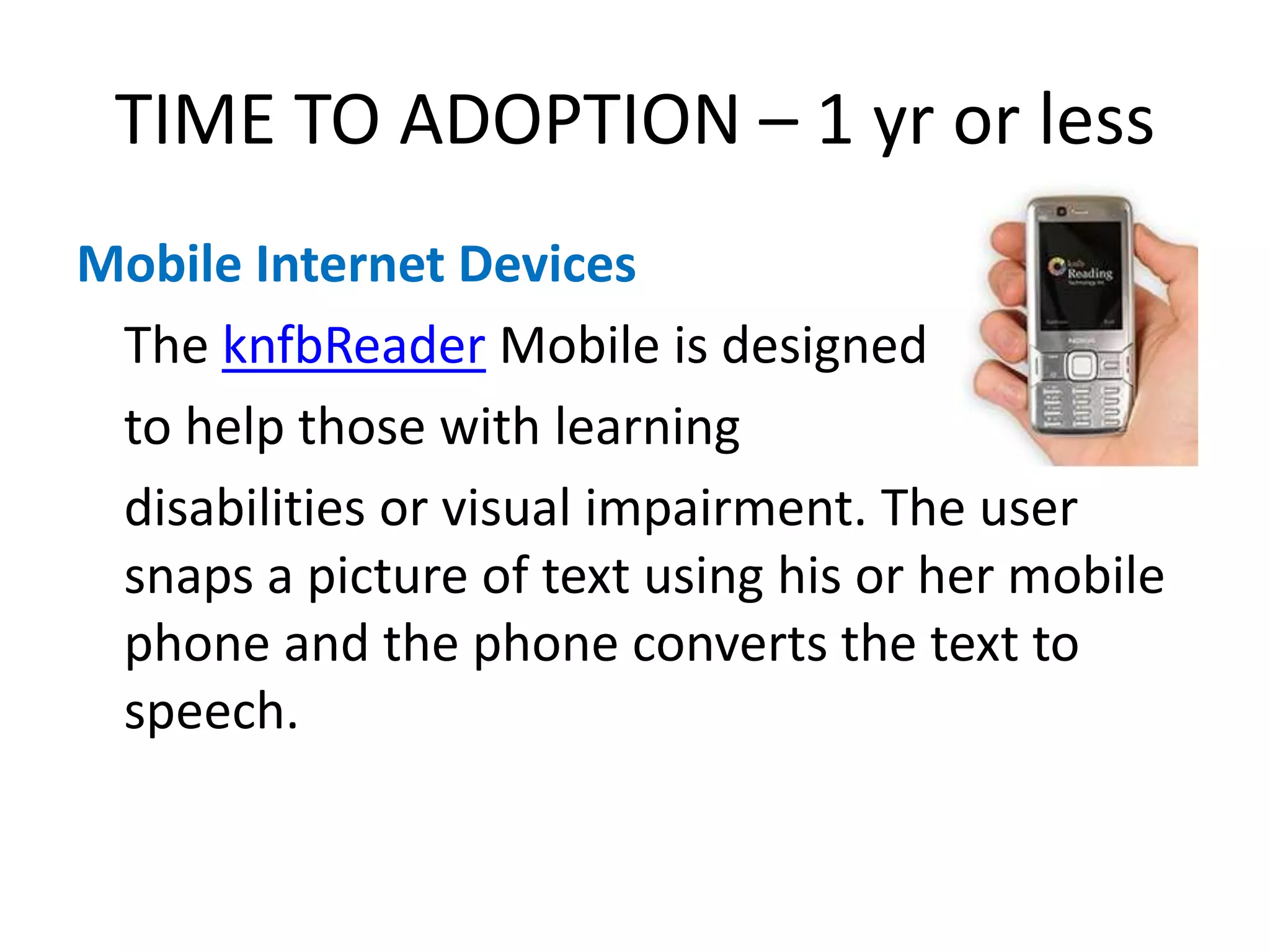
Mobile Internet Devices
 The knfbReader Mobile is designed
 to help those with learning
 disabilities or visual impairment. The user
 snaps a picture of text using his or her mobile
 phone and the phone converts the text to
 speech.
TIME TO ADOPTION –
1 yr or less

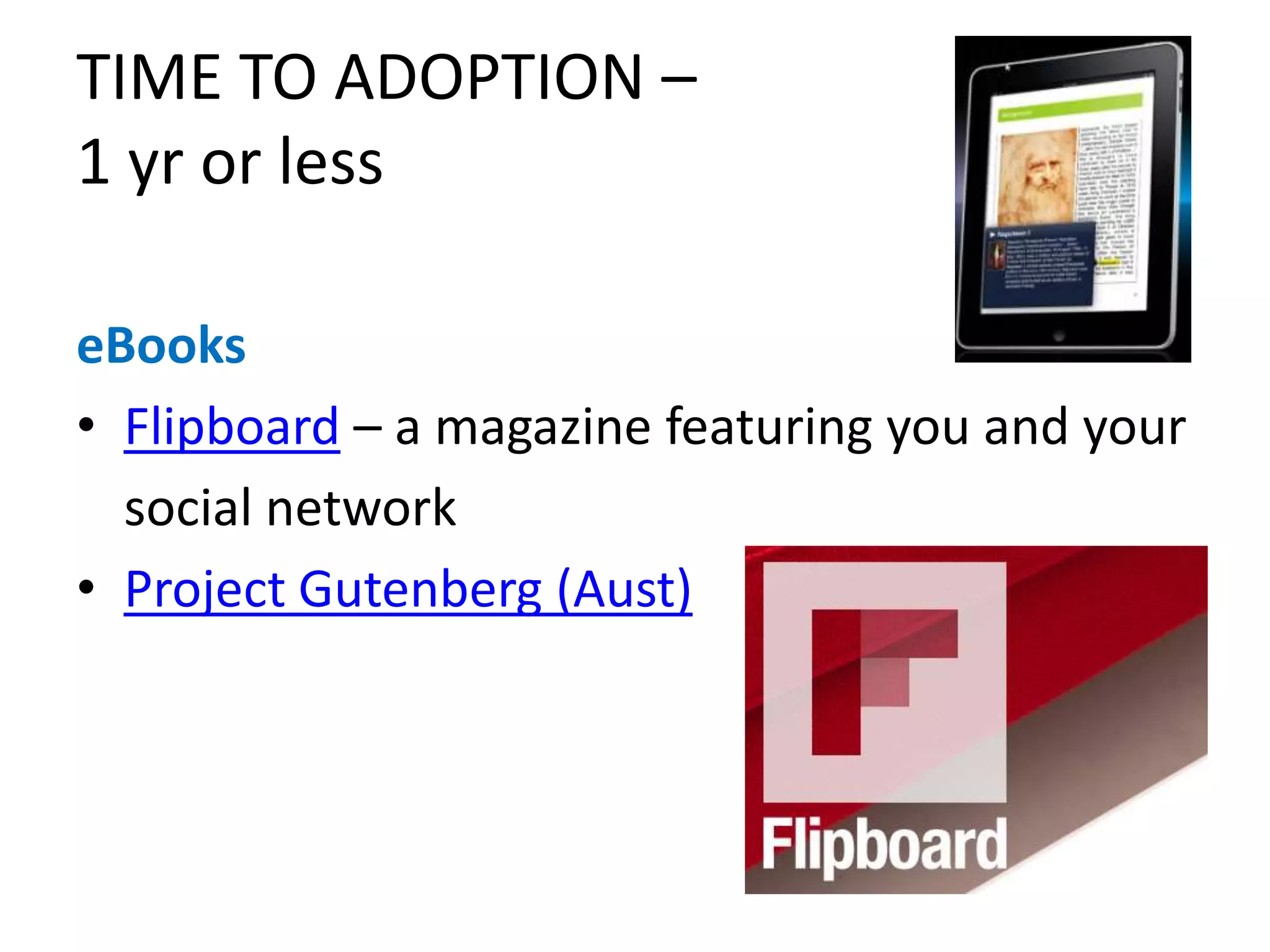
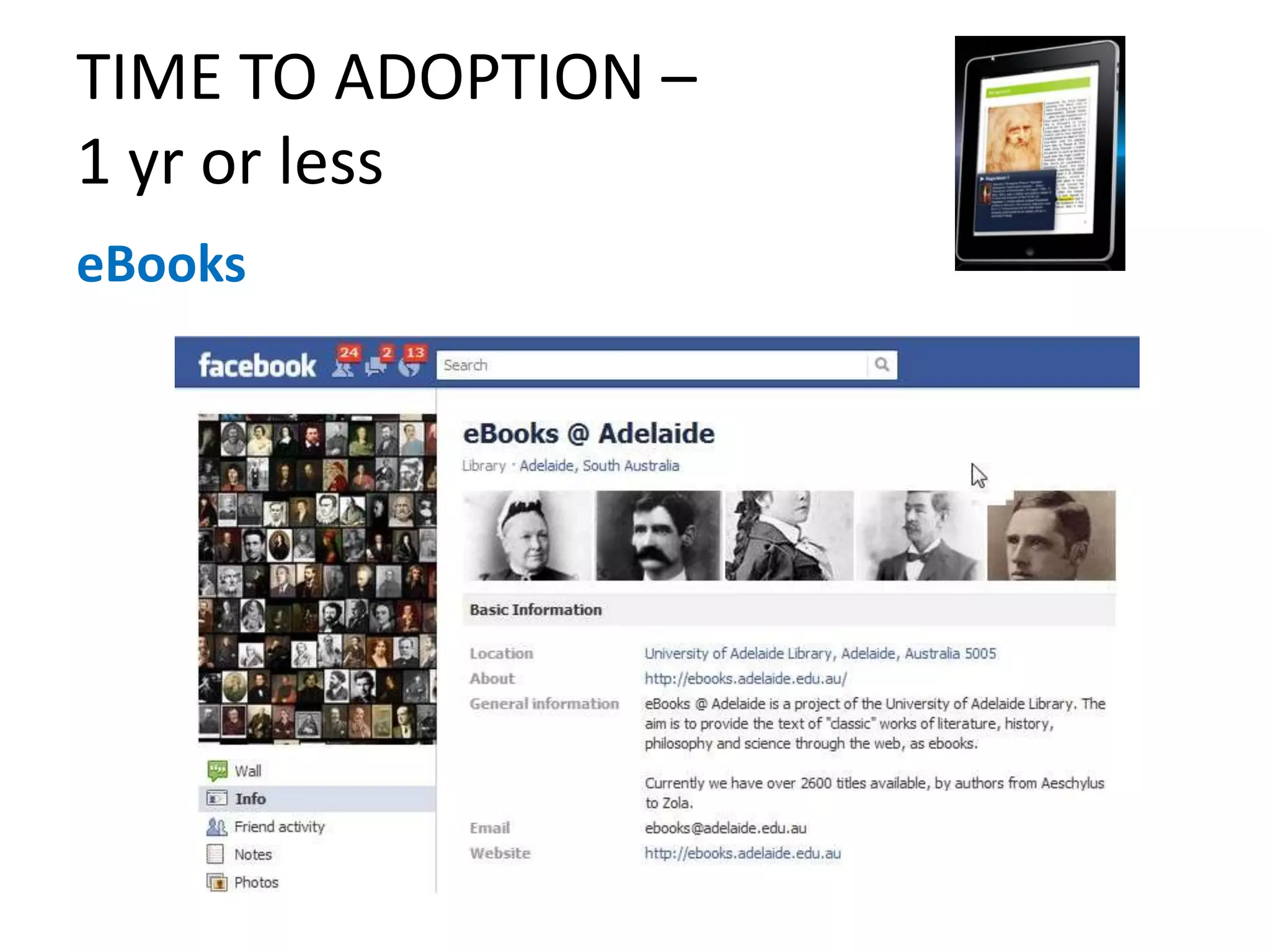
eBooks
• Flipboard – a magazine featuring you and your
  social network
• Project Gutenberg (Aust)
TIME TO ADOPTION –
1 yr or less
eBooks
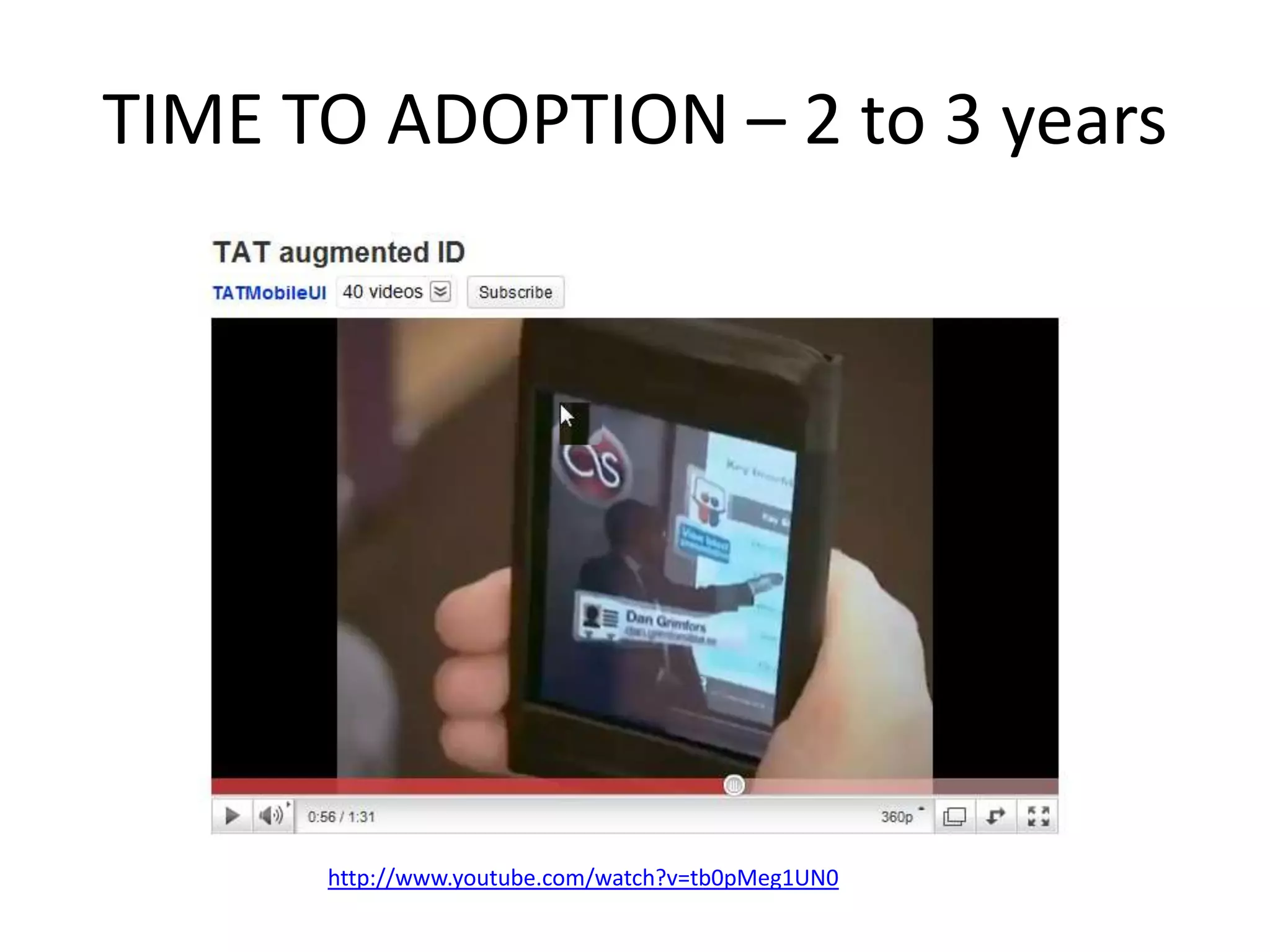
TIME TO ADOPTION – 2 to 3 years
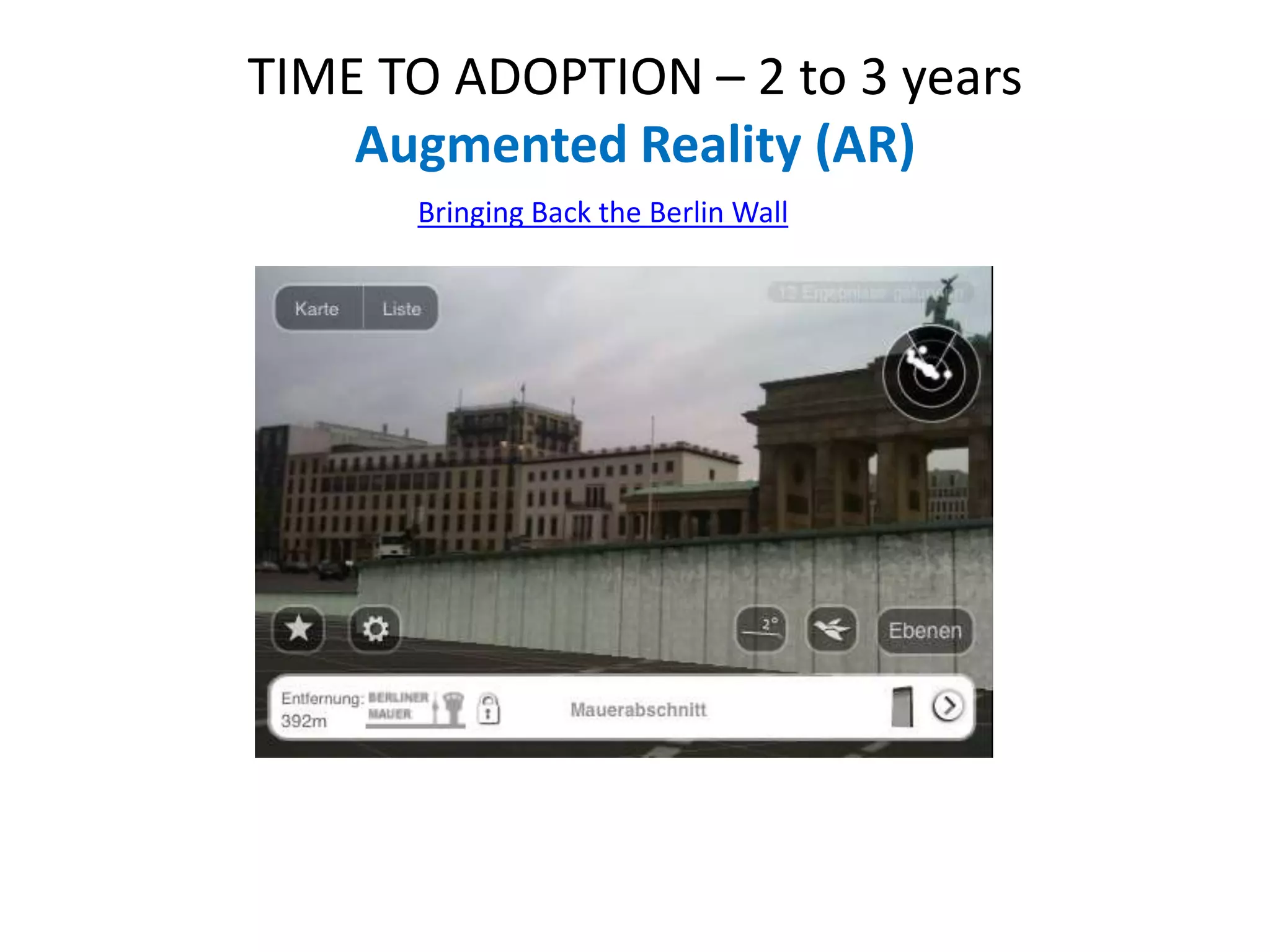
    Augmented Reality (AR)
      Bringing Back the Berlin Wall
TIME TO ADOPTION – 2 to 3 years
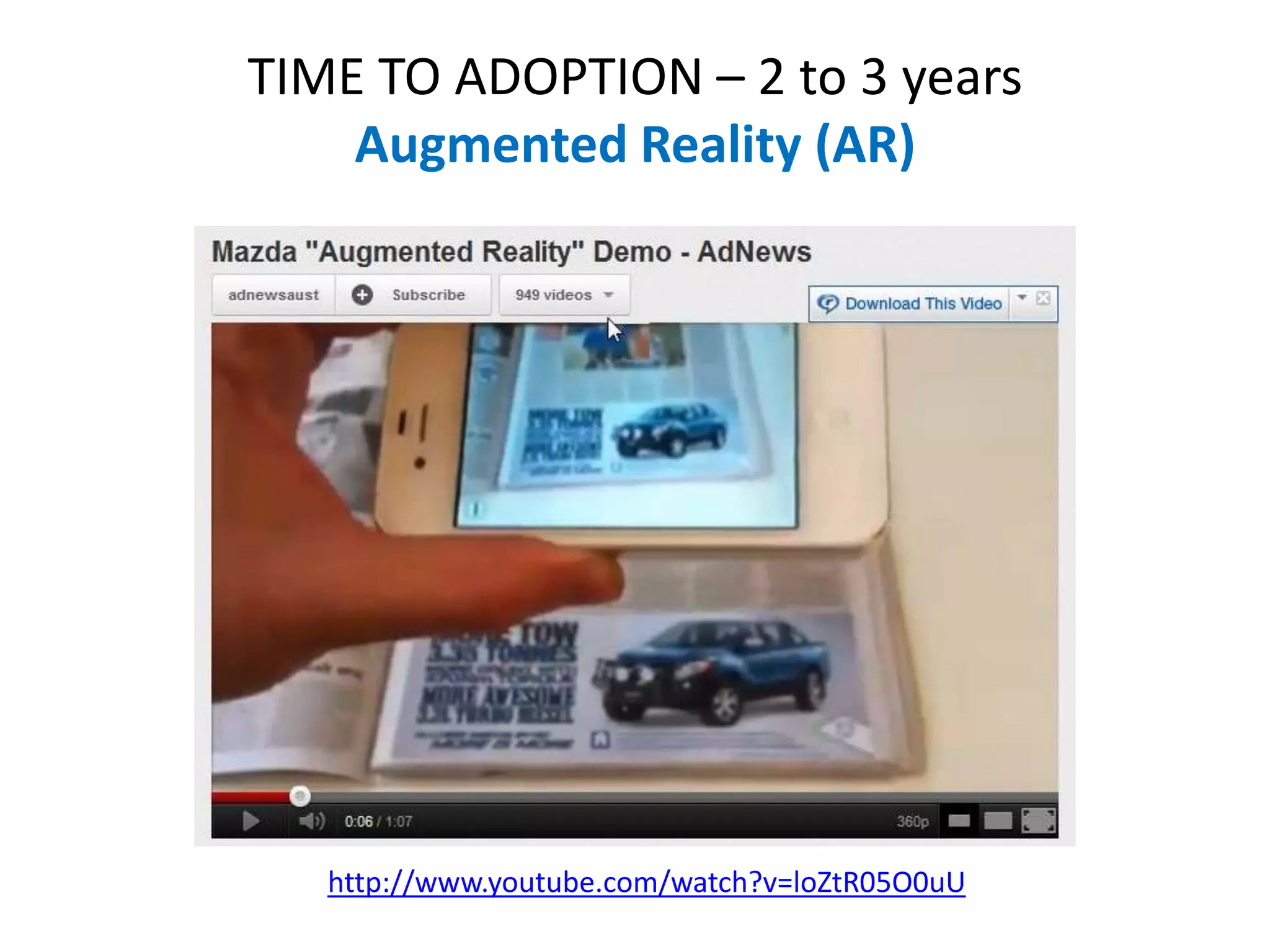
    Augmented Reality (AR)


   http://www.youtube.com/watch?v=loZtR05O0uU
TIME TO ADOPTION – 2 to 3 years
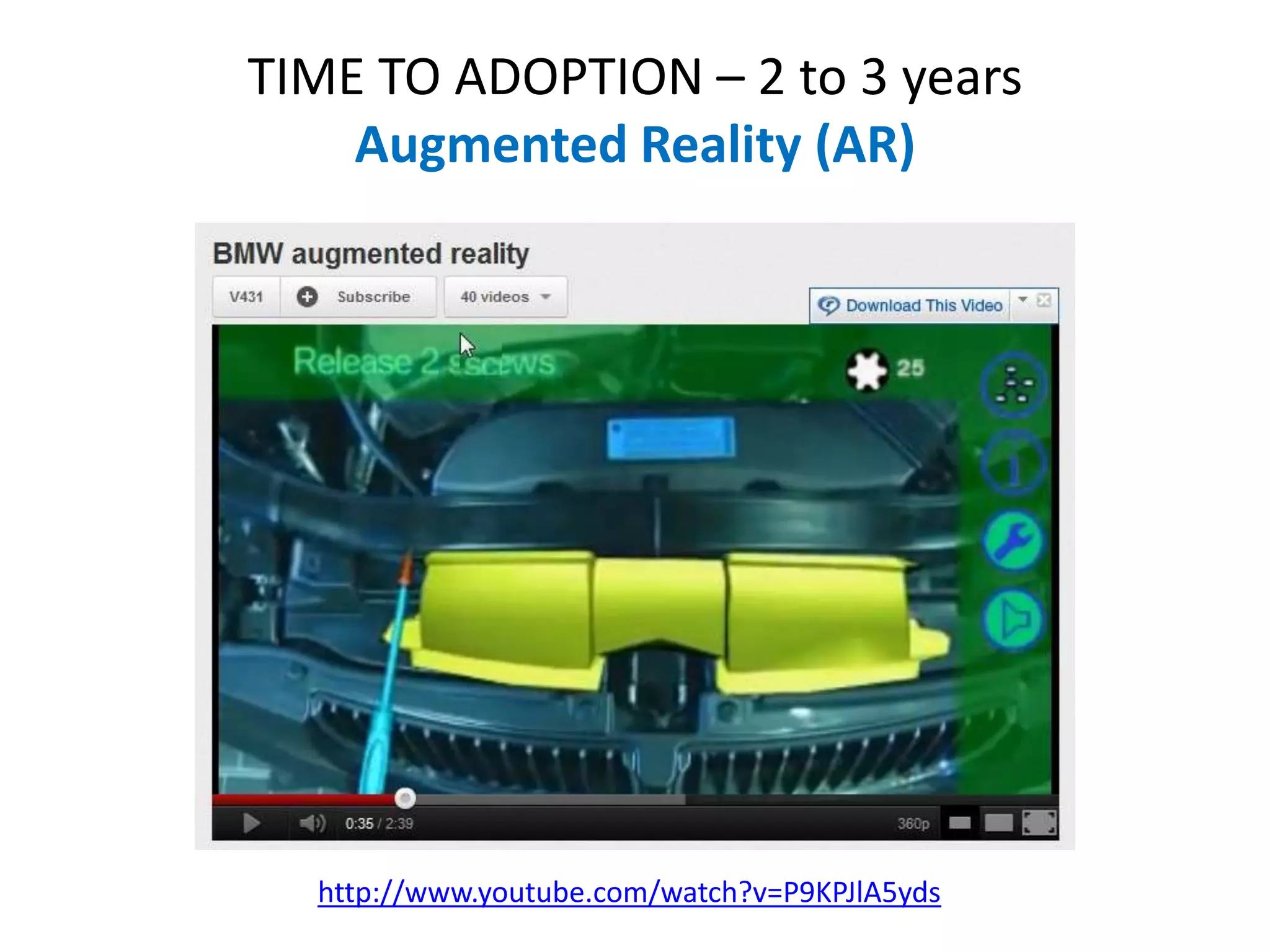
    Augmented Reality (AR)


  http://www.youtube.com/watch?v=P9KPJlA5yds
TIME TO ADOPTION – 2 to 3 years
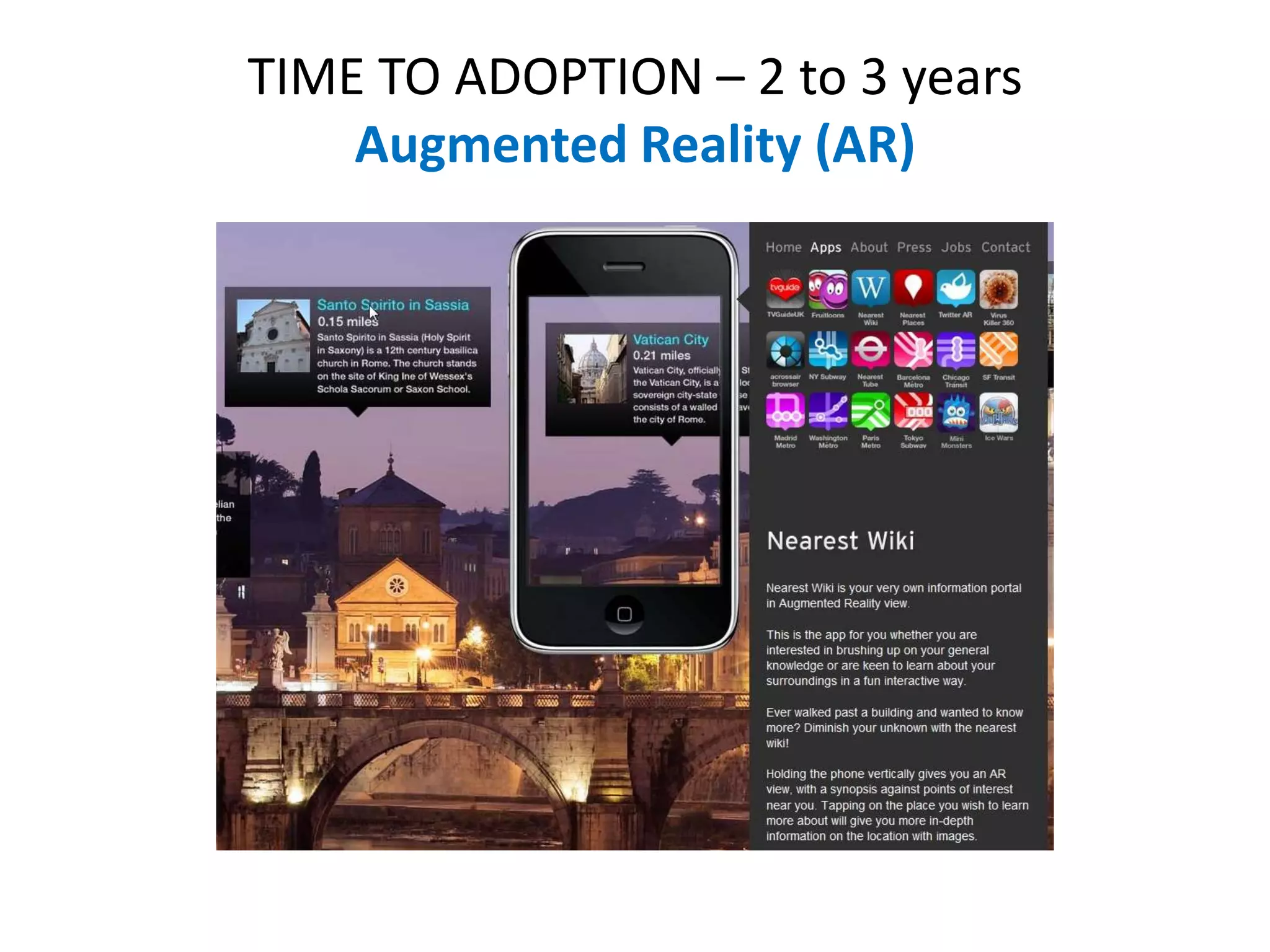
    Augmented Reality (AR)
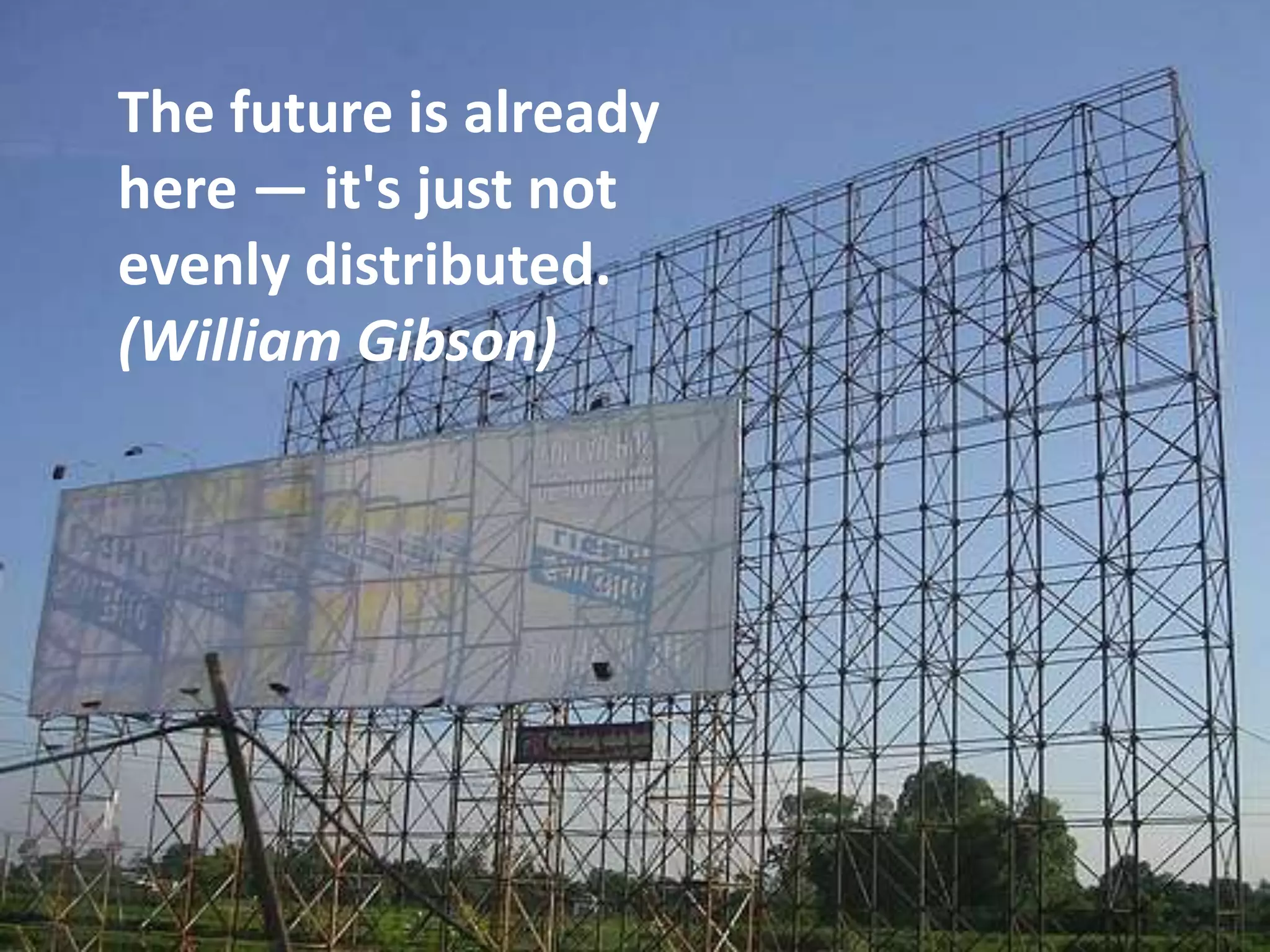
The future is already
here — it's just not
evenly distributed.
(William Gibson)
TIME TO ADOPTION – 2 to 3 years


      http://www.youtube.com/watch?v=tb0pMeg1UN0
CONVERGENCE
 TECHNOLOGICAL CONVERGENCE


The tendency for different technological
systems to evolve towards performing similar tasks.
eg mobile phone + Internet = Smart Phone
TIME TO ADOPTION – 2 to 3 years


        http://www.vimeo.com/2341387
TIME TO ADOPTION – 2 to 3 years
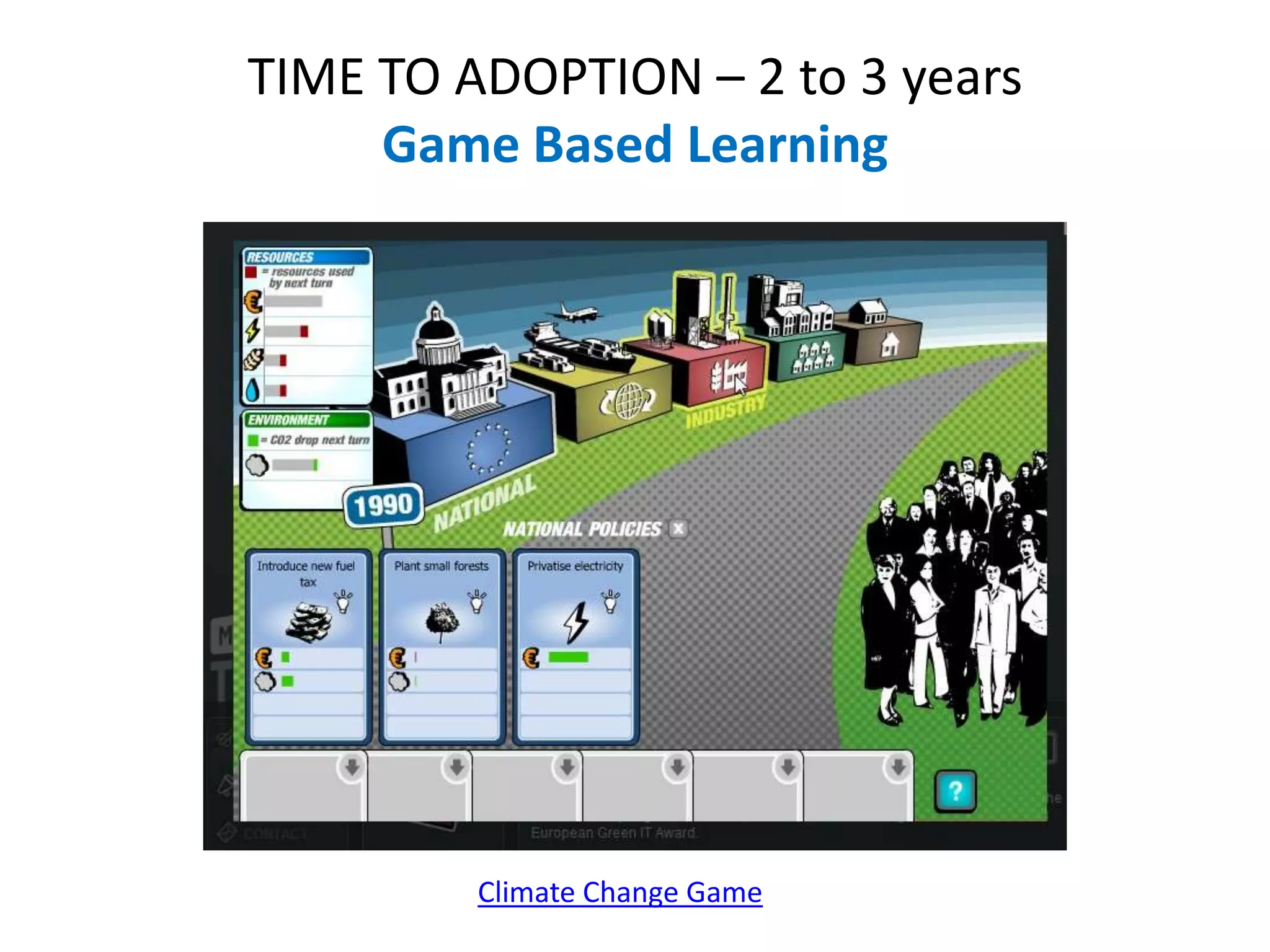
     Game Based Learning


         Climate Change Game
TIME TO ADOPTION – 2 to 3 years
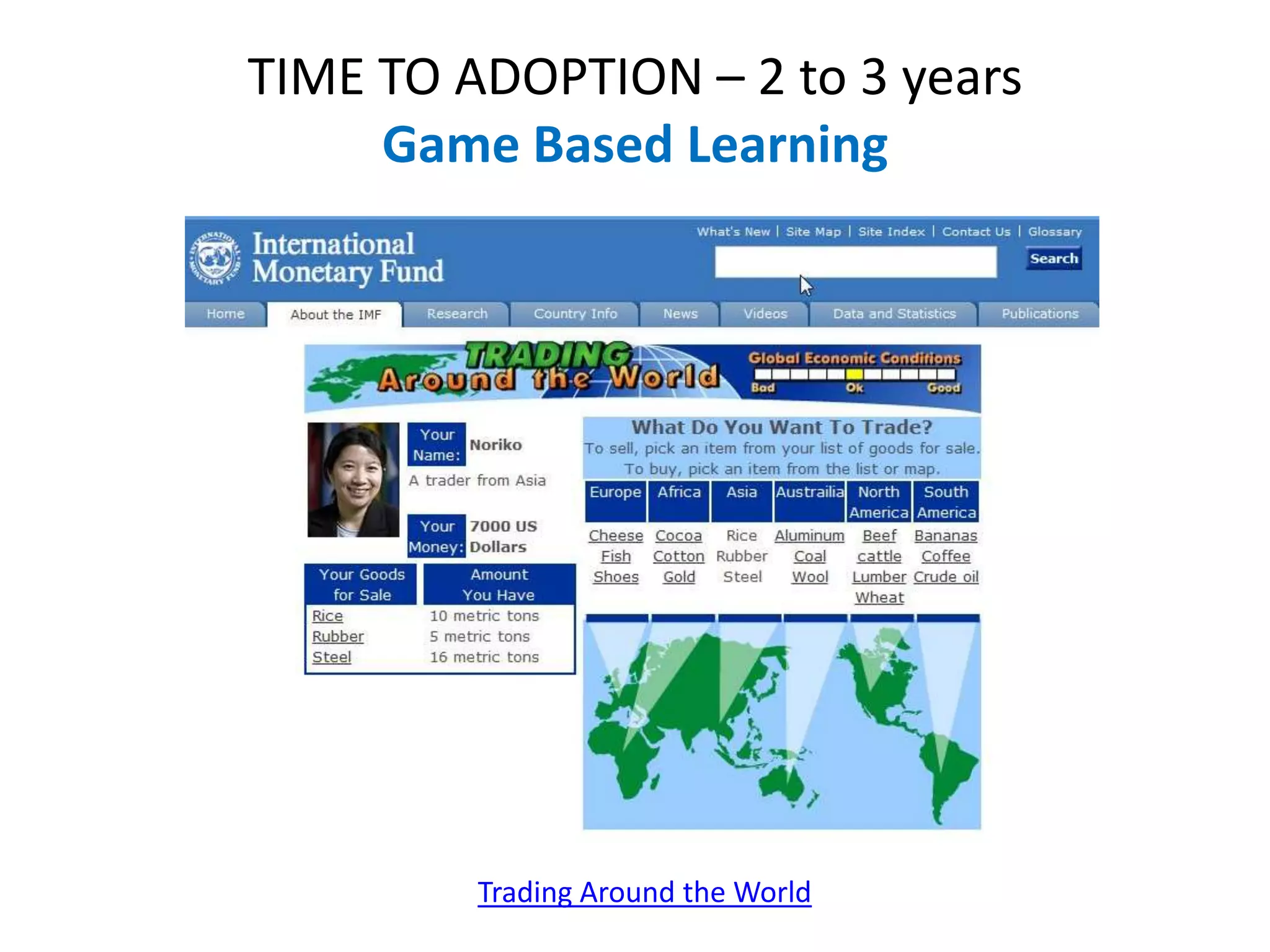
     Game Based Learning


         Trading Around the World
TIME TO ADOPTION – 2 to 3 years
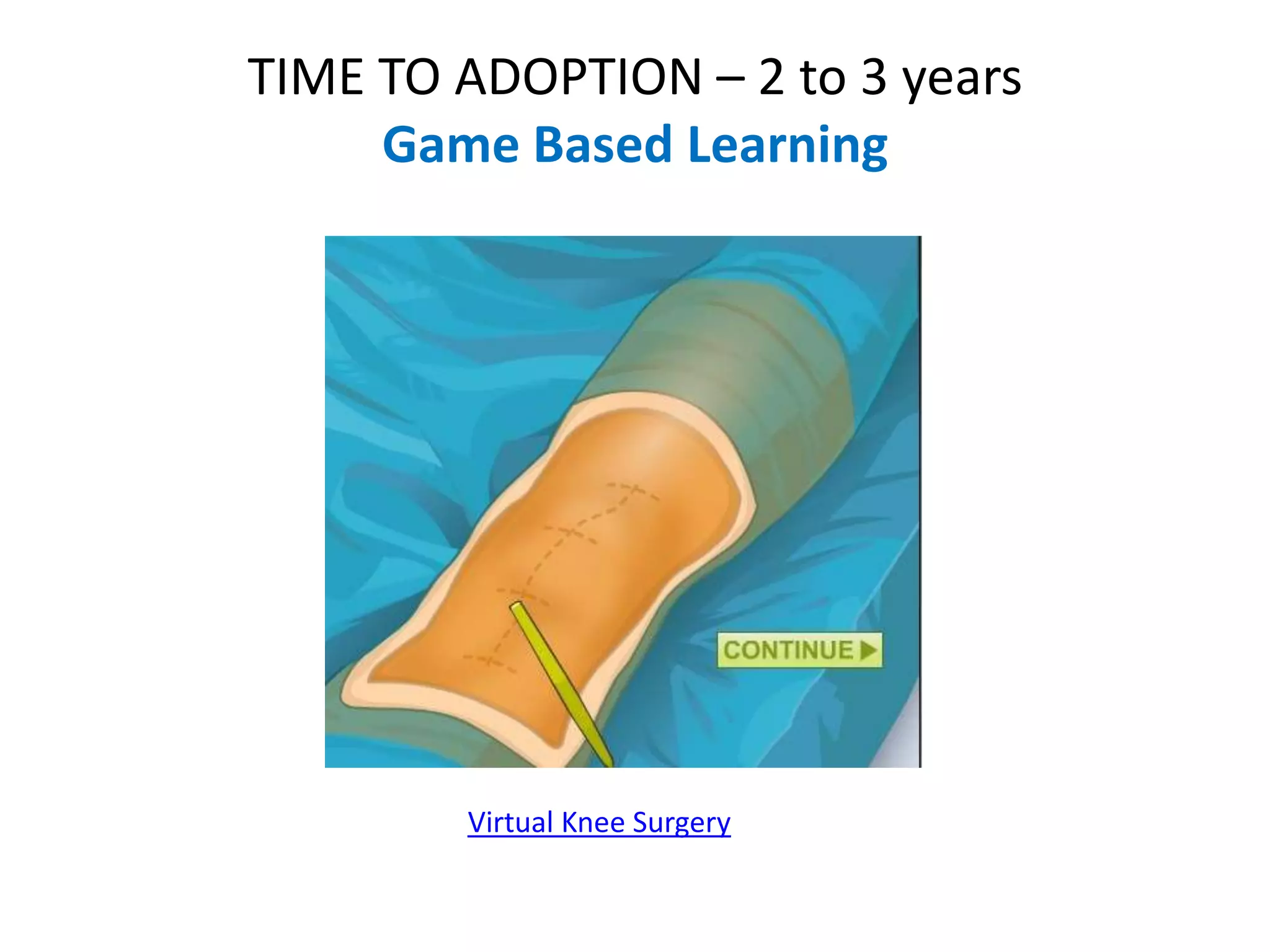
     Game Based Learning


        Virtual Knee Surgery
TIME TO ADOPTION – 4 to 5 years
Gesture Based Computing
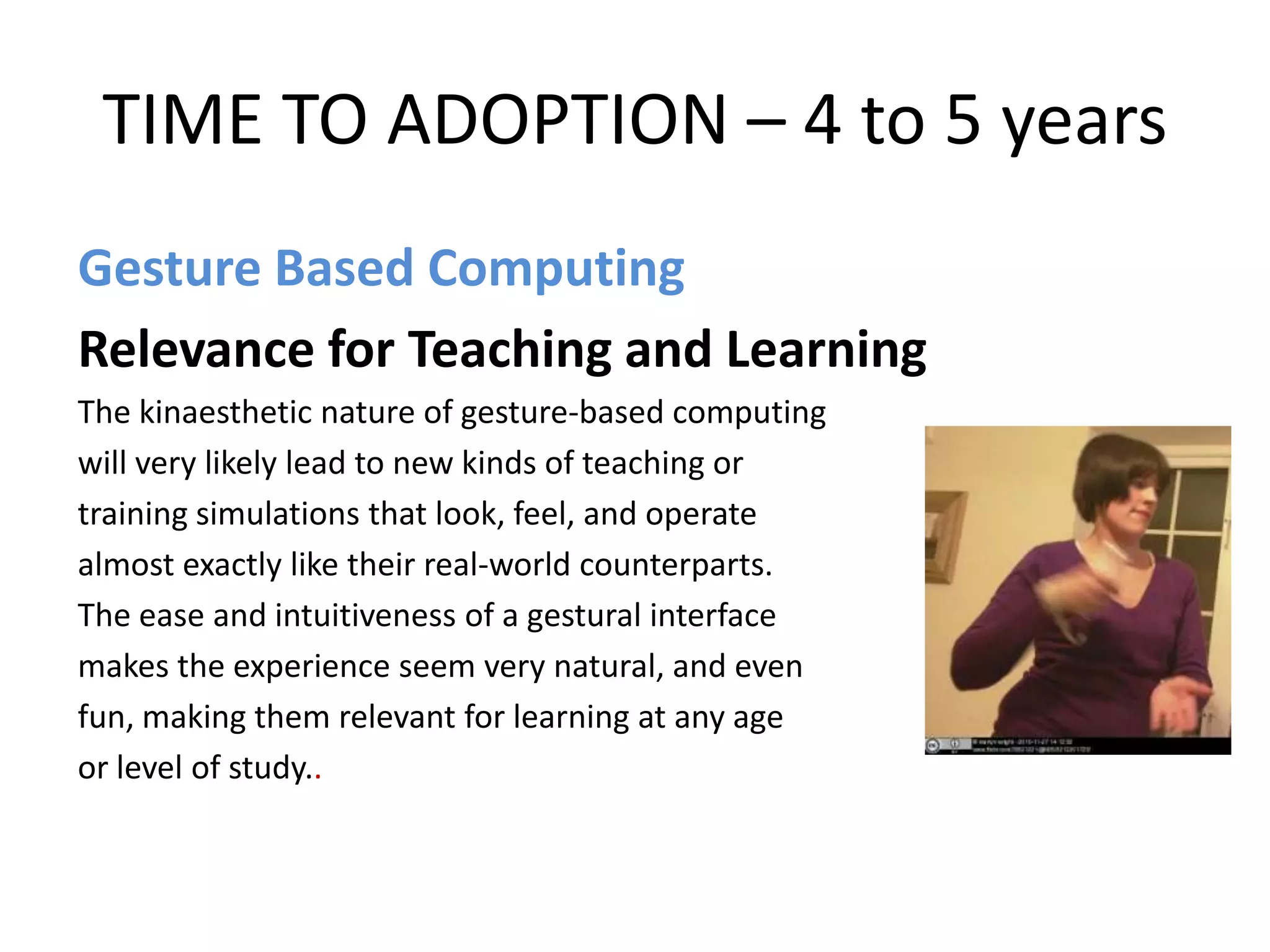
Relevance for Teaching and Learning
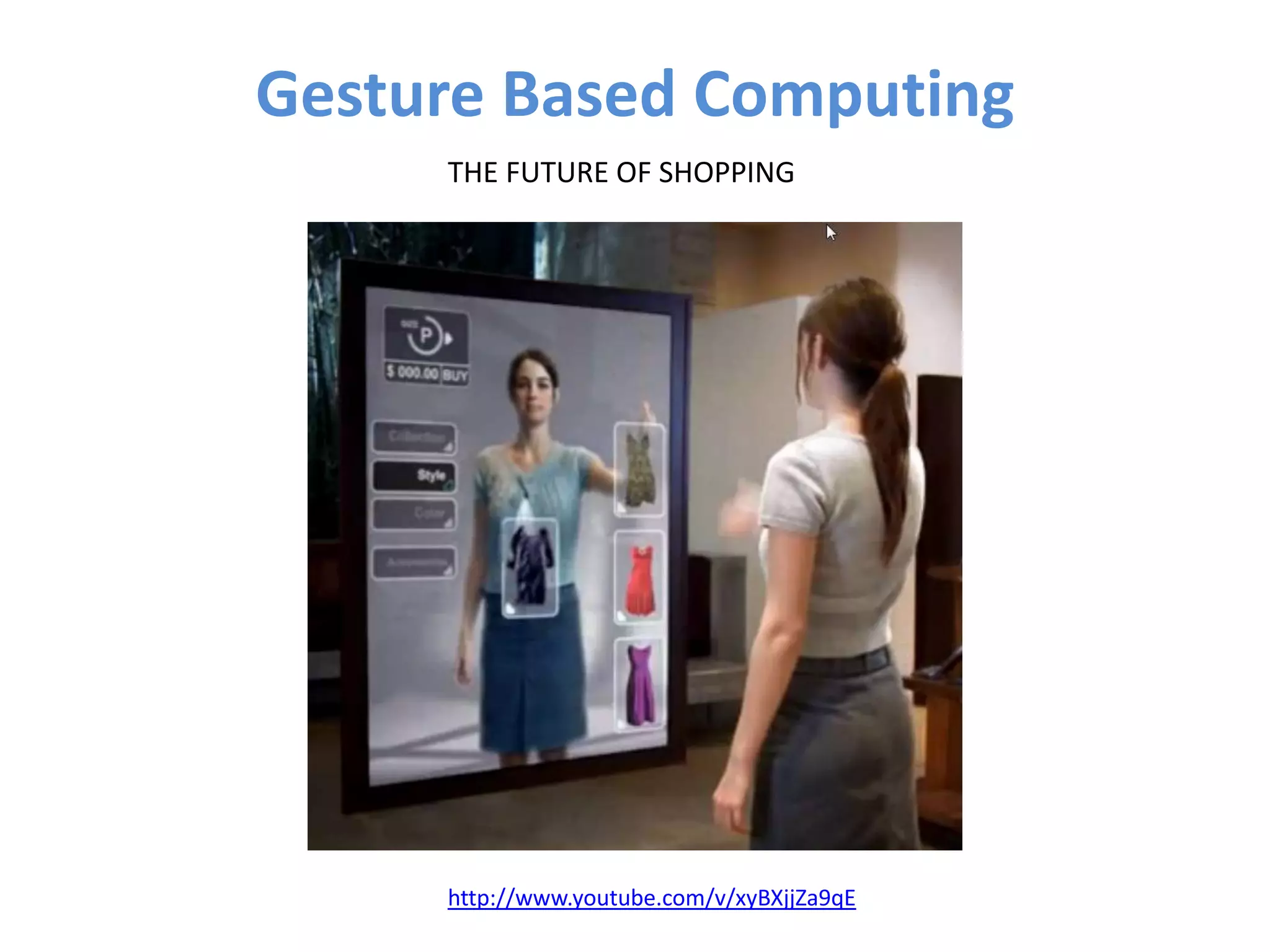
The kinaesthetic nature of gesture-based computing
will very likely lead to new kinds of teaching or
training simulations that look, feel, and operate
almost exactly like their real-world counterparts.
The ease and intuitiveness of a gestural interface
makes the experience seem very natural, and even
fun, making them relevant for learning at any age
or level of study..
Gesture Based Computing
     THE FUTURE OF SHOPPING


     http://www.youtube.com/v/xyBXjjZa9qE
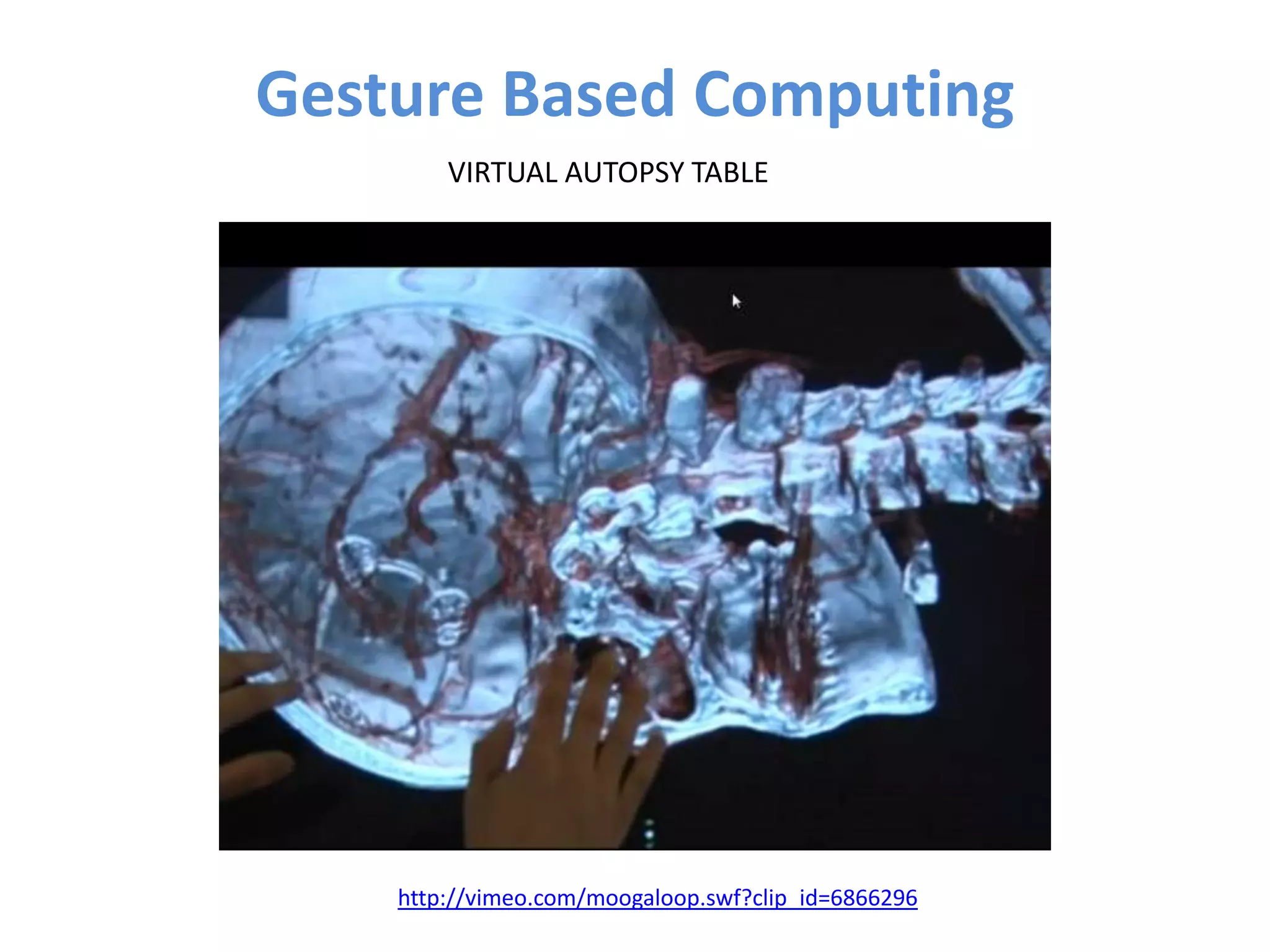
Gesture Based Computing
        VIRTUAL AUTOPSY TABLE


    http://vimeo.com/moogaloop.swf?clip_id=6866296
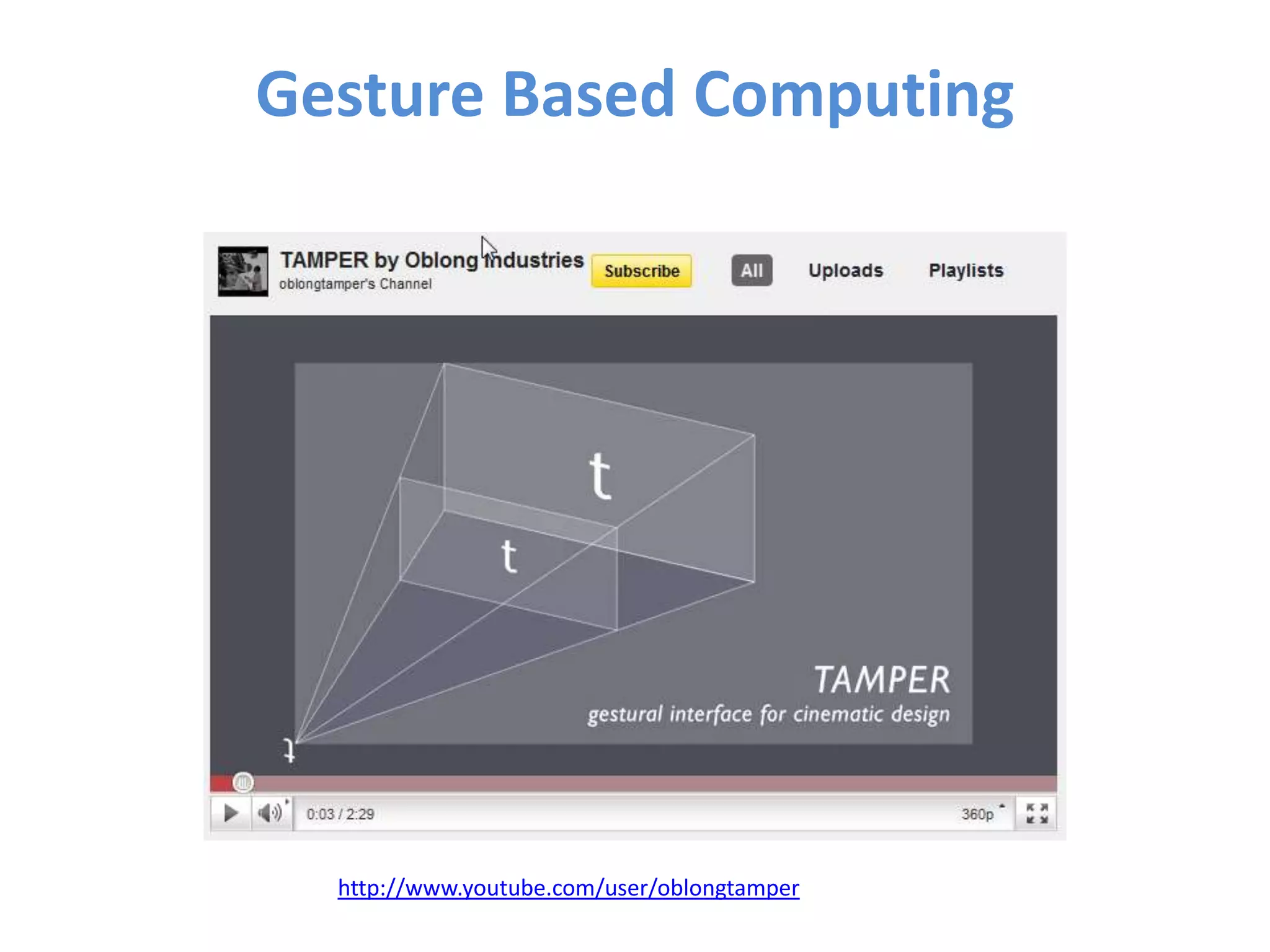
Gesture Based Computing


  http://www.youtube.com/user/oblongtamper
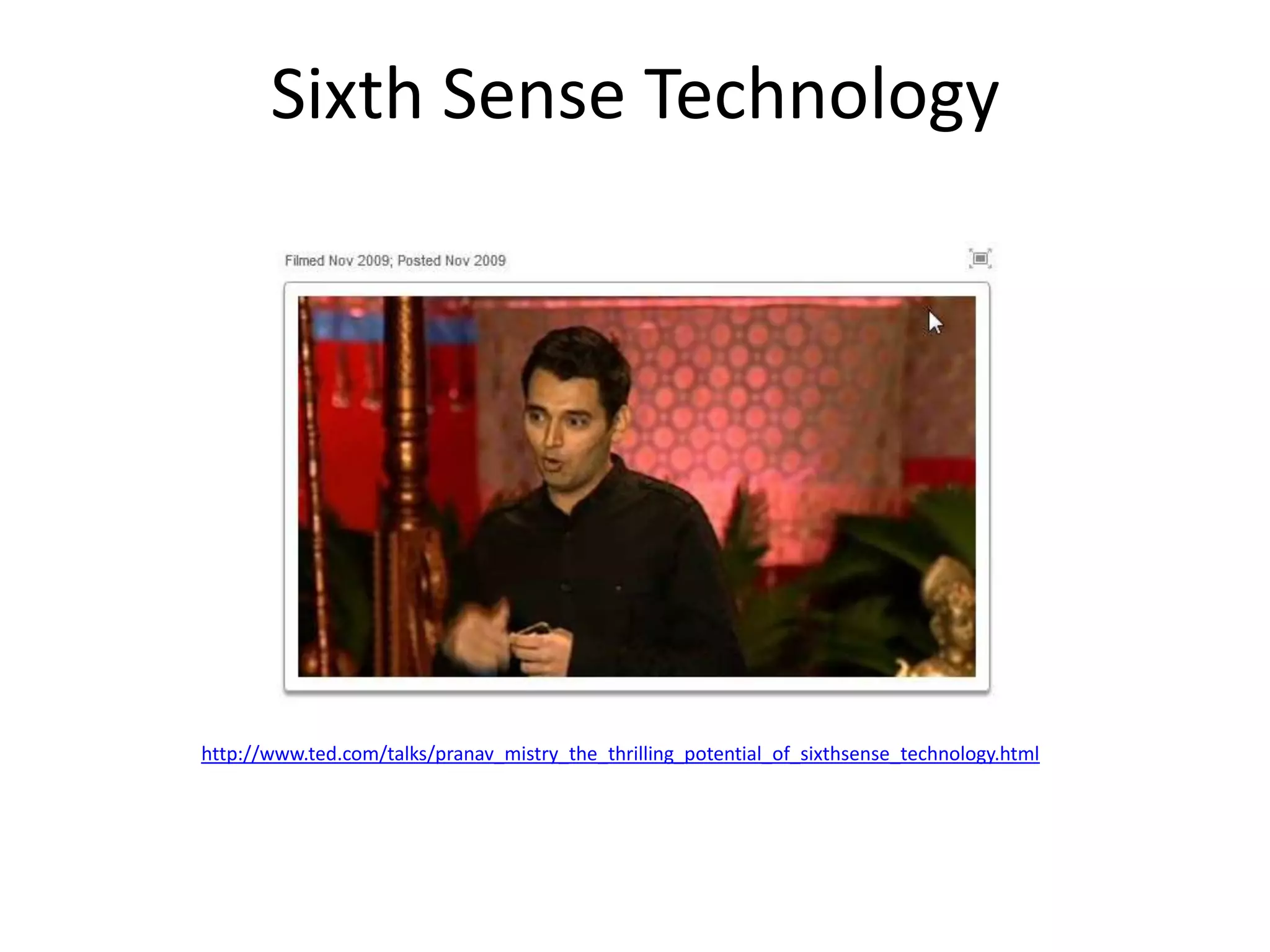
Sixth Sense Technology


http://www.ted.com/talks/pranav_mistry_the_thrilling_potential_of_sixthsense_technology.html
TIME TO ADOPTION – 4 to 5 years
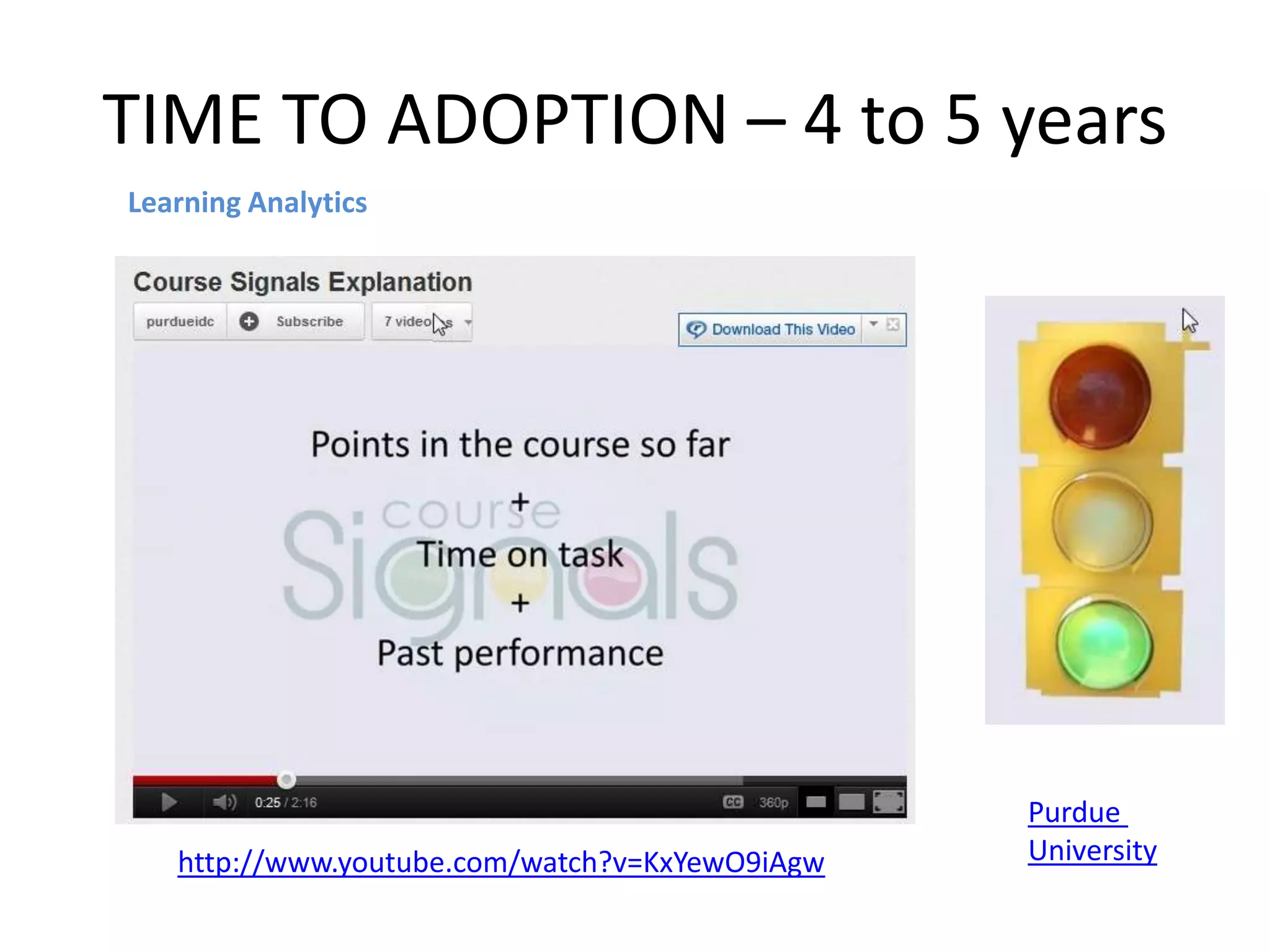
Learning Analytics


                                                Purdue
   http://www.youtube.com/watch?v=KxYewO9iAgw   University
TIME TO ADOPTION – 4 to 5 years
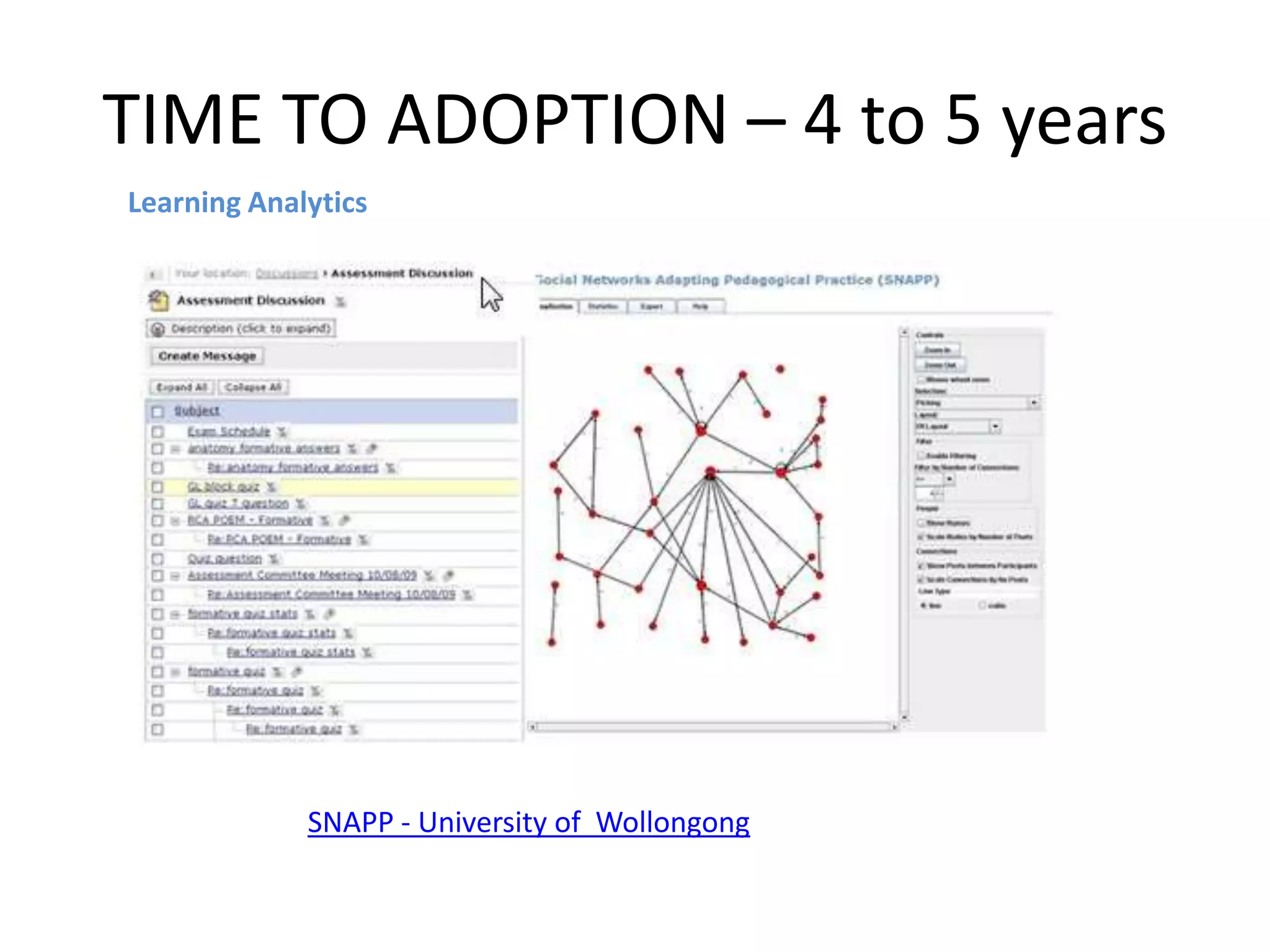
Learning Analytics


             SNAPP - University of Wollongong
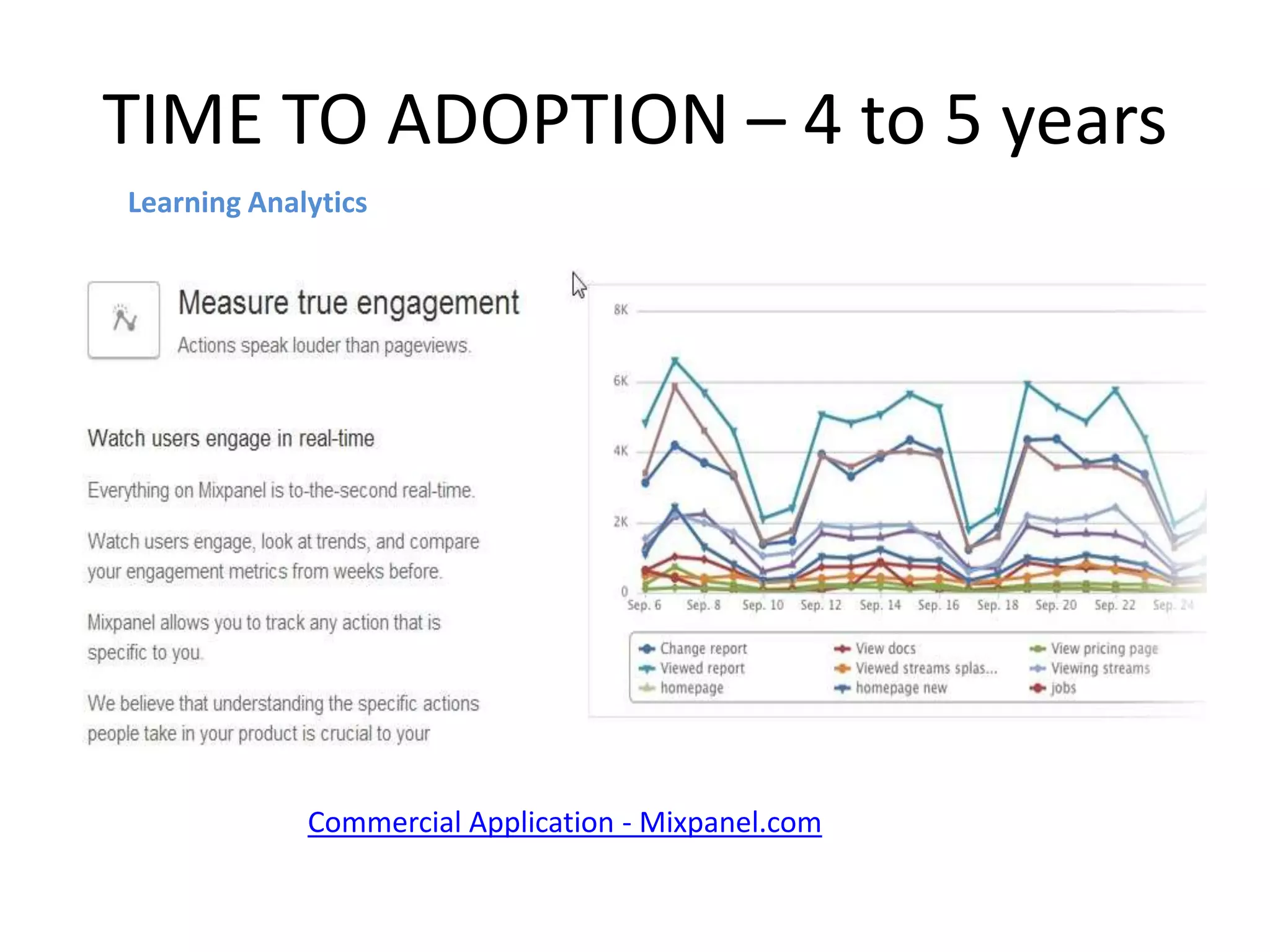
TIME TO ADOPTION – 4 to 5 years
Learning Analytics


             Commercial Application - Mixpanel.com
TIME TO ADOPTION – 4 to 5 years
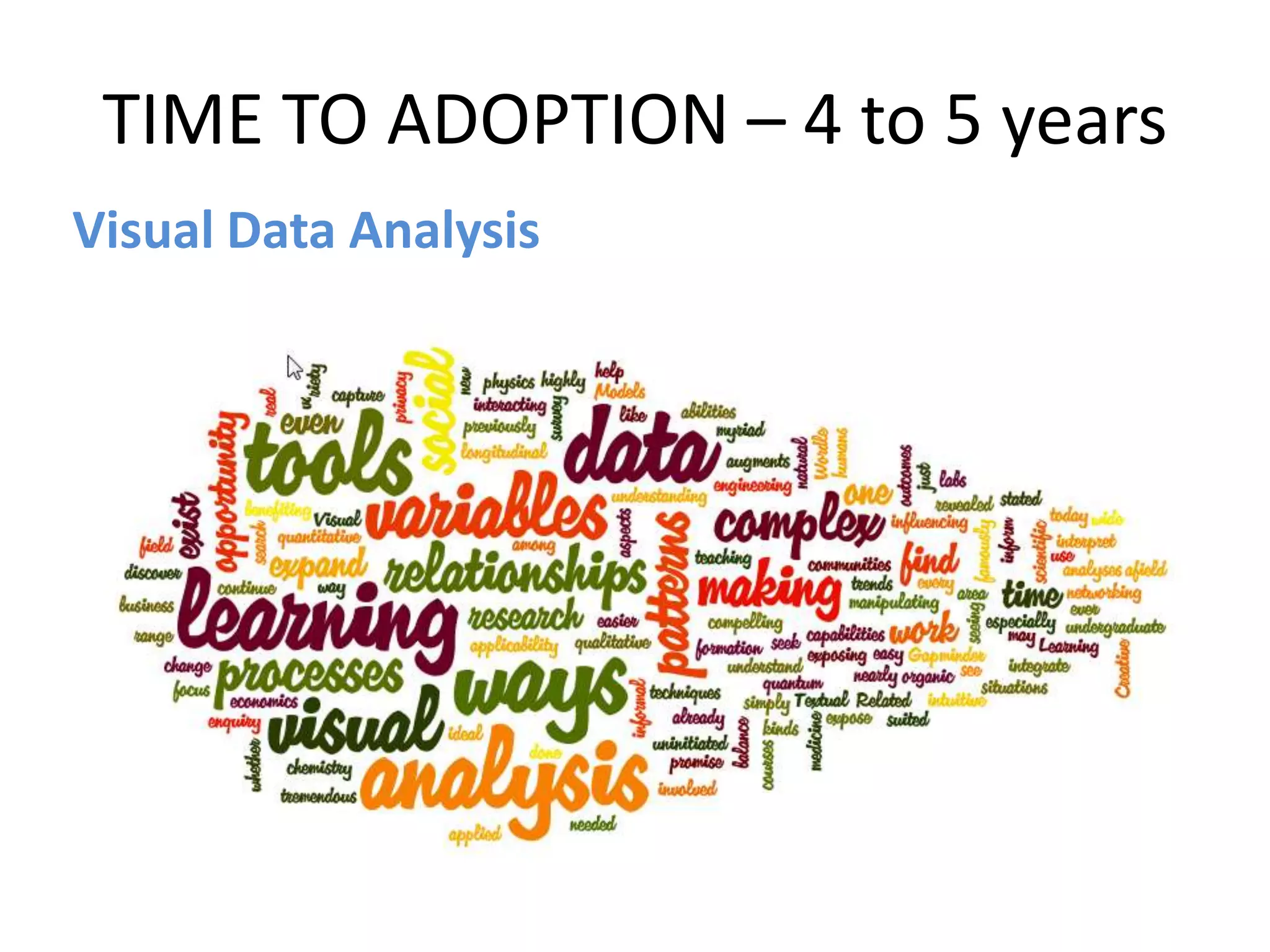
Visual Data Analysis
TIME TO ADOPTION – 4 to 5 years
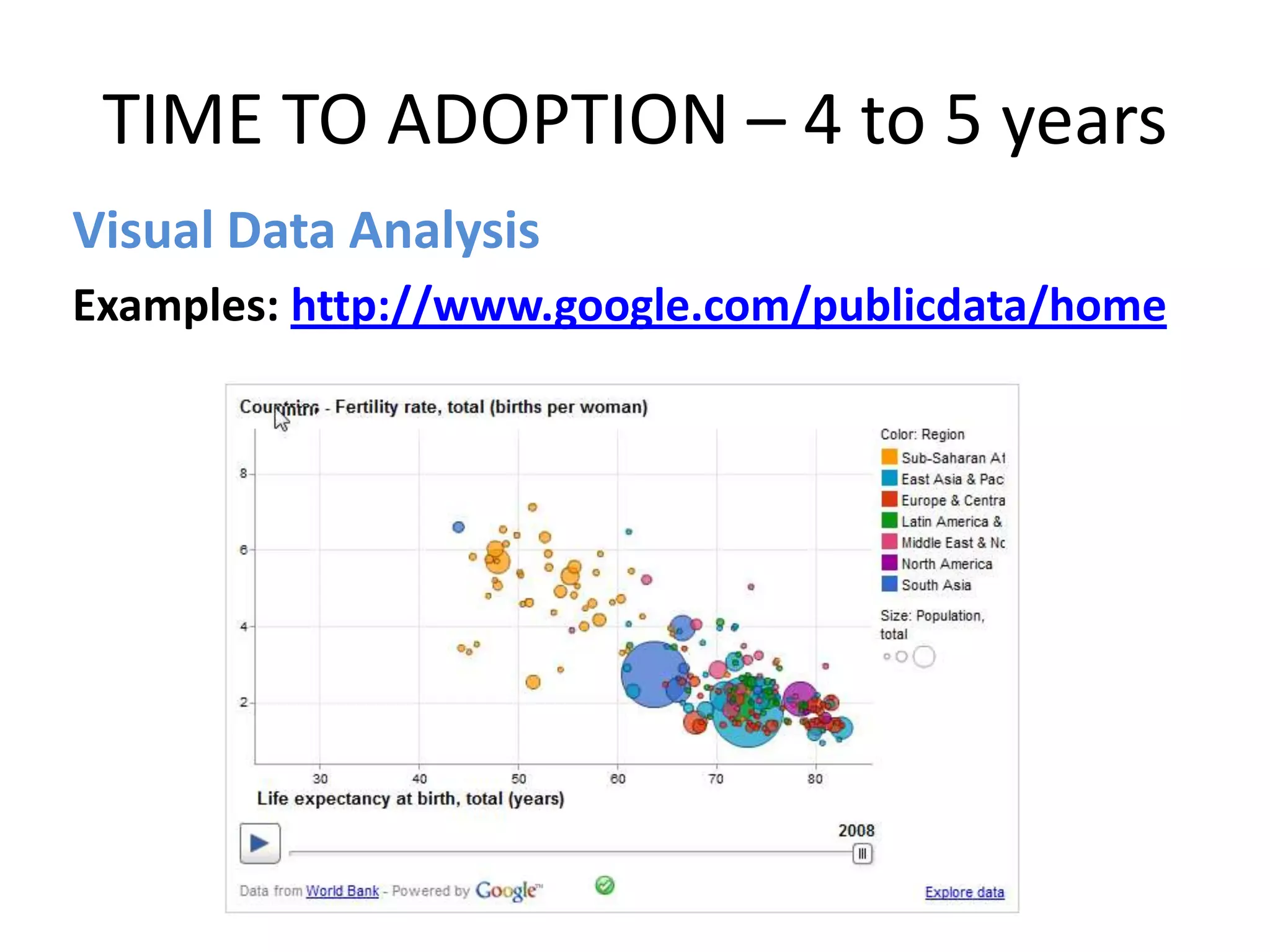
Visual Data Analysis
Examples: http://www.google.com/publicdata/home
TIME TO ADOPTION – 4 to 5 years
Visual Data Analysis


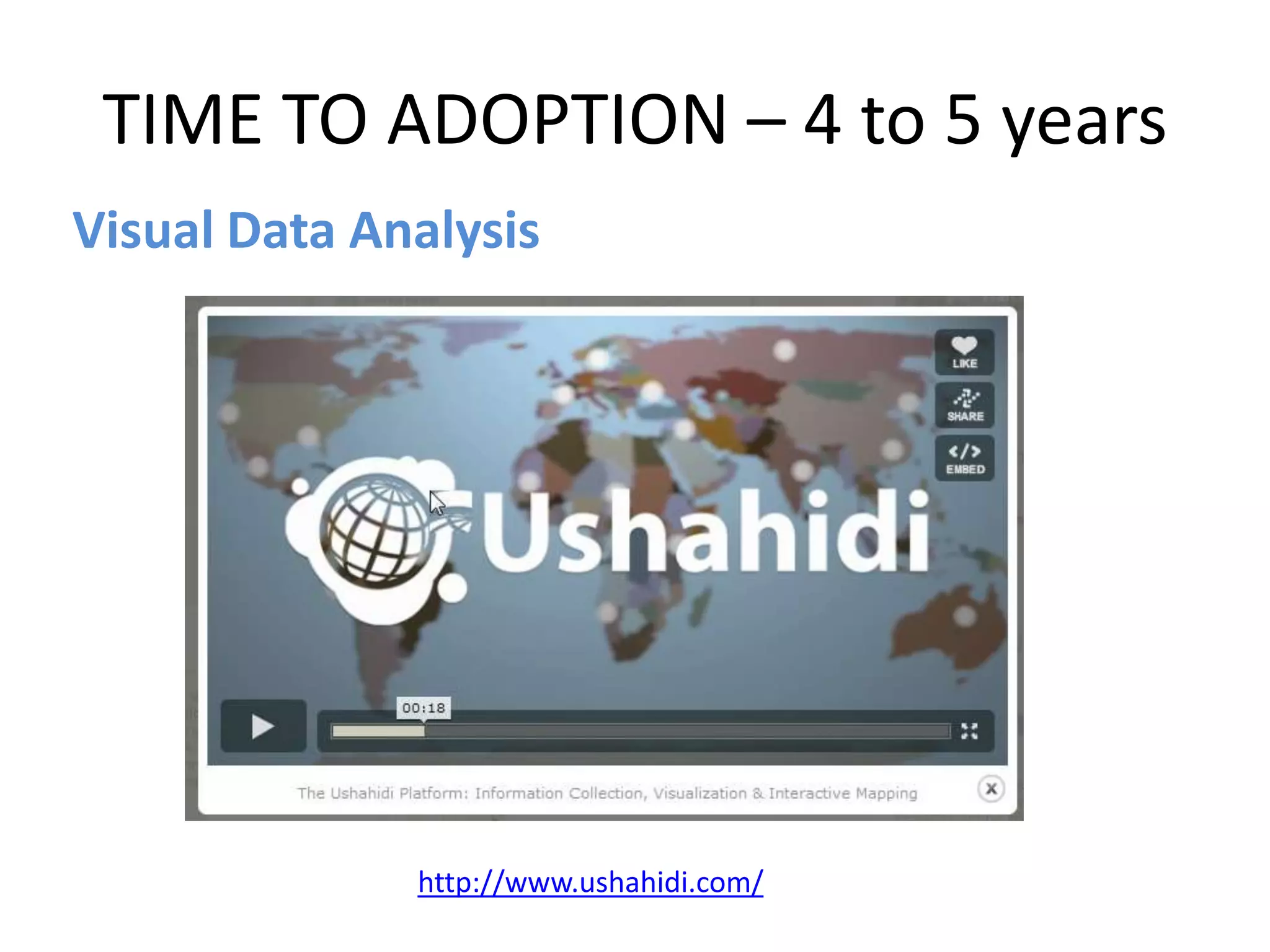
              http://www.ushahidi.com/
TIME TO ADOPTION – 4 to 5 years
Visual Data Analysis


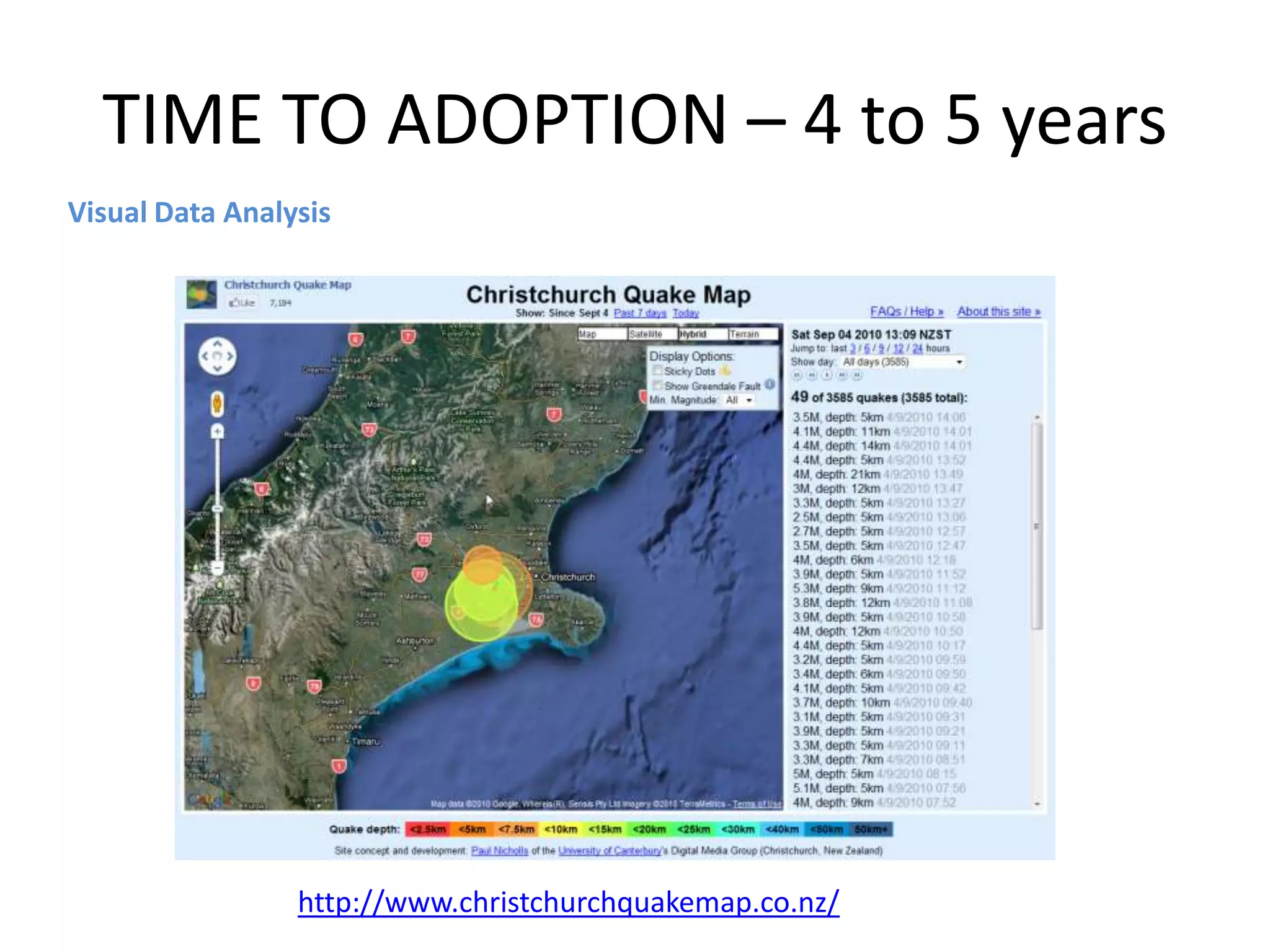
                 http://www.christchurchquakemap.co.nz/
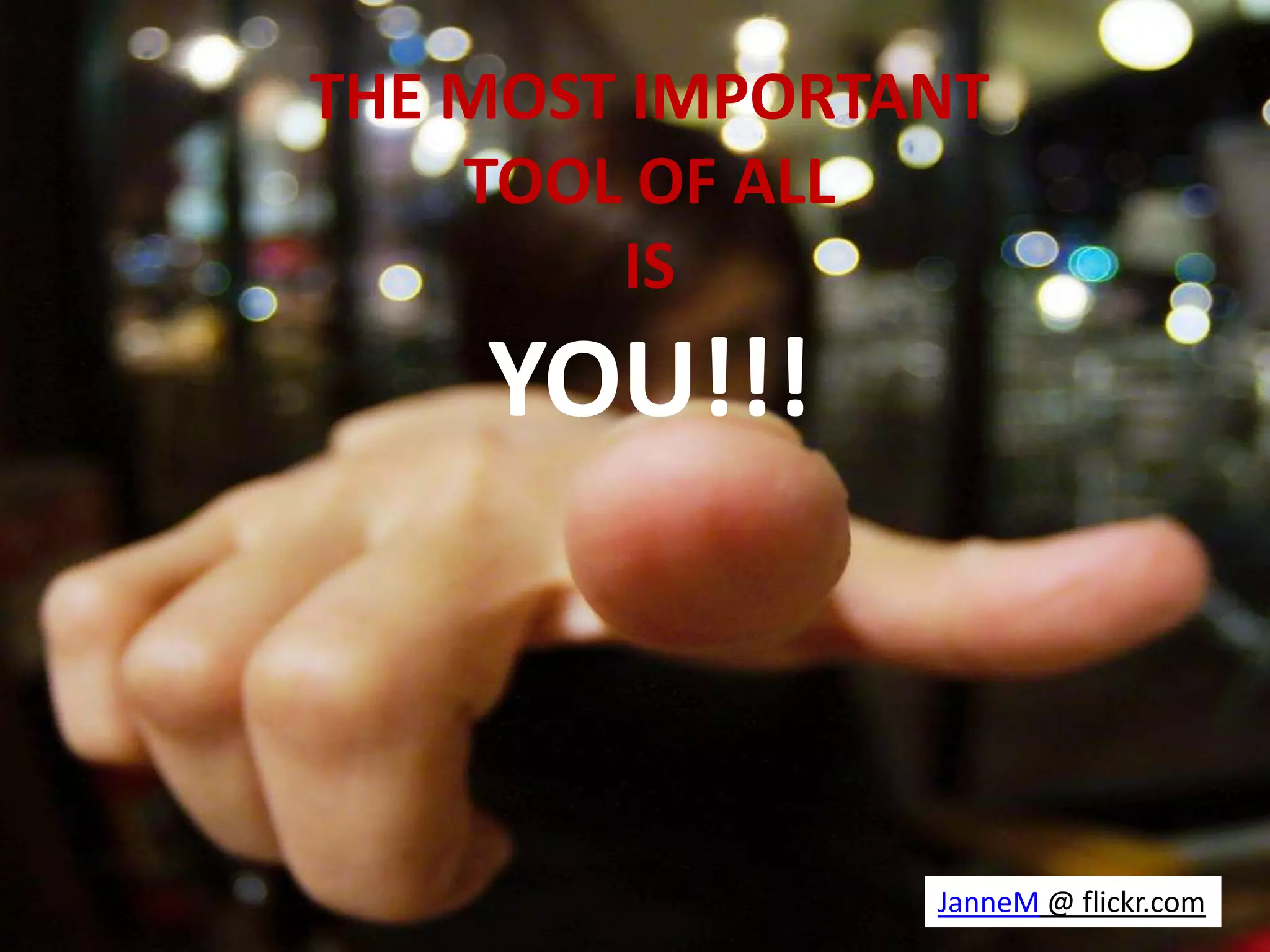
THE MOST IMPORTANT
    TOOL OF ALL
        IS
    YOU!!!


                JanneM @ flickr.com
WHAT DO YOU DO
   WITH ALL
  OF THIS??
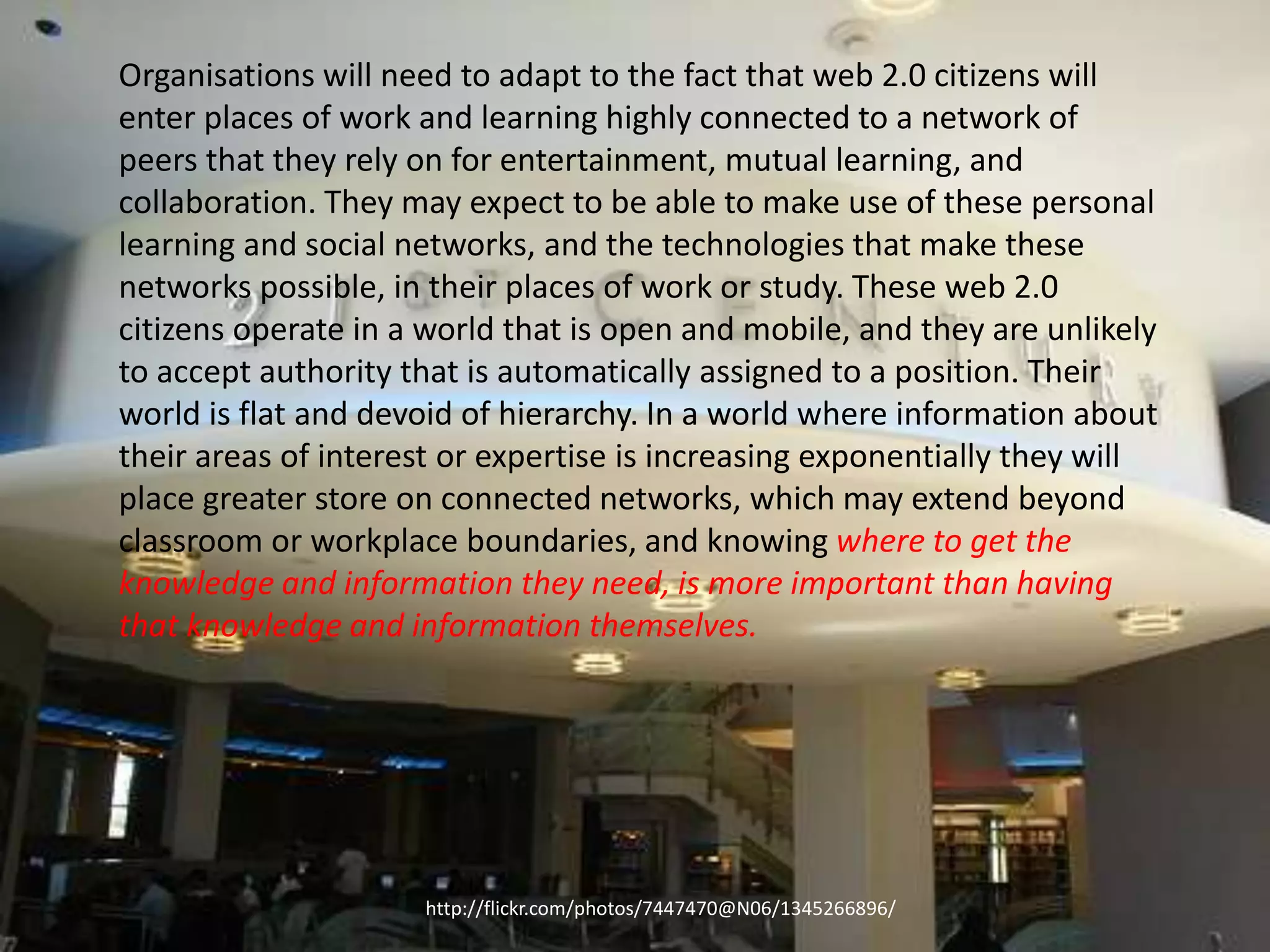
Organisations will need to adapt to the fact that web 2.0 citizens will
enter places of work and learning highly connected to a network of
peers that they rely on for entertainment, mutual learning, and
collaboration. They may expect to be able to make use of these personal
learning and social networks, and the technologies that make these
networks possible, in their places of work or study. These web 2.0
citizens operate in a world that is open and mobile, and they are unlikely
to accept authority that is automatically assigned to a position. Their
world is flat and devoid of hierarchy. In a world where information about
their areas of interest or expertise is increasing exponentially they will
place greater store on connected networks, which may extend beyond
classroom or workplace boundaries, and knowing where to get the
knowledge and information they need, is more important than having
that knowledge and information themselves.


                     http://flickr.com/photos/7447470@N06/1345266896/
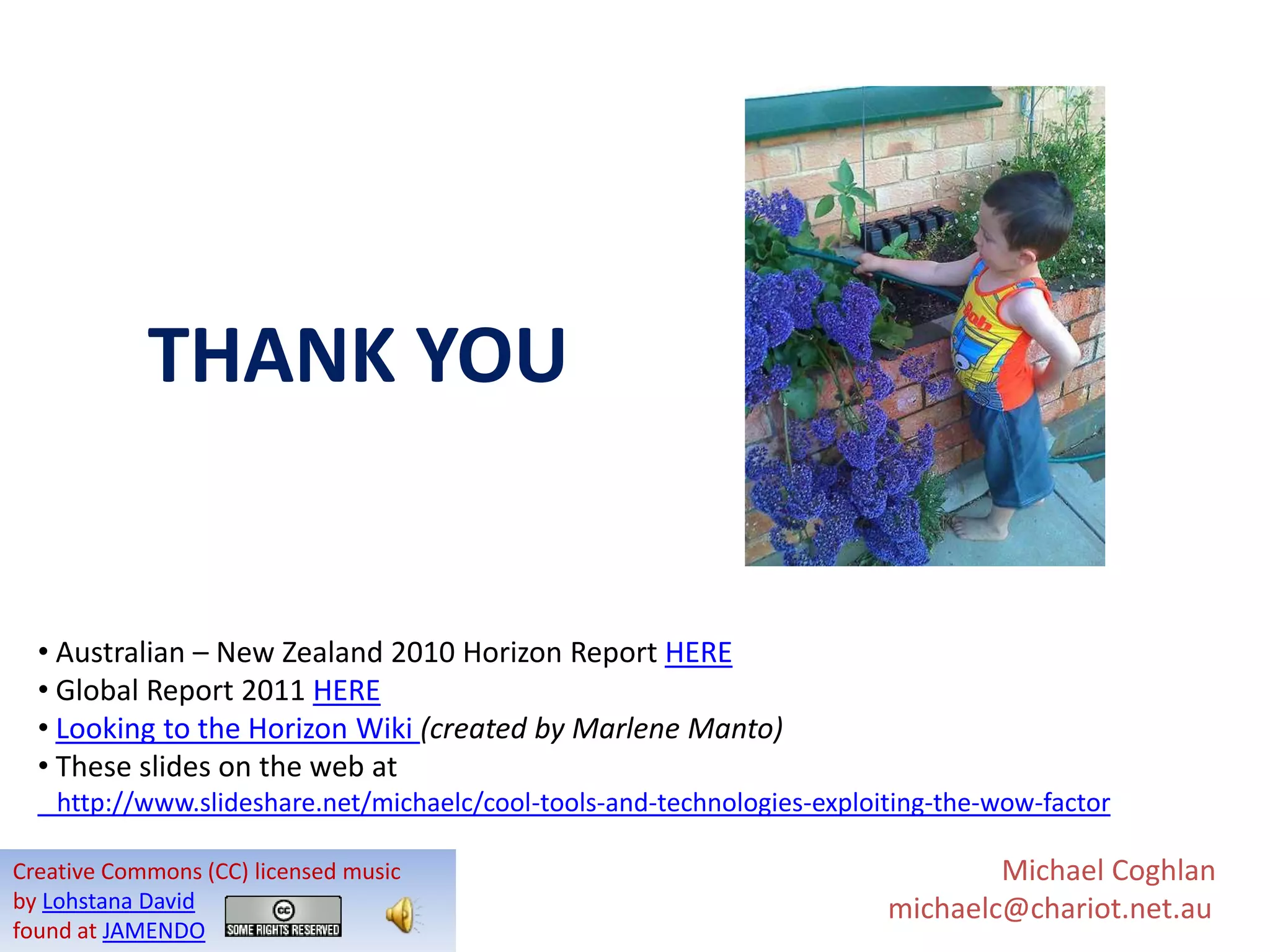
THANK YOU


  • Australian – New Zealand 2010 Horizon Report HERE
  • Global Report 2011 HERE
  • Looking to the Horizon Wiki (created by Marlene Manto)
  • These slides on the web at
    http://www.slideshare.net/michaelc/cool-tools-and-technologies-exploiting-the-wow-factor

Creative Commons (CC) licensed music                                             Michael Coghlan
by Lohstana David                                                        michaelc@chariot.net.au
found at JAMENDO

The WOW Factor - What's on the Horizon

  • 1.
    EXPLOITING THE WOW FACTOR Michael Coghlan eLearning11 Creative Commons (CC) licensed music 7/12/11 by Lohstana David found at JAMENDO
  • 2.
    10 YEARS AGO(2001) • BLOGS • VIRTUAL CLASSROOMS • WIKIS • FACEBOOK • PODCASTS • IPADS • RSS FEEDS • IPHONES • YOUTUBE • EBOOKS • TWITTER
  • 3.
    EXPLOITING THE WOWFACTOR TO ENHANCE TEACHING PRACTICE The WOW factor is very much underrated when attempting to engage people in educational technology. I was always hearing ' you can't let the technology' lead, and yet all my most exciting moments, and those I observed in others, were when that it is exactly what we did - we followed the technology FOR ITS OWN SAKE and discovered wonderful things!
  • 4.
  • 5.
    Andrew Douch Yr 12Biology Teacher
  • 8.
    THEORIES ABOUT TECHNOLOGY 1.Technological determinism: technology is an external agent that acts upon people and changes society. 2. Social construction of technology (SCOT): it is human decisions and processes that create the technologies we have, and that the prevailing social milieu has an influential role in the decisions we make about how we use that technology. 3. A middle ground between people and machine is the theory of Social Shaping. Nancy Baym refers to technologies having ‘logics’ that influence how we use them. Nicholas Carr calls them ‘ethics’: “the message that a tool or medium transmits into the minds and culture of its users”
  • 9.
    “We shape ourtools and thereafter our tools shape us.” (McLuhan)
  • 10.
    “ALL GOOD TECHNOLOGY IS INDISTINGUISHABLE FROMMAGIC.” (Arthur C Clarke) Creative Commons Image from dibytes
  • 11.
    QR Codes Make your own QR Codes at QRStuff.com
  • 12.
    Today’s Meeting –Your Feedback http://todaysmeet.com/imaginarium
  • 13.
    HORIZON REPORT –the Process Modified version of the Delphi Technique: “ a structured communication technique, originally developed as a systematic, interactive forecasting method which relies on a panel of experts.” Creative Commons image from Dramagirl
  • 14.
    HORIZON REPORT –the Process • WIKI - List of Emerging Technologies prepared in advance by the New Media Consortium (NMC) • Advisory board members invited to add/annotate list items • This list then summarised into major headings that group similar technologies • Further discussion to ensure clarification (note: not justification)
  • 15.
    HORIZON REPORT –the Process Several rounds of voting ensue to reveal: • majority choice • timeframes • short list • final list
  • 16.
    WHAT’S ON THEHORIZON? a summary of recent Horizon Reports 2010/2011
  • 17.
  • 18.
    TIME TO ADOPTION– 1 yr or less Mobile Devices Examples include: • Google Sky Map for Android platforms, which serves as a mobile planetarium • History: Maps of the World, containing full-colour, historical maps • iSeismometer - capable of measuring vibrations and tremors • Reference works such as the Australian Oxford Dictionary and the Aussie Slang Dictionary, featuring more than 700 common Australian phrases. • Forklift Driving Course (SA)
  • 19.
    TIME TO ADOPTION– 1 yr or less Mobile Internet Devices The knfbReader Mobile is designed to help those with learning disabilities or visual impairment. The user snaps a picture of text using his or her mobile phone and the phone converts the text to speech.
  • 20.
    TIME TO ADOPTION– 1 yr or less eBooks • Flipboard – a magazine featuring you and your social network • Project Gutenberg (Aust)
  • 21.
    TIME TO ADOPTION– 1 yr or less eBooks
  • 22.
    TIME TO ADOPTION– 2 to 3 years Augmented Reality (AR) Bringing Back the Berlin Wall
  • 23.
    TIME TO ADOPTION– 2 to 3 years Augmented Reality (AR) http://www.youtube.com/watch?v=loZtR05O0uU
  • 24.
    TIME TO ADOPTION– 2 to 3 years Augmented Reality (AR) http://www.youtube.com/watch?v=P9KPJlA5yds
  • 25.
    TIME TO ADOPTION– 2 to 3 years Augmented Reality (AR)
  • 26.
    The future isalready here — it's just not evenly distributed. (William Gibson)
  • 27.
    TIME TO ADOPTION– 2 to 3 years http://www.youtube.com/watch?v=tb0pMeg1UN0
  • 28.
    CONVERGENCE TECHNOLOGICAL CONVERGENCE Thetendency for different technological systems to evolve towards performing similar tasks. eg mobile phone + Internet = Smart Phone
  • 29.
    TIME TO ADOPTION– 2 to 3 years http://www.vimeo.com/2341387
  • 30.
    TIME TO ADOPTION– 2 to 3 years Game Based Learning Climate Change Game
  • 31.
    TIME TO ADOPTION– 2 to 3 years Game Based Learning Trading Around the World
  • 32.
    TIME TO ADOPTION– 2 to 3 years Game Based Learning Virtual Knee Surgery
  • 33.
    TIME TO ADOPTION– 4 to 5 years Gesture Based Computing Relevance for Teaching and Learning The kinaesthetic nature of gesture-based computing will very likely lead to new kinds of teaching or training simulations that look, feel, and operate almost exactly like their real-world counterparts. The ease and intuitiveness of a gestural interface makes the experience seem very natural, and even fun, making them relevant for learning at any age or level of study..
  • 34.
    Gesture Based Computing THE FUTURE OF SHOPPING http://www.youtube.com/v/xyBXjjZa9qE
  • 35.
    Gesture Based Computing VIRTUAL AUTOPSY TABLE http://vimeo.com/moogaloop.swf?clip_id=6866296
  • 36.
    Gesture Based Computing http://www.youtube.com/user/oblongtamper
  • 37.
  • 38.
    TIME TO ADOPTION– 4 to 5 years Learning Analytics Purdue http://www.youtube.com/watch?v=KxYewO9iAgw University
  • 39.
    TIME TO ADOPTION– 4 to 5 years Learning Analytics SNAPP - University of Wollongong
  • 40.
    TIME TO ADOPTION– 4 to 5 years Learning Analytics Commercial Application - Mixpanel.com
  • 41.
    TIME TO ADOPTION– 4 to 5 years Visual Data Analysis
  • 42.
    TIME TO ADOPTION– 4 to 5 years Visual Data Analysis Examples: http://www.google.com/publicdata/home
  • 43.
    TIME TO ADOPTION– 4 to 5 years Visual Data Analysis http://www.ushahidi.com/
  • 44.
    TIME TO ADOPTION– 4 to 5 years Visual Data Analysis http://www.christchurchquakemap.co.nz/
  • 45.
    THE MOST IMPORTANT TOOL OF ALL IS YOU!!! JanneM @ flickr.com
  • 46.
    WHAT DO YOUDO WITH ALL OF THIS??
  • 47.
    Organisations will needto adapt to the fact that web 2.0 citizens will enter places of work and learning highly connected to a network of peers that they rely on for entertainment, mutual learning, and collaboration. They may expect to be able to make use of these personal learning and social networks, and the technologies that make these networks possible, in their places of work or study. These web 2.0 citizens operate in a world that is open and mobile, and they are unlikely to accept authority that is automatically assigned to a position. Their world is flat and devoid of hierarchy. In a world where information about their areas of interest or expertise is increasing exponentially they will place greater store on connected networks, which may extend beyond classroom or workplace boundaries, and knowing where to get the knowledge and information they need, is more important than having that knowledge and information themselves. http://flickr.com/photos/7447470@N06/1345266896/
  • 48.
    THANK YOU • Australian – New Zealand 2010 Horizon Report HERE • Global Report 2011 HERE • Looking to the Horizon Wiki (created by Marlene Manto) • These slides on the web at http://www.slideshare.net/michaelc/cool-tools-and-technologies-exploiting-the-wow-factor Creative Commons (CC) licensed music Michael Coghlan by Lohstana David michaelc@chariot.net.au found at JAMENDO