Problem Solving with Issue Based Information System [IBIS] and ‘Wicked Problems’ techniques June 2008
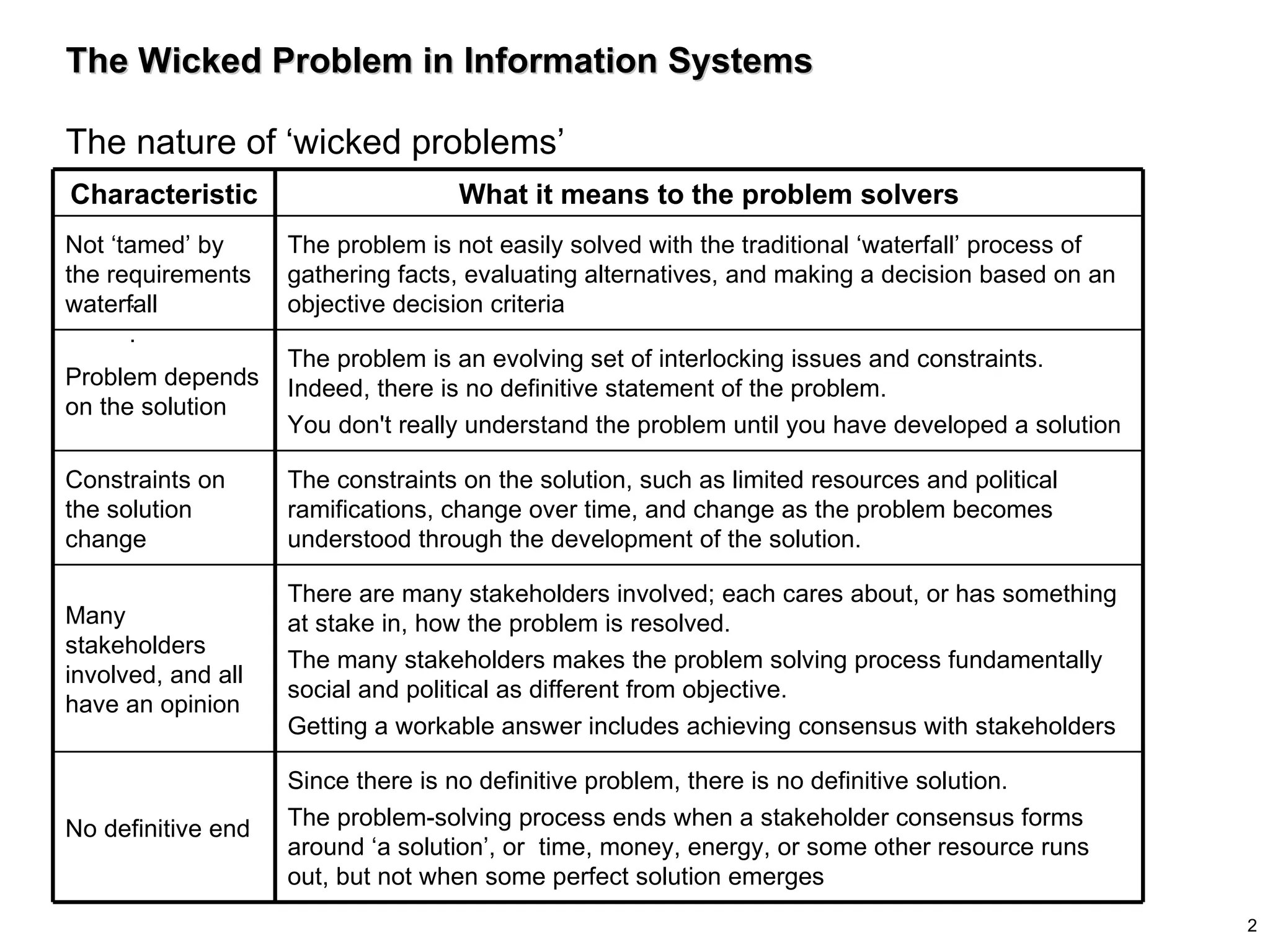
The Wicked Problem in Information Systems The nature of ‘wicked problems’ .  .  .  .   No definitive end Many stakeholders involved, and all have an opinion Constraints on the solution change Problem depends on the solution Not ‘tamed’ by the requirements waterfall Characteristic Since there is no definitive problem, there is no definitive solution.  The problem-solving process ends when a stakeholder consensus forms around ‘a solution’, or  time, money, energy, or some other resource runs out, but not when some perfect solution emerges There are many stakeholders involved; each cares about, or has something at stake in, how the problem is resolved.  The many stakeholders makes the problem solving process fundamentally social and political as different from objective.  Getting a workable answer includes achieving consensus with stakeholders The constraints on the solution, such as limited resources and political ramifications, change over time, and change as the problem becomes understood through the development of the solution.  The problem is an evolving set of interlocking issues and constraints. Indeed, there is no definitive statement of the problem.  You don't really understand the problem until you have developed a solution The problem is not easily solved with the traditional ‘waterfall’ process of gathering facts, evaluating alternatives, and making a decision based on an objective decision criteria What it means to the problem solvers
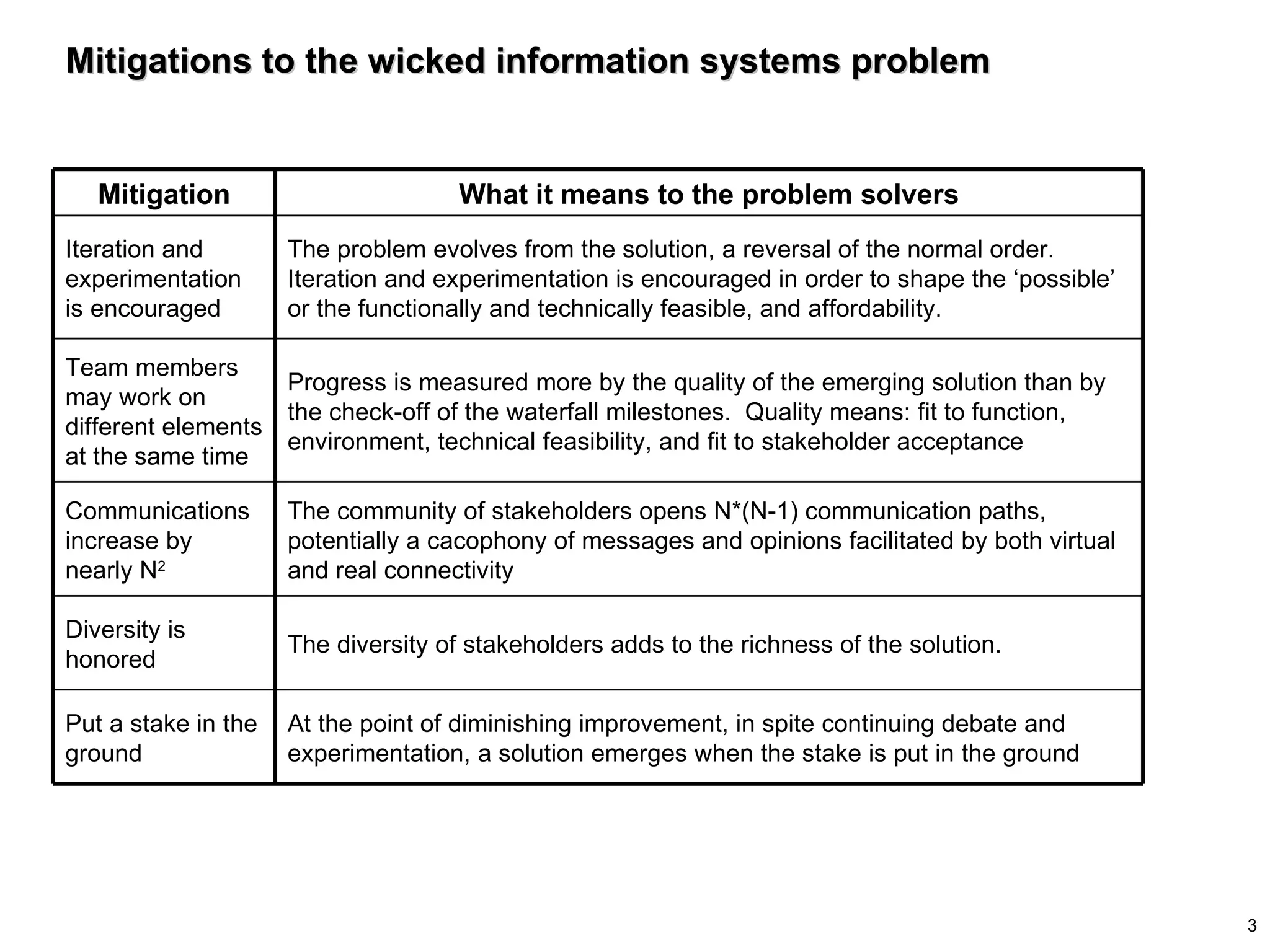
Mitigations to the wicked information systems problem Put a stake in the ground Diversity is honored Communications increase by nearly N 2 Team members may work on different elements at the same time Iteration and experimentation is encouraged Mitigation At the point of diminishing improvement, in spite continuing debate and experimentation, a solution emerges when the stake is put in the ground  The diversity of stakeholders adds to the richness of the solution.  The community of stakeholders opens N*(N-1) communication paths, potentially a cacophony of messages and opinions facilitated by both virtual and real connectivity  Progress is measured more by the quality of the emerging solution than by the check-off of the waterfall milestones.  Quality means: fit to function, environment, technical feasibility, and fit to stakeholder acceptance The problem evolves from the solution, a reversal of the normal order.  Iteration and experimentation is encouraged in order to shape the ‘possible’ or the functionally and technically feasible, and affordability. What it means to the problem solvers
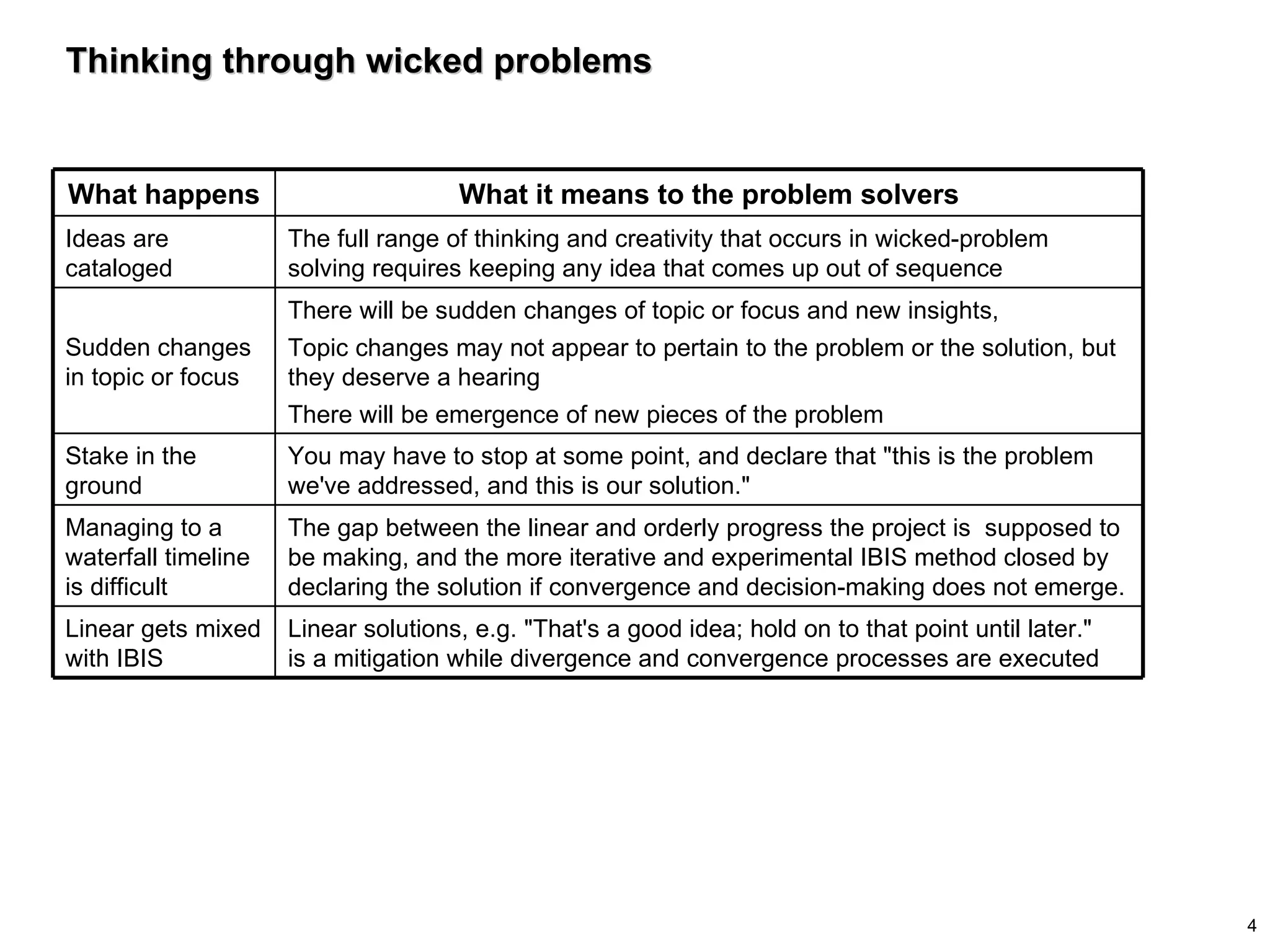
Thinking through wicked problems Linear solutions, e.g. "That's a good idea; hold on to that point until later." is a mitigation while divergence and convergence processes are executed Linear gets mixed with IBIS The gap between the linear and orderly progress the project is  supposed to be making, and the more iterative and experimental IBIS method closed by declaring the solution if convergence and decision-making does not emerge.  Managing to a waterfall timeline is difficult You may have to stop at some point, and declare that "this is the problem we've addressed, and this is our solution." Stake in the ground There will be sudden changes of topic or focus and new insights,  Topic changes may not appear to pertain to the problem or the solution, but they deserve a hearing There will be emergence of new pieces of the problem Sudden changes in topic or focus The full range of thinking and creativity that occurs in wicked-problem solving requires keeping any idea that comes up out of sequence Ideas are cataloged What it means to the problem solvers What happens
IBIS Fundamentals IBIS is an issue-based methodology for dialogue and conversation.  Issues are framed in a three-part matrix structure  Question  -- states a question, but does not include in the question Ideas or Arguments  Ideas  – link to the Question and propose possible resolutions for the Question; aka: solutions  Arguments  – link to the Ideas, and state opinions, facts, or judgments that either support or object to one or more Ideas; aka justifications Structuring the Question-Idea-Argument [QIA] provides: Exposure of points-of-view early in the process to enable stakeholder dialogue and project possibilities or opportunities Loose coupling of question, justifications, and solutions to enable iteration  Rich landscape of ‘links’ or relationships among the matrix values
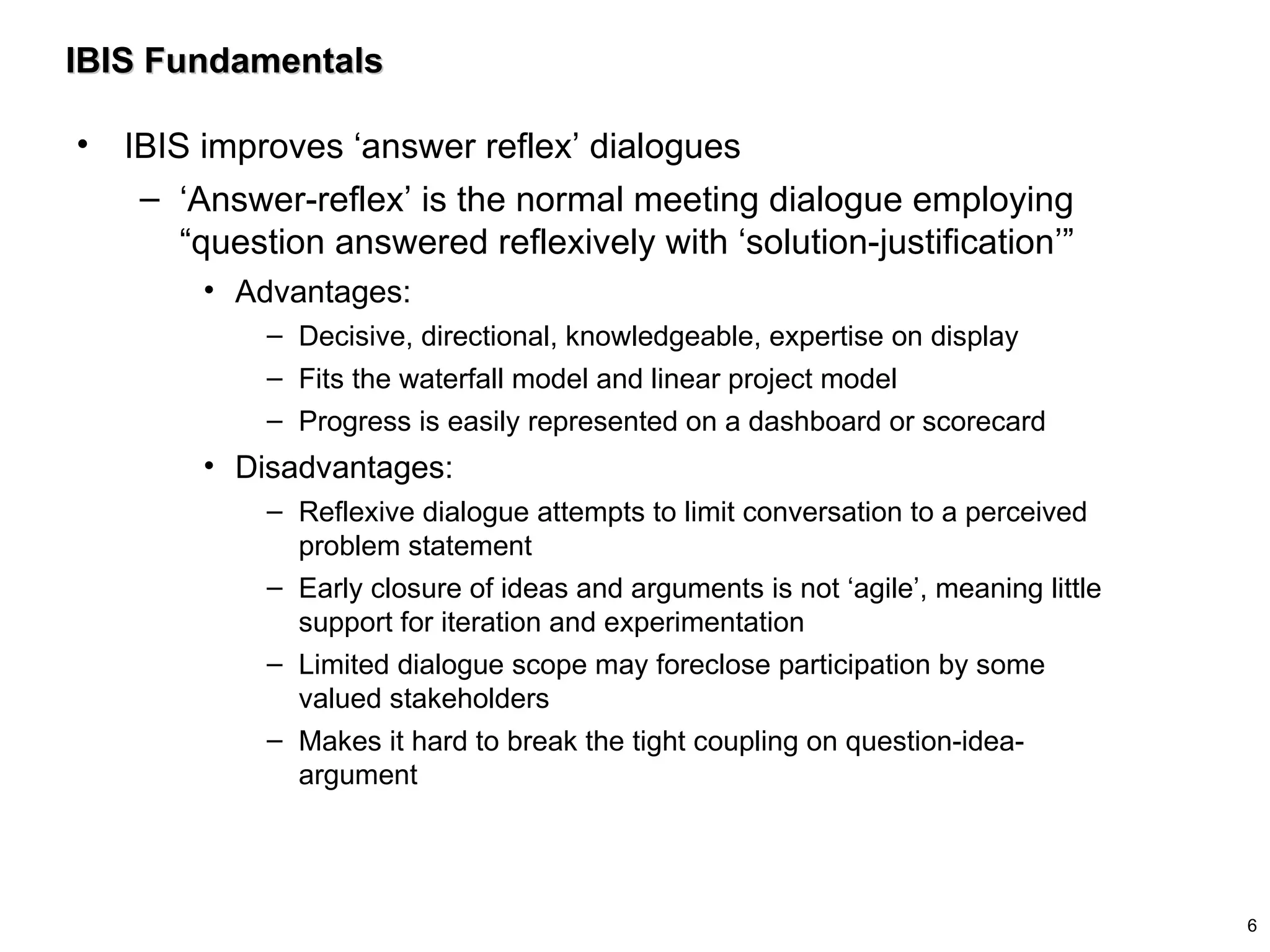
IBIS Fundamentals IBIS improves ‘answer reflex’ dialogues ‘Answer-reflex’ is the normal meeting dialogue employing “question answered reflexively with ‘solution-justification’” Advantages:  Decisive, directional, knowledgeable, expertise on display Fits the waterfall model and linear project model Progress is easily represented on a dashboard or scorecard  Disadvantages:  Reflexive dialogue attempts to limit conversation to a perceived problem statement Early closure of ideas and arguments is not ‘agile’, meaning little support for iteration and experimentation  Limited dialogue scope may foreclose participation by some valued stakeholders Makes it hard to break the tight coupling on question-idea-argument
IBIS Process steps Diverge All stakeholders participate Develop the QIA map with dialogue and communications Keep going until there are diminishing value-adds to the map Converge Develop deeper understanding of the various QIA’s Categorize and weigh for consensus [preponderance of acceptance] Endorsement Approval of an Idea by stakeholders Can be made by workflow approval or other communication Retirement Ideas are taken off the table by consensus of stakeholders Can be implemented by workflow Decide Finalize consensus on an Idea set, or Stake-in-the-ground by a ‘decider’ if no consensus emerges and time/resources runs out
IBIS getting started with QIA Root  Question  begins the   conversations  This will generally be something like "What should be our strategic plan for the next 5 years?" or "How can we increase customer 'delight' in our products and services?". Ideas  respond to a Question Brief, neutral proposal for resolution of the Question Linked to their Questions with "responds to" links. Does not contain a justification, or opinion re applicability, feasibility, affordability, desirability [benefits] etc Arguments  are statements of fact, judgments,  or opinions which either support or object to one or more  Ideas Arguments  are linked to their  Ideas  with links called "supports" (for pros) and "objects to" (for cons).
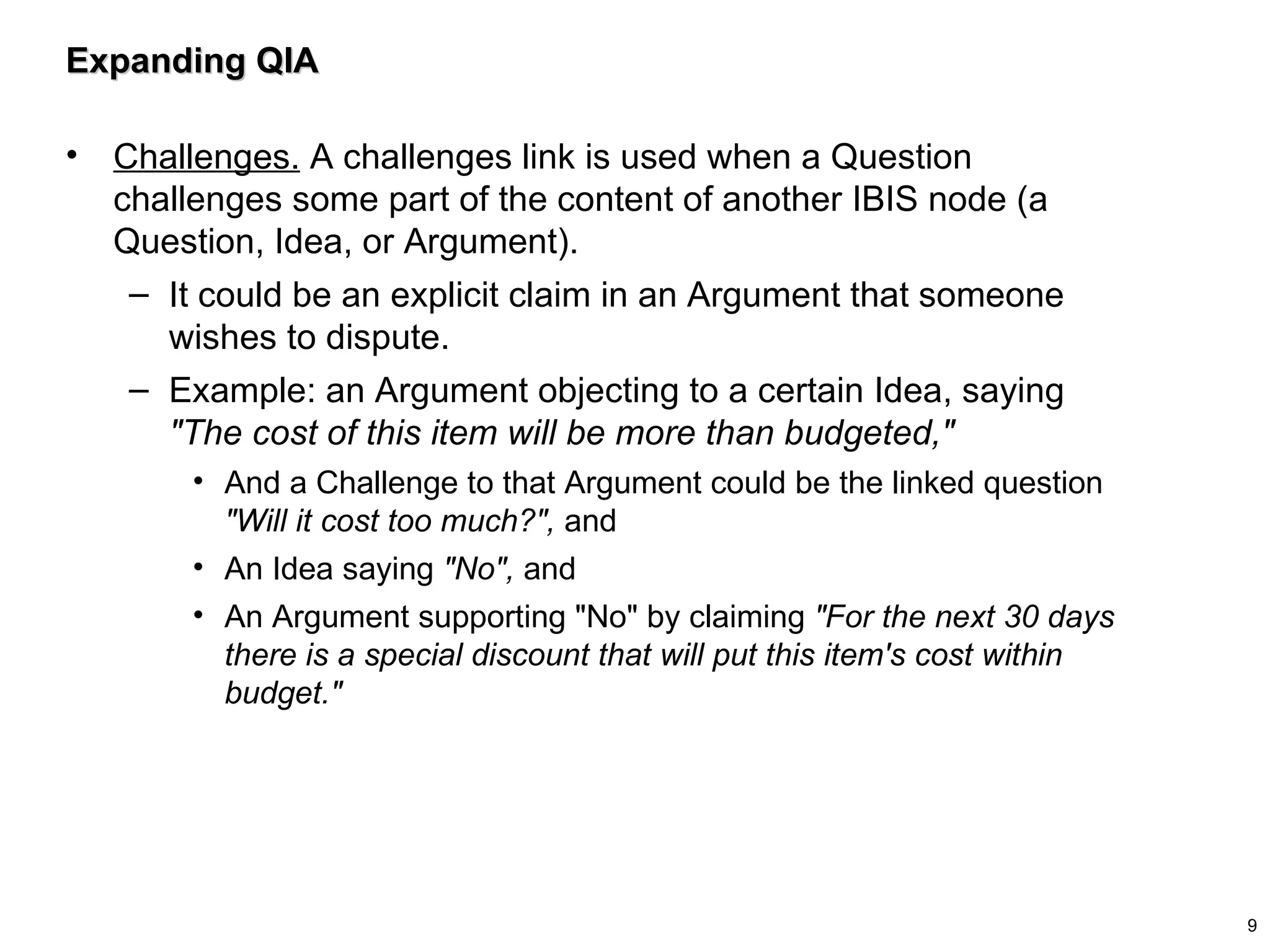
Expanding QIA Challenges.  A challenges link is used when a Question challenges some part of the content of another IBIS node (a Question, Idea, or Argument).  It could be an explicit claim in an Argument that someone wishes to dispute.  Example: an Argument objecting to a certain Idea, saying  "The cost of this item will be more than budgeted,"   And a Challenge to that Argument could be the linked question  "Will it cost too much?",  and An Idea saying  "No",  and  An Argument supporting "No" by claiming  "For the next 30 days there is a special discount that will put this item's cost within budget."
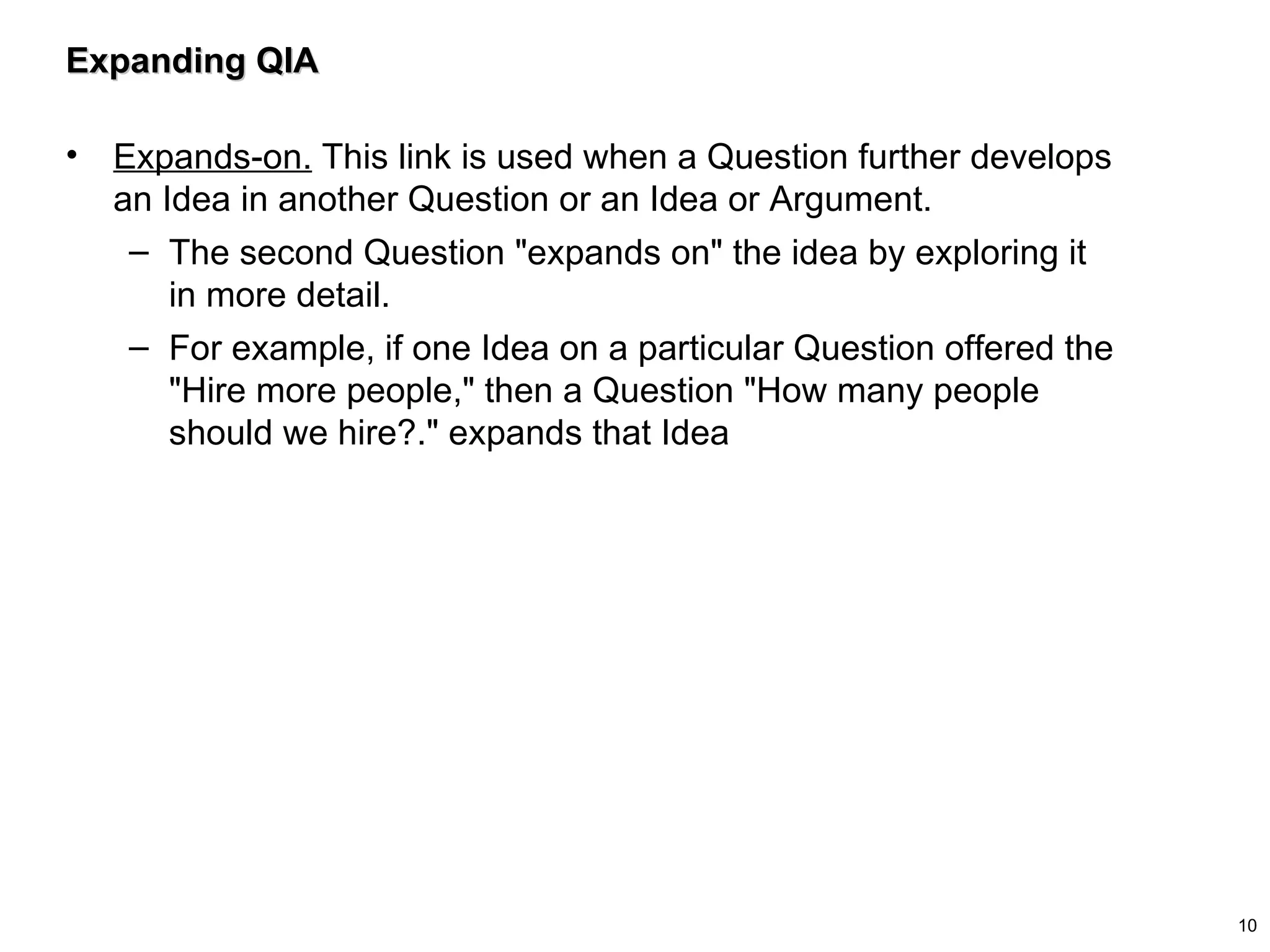
Expanding QIA Expands-on.  This link is used when a Question further develops an Idea in another Question or an Idea or Argument.  The second Question "expands on" the idea by exploring it in more detail.  For example, if one Idea on a particular Question offered the "Hire more people," then a Question "How many people should we hire?." expands that Idea
QIA Format List format of QIA [hierarchical]: 1. Question: "What system should we buy?"      1.1 Idea: "X"          1.1.1 Argument Con (Objects to): Doesn't fit w/ existing tools      1.2 Idea: "Y"          1.2.1 Argument Pro (Supports): State-of-the-art Technology Table format of QIA [relational]
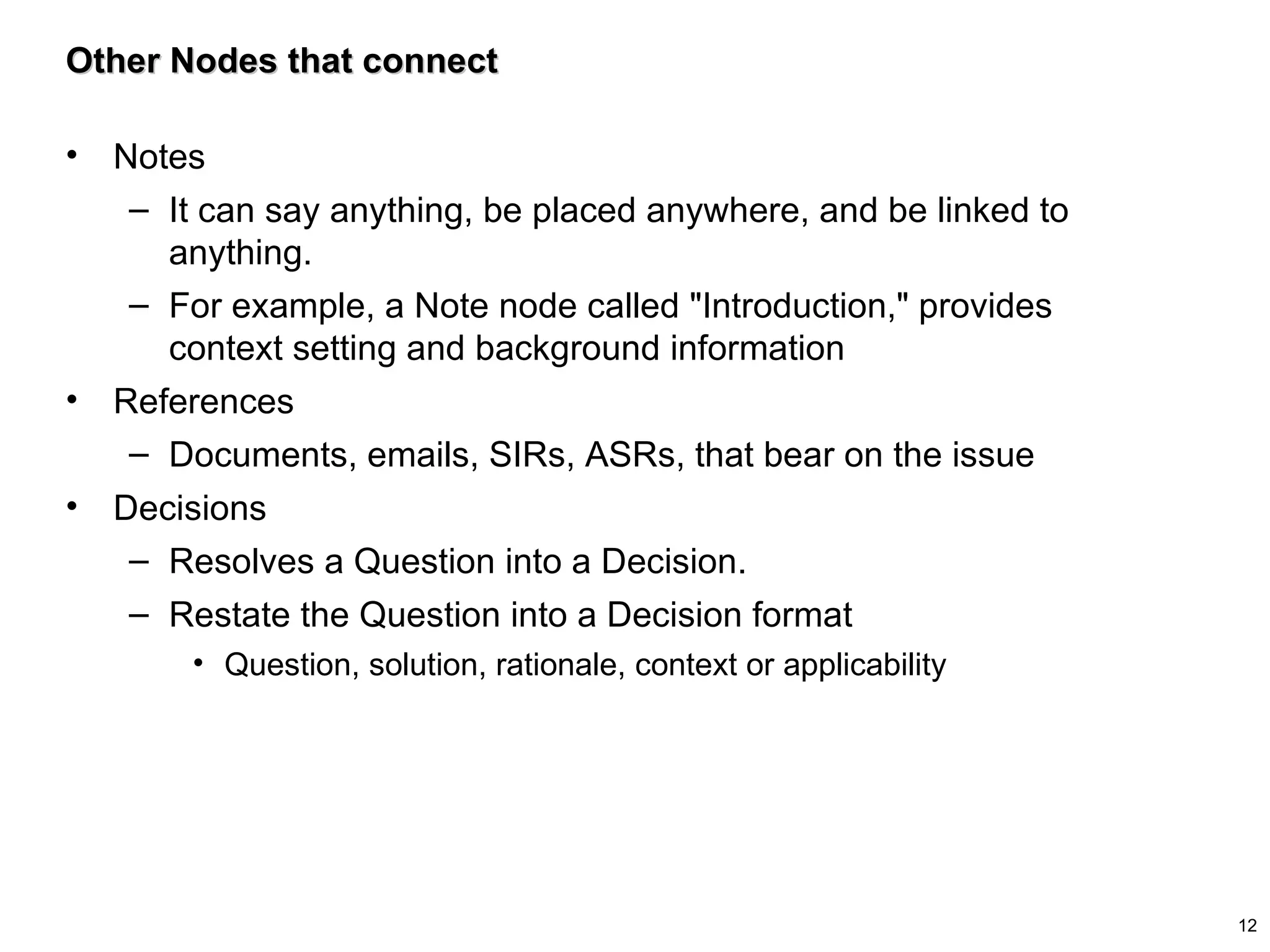
Other Nodes that connect Notes It can say anything, be placed anywhere, and be linked to anything.  For example, a Note node called "Introduction," provides context setting and background information References Documents, emails, SIRs, ASRs, that bear on the issue Decisions Resolves a Question into a Decision.  Restate the Question into a Decision format Question, solution, rationale, context or applicability
Mistakes to avoid Do not put more than one question in a  Question Example of poor practice: “How should complaints be handled, and who should handle them?“ Avoid putting a point into the wrong kind of node.  Example, putting a Question in an Idea, or using a Question node for a general announcement Question should not contain possible answers.  It should avoid the words "and", "or", or "not“ Avoid "Yes/No" Questions, and Questions that follow the pattern "Should we do X or Y?".  Leave questions ‘open’ for Ideas Avoid ‘Should we do…’ Questions Replace with ‘What [how] should we do..’? Replace “Is there a need..’ with ‘How can…’

The Wicked Problem

  • 1.
    Problem Solving withIssue Based Information System [IBIS] and ‘Wicked Problems’ techniques June 2008
  • 2.
    The Wicked Problemin Information Systems The nature of ‘wicked problems’ . . . . No definitive end Many stakeholders involved, and all have an opinion Constraints on the solution change Problem depends on the solution Not ‘tamed’ by the requirements waterfall Characteristic Since there is no definitive problem, there is no definitive solution. The problem-solving process ends when a stakeholder consensus forms around ‘a solution’, or time, money, energy, or some other resource runs out, but not when some perfect solution emerges There are many stakeholders involved; each cares about, or has something at stake in, how the problem is resolved. The many stakeholders makes the problem solving process fundamentally social and political as different from objective. Getting a workable answer includes achieving consensus with stakeholders The constraints on the solution, such as limited resources and political ramifications, change over time, and change as the problem becomes understood through the development of the solution. The problem is an evolving set of interlocking issues and constraints. Indeed, there is no definitive statement of the problem. You don't really understand the problem until you have developed a solution The problem is not easily solved with the traditional ‘waterfall’ process of gathering facts, evaluating alternatives, and making a decision based on an objective decision criteria What it means to the problem solvers
  • 3.
    Mitigations to thewicked information systems problem Put a stake in the ground Diversity is honored Communications increase by nearly N 2 Team members may work on different elements at the same time Iteration and experimentation is encouraged Mitigation At the point of diminishing improvement, in spite continuing debate and experimentation, a solution emerges when the stake is put in the ground The diversity of stakeholders adds to the richness of the solution. The community of stakeholders opens N*(N-1) communication paths, potentially a cacophony of messages and opinions facilitated by both virtual and real connectivity Progress is measured more by the quality of the emerging solution than by the check-off of the waterfall milestones. Quality means: fit to function, environment, technical feasibility, and fit to stakeholder acceptance The problem evolves from the solution, a reversal of the normal order. Iteration and experimentation is encouraged in order to shape the ‘possible’ or the functionally and technically feasible, and affordability. What it means to the problem solvers
  • 4.
    Thinking through wickedproblems Linear solutions, e.g. "That's a good idea; hold on to that point until later." is a mitigation while divergence and convergence processes are executed Linear gets mixed with IBIS The gap between the linear and orderly progress the project is supposed to be making, and the more iterative and experimental IBIS method closed by declaring the solution if convergence and decision-making does not emerge. Managing to a waterfall timeline is difficult You may have to stop at some point, and declare that "this is the problem we've addressed, and this is our solution." Stake in the ground There will be sudden changes of topic or focus and new insights, Topic changes may not appear to pertain to the problem or the solution, but they deserve a hearing There will be emergence of new pieces of the problem Sudden changes in topic or focus The full range of thinking and creativity that occurs in wicked-problem solving requires keeping any idea that comes up out of sequence Ideas are cataloged What it means to the problem solvers What happens
  • 5.
    IBIS Fundamentals IBISis an issue-based methodology for dialogue and conversation. Issues are framed in a three-part matrix structure Question -- states a question, but does not include in the question Ideas or Arguments Ideas – link to the Question and propose possible resolutions for the Question; aka: solutions Arguments – link to the Ideas, and state opinions, facts, or judgments that either support or object to one or more Ideas; aka justifications Structuring the Question-Idea-Argument [QIA] provides: Exposure of points-of-view early in the process to enable stakeholder dialogue and project possibilities or opportunities Loose coupling of question, justifications, and solutions to enable iteration Rich landscape of ‘links’ or relationships among the matrix values
  • 6.
    IBIS Fundamentals IBISimproves ‘answer reflex’ dialogues ‘Answer-reflex’ is the normal meeting dialogue employing “question answered reflexively with ‘solution-justification’” Advantages: Decisive, directional, knowledgeable, expertise on display Fits the waterfall model and linear project model Progress is easily represented on a dashboard or scorecard Disadvantages: Reflexive dialogue attempts to limit conversation to a perceived problem statement Early closure of ideas and arguments is not ‘agile’, meaning little support for iteration and experimentation Limited dialogue scope may foreclose participation by some valued stakeholders Makes it hard to break the tight coupling on question-idea-argument
  • 7.
    IBIS Process stepsDiverge All stakeholders participate Develop the QIA map with dialogue and communications Keep going until there are diminishing value-adds to the map Converge Develop deeper understanding of the various QIA’s Categorize and weigh for consensus [preponderance of acceptance] Endorsement Approval of an Idea by stakeholders Can be made by workflow approval or other communication Retirement Ideas are taken off the table by consensus of stakeholders Can be implemented by workflow Decide Finalize consensus on an Idea set, or Stake-in-the-ground by a ‘decider’ if no consensus emerges and time/resources runs out
  • 8.
    IBIS getting startedwith QIA Root Question begins the conversations This will generally be something like "What should be our strategic plan for the next 5 years?" or "How can we increase customer 'delight' in our products and services?". Ideas respond to a Question Brief, neutral proposal for resolution of the Question Linked to their Questions with "responds to" links. Does not contain a justification, or opinion re applicability, feasibility, affordability, desirability [benefits] etc Arguments are statements of fact, judgments, or opinions which either support or object to one or more Ideas Arguments are linked to their Ideas with links called "supports" (for pros) and "objects to" (for cons).
  • 9.
    Expanding QIA Challenges. A challenges link is used when a Question challenges some part of the content of another IBIS node (a Question, Idea, or Argument). It could be an explicit claim in an Argument that someone wishes to dispute. Example: an Argument objecting to a certain Idea, saying "The cost of this item will be more than budgeted," And a Challenge to that Argument could be the linked question "Will it cost too much?", and An Idea saying "No", and An Argument supporting "No" by claiming "For the next 30 days there is a special discount that will put this item's cost within budget."
  • 10.
    Expanding QIA Expands-on. This link is used when a Question further develops an Idea in another Question or an Idea or Argument. The second Question "expands on" the idea by exploring it in more detail. For example, if one Idea on a particular Question offered the "Hire more people," then a Question "How many people should we hire?." expands that Idea
  • 11.
    QIA Format Listformat of QIA [hierarchical]: 1. Question: "What system should we buy?"      1.1 Idea: "X"          1.1.1 Argument Con (Objects to): Doesn't fit w/ existing tools      1.2 Idea: "Y"          1.2.1 Argument Pro (Supports): State-of-the-art Technology Table format of QIA [relational]
  • 12.
    Other Nodes thatconnect Notes It can say anything, be placed anywhere, and be linked to anything. For example, a Note node called "Introduction," provides context setting and background information References Documents, emails, SIRs, ASRs, that bear on the issue Decisions Resolves a Question into a Decision. Restate the Question into a Decision format Question, solution, rationale, context or applicability
  • 13.
    Mistakes to avoidDo not put more than one question in a Question Example of poor practice: “How should complaints be handled, and who should handle them?“ Avoid putting a point into the wrong kind of node. Example, putting a Question in an Idea, or using a Question node for a general announcement Question should not contain possible answers. It should avoid the words "and", "or", or "not“ Avoid "Yes/No" Questions, and Questions that follow the pattern "Should we do X or Y?". Leave questions ‘open’ for Ideas Avoid ‘Should we do…’ Questions Replace with ‘What [how] should we do..’? Replace “Is there a need..’ with ‘How can…’