Five rules for risk management
                                                 A presentation


                                                  Produced by
                                           Square Peg Consulting, LLC
                                                Orlando, Florida
                                                www.sqpegconsulting.com


                                                                          1
Copyright 2011 Square Peg Consultiing, All Rights Reserved
What does PMBOK say about risk management?


• Risk: Events or conditions with uncertain potential to
  impact project objectives

• Risk management: Actions to minimize unfavorable
  impacts or maximize favorable possibilities


                                                                2
 Copyright 2011 Square Peg Consultiing, All Rights Reserved
More than Chapter 11; More than the risk register


• I want to forecast a risk (Chapter 11)

• I want to take a risk (Decision policy and risk-adjusted
  process)

• I want to be confident (Risk adjusted estimating paradigms)

• I want to test my hypothesis (Risk adjusted reasoning
  paradigms)


                                                                       3
 Copyright 2011 Square Peg Consultiing, All Rights Reserved
Where’s the risk?


• In the baseline: work estimates, project architecture,
  product architecture

• Off the baseline: risk register possibilities

• In the ether: stakeholders, regulators, users, customers

• Friends and neighbors: portfolio and program
  dependencies
• Among opportunities: Do this, or perhaps that ….

• After it’s over: post-project adoption & support


                                                              4
 Copyright 2011 Square Peg Consultiing, All Rights Reserved
5 Rules: Begin with the end in mind


1. There are no facts about the future: Facts are in the past;
   estimates, biases, and perception are the future

2. Requirements (and tests) are never complete: No one can
   imagine everything

3. Central tendency rules the metrics: Optimism and
   pessimism find a balance

4. Merge bias dominates schedule risk: Confidence takes a hit
   when paths, work streams, or projects join

5. If it’s mission critical, it often takes a model: PRA isn’t for
   everything
                                                                     5
 Copyright 2011 Square Peg Consultiing, All Rights Reserved
(Rule 1) There’s no objective estimate


• Adjustment and Anchor bias:
      – Initial value sets anchor (Boss to Dilbert: I think it oughta cost …. )
      – Anchor limits adjustment
• Representative bias:
      – A is part of B, B caused by A, A will cause B
      – Because there’s progress now, there will be progress when …..
• Availability:
      – Imaginable, retrievable comparisons, easily recalled
      – This is just like ……


                                     Amos Tversky and Daniel Kahneman: “Judgments under Uncertainty”


                                                                                                       6
 Copyright 2011 Square Peg Consultiing, All Rights Reserved
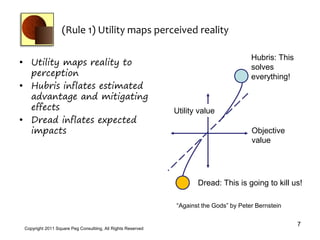
(Rule 1) Utility maps perceived reality


• Utility maps reality to
                                                                                        Hubris: This
                                                                                        solves
  perception                                                                            everything!
• Hubris inflates estimated
  advantage and mitigating
  effects                                                     Utility value
• Dread inflates expected
  impacts                                                                               Objective
                                                                                        value


                                                                     Dread: This is going to kill us!

                                                              “Against the Gods” by Peter Bernstein

                                                                                                       7
 Copyright 2011 Square Peg Consultiing, All Rights Reserved
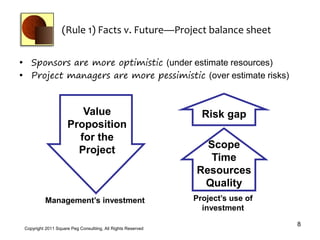
(Rule 1) Facts v. Future—Project balance sheet


• Sponsors are more optimistic (under estimate resources)
• Project managers are more pessimistic (over estimate risks)


                        Value                                   Risk gap
                     Proposition
                       for the
                       Project                                  Scope
                                                                 Time
                                                              Resources
                                                               Quality
           Management’s investment                            Project’s use of
                                                                investment
                                                                                 8
 Copyright 2011 Square Peg Consultiing, All Rights Reserved
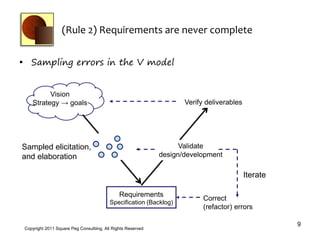
(Rule 2) Requirements are never complete


• Sampling errors in the V model


          Vision
    Strategy → goals                                                 Verify deliverables


Sampled elicitation,                                                Validate
and elaboration                                               design/development

                                                                                           Iterate

                                               Requirements
                                                                           Correct
                                          Specification (Backlog)
                                                                           (refactor) errors

                                                                                                     9
 Copyright 2011 Square Peg Consultiing, All Rights Reserved
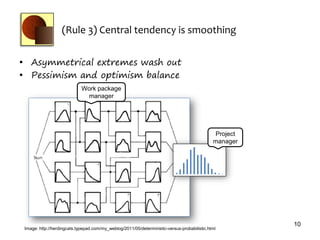
(Rule 3) Central tendency is smoothing


• Asymmetrical extremes wash out
• Pessimism and optimism balance
                             Work package
                              manager


                                                                                              Project
                                                                                              manager


                                                                                                        10
 Image: http://herdingcats.typepad.com/my_weblog/2011/05/deterministic-versus-probabilistic.html
 Copyright 2011 Square Peg Consultiing, All Rights Reserved
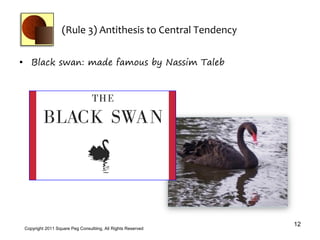
(Rule 3) Antithesis to Central Tendency


• Black swan: made famous by Nassim Taleb


                                                              12
 Copyright 2011 Square Peg Consultiing, All Rights Reserved
(Rule 3) Extreme impact events


• 3 rules of Black swans
      1. An outlier, beyond realm of reasonable expectation, with
         nothing in the past to convincingly point to its possibility
      2. Carries an extreme impact
      3. After the fact, it’s “explainable” and “predictable”

• 1% doctrine*
      – If the impact is extreme, no matter it’s probability, consider
        the event a certainty


* Ron Suskind: “The One Percent Doctrine”

                                                                         13
 Copyright 2011 Square Peg Consultiing, All Rights Reserved
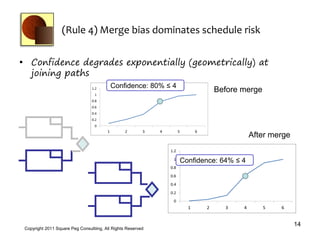
(Rule 4) Merge bias dominates schedule risk


• Confidence degrades exponentially (geometrically) at
  joining paths
                                          Confidence: 80% ≤ 4
                                                                         Before merge


                                                                                      After merge


                                                                Confidence: 64% ≤ 4


                                                                                                    14
 Copyright 2011 Square Peg Consultiing, All Rights Reserved
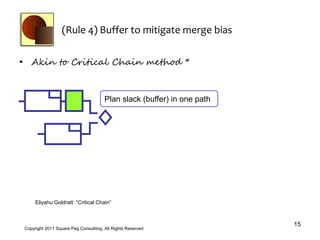
(Rule 4) Buffer to mitigate merge bias

• Akin to Critical Chain method *


                                       Plan slack (buffer) in one path


      Eliyahu Goldratt: “Critical Chain”


                                                                         15
 Copyright 2011 Square Peg Consultiing, All Rights Reserved
Rule 5: It often takes a model


• Probabilistic risk analysis (PRA) of large number of
  conjunctive constituents may be meaningless (everything
  has to work = success)

• Model behavior, failures, and safety
      – Confirming (prediction & control)*
      – Exploratory (insight & understanding)*


 *Steve Phelan, The Interaction of complexity and management

                                                               16
 Copyright 2011 Square Peg Consultiing, All Rights Reserved
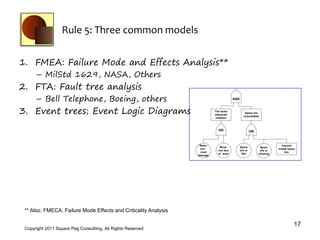
Rule 5: Three common models


1. FMEA: Failure Mode and Effects Analysis**
      – MilStd 1629, NASA, Others
2. FTA: Fault tree analysis
      – Bell Telephone, Boeing, others
3. Event trees; Event Logic Diagrams


 ** Also: FMECA, Failure Mode Effects and Criticality Analysis

                                                                 17
 Copyright 2011 Square Peg Consultiing, All Rights Reserved
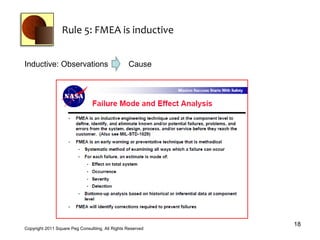
Rule 5: FMEA is inductive


Inductive: Observations                           Cause


                                                             18
Copyright 2011 Square Peg Consultiing, All Rights Reserved
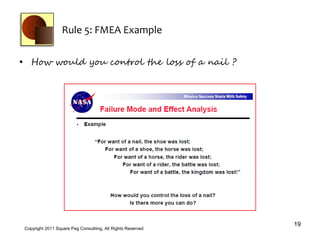
Rule 5: FMEA Example

• How would you control the loss of a nail ?


                                                              19
 Copyright 2011 Square Peg Consultiing, All Rights Reserved
The author of this seminar

John C Goodpasture, PMP
Program manager, author, coach,
and instructor
•       PMI eSeminarsWorldsm instructor for
        Advanced Risk Management, and Agile
        Project Management
•       Project coach in Europe, Asia, and the
        United States
Portfolio manager and business unit
leader
•       Operations and IT professional
•       System engineer in the Department of
        Defense and the aerospace industry


          info@sqpegconsulting.com
             johngoodpasture.com

                                                                 20
    Copyright 2011 Square Peg Consultiing, All Rights Reserved
Read more …..


•      “PMBOK Risk Management Practice Standard”

•      “Black Swan” by Nassim Taleb
•      “Against the Gods” by Peter Bernstein
•      “Judgments under Uncertainty” by Amos Tversky and Daniel Kahneman
•      Probability and statistics online: Khan Academy videos (khanacademy.org)


•      Schedule risk analysis by David Hulett (projectrisk.com)
•      FMEA NASA Practice Standard, DoD MilStd 1629
•      Project balance sheet (http://www.slideshare.net/jgoodpas/the-project-balance-sheet)
•      “The Flaw of Averages” by Sam Savage


                                                                                              21
    Copyright 2011 Square Peg Consultiing, All Rights Reserved
All done and ready for questions!


                                                             22
Copyright 2011 Square Peg Consultiing, All Rights Reserved

Five risk management rules for the project manager

  • 1.
    Five rules forrisk management A presentation Produced by Square Peg Consulting, LLC Orlando, Florida www.sqpegconsulting.com 1 Copyright 2011 Square Peg Consultiing, All Rights Reserved
  • 2.
    What does PMBOKsay about risk management? • Risk: Events or conditions with uncertain potential to impact project objectives • Risk management: Actions to minimize unfavorable impacts or maximize favorable possibilities 2 Copyright 2011 Square Peg Consultiing, All Rights Reserved
  • 3.
    More than Chapter11; More than the risk register • I want to forecast a risk (Chapter 11) • I want to take a risk (Decision policy and risk-adjusted process) • I want to be confident (Risk adjusted estimating paradigms) • I want to test my hypothesis (Risk adjusted reasoning paradigms) 3 Copyright 2011 Square Peg Consultiing, All Rights Reserved
  • 4.
    Where’s the risk? •In the baseline: work estimates, project architecture, product architecture • Off the baseline: risk register possibilities • In the ether: stakeholders, regulators, users, customers • Friends and neighbors: portfolio and program dependencies • Among opportunities: Do this, or perhaps that …. • After it’s over: post-project adoption & support 4 Copyright 2011 Square Peg Consultiing, All Rights Reserved
  • 5.
    5 Rules: Beginwith the end in mind 1. There are no facts about the future: Facts are in the past; estimates, biases, and perception are the future 2. Requirements (and tests) are never complete: No one can imagine everything 3. Central tendency rules the metrics: Optimism and pessimism find a balance 4. Merge bias dominates schedule risk: Confidence takes a hit when paths, work streams, or projects join 5. If it’s mission critical, it often takes a model: PRA isn’t for everything 5 Copyright 2011 Square Peg Consultiing, All Rights Reserved
  • 6.
    (Rule 1) There’sno objective estimate • Adjustment and Anchor bias: – Initial value sets anchor (Boss to Dilbert: I think it oughta cost …. ) – Anchor limits adjustment • Representative bias: – A is part of B, B caused by A, A will cause B – Because there’s progress now, there will be progress when ….. • Availability: – Imaginable, retrievable comparisons, easily recalled – This is just like …… Amos Tversky and Daniel Kahneman: “Judgments under Uncertainty” 6 Copyright 2011 Square Peg Consultiing, All Rights Reserved
  • 7.
    (Rule 1) Utilitymaps perceived reality • Utility maps reality to Hubris: This solves perception everything! • Hubris inflates estimated advantage and mitigating effects Utility value • Dread inflates expected impacts Objective value Dread: This is going to kill us! “Against the Gods” by Peter Bernstein 7 Copyright 2011 Square Peg Consultiing, All Rights Reserved
  • 8.
    (Rule 1) Factsv. Future—Project balance sheet • Sponsors are more optimistic (under estimate resources) • Project managers are more pessimistic (over estimate risks) Value Risk gap Proposition for the Project Scope Time Resources Quality Management’s investment Project’s use of investment 8 Copyright 2011 Square Peg Consultiing, All Rights Reserved
  • 9.
    (Rule 2) Requirementsare never complete • Sampling errors in the V model Vision Strategy → goals Verify deliverables Sampled elicitation, Validate and elaboration design/development Iterate Requirements Correct Specification (Backlog) (refactor) errors 9 Copyright 2011 Square Peg Consultiing, All Rights Reserved
  • 10.
    (Rule 3) Centraltendency is smoothing • Asymmetrical extremes wash out • Pessimism and optimism balance Work package manager Project manager 10 Image: http://herdingcats.typepad.com/my_weblog/2011/05/deterministic-versus-probabilistic.html Copyright 2011 Square Peg Consultiing, All Rights Reserved
  • 11.
    (Rule 3) Antithesisto Central Tendency • Black swan: made famous by Nassim Taleb 12 Copyright 2011 Square Peg Consultiing, All Rights Reserved
  • 12.
    (Rule 3) Extremeimpact events • 3 rules of Black swans 1. An outlier, beyond realm of reasonable expectation, with nothing in the past to convincingly point to its possibility 2. Carries an extreme impact 3. After the fact, it’s “explainable” and “predictable” • 1% doctrine* – If the impact is extreme, no matter it’s probability, consider the event a certainty * Ron Suskind: “The One Percent Doctrine” 13 Copyright 2011 Square Peg Consultiing, All Rights Reserved
  • 13.
    (Rule 4) Mergebias dominates schedule risk • Confidence degrades exponentially (geometrically) at joining paths Confidence: 80% ≤ 4 Before merge After merge Confidence: 64% ≤ 4 14 Copyright 2011 Square Peg Consultiing, All Rights Reserved
  • 14.
    (Rule 4) Bufferto mitigate merge bias • Akin to Critical Chain method * Plan slack (buffer) in one path Eliyahu Goldratt: “Critical Chain” 15 Copyright 2011 Square Peg Consultiing, All Rights Reserved
  • 15.
    Rule 5: Itoften takes a model • Probabilistic risk analysis (PRA) of large number of conjunctive constituents may be meaningless (everything has to work = success) • Model behavior, failures, and safety – Confirming (prediction & control)* – Exploratory (insight & understanding)* *Steve Phelan, The Interaction of complexity and management 16 Copyright 2011 Square Peg Consultiing, All Rights Reserved
  • 16.
    Rule 5: Threecommon models 1. FMEA: Failure Mode and Effects Analysis** – MilStd 1629, NASA, Others 2. FTA: Fault tree analysis – Bell Telephone, Boeing, others 3. Event trees; Event Logic Diagrams ** Also: FMECA, Failure Mode Effects and Criticality Analysis 17 Copyright 2011 Square Peg Consultiing, All Rights Reserved
  • 17.
    Rule 5: FMEAis inductive Inductive: Observations Cause 18 Copyright 2011 Square Peg Consultiing, All Rights Reserved
  • 18.
    Rule 5: FMEAExample • How would you control the loss of a nail ? 19 Copyright 2011 Square Peg Consultiing, All Rights Reserved
  • 19.
    The author ofthis seminar John C Goodpasture, PMP Program manager, author, coach, and instructor • PMI eSeminarsWorldsm instructor for Advanced Risk Management, and Agile Project Management • Project coach in Europe, Asia, and the United States Portfolio manager and business unit leader • Operations and IT professional • System engineer in the Department of Defense and the aerospace industry info@sqpegconsulting.com johngoodpasture.com 20 Copyright 2011 Square Peg Consultiing, All Rights Reserved
  • 20.
    Read more ….. • “PMBOK Risk Management Practice Standard” • “Black Swan” by Nassim Taleb • “Against the Gods” by Peter Bernstein • “Judgments under Uncertainty” by Amos Tversky and Daniel Kahneman • Probability and statistics online: Khan Academy videos (khanacademy.org) • Schedule risk analysis by David Hulett (projectrisk.com) • FMEA NASA Practice Standard, DoD MilStd 1629 • Project balance sheet (http://www.slideshare.net/jgoodpas/the-project-balance-sheet) • “The Flaw of Averages” by Sam Savage 21 Copyright 2011 Square Peg Consultiing, All Rights Reserved
  • 21.
    All done andready for questions! 22 Copyright 2011 Square Peg Consultiing, All Rights Reserved