Unit 2 A
WHY PROPOSE?


    • Creating Presence (Evoke the need or
      problem in a concrete and memorable
                      way.)

   • Appealing to the interest and values of
     decision makers (Show how the need or
       problem affects the larger society or
       group in general and the audience in
                   particular.)

     * Overcoming inherent conservatism
          * Predicting consequences
         * Evaluating consequences
KEY FEATURES OF A PROPOSAL


 * A well defined problem
   * A proposed solution is
       o action-oriented
       o focused on the future
       o a convincing argument
       o a solution to the problem
       o feasible
       o easily implemented
       o able to stand up to anticipated objections and
reservations
       o better than alternative(s)
   * A reasonable tone
   * Completely audience-centered (as should all of the
above)
QUESTIONS THAT PROPOSALS
                       ANSWER


              # Statement of the Problem

* What problem or problems will the proposal project address
                  or attempt to solve?
          * In other words, what is the felt need?
QUESTIONS THAT PROPOSALS
                         ANSWER


     # Analysis of the Audience

   * Who will benefit from the proposed
                   work?
    * Who will review the proposal and
         either accept or reject it?
     * Are the groups who will benefit
 from the proposed work and who will
 accept or reject the proposal the same?
     * If the groups are different, what
relationship do they have to each other?
QUESTIONS THAT PROPOSALS
                         ANSWER


# Statement of the Objectives

 * What are the objectives of the
       work proposed?
      * What are the goals?
  * What specifically will result if
the work is done in the way it is
           proposed?
QUESTIONS THAT PROPOSALS
                     ANSWER


   # Review of the Literature and Previous Work

  * What previous work has been done in the area of the
                     problem?
* How does the problem fit into the larger context of work
                  done in the area?
QUESTIONS THAT PROPOSALS
                      ANSWER


           # Methods for Doing the Work

              * How will the work be done?
* What methods will be used to solve or address the problem
        and to achieve the objectives as defined?
QUESTIONS THAT PROPOSALS
            ANSWER


            # Personnel

       * Who will do the work?
* How are they qualified to do the work?
QUESTIONS THAT PROPOSALS
             ANSWER


Expected Results and Evaluation Plan

     * What results can be expected?
   * How will the results be evaluated?
GENERAL PROPOSAL FORMAT


             # Statement of the Problem
           # Statement of the Objectives
# (Review of Literature and Previous Work/ History &
                      Solutions)
    # Methods and Rationale for Doing the Work
                   # Focus/ Scope
     # Restatement of Importance of topic/issue
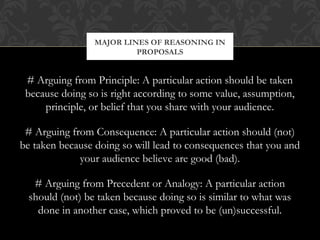
MAJOR LINES OF REASONING IN
                          PROPOSALS


 # Arguing from Principle: A particular action should be taken
 because doing so is right according to some value, assumption,
     principle, or belief that you share with your audience.

 # Arguing from Consequence: A particular action should (not)
be taken because doing so will lead to consequences that you and
             your audience believe are good (bad).

   # Arguing from Precedent or Analogy: A particular action
  should (not) be taken because doing so is similar to what was
    done in another case, which proved to be (un)successful.
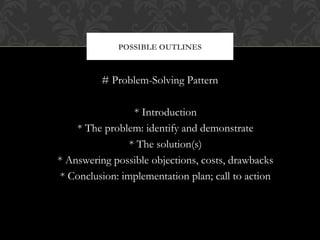
POSSIBLE OUTLINES


          # Problem-Solving Pattern

                  * Introduction
    * The problem: identify and demonstrate
                 * The solution(s)
* Answering possible objections, costs, drawbacks
 * Conclusion: implementation plan; call to action
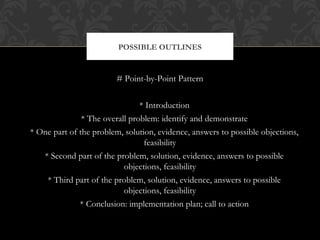
POSSIBLE OUTLINES


                         # Point-by-Point Pattern


                                * Introduction
               * The overall problem: identify and demonstrate
* One part of the problem, solution, evidence, answers to possible objections,
                                 feasibility
   * Second part of the problem, solution, evidence, answers to possible
                           objections, feasibility
    * Third part of the problem, solution, evidence, answers to possible
                           objections, feasibility
              * Conclusion: implementation plan; call to action
POSSIBLE OUTLINES


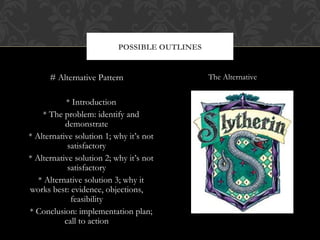
      # Alternative Pattern                    The Alternative


           * Introduction
    * The problem: identify and
           demonstrate
* Alternative solution 1; why it’s not
            satisfactory
* Alternative solution 2; why it’s not
            satisfactory
   * Alternative solution 3; why it
works best: evidence, objections,
             feasibility
* Conclusion: implementation plan;
           call to action
POSSIBLE OUTLINES


                             Step-by-Step Pattern

                                  * Introduction
                     * The problem: identify and demonstrate
   * Plan for implementing the solution or how solution has worked in the past:
 * Step one: reasons and evidence showing why this step is necessary and feasible
 * Step two: reasons and evidence showing why this step is necessary and feasible
* Step three: reasons and evidence showing why this step is necessary and feasible
                 * Conclusion: implementation plan; call to action
INVENTION/ FOCUSING
                                QUESTIONS


                     Invention Questions to Analyze Problems

                     * Does the problem really exist? How can I tell?
     * What caused this problem? Can I identify any immediate causes? Any deeper
  causes? Is the problem caused by a flaw in the system, lack of resources, individual
                    misconduct or incompetence? How can I tell?
    * What is the history of the problem? Why hasn’t the problem been solved up to
                                       this point?
      * What are the bad effects of the problem? How is it hurting members of the
community or group? What goals of the group are endangered by the existence of this
                 problem? Does it raise any moral or ethical questions?
     * Who in the community or group is affected by the problem? Be as specific as
  possible: Who is seriously affected? Minimally affected? Unaffected? Does anyone
                               benefit from its existence?
       * What similar problems exist in this same community or group? How can I
                         distinguish my problem from these?
INVENTION/FOCUSING
                           QUESTIONS


          Invention Questions to Analyze the Proposal Audience


 * Who will review the proposal? Who will make the decision about accepting
                          or rejecting the proposal?
     * Are the reviewers specialists or do they have a general knowledge?
           * What are the interests of the audience in the proposal?
                 * How will the proposal benefit the audience?
            * How well does the audience understand the problem?
   * What constraints will influence the audience’s response to the proposal?
(Consider time, money, competing projects, limits of facilities or equipment,
      limits in the type of project that the audience will support, etc.)
INVENTION/FOCUSING
                             QUESTIONS


               Invention Questions to Find a Tentative Solution

                * What solutions to this problem have already been tried?
 * What solutions have been proposed for related problems? Might they solve this
                                    problem as well?
 * Is a solution required that would disband or change the community or group in
                                        some way?
         * What solution would eliminate some of the causes of the problem?
       * What solution would eliminate any of the bad effects of the problem?
 * Maybe the problem is too big to be solved all at once. Try dividing into several
                     parts. What solutions might solve these parts?
        * If a series of solutions is required, which should come first? Second?
                  * What solution would ultimately solve the problem?
* What might be a daring solution? What would be the most conservative solution,
              acceptable to nearly everyone in the community or group?
INVENTION/FOCUSING
                           QUESTIONS


  Questions to Develop a Refutation Section for a Proposal Argument


           * Is there really a problem here that needs to be solved?
            * Will the proposed solution really solve this problem?
* Can the problem be solved more simply without disturbing the status quo?
* Is the proposed solution really practical? Does it stand a chance of actually
                                being enacted?
  * What will be the unforeseen positive and negative consequences of the
                                   proposal?
REMEMBER


                       Your proposal should:
-Demonstrate the worthiness and relevancy of your chosen topic
                        -Take a clear position
                            -Define terms
                    -Define your future audience
                 -Identify and explain the problem
                  -Explore currency, past solutions
            -Make clear why you are writing this paper
  -Use at least three sources from your annotated bibliography
                              -Be logical
             - Interest the reader (academic audience)
REMEMBER

Proposal Essay Presentation

  • 1.
  • 2.
    WHY PROPOSE? • Creating Presence (Evoke the need or problem in a concrete and memorable way.) • Appealing to the interest and values of decision makers (Show how the need or problem affects the larger society or group in general and the audience in particular.) * Overcoming inherent conservatism * Predicting consequences * Evaluating consequences
  • 3.
    KEY FEATURES OFA PROPOSAL * A well defined problem * A proposed solution is o action-oriented o focused on the future o a convincing argument o a solution to the problem o feasible o easily implemented o able to stand up to anticipated objections and reservations o better than alternative(s) * A reasonable tone * Completely audience-centered (as should all of the above)
  • 4.
    QUESTIONS THAT PROPOSALS ANSWER # Statement of the Problem * What problem or problems will the proposal project address or attempt to solve? * In other words, what is the felt need?
  • 5.
    QUESTIONS THAT PROPOSALS ANSWER # Analysis of the Audience * Who will benefit from the proposed work? * Who will review the proposal and either accept or reject it? * Are the groups who will benefit from the proposed work and who will accept or reject the proposal the same? * If the groups are different, what relationship do they have to each other?
  • 6.
    QUESTIONS THAT PROPOSALS ANSWER # Statement of the Objectives * What are the objectives of the work proposed? * What are the goals? * What specifically will result if the work is done in the way it is proposed?
  • 7.
    QUESTIONS THAT PROPOSALS ANSWER # Review of the Literature and Previous Work * What previous work has been done in the area of the problem? * How does the problem fit into the larger context of work done in the area?
  • 8.
    QUESTIONS THAT PROPOSALS ANSWER # Methods for Doing the Work * How will the work be done? * What methods will be used to solve or address the problem and to achieve the objectives as defined?
  • 9.
    QUESTIONS THAT PROPOSALS ANSWER # Personnel * Who will do the work? * How are they qualified to do the work?
  • 10.
    QUESTIONS THAT PROPOSALS ANSWER Expected Results and Evaluation Plan * What results can be expected? * How will the results be evaluated?
  • 11.
    GENERAL PROPOSAL FORMAT # Statement of the Problem # Statement of the Objectives # (Review of Literature and Previous Work/ History & Solutions) # Methods and Rationale for Doing the Work # Focus/ Scope # Restatement of Importance of topic/issue
  • 12.
    MAJOR LINES OFREASONING IN PROPOSALS # Arguing from Principle: A particular action should be taken because doing so is right according to some value, assumption, principle, or belief that you share with your audience. # Arguing from Consequence: A particular action should (not) be taken because doing so will lead to consequences that you and your audience believe are good (bad). # Arguing from Precedent or Analogy: A particular action should (not) be taken because doing so is similar to what was done in another case, which proved to be (un)successful.
  • 13.
    POSSIBLE OUTLINES # Problem-Solving Pattern * Introduction * The problem: identify and demonstrate * The solution(s) * Answering possible objections, costs, drawbacks * Conclusion: implementation plan; call to action
  • 14.
    POSSIBLE OUTLINES # Point-by-Point Pattern * Introduction * The overall problem: identify and demonstrate * One part of the problem, solution, evidence, answers to possible objections, feasibility * Second part of the problem, solution, evidence, answers to possible objections, feasibility * Third part of the problem, solution, evidence, answers to possible objections, feasibility * Conclusion: implementation plan; call to action
  • 15.
    POSSIBLE OUTLINES # Alternative Pattern The Alternative * Introduction * The problem: identify and demonstrate * Alternative solution 1; why it’s not satisfactory * Alternative solution 2; why it’s not satisfactory * Alternative solution 3; why it works best: evidence, objections, feasibility * Conclusion: implementation plan; call to action
  • 16.
    POSSIBLE OUTLINES Step-by-Step Pattern * Introduction * The problem: identify and demonstrate * Plan for implementing the solution or how solution has worked in the past: * Step one: reasons and evidence showing why this step is necessary and feasible * Step two: reasons and evidence showing why this step is necessary and feasible * Step three: reasons and evidence showing why this step is necessary and feasible * Conclusion: implementation plan; call to action
  • 17.
    INVENTION/ FOCUSING QUESTIONS Invention Questions to Analyze Problems * Does the problem really exist? How can I tell? * What caused this problem? Can I identify any immediate causes? Any deeper causes? Is the problem caused by a flaw in the system, lack of resources, individual misconduct or incompetence? How can I tell? * What is the history of the problem? Why hasn’t the problem been solved up to this point? * What are the bad effects of the problem? How is it hurting members of the community or group? What goals of the group are endangered by the existence of this problem? Does it raise any moral or ethical questions? * Who in the community or group is affected by the problem? Be as specific as possible: Who is seriously affected? Minimally affected? Unaffected? Does anyone benefit from its existence? * What similar problems exist in this same community or group? How can I distinguish my problem from these?
  • 18.
    INVENTION/FOCUSING QUESTIONS Invention Questions to Analyze the Proposal Audience * Who will review the proposal? Who will make the decision about accepting or rejecting the proposal? * Are the reviewers specialists or do they have a general knowledge? * What are the interests of the audience in the proposal? * How will the proposal benefit the audience? * How well does the audience understand the problem? * What constraints will influence the audience’s response to the proposal? (Consider time, money, competing projects, limits of facilities or equipment, limits in the type of project that the audience will support, etc.)
  • 19.
    INVENTION/FOCUSING QUESTIONS Invention Questions to Find a Tentative Solution * What solutions to this problem have already been tried? * What solutions have been proposed for related problems? Might they solve this problem as well? * Is a solution required that would disband or change the community or group in some way? * What solution would eliminate some of the causes of the problem? * What solution would eliminate any of the bad effects of the problem? * Maybe the problem is too big to be solved all at once. Try dividing into several parts. What solutions might solve these parts? * If a series of solutions is required, which should come first? Second? * What solution would ultimately solve the problem? * What might be a daring solution? What would be the most conservative solution, acceptable to nearly everyone in the community or group?
  • 20.
    INVENTION/FOCUSING QUESTIONS Questions to Develop a Refutation Section for a Proposal Argument * Is there really a problem here that needs to be solved? * Will the proposed solution really solve this problem? * Can the problem be solved more simply without disturbing the status quo? * Is the proposed solution really practical? Does it stand a chance of actually being enacted? * What will be the unforeseen positive and negative consequences of the proposal?
  • 21.
    REMEMBER Your proposal should: -Demonstrate the worthiness and relevancy of your chosen topic -Take a clear position -Define terms -Define your future audience -Identify and explain the problem -Explore currency, past solutions -Make clear why you are writing this paper -Use at least three sources from your annotated bibliography -Be logical - Interest the reader (academic audience)
  • 22.