Product and Services
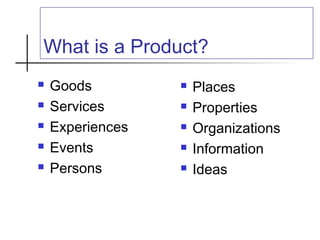
What is a Product?
 Goods
 Services
 Experiences
 Events
 Persons
 Places
 Properties
 Organizations
 Information
 Ideas
What Is a Product?
Products, Services, and Experiences
Product is anything that can be offered in a
market for attention, acquisition, use, or
consumption that might satisfy a need or
want
• Soap
• Toothpaste
8-4
What Is a Product?
Product and Service Classifications
• Consumer products
• Industrial products
8-9
What Is a Product?
Product and Service Classifications
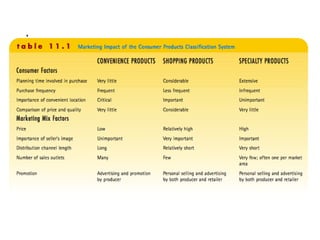
Consumer products are products and
services for personal consumption
• Classified by how consumers buy them
• Convenience product
• Shopping products
• Specialty products
• Unsought products
8-10
What Is a Product?
Product and Service Classifications
Convenience products are consumer
products and services that the customer
usually buys frequently, immediately, and
with a minimum comparison and buying
effort
• Newspapers
• Candy
• Fast food
8-11
What Is a Product?
Product and Service Classifications
Shopping products are consumer products
and services that the customer compares
carefully on suitability, quality, price, and
style
• Furniture
• Cars
• Appliances
8-12
What Is a Product?
Product and Service Classifications
Specialty products are consumer products and
services with unique characteristics or brand
identification for which a significant group of buyers
is willing to make a special purchase effort
• Medical services
• Designer clothes
• High-end electronics
8-13
What Is a Product?
Product and Service Classifications
Unsought products are consumer products
that the consumer does not know about or
knows about but does not normally think of
buying
• Life insurance
• Funeral services
• Blood donations
8-14
What Is a Product?
Product and Service Classifications
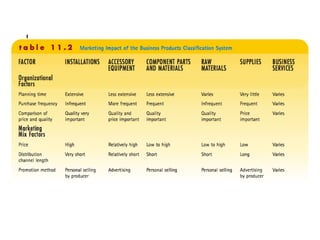
Industrial products are products purchased for
further processing or for use in conducting a
business
Classified by the purpose for which the product is
purchased
• Raw Materials and parts
• Capital
• Supplies and services
8-15
What Is a Product?
Product and Service Classifications
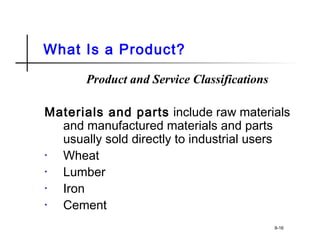
Materials and parts include raw materials
and manufactured materials and parts
usually sold directly to industrial users
• Wheat
• Lumber
• Iron
• Cement
8-16
What Is a Product?
Product and Service Classifications
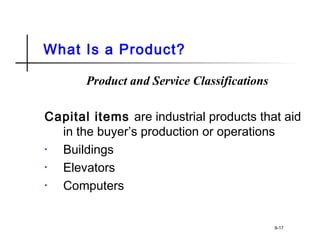
Capital items are industrial products that aid
in the buyer’s production or operations
• Buildings
• Elevators
• Computers
8-17
What Is a Product?
Organization marketing consists of
activities undertaken to create, maintain, or
change attitudes and behavior of target
consumers toward an organization
8-18
Organizations, Persons, Places, and Ideas
What Is a Product?
Person marketing consists of activities
undertaken to create, maintain, or
change attitudes and behavior of target
consumers toward particular people
• Rakhi’s swayamwar
8-19
Organizations, Persons, Places, and Ideas
What Is a Product?
Organizations, Persons, Places, and Ideas
Place marketing consists of activities
undertaken to create, maintain, or change
attitudes and behavior of target consumers
toward particular places
• Tourism
8-20
What Is a Product?
Organizations, Persons, Places, and Ideas
Social marketing is the use of commercial
marketing concepts and tools in programs
designed to influence individuals’ behavior
to improve their well-being and that of
society
• Public health campaign
• Tourism
8-21
What Is a Product?
Experiences represent what buying the product
or service will do for the customer
• Treasure Land
• Disney land
8-6
Products, Services, and Experiences
What Is a Product?
Products, Services, and Experiences
Service is a form of product that consists of
activities, benefits, or satisfactions offered
for sale that are essentially intangible and do
not result in ownership
• Doctor’s exam
• Legal advice
8-5
The Product and Product Mix
 Potential customers judge product
offerings according to three elements:
 Product features and quality
 Services mix and quality
 Value-based prices
The Product and Product Mix
 The customer value hierarchy:
 Core benefit
 Basic product
 Expected product
 Augmented product
 Potential product
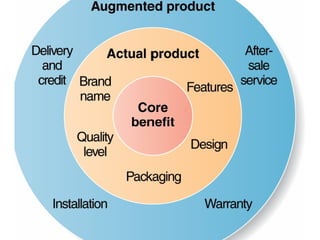
What Is a Product?
• Core benefits
• Actual product
• Augmented product
8-7
Levels of Product and Services
What Is a Product?
Levels of Product and Services
Core benefits represent what the buyer is really
buying
Actual product represents the design, brand name,
and packaging that delivers the core benefit to the
customer
Augmented product represents additional services or
benefits of the actual product
8-8
Product and Service Decisions
Product Mix Decisions
Product mix consists of all the products and
items that a particular seller offers for sale
• Width
• Length
• Depth
• Consistency
8-39
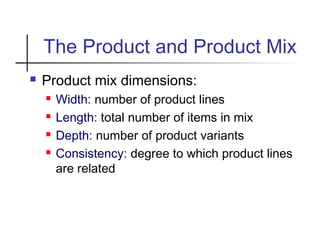
The Product and Product Mix
 Product mix dimensions:
 Width: number of product lines
 Length: total number of items in mix
 Depth: number of product variants
 Consistency: degree to which product lines
are related
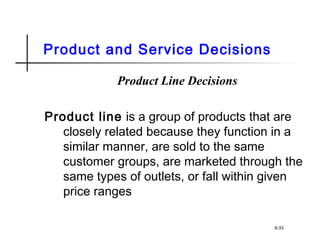
Product and Service Decisions
Product Line Decisions
Product line is a group of products that are
closely related because they function in a
similar manner, are sold to the same
customer groups, are marketed through the
same types of outlets, or fall within given
price ranges
8-33
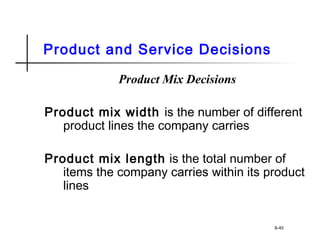
Product and Service Decisions
Product Mix Decisions
Product mix width is the number of different
product lines the company carries
Product mix length is the total number of
items the company carries within its product
lines
8-40
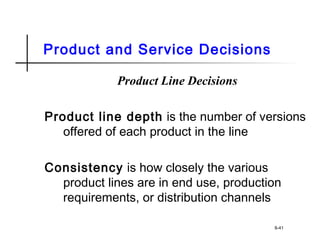
Product and Service Decisions
Product Line Decisions
Product line depth is the number of versions
offered of each product in the line
Consistency is how closely the various
product lines are in end use, production
requirements, or distribution channels
8-41
Product and Service Decisions
Product Line Decisions
Product line length is the number of items in
the product line
• Line stretching
• Line filling
• Line pruning
8-34
Line stretching
 Down mkt stretch
 Up mkt stretch
 Two way stretch / combination line
stretching
Product and Service Decisions
Product Line Decisions
Combination line stretching is used by
companies in the middle range of the market
to achieve both goals of upward and
downward line stretching
8-37
Product and Service Decisions
Product Line Decisions
Product line filling occurs when companies
add more items within the present range of
the line
• More profits
• Satisfying dealers
• Excess capacity
• Plugging holes to fend off competitors
8-38
Product and Service Decisions
Brand is the name, term, sign, or design, or
a combination of these, that identifies the
maker or seller of a product or service
8-29
Individual Product and Service Decisions
Brand Decisions
 The AMA definition of a brand:
“A name, term, sign, symbol, or design, or a
combination of these, intended to identify
the goods or services of one seller or
group of sellers and to differentiate them
from the competition.”
Branding Strategy:
Building Strong Brands
Brand represents the consumer’s perceptions
and feelings about a product and its
performance. It is the company’s promise to
deliver a specific set of features, benefits,
services, and experiences consistently to
the buyers
8-42
Brand Decisions
 Brands can convey six levels of meaning:
 Attributes
 Benefits
 Values
 Culture
 Personality
 User
Brand Decisions
 Aaker identified five levels of customer
attitudes toward brands:
 Will change brands, especially for price. No brand
loyalty.
 Satisfied -- has no reason to change.
 Satisfied -- switching would incur costs.
 Values brand, sees it as a friend.
 Devoted to the brand.
Brand Decisions
 Brand identity decisions include:
 Name
 Logo
 Colors
 Tagline
 Symbol
 Consumer experiences create brand bonding,
brand advertising does not.
Brand name decision
 Individual name – zen, esteem
 Blanket family name – GE,maruti, tata
 Separate family names- Pantaloons,
Sears, Walmart
 Corporate+individual prod. Name –
Maruti800, honda city
Branding Strategy:
Building Strong Brands
Brand Name Selection
Desirable qualities
• Suggests benefits and qualities
• Easy to pronounce, recognize, and
remember
• Distinctive
• Extendable
• Translatable for the global economy
8-48
Brand Decisions
 Marketers should attempt to create or facilitate
awareness, acceptability, preference, and
loyalty among consumers.
 Valuable and powerful brands enjoy high levels
of brand loyalty.
Branding Strategy:
Building Strong Brands
Brand equity is the positive differential
effect that knowing the brand name has
on customer response to the product or
service
8-43
Brand Decisions
 Brand equity refers to the positive differential
effect that a brand name has on customers.
 Brand equity:
 is related to many factors.
 allows for reduced marketing costs.
 is a major contributor to customer equity.
Branding Strategy:
Building Strong Brands
Customer equity is the value of the customer
relationships that the brand creates
Brand valuation is the process of estimating
the total financial value of the brand
8-45
Brand Decisions
Key Challenges
 To brand or not
 Brand sponsor
 Brand name
 Brand strategy
 Brand repositioning
 Advantages of branding:
 Facilitates order processing
 Trademark protection
 Aids in segmentation
 Enhances corporate image
 Branded goods are desired
by retailers and distributors
Brand Decisions
Key Challenges
 To brand or not
 Brand sponsor
 Brand name
 Brand strategy
 Brand repositioning
 Options include:
 Manufacturer (national)
brand
 Distributor (reseller,
store, house, private)
brand
 Licensing the brand
name
Brand Decisions
Key Challenges
 To brand or not
 Brand sponsor
 Brand name
 Brand strategy
 Brand repositioning
 Strong brand names:
 Suggest benefits
 Suggest product qualities
 Are easy to say, recognize,
and remember
 Are distinctive
 Should not carry poor
meanings in other
languages
Brand Decisions
Key Challenges
 To brand or not
 Brand sponsor
 Brand name
 Brand strategy
 Brand repositioning
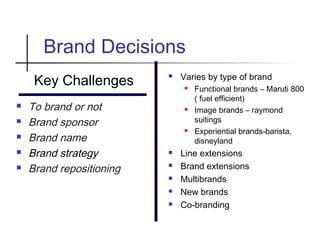
 Varies by type of brand
 Functional brands – Maruti 800
( fuel efficient)
 Image brands – raymond
suitings
 Experiential brands-barista,
disneyland
 Line extensions
 Brand extensions
 Multibrands
 New brands
 Co-branding
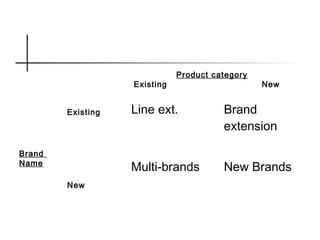
Line ext. Brand
extension
Multi-brands New Brands
Product category
Existing New
Existing
New
Brand
Name
Branding Strategy:
Building Strong Brands
Brand Development
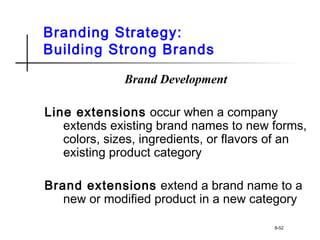
Line extensions occur when a company
extends existing brand names to new forms,
colors, sizes, ingredients, or flavors of an
existing product category
Brand extensions extend a brand name to a
new or modified product in a new category
8-52
Branding Strategy:
Building Strong Brands
Brand Development
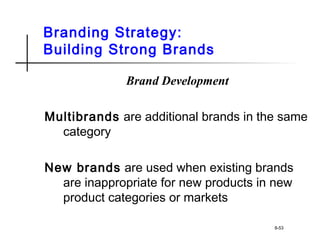
Multibrands are additional brands in the same
category
New brands are used when existing brands
are inappropriate for new products in new
product categories or markets
8-53
Branding Strategy:
Building Strong Brands
Brand Development
• Line extensions e.g: surf excel, excelmatic
• Brand extensions e.g:nature fresh sunflower
oil, fresh flour, honda motorcycle
• Multibrands, e.g:Maruti zen, titan sonata
• New brands
• Co-brands e.g:TATA-IBM, Birla –AT&T etc.
8-51
Brand Decisions
Key Challenges
 To brand or not
 Brand sponsor
 Brand name
 Brand strategy
 Brand repositioning
 A brand report card can
be used to audit a brand’s
strengths and
weaknesses.
 Changes in preferences or
the presence of a new
competitor may indicate a
need for brand
repositioning.
Branding Strategy:
Building Strong Brands
Brand Sponsorship
• Manufacturer’s brand-Merchandise
bearing a manufacturer's brand name,
rather than a private label brand
• Private brand - Product brands owned
by a retailer or a wholesaler rather
than the manufacturer; also called
house brands. 8-49
Branding Strategy:
Building Strong Brands
Private brands provide retailers with
advantages
• Product mix control
• Slotting fees for manufacturers’
brands
• Higher margins
• Exclusivity
8-50
Brand Sponsorship
Brand Sponsorship
• Licensed brand - A product or service
using a registered brand name offered
by the brand owner to a licensee for an
agreed fee or royalty.
• Co-branding is a process when two
companies form an alliance to work
together, creating marketing synergy.
Co-branding
 According to Prof.Chang there are three
levels of co-branding:
 Level 1 includes joining with another
company to penetrate the market
 Level 2 is working to extend the brand based
on the company's current market share
 Level 3 tries to achieve a global strategy by
combining the two brands
Types of co-branding
 Ingredient co-branding – This involves
creating brand equity for materials,
components or parts that are contained
within other products. E.g:
 Pillsbury Brownies with Nestle
Chocolate, Dell Computers with Intel
Processors
Types of co-branding
 same-company co-branding This is
when a company with more than one
product promotes their own brands
together simultaneously. E.g;
cosmetics, shampoo+conditioner .
Types of co-branding
 Joint venture co-branding two or
more companies going for a strategic
alliance to present a product to the
target audience. British Airways and
Citibank formed a partnership offering a
credit card where the card owner will
automatically become a member of the
British Airway’s Executive club
Types of co-branding
 multiple sponsor co-branding
involves two or more companies working
together to form a strategic alliance in
technology, promotions, sales, etc. e.g:
Citibank/American Airlines/Visa credit card
partnership
Branding Strategy:
Building Strong Brands
Managing Brands
Requires:
• Continuous brand communication
• Customer-centered training
• Brand audits
8-54
Product and Service Decisions
Individual Product and Service Decisions
Packaging involves designing and producing
the container or wrapper for a product
Label identifies the product or brand, describes
attributes, and provides promotion
8-31
Packaging and Labeling
 Packaging includes:
 The primary package
 The secondary package
 The shipping package
 Many factors have influenced the
increased use of packaging as a
marketing tool.
Packaging and Labeling
 Developing an effective package:
 Determine the packaging concept
 Determine key package elements
 Testing:

Engineering tests

Visual tests

Dealer tests

Consumer tests
Packaging and Labeling
 Labeling functions:
 Identifies the product or brand
 May identify product grade
 May describe the product
 May promote the product
 Legal restrictions impact packaging for
many products.
Services Marketing
Nature and Characteristics of a Service
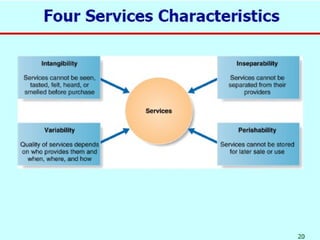
• Intangibility
• Inseparability
• Variability
• Perishability
8-56
Services Marketing
Nature and Characteristics of a Service
Intangibility refers to the fact that services
cannot be seen, tasted, felt, heard, or
smelled before they are purchased
Inseparability refers to the fact that services
cannot be separated from their providers
8-57
Services Marketing
Nature and Characteristics of a Service
Variability refers to the fact that service
quality depends on who provides it as well
as when, where, and how it is provided
Perishability refers to the fact that services
cannot be stored for later sale or use
8-58
Services Marketing
Types of Service Industries
• Government
• Private not-for-profit organizations
• Business services
8-55
Services Marketing
Marketing Strategies for Service Firms
Managing service quality provides a
competitive advantage by delivering
consistently higher quality than its
competitors
Service quality always varies depending on
interactions between employees and
customers
8-64
Services Marketing
Marketing Strategies for Service Firms
Service recovery can turn disappointed
customers into loyal customers
• Empower employees
• Responsibility
• Authority
• Incentive
8-65
Marketing Strategies for Service
Firms
Managing ServiceManaging Service
DifferentiationDifferentiation
 Develop offer, delivery and image with
competitive advantages.
Managing Service QualityManaging Service Quality
 Empower employees
 Become “Customer obsessed”
 Develop high service quality
standards
 Watch service performance
closely
Managing Service ProductivityManaging Service Productivity
 Train current or new employees
 Increase quantity by decreasing
quality
 Utilize technology

Marketing Products & Services

  • 1.
  • 3.
    What is aProduct?  Goods  Services  Experiences  Events  Persons  Places  Properties  Organizations  Information  Ideas
  • 4.
    What Is aProduct? Products, Services, and Experiences Product is anything that can be offered in a market for attention, acquisition, use, or consumption that might satisfy a need or want • Soap • Toothpaste 8-4
  • 5.
    What Is aProduct? Product and Service Classifications • Consumer products • Industrial products 8-9
  • 6.
    What Is aProduct? Product and Service Classifications Consumer products are products and services for personal consumption • Classified by how consumers buy them • Convenience product • Shopping products • Specialty products • Unsought products 8-10
  • 7.
    What Is aProduct? Product and Service Classifications Convenience products are consumer products and services that the customer usually buys frequently, immediately, and with a minimum comparison and buying effort • Newspapers • Candy • Fast food 8-11
  • 8.
    What Is aProduct? Product and Service Classifications Shopping products are consumer products and services that the customer compares carefully on suitability, quality, price, and style • Furniture • Cars • Appliances 8-12
  • 9.
    What Is aProduct? Product and Service Classifications Specialty products are consumer products and services with unique characteristics or brand identification for which a significant group of buyers is willing to make a special purchase effort • Medical services • Designer clothes • High-end electronics 8-13
  • 10.
    What Is aProduct? Product and Service Classifications Unsought products are consumer products that the consumer does not know about or knows about but does not normally think of buying • Life insurance • Funeral services • Blood donations 8-14
  • 11.
    What Is aProduct? Product and Service Classifications Industrial products are products purchased for further processing or for use in conducting a business Classified by the purpose for which the product is purchased • Raw Materials and parts • Capital • Supplies and services 8-15
  • 12.
    What Is aProduct? Product and Service Classifications Materials and parts include raw materials and manufactured materials and parts usually sold directly to industrial users • Wheat • Lumber • Iron • Cement 8-16
  • 13.
    What Is aProduct? Product and Service Classifications Capital items are industrial products that aid in the buyer’s production or operations • Buildings • Elevators • Computers 8-17
  • 16.
    What Is aProduct? Organization marketing consists of activities undertaken to create, maintain, or change attitudes and behavior of target consumers toward an organization 8-18 Organizations, Persons, Places, and Ideas
  • 17.
    What Is aProduct? Person marketing consists of activities undertaken to create, maintain, or change attitudes and behavior of target consumers toward particular people • Rakhi’s swayamwar 8-19 Organizations, Persons, Places, and Ideas
  • 18.
    What Is aProduct? Organizations, Persons, Places, and Ideas Place marketing consists of activities undertaken to create, maintain, or change attitudes and behavior of target consumers toward particular places • Tourism 8-20
  • 19.
    What Is aProduct? Organizations, Persons, Places, and Ideas Social marketing is the use of commercial marketing concepts and tools in programs designed to influence individuals’ behavior to improve their well-being and that of society • Public health campaign • Tourism 8-21
  • 20.
    What Is aProduct? Experiences represent what buying the product or service will do for the customer • Treasure Land • Disney land 8-6 Products, Services, and Experiences
  • 21.
    What Is aProduct? Products, Services, and Experiences Service is a form of product that consists of activities, benefits, or satisfactions offered for sale that are essentially intangible and do not result in ownership • Doctor’s exam • Legal advice 8-5
  • 22.
    The Product andProduct Mix  Potential customers judge product offerings according to three elements:  Product features and quality  Services mix and quality  Value-based prices
  • 23.
    The Product andProduct Mix  The customer value hierarchy:  Core benefit  Basic product  Expected product  Augmented product  Potential product
  • 25.
    What Is aProduct? • Core benefits • Actual product • Augmented product 8-7 Levels of Product and Services
  • 26.
    What Is aProduct? Levels of Product and Services Core benefits represent what the buyer is really buying Actual product represents the design, brand name, and packaging that delivers the core benefit to the customer Augmented product represents additional services or benefits of the actual product 8-8
  • 27.
    Product and ServiceDecisions Product Mix Decisions Product mix consists of all the products and items that a particular seller offers for sale • Width • Length • Depth • Consistency 8-39
  • 28.
    The Product andProduct Mix  Product mix dimensions:  Width: number of product lines  Length: total number of items in mix  Depth: number of product variants  Consistency: degree to which product lines are related
  • 29.
    Product and ServiceDecisions Product Line Decisions Product line is a group of products that are closely related because they function in a similar manner, are sold to the same customer groups, are marketed through the same types of outlets, or fall within given price ranges 8-33
  • 30.
    Product and ServiceDecisions Product Mix Decisions Product mix width is the number of different product lines the company carries Product mix length is the total number of items the company carries within its product lines 8-40
  • 31.
    Product and ServiceDecisions Product Line Decisions Product line depth is the number of versions offered of each product in the line Consistency is how closely the various product lines are in end use, production requirements, or distribution channels 8-41
  • 32.
    Product and ServiceDecisions Product Line Decisions Product line length is the number of items in the product line • Line stretching • Line filling • Line pruning 8-34
  • 33.
    Line stretching  Downmkt stretch  Up mkt stretch  Two way stretch / combination line stretching
  • 34.
    Product and ServiceDecisions Product Line Decisions Combination line stretching is used by companies in the middle range of the market to achieve both goals of upward and downward line stretching 8-37
  • 35.
    Product and ServiceDecisions Product Line Decisions Product line filling occurs when companies add more items within the present range of the line • More profits • Satisfying dealers • Excess capacity • Plugging holes to fend off competitors 8-38
  • 36.
    Product and ServiceDecisions Brand is the name, term, sign, or design, or a combination of these, that identifies the maker or seller of a product or service 8-29 Individual Product and Service Decisions
  • 37.
    Brand Decisions  TheAMA definition of a brand: “A name, term, sign, symbol, or design, or a combination of these, intended to identify the goods or services of one seller or group of sellers and to differentiate them from the competition.”
  • 38.
    Branding Strategy: Building StrongBrands Brand represents the consumer’s perceptions and feelings about a product and its performance. It is the company’s promise to deliver a specific set of features, benefits, services, and experiences consistently to the buyers 8-42
  • 39.
    Brand Decisions  Brandscan convey six levels of meaning:  Attributes  Benefits  Values  Culture  Personality  User
  • 40.
    Brand Decisions  Aakeridentified five levels of customer attitudes toward brands:  Will change brands, especially for price. No brand loyalty.  Satisfied -- has no reason to change.  Satisfied -- switching would incur costs.  Values brand, sees it as a friend.  Devoted to the brand.
  • 41.
    Brand Decisions  Brandidentity decisions include:  Name  Logo  Colors  Tagline  Symbol  Consumer experiences create brand bonding, brand advertising does not.
  • 42.
    Brand name decision Individual name – zen, esteem  Blanket family name – GE,maruti, tata  Separate family names- Pantaloons, Sears, Walmart  Corporate+individual prod. Name – Maruti800, honda city
  • 43.
    Branding Strategy: Building StrongBrands Brand Name Selection Desirable qualities • Suggests benefits and qualities • Easy to pronounce, recognize, and remember • Distinctive • Extendable • Translatable for the global economy 8-48
  • 44.
    Brand Decisions  Marketersshould attempt to create or facilitate awareness, acceptability, preference, and loyalty among consumers.  Valuable and powerful brands enjoy high levels of brand loyalty.
  • 45.
    Branding Strategy: Building StrongBrands Brand equity is the positive differential effect that knowing the brand name has on customer response to the product or service 8-43
  • 46.
    Brand Decisions  Brandequity refers to the positive differential effect that a brand name has on customers.  Brand equity:  is related to many factors.  allows for reduced marketing costs.  is a major contributor to customer equity.
  • 47.
    Branding Strategy: Building StrongBrands Customer equity is the value of the customer relationships that the brand creates Brand valuation is the process of estimating the total financial value of the brand 8-45
  • 48.
    Brand Decisions Key Challenges To brand or not  Brand sponsor  Brand name  Brand strategy  Brand repositioning  Advantages of branding:  Facilitates order processing  Trademark protection  Aids in segmentation  Enhances corporate image  Branded goods are desired by retailers and distributors
  • 49.
    Brand Decisions Key Challenges To brand or not  Brand sponsor  Brand name  Brand strategy  Brand repositioning  Options include:  Manufacturer (national) brand  Distributor (reseller, store, house, private) brand  Licensing the brand name
  • 50.
    Brand Decisions Key Challenges To brand or not  Brand sponsor  Brand name  Brand strategy  Brand repositioning  Strong brand names:  Suggest benefits  Suggest product qualities  Are easy to say, recognize, and remember  Are distinctive  Should not carry poor meanings in other languages
  • 51.
    Brand Decisions Key Challenges To brand or not  Brand sponsor  Brand name  Brand strategy  Brand repositioning  Varies by type of brand  Functional brands – Maruti 800 ( fuel efficient)  Image brands – raymond suitings  Experiential brands-barista, disneyland  Line extensions  Brand extensions  Multibrands  New brands  Co-branding
  • 52.
    Line ext. Brand extension Multi-brandsNew Brands Product category Existing New Existing New Brand Name
  • 53.
    Branding Strategy: Building StrongBrands Brand Development Line extensions occur when a company extends existing brand names to new forms, colors, sizes, ingredients, or flavors of an existing product category Brand extensions extend a brand name to a new or modified product in a new category 8-52
  • 54.
    Branding Strategy: Building StrongBrands Brand Development Multibrands are additional brands in the same category New brands are used when existing brands are inappropriate for new products in new product categories or markets 8-53
  • 55.
    Branding Strategy: Building StrongBrands Brand Development • Line extensions e.g: surf excel, excelmatic • Brand extensions e.g:nature fresh sunflower oil, fresh flour, honda motorcycle • Multibrands, e.g:Maruti zen, titan sonata • New brands • Co-brands e.g:TATA-IBM, Birla –AT&T etc. 8-51
  • 56.
    Brand Decisions Key Challenges To brand or not  Brand sponsor  Brand name  Brand strategy  Brand repositioning  A brand report card can be used to audit a brand’s strengths and weaknesses.  Changes in preferences or the presence of a new competitor may indicate a need for brand repositioning.
  • 57.
    Branding Strategy: Building StrongBrands Brand Sponsorship • Manufacturer’s brand-Merchandise bearing a manufacturer's brand name, rather than a private label brand • Private brand - Product brands owned by a retailer or a wholesaler rather than the manufacturer; also called house brands. 8-49
  • 58.
    Branding Strategy: Building StrongBrands Private brands provide retailers with advantages • Product mix control • Slotting fees for manufacturers’ brands • Higher margins • Exclusivity 8-50 Brand Sponsorship
  • 59.
    Brand Sponsorship • Licensedbrand - A product or service using a registered brand name offered by the brand owner to a licensee for an agreed fee or royalty. • Co-branding is a process when two companies form an alliance to work together, creating marketing synergy.
  • 60.
    Co-branding  According toProf.Chang there are three levels of co-branding:  Level 1 includes joining with another company to penetrate the market  Level 2 is working to extend the brand based on the company's current market share  Level 3 tries to achieve a global strategy by combining the two brands
  • 61.
    Types of co-branding Ingredient co-branding – This involves creating brand equity for materials, components or parts that are contained within other products. E.g:  Pillsbury Brownies with Nestle Chocolate, Dell Computers with Intel Processors
  • 62.
    Types of co-branding same-company co-branding This is when a company with more than one product promotes their own brands together simultaneously. E.g; cosmetics, shampoo+conditioner .
  • 63.
    Types of co-branding Joint venture co-branding two or more companies going for a strategic alliance to present a product to the target audience. British Airways and Citibank formed a partnership offering a credit card where the card owner will automatically become a member of the British Airway’s Executive club
  • 64.
    Types of co-branding multiple sponsor co-branding involves two or more companies working together to form a strategic alliance in technology, promotions, sales, etc. e.g: Citibank/American Airlines/Visa credit card partnership
  • 65.
    Branding Strategy: Building StrongBrands Managing Brands Requires: • Continuous brand communication • Customer-centered training • Brand audits 8-54
  • 66.
    Product and ServiceDecisions Individual Product and Service Decisions Packaging involves designing and producing the container or wrapper for a product Label identifies the product or brand, describes attributes, and provides promotion 8-31
  • 67.
    Packaging and Labeling Packaging includes:  The primary package  The secondary package  The shipping package  Many factors have influenced the increased use of packaging as a marketing tool.
  • 68.
    Packaging and Labeling Developing an effective package:  Determine the packaging concept  Determine key package elements  Testing:  Engineering tests  Visual tests  Dealer tests  Consumer tests
  • 69.
    Packaging and Labeling Labeling functions:  Identifies the product or brand  May identify product grade  May describe the product  May promote the product  Legal restrictions impact packaging for many products.
  • 70.
    Services Marketing Nature andCharacteristics of a Service • Intangibility • Inseparability • Variability • Perishability 8-56
  • 71.
    Services Marketing Nature andCharacteristics of a Service Intangibility refers to the fact that services cannot be seen, tasted, felt, heard, or smelled before they are purchased Inseparability refers to the fact that services cannot be separated from their providers 8-57
  • 72.
    Services Marketing Nature andCharacteristics of a Service Variability refers to the fact that service quality depends on who provides it as well as when, where, and how it is provided Perishability refers to the fact that services cannot be stored for later sale or use 8-58
  • 74.
    Services Marketing Types ofService Industries • Government • Private not-for-profit organizations • Business services 8-55
  • 75.
    Services Marketing Marketing Strategiesfor Service Firms Managing service quality provides a competitive advantage by delivering consistently higher quality than its competitors Service quality always varies depending on interactions between employees and customers 8-64
  • 76.
    Services Marketing Marketing Strategiesfor Service Firms Service recovery can turn disappointed customers into loyal customers • Empower employees • Responsibility • Authority • Incentive 8-65
  • 77.
  • 78.
    Managing ServiceManaging Service DifferentiationDifferentiation Develop offer, delivery and image with competitive advantages.
  • 79.
    Managing Service QualityManagingService Quality  Empower employees  Become “Customer obsessed”  Develop high service quality standards  Watch service performance closely
  • 80.
    Managing Service ProductivityManagingService Productivity  Train current or new employees  Increase quantity by decreasing quality  Utilize technology