1
Copyright 2017 John Goodpasture All Rights Reserved
Essentials of Project Management
Five tools for Managing
Produced by
Square Peg Consulting, LLC
www.sqpegconsulting.com
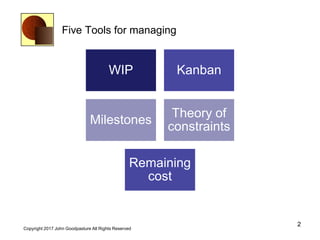
Five Tools for managing
2
Copyright 2017 John Goodpasture All Rights Reserved
WIP Kanban
Milestones
Theory of
constraints
Remaining
cost
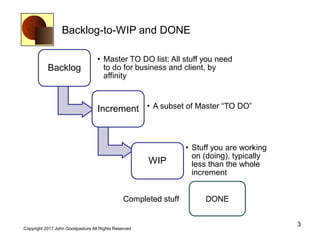
Backlog-to-WIP and DONE
3
Copyright 2017 John Goodpasture All Rights Reserved
Backlog
• Master TO DO list: All stuff you need
to do for business and client, by
affinity
Increment • A subset of Master “TO DO”
WIP
• Stuff you are working
on (doing), typically
less than the whole
increment
DONECompleted stuff
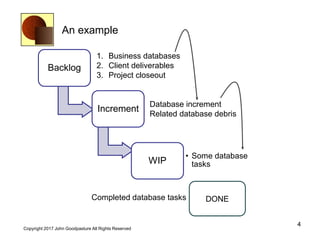
An example
4
Copyright 2017 John Goodpasture All Rights Reserved
Backlog
Increment
WIP
• Some database
tasks
DONECompleted database tasks
1. Business databases
2. Client deliverables
3. Project closeout
Database increment
Related database debris
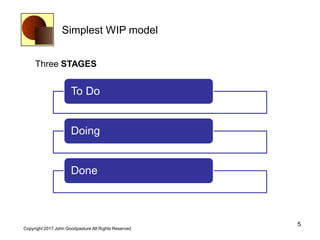
Simplest WIP model
5
Copyright 2017 John Goodpasture All Rights Reserved
To Do
Doing
Done
Three STAGES
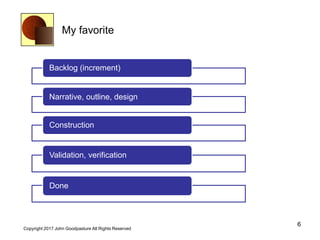
My favorite
6
Copyright 2017 John Goodpasture All Rights Reserved
Backlog (increment)
Narrative, outline, design
Construction
Validation, verification
Done
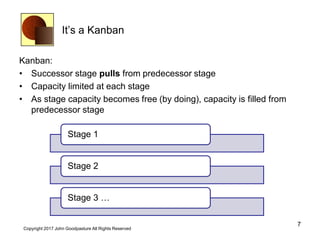
It’s a Kanban
Kanban:
• Successor stage pulls from predecessor stage
• Capacity limited at each stage
• As stage capacity becomes free (by doing), capacity is filled from
predecessor stage
7
Copyright 2017 John Goodpasture All Rights Reserved
Stage 1
Stage 2
Stage 3 …
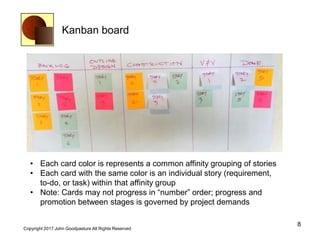
Kanban board
8
Copyright 2017 John Goodpasture All Rights Reserved
• Each card color is represents a common affinity grouping of stories
• Each card with the same color is an individual story (requirement,
to-do, or task) within that affinity group
• Note: Cards may not progress in “number” order; progress and
promotion between stages is governed by project demands
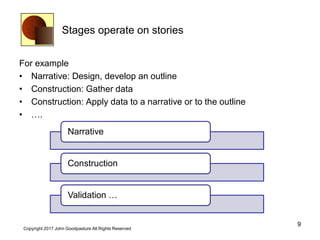
Stages operate on stories
For example
• Narrative: Design, develop an outline
• Construction: Gather data
• Construction: Apply data to a narrative or to the outline
• ….
9
Copyright 2017 John Goodpasture All Rights Reserved
Narrative
Construction
Validation …
Debt in the backlog
10
Copyright 2017 John Goodpasture All Rights Reserved
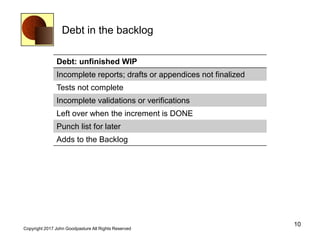
Debt: unfinished WIP
Incomplete reports; drafts or appendices not finalized
Tests not complete
Incomplete validations or verifications
Left over when the increment is DONE
Punch list for later
Adds to the Backlog
Theory of constraints*
What is a constraint?
• Limitation on throughput
What’s throughput?
• Stuff, outcomes, that are valuable to business or client
• That which is value-add to the business value proposition
• Debris is not throughput; it’s overhead
11
Copyright 2017 John Goodpasture All Rights Reserved
* “The Goal”
Dr. Eliyahu M. Goldratt
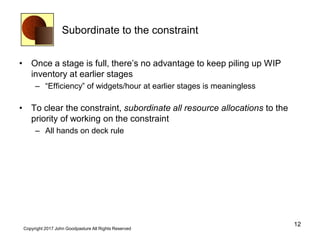
Subordinate to the constraint
• Once a stage is full, there’s no advantage to keep piling up WIP
inventory at earlier stages
– “Efficiency” of widgets/hour at earlier stages is meaningless
• To clear the constraint, subordinate all resource allocations to the
priority of working on the constraint
– All hands on deck rule
12
Copyright 2017 John Goodpasture All Rights Reserved
More capable constraints
• Add similar resources (parallelism)*
• Re-organize methodology at the constraint
• Re-tool or re-train
• Avoid constraint by going a different direction
13
Copyright 2017 John Goodpasture All Rights Reserved
*Brooks Law: “Adding resources to a late task will make it later”
Dr. Fred Brooks
Author: Mythical Manmonth
Managing with milestones
Milestone:
• Measurable, discernible event
• Evident to business and client
• Usually zero-duration point-in-time, but not always
• Valuable to business and client
14
Copyright 2017 John Goodpasture All Rights Reserved
Backward planning
• Establish the client’s most valuable milestone
– May not be the project ending
• Buffer the client’s most valuable milestone (to protect it’s integrity)
• Set the earliest start milestone
• Narrative reduction in between
15
Copyright 2017 John Goodpasture All Rights Reserved
Backward planning sequence
• Establish the client’s most valuable milestone
– May not be the project ending
• Buffer the client’s most valuable milestone (to protect it’s integrity)
• Set the earliest start milestone
• Narrative reduction in between
16
Copyright 2017 John Goodpasture All Rights Reserved
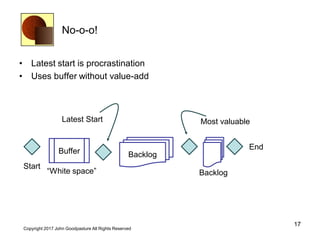
Backlog
Buffer
Backlog
Most valuable
End
Start
“White space”
No-o-o!
• Latest start is procrastination
• Uses buffer without value-add
17
Copyright 2017 John Goodpasture All Rights Reserved
BacklogBuffer
Backlog
Most valuable
End
Latest Start
“White space”
Start
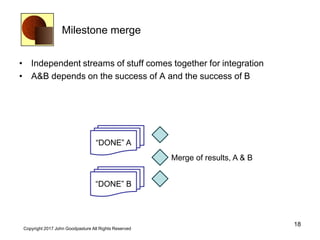
Milestone merge
• Independent streams of stuff comes together for integration
• A&B depends on the success of A and the success of B
18
Copyright 2017 John Goodpasture All Rights Reserved
“DONE” A
“DONE” B
Merge of results, A & B
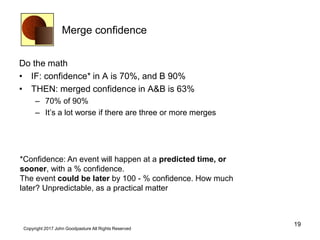
Merge confidence
Do the math
• IF: confidence* in A is 70%, and B 90%
• THEN: merged confidence in A&B is 63%
– 70% of 90%
– It’s a lot worse if there are three or more merges
19
Copyright 2017 John Goodpasture All Rights Reserved
*Confidence: An event will happen at a predicted time, or
sooner, with a % confidence.
The event could be later by 100 - % confidence. How much
later? Unpredictable, as a practical matter
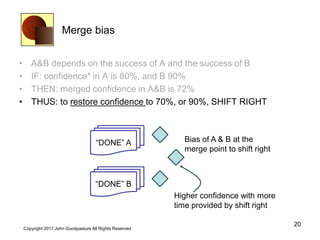
Merge bias
• A&B depends on the success of A and the success of B
• IF: confidence* in A is 80%, and B 90%
• THEN: merged confidence in A&B is 72%
• THUS: to restore confidence to 70%, or 90%, SHIFT RIGHT
20
Copyright 2017 John Goodpasture All Rights Reserved
“DONE” A
“DONE” B
Bias of A & B at the
merge point to shift right
Higher confidence with more
time provided by shift right
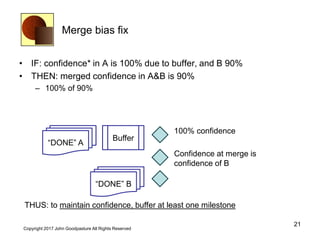
Merge bias fix
• IF: confidence* in A is 100% due to buffer, and B 90%
• THEN: merged confidence in A&B is 90%
– 100% of 90%
21
Copyright 2017 John Goodpasture All Rights Reserved
“DONE” A
“DONE” B
100% confidence
Buffer
THUS: to maintain confidence, buffer at least one milestone
Confidence at merge is
confidence of B
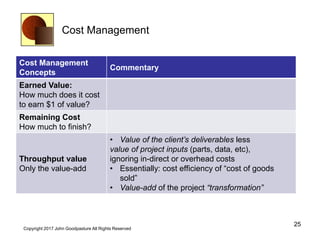
Cost Management
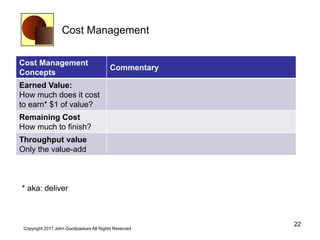
Cost Management
Concepts
Commentary
Earned Value:
How much does it cost
to earn* $1 of value?
Remaining Cost
How much to finish?
Throughput value
Only the value-add
22
Copyright 2017 John Goodpasture All Rights Reserved
* aka: deliver
Cost Management
Cost Management
Concepts
Commentary
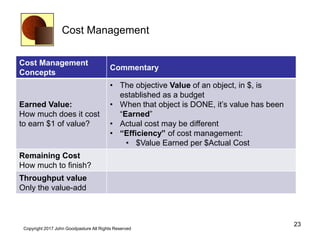
Earned Value:
How much does it cost
to earn $1 of value?
• The objective Value of an object, in $, is
established as a budget
• When that object is DONE, it’s value has been
“Earned”
• Actual cost may be different
• “Efficiency” of cost management:
• $Value Earned per $Actual Cost
Remaining Cost
How much to finish?
Throughput value
Only the value-add
23
Copyright 2017 John Goodpasture All Rights Reserved
Cost Management
Cost Management
Concepts
Commentary
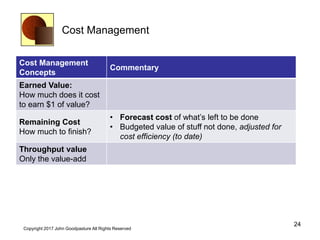
Earned Value:
How much does it cost
to earn $1 of value?
Remaining Cost
How much to finish?
• Forecast cost of what’s left to be done
• Budgeted value of stuff not done, adjusted for
cost efficiency (to date)
Throughput value
Only the value-add
24
Copyright 2017 John Goodpasture All Rights Reserved
Cost Management
Cost Management
Concepts
Commentary
Earned Value:
How much does it cost
to earn $1 of value?
Remaining Cost
How much to finish?
Throughput value
Only the value-add
• Value of the client’s deliverables less
value of project inputs (parts, data, etc),
ignoring in-direct or overhead costs
• Essentially: cost efficiency of “cost of goods
sold”
• Value-add of the project “transformation”
25
Copyright 2017 John Goodpasture All Rights Reserved
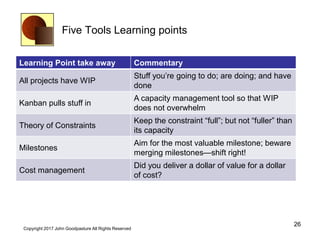
Five Tools Learning points
Learning Point take away Commentary
All projects have WIP
Stuff you’re going to do; are doing; and have
done
Kanban pulls stuff in
A capacity management tool so that WIP
does not overwhelm
Theory of Constraints
Keep the constraint “full”; but not “fuller” than
its capacity
Milestones
Aim for the most valuable milestone; beware
merging milestones—shift right!
Cost management
Did you deliver a dollar of value for a dollar
of cost?
26
Copyright 2017 John Goodpasture All Rights Reserved
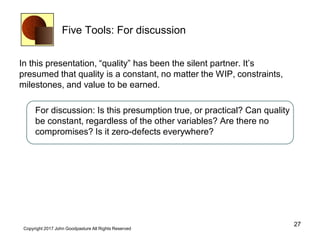
Five Tools: For discussion
In this presentation, “quality” has been the silent partner. It’s
presumed that quality is a constant, no matter the WIP, constraints,
milestones, and value to be earned.
For discussion: Is this presumption true, or practical? Can quality
be constant, regardless of the other variables? Are there no
compromises? Is it zero-defects everywhere?
27
Copyright 2017 John Goodpasture All Rights Reserved

Five tools for managing projects

  • 1.
    1 Copyright 2017 JohnGoodpasture All Rights Reserved Essentials of Project Management Five tools for Managing Produced by Square Peg Consulting, LLC www.sqpegconsulting.com
  • 2.
    Five Tools formanaging 2 Copyright 2017 John Goodpasture All Rights Reserved WIP Kanban Milestones Theory of constraints Remaining cost
  • 3.
    Backlog-to-WIP and DONE 3 Copyright2017 John Goodpasture All Rights Reserved Backlog • Master TO DO list: All stuff you need to do for business and client, by affinity Increment • A subset of Master “TO DO” WIP • Stuff you are working on (doing), typically less than the whole increment DONECompleted stuff
  • 4.
    An example 4 Copyright 2017John Goodpasture All Rights Reserved Backlog Increment WIP • Some database tasks DONECompleted database tasks 1. Business databases 2. Client deliverables 3. Project closeout Database increment Related database debris
  • 5.
    Simplest WIP model 5 Copyright2017 John Goodpasture All Rights Reserved To Do Doing Done Three STAGES
  • 6.
    My favorite 6 Copyright 2017John Goodpasture All Rights Reserved Backlog (increment) Narrative, outline, design Construction Validation, verification Done
  • 7.
    It’s a Kanban Kanban: •Successor stage pulls from predecessor stage • Capacity limited at each stage • As stage capacity becomes free (by doing), capacity is filled from predecessor stage 7 Copyright 2017 John Goodpasture All Rights Reserved Stage 1 Stage 2 Stage 3 …
  • 8.
    Kanban board 8 Copyright 2017John Goodpasture All Rights Reserved • Each card color is represents a common affinity grouping of stories • Each card with the same color is an individual story (requirement, to-do, or task) within that affinity group • Note: Cards may not progress in “number” order; progress and promotion between stages is governed by project demands
  • 9.
    Stages operate onstories For example • Narrative: Design, develop an outline • Construction: Gather data • Construction: Apply data to a narrative or to the outline • …. 9 Copyright 2017 John Goodpasture All Rights Reserved Narrative Construction Validation …
  • 10.
    Debt in thebacklog 10 Copyright 2017 John Goodpasture All Rights Reserved Debt: unfinished WIP Incomplete reports; drafts or appendices not finalized Tests not complete Incomplete validations or verifications Left over when the increment is DONE Punch list for later Adds to the Backlog
  • 11.
    Theory of constraints* Whatis a constraint? • Limitation on throughput What’s throughput? • Stuff, outcomes, that are valuable to business or client • That which is value-add to the business value proposition • Debris is not throughput; it’s overhead 11 Copyright 2017 John Goodpasture All Rights Reserved * “The Goal” Dr. Eliyahu M. Goldratt
  • 12.
    Subordinate to theconstraint • Once a stage is full, there’s no advantage to keep piling up WIP inventory at earlier stages – “Efficiency” of widgets/hour at earlier stages is meaningless • To clear the constraint, subordinate all resource allocations to the priority of working on the constraint – All hands on deck rule 12 Copyright 2017 John Goodpasture All Rights Reserved
  • 13.
    More capable constraints •Add similar resources (parallelism)* • Re-organize methodology at the constraint • Re-tool or re-train • Avoid constraint by going a different direction 13 Copyright 2017 John Goodpasture All Rights Reserved *Brooks Law: “Adding resources to a late task will make it later” Dr. Fred Brooks Author: Mythical Manmonth
  • 14.
    Managing with milestones Milestone: •Measurable, discernible event • Evident to business and client • Usually zero-duration point-in-time, but not always • Valuable to business and client 14 Copyright 2017 John Goodpasture All Rights Reserved
  • 15.
    Backward planning • Establishthe client’s most valuable milestone – May not be the project ending • Buffer the client’s most valuable milestone (to protect it’s integrity) • Set the earliest start milestone • Narrative reduction in between 15 Copyright 2017 John Goodpasture All Rights Reserved
  • 16.
    Backward planning sequence •Establish the client’s most valuable milestone – May not be the project ending • Buffer the client’s most valuable milestone (to protect it’s integrity) • Set the earliest start milestone • Narrative reduction in between 16 Copyright 2017 John Goodpasture All Rights Reserved Backlog Buffer Backlog Most valuable End Start “White space”
  • 17.
    No-o-o! • Latest startis procrastination • Uses buffer without value-add 17 Copyright 2017 John Goodpasture All Rights Reserved BacklogBuffer Backlog Most valuable End Latest Start “White space” Start
  • 18.
    Milestone merge • Independentstreams of stuff comes together for integration • A&B depends on the success of A and the success of B 18 Copyright 2017 John Goodpasture All Rights Reserved “DONE” A “DONE” B Merge of results, A & B
  • 19.
    Merge confidence Do themath • IF: confidence* in A is 70%, and B 90% • THEN: merged confidence in A&B is 63% – 70% of 90% – It’s a lot worse if there are three or more merges 19 Copyright 2017 John Goodpasture All Rights Reserved *Confidence: An event will happen at a predicted time, or sooner, with a % confidence. The event could be later by 100 - % confidence. How much later? Unpredictable, as a practical matter
  • 20.
    Merge bias • A&Bdepends on the success of A and the success of B • IF: confidence* in A is 80%, and B 90% • THEN: merged confidence in A&B is 72% • THUS: to restore confidence to 70%, or 90%, SHIFT RIGHT 20 Copyright 2017 John Goodpasture All Rights Reserved “DONE” A “DONE” B Bias of A & B at the merge point to shift right Higher confidence with more time provided by shift right
  • 21.
    Merge bias fix •IF: confidence* in A is 100% due to buffer, and B 90% • THEN: merged confidence in A&B is 90% – 100% of 90% 21 Copyright 2017 John Goodpasture All Rights Reserved “DONE” A “DONE” B 100% confidence Buffer THUS: to maintain confidence, buffer at least one milestone Confidence at merge is confidence of B
  • 22.
    Cost Management Cost Management Concepts Commentary EarnedValue: How much does it cost to earn* $1 of value? Remaining Cost How much to finish? Throughput value Only the value-add 22 Copyright 2017 John Goodpasture All Rights Reserved * aka: deliver
  • 23.
    Cost Management Cost Management Concepts Commentary EarnedValue: How much does it cost to earn $1 of value? • The objective Value of an object, in $, is established as a budget • When that object is DONE, it’s value has been “Earned” • Actual cost may be different • “Efficiency” of cost management: • $Value Earned per $Actual Cost Remaining Cost How much to finish? Throughput value Only the value-add 23 Copyright 2017 John Goodpasture All Rights Reserved
  • 24.
    Cost Management Cost Management Concepts Commentary EarnedValue: How much does it cost to earn $1 of value? Remaining Cost How much to finish? • Forecast cost of what’s left to be done • Budgeted value of stuff not done, adjusted for cost efficiency (to date) Throughput value Only the value-add 24 Copyright 2017 John Goodpasture All Rights Reserved
  • 25.
    Cost Management Cost Management Concepts Commentary EarnedValue: How much does it cost to earn $1 of value? Remaining Cost How much to finish? Throughput value Only the value-add • Value of the client’s deliverables less value of project inputs (parts, data, etc), ignoring in-direct or overhead costs • Essentially: cost efficiency of “cost of goods sold” • Value-add of the project “transformation” 25 Copyright 2017 John Goodpasture All Rights Reserved
  • 26.
    Five Tools Learningpoints Learning Point take away Commentary All projects have WIP Stuff you’re going to do; are doing; and have done Kanban pulls stuff in A capacity management tool so that WIP does not overwhelm Theory of Constraints Keep the constraint “full”; but not “fuller” than its capacity Milestones Aim for the most valuable milestone; beware merging milestones—shift right! Cost management Did you deliver a dollar of value for a dollar of cost? 26 Copyright 2017 John Goodpasture All Rights Reserved
  • 27.
    Five Tools: Fordiscussion In this presentation, “quality” has been the silent partner. It’s presumed that quality is a constant, no matter the WIP, constraints, milestones, and value to be earned. For discussion: Is this presumption true, or practical? Can quality be constant, regardless of the other variables? Are there no compromises? Is it zero-defects everywhere? 27 Copyright 2017 John Goodpasture All Rights Reserved