Integrating a Variety of
Learning Methods into Safety
          Training

              Ralph Stuart, CIH

              Aaron Batchelder

  Dept. of Environmental Health and Safety

             rstuart@cornell.edu

                 March, 2012
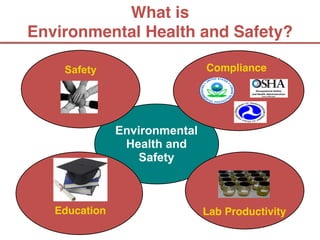
What is 

Environmental Health and Safety?

    Safety                       Compliance


               Environmental 
                Health and
                  Safety


   Education                 Lab Productivity
Adult Learning Principles

Adults prefer learning situations which:
1. Are practical and problem-centered
2. Promote their positive self esteem
3. Integrate new ideas with existing knowledge
4. Show respect for the individual learner
5. Capitalize on their experience
6. Allow choice and self-direction 

The question is 
How do we organize safety training around these ideas
when the regulations aren’t?
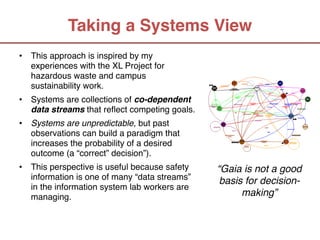
Taking a Systems View
•   This approach is inspired by my
    experiences with the XL Project for
    hazardous waste and campus
    sustainability work.
•   Systems are collections of co-dependent
    data streams that reflect competing goals.
•   Systems are unpredictable, but past
    observations can build a paradigm that
    increases the probability of a desired
    outcome (a “correct” decision”).
•   This perspective is useful because safety     “Gaia is not a good
    information is one of many “data streams”      basis for decision-
    in the information system lab workers are
    managing.                                           making”
Key Characteristics of Systems
                              Ten Criteria for Wicked Problems
                              Rittel and Webber characterize wicked problems by the
• Working within systems                          
                              following 10 criteria.
  presents “wicked”           1. There is no definite formulation of a wicked problem. 
  problems. 
                 2. Wicked problems have no stopping rules.   
                              3. Solutions to wicked problems are not true or false, but
• These characteristics       better or worse.
  connect to the continuous   4. There is no immediate and no ultimate test of a
  improvement approach of     solution to a wicked problem. 
  PDCA based management       5. Every solution to a wicked problem is a "one shot
  systems
                    operation"; because there is no opportunity to learn by
                              trial and error, every attempt counts significantly. 
• Enlightenment is an         6. Wicked problems do not have an enumerable (or an
  accident. Practice makes    exhaustively describable) set of potential solutions, nor
  us accident prone. - Zen    is there a well described set of permissible operations
  proverb
                    that may be incorporated into the plan. 
                              7. Every wicked problem is essentially unique.   
                              8. Every wicked problem can be considered to be a
                              symptom of another [wicked] problem.   
                              9. The causes of a wicked problem can be explained in
                              numerous ways. The choice of explanation determines
                                                                    
                              the nature of the problem's resolution.
                              10. [With wicked problems,] the planner has no right to
                              be wrong.
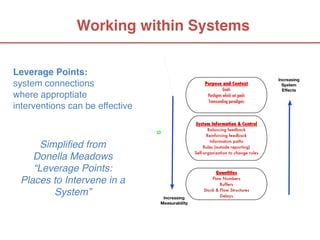
Working within Systems

Leverage Points:

system connections 

where approptiate
interventions can be effective


      Simplified from 

    Donella Meadows 

    “Leverage Points:
 Places to Intervene in a
         System”
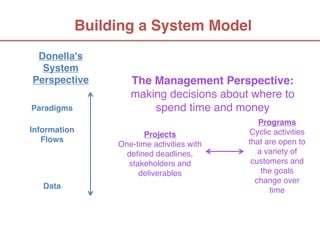
Building a System Model
 Donella's
  System
Perspective
      The Management Perspective:

                  making decisions about where to
Paradigms
            spend time and money
                                             Programs
                      Projects
Information                               Cyclic activities
   Flows                                  that are open to
               One-time activities with
                 defined deadlines,          a variety of
                 stakeholders and          customers and
                    deliverables              the goals
                                            change over
   Data                                         time
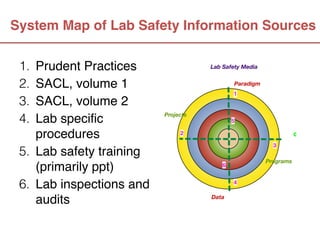
System Map of Lab Safety Information Sources

 1. Prudent Practices
 2. SACL, volume 1
 3. SACL, volume 2
 4. Lab specific
    procedures
 5. Lab safety training
    (primarily ppt)
 6. Lab inspections and
    audits
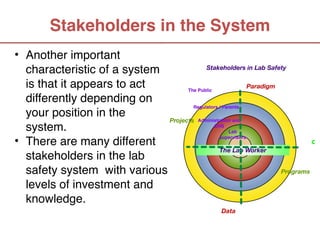
Stakeholders in the System
• Another important
  characteristic of a system
  is that it appears to act
  differently depending on
  your position in the
  system.
• There are many different
  stakeholders in the lab
  safety system with various
  levels of investment and
  knowledge.
How can we use this approach 
            to improve training?

1. Brainstorming new ideas and messages
2. Setting priorities for training program activities
3. Organizing web sites for various audiences
4. Explaining the distribution of responsibilities
   for safety training
5. Developing effective social media messages
A Practical Application

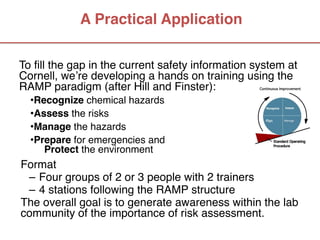
To fill the gap in the current safety information system at
Cornell, we’re developing a hands on training using the
RAMP paradigm (after Hill and Finster):
  •Recognize chemical hazards
  •Assess the risks
  •Manage the hazards
  •Prepare for emergencies and 

     Protect the environment
Format
     
 – Four groups of 2 or 3 people with 2 trainers 
 – 4 stations following the RAMP structure
The overall goal is to generate awareness within the lab
community of the importance of risk assessment.
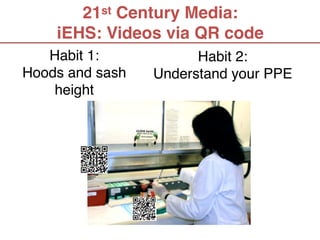
21st Century Media:

    iEHS: Videos via QR code
   Habit 1: 
          Habit 2: 

Hoods and sash   Understand your PPE
    height
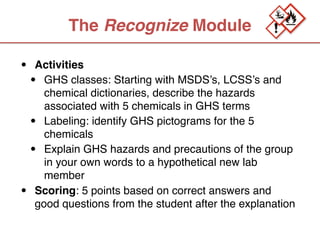
The Recognize Module

• Activities
 • GHS classes: Starting with MSDS’s, LCSS’s and
    chemical dictionaries, describe the hazards
    associated with 5 chemicals in GHS terms
 • Labeling: identify GHS pictograms for the 5
    chemicals
 • Explain GHS hazards and precautions of the group
    in your own words to a hypothetical new lab
    member
• Scoring: 5 points based on correct answers and
  good questions from the student after the explanation
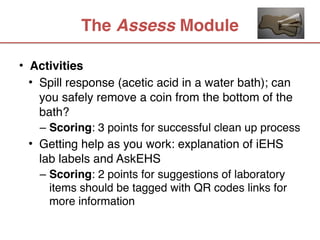
The Assess Module

• Activities
  • Spill response (acetic acid in a water bath); can
    you safely remove a coin from the bottom of the
    bath?
   – Scoring: 3 points for successful clean up process
 • Getting help as you work: explanation of iEHS
   lab labels and AskEHS 
   – Scoring: 2 points for suggestions of laboratory
     items should be tagged with QR codes links for
     more information
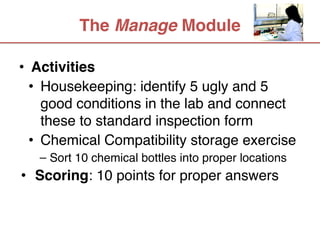
The Manage Module

• Activities
  • Housekeeping: identify 5 ugly and 5
    good conditions in the lab and connect
    these to standard inspection form
  • Chemical Compatibility storage exercise
   – Sort 10 chemical bottles into proper locations
• Scoring: 10 points for proper answers
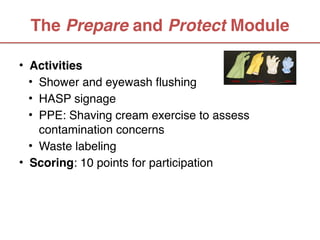
The Prepare and Protect Module

• Activities
  • Shower and eyewash flushing
  • HASP signage
  • PPE: Shaving cream exercise to assess
    contamination concerns
  • Waste labeling
• Scoring: 10 points for participation
References: Systems analysis

• Donella Meadows, Places to Intervene in a System 

  http://www.sustainer.org/pubs/Leverage_Points.pdf
• Wikipedia on Wicked Problems: 

  http://en.wikipedia.org/wiki/Wicked_problem
• The Ecosystem Approach: Complexity, Uncertainty,
  and Managing for Sustainability; David Waltner-
  Toews 
• Posner and Stuart article in press
References: Training resources

• Hill and Finster, 2010: Laboratory Safety
  for Chemistry Students
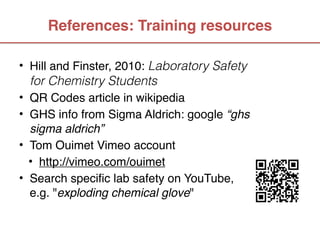
• QR Codes article in wikipedia
• GHS info from Sigma Aldrich: google “ghs
  sigma aldrich”
• Tom Ouimet Vimeo account
  • http://vimeo.com/ouimet
• Search specific lab safety on YouTube,
  e.g. "exploding chemical glove"
Questions?

Multi Media Lab Training

  • 1.
    Integrating a Varietyof Learning Methods into Safety Training Ralph Stuart, CIH
 Aaron Batchelder
 Dept. of Environmental Health and Safety
 rstuart@cornell.edu
 March, 2012
  • 2.
    What is 
 EnvironmentalHealth and Safety? Safety Compliance Environmental Health and Safety Education Lab Productivity
  • 3.
    Adult Learning Principles Adultsprefer learning situations which: 1. Are practical and problem-centered 2. Promote their positive self esteem 3. Integrate new ideas with existing knowledge 4. Show respect for the individual learner 5. Capitalize on their experience 6. Allow choice and self-direction The question is How do we organize safety training around these ideas when the regulations aren’t?
  • 4.
    Taking a SystemsView • This approach is inspired by my experiences with the XL Project for hazardous waste and campus sustainability work. • Systems are collections of co-dependent data streams that reflect competing goals. • Systems are unpredictable, but past observations can build a paradigm that increases the probability of a desired outcome (a “correct” decision”). • This perspective is useful because safety “Gaia is not a good information is one of many “data streams” basis for decision- in the information system lab workers are managing. making”
  • 5.
    Key Characteristics ofSystems Ten Criteria for Wicked Problems Rittel and Webber characterize wicked problems by the • Working within systems following 10 criteria. presents “wicked” 1. There is no definite formulation of a wicked problem. problems. 2. Wicked problems have no stopping rules. 3. Solutions to wicked problems are not true or false, but • These characteristics better or worse. connect to the continuous 4. There is no immediate and no ultimate test of a improvement approach of solution to a wicked problem. PDCA based management 5. Every solution to a wicked problem is a "one shot systems operation"; because there is no opportunity to learn by trial and error, every attempt counts significantly. • Enlightenment is an 6. Wicked problems do not have an enumerable (or an accident. Practice makes exhaustively describable) set of potential solutions, nor us accident prone. - Zen is there a well described set of permissible operations proverb that may be incorporated into the plan. 7. Every wicked problem is essentially unique. 8. Every wicked problem can be considered to be a symptom of another [wicked] problem. 9. The causes of a wicked problem can be explained in numerous ways. The choice of explanation determines the nature of the problem's resolution. 10. [With wicked problems,] the planner has no right to be wrong.
  • 6.
    Working within Systems LeveragePoints:
 system connections 
 where approptiate interventions can be effective Simplified from 
 Donella Meadows 
 “Leverage Points: Places to Intervene in a System”
  • 7.
    Building a SystemModel Donella's System Perspective The Management Perspective:
 making decisions about where to Paradigms spend time and money Programs Projects Information Cyclic activities Flows that are open to One-time activities with defined deadlines, a variety of stakeholders and customers and deliverables the goals change over Data time
  • 8.
    System Map ofLab Safety Information Sources 1. Prudent Practices 2. SACL, volume 1 3. SACL, volume 2 4. Lab specific procedures 5. Lab safety training (primarily ppt) 6. Lab inspections and audits
  • 9.
    Stakeholders in theSystem • Another important characteristic of a system is that it appears to act differently depending on your position in the system. • There are many different stakeholders in the lab safety system with various levels of investment and knowledge.
  • 10.
    How can weuse this approach to improve training? 1. Brainstorming new ideas and messages 2. Setting priorities for training program activities 3. Organizing web sites for various audiences 4. Explaining the distribution of responsibilities for safety training 5. Developing effective social media messages
  • 11.
    A Practical Application Tofill the gap in the current safety information system at Cornell, we’re developing a hands on training using the RAMP paradigm (after Hill and Finster): •Recognize chemical hazards •Assess the risks •Manage the hazards •Prepare for emergencies and 
 Protect the environment Format – Four groups of 2 or 3 people with 2 trainers – 4 stations following the RAMP structure The overall goal is to generate awareness within the lab community of the importance of risk assessment.
  • 12.
    21st Century Media:
 iEHS: Videos via QR code Habit 1: 
 Habit 2: 
 Hoods and sash Understand your PPE height
  • 13.
    The Recognize Module •Activities • GHS classes: Starting with MSDS’s, LCSS’s and chemical dictionaries, describe the hazards associated with 5 chemicals in GHS terms • Labeling: identify GHS pictograms for the 5 chemicals • Explain GHS hazards and precautions of the group in your own words to a hypothetical new lab member • Scoring: 5 points based on correct answers and good questions from the student after the explanation
  • 14.
    The Assess Module •Activities • Spill response (acetic acid in a water bath); can you safely remove a coin from the bottom of the bath? – Scoring: 3 points for successful clean up process • Getting help as you work: explanation of iEHS lab labels and AskEHS – Scoring: 2 points for suggestions of laboratory items should be tagged with QR codes links for more information
  • 15.
    The Manage Module •Activities • Housekeeping: identify 5 ugly and 5 good conditions in the lab and connect these to standard inspection form • Chemical Compatibility storage exercise – Sort 10 chemical bottles into proper locations • Scoring: 10 points for proper answers
  • 16.
    The Prepare andProtect Module • Activities • Shower and eyewash flushing • HASP signage • PPE: Shaving cream exercise to assess contamination concerns • Waste labeling • Scoring: 10 points for participation
  • 17.
    References: Systems analysis •Donella Meadows, Places to Intervene in a System 
 http://www.sustainer.org/pubs/Leverage_Points.pdf • Wikipedia on Wicked Problems: 
 http://en.wikipedia.org/wiki/Wicked_problem • The Ecosystem Approach: Complexity, Uncertainty, and Managing for Sustainability; David Waltner- Toews • Posner and Stuart article in press
  • 18.
    References: Training resources •Hill and Finster, 2010: Laboratory Safety for Chemistry Students • QR Codes article in wikipedia • GHS info from Sigma Aldrich: google “ghs sigma aldrich” • Tom Ouimet Vimeo account • http://vimeo.com/ouimet • Search specific lab safety on YouTube, e.g. "exploding chemical glove"
  • 19.