!mportant 
Urgent! 
The 
Matrix zen 
Danielle Nocon
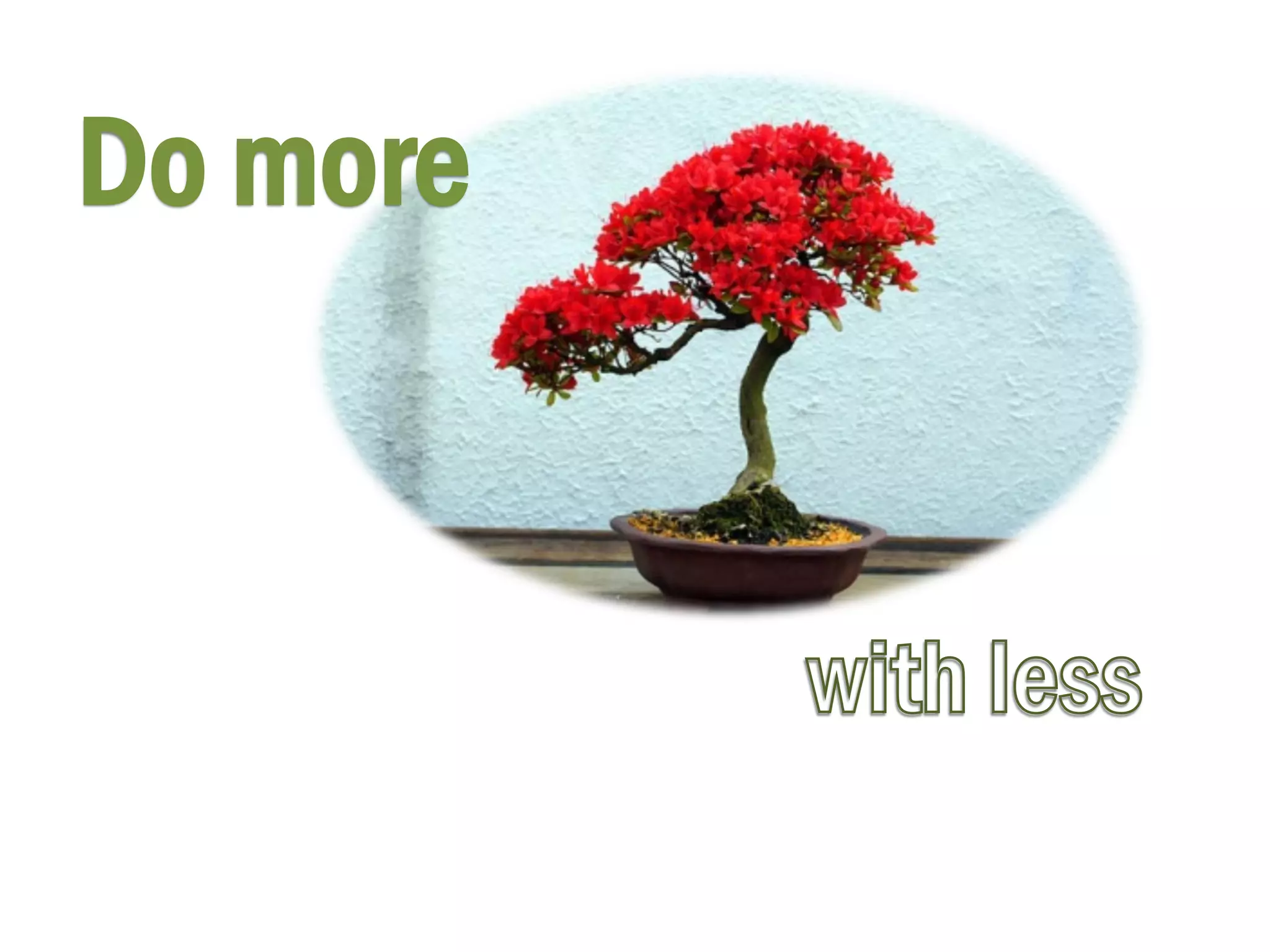
Do more
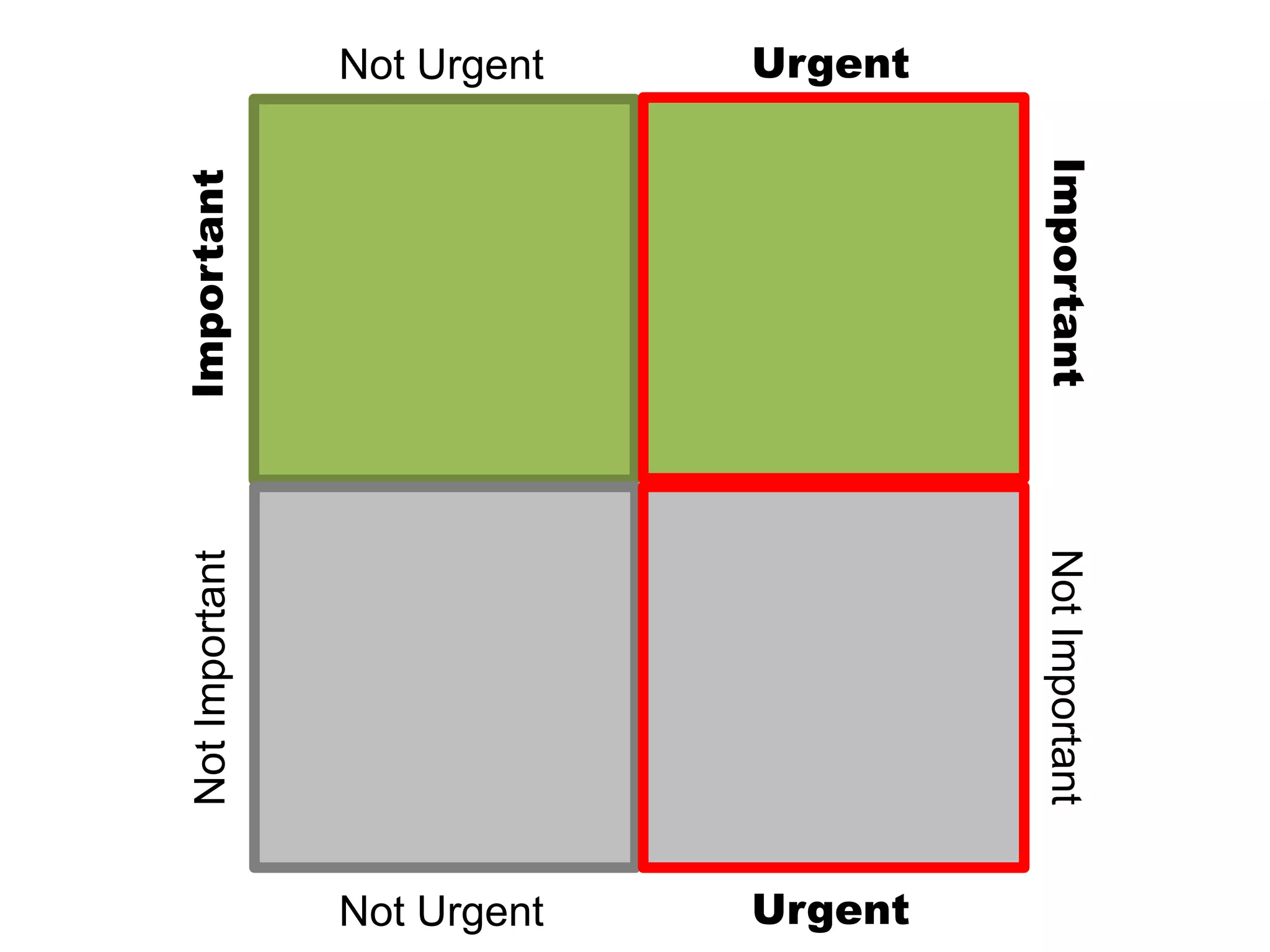
Important 
Not Urgent 
Urgent 
Important 
Not Important 
Urgent 
Not Urgent 
Not Important
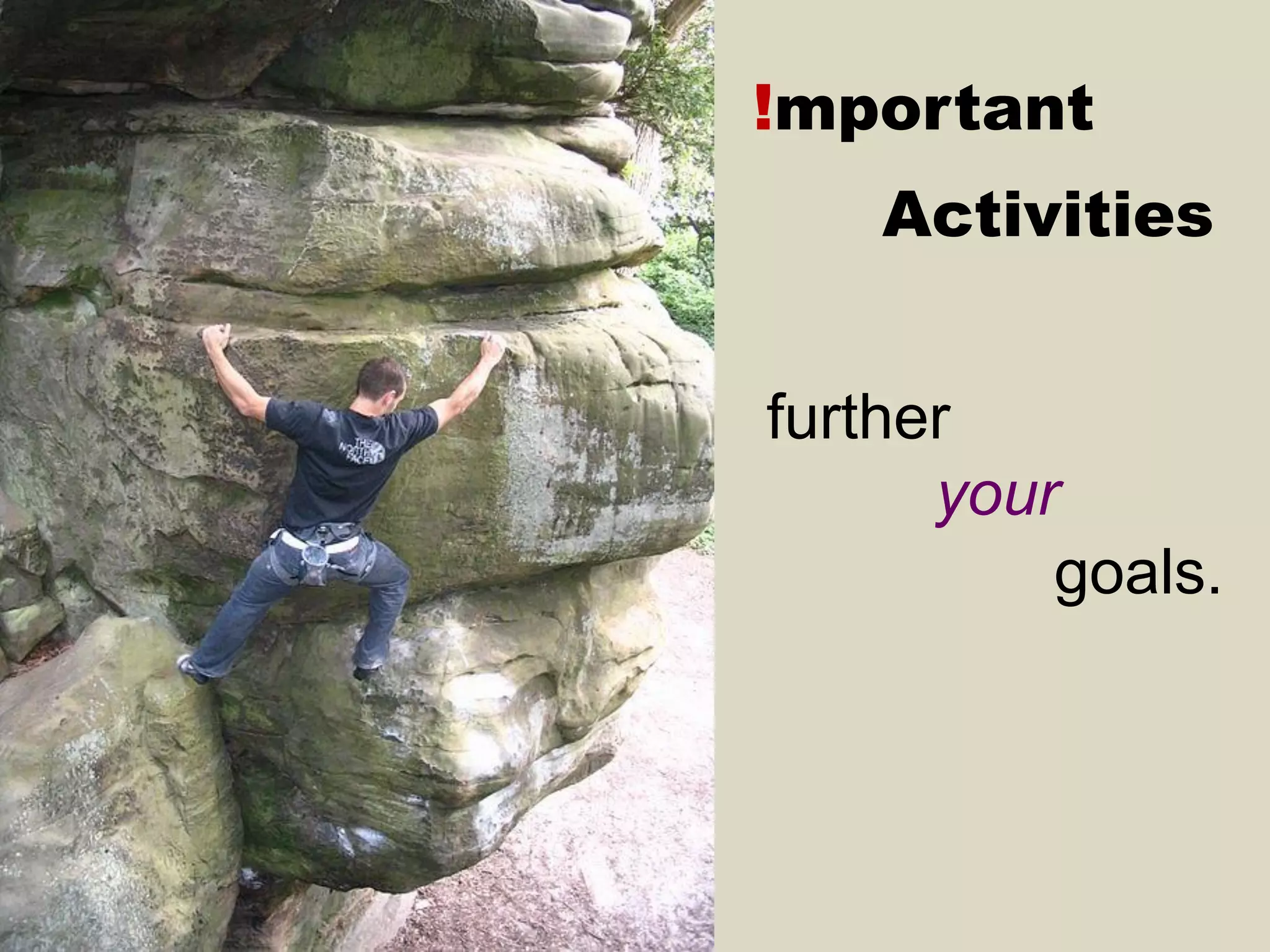
!mportant 
Activities 
further your 
goals.
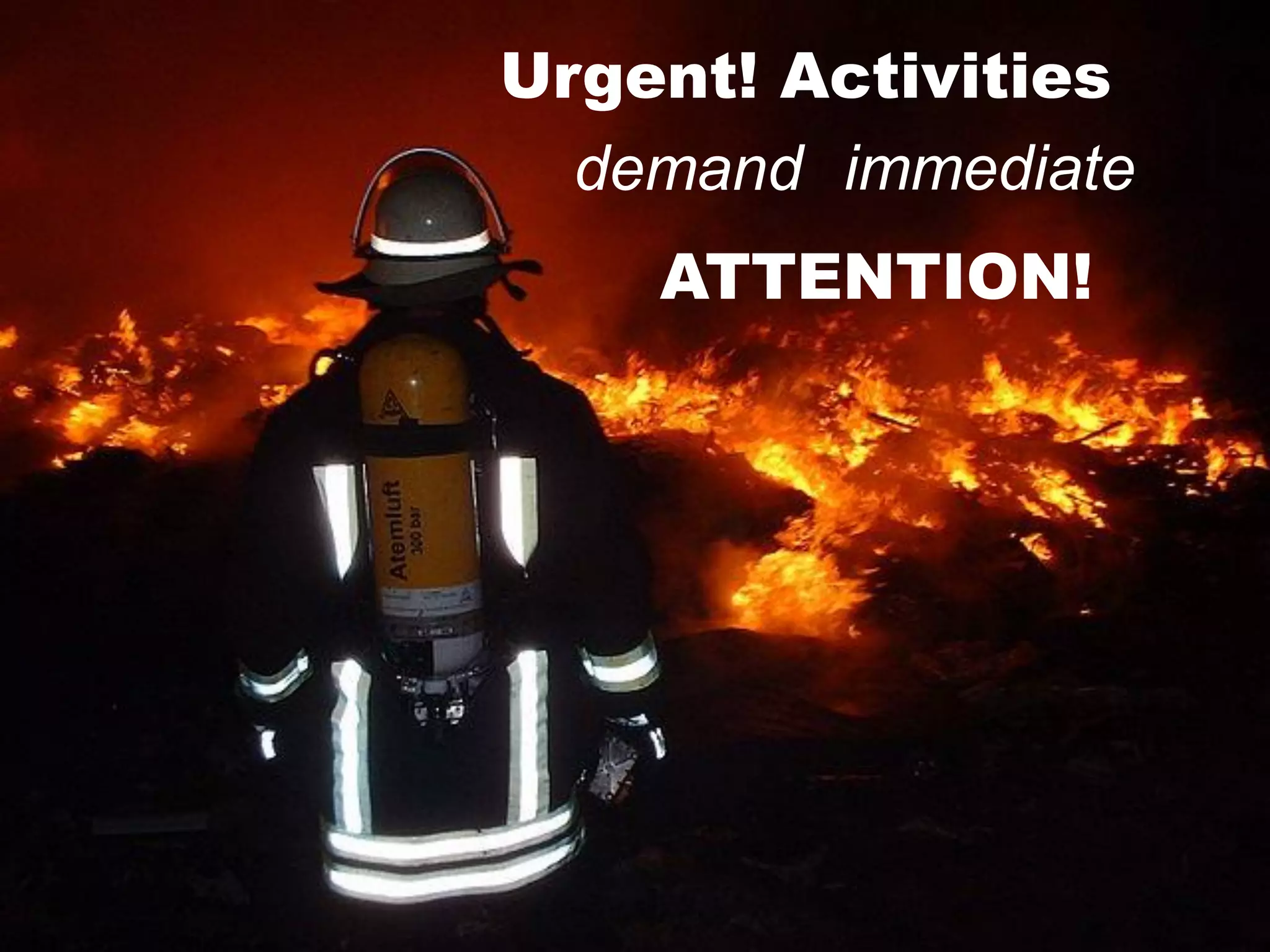
Urgent! Activities 
demand 
immediate 
ATTENTION!
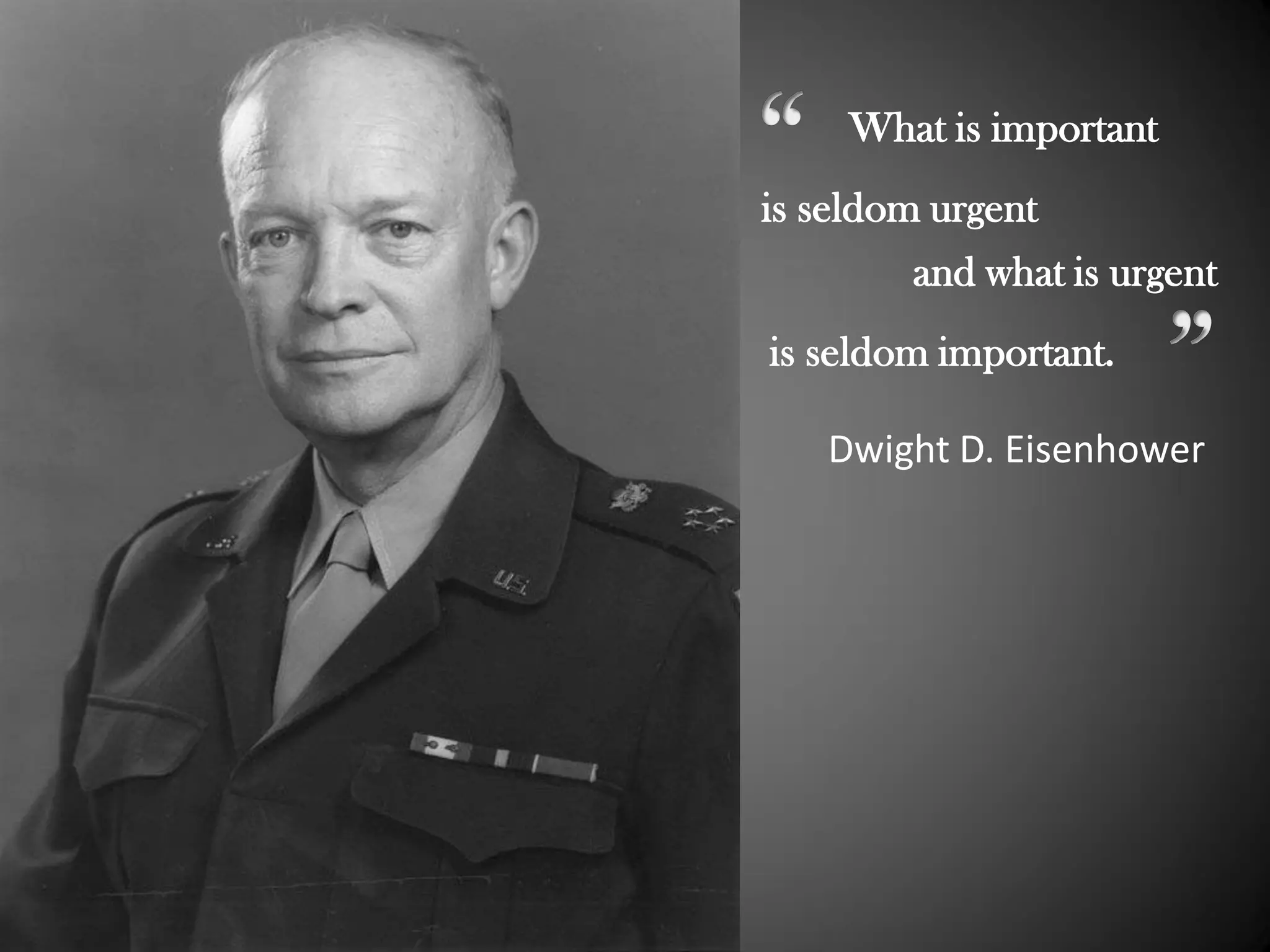
What is important 
is seldom urgent 
and what is urgent 
is seldom important. 
Dwight D. Eisenhower
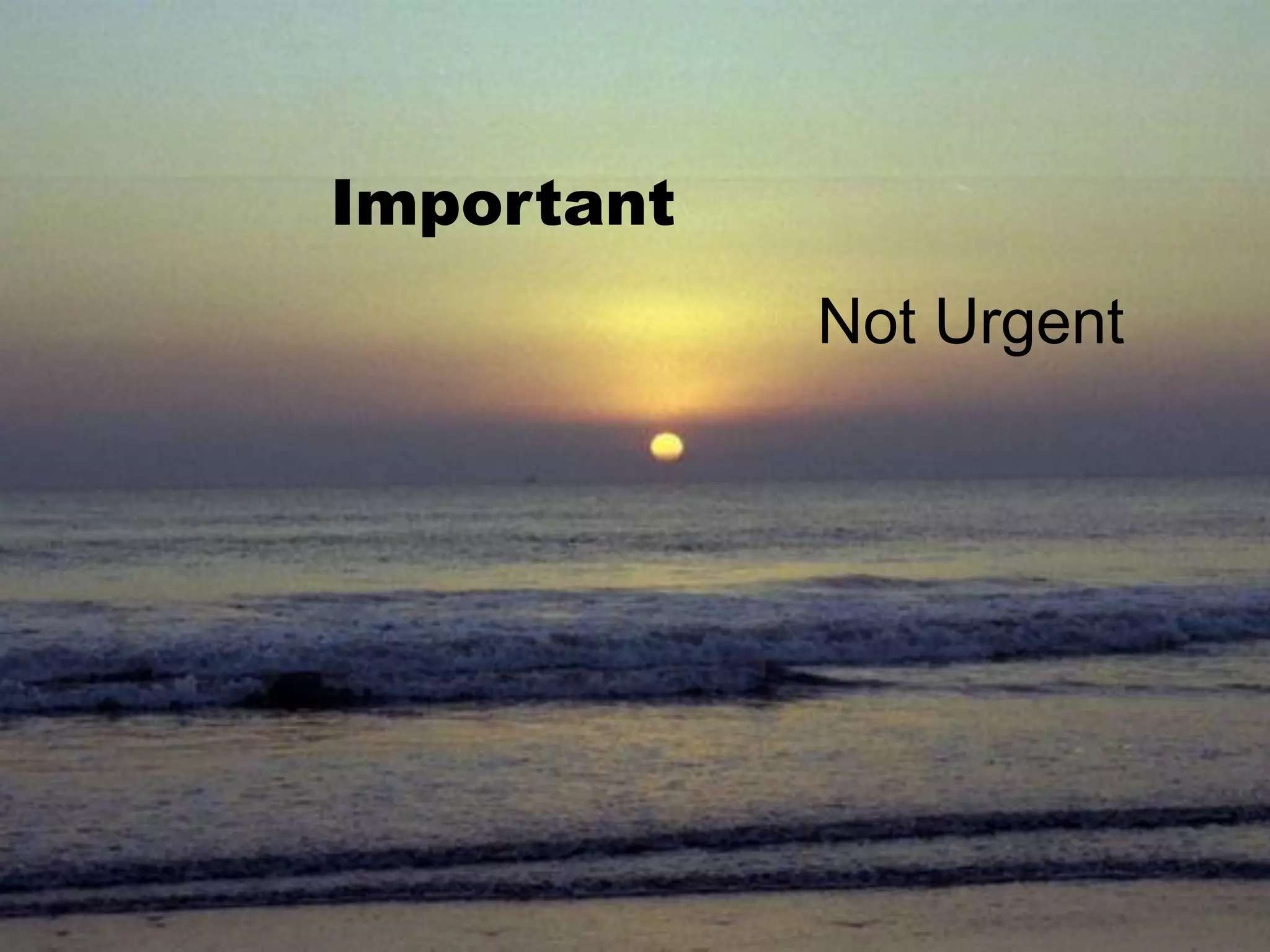
Important 
Not Urgent
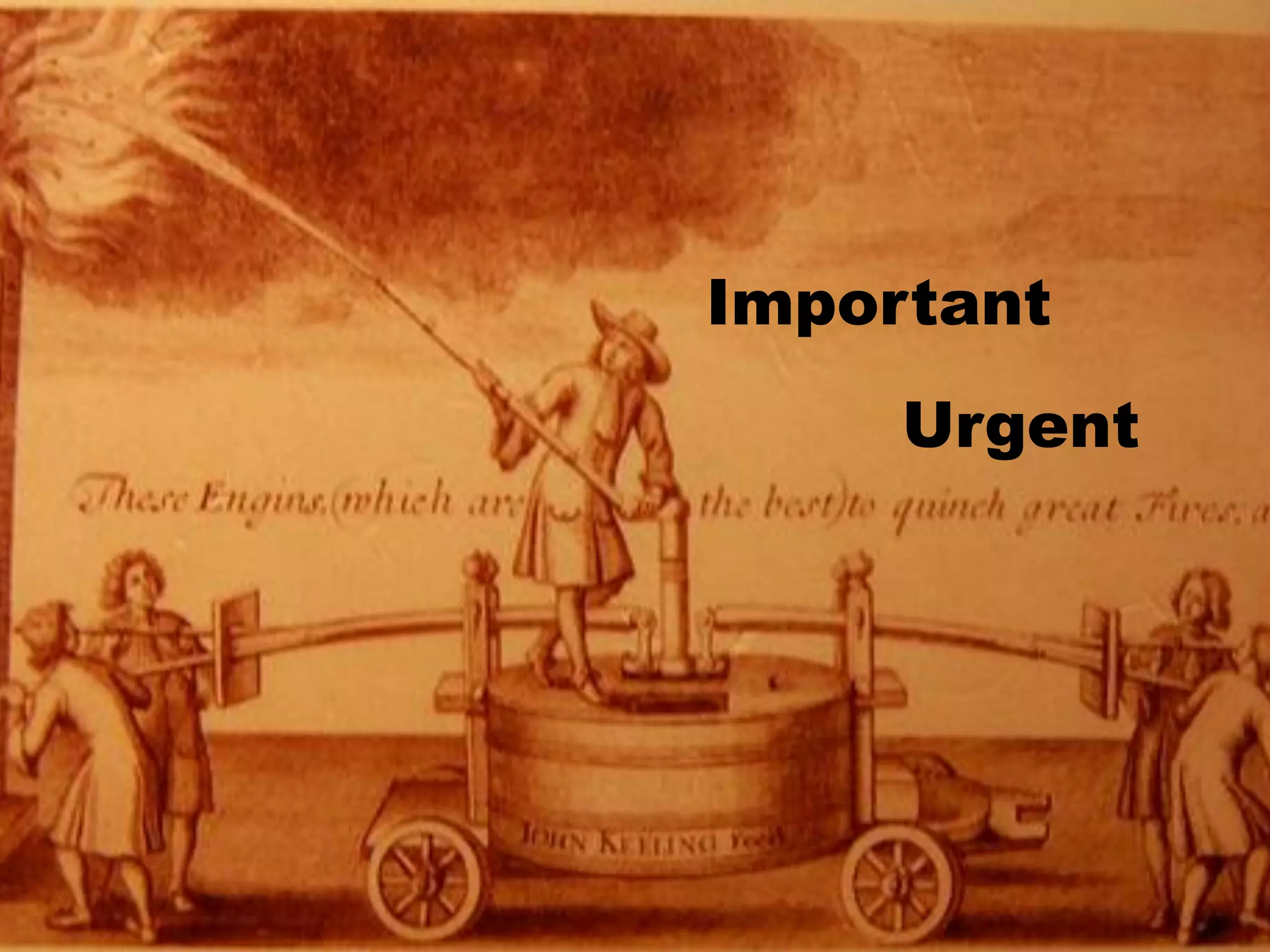
Important 
Urgent
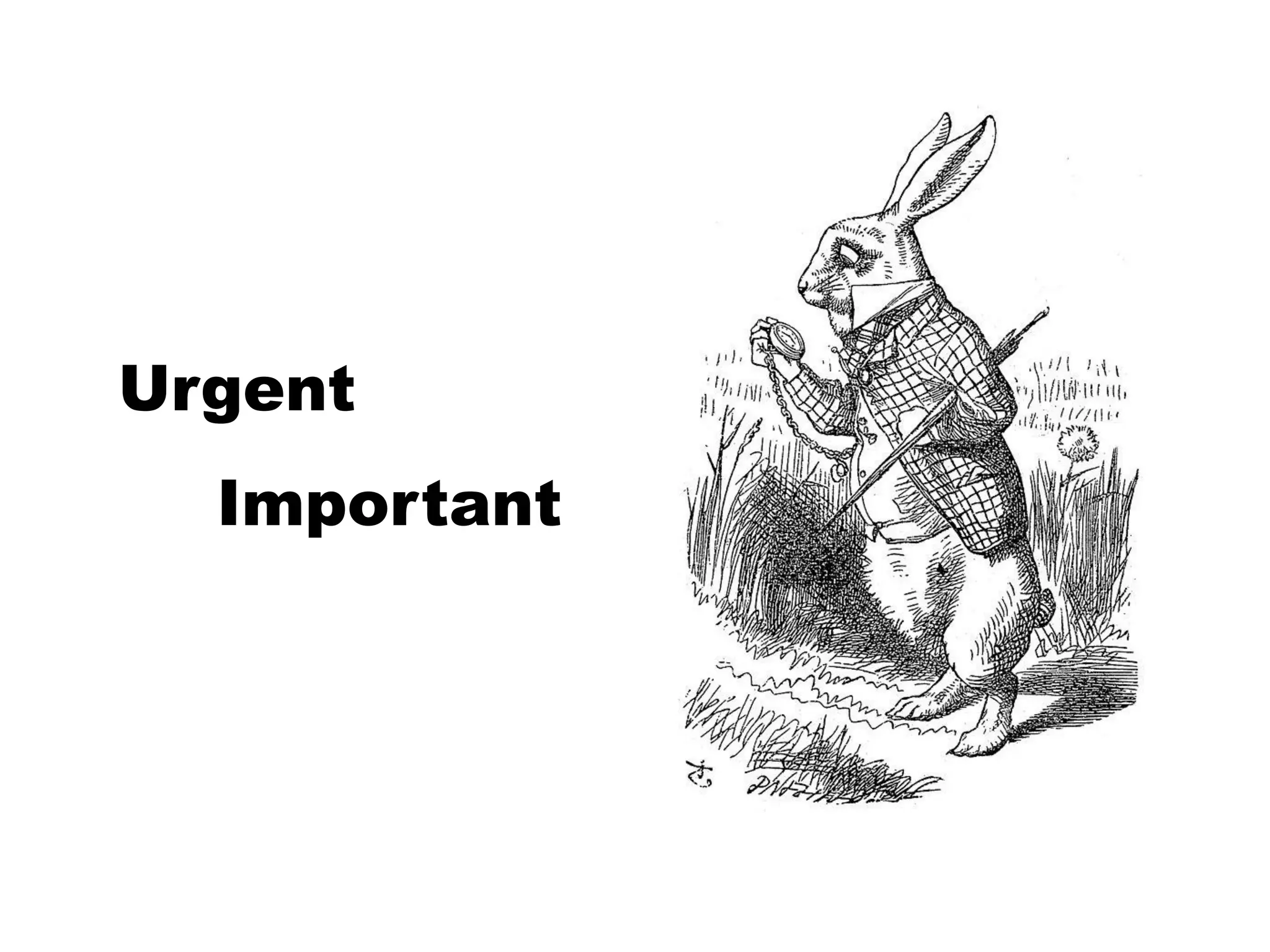
Urgent 
Important
Urgent 
Not Important
Not Urgent 
Not Important
Bibliography 
Reynolds, Garr. Presentation Zen: Simple Ideas on Presentation Design and Delivery. 2nd ed. Berkeley, CA: New Riders, 2012. 
“The Urgent/Important Matrix: Using Time Effectively, Not Just Efficiently.” Mind Tools. Retrieved from http://www.mindtools.com/pages/article/newHTE_91.htm.
Image Credits Slide 2 Kurume Azalea Bonsai in Bloom (in training since 1982), US National Arboretum by Sudhirpv [CC BY-SA 3.0 (http://creativecommons.org/licenses/by-sa/3.0/)], via Wikimedia Commons (http://commons.wikimedia.org/wiki/File:Kurume_Azalea_Bonsai_in_Bloom_(in_training_since_1982),_US_National_Arboretum.jpg#mediaviewer/File:Kurume_Azalea_Bonsai_in_Bloom_%28in_training_since_1982%29%2C_US_National_Arboretum.jpg) Slide 4 Tunbridge Wells High Rocks Climber by Cmglee (Own work) [CC-BY-SA-3.0 (http://creativecommons.org/licenses/by-sa/3.0) or GFDL (http://www.gnu.org/copyleft/fdl.html)], via Wikimedia Commons (http://commons.wikimedia.org/wiki/File%3ATunbridge_Wells_High_Rocks_climber.jpg) Slide 5 Feuerwehrmann beim Brand einer Muelldeponie by Dennis Janssen (Own work), [CC BY-SA 3.9 (http://creativecommons.org/licenses/by-sa/3.0/)], via Wikimedia Commons (http://commons.wikimedia.org/wiki/File:Feuerwehrmann_beim_Brand_einer_Muelldeponie.JPG#mediaviewer/File:Feuerwehrmann_beim_Brand_einer_Muelldeponie.JPG) Slide 6 General of the Army Dwight D. Eisenhower 1947 by Unknown [Public Domain], via Wikimedia Commons (http://commons.wikimedia.org/wiki/File:General_of_the_Army_Dwight_D._Eisenhower_1947.jpg#mediaviewer/File:General_of_the_Army_Dwight_D._Eisenhower_1947.jpg)
Slide 7 Cox Bazar Sunset [Public Domain], via Wikimedia Commons (http://commons.wikimedia.org/wiki/File:Cox_Bazar_Sunset.jpg#mediaviewer/File:Cox_ Bazar_Sunset.jpg) 
Slide 8 Keeling Fire Engine Illustration, Author Unknown [Public Domain] via Wikimedia Commons (http://commons.wikimedia.org/wiki/File%3AKeeling-fire-engine- illustration.jpg) 
Slide 9 Alice White Rabbit by Sir John Tenniel (“Alice’s Adventures in Wonderland” (1865)) [Public domain], via Wikimedia Commons (http://commons.wikimedia.org/wiki/File%3AAlice-white-rabbit.jpg) 
Slide 10 Millard County Utah Miller Canyon Petroglyphs by Sid.L.Young (Own work) [CC- BY-SA-3.0 (http://creativecommons.org/licenses/by-sa/3.0)], via Wikimedia Commons (http://commons.wikimedia.org/wiki/File%3AMillard_County_Utah_Millers_Canyon_petroglyphs_1.JPG) 
Slide 11 detail of Surrounds of Newmarket Train Station by Uploader. (Own work (Own picture)). [Public domain], via Wikimedia Commons (http://commons.wikimedia.org/wiki/File%3ASurrounds_Of_Newmarket_Train_Station_I.jpg)
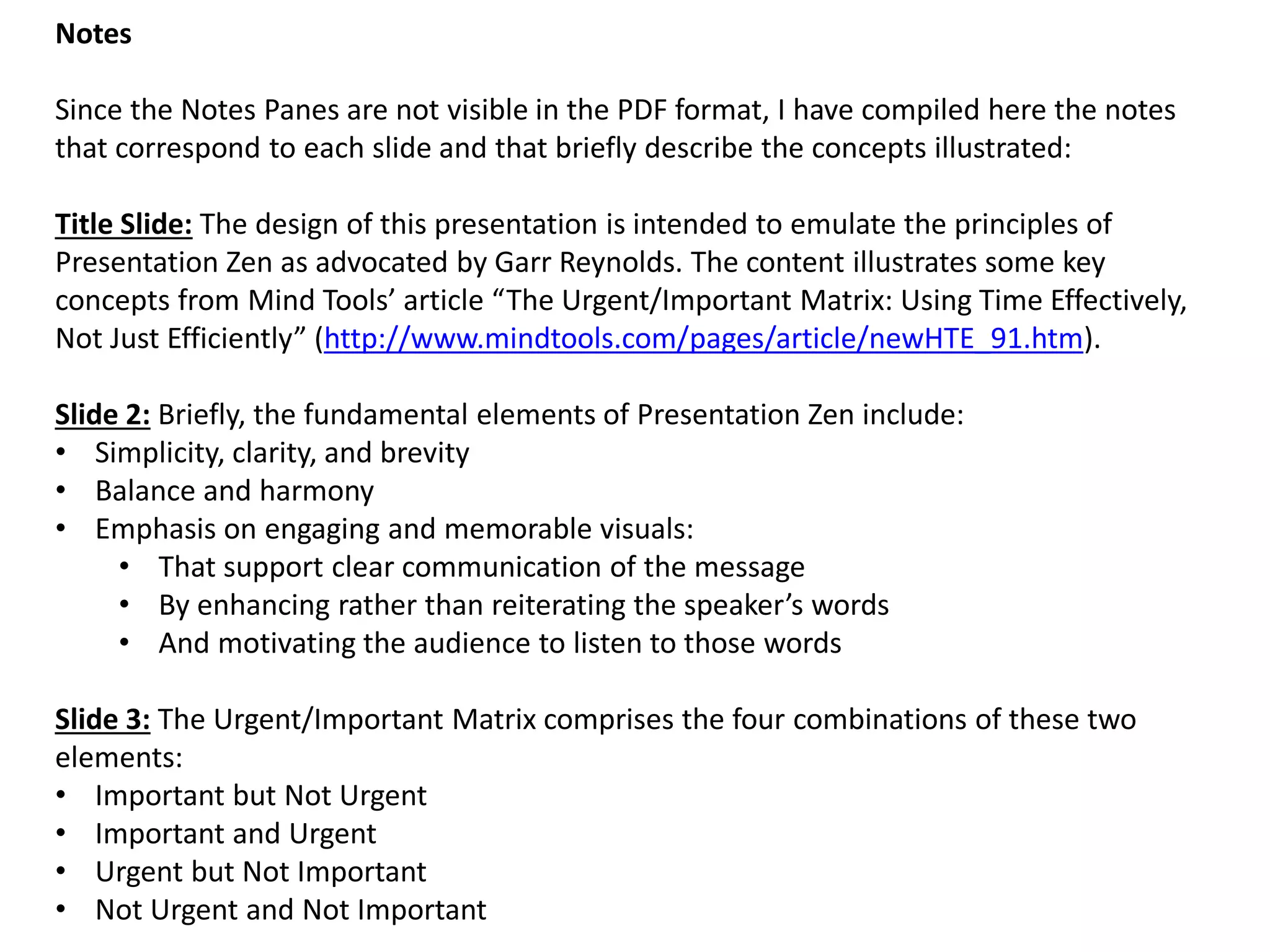
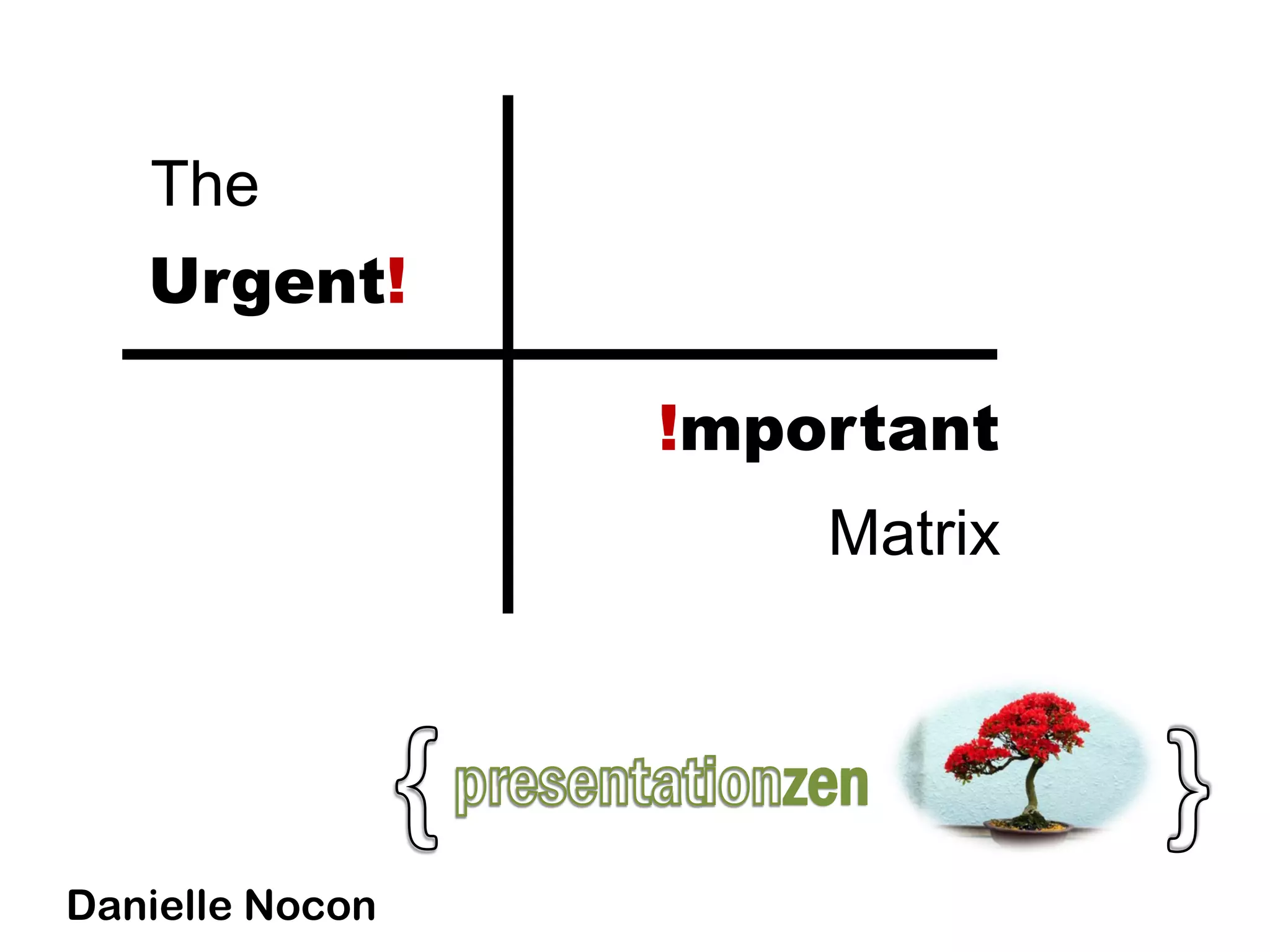
Notes Since the Notes Panes are not visible in the PDF format, I have compiled here the notes that correspond to each slide and that briefly describe the concepts illustrated: Title Slide: The design of this presentation is intended to emulate the principles of Presentation Zen as advocated by Garr Reynolds. The content illustrates some key concepts from Mind Tools’ article “The Urgent/Important Matrix: Using Time Effectively, Not Just Efficiently” (http://www.mindtools.com/pages/article/newHTE_91.htm). Slide 2: Briefly, the fundamental elements of Presentation Zen include: 
•Simplicity, clarity, and brevity 
•Balance and harmony 
•Emphasis on engaging and memorable visuals: 
•That support clear communication of the message 
•By enhancing rather than reiterating the speaker’s words 
•And motivating the audience to listen to those words Slide 3: The Urgent/Important Matrix comprises the four combinations of these two elements: 
•Important but Not Urgent 
•Important and Urgent 
•Urgent but Not Important 
•Not Urgent and Not Important
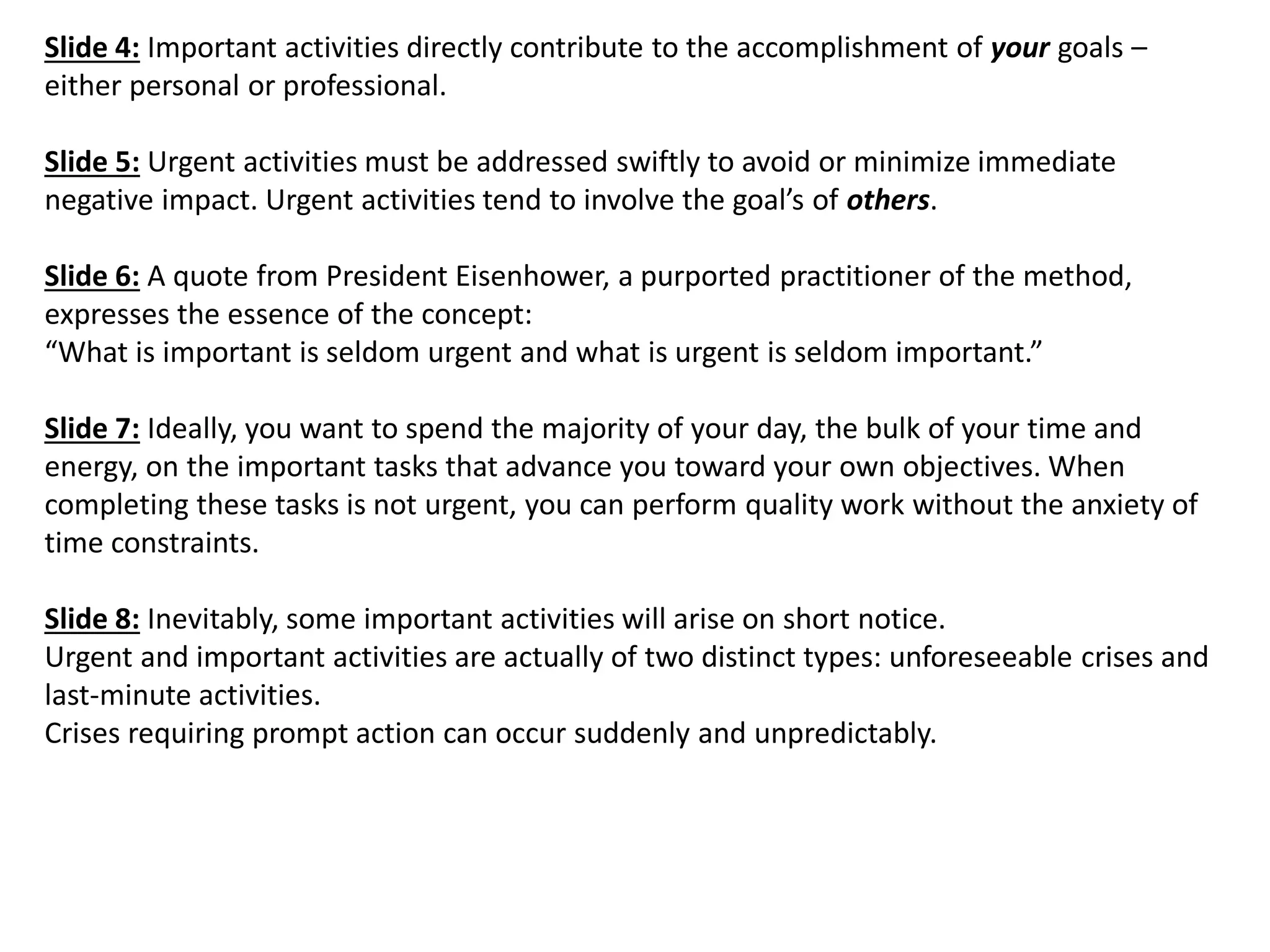
Slide 4: Important activities directly contribute to the accomplishment of your goals – either personal or professional. Slide 5: Urgent activities must be addressed swiftly to avoid or minimize immediate negative impact. Urgent activities tend to involve the goal’s of others. Slide 6: A quote from President Eisenhower, a purported practitioner of the method, expresses the essence of the concept: “What is important is seldom urgent and what is urgent is seldom important.” Slide 7: Ideally, you want to spend the majority of your day, the bulk of your time and energy, on the important tasks that advance you toward your own objectives. When completing these tasks is not urgent, you can perform quality work without the anxiety of time constraints. Slide 8: Inevitably, some important activities will arise on short notice. Urgent and important activities are actually of two distinct types: unforeseeable crises and last-minute activities. Crises requiring prompt action can occur suddenly and unpredictably.
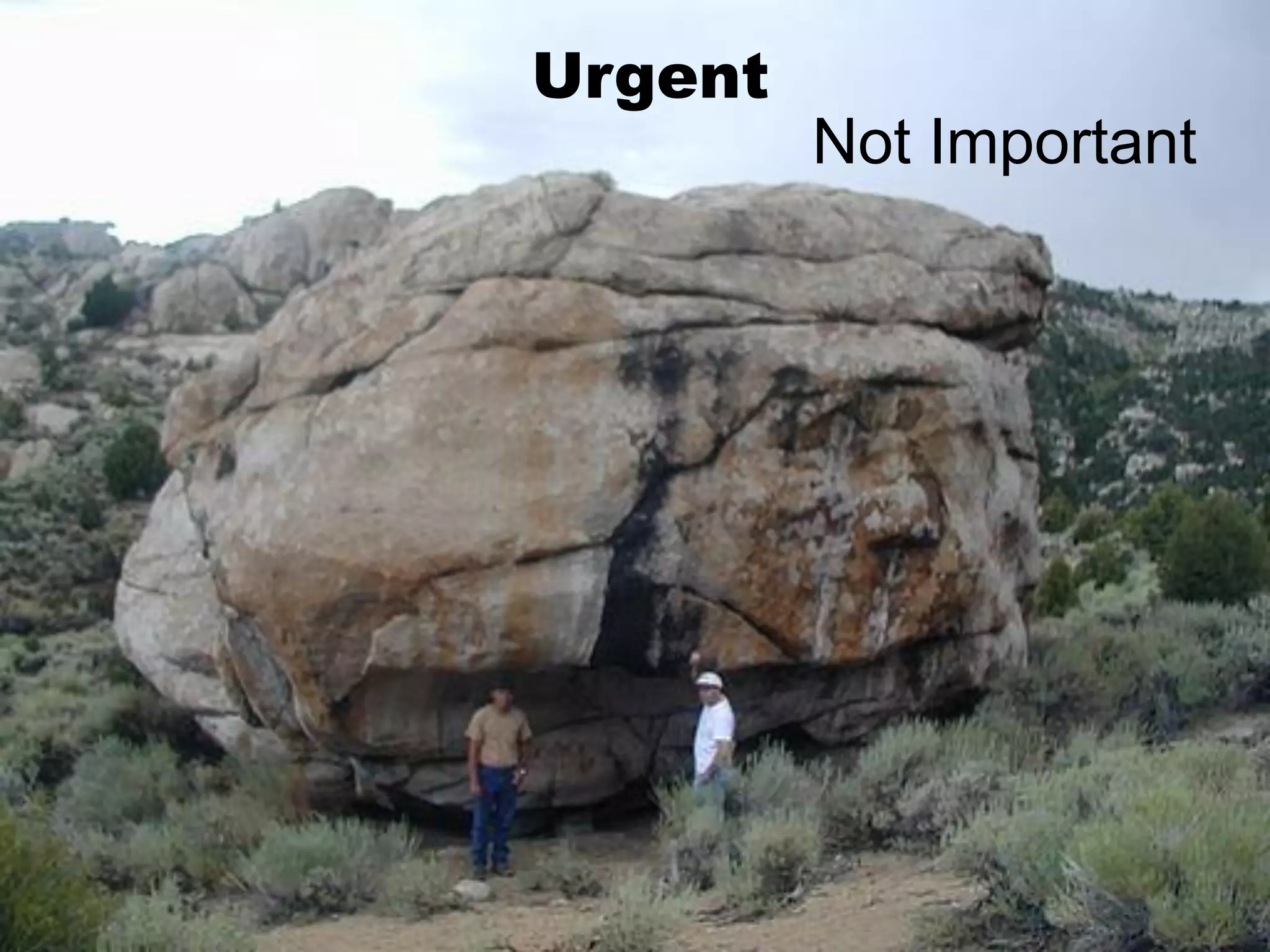
Slide 9: However, some activities become short on time due to unanticipated disruptions, inadequate planning, or procrastination. To minimize the impact to the rest of your schedule, allow some time for unanticipated problems and unexpected important tasks that need immediate attention. To minimize last-minute activities, plan in advance and do not procrastinate. Slide 10: Urgent activities that are not important are impediments that stop your progress toward your goals. Often, they involve requests from others that interfere with your own important work. Potential approaches to handling these issues include: 
•Declining or delegating the task 
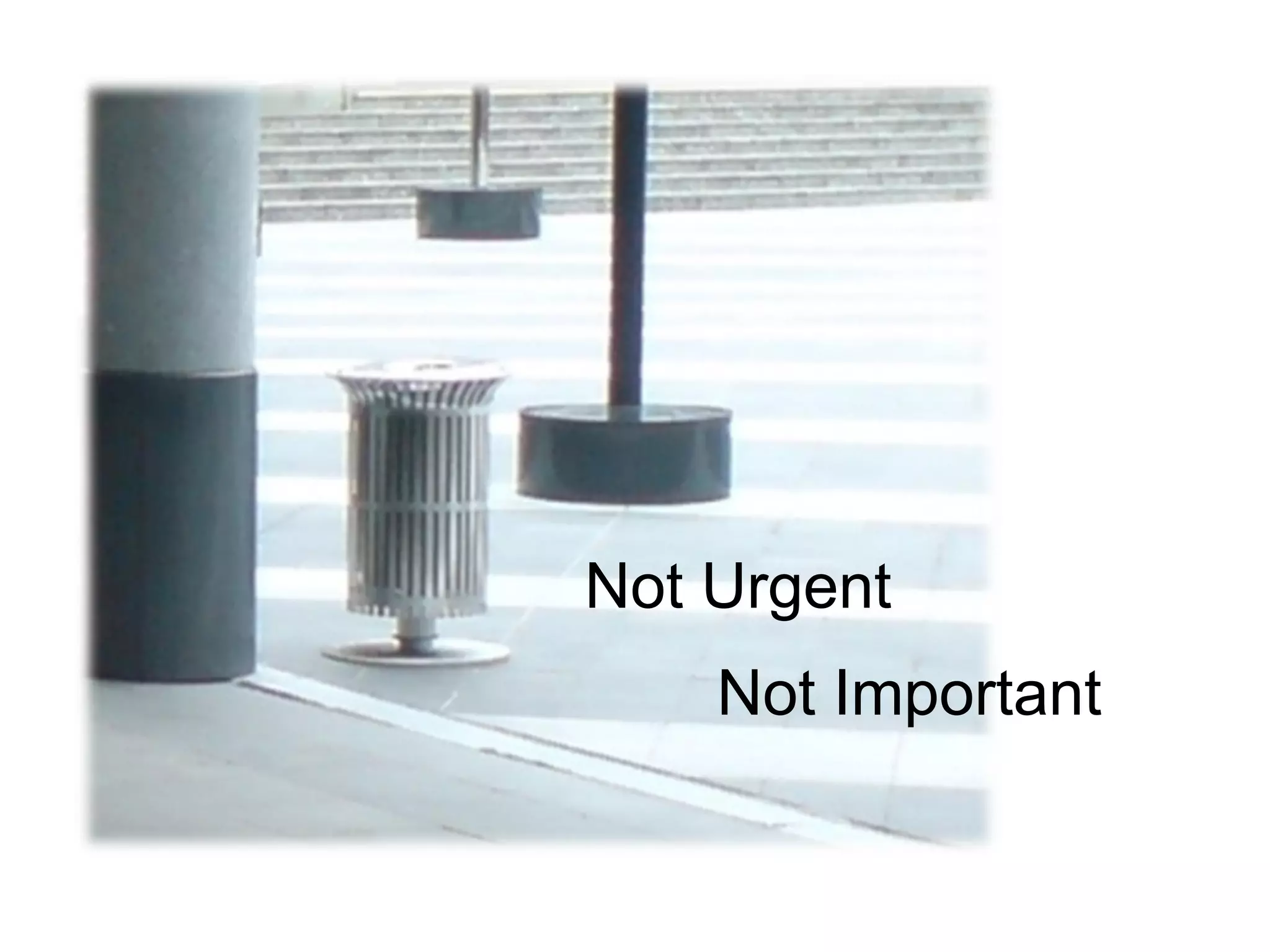
•Setting aside a specific time when you can be interrupted for such requests Slide 11: Not urgent? Not important? Toss it!

The Urgent/Important Matrix (Presentation Zen style)

  • 1.
    !mportant Urgent! The Matrix zen Danielle Nocon
  • 2.
  • 3.
    Important Not Urgent Urgent Important Not Important Urgent Not Urgent Not Important
  • 4.
  • 5.
    Urgent! Activities demand immediate ATTENTION!
  • 6.
    What is important is seldom urgent and what is urgent is seldom important. Dwight D. Eisenhower
  • 7.
  • 8.
  • 9.
  • 10.
  • 11.
    Not Urgent NotImportant
  • 12.
    Bibliography Reynolds, Garr.Presentation Zen: Simple Ideas on Presentation Design and Delivery. 2nd ed. Berkeley, CA: New Riders, 2012. “The Urgent/Important Matrix: Using Time Effectively, Not Just Efficiently.” Mind Tools. Retrieved from http://www.mindtools.com/pages/article/newHTE_91.htm.
  • 13.
    Image Credits Slide2 Kurume Azalea Bonsai in Bloom (in training since 1982), US National Arboretum by Sudhirpv [CC BY-SA 3.0 (http://creativecommons.org/licenses/by-sa/3.0/)], via Wikimedia Commons (http://commons.wikimedia.org/wiki/File:Kurume_Azalea_Bonsai_in_Bloom_(in_training_since_1982),_US_National_Arboretum.jpg#mediaviewer/File:Kurume_Azalea_Bonsai_in_Bloom_%28in_training_since_1982%29%2C_US_National_Arboretum.jpg) Slide 4 Tunbridge Wells High Rocks Climber by Cmglee (Own work) [CC-BY-SA-3.0 (http://creativecommons.org/licenses/by-sa/3.0) or GFDL (http://www.gnu.org/copyleft/fdl.html)], via Wikimedia Commons (http://commons.wikimedia.org/wiki/File%3ATunbridge_Wells_High_Rocks_climber.jpg) Slide 5 Feuerwehrmann beim Brand einer Muelldeponie by Dennis Janssen (Own work), [CC BY-SA 3.9 (http://creativecommons.org/licenses/by-sa/3.0/)], via Wikimedia Commons (http://commons.wikimedia.org/wiki/File:Feuerwehrmann_beim_Brand_einer_Muelldeponie.JPG#mediaviewer/File:Feuerwehrmann_beim_Brand_einer_Muelldeponie.JPG) Slide 6 General of the Army Dwight D. Eisenhower 1947 by Unknown [Public Domain], via Wikimedia Commons (http://commons.wikimedia.org/wiki/File:General_of_the_Army_Dwight_D._Eisenhower_1947.jpg#mediaviewer/File:General_of_the_Army_Dwight_D._Eisenhower_1947.jpg)
  • 14.
    Slide 7 CoxBazar Sunset [Public Domain], via Wikimedia Commons (http://commons.wikimedia.org/wiki/File:Cox_Bazar_Sunset.jpg#mediaviewer/File:Cox_ Bazar_Sunset.jpg) Slide 8 Keeling Fire Engine Illustration, Author Unknown [Public Domain] via Wikimedia Commons (http://commons.wikimedia.org/wiki/File%3AKeeling-fire-engine- illustration.jpg) Slide 9 Alice White Rabbit by Sir John Tenniel (“Alice’s Adventures in Wonderland” (1865)) [Public domain], via Wikimedia Commons (http://commons.wikimedia.org/wiki/File%3AAlice-white-rabbit.jpg) Slide 10 Millard County Utah Miller Canyon Petroglyphs by Sid.L.Young (Own work) [CC- BY-SA-3.0 (http://creativecommons.org/licenses/by-sa/3.0)], via Wikimedia Commons (http://commons.wikimedia.org/wiki/File%3AMillard_County_Utah_Millers_Canyon_petroglyphs_1.JPG) Slide 11 detail of Surrounds of Newmarket Train Station by Uploader. (Own work (Own picture)). [Public domain], via Wikimedia Commons (http://commons.wikimedia.org/wiki/File%3ASurrounds_Of_Newmarket_Train_Station_I.jpg)
  • 15.
    Notes Since theNotes Panes are not visible in the PDF format, I have compiled here the notes that correspond to each slide and that briefly describe the concepts illustrated: Title Slide: The design of this presentation is intended to emulate the principles of Presentation Zen as advocated by Garr Reynolds. The content illustrates some key concepts from Mind Tools’ article “The Urgent/Important Matrix: Using Time Effectively, Not Just Efficiently” (http://www.mindtools.com/pages/article/newHTE_91.htm). Slide 2: Briefly, the fundamental elements of Presentation Zen include: •Simplicity, clarity, and brevity •Balance and harmony •Emphasis on engaging and memorable visuals: •That support clear communication of the message •By enhancing rather than reiterating the speaker’s words •And motivating the audience to listen to those words Slide 3: The Urgent/Important Matrix comprises the four combinations of these two elements: •Important but Not Urgent •Important and Urgent •Urgent but Not Important •Not Urgent and Not Important
  • 16.
    Slide 4: Importantactivities directly contribute to the accomplishment of your goals – either personal or professional. Slide 5: Urgent activities must be addressed swiftly to avoid or minimize immediate negative impact. Urgent activities tend to involve the goal’s of others. Slide 6: A quote from President Eisenhower, a purported practitioner of the method, expresses the essence of the concept: “What is important is seldom urgent and what is urgent is seldom important.” Slide 7: Ideally, you want to spend the majority of your day, the bulk of your time and energy, on the important tasks that advance you toward your own objectives. When completing these tasks is not urgent, you can perform quality work without the anxiety of time constraints. Slide 8: Inevitably, some important activities will arise on short notice. Urgent and important activities are actually of two distinct types: unforeseeable crises and last-minute activities. Crises requiring prompt action can occur suddenly and unpredictably.
  • 17.
    Slide 9: However,some activities become short on time due to unanticipated disruptions, inadequate planning, or procrastination. To minimize the impact to the rest of your schedule, allow some time for unanticipated problems and unexpected important tasks that need immediate attention. To minimize last-minute activities, plan in advance and do not procrastinate. Slide 10: Urgent activities that are not important are impediments that stop your progress toward your goals. Often, they involve requests from others that interfere with your own important work. Potential approaches to handling these issues include: •Declining or delegating the task •Setting aside a specific time when you can be interrupted for such requests Slide 11: Not urgent? Not important? Toss it!