EFFECTIVE  TIME MANAGEMENT TRAINING WORKSHOP
Renew yourself regularly
Objective of the Training Prioritize Effectively with Multitasks Manage and Control Crises Values Clarification with Superiors and Subordinates Increase Productivity  Reduce your Stress Levels Balance Work and Personal Priorities
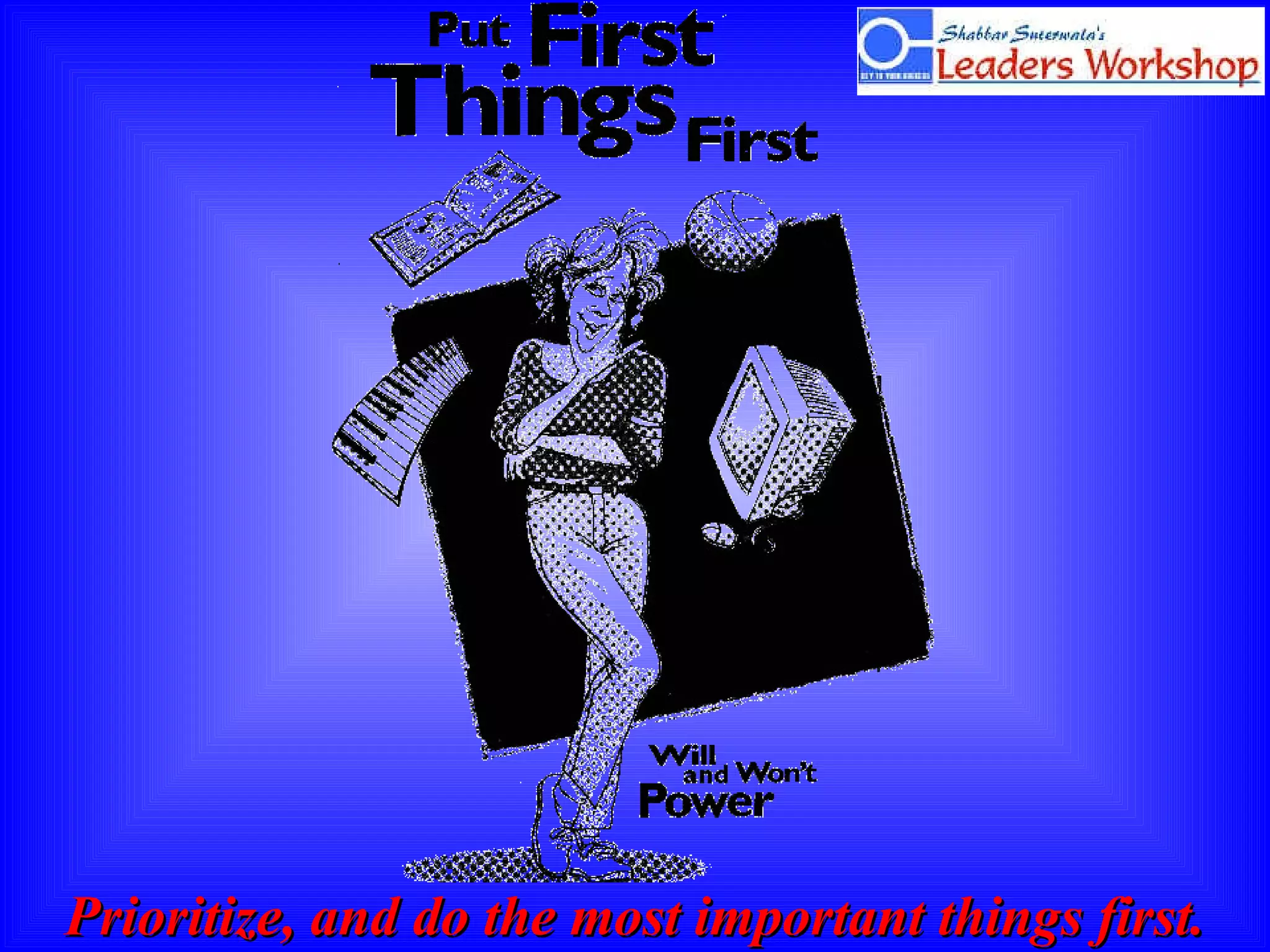
Prioritize, and do the most important things first.
Define your mission and goals in life.
“ Change is Universal… Change is Permanent….  Be ever willing to Change…..  For, change alone leads you to success and happiness!!!”
Pareto’s Principle  (80/20 Rule) 80% of Work gives 20% Results & 20% of Work gives 80% Results One Rs.500/-  v/s  Hundred Rs.5/-  Effective v/s Efficient Smart work  v/s Hard work
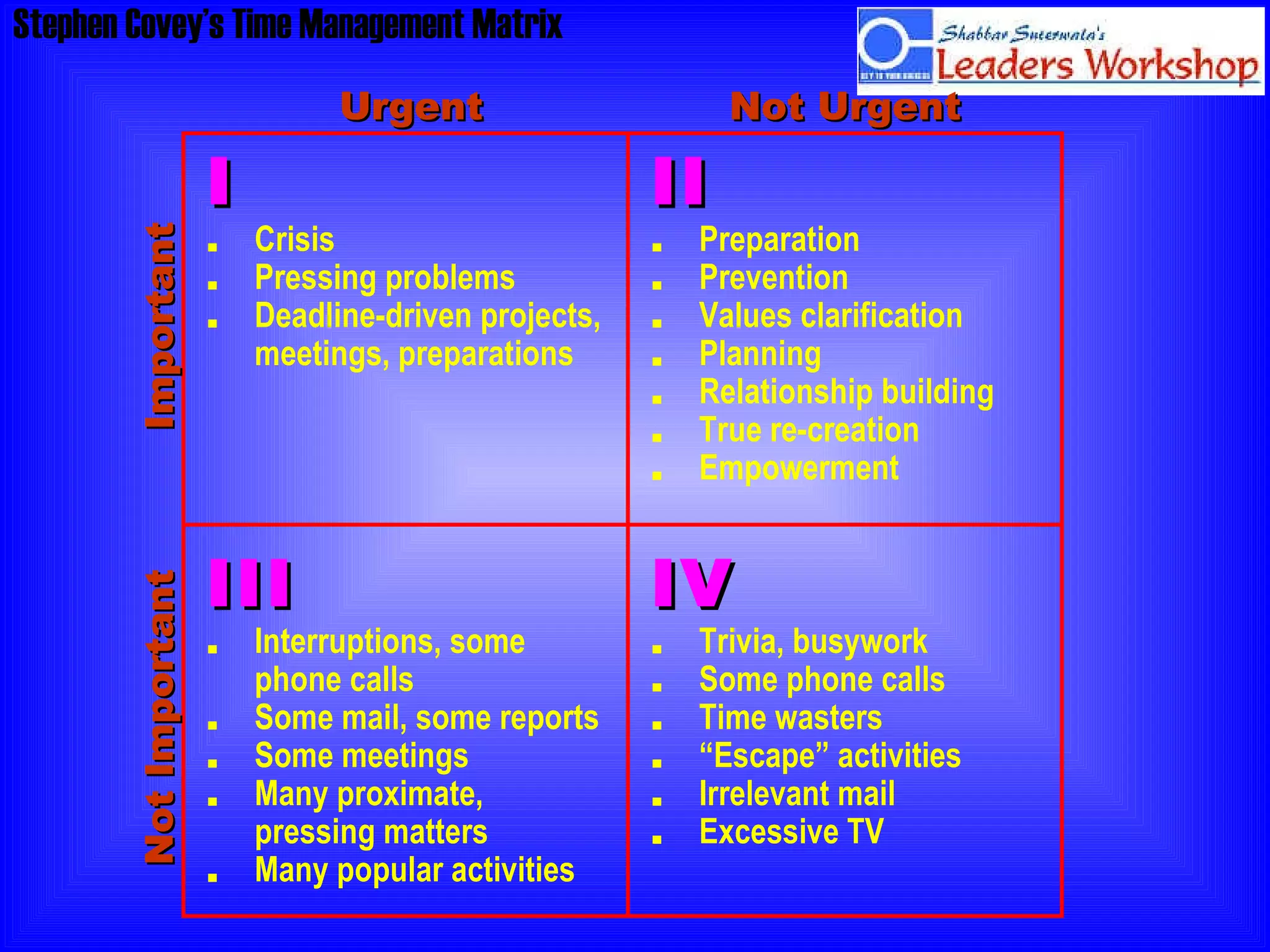
. Crisis .   Pressing problems .   Deadline-driven projects,  meetings, preparations .   Preparation .   Prevention .   Values clarification .   Planning .   Relationship building .   True re-creation .   Empowerment .   Interruptions, some  phone calls .   Some mail, some reports  .   Some meetings .   Many proximate, pressing matters .   Many popular activities .   Trivia, busywork .   Some phone calls .   Time wasters .   “Escape” activities . Irrelevant mail .   Excessive TV I II III IV Urgent Not Urgent Important Not Important Stephen Covey’s Time Management Matrix
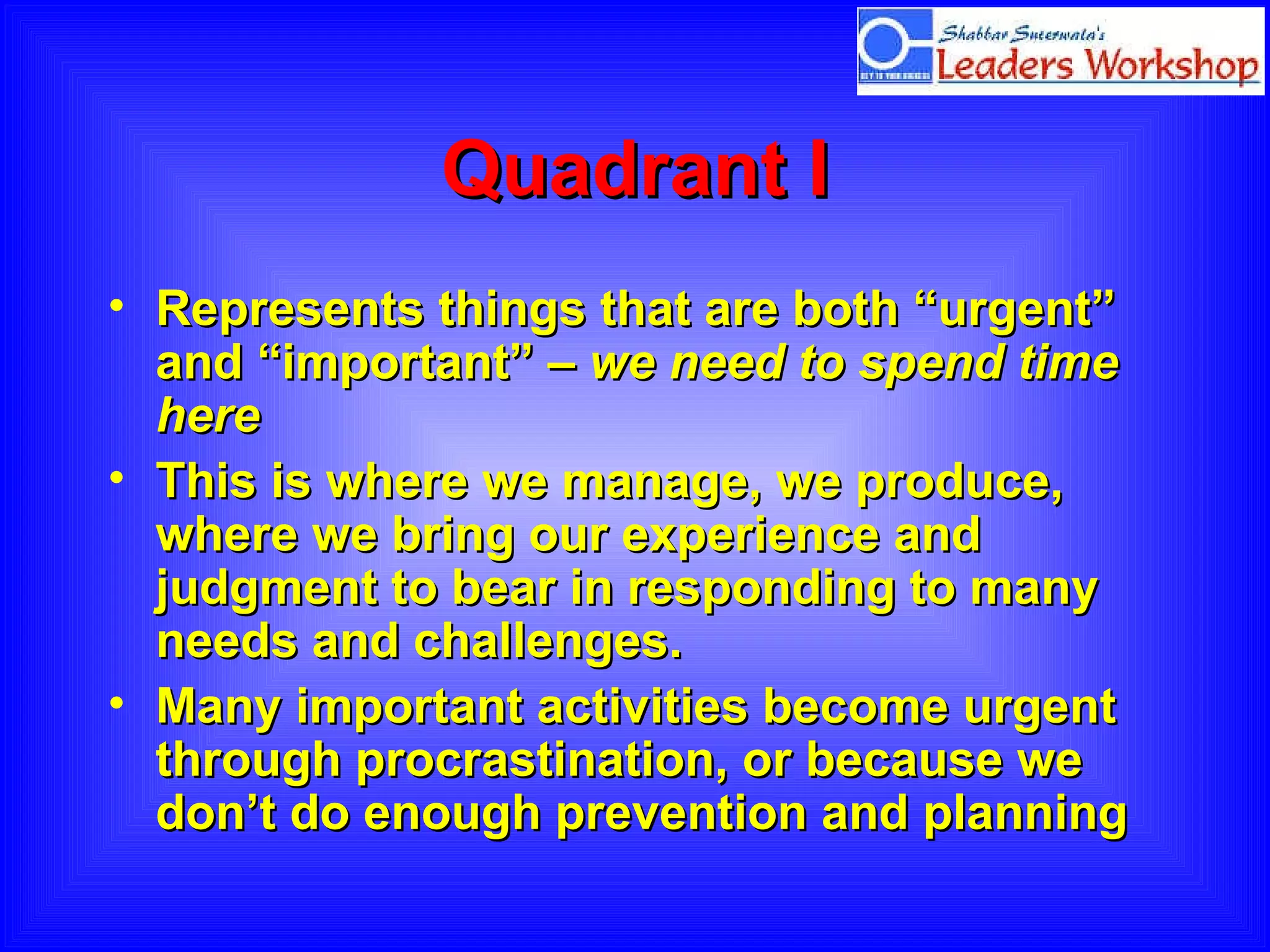
Quadrant I Represents things that are both “urgent” and “important” –  we need to spend time here This is where we manage, we produce, where we bring our experience and judgment to bear in responding to many needs and challenges.  Many important activities become urgent through procrastination, or because we don’t do enough prevention and planning
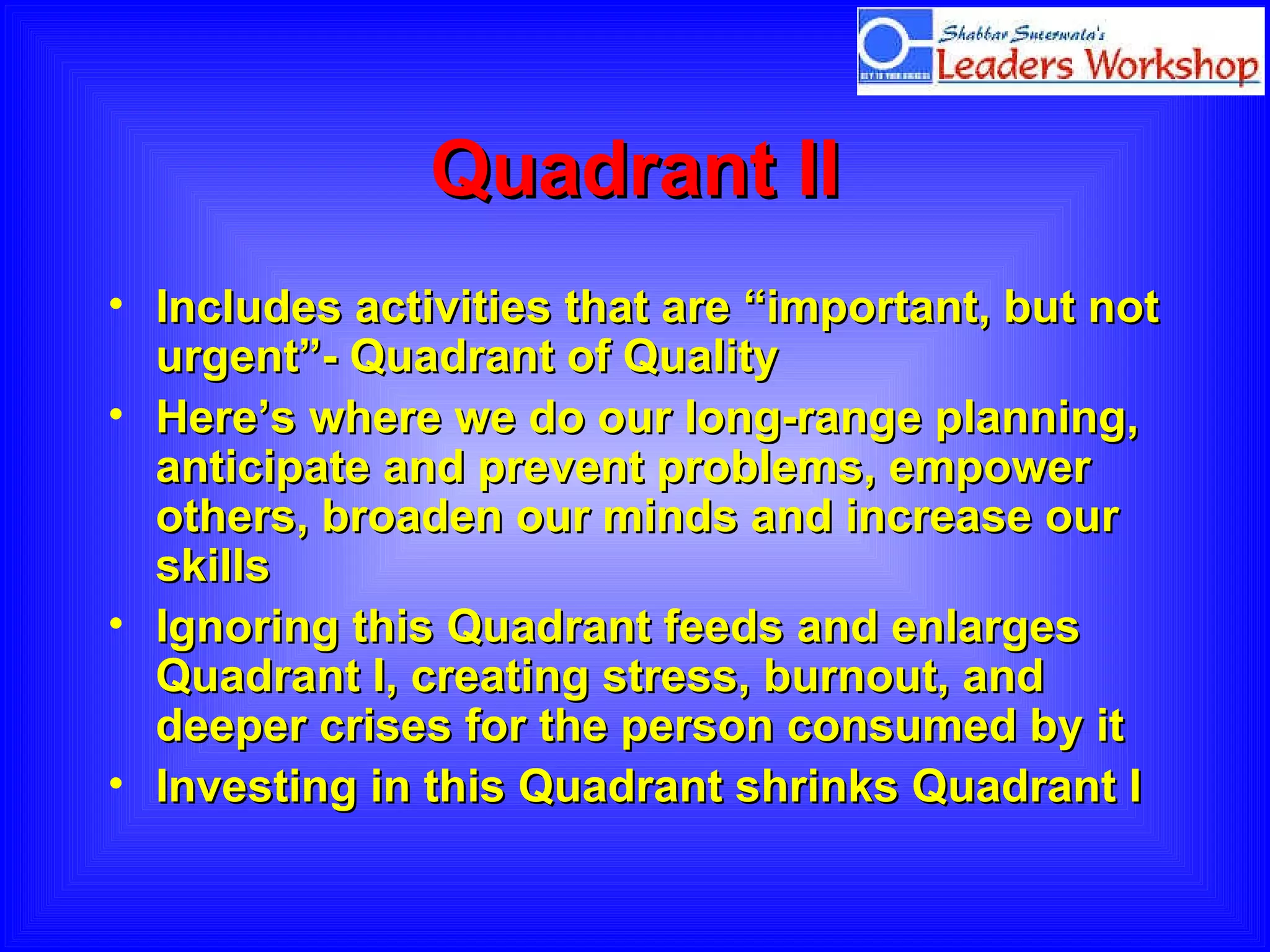
Quadrant II Includes activities that are “important, but not urgent”- Quadrant of Quality Here’s where we do our long-range planning, anticipate and prevent problems, empower others, broaden our minds and increase our skills Ignoring this Quadrant feeds and enlarges Quadrant I, creating stress, burnout, and deeper crises for the person consumed by it Investing in this Quadrant shrinks Quadrant I
Quadrant III Includes things that are “urgent, but not important” - Quadrant of Deception.  The noise of urgency creates the illusion of importance.  Actual activities, if they’re important at all, are important to someone else.  Many phone calls, meetings and drop-in visitors fall into this category
Quadrant IV Reserved for activities that are “not urgent, not important”- Quadrant of Waste We often “escape” to Quadrant IV for survival  Reading addictive novels, watching mindless television shows, or gossiping at office would qualify as Quadrant IV time-wasters
Is it bad to be in Quadrant I?  Are you in Quadrant I because of the urgency or the importance?  If urgency dominates, when importance fades, you’ll slip into Quadrant III.  But if you’re in Quadrant I because of importance, when urgency fades you’ll move to Quadrant II.
What is the problem with urgency? Urgency itself is not the problem… When urgency is the dominant factor in our lives, importance isn’t  What we regard as “first things” are urgent things
Where do I get time to spend in Quadrant II?   From Quadrant III  Time spent in Quadrant I is both urgent and important- we already know we need to be there  We know we shouldn’t be there in Quadrant IV  But Quadrant III can fool us
MINOR TIME WASTERS Interruptions we face during the day Being a slave on the telephone Unexpected/Unwanted visitors Needless reports/Junk mail Meetings without agenda
MAJOR   TIME WASTERS Procrastination Afraid to Delegate Not Wanting to Say "NO" Low Self-Esteem Problems With Objectives/Priorities
WHAT CAN STOP YOU? Negative Thoughts Negative People Low Self-Esteem Fear of Failure  Fear of Rejection / Criticism
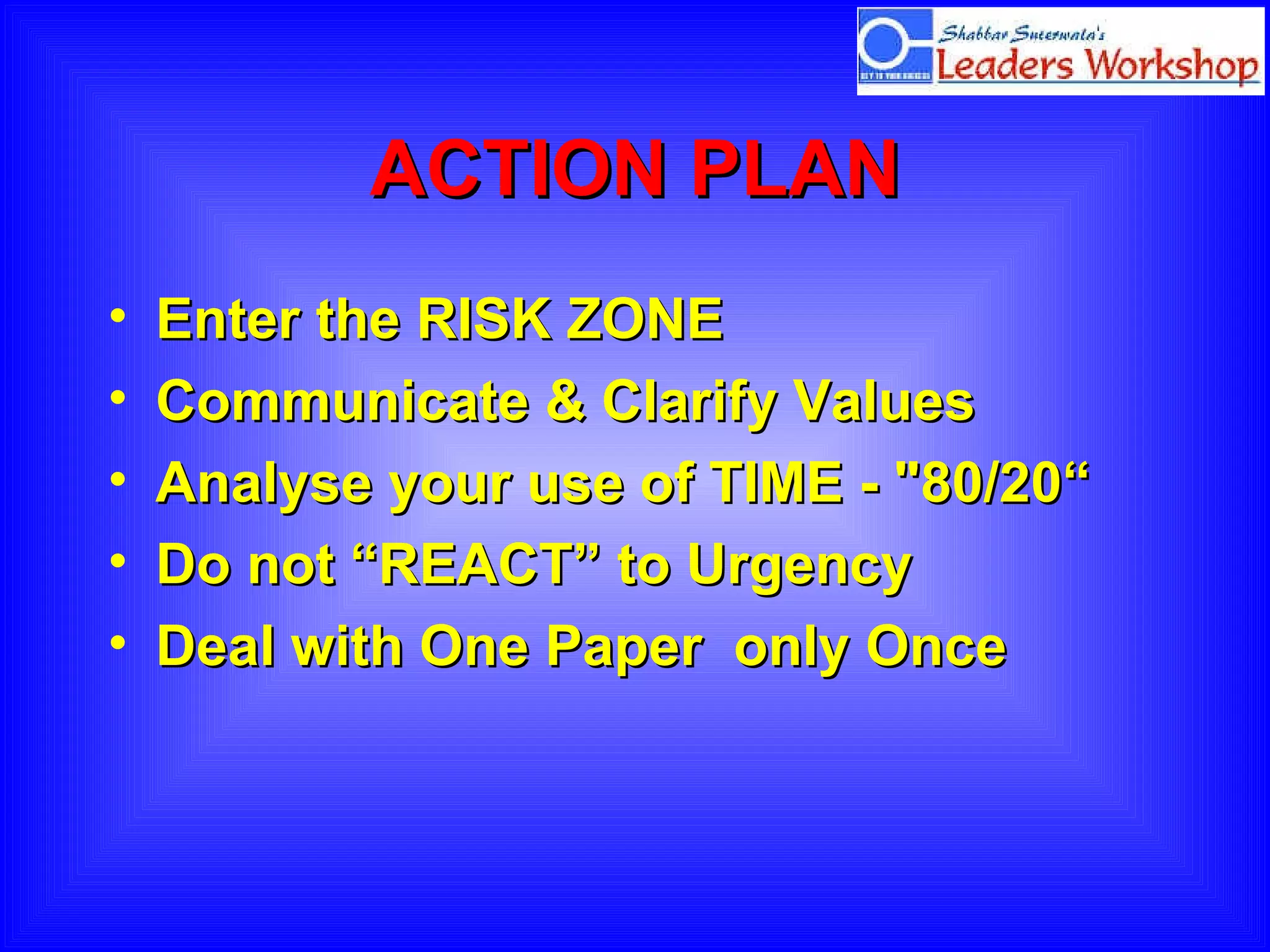
ACTION PLAN Enter the RISK ZONE Communicate & Clarify Values Analyse your use of TIME - "80/20“ Do not “REACT” to Urgency  Deal with One Paper  only Once
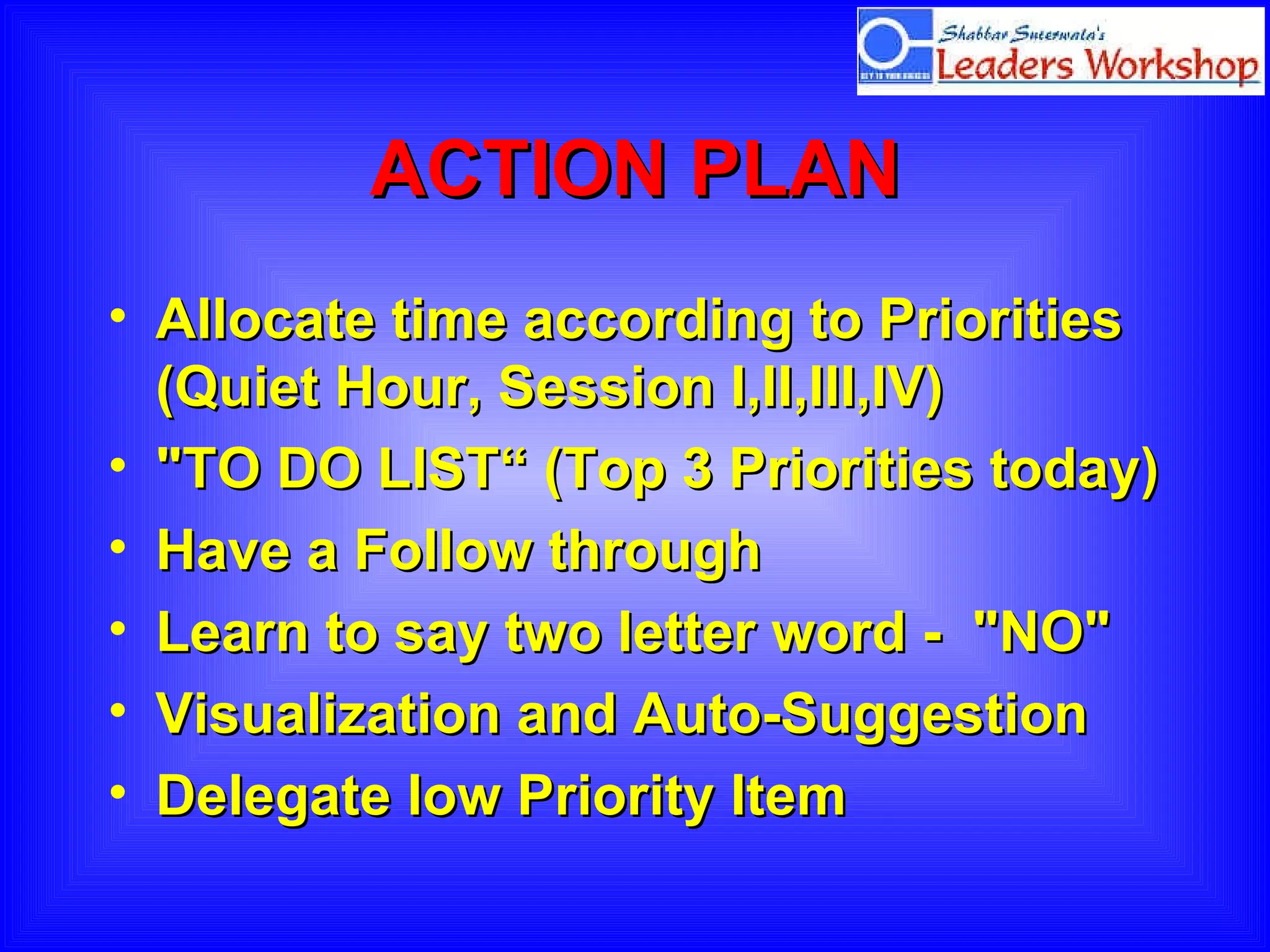
ACTION PLAN Allocate time according to Priorities (Quiet Hour, Session I,II,III,IV) "TO DO LIST“ (Top 3 Priorities today) Have a Follow through Learn to say two letter word -  "NO" Visualization and Auto-Suggestion Delegate low Priority Item
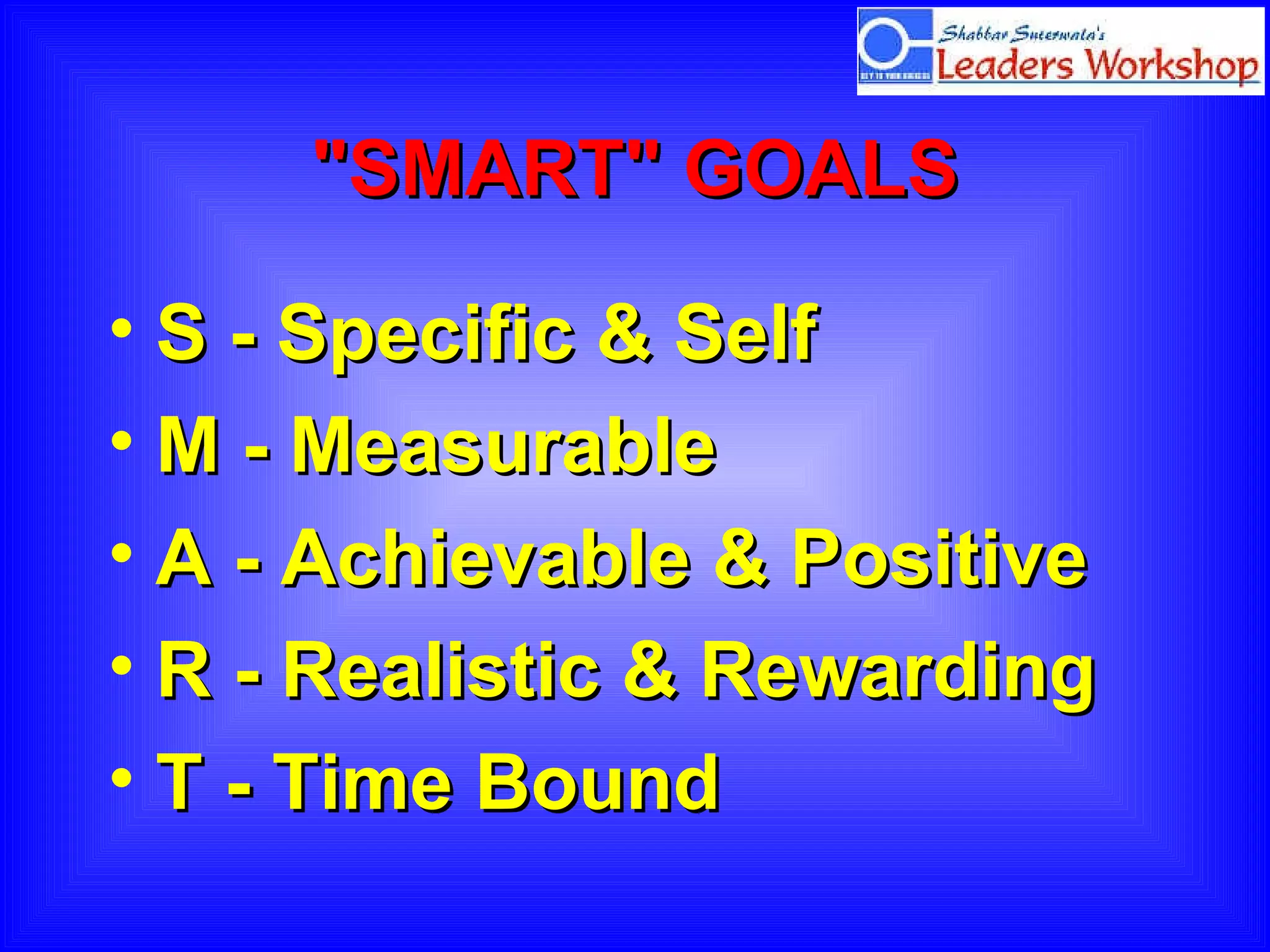
"SMART" GOALS S - Specific & Self M - Measurable A - Achievable & Positive R - Realistic & Rewarding T - Time Bound
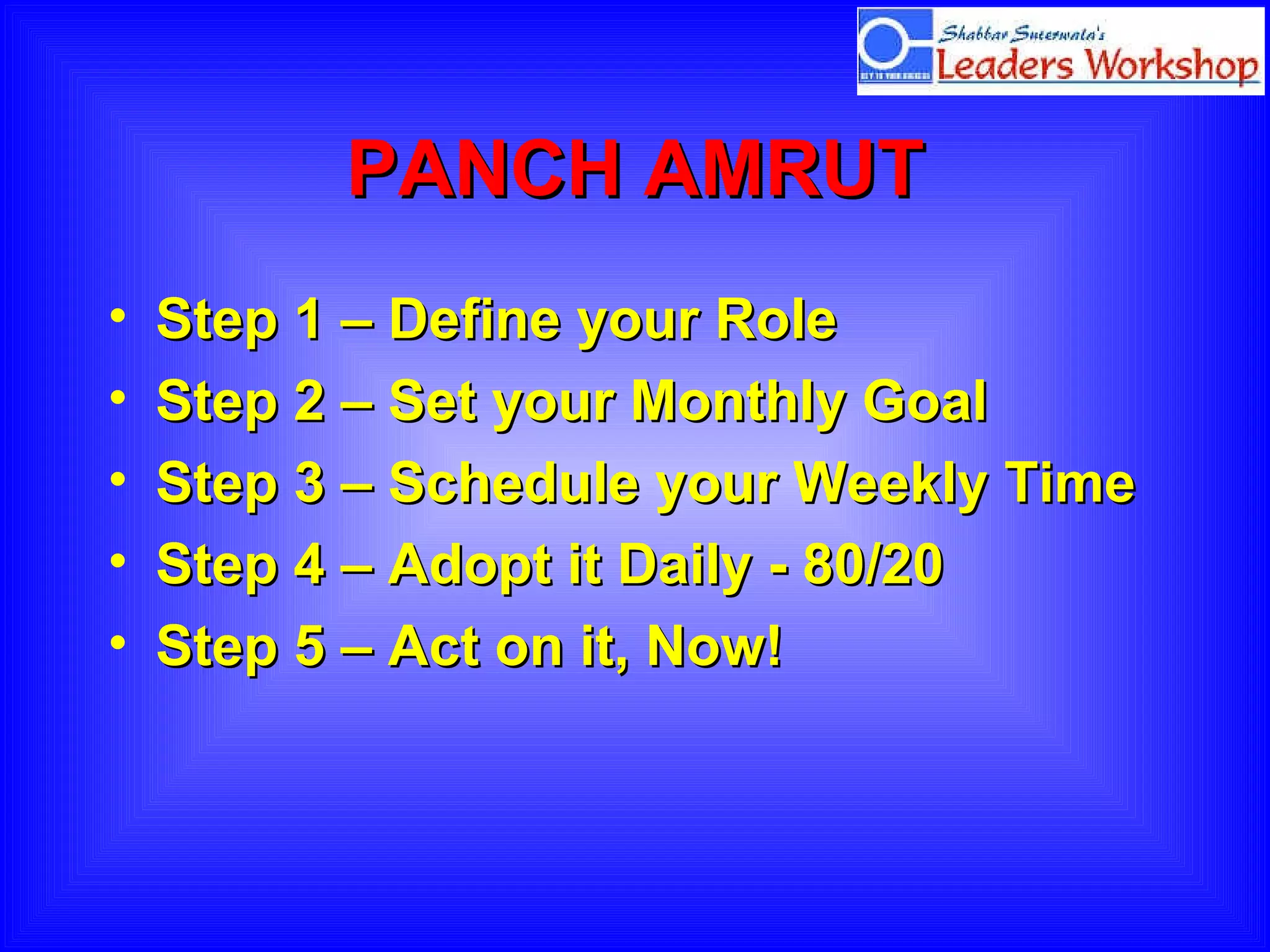
PANCH AMRUT Step 1 – Define your Role Step 2 – Set your Monthly Goal Step 3 – Schedule your Weekly Time  Step 4 – Adopt it Daily - 80/20 Step 5 – Act on it, Now!
For CD of Soft Skills Presentations contact Email:  [email_address] Or Call: +91-989 222 5864 Designed & Created by Shabbar Suterwala – Director Leaders Workshop Corporate Soft Skills Trainer – NLP Practitioner

Effective time-management-important-vs-urgent

  • 1.
    EFFECTIVE TIMEMANAGEMENT TRAINING WORKSHOP
  • 2.
  • 3.
    Objective of theTraining Prioritize Effectively with Multitasks Manage and Control Crises Values Clarification with Superiors and Subordinates Increase Productivity Reduce your Stress Levels Balance Work and Personal Priorities
  • 4.
    Prioritize, and dothe most important things first.
  • 5.
    Define your missionand goals in life.
  • 6.
    “ Change isUniversal… Change is Permanent…. Be ever willing to Change….. For, change alone leads you to success and happiness!!!”
  • 7.
    Pareto’s Principle (80/20 Rule) 80% of Work gives 20% Results & 20% of Work gives 80% Results One Rs.500/- v/s Hundred Rs.5/- Effective v/s Efficient Smart work v/s Hard work
  • 8.
    . Crisis . Pressing problems . Deadline-driven projects, meetings, preparations . Preparation . Prevention . Values clarification . Planning . Relationship building . True re-creation . Empowerment . Interruptions, some phone calls . Some mail, some reports . Some meetings . Many proximate, pressing matters . Many popular activities . Trivia, busywork . Some phone calls . Time wasters . “Escape” activities . Irrelevant mail . Excessive TV I II III IV Urgent Not Urgent Important Not Important Stephen Covey’s Time Management Matrix
  • 9.
    Quadrant I Representsthings that are both “urgent” and “important” – we need to spend time here This is where we manage, we produce, where we bring our experience and judgment to bear in responding to many needs and challenges. Many important activities become urgent through procrastination, or because we don’t do enough prevention and planning
  • 10.
    Quadrant II Includesactivities that are “important, but not urgent”- Quadrant of Quality Here’s where we do our long-range planning, anticipate and prevent problems, empower others, broaden our minds and increase our skills Ignoring this Quadrant feeds and enlarges Quadrant I, creating stress, burnout, and deeper crises for the person consumed by it Investing in this Quadrant shrinks Quadrant I
  • 11.
    Quadrant III Includesthings that are “urgent, but not important” - Quadrant of Deception. The noise of urgency creates the illusion of importance. Actual activities, if they’re important at all, are important to someone else. Many phone calls, meetings and drop-in visitors fall into this category
  • 12.
    Quadrant IV Reservedfor activities that are “not urgent, not important”- Quadrant of Waste We often “escape” to Quadrant IV for survival Reading addictive novels, watching mindless television shows, or gossiping at office would qualify as Quadrant IV time-wasters
  • 13.
    Is it badto be in Quadrant I? Are you in Quadrant I because of the urgency or the importance? If urgency dominates, when importance fades, you’ll slip into Quadrant III. But if you’re in Quadrant I because of importance, when urgency fades you’ll move to Quadrant II.
  • 14.
    What is theproblem with urgency? Urgency itself is not the problem… When urgency is the dominant factor in our lives, importance isn’t What we regard as “first things” are urgent things
  • 15.
    Where do Iget time to spend in Quadrant II? From Quadrant III Time spent in Quadrant I is both urgent and important- we already know we need to be there We know we shouldn’t be there in Quadrant IV But Quadrant III can fool us
  • 16.
    MINOR TIME WASTERSInterruptions we face during the day Being a slave on the telephone Unexpected/Unwanted visitors Needless reports/Junk mail Meetings without agenda
  • 17.
    MAJOR TIME WASTERS Procrastination Afraid to Delegate Not Wanting to Say "NO" Low Self-Esteem Problems With Objectives/Priorities
  • 18.
    WHAT CAN STOPYOU? Negative Thoughts Negative People Low Self-Esteem Fear of Failure Fear of Rejection / Criticism
  • 19.
    ACTION PLAN Enterthe RISK ZONE Communicate & Clarify Values Analyse your use of TIME - "80/20“ Do not “REACT” to Urgency Deal with One Paper only Once
  • 20.
    ACTION PLAN Allocatetime according to Priorities (Quiet Hour, Session I,II,III,IV) "TO DO LIST“ (Top 3 Priorities today) Have a Follow through Learn to say two letter word - "NO" Visualization and Auto-Suggestion Delegate low Priority Item
  • 21.
    "SMART" GOALS S- Specific & Self M - Measurable A - Achievable & Positive R - Realistic & Rewarding T - Time Bound
  • 22.
    PANCH AMRUT Step1 – Define your Role Step 2 – Set your Monthly Goal Step 3 – Schedule your Weekly Time Step 4 – Adopt it Daily - 80/20 Step 5 – Act on it, Now!
  • 23.
    For CD ofSoft Skills Presentations contact Email: [email_address] Or Call: +91-989 222 5864 Designed & Created by Shabbar Suterwala – Director Leaders Workshop Corporate Soft Skills Trainer – NLP Practitioner