1
In the Name of Allah the Most Beneficent and Merciful
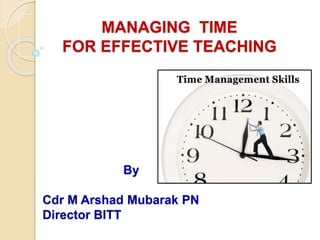
MANAGING TIME
FOR EFFECTIVE TEACHING
By
Cdr M Arshad Mubarak PN
Director BITT
What challenges do you
face in managing Time?
Problem # 1
There’s so much to do and there’s never
enough time. I feel pressured and
hassled all day, every day, seven days a
week. I’ve attended time management
seminars and I’ve tried half a dozen
different planning strategies. They have
helped somewhat, but I still don’t feel I’m
living the happy productive and peaceful
life I want to live.
Problem # 2
I’ve set and met my career goals and
I’m having tremendous professional
success. But at the cost of my
personal and family life. I don’t know
my wife/husband and children any
more. I’m not even sure I know myself
and what’s really important to me.
A Big Question…!!!
 If so, then what is the reason we
feel unsatisfied, unfulfilled,
incomplete, frustrated, being
wasted….and what not..!!
The Problem
 More things to do in a limited time
 Need to set our Priorities
 Lack of Balance in our life
 Curing symptoms instead of cause
 Focusing on ‘Urgent’ tasks rather than
‘Important’
 Time Wasters
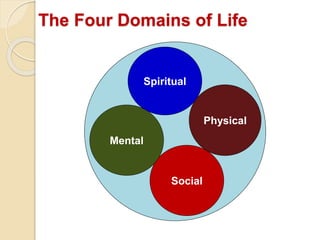
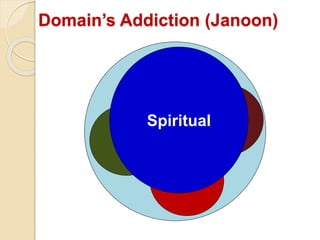
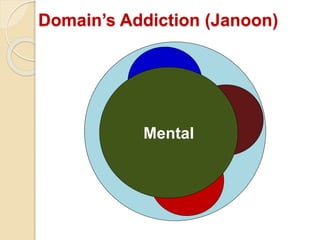
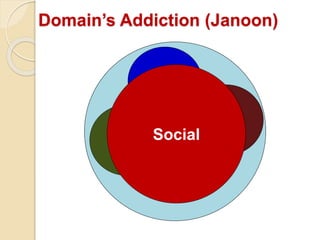
The Four Domains of Life
Spiritual
Physical
Social
Mental
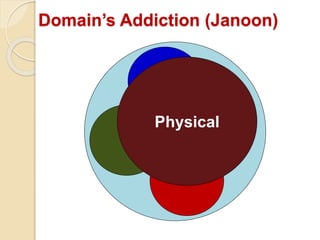
Domain’s Addiction (Janoon)
Physical
Spiritual
Domain’s Addiction (Janoon)
Mental
Domain’s Addiction (Janoon)
Social
Domain’s Addiction (Janoon)
Spiritual
Physical
Social
Mental
Balance… The Real Satisfaction
Activity
List down the tasks you have
performed today pertaining to
each domain of your life.
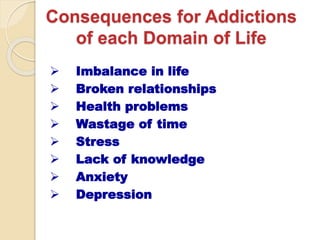
Consequences for Addictions
of each Domain of Life
 Imbalance in life
 Broken relationships
 Health problems
 Wastage of time
 Stress
 Lack of knowledge
 Anxiety
 Depression
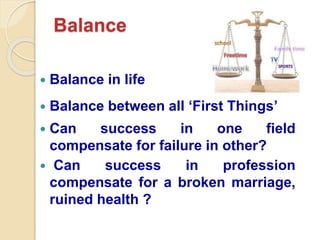
Balance
 Balance in life
 Balance between all ‘First Things’
 Can success in one field
compensate for failure in other?
 Can success in profession
compensate for a broken marriage,
ruined health ?
Balance
 “I think the world today is upside-down.
It is suffering so much because there is
so little love in the home and in family
life. We have no time for our children.
We have no time for each other. There
is no time to enjoy each other, and the
lack of love causes so much suffering
and unhappiness in the world.”
(Mother Teresa)
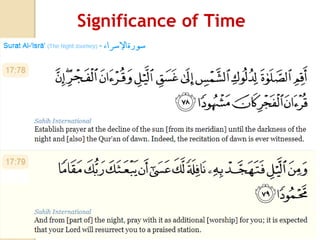
Significance of Time
21
What is time to you????
Time is the coin of your life. It is the
only coin you have, and only you can
determine how it will be spent. Be
careful lest you let other people
spend it for you.
(Carl Sandburg)
22
 Time is a unique resource that cannot be
rented, hired or bought
 The supply of time is totally inelastic
 There is no price for it
 Time is totally perishable/consumable
 It cannot be stored
 There is no substitute for time
 Everything requires time to accomplish
 All work takes place in time and uses up time
What is Time ?
23
Why Managing the Time?
 To increase its availability
 To achieve targets/deadlines
 To have peace of mind.
 To be more effective.
 To bring peace, productivity and happiness.
24
Myths of Time Management
 By doing it yourself, tasks are achieved faster
and better.
 Most executives are overworked.
 The ‘open door’ policy improves the
manager’s effectiveness in dealing with his
team.
 No one has enough time.
 Time flies.
 Time is against us.
25
Enemies of Time
 People without goals.
 People without a lot to do.
 Interrupters.
 People who call you and then put you on hold.
 Cars that spend a lot of time being repaired.
 Anyone who does not cherish the value of
time.
 Fueling of cars
 Others?
26
Symptoms of Poor Time Management
 Never having time to do the really
important work.
 Devoting too much time to the ‘urgent’
rather than the ‘important’.
 Frequently staying late at the office.
 Taking file work at home.
 Rarely having time to keep up to date
with paperwork.
Cont---
27
Symptoms of Poor Time Management
 Doing the work of others.
 Attending too many meetings.
 Having difficulty in saying ‘No’.
 Letting others dictate how you use your
time.
 Frequently feeling stressed, anxious and
time pressured.
 Rarely completing work on time.
28
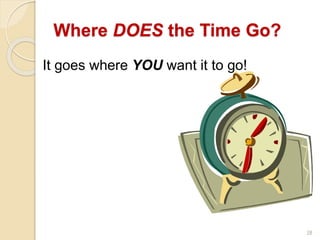
Where DOES the Time Go?
It goes where YOU want it to go!
29
What is Time Management?
 Time Management means the efficient
use of our resources, including time,
in such a way that we are effective in
achieving long term goals.
 It is a continuous, ongoing process of
analyzing, planning, reanalyzing and
re-planning.
(Jack D. Ferner)
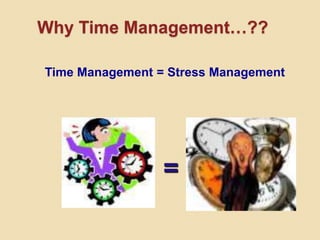
Why Time Management…??
Time Management = Stress Management
=
31
80% of unfocussed effort generates only
20% of results. The remaining 80% of
results are achieved with only 20% of the
focused effort.
Pareto Principle
The 80 : 20 Rule
32
Please write down the Meaning of
the words ‘Important’ and ‘Urgent’
33
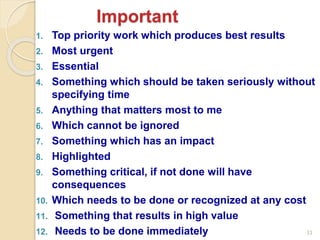
1. Top priority work which produces best results
2. Most urgent
3. Essential
4. Something which should be taken seriously without
specifying time
5. Anything that matters most to me
6. Which cannot be ignored
7. Something which has an impact
8. Highlighted
9. Something critical, if not done will have
consequences
10. Which needs to be done or recognized at any cost
11. Something that results in high value
12. Needs to be done immediately
Important
34
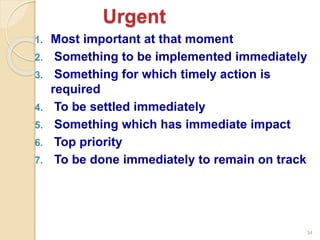
1. Most important at that moment
2. Something to be implemented immediately
3. Something for which timely action is
required
4. To be settled immediately
5. Something which has immediate impact
6. Top priority
7. To be done immediately to remain on track
Urgent
35
Important:
Anything that takes us towards our ‘desired
destination’ and adds value to our life is
called important.
Unimportant:
Anything that doesn’t take us towards or
takes us away from our ‘desired destination’
and does not add any value to our life is
called Unimportant or Not Important.
Definition of Important
36
“Urgent is defined as anything which
if not done in the present, most
probably cannot be done later if you
are alive and able.”
Definition of Urgent
37
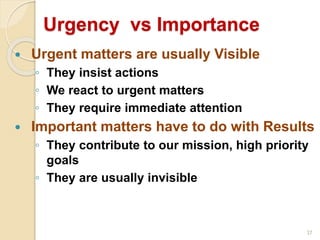
Urgency vs Importance
 Urgent matters are usually Visible
◦ They insist actions
◦ We react to urgent matters
◦ They require immediate attention
 Important matters have to do with Results
◦ They contribute to our mission, high priority
goals
◦ They are usually invisible
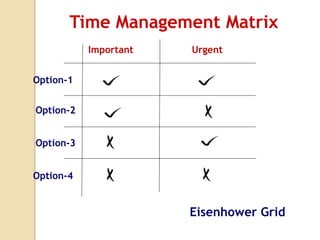
Important Urgent
Time Management Matrix
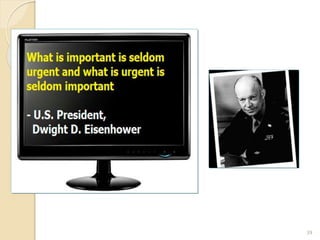
Eisenhower Grid
Option-1
Option-2
Option-3
Option-4
39
40
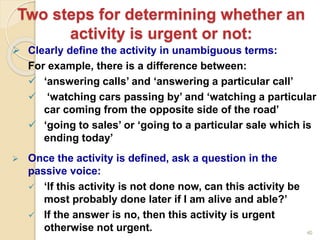
Two steps for determining whether an
activity is urgent or not:
 Clearly define the activity in unambiguous terms:
For example, there is a difference between:
 ‘answering calls’ and ‘answering a particular call’
 ‘watching cars passing by’ and ‘watching a particular
car coming from the opposite side of the road’
 ‘going to sales’ or ‘going to a particular sale which is
ending today’
 Once the activity is defined, ask a question in the
passive voice:
 ‘If this activity is not done now, can this activity be
most probably done later if I am alive and able?’
 If the answer is no, then this activity is urgent
otherwise not urgent.
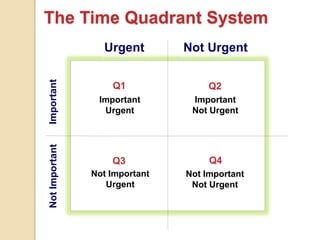
The Time Quadrant System
Urgent Not UrgentNotImportantImportant
Q1
Important
Urgent
Q3
Not Important
Urgent
Q2
Important
Not Urgent
Q4
Not Important
Not Urgent
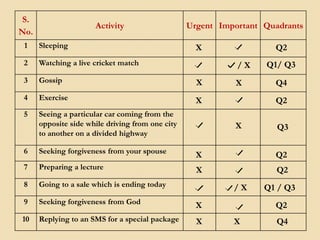
S.
No.
Activity Urgent Important Quadrants
1 Sleeping
2 Watching a live cricket match
3 Gossip
4 Exercise
5 Seeing a particular car coming from the
opposite side while driving from one city
to another on a divided highway
6 Seeking forgiveness from your spouse
7 Preparing a lecture
8 Going to a sale which is ending today
9 Seeking forgiveness from God
10 Replying to an SMS for a special package
X Q2
Q1/ Q3
X Q4
X Q2
X Q3
X Q2
X Q2
/ X Q1 / Q3
X Q2
/ X
X
X X Q4
Urgent Not Urgent
NotImportantImportant
Q 1
Q 3
Q 2
Q 4
General checking of emails
P
Urgent Not Urgent
NotImportantImportant
Q 1
Q 3
Q 2
Q 4
Checking an email from a colleague who sent a request
that has to be responded within two hours
P
Urgent Not Urgent
NotImportantImportant
Q 1
Q 3
Q 2
Q 4
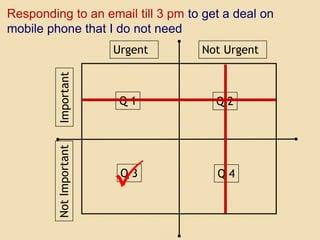
Responding to an email till 3 pm to get a deal on
mobile phone that I do not need
P
Urgent Not Urgent
NotImportantImportant
Q 1
Q 3
Q 2
Q 4
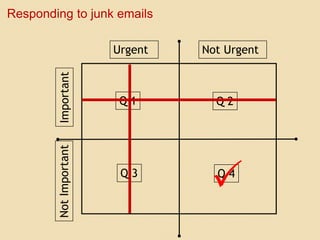
Responding to junk emails
P
Urgent Not Urgent
NotImportantImportant
Q 1
Q 3
Q 2
Q 4
P
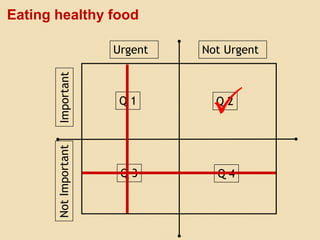
Eating healthy food
Urgent Not Urgent
NotImportantImportant
Q 1
Q 3
Q 2
Q 4
P
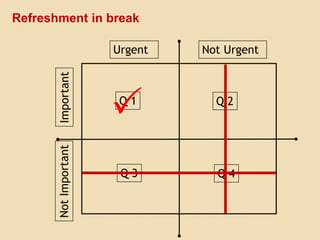
Refreshment in break
“ It is not only important to know,
What is IMPORTANT to you ?
But
It is also important to know,
What is NOT IMPORTANT to you?”
“If something is not urgent, it means
it is not necessary to do it now!”
Misconception
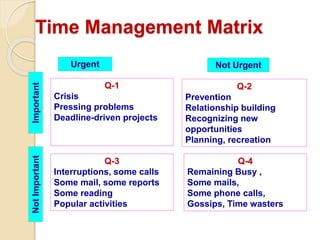
Time Management Matrix
Q-1
Crisis
Pressing problems
Deadline-driven projects
Q-2
Prevention
Relationship building
Recognizing new
opportunities
Planning, recreation
Q-3
Interruptions, some calls
Some mail, some reports
Some reading
Popular activities
Q-4
Remaining Busy ,
Some mails,
Some phone calls,
Gossips, Time wasters
Urgent Not Urgent
ImportantNotImportant
52
Quadrant -1
 Both Urgent and Important
 Deals with significant results that need
our immediate attention
 Crisis management
 Shallow or broken relationships
 May consume many people to become
crisis managers.
 May neglect other quadrants.
 Focus on Q-I makes it bigger and bigger
 Internal and External Q-1s
53
Quadrant -3
 Urgent but not Important
 Short term focus
 Crisis management
 React to urgent assuming them
important
 Think they are in Q-1
 Shallow or broken relationships
54
Quadrant -4
 Not Urgent, Not Important
 Total irresponsibility if overdone
 Dependent on others for basics.
 An escape zone
 Professional as well as relationship loss
 Fired from job
Quadrant - 4
“It's not so important how busy you
are, but why you are busy. The bee is
praised. The mosquito is swatted.”
(Mary O'Connor)
56
Quadrant -2
 Things that are Important but not Urgent
 Heart of self-management
 Building relationships, planning,
preventive maintenance, preparation
 Recognizing new opportunities
 Recreation
 Prevention rather than prioritizing crisis
Group Activity
List down activities of your
job related to each quadrant.
Urgent Not Urgent
NotImportantImportant
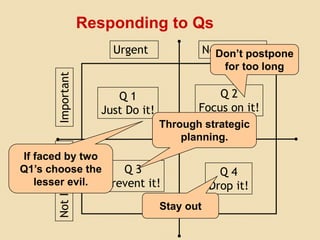
Q 1
Just Do it!
Q 3
Prevent it!
Q 2
Focus on it!
Q 4
Drop it!
Responding to Qs
If faced by two
Q1’s choose the
lesser evil.
Don’t postpone
for too long
Through strategic
planning.
Stay out
41
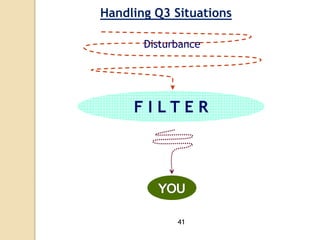
Handling Q3 Situations
F I L T E R
Disturbance
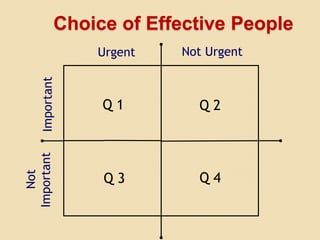
Urgent Not Urgent
Not
ImportantImportant
Q 1 Q 2
Q 3 Q 4
“The degree of success of a person is
directly proportional to the number of
hours he / she puts in Q2 activities in a
day.”
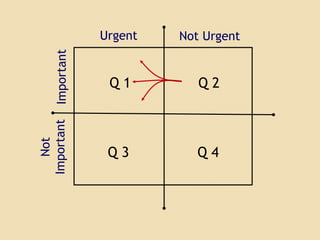
Choice of Effective People
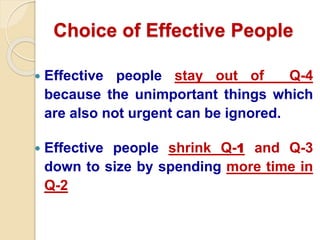
 Effective people stay out of Q-4
because the unimportant things which
are also not urgent can be ignored.
 Effective people shrink Q-1 and Q-3
down to size by spending more time in
Q-2
Urgent Not Urgent
Not
ImportantImportant
Q 1 Q 2
Q 3 Q 4
Choice of Effective People
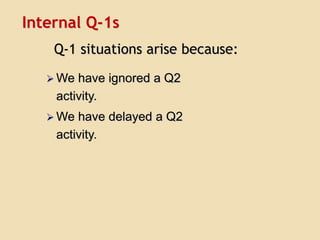
Internal Q-1s
Q-1 situations arise because:
 We have ignored a Q2
activity.
 We have delayed a Q2
activity.
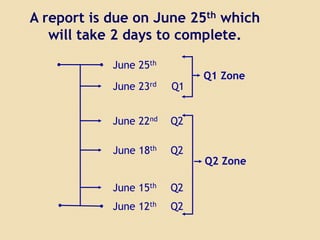
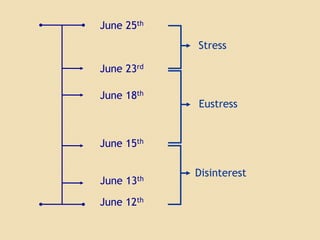
A report is due on June 25th which
will take 2 days to complete.
June 12th
June 15th
June 18th
June 22nd
June 23rd
June 25th
Q2 Zone
Q1 Zone
Q2
Q2
Q2
Q2
Q1
Disinterest
Eustress
Stress
June 12th
June 15th
June 18th
June 23rd
June 25th
June 13th
Hakeem Saeed
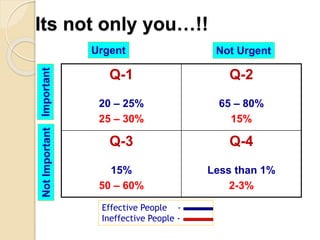
Its not only you…!!
Q-1
20 – 25%
25 – 30%
Q-2
65 – 80%
15%
Q-3
15%
50 – 60%
Q-4
Less than 1%
2-3%
Urgent Not UrgentImportantNotImportant
Effective People -
Ineffective People -
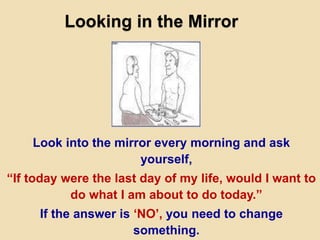
Looking in the Mirror
Look into the mirror every morning and ask
yourself,
“If today were the last day of my life, would I want to
do what I am about to do today.”
If the answer is ‘NO’, you need to change
something.
And the Last Thing..!!!
No person on his deathbed wishes
he had spent more time at the
office!
Time Management (Final)- Cdr Arshad

Time Management (Final)- Cdr Arshad

  • 1.
    1 In the Nameof Allah the Most Beneficent and Merciful
  • 2.
    MANAGING TIME FOR EFFECTIVETEACHING By Cdr M Arshad Mubarak PN Director BITT
  • 3.
    What challenges doyou face in managing Time?
  • 4.
    Problem # 1 There’sso much to do and there’s never enough time. I feel pressured and hassled all day, every day, seven days a week. I’ve attended time management seminars and I’ve tried half a dozen different planning strategies. They have helped somewhat, but I still don’t feel I’m living the happy productive and peaceful life I want to live.
  • 5.
    Problem # 2 I’veset and met my career goals and I’m having tremendous professional success. But at the cost of my personal and family life. I don’t know my wife/husband and children any more. I’m not even sure I know myself and what’s really important to me.
  • 6.
    A Big Question…!!! If so, then what is the reason we feel unsatisfied, unfulfilled, incomplete, frustrated, being wasted….and what not..!!
  • 7.
    The Problem  Morethings to do in a limited time  Need to set our Priorities  Lack of Balance in our life  Curing symptoms instead of cause  Focusing on ‘Urgent’ tasks rather than ‘Important’  Time Wasters
  • 8.
    The Four Domainsof Life Spiritual Physical Social Mental
  • 9.
  • 10.
  • 11.
  • 12.
  • 13.
  • 14.
    Activity List down thetasks you have performed today pertaining to each domain of your life.
  • 15.
    Consequences for Addictions ofeach Domain of Life  Imbalance in life  Broken relationships  Health problems  Wastage of time  Stress  Lack of knowledge  Anxiety  Depression
  • 16.
    Balance  Balance inlife  Balance between all ‘First Things’  Can success in one field compensate for failure in other?  Can success in profession compensate for a broken marriage, ruined health ?
  • 17.
    Balance  “I thinkthe world today is upside-down. It is suffering so much because there is so little love in the home and in family life. We have no time for our children. We have no time for each other. There is no time to enjoy each other, and the lack of love causes so much suffering and unhappiness in the world.” (Mother Teresa)
  • 19.
  • 21.
    21 What is timeto you???? Time is the coin of your life. It is the only coin you have, and only you can determine how it will be spent. Be careful lest you let other people spend it for you. (Carl Sandburg)
  • 22.
    22  Time isa unique resource that cannot be rented, hired or bought  The supply of time is totally inelastic  There is no price for it  Time is totally perishable/consumable  It cannot be stored  There is no substitute for time  Everything requires time to accomplish  All work takes place in time and uses up time What is Time ?
  • 23.
    23 Why Managing theTime?  To increase its availability  To achieve targets/deadlines  To have peace of mind.  To be more effective.  To bring peace, productivity and happiness.
  • 24.
    24 Myths of TimeManagement  By doing it yourself, tasks are achieved faster and better.  Most executives are overworked.  The ‘open door’ policy improves the manager’s effectiveness in dealing with his team.  No one has enough time.  Time flies.  Time is against us.
  • 25.
    25 Enemies of Time People without goals.  People without a lot to do.  Interrupters.  People who call you and then put you on hold.  Cars that spend a lot of time being repaired.  Anyone who does not cherish the value of time.  Fueling of cars  Others?
  • 26.
    26 Symptoms of PoorTime Management  Never having time to do the really important work.  Devoting too much time to the ‘urgent’ rather than the ‘important’.  Frequently staying late at the office.  Taking file work at home.  Rarely having time to keep up to date with paperwork. Cont---
  • 27.
    27 Symptoms of PoorTime Management  Doing the work of others.  Attending too many meetings.  Having difficulty in saying ‘No’.  Letting others dictate how you use your time.  Frequently feeling stressed, anxious and time pressured.  Rarely completing work on time.
  • 28.
    28 Where DOES theTime Go? It goes where YOU want it to go!
  • 29.
    29 What is TimeManagement?  Time Management means the efficient use of our resources, including time, in such a way that we are effective in achieving long term goals.  It is a continuous, ongoing process of analyzing, planning, reanalyzing and re-planning. (Jack D. Ferner)
  • 30.
    Why Time Management…?? TimeManagement = Stress Management =
  • 31.
    31 80% of unfocussedeffort generates only 20% of results. The remaining 80% of results are achieved with only 20% of the focused effort. Pareto Principle The 80 : 20 Rule
  • 32.
    32 Please write downthe Meaning of the words ‘Important’ and ‘Urgent’
  • 33.
    33 1. Top prioritywork which produces best results 2. Most urgent 3. Essential 4. Something which should be taken seriously without specifying time 5. Anything that matters most to me 6. Which cannot be ignored 7. Something which has an impact 8. Highlighted 9. Something critical, if not done will have consequences 10. Which needs to be done or recognized at any cost 11. Something that results in high value 12. Needs to be done immediately Important
  • 34.
    34 1. Most importantat that moment 2. Something to be implemented immediately 3. Something for which timely action is required 4. To be settled immediately 5. Something which has immediate impact 6. Top priority 7. To be done immediately to remain on track Urgent
  • 35.
    35 Important: Anything that takesus towards our ‘desired destination’ and adds value to our life is called important. Unimportant: Anything that doesn’t take us towards or takes us away from our ‘desired destination’ and does not add any value to our life is called Unimportant or Not Important. Definition of Important
  • 36.
    36 “Urgent is definedas anything which if not done in the present, most probably cannot be done later if you are alive and able.” Definition of Urgent
  • 37.
    37 Urgency vs Importance Urgent matters are usually Visible ◦ They insist actions ◦ We react to urgent matters ◦ They require immediate attention  Important matters have to do with Results ◦ They contribute to our mission, high priority goals ◦ They are usually invisible
  • 38.
    Important Urgent Time ManagementMatrix Eisenhower Grid Option-1 Option-2 Option-3 Option-4
  • 39.
  • 40.
    40 Two steps fordetermining whether an activity is urgent or not:  Clearly define the activity in unambiguous terms: For example, there is a difference between:  ‘answering calls’ and ‘answering a particular call’  ‘watching cars passing by’ and ‘watching a particular car coming from the opposite side of the road’  ‘going to sales’ or ‘going to a particular sale which is ending today’  Once the activity is defined, ask a question in the passive voice:  ‘If this activity is not done now, can this activity be most probably done later if I am alive and able?’  If the answer is no, then this activity is urgent otherwise not urgent.
  • 41.
    The Time QuadrantSystem Urgent Not UrgentNotImportantImportant Q1 Important Urgent Q3 Not Important Urgent Q2 Important Not Urgent Q4 Not Important Not Urgent
  • 42.
    S. No. Activity Urgent ImportantQuadrants 1 Sleeping 2 Watching a live cricket match 3 Gossip 4 Exercise 5 Seeing a particular car coming from the opposite side while driving from one city to another on a divided highway 6 Seeking forgiveness from your spouse 7 Preparing a lecture 8 Going to a sale which is ending today 9 Seeking forgiveness from God 10 Replying to an SMS for a special package X Q2 Q1/ Q3 X Q4 X Q2 X Q3 X Q2 X Q2 / X Q1 / Q3 X Q2 / X X X X Q4
  • 43.
    Urgent Not Urgent NotImportantImportant Q1 Q 3 Q 2 Q 4 General checking of emails P
  • 44.
    Urgent Not Urgent NotImportantImportant Q1 Q 3 Q 2 Q 4 Checking an email from a colleague who sent a request that has to be responded within two hours P
  • 45.
    Urgent Not Urgent NotImportantImportant Q1 Q 3 Q 2 Q 4 Responding to an email till 3 pm to get a deal on mobile phone that I do not need P
  • 46.
    Urgent Not Urgent NotImportantImportant Q1 Q 3 Q 2 Q 4 Responding to junk emails P
  • 47.
    Urgent Not Urgent NotImportantImportant Q1 Q 3 Q 2 Q 4 P Eating healthy food
  • 48.
    Urgent Not Urgent NotImportantImportant Q1 Q 3 Q 2 Q 4 P Refreshment in break
  • 49.
    “ It isnot only important to know, What is IMPORTANT to you ? But It is also important to know, What is NOT IMPORTANT to you?”
  • 50.
    “If something isnot urgent, it means it is not necessary to do it now!” Misconception
  • 51.
    Time Management Matrix Q-1 Crisis Pressingproblems Deadline-driven projects Q-2 Prevention Relationship building Recognizing new opportunities Planning, recreation Q-3 Interruptions, some calls Some mail, some reports Some reading Popular activities Q-4 Remaining Busy , Some mails, Some phone calls, Gossips, Time wasters Urgent Not Urgent ImportantNotImportant
  • 52.
    52 Quadrant -1  BothUrgent and Important  Deals with significant results that need our immediate attention  Crisis management  Shallow or broken relationships  May consume many people to become crisis managers.  May neglect other quadrants.  Focus on Q-I makes it bigger and bigger  Internal and External Q-1s
  • 53.
    53 Quadrant -3  Urgentbut not Important  Short term focus  Crisis management  React to urgent assuming them important  Think they are in Q-1  Shallow or broken relationships
  • 54.
    54 Quadrant -4  NotUrgent, Not Important  Total irresponsibility if overdone  Dependent on others for basics.  An escape zone  Professional as well as relationship loss  Fired from job
  • 55.
    Quadrant - 4 “It'snot so important how busy you are, but why you are busy. The bee is praised. The mosquito is swatted.” (Mary O'Connor)
  • 56.
    56 Quadrant -2  Thingsthat are Important but not Urgent  Heart of self-management  Building relationships, planning, preventive maintenance, preparation  Recognizing new opportunities  Recreation  Prevention rather than prioritizing crisis
  • 57.
    Group Activity List downactivities of your job related to each quadrant.
  • 58.
    Urgent Not Urgent NotImportantImportant Q1 Just Do it! Q 3 Prevent it! Q 2 Focus on it! Q 4 Drop it! Responding to Qs If faced by two Q1’s choose the lesser evil. Don’t postpone for too long Through strategic planning. Stay out
  • 59.
    41 Handling Q3 Situations FI L T E R Disturbance
  • 60.
  • 61.
    “The degree ofsuccess of a person is directly proportional to the number of hours he / she puts in Q2 activities in a day.”
  • 63.
    Choice of EffectivePeople  Effective people stay out of Q-4 because the unimportant things which are also not urgent can be ignored.  Effective people shrink Q-1 and Q-3 down to size by spending more time in Q-2
  • 64.
    Urgent Not Urgent Not ImportantImportant Q1 Q 2 Q 3 Q 4 Choice of Effective People
  • 65.
    Internal Q-1s Q-1 situationsarise because:  We have ignored a Q2 activity.  We have delayed a Q2 activity.
  • 66.
    A report isdue on June 25th which will take 2 days to complete. June 12th June 15th June 18th June 22nd June 23rd June 25th Q2 Zone Q1 Zone Q2 Q2 Q2 Q2 Q1
  • 67.
    Disinterest Eustress Stress June 12th June 15th June18th June 23rd June 25th June 13th
  • 71.
  • 77.
    Its not onlyyou…!! Q-1 20 – 25% 25 – 30% Q-2 65 – 80% 15% Q-3 15% 50 – 60% Q-4 Less than 1% 2-3% Urgent Not UrgentImportantNotImportant Effective People - Ineffective People -
  • 78.
    Looking in theMirror Look into the mirror every morning and ask yourself, “If today were the last day of my life, would I want to do what I am about to do today.” If the answer is ‘NO’, you need to change something.
  • 79.
    And the LastThing..!!! No person on his deathbed wishes he had spent more time at the office!