USING
THE
EISENHOWER
MATRIX
O The Eisenhower Matrix is named after the 34th President of the
United States, Dwight D. Eisenhower, who served in office from
1953 to 1961.
O Before being elected as President, Eisenhower had an impressive
career in the military. He served during World War I and later wrote
a guidebook of its battlefields. He also served in France,
Washington, the Philippines, and World War II.
O Eisenhower was recognized by the Army Chief for his role in
planning military exercises with almost 50,000 troops. He
continued to increase in rank over the years as a result of his
impressive knowledge, effective organization, and social skills that
enabled him to get along with others and mediate relationships.
O This ability got the attention of both the Democratic and
Republican parties who wanted Eisenhower to represent them. He
retired from the military after 37 years of service to represent the
Republican party, with Richard Nixon as his Vice President.
THE HISTORY
O Eisenhower was a very busy man with a multitude of
responsibilities. He was incredibly accomplished and was able to
manage his different roles with tact, grace, and efficiency. After his
terms as President, Eisenhower delivered a speech to the Second
Assembly of the World Council of Churches, a fellowship of
churches. In his speech, he quoted J. Roscoe Miller, the 12th
president of Northwestern University, who said, “The urgent are
not important, and the important are never urgent.”
O Eisenhower understood that Time Management needed to both be
effective and efficient and he wanted to help individuals navigate
their priorities. Inspired by Miller, Eisenhower claimed that to be
successful, one had to do things that were both urgent and
important: thus, the Eisenhower Matrix was born.
THE NEXUS
O There are a number of cognitive biases that impede our
ability to manage our time effectively and efficiently.
O The Projection Bias causes us to take on big tasks when
we feel optimistic, inaccurately projecting that we will
continue to feel that way in the future.
O Similarly, the Optimism Bias leads us to believe we are
going to be more efficient than we are, so we might take on
a task that is too big for us to handle alone.
O Bikeshedding describes our tendency to spend too much
time on menial tasks because it is easier to have an opinion
on simpler matters than to try and tackle the complex ones.
O The Restraint Bias causes us to overestimate the level of
control we have over our impulse behaviors and
underestimate how distracted we might get while trying to
complete our to-do list.
WHY THE MATRIX?
O These two terms are sometimes used synonymously, but the
matrix suggests that they should be treated differently.
O Urgent tasks are time-sensitive. They might be simpler than
important tasks, such as replying to emails or filling out forms, but
we feel pressured to do these tasks first because they require us
to be reactive. These are often the tasks we focus on first, even
though they might not yield the most impactful results for our
overall lives.
O Important tasks, by contrast, are more complex and strategic
tasks. They are aligned with our goals and achieving them
advances our personal or professional lives. We often put these
tasks off because they require more work and even perhaps
because we are afraid of failing at them.
O Unfortunately, procrastinating these tasks often means that by the
time we get around to them, we have less brain power and energy,
and are thus more likely to make mistakes.
THE URGENT / IMPORTANT MIX
PROCRASTINATION
O An Urgent-Important Matrix is a simple but effective tool for
prioritizing your to-do list based on the level
of urgency and importance of each task. It's is sometimes
referred to as the 'Eisenhower Matrix' or 'Eisenhower
Decision Matrix' and is one of the easiest time management
strategies to implement.
O The essence of the simple but powerful Urgent-
Important Matrix is:
O To consciously give priority to our most important tasks and
to plan and delegate so that we deal with problems
BEFORE they become urgent or a crises…….and;
O To become aware of our interruptions and distractions so
that we can reduce or eliminate them.
THE EISENHOWER MATRIX
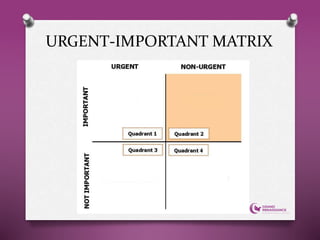
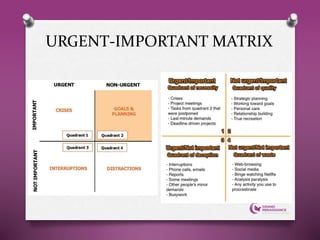
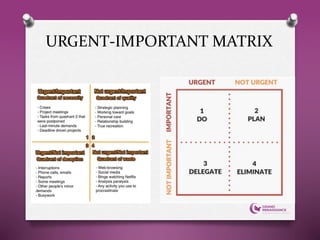
URGENT-IMPORTANT MATRIX
HOW TO USE THE MATRIX
 Urgent & Important tasks/projects to be completed
immediately.
 Not Urgent & Important tasks/projects to be
scheduled on your calendar
 Urgent & Unimportant tasks/projects to be
delegated to someone else.
 Not Urgent & Unimportant tasks/projects to be
deleted.
HOW TO PRIORITISE MANY
PRIORITIES
1. Have a list that contains all tasks in one.
2. Identify what's important: Understanding
your true goals.
3. Highlight what's urgent.
4. Prioritize based on importance and urgency.
5. Avoid competing priorities.
6. Consider effort.
7. Review constantly and be realistic.
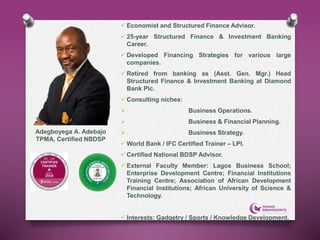
 Economist and Structured Finance Advisor.
 25-year Structured Finance & Investment Banking
Career.
 Developed Financing Strategies for various large
companies.
 Retired from banking as (Asst. Gen. Mgr.) Head
Structured Finance & Investment Banking at Diamond
Bank Plc.
 Consulting niches:
 Business Operations.
 Business & Financial Planning.
 Business Strategy.
 World Bank / IFC Certified Trainer – LPI.
 Certified National BDSP Advisor.
 External Faculty Member: Lagos Business School;
Enterprise Development Centre; Financial Institutions
Training Centre; Association of African Development
Financial Institutions; African University of Science &
Technology.
 Interests: Gadgetry / Sports / Knowledge Development.
Adegboyega A. Adebajo
TPMA, Certified NBDSP
THE EISENHOWER MATRIX.pptx

THE EISENHOWER MATRIX.pptx

  • 1.
  • 2.
    O The EisenhowerMatrix is named after the 34th President of the United States, Dwight D. Eisenhower, who served in office from 1953 to 1961. O Before being elected as President, Eisenhower had an impressive career in the military. He served during World War I and later wrote a guidebook of its battlefields. He also served in France, Washington, the Philippines, and World War II. O Eisenhower was recognized by the Army Chief for his role in planning military exercises with almost 50,000 troops. He continued to increase in rank over the years as a result of his impressive knowledge, effective organization, and social skills that enabled him to get along with others and mediate relationships. O This ability got the attention of both the Democratic and Republican parties who wanted Eisenhower to represent them. He retired from the military after 37 years of service to represent the Republican party, with Richard Nixon as his Vice President. THE HISTORY
  • 3.
    O Eisenhower wasa very busy man with a multitude of responsibilities. He was incredibly accomplished and was able to manage his different roles with tact, grace, and efficiency. After his terms as President, Eisenhower delivered a speech to the Second Assembly of the World Council of Churches, a fellowship of churches. In his speech, he quoted J. Roscoe Miller, the 12th president of Northwestern University, who said, “The urgent are not important, and the important are never urgent.” O Eisenhower understood that Time Management needed to both be effective and efficient and he wanted to help individuals navigate their priorities. Inspired by Miller, Eisenhower claimed that to be successful, one had to do things that were both urgent and important: thus, the Eisenhower Matrix was born. THE NEXUS
  • 4.
    O There area number of cognitive biases that impede our ability to manage our time effectively and efficiently. O The Projection Bias causes us to take on big tasks when we feel optimistic, inaccurately projecting that we will continue to feel that way in the future. O Similarly, the Optimism Bias leads us to believe we are going to be more efficient than we are, so we might take on a task that is too big for us to handle alone. O Bikeshedding describes our tendency to spend too much time on menial tasks because it is easier to have an opinion on simpler matters than to try and tackle the complex ones. O The Restraint Bias causes us to overestimate the level of control we have over our impulse behaviors and underestimate how distracted we might get while trying to complete our to-do list. WHY THE MATRIX?
  • 5.
    O These twoterms are sometimes used synonymously, but the matrix suggests that they should be treated differently. O Urgent tasks are time-sensitive. They might be simpler than important tasks, such as replying to emails or filling out forms, but we feel pressured to do these tasks first because they require us to be reactive. These are often the tasks we focus on first, even though they might not yield the most impactful results for our overall lives. O Important tasks, by contrast, are more complex and strategic tasks. They are aligned with our goals and achieving them advances our personal or professional lives. We often put these tasks off because they require more work and even perhaps because we are afraid of failing at them. O Unfortunately, procrastinating these tasks often means that by the time we get around to them, we have less brain power and energy, and are thus more likely to make mistakes. THE URGENT / IMPORTANT MIX
  • 6.
  • 7.
    O An Urgent-ImportantMatrix is a simple but effective tool for prioritizing your to-do list based on the level of urgency and importance of each task. It's is sometimes referred to as the 'Eisenhower Matrix' or 'Eisenhower Decision Matrix' and is one of the easiest time management strategies to implement. O The essence of the simple but powerful Urgent- Important Matrix is: O To consciously give priority to our most important tasks and to plan and delegate so that we deal with problems BEFORE they become urgent or a crises…….and; O To become aware of our interruptions and distractions so that we can reduce or eliminate them. THE EISENHOWER MATRIX
  • 8.
  • 9.
  • 10.
  • 11.
    HOW TO USETHE MATRIX  Urgent & Important tasks/projects to be completed immediately.  Not Urgent & Important tasks/projects to be scheduled on your calendar  Urgent & Unimportant tasks/projects to be delegated to someone else.  Not Urgent & Unimportant tasks/projects to be deleted.
  • 12.
    HOW TO PRIORITISEMANY PRIORITIES 1. Have a list that contains all tasks in one. 2. Identify what's important: Understanding your true goals. 3. Highlight what's urgent. 4. Prioritize based on importance and urgency. 5. Avoid competing priorities. 6. Consider effort. 7. Review constantly and be realistic.
  • 14.
     Economist andStructured Finance Advisor.  25-year Structured Finance & Investment Banking Career.  Developed Financing Strategies for various large companies.  Retired from banking as (Asst. Gen. Mgr.) Head Structured Finance & Investment Banking at Diamond Bank Plc.  Consulting niches:  Business Operations.  Business & Financial Planning.  Business Strategy.  World Bank / IFC Certified Trainer – LPI.  Certified National BDSP Advisor.  External Faculty Member: Lagos Business School; Enterprise Development Centre; Financial Institutions Training Centre; Association of African Development Financial Institutions; African University of Science & Technology.  Interests: Gadgetry / Sports / Knowledge Development. Adegboyega A. Adebajo TPMA, Certified NBDSP