The System and Process ofThe System and Process of
ControllingControlling   
What is Controlling?What is Controlling?
► ControllingControlling is the measurement and correction of performance inis the measurement and correction of performance in
order to make sure that enterprise objectives and the plans devised toorder to make sure that enterprise objectives and the plans devised to
attain them are being accomplishedattain them are being accomplished
► Bureaucratic or formal ControlBureaucratic or formal Control
 Use of formal rules, standards, hierarchy, legitimate authority – tasks areUse of formal rules, standards, hierarchy, legitimate authority – tasks are
certain and workers are independentcertain and workers are independent
► Market ControlMarket Control
 Use of price, competition, profit centres exchange relationship- tangibleUse of price, competition, profit centres exchange relationship- tangible
outputs can be identified market can be developed between partiesoutputs can be identified market can be developed between parties
► Clan ControlClan Control
 Involves culture, shared values, beliefs, expectations and trust- no one bestInvolves culture, shared values, beliefs, expectations and trust- no one best
way to do and employees are empowered to make decisionsway to do and employees are empowered to make decisions
Planning and controlling are closely relatedPlanning and controlling are closely related
Features of controllingFeatures of controlling
►Positive forcePositive force
►Continuous processContinuous process
►Forward lookingForward looking
►UniversalUniversal
►DynamicDynamic
►Goal-orientedGoal-oriented
►Key to control based on planningKey to control based on planning
Importance of controllingImportance of controlling
►Achievement of goalsAchievement of goals
►Execution and revision of plansExecution and revision of plans
►Brings order and disciplineBrings order and discipline
►Facilitates decentralization of authorityFacilitates decentralization of authority
►Promotes coordinationPromotes coordination
►Coping with uncertainty and changeCoping with uncertainty and change
Limitations of controllingLimitations of controlling
►Enterprise has very little control overEnterprise has very little control over
external influencesexternal influences
►Employees do not like to be watched andEmployees do not like to be watched and
offer resistanceoffer resistance
►Setting control points is not easySetting control points is not easy
►It is expensive and takes time and effortIt is expensive and takes time and effort
►Many areas defy measurement inMany areas defy measurement in
quantitative termsquantitative terms
The Basic Control ProcessThe Basic Control Process
► TheThe basic control processbasic control process involves three steps:involves three steps:
 establishing standards,establishing standards,
 measurement of actual performancemeasurement of actual performance
 comparing performance against the standards, andcomparing performance against the standards, and
 correcting variations from standards and planscorrecting variations from standards and plans
► Standards are criteria of performanceStandards are criteria of performance
Resistance to controlResistance to control
►Over-controlOver-control
►Inappropriate controlsInappropriate controls
►Unachievable standardsUnachievable standards
►Unpredictable standardsUnpredictable standards
►Rewards for efficiencyRewards for efficiency
►Uncontrollable variablesUncontrollable variables
Overcoming resistance to controlOvercoming resistance to control
►Employee participationEmployee participation
►Justifiable controlsJustifiable controls
►Precise and understandable standardsPrecise and understandable standards
►Realistic standardsRealistic standards
►Timely communication of findingsTimely communication of findings
►Accurate findingsAccurate findings
►Assuring supportAssuring support
►Positive reinforcementPositive reinforcement
Characteristics of effective controlCharacteristics of effective control
systemsystem
► SuitableSuitable
► SimpleSimple
► SelectiveSelective
► Sound and economicalSound and economical
► FlexibleFlexible
► Forward-lookingForward-looking
► ReasonableReasonable
► ObjectiveObjective
► Responsibility for failuresResponsibility for failures
► AcceptableAcceptable
Dimensions of ControlDimensions of Control
► Principle of Critical-Point ControlPrinciple of Critical-Point Control
► Strategic control comprises systematic monitoring atStrategic control comprises systematic monitoring at
strategic control points as well as modifying thestrategic control points as well as modifying the
organization's strategy on the basis of this evaluationorganization's strategy on the basis of this evaluation
► Effective control requires attention to those factors criticalEffective control requires attention to those factors critical
to evaluating performance against plansto evaluating performance against plans
► Examples of critical-point standardsExamples of critical-point standards
 (1) physical standards, (2) cost standards, (3) capital(1) physical standards, (2) cost standards, (3) capital
standards, (4) revenue standards, (5) programstandards, (4) revenue standards, (5) program
standards, (6) intangible standards, (7) goals asstandards, (6) intangible standards, (7) goals as
standards, and (8) strategic plans as control points forstandards, and (8) strategic plans as control points for
strategic controlstrategic control
Dimensions of ControlDimensions of Control
► Management by Exception (MBE)Management by Exception (MBE)
► It triesIt tries to focus attention on exceptionally seriousto focus attention on exceptionally serious
deviations from the plans and standardsdeviations from the plans and standards
 Saves timeSaves time
 Identifies critical problem areasIdentifies critical problem areas
 Stimulates communicationStimulates communication
 Reduces the frequency of decision-makingReduces the frequency of decision-making
 Leads to concentration of efforts on important thingsLeads to concentration of efforts on important things
 Makes more use of knowledge and dataMakes more use of knowledge and data
What is Benchmarking?What is Benchmarking?
►Benchmarking is an approach for settingBenchmarking is an approach for setting
goals and productivity measures based ongoals and productivity measures based on
best-industry practicesbest-industry practices
►Three types of benchmarking:Three types of benchmarking:
 strategic,strategic,
 operational, andoperational, and
 managementmanagement
Control as a Feedback SystemControl as a Feedback System
►Management control is usually perceived asManagement control is usually perceived as
a feedback system similar to that whicha feedback system similar to that which
operates in the common householdoperates in the common household
thermostatthermostat
► Real‑Time Information and ControlReal‑Time Information and Control
 Real‑time information is information about whatReal‑time information is information about what
is happening while it is happeningis happening while it is happening
Feedforward ControlFeedforward Control
► What managers need for effective control is aWhat managers need for effective control is a
system that will tell them potential problems, givingsystem that will tell them potential problems, giving
them time to take corrective action beforethem time to take corrective action before
problems occurproblems occur
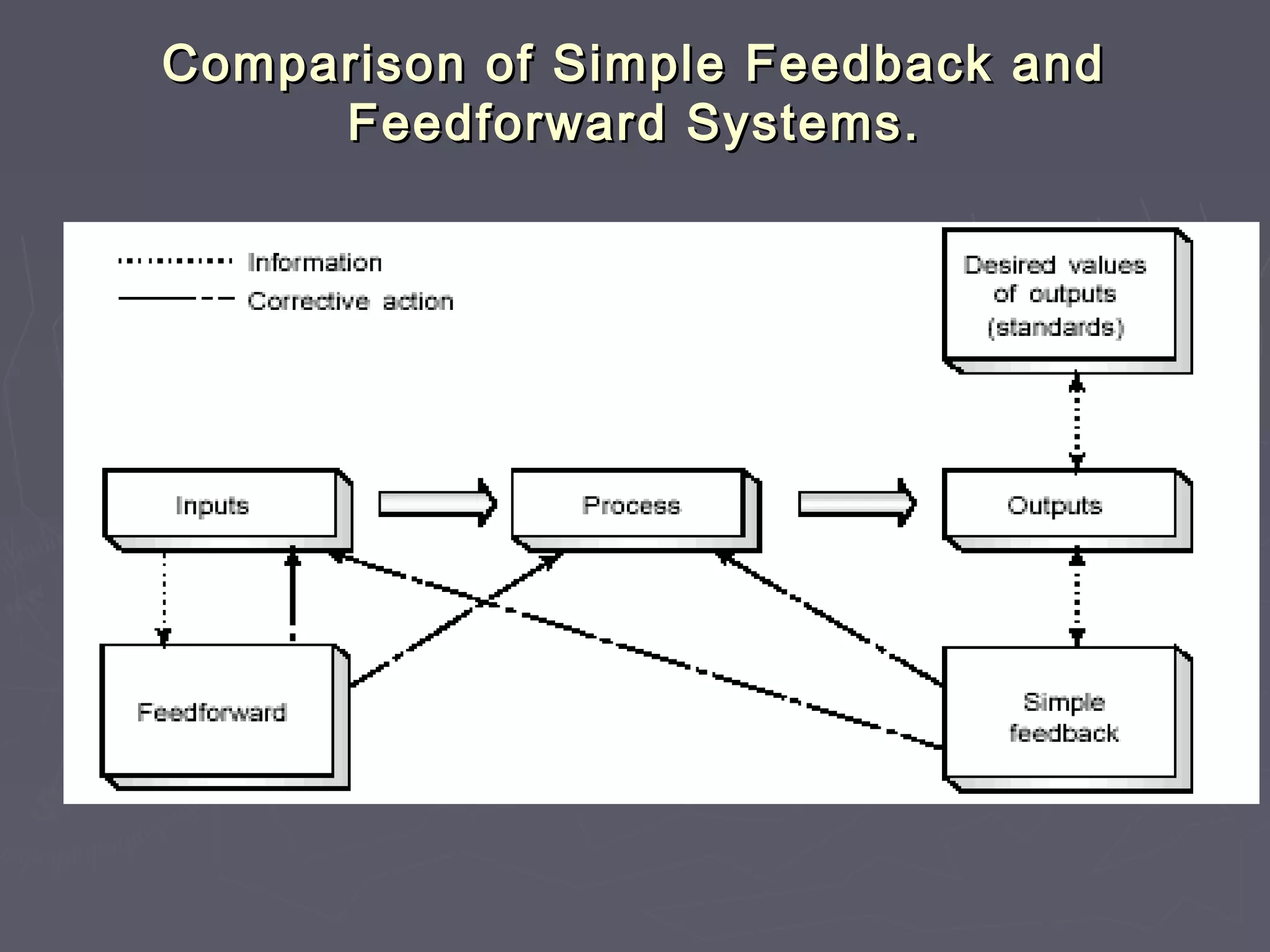
► Feedforward systems monitor inputs into aFeedforward systems monitor inputs into a
process to ascertain if the inputs are as planned; ifprocess to ascertain if the inputs are as planned; if
they are not, the inputs or the process is changedthey are not, the inputs or the process is changed
in order to obtain the desired resultsin order to obtain the desired results
Comparison of Simple Feedback andComparison of Simple Feedback and
Feedforward Systems.Feedforward Systems.
Requirements for Feedforward ControlRequirements for Feedforward Control
1.1. Make a thorough and careful analysis of the planning andMake a thorough and careful analysis of the planning and
control system, and identify the more important inputcontrol system, and identify the more important input
variablesvariables
2.2. Develop a model of the systemDevelop a model of the system
3.3. Take care to keep the model up to date; in other words, theTake care to keep the model up to date; in other words, the
model should be reviewed regularly to see whether the inputmodel should be reviewed regularly to see whether the input
variables identified and their interrelationships continue tovariables identified and their interrelationships continue to
represent realitiesrepresent realities
4.4. Collect data on input variables regularly, and put them intoCollect data on input variables regularly, and put them into
the systemthe system
5.5. Regularly assess the variations of actual input data fromRegularly assess the variations of actual input data from
planned‑for inputs, and evaluate the impact on the expectedplanned‑for inputs, and evaluate the impact on the expected
end resultend result
6.6.  Take actionTake action
CONTROL OF OVERALLCONTROL OF OVERALL
PERFORMANCEPERFORMANCE
►As overall planning is applied to enterprise,As overall planning is applied to enterprise,
in the same way overall control is appliedin the same way overall control is applied
►Decentralization of authorityDecentralization of authority
►Measuring total effortsMeasuring total efforts
►Financial controls have to be tailored to theFinancial controls have to be tailored to the
specific needsspecific needs
PROFIT AND LOSS CONTROLPROFIT AND LOSS CONTROL
►Profit and Loss controls are used inProfit and Loss controls are used in
departments and divisions where each hasdepartments and divisions where each has
to make a profitto make a profit
►But high cost of accounting and paperBut high cost of accounting and paper
transactions give rise to limitations. Thoughtransactions give rise to limitations. Though
computer technology has made thingscomputer technology has made things
easiereasier
Requirements for Effective ControlsRequirements for Effective Controls
► Tailoring Controls to Plans and PositionsTailoring Controls to Plans and Positions
► Tailoring Controls to Individual ManagersTailoring Controls to Individual Managers
► Making Sure That Controls Point Up ExceptionsMaking Sure That Controls Point Up Exceptions
at Critical Pointsat Critical Points
► Seeking Objectivity of ControlsSeeking Objectivity of Controls
► Ensuring Flexibility of ControlsEnsuring Flexibility of Controls
► Fitting the Control System to the OrganizationFitting the Control System to the Organization
CultureCulture
► Achieving Economy of ControlsAchieving Economy of Controls
► Establishing Controls that Lead to CorrectiveEstablishing Controls that Lead to Corrective
ActionAction
What is Budgeting?What is Budgeting?
►Budgeting is the formulation of plans for aBudgeting is the formulation of plans for a
given future period in numerical termsgiven future period in numerical terms
►Zero‑base budgeting is dividingZero‑base budgeting is dividing
enterprise programs into "packages"enterprise programs into "packages"
composed of goals, activities, andcomposed of goals, activities, and
needed resources and calculating theneeded resources and calculating the
costs for each package from the basecosts for each package from the base
zerozero
Information TechnologyInformation Technology
► DataData are the raw facts that may not be veryare the raw facts that may not be very
useful until they becomeuseful until they become informationinformation, that is,, that is,
after they are processed and becomeafter they are processed and become
meaningful and understandable by the receivermeaningful and understandable by the receiver
► The information system is defined as a formalThe information system is defined as a formal
system of gathering, processing, and dispersingsystem of gathering, processing, and dispersing
information internal and external to theinformation internal and external to the
enterprise in a timely, effective, and efficiententerprise in a timely, effective, and efficient
mannermanner
Challenges Created by InformationChallenges Created by Information
TechnologyTechnology
► Resistance to Computer UseResistance to Computer Use
► Speech Recognition DevicesSpeech Recognition Devices
► TelecommutingTelecommuting
 Telecommuting means that a person can work at a computerTelecommuting means that a person can work at a computer
terminal at home instead of commuting to workterminal at home instead of commuting to work
► Computer NetworksComputer Networks
► InternetInternet
► Other Types of NetworksOther Types of Networks
 intranetintranet extranetextranet
► GroupwareGroupware
 Groupware makes it possible to collaborate with others overGroupware makes it possible to collaborate with others over
long distances at the same timelong distances at the same time
► Information SecurityInformation Security
CAD/CAMCAD/CAM
►CAD/CAMs help engineers designCAD/CAMs help engineers design
products much more quickly thanproducts much more quickly than
they could with the traditional paper-they could with the traditional paper-
and-pencil approachand-pencil approach
The Digital Economy,The Digital Economy,
E-commerce, and M-commerceE-commerce, and M-commerce
The Emerging Digital EconomyThe Emerging Digital Economy
Four Kinds of TransactionsFour Kinds of Transactions
Business to Consumers (B2C).Business to Consumers (B2C).
Consumer to Business (C2B).Consumer to Business (C2B).
Consumer to Consumer (C2C).Consumer to Consumer (C2C).
Business to Business (B2B).Business to Business (B2B).
M-Commerce and WirelessM-Commerce and Wireless
CommunicationCommunication
Productivity, OperationsProductivity, Operations
Management, and Total QualityManagement, and Total Quality
ManagementManagement
What is Productivity?What is Productivity?
►Productivity is the input-output ratio within aProductivity is the input-output ratio within a
time period with due consideration fortime period with due consideration for
qualityquality
Production and Operations Management:Production and Operations Management:
Manufacturing and ServiceManufacturing and Service
►Production management was the term usedProduction management was the term used
to refer to those activities necessary toto refer to those activities necessary to
manufacture productsmanufacture products
►Operations management refers to activitiesOperations management refers to activities
necessary to produce and deliver a servicenecessary to produce and deliver a service
as well as a physical productas well as a physical product
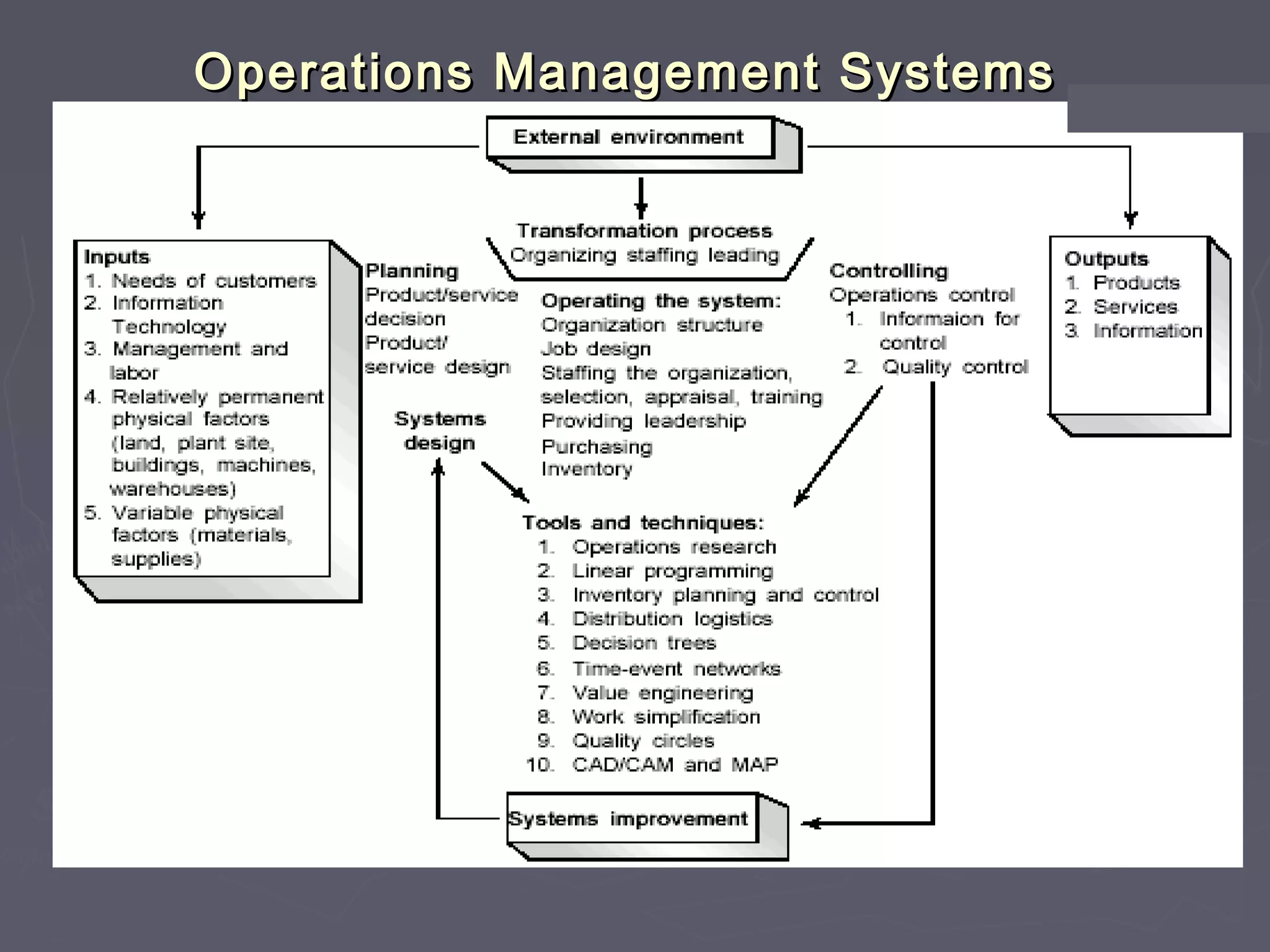
Operations Management SystemsOperations Management Systems
Steps inSteps in Product and Production DesignProduct and Production Design
1.1. Create product ideas by searching for consumerCreate product ideas by searching for consumer
needsneeds and screening the various alternativesand screening the various alternatives
2.2. Select the product on the basis of variousSelect the product on the basis of various
considerations,considerations, including data from market andincluding data from market and
economic analyses, andeconomic analyses, and make a general feasibilitymake a general feasibility
studystudy
3.3. Prepare a preliminary design by evaluating variousPrepare a preliminary design by evaluating various
alternatives, taking into consideration reliability,alternatives, taking into consideration reliability,
quality,quality, and maintenance requirementsand maintenance requirements
4.4. Reach a final decision by developing, testing, andReach a final decision by developing, testing, and
simulatingsimulating the processes to see if they workthe processes to see if they work
5.5. Decide whether the enterprise's current facilities areDecide whether the enterprise's current facilities are
adequate or if new or modified facilities are requiredadequate or if new or modified facilities are required
6.6. Select the process for producing the product;Select the process for producing the product;
consider theconsider the technology and the methodstechnology and the methods
availableavailable
7.7. After the product is designed, prepare the layout ofAfter the product is designed, prepare the layout of
thethe facilities to be used, plan the system offacilities to be used, plan the system of
production, andproduction, and schedule the various things thatschedule the various things that
must be done
Tools and Techniques for ImprovingTools and Techniques for Improving
ProductivityProductivity
► Inventory Planning and ControlInventory Planning and Control
► Just-in-Time Inventory SystemJust-in-Time Inventory System
 In the just-in-time (JIT) inventory method, theIn the just-in-time (JIT) inventory method, the
supplier delivers the components and parts to thesupplier delivers the components and parts to the
production line "just in time" to be assembledproduction line "just in time" to be assembled
► OutsourcingOutsourcing
 Outsourcing means that production and operationsOutsourcing means that production and operations
are contracted to outside vendors that haveare contracted to outside vendors that have
expertise in specific areasexpertise in specific areas
What is Operations Research?What is Operations Research?
►Operations researchOperations research is the application ofis the application of
scientific methods to the study ofscientific methods to the study of
alternatives in a problem situation, with aalternatives in a problem situation, with a
view to obtaining a quantitative basis forview to obtaining a quantitative basis for
arriving at a best solutionarriving at a best solution
What is Value Engineering?What is Value Engineering?
► Value engineering, is the process of analyzing theValue engineering, is the process of analyzing the
operations of the product or service, estimating the value ofoperations of the product or service, estimating the value of
each operation, and attempting to improve that operationeach operation, and attempting to improve that operation
by trying to keep costs low at each step or partby trying to keep costs low at each step or part
► Work simplification is the process of obtaining theWork simplification is the process of obtaining the
participation of workers in simplifying their workparticipation of workers in simplifying their work
► A quality circle (QC) is a group of people from the sameA quality circle (QC) is a group of people from the same
organizational area who meet regularly to solve problemsorganizational area who meet regularly to solve problems
they experience at workthey experience at work
► Total quality management (TQM) is the organization's long-Total quality management (TQM) is the organization's long-
term commitment to the continuous improvement of quality,term commitment to the continuous improvement of quality,
throughout the organization and with the activethroughout the organization and with the active
participation of all members at all levels, to meet andparticipation of all members at all levels, to meet and
exceed customer expectationsexceed customer expectations
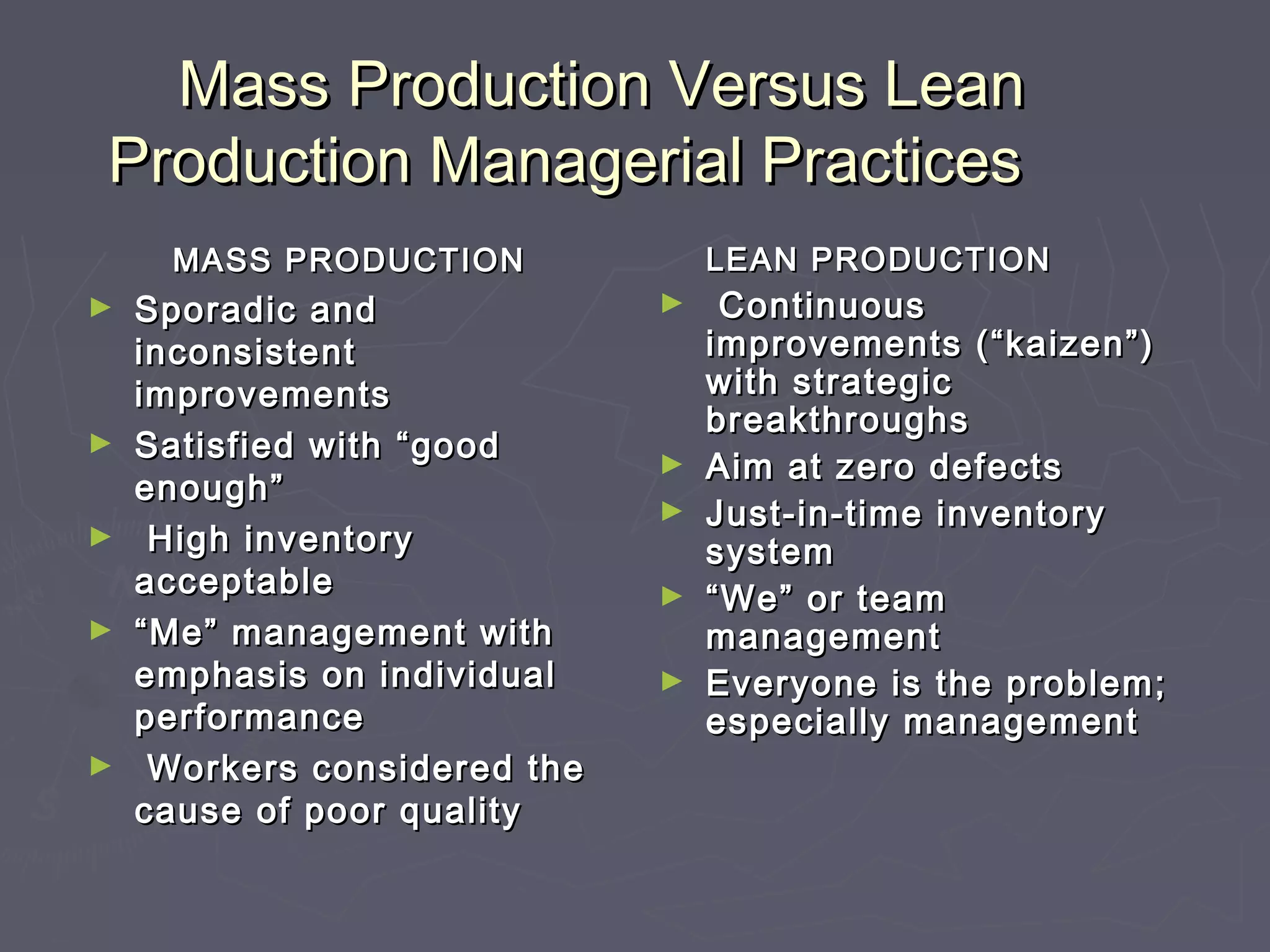
Mass Production Versus LeanMass Production Versus Lean
Production Managerial PracticesProduction Managerial Practices
MASS PRODUCTIONMASS PRODUCTION
► Sporadic andSporadic and
inconsistentinconsistent
improvementsimprovements
► Satisfied with “goodSatisfied with “good
enough”enough”
►   High inventoryHigh inventory
acceptableacceptable
► ““Me” management withMe” management with
emphasis on individualemphasis on individual
performanceperformance
►   Workers considered theWorkers considered the
cause of poor qualitycause of poor quality
LEAN PRODUCTIONLEAN PRODUCTION
►   ContinuousContinuous
improvements (“kaizen”)improvements (“kaizen”)
with strategicwith strategic
breakthroughsbreakthroughs
► Aim at zero defectsAim at zero defects
► Just-in-time inventoryJust-in-time inventory
systemsystem
► ““We” or teamWe” or team
managementmanagement
► Everyone is the problem;Everyone is the problem;
especially managementespecially management

The System and Process of Controlling

  • 1.
    The System andProcess ofThe System and Process of ControllingControlling   
  • 2.
    What is Controlling?Whatis Controlling? ► ControllingControlling is the measurement and correction of performance inis the measurement and correction of performance in order to make sure that enterprise objectives and the plans devised toorder to make sure that enterprise objectives and the plans devised to attain them are being accomplishedattain them are being accomplished ► Bureaucratic or formal ControlBureaucratic or formal Control  Use of formal rules, standards, hierarchy, legitimate authority – tasks areUse of formal rules, standards, hierarchy, legitimate authority – tasks are certain and workers are independentcertain and workers are independent ► Market ControlMarket Control  Use of price, competition, profit centres exchange relationship- tangibleUse of price, competition, profit centres exchange relationship- tangible outputs can be identified market can be developed between partiesoutputs can be identified market can be developed between parties ► Clan ControlClan Control  Involves culture, shared values, beliefs, expectations and trust- no one bestInvolves culture, shared values, beliefs, expectations and trust- no one best way to do and employees are empowered to make decisionsway to do and employees are empowered to make decisions Planning and controlling are closely relatedPlanning and controlling are closely related
  • 3.
    Features of controllingFeaturesof controlling ►Positive forcePositive force ►Continuous processContinuous process ►Forward lookingForward looking ►UniversalUniversal ►DynamicDynamic ►Goal-orientedGoal-oriented ►Key to control based on planningKey to control based on planning
  • 4.
    Importance of controllingImportanceof controlling ►Achievement of goalsAchievement of goals ►Execution and revision of plansExecution and revision of plans ►Brings order and disciplineBrings order and discipline ►Facilitates decentralization of authorityFacilitates decentralization of authority ►Promotes coordinationPromotes coordination ►Coping with uncertainty and changeCoping with uncertainty and change
  • 5.
    Limitations of controllingLimitationsof controlling ►Enterprise has very little control overEnterprise has very little control over external influencesexternal influences ►Employees do not like to be watched andEmployees do not like to be watched and offer resistanceoffer resistance ►Setting control points is not easySetting control points is not easy ►It is expensive and takes time and effortIt is expensive and takes time and effort ►Many areas defy measurement inMany areas defy measurement in quantitative termsquantitative terms
  • 6.
    The Basic ControlProcessThe Basic Control Process ► TheThe basic control processbasic control process involves three steps:involves three steps:  establishing standards,establishing standards,  measurement of actual performancemeasurement of actual performance  comparing performance against the standards, andcomparing performance against the standards, and  correcting variations from standards and planscorrecting variations from standards and plans ► Standards are criteria of performanceStandards are criteria of performance
  • 7.
    Resistance to controlResistanceto control ►Over-controlOver-control ►Inappropriate controlsInappropriate controls ►Unachievable standardsUnachievable standards ►Unpredictable standardsUnpredictable standards ►Rewards for efficiencyRewards for efficiency ►Uncontrollable variablesUncontrollable variables
  • 8.
    Overcoming resistance tocontrolOvercoming resistance to control ►Employee participationEmployee participation ►Justifiable controlsJustifiable controls ►Precise and understandable standardsPrecise and understandable standards ►Realistic standardsRealistic standards ►Timely communication of findingsTimely communication of findings ►Accurate findingsAccurate findings ►Assuring supportAssuring support ►Positive reinforcementPositive reinforcement
  • 9.
    Characteristics of effectivecontrolCharacteristics of effective control systemsystem ► SuitableSuitable ► SimpleSimple ► SelectiveSelective ► Sound and economicalSound and economical ► FlexibleFlexible ► Forward-lookingForward-looking ► ReasonableReasonable ► ObjectiveObjective ► Responsibility for failuresResponsibility for failures ► AcceptableAcceptable
  • 10.
    Dimensions of ControlDimensionsof Control ► Principle of Critical-Point ControlPrinciple of Critical-Point Control ► Strategic control comprises systematic monitoring atStrategic control comprises systematic monitoring at strategic control points as well as modifying thestrategic control points as well as modifying the organization's strategy on the basis of this evaluationorganization's strategy on the basis of this evaluation ► Effective control requires attention to those factors criticalEffective control requires attention to those factors critical to evaluating performance against plansto evaluating performance against plans ► Examples of critical-point standardsExamples of critical-point standards  (1) physical standards, (2) cost standards, (3) capital(1) physical standards, (2) cost standards, (3) capital standards, (4) revenue standards, (5) programstandards, (4) revenue standards, (5) program standards, (6) intangible standards, (7) goals asstandards, (6) intangible standards, (7) goals as standards, and (8) strategic plans as control points forstandards, and (8) strategic plans as control points for strategic controlstrategic control
  • 11.
    Dimensions of ControlDimensionsof Control ► Management by Exception (MBE)Management by Exception (MBE) ► It triesIt tries to focus attention on exceptionally seriousto focus attention on exceptionally serious deviations from the plans and standardsdeviations from the plans and standards  Saves timeSaves time  Identifies critical problem areasIdentifies critical problem areas  Stimulates communicationStimulates communication  Reduces the frequency of decision-makingReduces the frequency of decision-making  Leads to concentration of efforts on important thingsLeads to concentration of efforts on important things  Makes more use of knowledge and dataMakes more use of knowledge and data
  • 12.
    What is Benchmarking?Whatis Benchmarking? ►Benchmarking is an approach for settingBenchmarking is an approach for setting goals and productivity measures based ongoals and productivity measures based on best-industry practicesbest-industry practices ►Three types of benchmarking:Three types of benchmarking:  strategic,strategic,  operational, andoperational, and  managementmanagement
  • 13.
    Control as aFeedback SystemControl as a Feedback System ►Management control is usually perceived asManagement control is usually perceived as a feedback system similar to that whicha feedback system similar to that which operates in the common householdoperates in the common household thermostatthermostat ► Real‑Time Information and ControlReal‑Time Information and Control  Real‑time information is information about whatReal‑time information is information about what is happening while it is happeningis happening while it is happening
  • 14.
    Feedforward ControlFeedforward Control ►What managers need for effective control is aWhat managers need for effective control is a system that will tell them potential problems, givingsystem that will tell them potential problems, giving them time to take corrective action beforethem time to take corrective action before problems occurproblems occur ► Feedforward systems monitor inputs into aFeedforward systems monitor inputs into a process to ascertain if the inputs are as planned; ifprocess to ascertain if the inputs are as planned; if they are not, the inputs or the process is changedthey are not, the inputs or the process is changed in order to obtain the desired resultsin order to obtain the desired results
  • 15.
    Comparison of SimpleFeedback andComparison of Simple Feedback and Feedforward Systems.Feedforward Systems.
  • 16.
    Requirements for FeedforwardControlRequirements for Feedforward Control 1.1. Make a thorough and careful analysis of the planning andMake a thorough and careful analysis of the planning and control system, and identify the more important inputcontrol system, and identify the more important input variablesvariables 2.2. Develop a model of the systemDevelop a model of the system 3.3. Take care to keep the model up to date; in other words, theTake care to keep the model up to date; in other words, the model should be reviewed regularly to see whether the inputmodel should be reviewed regularly to see whether the input variables identified and their interrelationships continue tovariables identified and their interrelationships continue to represent realitiesrepresent realities 4.4. Collect data on input variables regularly, and put them intoCollect data on input variables regularly, and put them into the systemthe system 5.5. Regularly assess the variations of actual input data fromRegularly assess the variations of actual input data from planned‑for inputs, and evaluate the impact on the expectedplanned‑for inputs, and evaluate the impact on the expected end resultend result 6.6.  Take actionTake action
  • 17.
    CONTROL OF OVERALLCONTROLOF OVERALL PERFORMANCEPERFORMANCE ►As overall planning is applied to enterprise,As overall planning is applied to enterprise, in the same way overall control is appliedin the same way overall control is applied ►Decentralization of authorityDecentralization of authority ►Measuring total effortsMeasuring total efforts ►Financial controls have to be tailored to theFinancial controls have to be tailored to the specific needsspecific needs
  • 18.
    PROFIT AND LOSSCONTROLPROFIT AND LOSS CONTROL ►Profit and Loss controls are used inProfit and Loss controls are used in departments and divisions where each hasdepartments and divisions where each has to make a profitto make a profit ►But high cost of accounting and paperBut high cost of accounting and paper transactions give rise to limitations. Thoughtransactions give rise to limitations. Though computer technology has made thingscomputer technology has made things easiereasier
  • 19.
    Requirements for EffectiveControlsRequirements for Effective Controls ► Tailoring Controls to Plans and PositionsTailoring Controls to Plans and Positions ► Tailoring Controls to Individual ManagersTailoring Controls to Individual Managers ► Making Sure That Controls Point Up ExceptionsMaking Sure That Controls Point Up Exceptions at Critical Pointsat Critical Points ► Seeking Objectivity of ControlsSeeking Objectivity of Controls ► Ensuring Flexibility of ControlsEnsuring Flexibility of Controls ► Fitting the Control System to the OrganizationFitting the Control System to the Organization CultureCulture ► Achieving Economy of ControlsAchieving Economy of Controls ► Establishing Controls that Lead to CorrectiveEstablishing Controls that Lead to Corrective ActionAction
  • 20.
    What is Budgeting?Whatis Budgeting? ►Budgeting is the formulation of plans for aBudgeting is the formulation of plans for a given future period in numerical termsgiven future period in numerical terms ►Zero‑base budgeting is dividingZero‑base budgeting is dividing enterprise programs into "packages"enterprise programs into "packages" composed of goals, activities, andcomposed of goals, activities, and needed resources and calculating theneeded resources and calculating the costs for each package from the basecosts for each package from the base zerozero
  • 21.
    Information TechnologyInformation Technology ►DataData are the raw facts that may not be veryare the raw facts that may not be very useful until they becomeuseful until they become informationinformation, that is,, that is, after they are processed and becomeafter they are processed and become meaningful and understandable by the receivermeaningful and understandable by the receiver ► The information system is defined as a formalThe information system is defined as a formal system of gathering, processing, and dispersingsystem of gathering, processing, and dispersing information internal and external to theinformation internal and external to the enterprise in a timely, effective, and efficiententerprise in a timely, effective, and efficient mannermanner
  • 22.
    Challenges Created byInformationChallenges Created by Information TechnologyTechnology ► Resistance to Computer UseResistance to Computer Use ► Speech Recognition DevicesSpeech Recognition Devices ► TelecommutingTelecommuting  Telecommuting means that a person can work at a computerTelecommuting means that a person can work at a computer terminal at home instead of commuting to workterminal at home instead of commuting to work ► Computer NetworksComputer Networks ► InternetInternet ► Other Types of NetworksOther Types of Networks  intranetintranet extranetextranet ► GroupwareGroupware  Groupware makes it possible to collaborate with others overGroupware makes it possible to collaborate with others over long distances at the same timelong distances at the same time ► Information SecurityInformation Security
  • 23.
    CAD/CAMCAD/CAM ►CAD/CAMs help engineersdesignCAD/CAMs help engineers design products much more quickly thanproducts much more quickly than they could with the traditional paper-they could with the traditional paper- and-pencil approachand-pencil approach
  • 24.
    The Digital Economy,TheDigital Economy, E-commerce, and M-commerceE-commerce, and M-commerce The Emerging Digital EconomyThe Emerging Digital Economy Four Kinds of TransactionsFour Kinds of Transactions Business to Consumers (B2C).Business to Consumers (B2C). Consumer to Business (C2B).Consumer to Business (C2B). Consumer to Consumer (C2C).Consumer to Consumer (C2C). Business to Business (B2B).Business to Business (B2B). M-Commerce and WirelessM-Commerce and Wireless CommunicationCommunication
  • 25.
    Productivity, OperationsProductivity, Operations Management,and Total QualityManagement, and Total Quality ManagementManagement
  • 26.
    What is Productivity?Whatis Productivity? ►Productivity is the input-output ratio within aProductivity is the input-output ratio within a time period with due consideration fortime period with due consideration for qualityquality
  • 27.
    Production and OperationsManagement:Production and Operations Management: Manufacturing and ServiceManufacturing and Service ►Production management was the term usedProduction management was the term used to refer to those activities necessary toto refer to those activities necessary to manufacture productsmanufacture products ►Operations management refers to activitiesOperations management refers to activities necessary to produce and deliver a servicenecessary to produce and deliver a service as well as a physical productas well as a physical product
  • 28.
  • 29.
    Steps inSteps inProduct and Production DesignProduct and Production Design 1.1. Create product ideas by searching for consumerCreate product ideas by searching for consumer needsneeds and screening the various alternativesand screening the various alternatives 2.2. Select the product on the basis of variousSelect the product on the basis of various considerations,considerations, including data from market andincluding data from market and economic analyses, andeconomic analyses, and make a general feasibilitymake a general feasibility studystudy 3.3. Prepare a preliminary design by evaluating variousPrepare a preliminary design by evaluating various alternatives, taking into consideration reliability,alternatives, taking into consideration reliability, quality,quality, and maintenance requirementsand maintenance requirements 4.4. Reach a final decision by developing, testing, andReach a final decision by developing, testing, and simulatingsimulating the processes to see if they workthe processes to see if they work 5.5. Decide whether the enterprise's current facilities areDecide whether the enterprise's current facilities are adequate or if new or modified facilities are requiredadequate or if new or modified facilities are required 6.6. Select the process for producing the product;Select the process for producing the product; consider theconsider the technology and the methodstechnology and the methods availableavailable 7.7. After the product is designed, prepare the layout ofAfter the product is designed, prepare the layout of thethe facilities to be used, plan the system offacilities to be used, plan the system of production, andproduction, and schedule the various things thatschedule the various things that must be done
  • 30.
    Tools and Techniquesfor ImprovingTools and Techniques for Improving ProductivityProductivity ► Inventory Planning and ControlInventory Planning and Control ► Just-in-Time Inventory SystemJust-in-Time Inventory System  In the just-in-time (JIT) inventory method, theIn the just-in-time (JIT) inventory method, the supplier delivers the components and parts to thesupplier delivers the components and parts to the production line "just in time" to be assembledproduction line "just in time" to be assembled ► OutsourcingOutsourcing  Outsourcing means that production and operationsOutsourcing means that production and operations are contracted to outside vendors that haveare contracted to outside vendors that have expertise in specific areasexpertise in specific areas
  • 31.
    What is OperationsResearch?What is Operations Research? ►Operations researchOperations research is the application ofis the application of scientific methods to the study ofscientific methods to the study of alternatives in a problem situation, with aalternatives in a problem situation, with a view to obtaining a quantitative basis forview to obtaining a quantitative basis for arriving at a best solutionarriving at a best solution
  • 32.
    What is ValueEngineering?What is Value Engineering? ► Value engineering, is the process of analyzing theValue engineering, is the process of analyzing the operations of the product or service, estimating the value ofoperations of the product or service, estimating the value of each operation, and attempting to improve that operationeach operation, and attempting to improve that operation by trying to keep costs low at each step or partby trying to keep costs low at each step or part ► Work simplification is the process of obtaining theWork simplification is the process of obtaining the participation of workers in simplifying their workparticipation of workers in simplifying their work ► A quality circle (QC) is a group of people from the sameA quality circle (QC) is a group of people from the same organizational area who meet regularly to solve problemsorganizational area who meet regularly to solve problems they experience at workthey experience at work ► Total quality management (TQM) is the organization's long-Total quality management (TQM) is the organization's long- term commitment to the continuous improvement of quality,term commitment to the continuous improvement of quality, throughout the organization and with the activethroughout the organization and with the active participation of all members at all levels, to meet andparticipation of all members at all levels, to meet and exceed customer expectationsexceed customer expectations
  • 33.
    Mass Production VersusLeanMass Production Versus Lean Production Managerial PracticesProduction Managerial Practices MASS PRODUCTIONMASS PRODUCTION ► Sporadic andSporadic and inconsistentinconsistent improvementsimprovements ► Satisfied with “goodSatisfied with “good enough”enough” ►   High inventoryHigh inventory acceptableacceptable ► ““Me” management withMe” management with emphasis on individualemphasis on individual performanceperformance ►   Workers considered theWorkers considered the cause of poor qualitycause of poor quality LEAN PRODUCTIONLEAN PRODUCTION ►   ContinuousContinuous improvements (“kaizen”)improvements (“kaizen”) with strategicwith strategic breakthroughsbreakthroughs ► Aim at zero defectsAim at zero defects ► Just-in-time inventoryJust-in-time inventory systemsystem ► ““We” or teamWe” or team managementmanagement ► Everyone is the problem;Everyone is the problem; especially managementespecially management