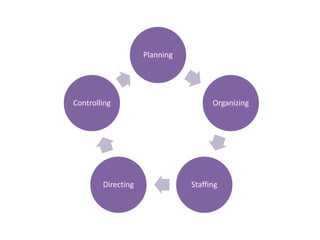
Planning
Organizing
StaffingDirecting
Controlling
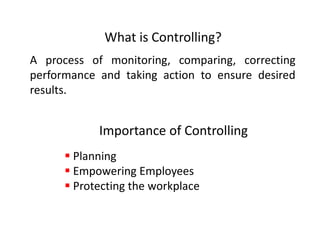
What is Controlling?
A process of monitoring, comparing, correcting
performance and taking action to ensure desired
results.
Importance of Controlling
 Planning
 Empowering Employees
 Protecting the workplace
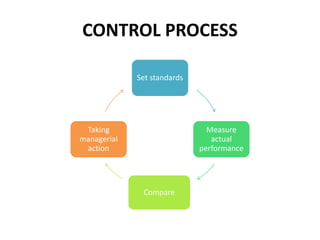
CONTROL PROCESS
Set standards
Measure
actual
performance
Compare
Taking
managerial
action
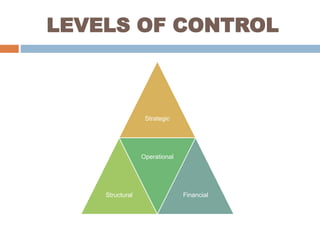
LEVELS OF CONTROL
Strategic
Structural
Operational
Financial
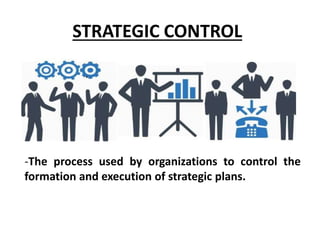
STRATEGIC CONTROL
-The process used by organizations to control the
formation and execution of strategic plans.
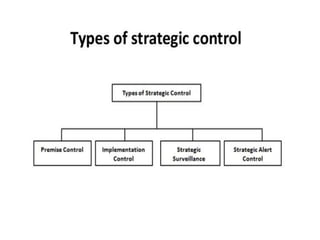
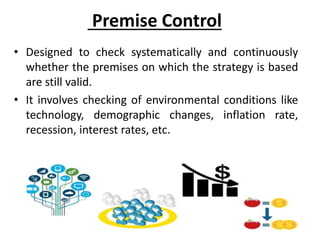
Premise Control
• Designed to check systematically and continuously
whether the premises on which the strategy is based
are still valid.
• It involves checking of environmental conditions like
technology, demographic changes, inflation rate,
recession, interest rates, etc.
Implementing Control
• the type of strategic control that must be
carried out as events unfold.
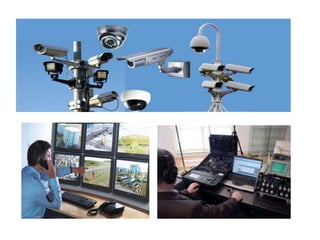
Strategic Surveillance
• Strategic surveillance is designed to monitor a wide
range of events inside and outside the company.
• Such sources include trade magazines, journals,
trade conferences, conversations and observations.
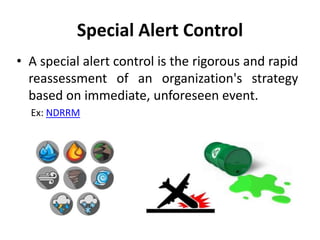
Special Alert Control
• A special alert control is the rigorous and rapid
reassessment of an organization's strategy
based on immediate, unforeseen event.
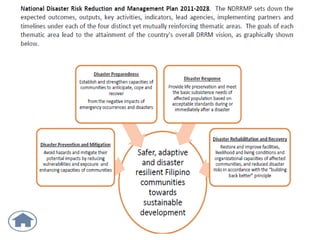
Ex: NDRRM
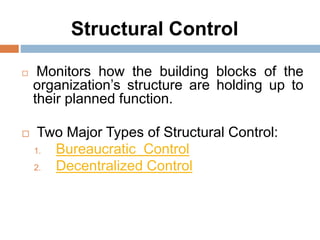
Structural Control
 Monitors how the building blocks of the
organization’s structure are holding up to
their planned function.
 Two Major Types of Structural Control:
1. Bureaucratic Control
2. Decentralized Control
Operational Control
• Operational control is concerned with
executing the strategy.
• It regulates the day-to-day output
relative to schedules, specifications, and
costs.
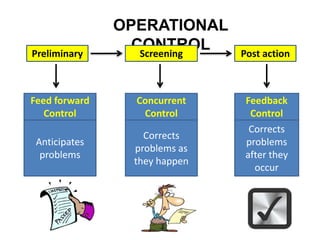
Preliminary Screening Post action
OPERATIONAL
CONTROLPreliminary Screening Post action
Anticipates
problems
Feed forward
Control
Concurrent
Control
Corrects
problems as
they happen
Feedback
Control
Corrects
problems
after they
occur
Financial Control
Financial control is the control of financial
resources as they flow into the organization. It
involves costs and expenses to control them in
relation to budgeted amounts.
Tools of Financial Control
• Budget – Planned allocation of Resources
• Financial Statements (balance sheet, income statement, cash
flow)
• Ratio Analysis (Liquidity, Profitability, Activity, Debt Ratio)
• Financial Audits (Internal and External)
All done. Thank You 
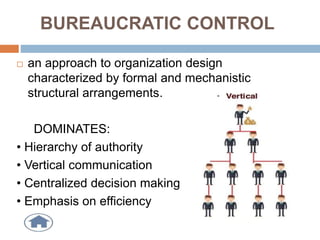
BUREAUCRATIC CONTROL
 an approach to organization design
characterized by formal and mechanistic
structural arrangements.
DOMINATES:
• Hierarchy of authority
• Vertical communication
• Centralized decision making
• Emphasis on efficiency
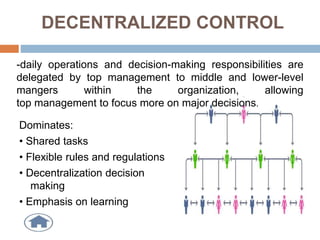
DECENTRALIZED CONTROL
Dominates:
• Shared tasks
• Flexible rules and regulations
• Decentralization decision
making
• Emphasis on learning
-daily operations and decision-making responsibilities are
delegated by top management to middle and lower-level
mangers within the organization, allowing
top management to focus more on major decisions.
Levels of Control

Levels of Control

  • 2.
  • 4.
    What is Controlling? Aprocess of monitoring, comparing, correcting performance and taking action to ensure desired results. Importance of Controlling  Planning  Empowering Employees  Protecting the workplace
  • 5.
  • 6.
  • 7.
    STRATEGIC CONTROL -The processused by organizations to control the formation and execution of strategic plans.
  • 9.
    Premise Control • Designedto check systematically and continuously whether the premises on which the strategy is based are still valid. • It involves checking of environmental conditions like technology, demographic changes, inflation rate, recession, interest rates, etc.
  • 10.
    Implementing Control • thetype of strategic control that must be carried out as events unfold.
  • 11.
    Strategic Surveillance • Strategicsurveillance is designed to monitor a wide range of events inside and outside the company. • Such sources include trade magazines, journals, trade conferences, conversations and observations.
  • 15.
    Special Alert Control •A special alert control is the rigorous and rapid reassessment of an organization's strategy based on immediate, unforeseen event. Ex: NDRRM
  • 16.
    Structural Control  Monitorshow the building blocks of the organization’s structure are holding up to their planned function.  Two Major Types of Structural Control: 1. Bureaucratic Control 2. Decentralized Control
  • 17.
    Operational Control • Operationalcontrol is concerned with executing the strategy. • It regulates the day-to-day output relative to schedules, specifications, and costs.
  • 18.
    Preliminary Screening Postaction OPERATIONAL CONTROLPreliminary Screening Post action Anticipates problems Feed forward Control Concurrent Control Corrects problems as they happen Feedback Control Corrects problems after they occur
  • 19.
    Financial Control Financial controlis the control of financial resources as they flow into the organization. It involves costs and expenses to control them in relation to budgeted amounts. Tools of Financial Control • Budget – Planned allocation of Resources • Financial Statements (balance sheet, income statement, cash flow) • Ratio Analysis (Liquidity, Profitability, Activity, Debt Ratio) • Financial Audits (Internal and External)
  • 20.
  • 21.
    BUREAUCRATIC CONTROL  anapproach to organization design characterized by formal and mechanistic structural arrangements. DOMINATES: • Hierarchy of authority • Vertical communication • Centralized decision making • Emphasis on efficiency
  • 22.
    DECENTRALIZED CONTROL Dominates: • Sharedtasks • Flexible rules and regulations • Decentralization decision making • Emphasis on learning -daily operations and decision-making responsibilities are delegated by top management to middle and lower-level mangers within the organization, allowing top management to focus more on major decisions.