05.04.2022
UNIT 5: controlling
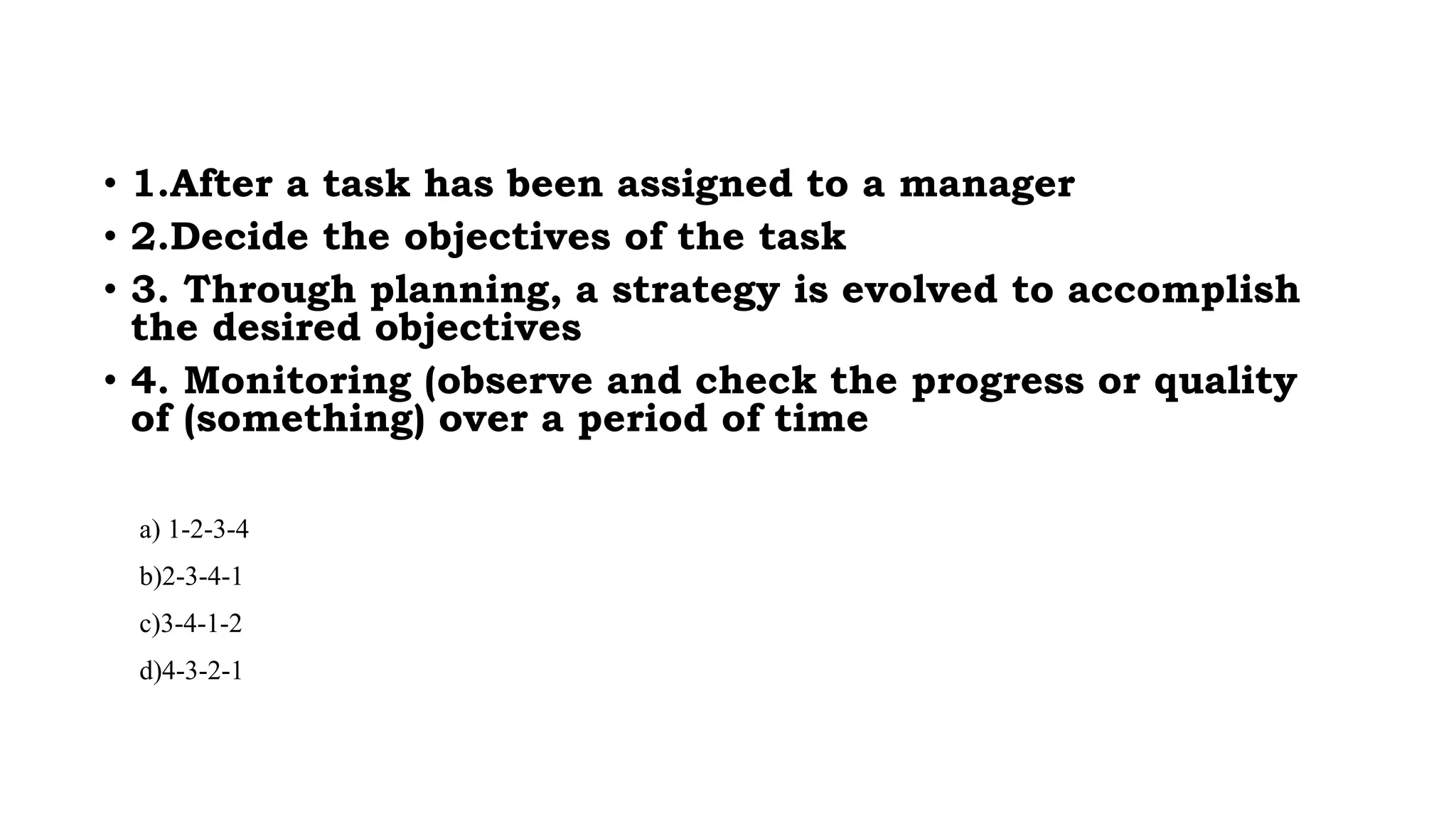
• 1.After a task has been assigned to a manager
• 2.Decide the objectives of the task
• 3. Through planning, a strategy is evolved to accomplish
the desired objectives
• 4. Monitoring (observe and check the progress or quality
of (something) over a period of time
a) 1-2-3-4
b)2-3-4-1
c)3-4-1-2
d)4-3-2-1
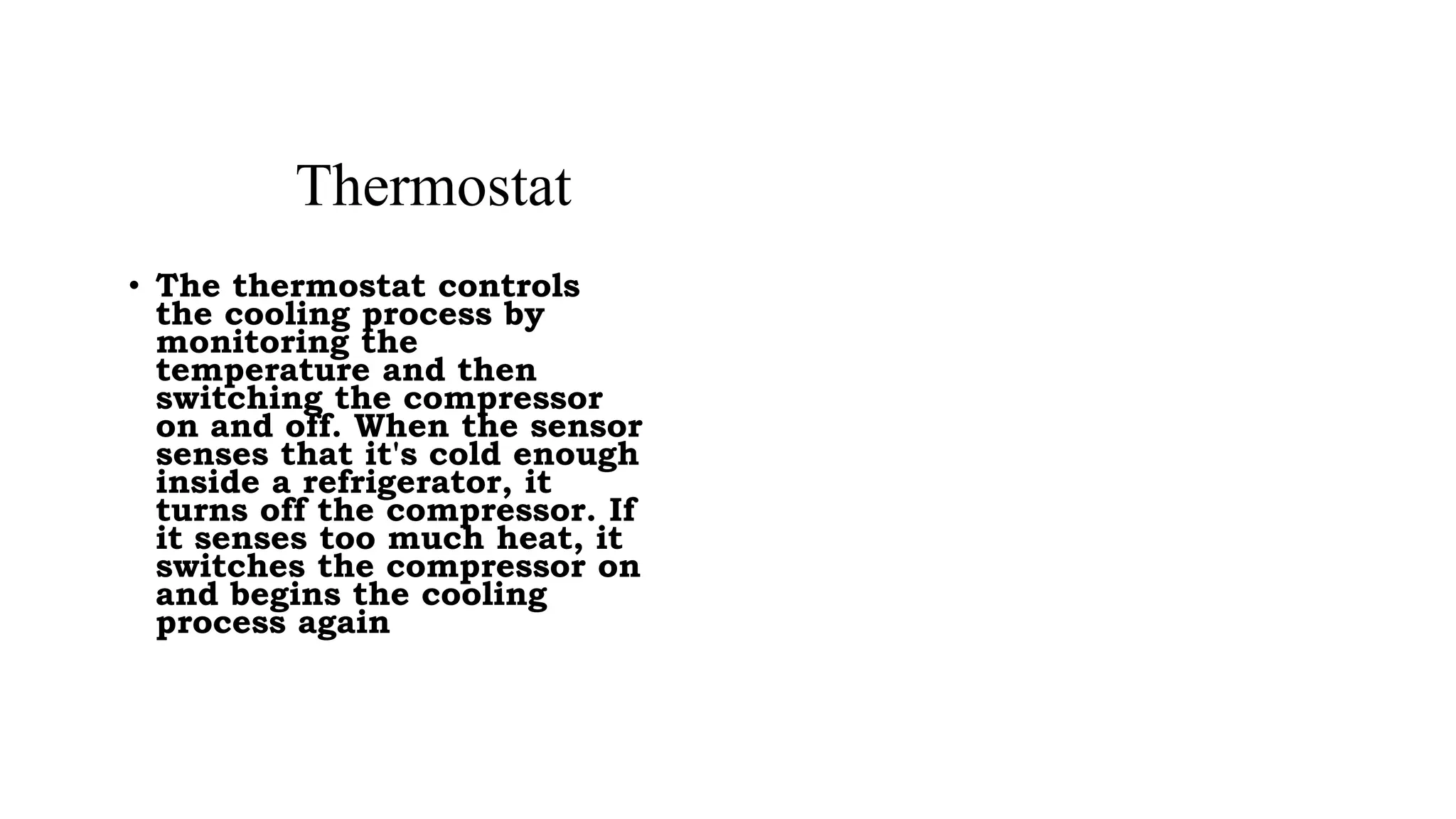
• The thermostat controls
the cooling process by
monitoring the
temperature and then
switching the compressor
on and off. When the sensor
senses that it's cold enough
inside a refrigerator, it
turns off the compressor. If
it senses too much heat, it
switches the compressor on
and begins the cooling
process again
Thermostat
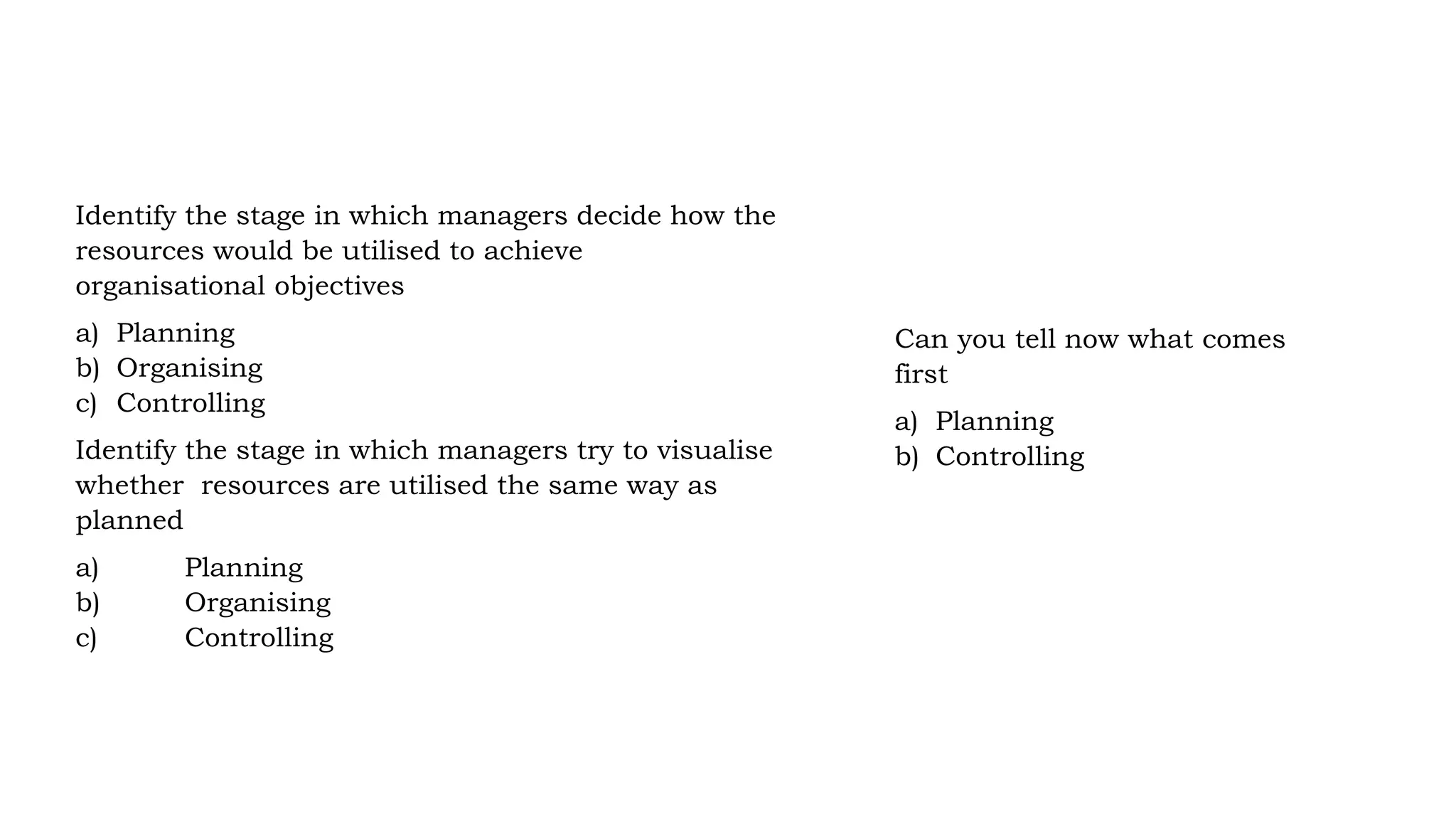
Identify the stage in which managers decide how the
resources would be utilised to achieve
organisational objectives
a) Planning
b) Organising
c) Controlling
Identify the stage in which managers try to visualise
whether resources are utilised the same way as
planned
a) Planning
b) Organising
c) Controlling
Can you tell now what comes
first
a) Planning
b) Controlling
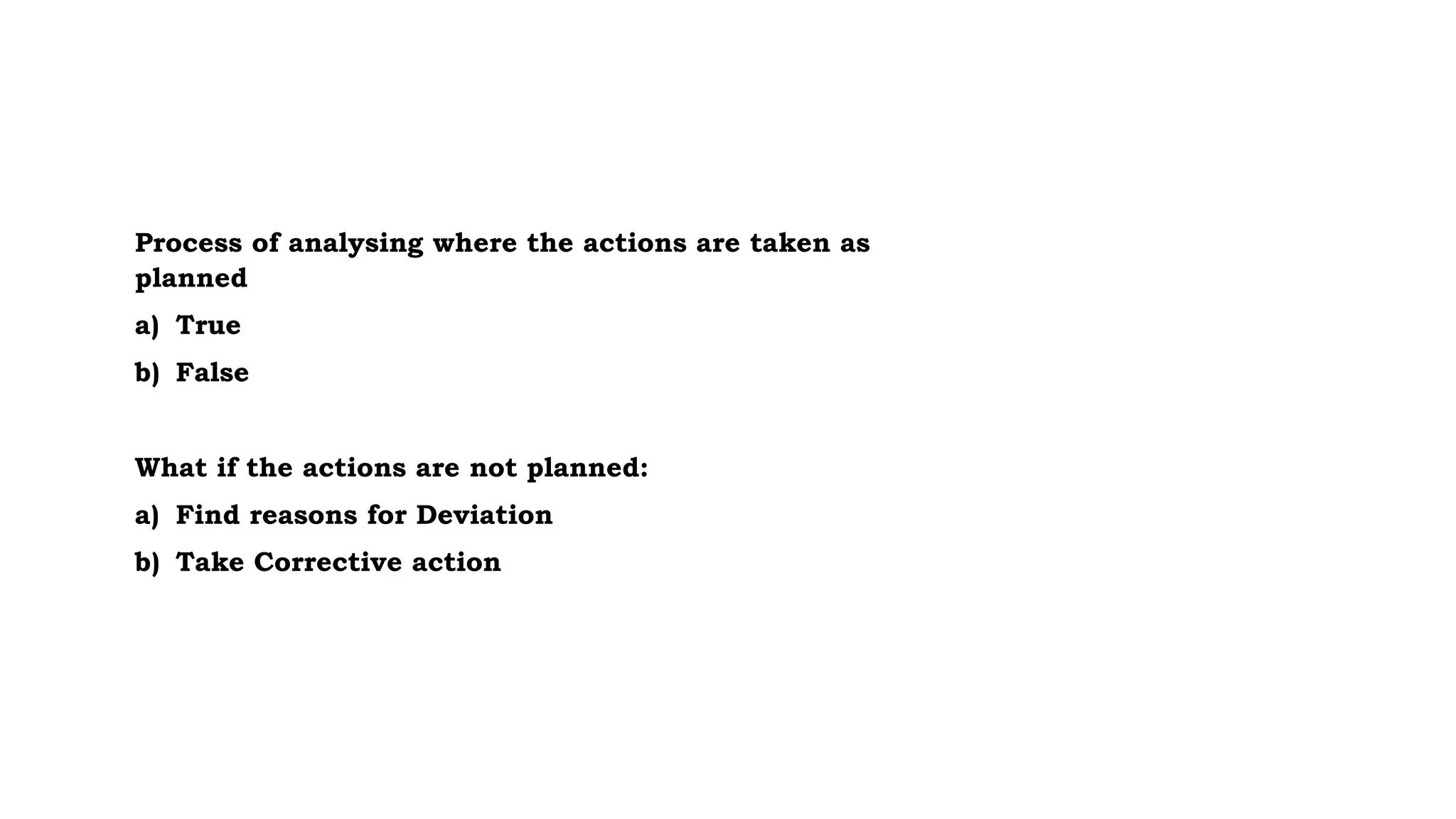
Process of analysing where the actions are taken as
planned
a) True
b) False
What if the actions are not planned:
a) Find reasons for Deviation
b) Take Corrective action
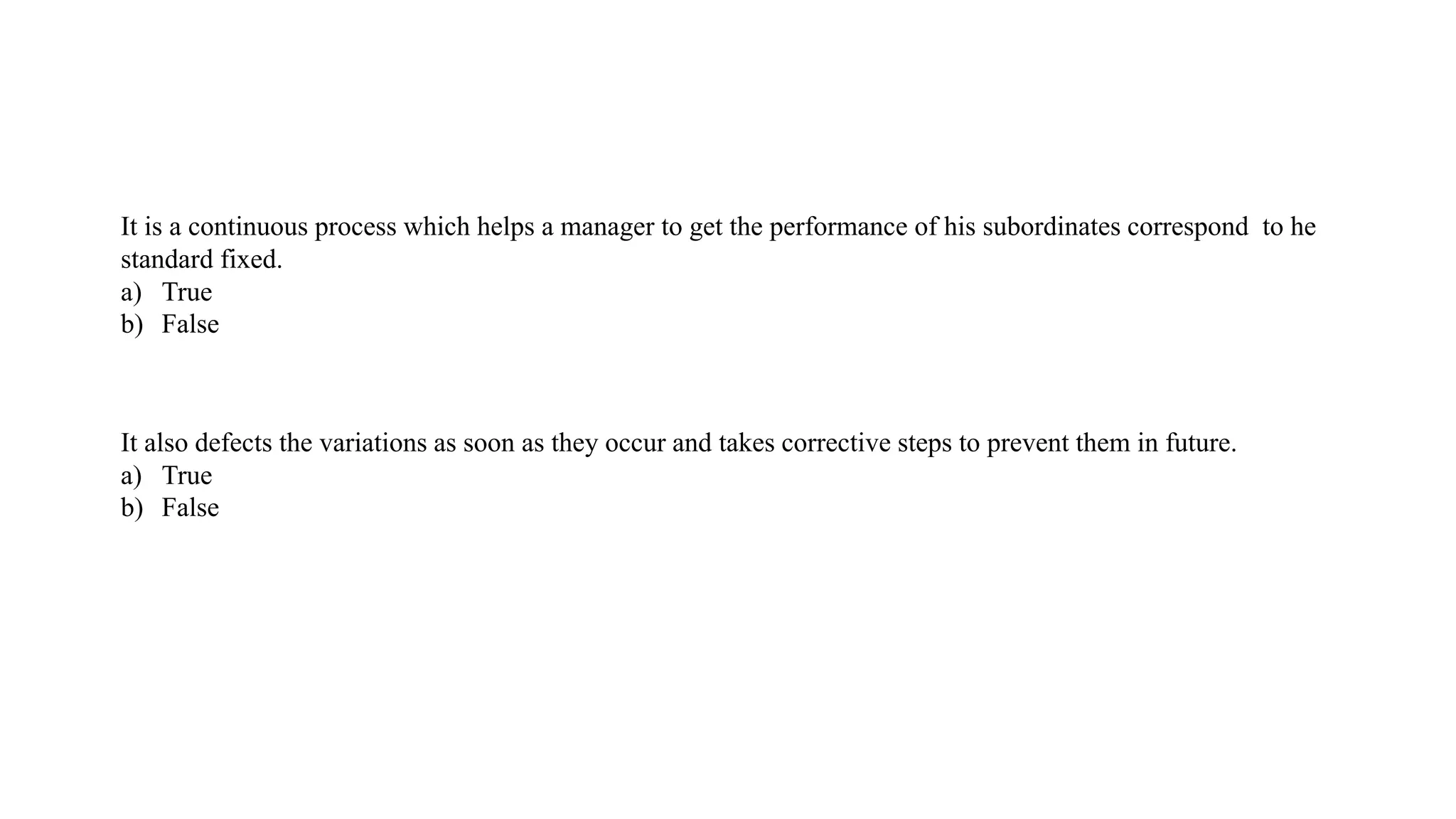
It is a continuous process which helps a manager to get the performance of his subordinates correspond to he
standard fixed.
a) True
b) False
It also defects the variations as soon as they occur and takes corrective steps to prevent them in future.
a) True
b) False
."Henri Fayol: "Control consists in verifying whether everything occurs in
conformity with the plan adopted, instructions issued and principles established
The control function of management involves determining what is to be accomplished
(THE STANDARD); what is being accomplished (THE PERFORMANCE), and, if
necessary, applying corrective measures so that performance takes place according to
plans is. in CONFORMITY with the standard.
Vijay an MBA First Student planned to get 75 % in MBA-I , he got 72 % what
can be done to take corrective action?
Can you tell me what is Standarad, Performance
a) Knowing exactly what WORK is to be done as to quantity, quality and time available
b) Checking whether work has been or is being carried out with the RESOURCES available,
within the TIME available. at a reasonable COST and in ACCORDANCE with the required
standard of quality
C) ANALYSING DEVIATIONS, if any, from the planned targets and standards to ascertain
the causes thereof
d) ADOPTING REMEDIAL MEASURES to correct the deviations, and
e) Suggesting revision of plans and targets, if necessary.
What Controlling Involves
CHARACTERISTICS OF CONTROL
Is Controlling essential at all levels of organisation?
a) Yes
b) No
Every manager performs the control function irrespective of
his rank and nature of job
a) True
b) False
It is the control function which completes the management
process.
a) Yes
b) No
Control is all pervasive function
CHARACTERISTICS OF CONTROL
Control is an ongoing and dynamic function of management.
a) Yes
b) No
As long as an organisation exists, control continues to exist
a) True
b) False
It is amenable to change with the external environment.
a) Yes
b) No
Control is a continuous process
CHARACTERISTICS OF CONTROL
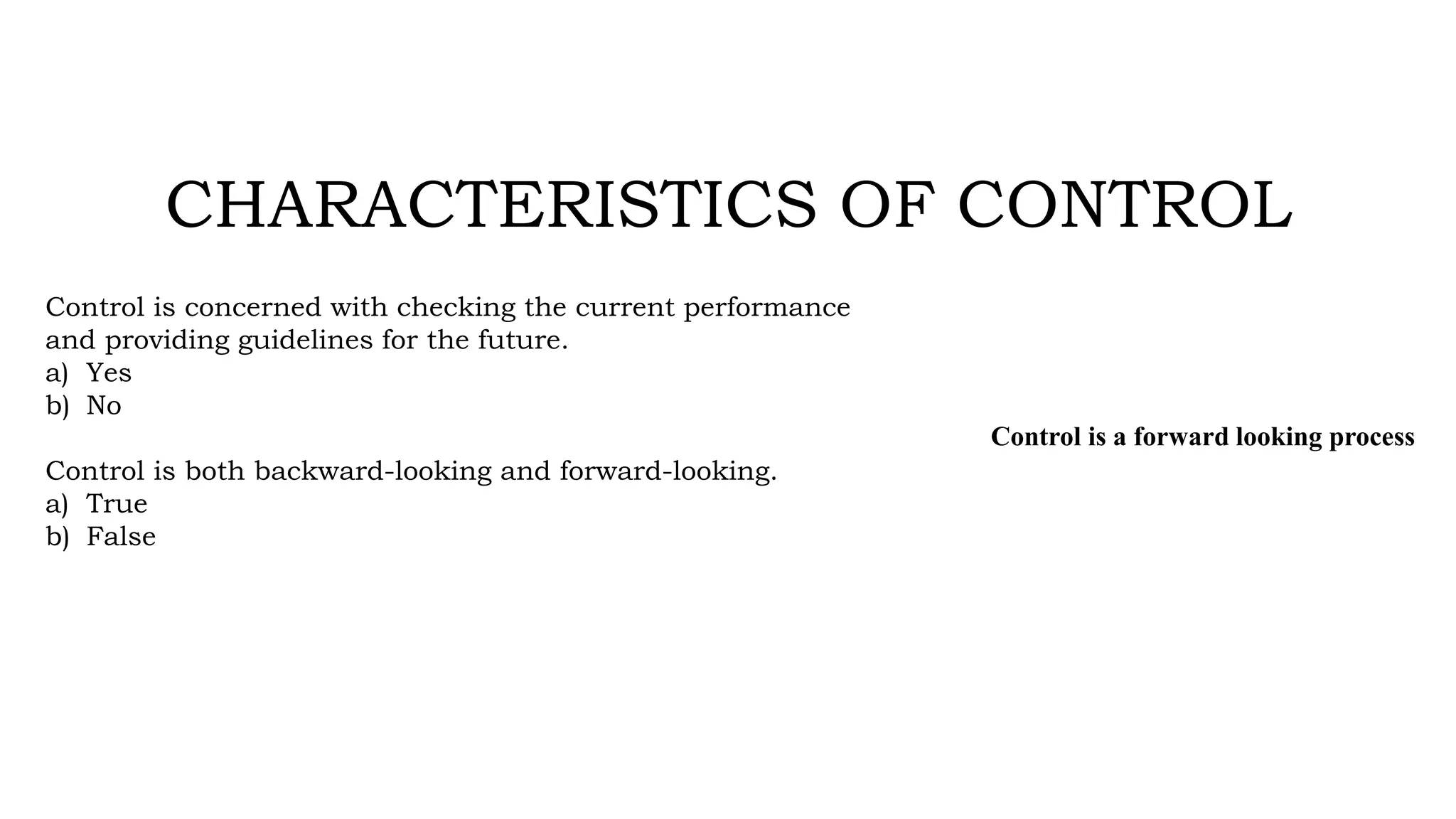
Control is concerned with checking the current performance
and providing guidelines for the future.
a) Yes
b) No
Control is both backward-looking and forward-looking.
a) True
b) False
Control is a forward looking process
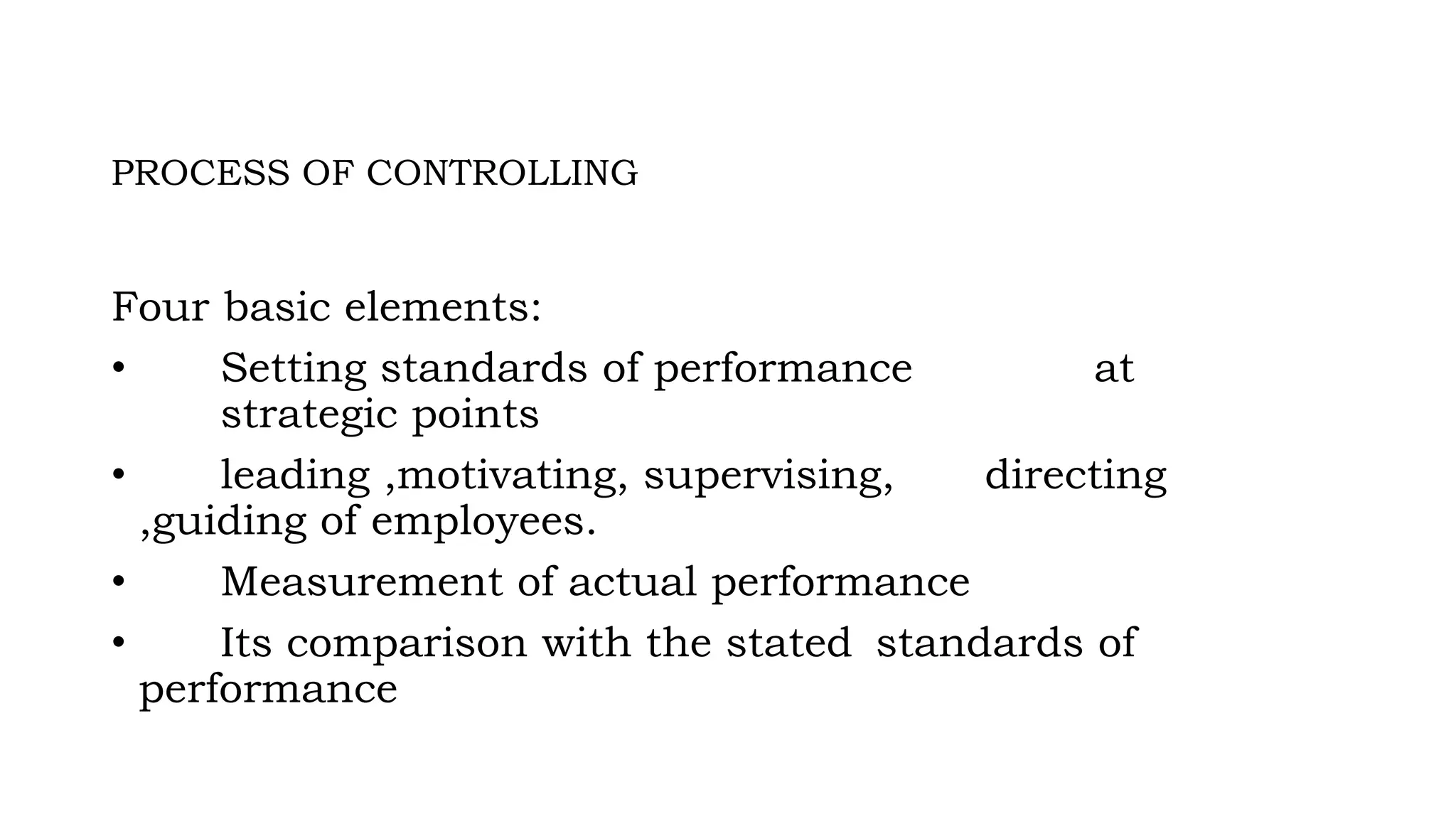
PROCESS OF CONTROLLING
Four basic elements:
• Setting standards of performance at
strategic points
• leading ,motivating, supervising, directing
,guiding of employees.
• Measurement of actual performance
• Its comparison with the stated standards of
performance
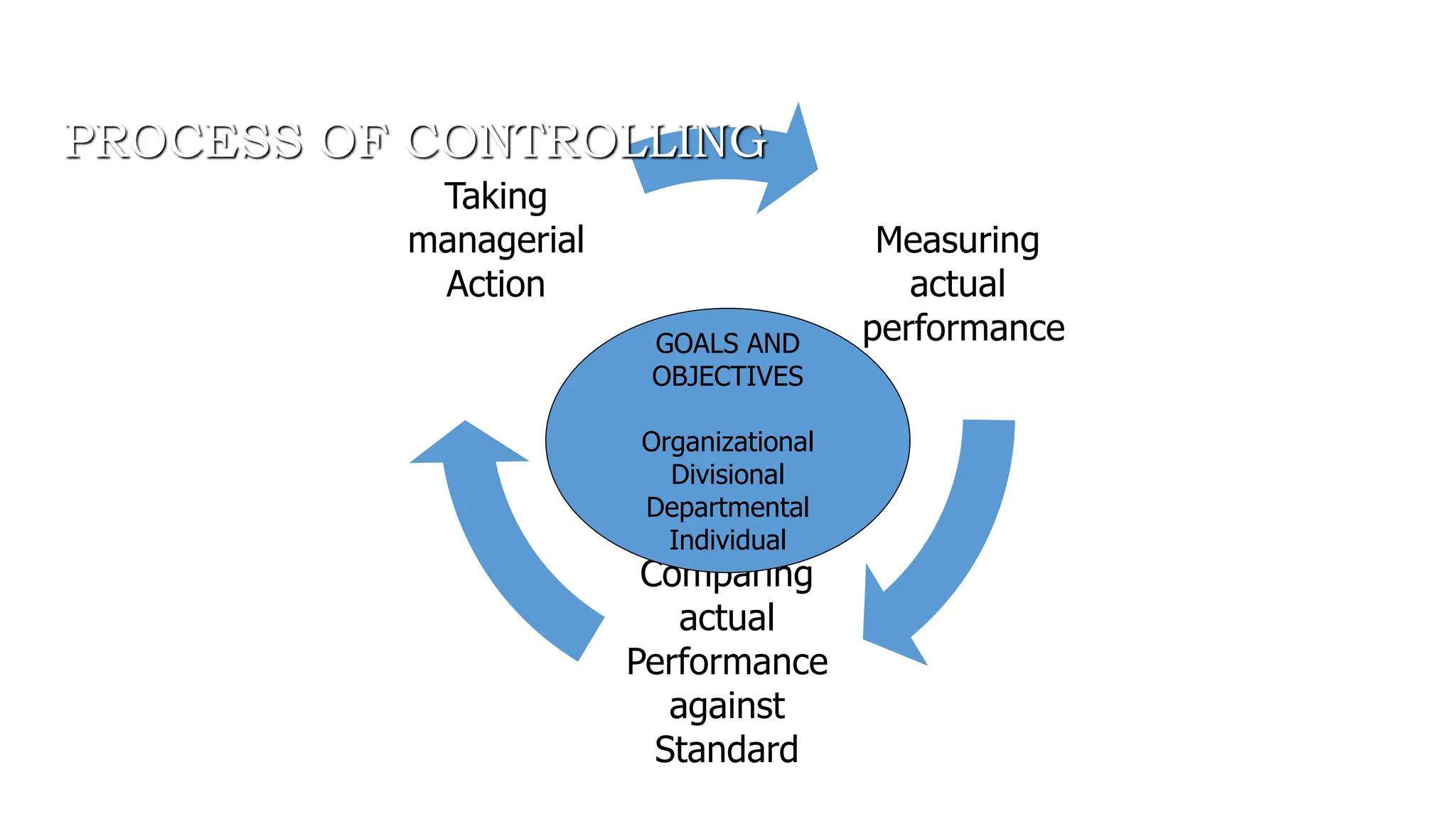
Measuring
actual
performance
Comparing
actual
Performance
against
Standard
Taking
managerial
Action
GOALS AND
OBJECTIVES
Organizational
Divisional
Departmental
Individual
PROCESS OF CONTROLLING
Step 3 Step 1
Step 2
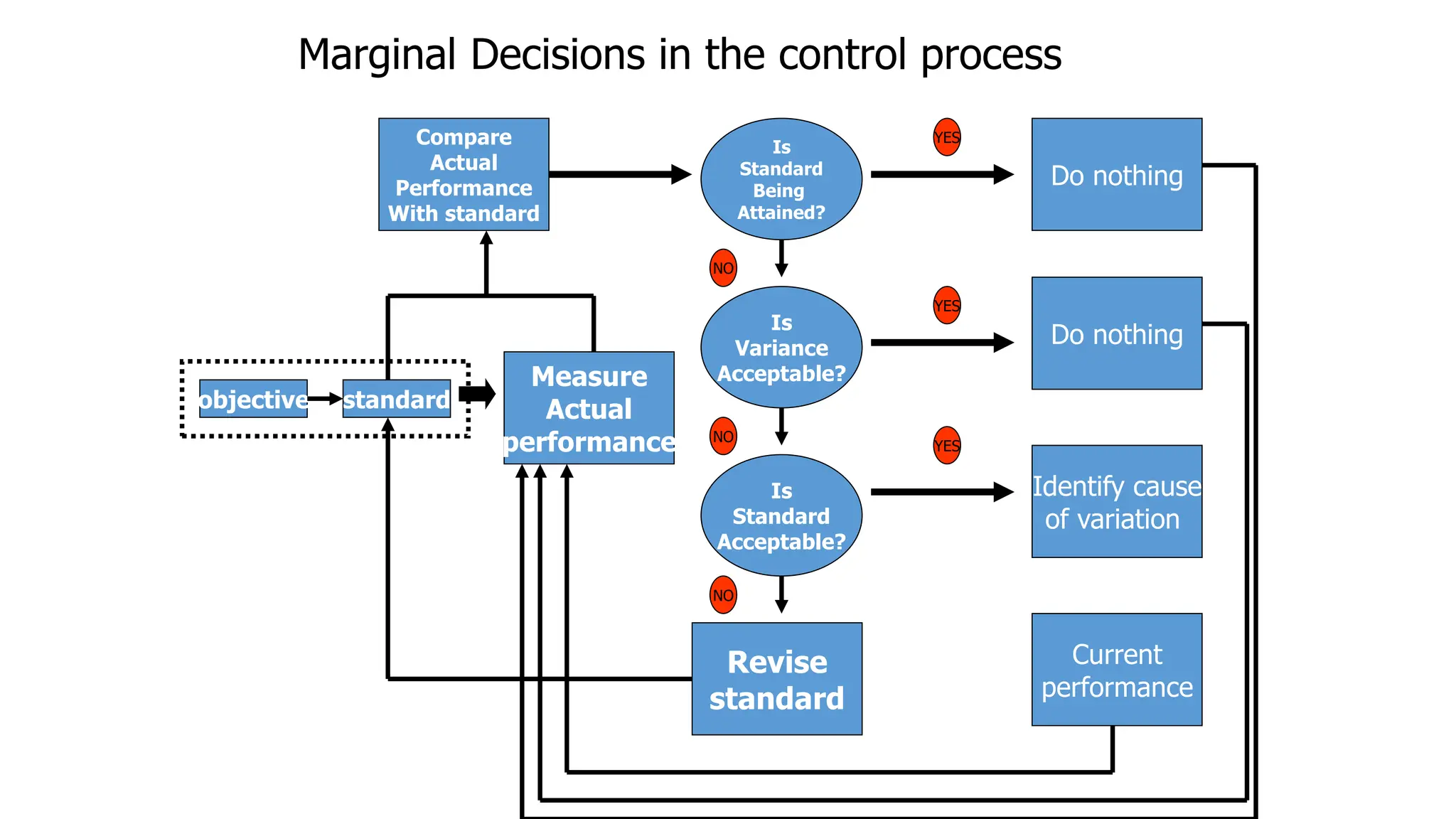
Compare
Actual
Performance
With standard
Is
Standard
Being
Attained?
Do nothing
Is
Variance
Acceptable?
Is
Standard
Acceptable?
Do nothing
Identify cause
of variation
Current
performance
Revise
standard
Measure
Actual
performance
objective standard
NO
NO
NO
YES
YES
YES
Marginal Decisions in the control process
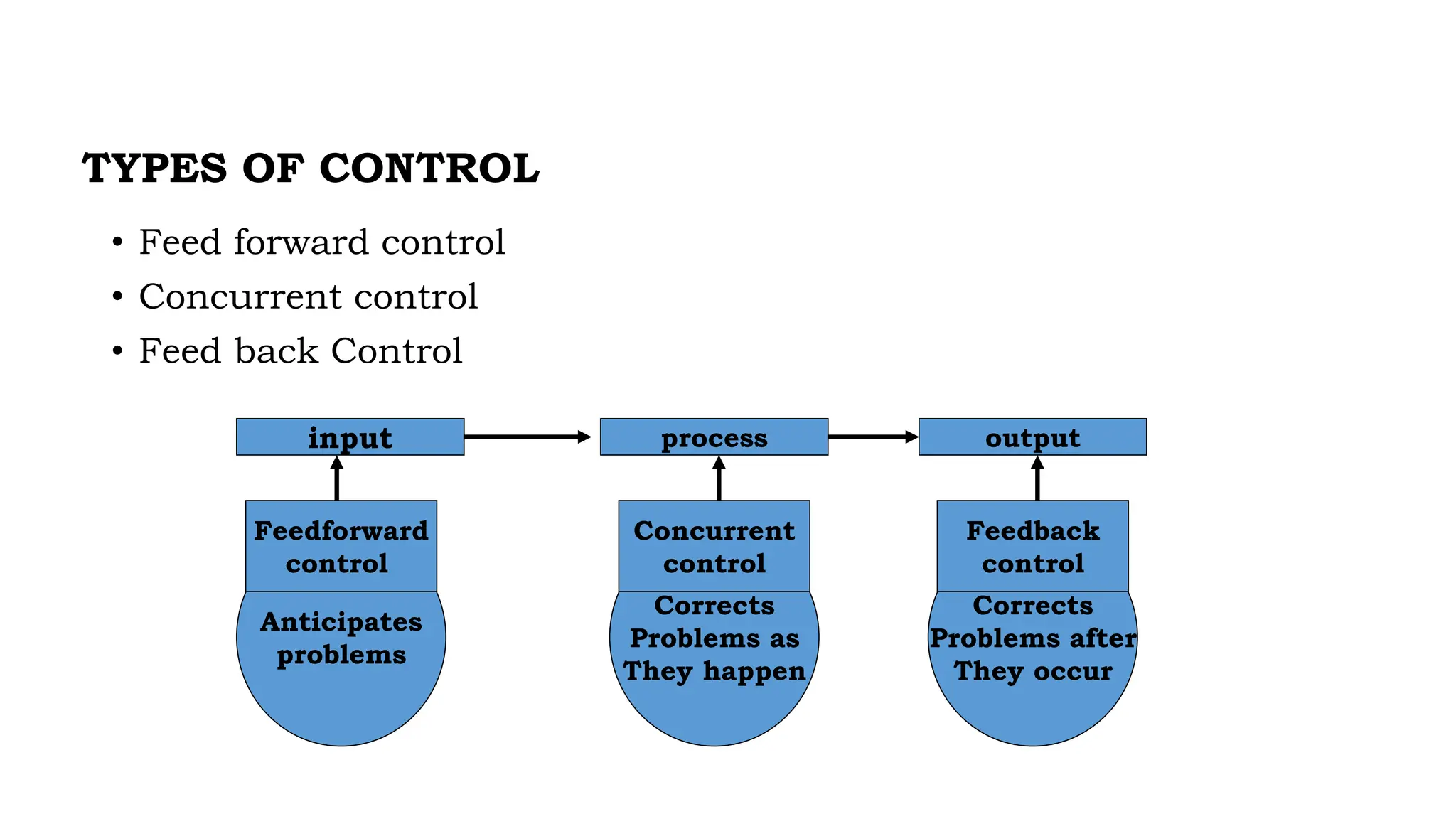
TYPES OF CONTROL
• Feed forward control
• Concurrent control
• Feed back Control
Corrects
Problems after
They occur
Corrects
Problems as
They happen
Anticipates
problems
input process output
Feedforward
control
Concurrent
control
Feedback
control
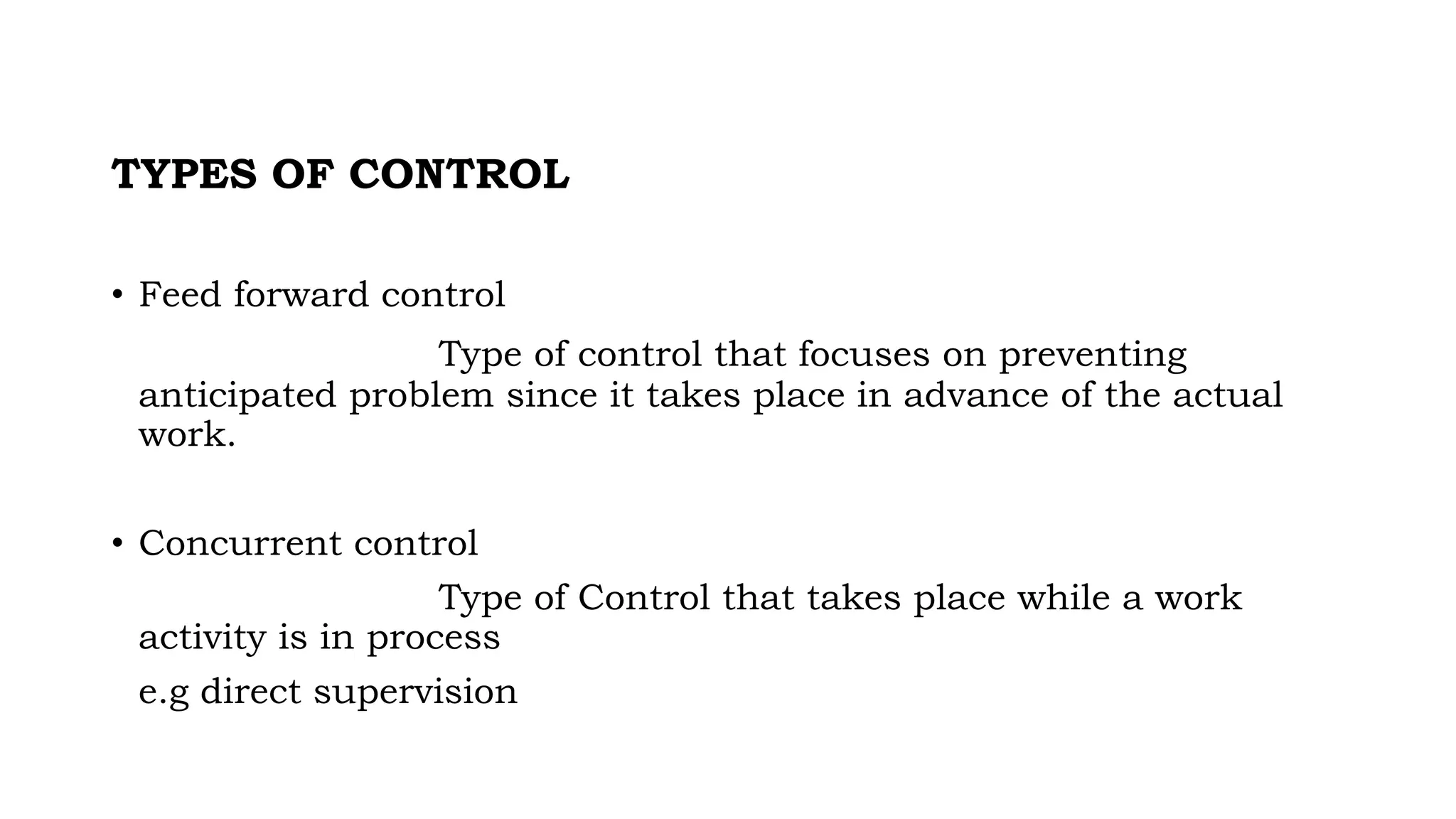
TYPES OF CONTROL
• Feed forward control
Type of control that focuses on preventing
anticipated problem since it takes place in advance of the actual
work.
• Concurrent control
Type of Control that takes place while a work
activity is in process
e.g direct supervision
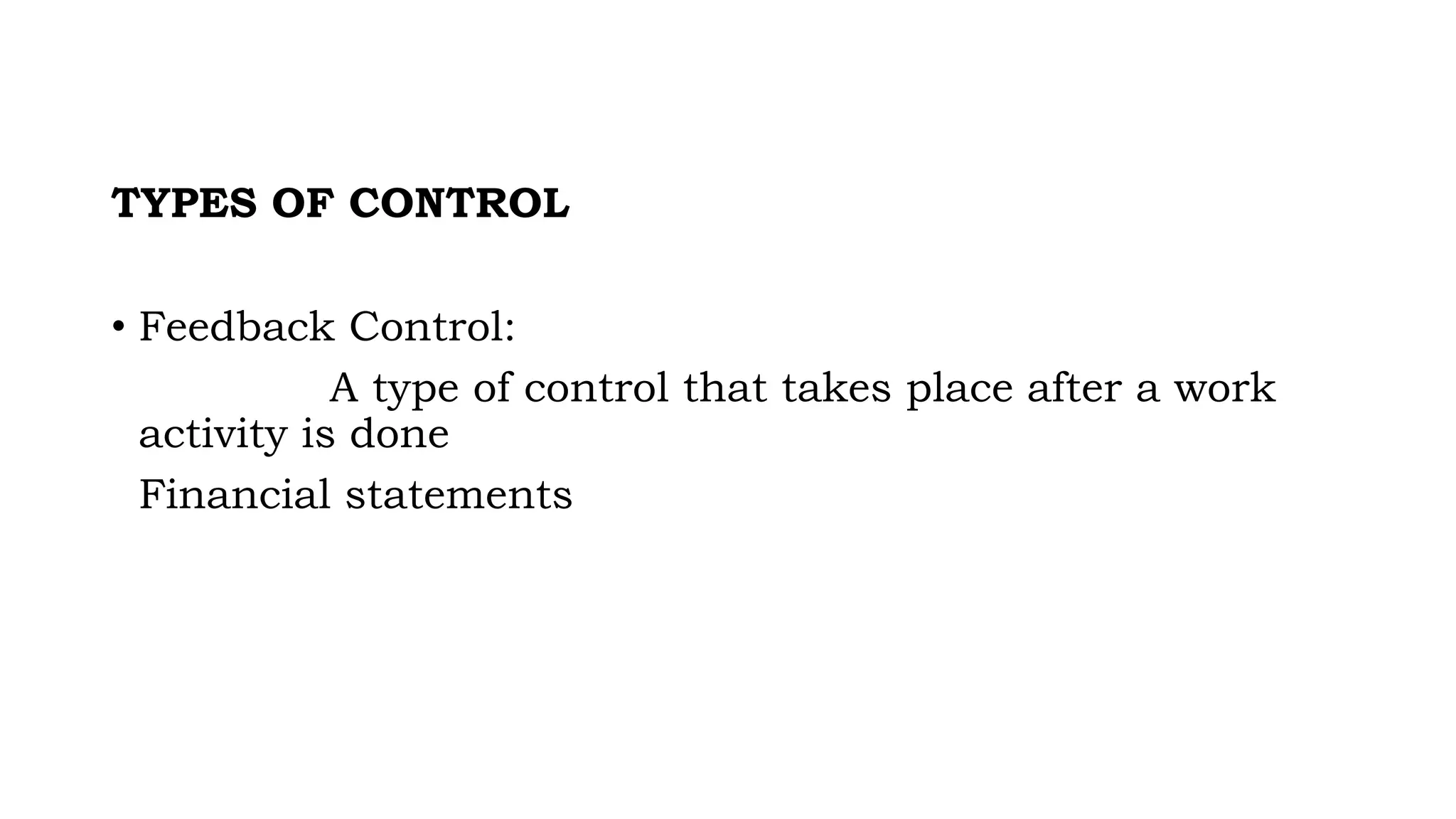
TYPES OF CONTROL
• Feedback Control:
A type of control that takes place after a work
activity is done
Financial statements
QUALITIES OF AN EFFECTIVE CONTROL SYSTEM
• Accuracy
• Timeliness
• Economy
• Understandability
• Reasonable criteria
• Corrective action
CONTROL TECHNIQUES
• Traditional
Personal observation
Break even Analysis
Budgetary Control
• Sales, production
• Modern
Management Audit
Return on investment
PERT
CPM
CONTROL TECHNIQUES
• Management Audit:
Overall and scientific management of quality of
management
Comprehensive and constructive review of the
performance of management
• Return on Investment
How Effectively resources are used
Helps management aware of wastages
and inefficiency
CONTROL TECHNIQUES
• PERT: Programme Evaluation & Review Technique
• CPM: Critical Path Method
Both this methods are oriented towards achieving better
managerial control of time spent in completing the project.
Project is decomposed into activities and then all activities are
integrated in a highly logical sequence to find the shortest time
required to complete the project
PERT focuses on time
CPM focuses on Cost
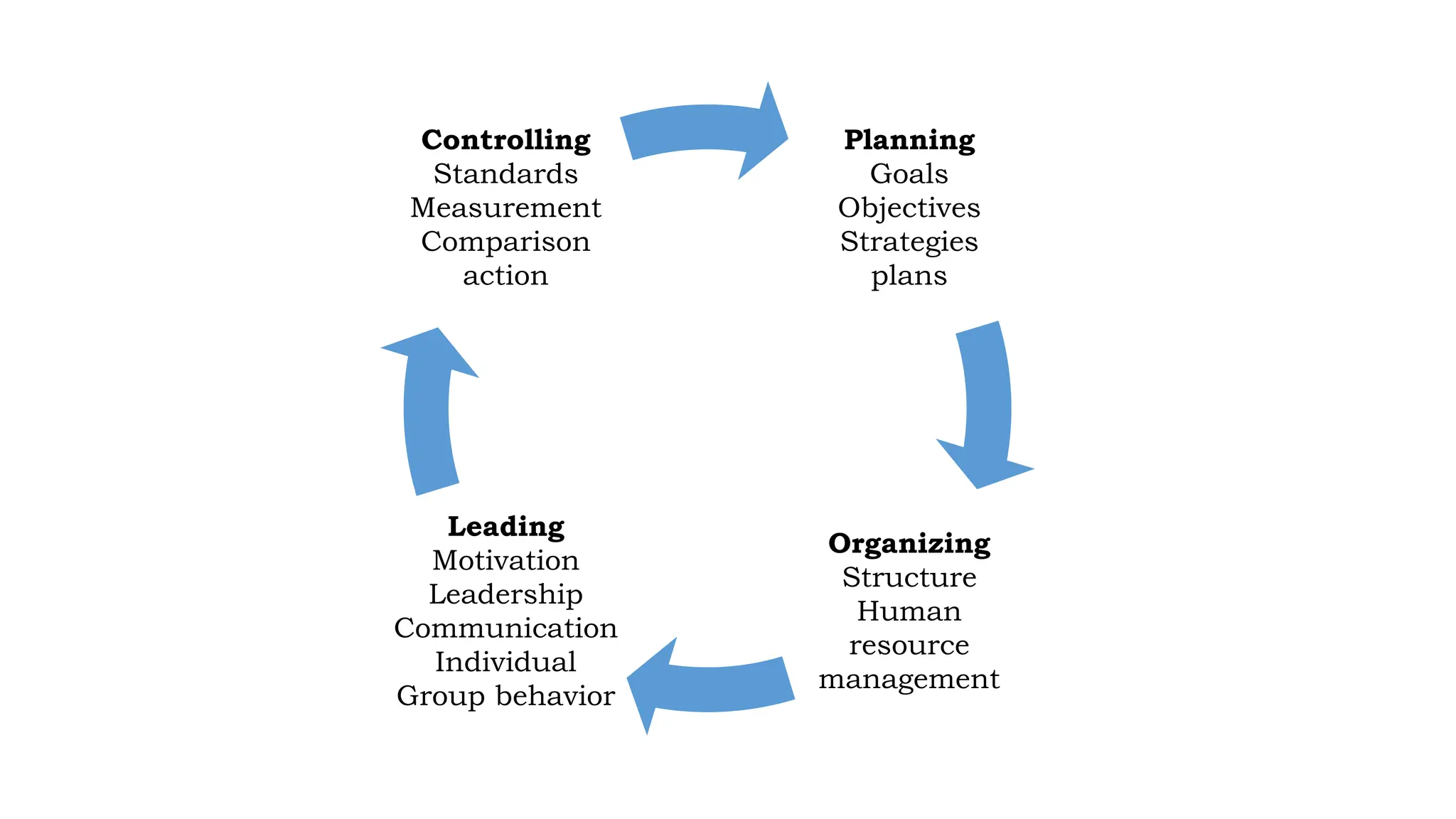
Planning
Goals
Objectives
Strategies
plans
Organizing
Structure
Human
resource
management
Leading
Motivation
Leadership
Communication
Individual
Group behavior
Controlling
Standards
Measurement
Comparison
action
CONCLUSION
• “Planning is the basis of control,
Action is the essence of control,
Delegation is the key to control,
And information is the guide to control.

Controlling is the most important tool of Management

  • 1.
  • 4.
    • 1.After atask has been assigned to a manager • 2.Decide the objectives of the task • 3. Through planning, a strategy is evolved to accomplish the desired objectives • 4. Monitoring (observe and check the progress or quality of (something) over a period of time a) 1-2-3-4 b)2-3-4-1 c)3-4-1-2 d)4-3-2-1
  • 5.
    • The thermostatcontrols the cooling process by monitoring the temperature and then switching the compressor on and off. When the sensor senses that it's cold enough inside a refrigerator, it turns off the compressor. If it senses too much heat, it switches the compressor on and begins the cooling process again Thermostat
  • 6.
    Identify the stagein which managers decide how the resources would be utilised to achieve organisational objectives a) Planning b) Organising c) Controlling Identify the stage in which managers try to visualise whether resources are utilised the same way as planned a) Planning b) Organising c) Controlling Can you tell now what comes first a) Planning b) Controlling
  • 7.
    Process of analysingwhere the actions are taken as planned a) True b) False What if the actions are not planned: a) Find reasons for Deviation b) Take Corrective action
  • 8.
    It is acontinuous process which helps a manager to get the performance of his subordinates correspond to he standard fixed. a) True b) False It also defects the variations as soon as they occur and takes corrective steps to prevent them in future. a) True b) False
  • 9.
    ."Henri Fayol: "Controlconsists in verifying whether everything occurs in conformity with the plan adopted, instructions issued and principles established The control function of management involves determining what is to be accomplished (THE STANDARD); what is being accomplished (THE PERFORMANCE), and, if necessary, applying corrective measures so that performance takes place according to plans is. in CONFORMITY with the standard. Vijay an MBA First Student planned to get 75 % in MBA-I , he got 72 % what can be done to take corrective action? Can you tell me what is Standarad, Performance
  • 10.
    a) Knowing exactlywhat WORK is to be done as to quantity, quality and time available b) Checking whether work has been or is being carried out with the RESOURCES available, within the TIME available. at a reasonable COST and in ACCORDANCE with the required standard of quality C) ANALYSING DEVIATIONS, if any, from the planned targets and standards to ascertain the causes thereof d) ADOPTING REMEDIAL MEASURES to correct the deviations, and e) Suggesting revision of plans and targets, if necessary. What Controlling Involves
  • 11.
    CHARACTERISTICS OF CONTROL IsControlling essential at all levels of organisation? a) Yes b) No Every manager performs the control function irrespective of his rank and nature of job a) True b) False It is the control function which completes the management process. a) Yes b) No Control is all pervasive function
  • 12.
    CHARACTERISTICS OF CONTROL Controlis an ongoing and dynamic function of management. a) Yes b) No As long as an organisation exists, control continues to exist a) True b) False It is amenable to change with the external environment. a) Yes b) No Control is a continuous process
  • 13.
    CHARACTERISTICS OF CONTROL Controlis concerned with checking the current performance and providing guidelines for the future. a) Yes b) No Control is both backward-looking and forward-looking. a) True b) False Control is a forward looking process
  • 14.
    PROCESS OF CONTROLLING Fourbasic elements: • Setting standards of performance at strategic points • leading ,motivating, supervising, directing ,guiding of employees. • Measurement of actual performance • Its comparison with the stated standards of performance
  • 15.
  • 16.
    Compare Actual Performance With standard Is Standard Being Attained? Do nothing Is Variance Acceptable? Is Standard Acceptable? Donothing Identify cause of variation Current performance Revise standard Measure Actual performance objective standard NO NO NO YES YES YES Marginal Decisions in the control process
  • 17.
    TYPES OF CONTROL •Feed forward control • Concurrent control • Feed back Control Corrects Problems after They occur Corrects Problems as They happen Anticipates problems input process output Feedforward control Concurrent control Feedback control
  • 18.
    TYPES OF CONTROL •Feed forward control Type of control that focuses on preventing anticipated problem since it takes place in advance of the actual work. • Concurrent control Type of Control that takes place while a work activity is in process e.g direct supervision
  • 19.
    TYPES OF CONTROL •Feedback Control: A type of control that takes place after a work activity is done Financial statements
  • 20.
    QUALITIES OF ANEFFECTIVE CONTROL SYSTEM • Accuracy • Timeliness • Economy • Understandability • Reasonable criteria • Corrective action
  • 21.
    CONTROL TECHNIQUES • Traditional Personalobservation Break even Analysis Budgetary Control • Sales, production • Modern Management Audit Return on investment PERT CPM
  • 22.
    CONTROL TECHNIQUES • ManagementAudit: Overall and scientific management of quality of management Comprehensive and constructive review of the performance of management • Return on Investment How Effectively resources are used Helps management aware of wastages and inefficiency
  • 23.
    CONTROL TECHNIQUES • PERT:Programme Evaluation & Review Technique • CPM: Critical Path Method Both this methods are oriented towards achieving better managerial control of time spent in completing the project. Project is decomposed into activities and then all activities are integrated in a highly logical sequence to find the shortest time required to complete the project PERT focuses on time CPM focuses on Cost
  • 24.
  • 25.
    CONCLUSION • “Planning isthe basis of control, Action is the essence of control, Delegation is the key to control, And information is the guide to control.