BRANDING
Dr. Ashutosh Kumar
Asia Pacific Institute of Management
What are the unique features of the
brands you buy most often?
•
•
•
•
•
•

Amazon.com
Surf excel
Kingfisher
McDonalds
Gap
Coke
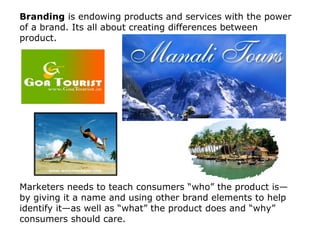
Branding is endowing products and services with the power
of a brand. Its all about creating differences between
product.

Marketers needs to teach consumers “who” the product is—
by giving it a name and using other brand elements to help
identify it—as well as “what” the product does and “why”
consumers should care.
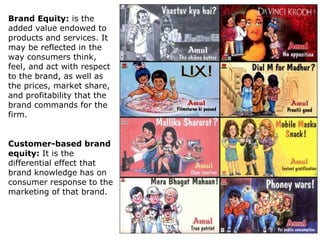
Brand Equity: is the
added value endowed to
products and services. It
may be reflected in the
way consumers think,
feel, and act with respect
to the brand, as well as
the prices, market share,
and profitability that the
brand commands for the
firm.
Customer-based brand
equity: It is the
differential effect that
brand knowledge has on
consumer response to the
marketing of that brand.
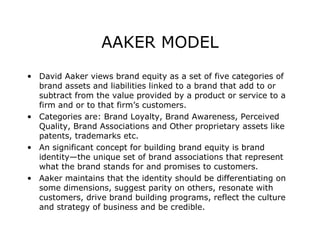
AAKER MODEL
• David Aaker views brand equity as a set of five categories of
brand assets and liabilities linked to a brand that add to or
subtract from the value provided by a product or service to a
firm and or to that firm’s customers.
• Categories are: Brand Loyalty, Brand Awareness, Perceived
Quality, Brand Associations and Other proprietary assets like
patents, trademarks etc.
• An significant concept for building brand equity is brand
identity—the unique set of brand associations that represent
what the brand stands for and promises to customers.
• Aaker maintains that the identity should be differentiating on
some dimensions, suggest parity on others, resonate with
customers, drive brand building programs, reflect the culture
and strategy of business and be credible.
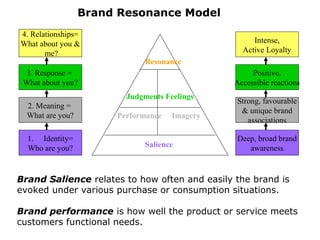
Brand Resonance Model
4. Relationships=
What about you &
me?

Intense,
Active Loyalty
Resonance

3. Response =
What about you?

Positive,
Accessible reactions
Judgments Feelings

2. Meaning =
What are you?
1. Identity=
Who are you?

Performance

Imagery

Salience

Strong, favourable
& unique brand
associations
Deep, broad brand
awareness

Brand Salience relates to how often and easily the brand is
evoked under various purchase or consumption situations.
Brand performance is how well the product or service meets
customers functional needs.
Measuring Brand Equity
• Brand Audits: It is a consumer-focused
exercise that involves a series of procedures to
assess the health of the brand, uncover its
sources of brand equity, and suggest ways to
improve and leverage its equity.
• It consist of Brand inventory and Brand
exploratory
– Brand inventory purpose is to provide a current,
comprehensive profile of how all the products and
services sold by a company are marketed and
branded.
Measuring Brand Equity
– Brand exploratory is research activity conducted to
understand what consumers think and feel about the
brand and its corresponding product category to
identify sources of brand equity.

• Brand Tracking: Brand tracking studies usually

involve collecting quantitative data from consumers on
a regular basis. One way to do it is to continuously
collect information, which provide a more representative
picture of how the brand stands and allow us to control
for unusual marketing activities during the analysis.
Measuring Brand Equity
• Brand Valuation: Brand valuation is the process
used to calculate the value of brands.
Managing Brand Equity
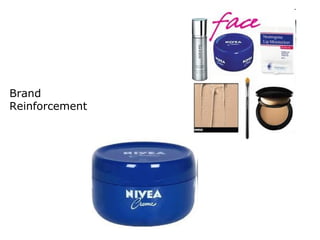
Brand
Reinforcement
Brand Crisis
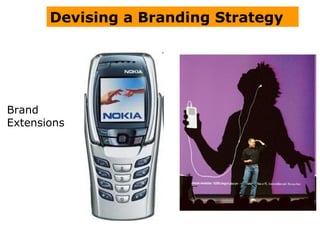
Devising a Branding Strategy

Brand
Extensions
Brand Portfolios
It is the set of all brands and brand lines a particular firm offers
for sale to buyers in a particular category. Different brands may
be designed and marketed to appeal to different market
segments.
Brand equity

Brand equity

  • 1.
    BRANDING Dr. Ashutosh Kumar AsiaPacific Institute of Management
  • 3.
    What are theunique features of the brands you buy most often? • • • • • • Amazon.com Surf excel Kingfisher McDonalds Gap Coke
  • 4.
    Branding is endowingproducts and services with the power of a brand. Its all about creating differences between product. Marketers needs to teach consumers “who” the product is— by giving it a name and using other brand elements to help identify it—as well as “what” the product does and “why” consumers should care.
  • 5.
    Brand Equity: isthe added value endowed to products and services. It may be reflected in the way consumers think, feel, and act with respect to the brand, as well as the prices, market share, and profitability that the brand commands for the firm. Customer-based brand equity: It is the differential effect that brand knowledge has on consumer response to the marketing of that brand.
  • 8.
    AAKER MODEL • DavidAaker views brand equity as a set of five categories of brand assets and liabilities linked to a brand that add to or subtract from the value provided by a product or service to a firm and or to that firm’s customers. • Categories are: Brand Loyalty, Brand Awareness, Perceived Quality, Brand Associations and Other proprietary assets like patents, trademarks etc. • An significant concept for building brand equity is brand identity—the unique set of brand associations that represent what the brand stands for and promises to customers. • Aaker maintains that the identity should be differentiating on some dimensions, suggest parity on others, resonate with customers, drive brand building programs, reflect the culture and strategy of business and be credible.
  • 9.
    Brand Resonance Model 4.Relationships= What about you & me? Intense, Active Loyalty Resonance 3. Response = What about you? Positive, Accessible reactions Judgments Feelings 2. Meaning = What are you? 1. Identity= Who are you? Performance Imagery Salience Strong, favourable & unique brand associations Deep, broad brand awareness Brand Salience relates to how often and easily the brand is evoked under various purchase or consumption situations. Brand performance is how well the product or service meets customers functional needs.
  • 13.
    Measuring Brand Equity •Brand Audits: It is a consumer-focused exercise that involves a series of procedures to assess the health of the brand, uncover its sources of brand equity, and suggest ways to improve and leverage its equity. • It consist of Brand inventory and Brand exploratory – Brand inventory purpose is to provide a current, comprehensive profile of how all the products and services sold by a company are marketed and branded.
  • 14.
    Measuring Brand Equity –Brand exploratory is research activity conducted to understand what consumers think and feel about the brand and its corresponding product category to identify sources of brand equity. • Brand Tracking: Brand tracking studies usually involve collecting quantitative data from consumers on a regular basis. One way to do it is to continuously collect information, which provide a more representative picture of how the brand stands and allow us to control for unusual marketing activities during the analysis.
  • 15.
    Measuring Brand Equity •Brand Valuation: Brand valuation is the process used to calculate the value of brands.
  • 16.
  • 17.
  • 18.
  • 19.
    Devising a BrandingStrategy Brand Extensions
  • 20.
    Brand Portfolios It isthe set of all brands and brand lines a particular firm offers for sale to buyers in a particular category. Different brands may be designed and marketed to appeal to different market segments.