From Exile
- -- R.Parthasarthy
By
Prof.R.R.Borse,
Asst.Prof. & Head,
Eng.Dept.
B.P.Arts,S.M.A.Sci.,K.K.C.Comm.College,
Chalisgaon,Dist.Jalgaon
ravindraborse1@gmail.com
 Rajagopal Parthasarathy was born at Tirupparaiturai near TiruchchirappaUi
in 1934 educated at Don Bosco High School and Siddharth College, Bombay
 Higher Education at Leeds University, England
 At Leeds University, he was a British Council Scholar in 1963--4.
 He was a Lecturer in English Literature in Bombay for ten years before he
joined Oxford University Press in 1971 as Regional Editor in Madras.
Parthasarthy’s Career as a Poet
Bilingual Poet – poems in Tamil & English
His poems are –
Poetry from Leeds (1968), which he edited with Healy, Ten
Twentieth-Century Indian Poets (1976) and Rough Passage
(1977), which was a runner-up for the Commonwealth Poetry
Prize in 1977.
He has had poems published in Encounter, London Magazine,
Poetry India, Quest, The Times Literary Supplement, Many
People, Many Voices (Hutchinson, 1978) and The Shell and the
Rain (Allen and Unwin, 1973).
He was awarded the Ulka Poetry Prize of Poetry India in 1966.
During 1978-9, he was a member of the 'University of Lowa's
International Writing Program.
He is a member of Advisory Board for English of the National
Academy of Letters, New Delhi.
Parthasarthy : Themes
 cultural dilemma, alienation, search for identity, Tamil culture and root
 He lived for many years in England but he always missed his motherland
India and specially Tamil culture.
 So in doing so he has to suffer a lot as he dwells in cultural dilemma which
results in alienation and rootlessness.
 On one hand he dreamt of England as his future home and English language
with English culture as his medium of expression.
 And on the other hand he loves his own Tamil culture very much. As a result,
a double alienation from English language and Tamil culture are found in his
poetry.
 He is suffering from the conflicts between his past memories and present
social reality. Alienation and search for identity come obviously with a sense
of homesickness in his poetry.
 So his “Rough Passage” deals with emotional and cultural dilemma,
rootlessness, urge for belongingness, impotence to acquire foreign culture
and language and love for Tamil culture.
Parthasarthy : Hatred for England
 Went to England for his higher education
 Disconnected from his Tamil roots
 England was a dirty place
 English people’s arrogance towards Indians
 English people called Indians as ‘coloureds’ (colour/racial
discrimination)
 When he returned to India, he felt that he lost his native culture
and he had become a misfit in his own country.
 Feels socially and culturally alienated
 Feels sorry to see that Tamil Nadu is blindly copying the west and
Indian old values are ignored.
“Rough Passage”
 “Rough Passage” has divided into three
sections namely “Exile”, “Trial” and
“Homecoming”.
 In “Exile”, he wants to show his solitary
condition in England and his fractured bond
with Tamil culture.
 In “Trial”, he wants to find consolation
through physical love as this section deals
with emotion, love and human relationship.
 And in the last section “Homecoming”, he
tries to harmonize the fusion of the English
language with his Tamil culture.
Parthasarthy : on Language & Culture
“Parthasarathy dwells upon the question of language and
identity and upon the inner conflict that arises in Postcolonial era
from being brought up in two cultures.
Exile, the first poet, opposes the culture of Europe with that of
India, and examines the consequences of British rule on an
Indian, especially the loss of identity with his own culture and
therefore the need for roots.
Again the turmoil of non-relationship personal love holds forth
the promise of belonging, and the second part “Trial” celebrates
love as a reality here and now “Homecoming”, the third and final
part of Rough Passage explores the phenomenon of returning to
one’s home. It is a sort of overture made with the aim of starting
a dialogue between the poet and his Tamil past.
The strength of the poem derives from his sense of responsibility
towards crucial personal events in his life.
Parthasarthy : on Language & Culture
 In his “Rough Passage” comprises of three parts namely “Exile”, “Trial” and
“Homecoming”, he experiments with his English language and Tamil culture to
create a balance between them.
 In these poems we find so many conflicts and dilemmas as he is heir to two
languages and two cultures.
 He deeply suffers from cultural anxiety because of divided allegiance. As in
some poems we find his desperate longing for home.
 In “Exile”, Parthasarathy wants to show the images of India along with poverty,
filth, domination and socio-cultural structure of his natives as they were
colonized and controlled through colonial discourse.
 As he realizes the fact that his diasporic identity creates so much problems and
dilemma in him that his poems alienates from his own culture.
 Actually throughout “Exile”, he wants to show his sense of alienation with his
complete knowledge of dislocation from past.
from EXILE
(Setting :Poet in a London Basement Flat)
Through holes in a wall, as it were,
lamps burned in the fog.
In a basement flat, conversation
filled the night, while Ravi Shankar,.(who imitated english lifestyle)
cigarette stubs, empty bottles of stout (a kind of strong beer)
and crisps provided the necessary pauses.
He had spent his youth whoring (worshipping/loving)
after English gods.
There is something to be said for exile:
you learn roots are deep. (i.e.Tamil culture)
That language is a tree, loses colour
under another sky. (i.e.England)
The bark disappears with · the snow
and branches become hoarse.
From EXILE
However, the most reassuring thing
about the past is that it happened.
Dressed
in tweeds or grey flannel
Its suburban pockets
bursting with immigrants-
'coloureds' is what they calls us
over there-the city is no jewel, either:
lanes full of smoke and litter
with puddles of unwashed '
English children.
On New Year's Eve he heard an old man
at Trafalgar Square, 'It's no use trying (an important,fashionable place in England)
to change people. They'll be what they are.
From EXILE
An empire's last words are heard
on the hot sands of Africa.
The da Gamas, Clives, Dupleixs are back.(the names of some European imperialists, their
statues are in London which symbolises English empire in the world)
Victoria sleeps on her island (Queen Victoria i.e.European imperialisam)
alone, an old hag,
shaking her invincible locks.'
Standing on Westminster Bridge, (famous bridge in London on Thames river)
it seemed the Thames had clogged
the chariot wheels of Boadicea to stone.(Boadicea was an ancient British Queen who had
fought against the Romans when they attacked England.She was defeated.The poet contrasts her with
Queen Victoria who symoloses colonialism and Boadicea freedom)
Under the shadow of poplars
the river divides the city from the night.
The noises reappear,
of early trains, the milkman,
and the events of the day become
vocal in the newsboy.
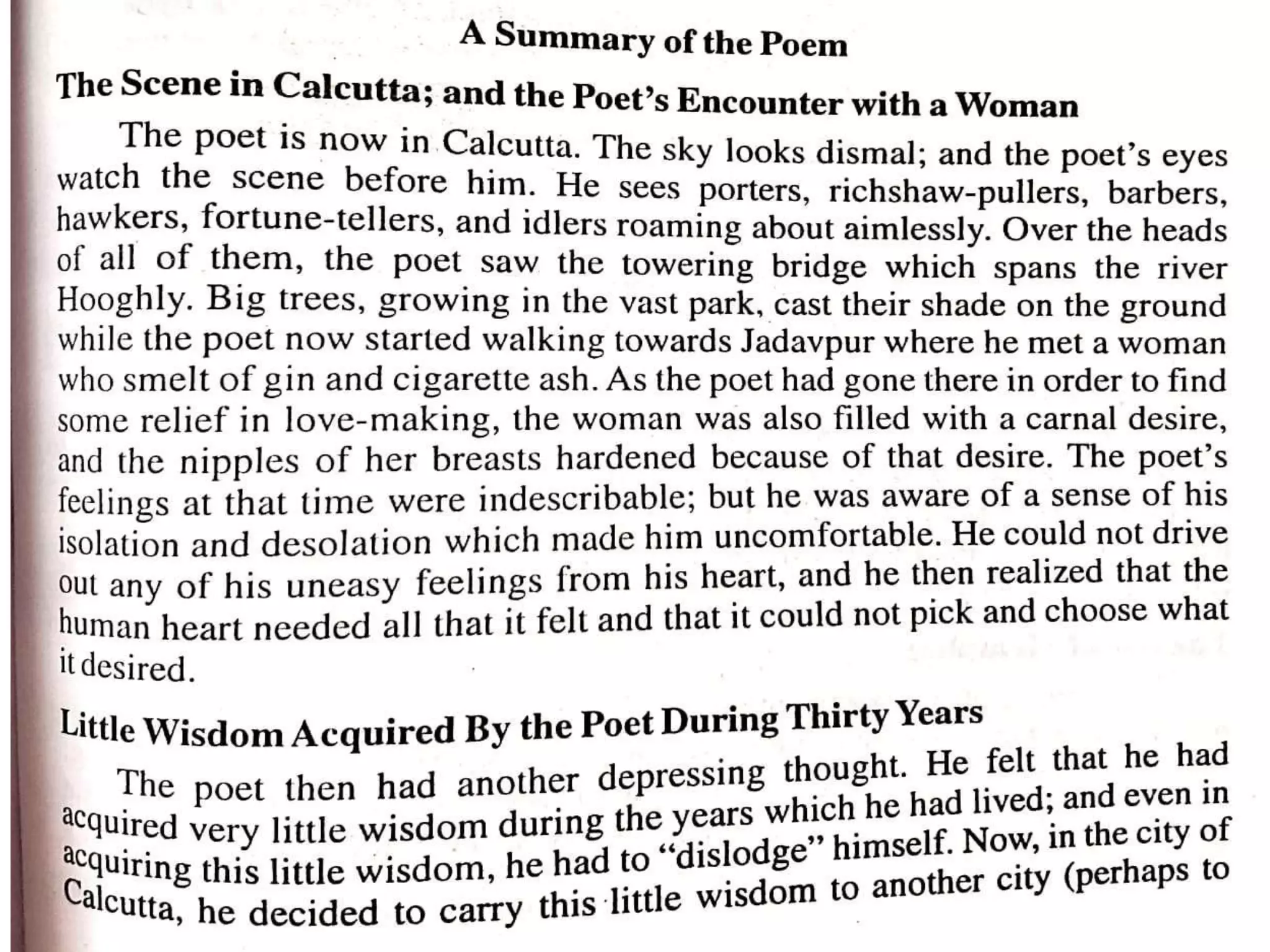
From EXILE (Part 2,Poem No.8)
(The poet Imagines being in Calcutta (India)
A grey sky oppresses the eyes (dim,not shining)
porters, rickshaw-pullers, barbers, hawkers,
fortune-tellers, loungers compose the scene.(idlers walking about aimlessly)
Above them towers the bridge, (a bridge on Hooghly river-between Howra and Calcutta)
a pale diamond in the water.
Trees, big with shade, squat in the maidan
as I walk, my tongue hunchbacked
with words, towards Jadavpur (an area in Calcutta)
to your arms. You smell of gin (alcohol)
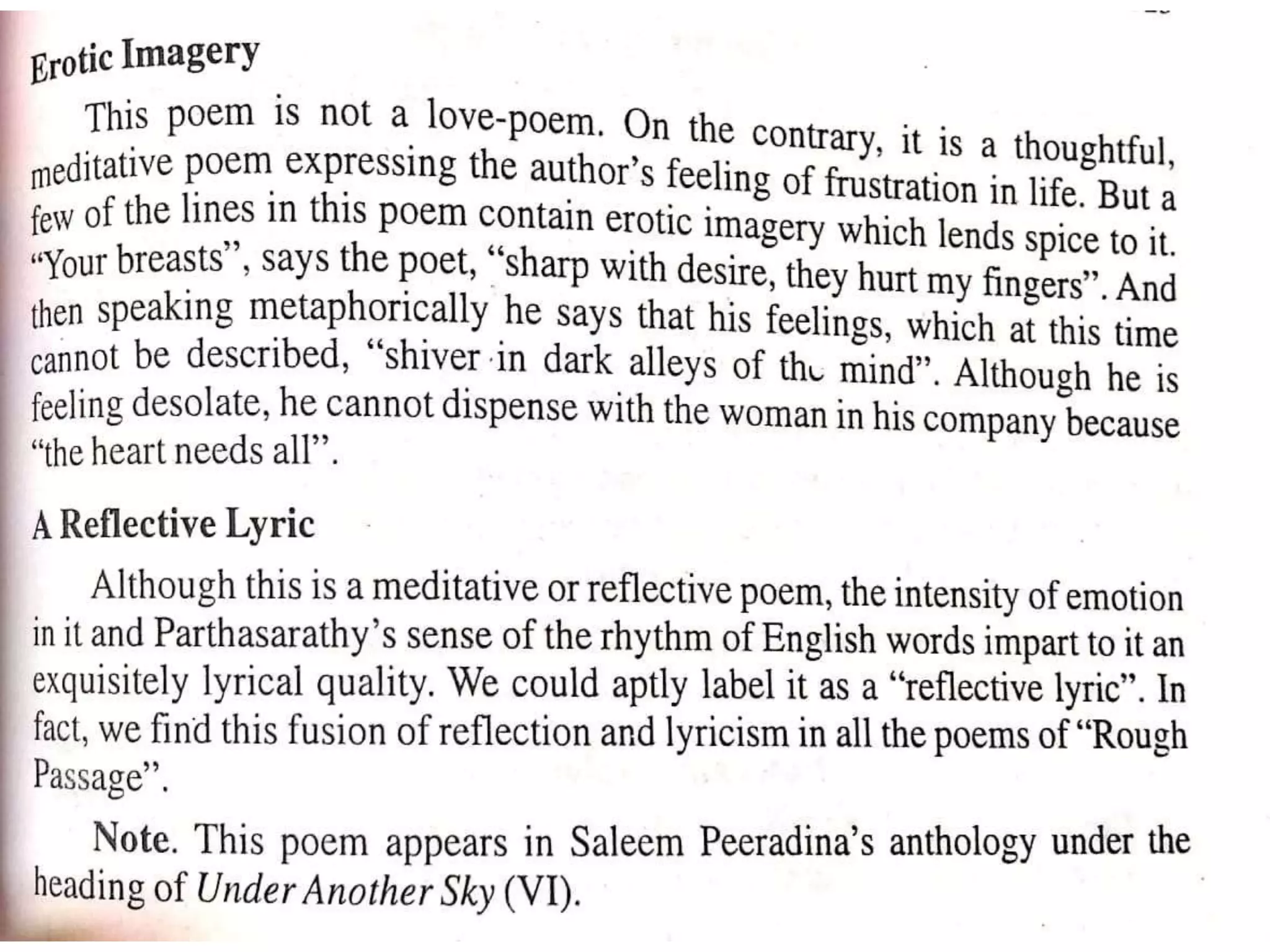
and cigarette ash. Your breasts,
sharp with desire, hurt my fingers.(referring some woman)
Feelings beggar description,
shiver in dark alleys of the mind,
hungry and alone. Nothing can really
be dispensed with. The heart needs all.
From EXILE
The years have given me little (no) wisdom,
and I've dislodged myself to find it.
Here, on the banks of the Hooghly,
in the city Job Charnock 1 built.
I shall carry this wisdom to another city
in the bone urn ormy (dead) mind.(urn-a pot which contains the ashes of a dead
man,asthikalash in Hindi)
These ashes are all that's left
of the flesh and brightness of youth. (the poet is now 30,feels dead)
My life has come full circle: I'm thirty.
I must give quality to the other haH: (remaining life to be spent in India only)
I've forfeited the embarrassing gift (lost)
innocence in my scramble (attempt) to be man. (man of wisdom)
Thank you…..

From Exile poem by R.Parthasarthy

  • 1.
    From Exile - --R.Parthasarthy By Prof.R.R.Borse, Asst.Prof. & Head, Eng.Dept. B.P.Arts,S.M.A.Sci.,K.K.C.Comm.College, Chalisgaon,Dist.Jalgaon ravindraborse1@gmail.com
  • 2.
     Rajagopal Parthasarathywas born at Tirupparaiturai near TiruchchirappaUi in 1934 educated at Don Bosco High School and Siddharth College, Bombay  Higher Education at Leeds University, England  At Leeds University, he was a British Council Scholar in 1963--4.  He was a Lecturer in English Literature in Bombay for ten years before he joined Oxford University Press in 1971 as Regional Editor in Madras.
  • 3.
    Parthasarthy’s Career asa Poet Bilingual Poet – poems in Tamil & English His poems are – Poetry from Leeds (1968), which he edited with Healy, Ten Twentieth-Century Indian Poets (1976) and Rough Passage (1977), which was a runner-up for the Commonwealth Poetry Prize in 1977. He has had poems published in Encounter, London Magazine, Poetry India, Quest, The Times Literary Supplement, Many People, Many Voices (Hutchinson, 1978) and The Shell and the Rain (Allen and Unwin, 1973). He was awarded the Ulka Poetry Prize of Poetry India in 1966. During 1978-9, he was a member of the 'University of Lowa's International Writing Program. He is a member of Advisory Board for English of the National Academy of Letters, New Delhi.
  • 4.
    Parthasarthy : Themes cultural dilemma, alienation, search for identity, Tamil culture and root  He lived for many years in England but he always missed his motherland India and specially Tamil culture.  So in doing so he has to suffer a lot as he dwells in cultural dilemma which results in alienation and rootlessness.  On one hand he dreamt of England as his future home and English language with English culture as his medium of expression.  And on the other hand he loves his own Tamil culture very much. As a result, a double alienation from English language and Tamil culture are found in his poetry.  He is suffering from the conflicts between his past memories and present social reality. Alienation and search for identity come obviously with a sense of homesickness in his poetry.  So his “Rough Passage” deals with emotional and cultural dilemma, rootlessness, urge for belongingness, impotence to acquire foreign culture and language and love for Tamil culture.
  • 5.
    Parthasarthy : Hatredfor England  Went to England for his higher education  Disconnected from his Tamil roots  England was a dirty place  English people’s arrogance towards Indians  English people called Indians as ‘coloureds’ (colour/racial discrimination)  When he returned to India, he felt that he lost his native culture and he had become a misfit in his own country.  Feels socially and culturally alienated  Feels sorry to see that Tamil Nadu is blindly copying the west and Indian old values are ignored.
  • 6.
    “Rough Passage”  “RoughPassage” has divided into three sections namely “Exile”, “Trial” and “Homecoming”.  In “Exile”, he wants to show his solitary condition in England and his fractured bond with Tamil culture.  In “Trial”, he wants to find consolation through physical love as this section deals with emotion, love and human relationship.  And in the last section “Homecoming”, he tries to harmonize the fusion of the English language with his Tamil culture.
  • 7.
    Parthasarthy : onLanguage & Culture “Parthasarathy dwells upon the question of language and identity and upon the inner conflict that arises in Postcolonial era from being brought up in two cultures. Exile, the first poet, opposes the culture of Europe with that of India, and examines the consequences of British rule on an Indian, especially the loss of identity with his own culture and therefore the need for roots. Again the turmoil of non-relationship personal love holds forth the promise of belonging, and the second part “Trial” celebrates love as a reality here and now “Homecoming”, the third and final part of Rough Passage explores the phenomenon of returning to one’s home. It is a sort of overture made with the aim of starting a dialogue between the poet and his Tamil past. The strength of the poem derives from his sense of responsibility towards crucial personal events in his life.
  • 8.
    Parthasarthy : onLanguage & Culture  In his “Rough Passage” comprises of three parts namely “Exile”, “Trial” and “Homecoming”, he experiments with his English language and Tamil culture to create a balance between them.  In these poems we find so many conflicts and dilemmas as he is heir to two languages and two cultures.  He deeply suffers from cultural anxiety because of divided allegiance. As in some poems we find his desperate longing for home.  In “Exile”, Parthasarathy wants to show the images of India along with poverty, filth, domination and socio-cultural structure of his natives as they were colonized and controlled through colonial discourse.  As he realizes the fact that his diasporic identity creates so much problems and dilemma in him that his poems alienates from his own culture.  Actually throughout “Exile”, he wants to show his sense of alienation with his complete knowledge of dislocation from past.
  • 9.
    from EXILE (Setting :Poetin a London Basement Flat) Through holes in a wall, as it were, lamps burned in the fog. In a basement flat, conversation filled the night, while Ravi Shankar,.(who imitated english lifestyle) cigarette stubs, empty bottles of stout (a kind of strong beer) and crisps provided the necessary pauses. He had spent his youth whoring (worshipping/loving) after English gods. There is something to be said for exile: you learn roots are deep. (i.e.Tamil culture) That language is a tree, loses colour under another sky. (i.e.England) The bark disappears with · the snow and branches become hoarse.
  • 10.
    From EXILE However, themost reassuring thing about the past is that it happened. Dressed in tweeds or grey flannel Its suburban pockets bursting with immigrants- 'coloureds' is what they calls us over there-the city is no jewel, either: lanes full of smoke and litter with puddles of unwashed ' English children. On New Year's Eve he heard an old man at Trafalgar Square, 'It's no use trying (an important,fashionable place in England) to change people. They'll be what they are.
  • 11.
    From EXILE An empire'slast words are heard on the hot sands of Africa. The da Gamas, Clives, Dupleixs are back.(the names of some European imperialists, their statues are in London which symbolises English empire in the world) Victoria sleeps on her island (Queen Victoria i.e.European imperialisam) alone, an old hag, shaking her invincible locks.' Standing on Westminster Bridge, (famous bridge in London on Thames river) it seemed the Thames had clogged the chariot wheels of Boadicea to stone.(Boadicea was an ancient British Queen who had fought against the Romans when they attacked England.She was defeated.The poet contrasts her with Queen Victoria who symoloses colonialism and Boadicea freedom) Under the shadow of poplars the river divides the city from the night. The noises reappear, of early trains, the milkman, and the events of the day become vocal in the newsboy.
  • 12.
    From EXILE (Part2,Poem No.8) (The poet Imagines being in Calcutta (India) A grey sky oppresses the eyes (dim,not shining) porters, rickshaw-pullers, barbers, hawkers, fortune-tellers, loungers compose the scene.(idlers walking about aimlessly) Above them towers the bridge, (a bridge on Hooghly river-between Howra and Calcutta) a pale diamond in the water. Trees, big with shade, squat in the maidan as I walk, my tongue hunchbacked with words, towards Jadavpur (an area in Calcutta) to your arms. You smell of gin (alcohol) and cigarette ash. Your breasts, sharp with desire, hurt my fingers.(referring some woman) Feelings beggar description, shiver in dark alleys of the mind, hungry and alone. Nothing can really be dispensed with. The heart needs all.
  • 13.
    From EXILE The yearshave given me little (no) wisdom, and I've dislodged myself to find it. Here, on the banks of the Hooghly, in the city Job Charnock 1 built. I shall carry this wisdom to another city in the bone urn ormy (dead) mind.(urn-a pot which contains the ashes of a dead man,asthikalash in Hindi) These ashes are all that's left of the flesh and brightness of youth. (the poet is now 30,feels dead) My life has come full circle: I'm thirty. I must give quality to the other haH: (remaining life to be spent in India only) I've forfeited the embarrassing gift (lost) innocence in my scramble (attempt) to be man. (man of wisdom)
  • 22.