Group
Members
Shawal Ali
Ehtisam Ahmed
Shahzaib
Introduction
What is 7cs
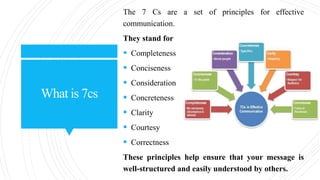
The 7 Cs are a set of principles for effective
communication.
They stand for
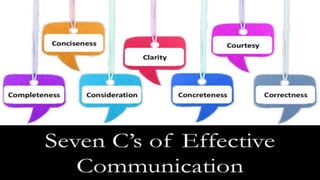
 Completeness
 Conciseness
 Consideration
 Concreteness
 Clarity
 Courtesy
 Correctness
These principles help ensure that your message is
well-structured and easily understood by others.
1st c is
Completeness
Defination
The Information conveyed in the message
should be complete for the communication to
be effective. Your message is complete when it
contains all the facts readers or listeners need
for the reaction you desire.
Guidelines
Include all necessary information for the
reader to fully understand the message.
Address all relevant points or questions to
prevent confusion or misunderstanding.
Example
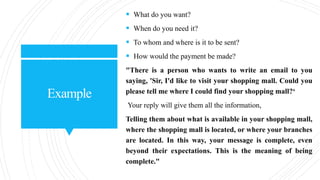
 What do you want?
 When do you need it?
 To whom and where is it to be sent?
 How would the payment be made?
"There is a person who wants to write an email to you
saying, 'Sir, I'd like to visit your shopping mall. Could you
please tell me where I could find your shopping mall?‘
Your reply will give them all the information,
Telling them about what is available in your shopping mall,
where the shopping mall is located, or where your branches
are located. In this way, your message is complete, even
beyond their expectations. This is the meaning of being
complete."
2nd c is
Conciseness
Defination
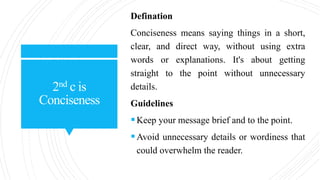
Conciseness means saying things in a short,
clear, and direct way, without using extra
words or explanations. It's about getting
straight to the point without unnecessary
details.
Guidelines
Keep your message brief and to the point.
Avoid unnecessary details or wordiness that
could overwhelm the reader.
Example
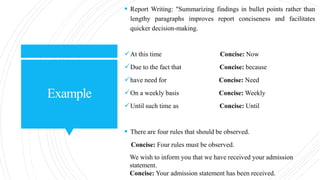
 Report Writing: "Summarizing findings in bullet points rather than
lengthy paragraphs improves report conciseness and facilitates
quicker decision-making.
At this time Concise: Now
Due to the fact that Concise: because
have need for Concise: Need
On a weekly basis Concise: Weekly
Until such time as Concise: Until
 There are four rules that should be observed.
Concise: Four rules must be observed.
We wish to inform you that we have received your admission
statement.
Concise: Your admission statement has been received.
3rd c is
Consideration
Defination
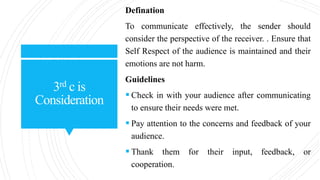
To communicate effectively, the sender should
consider the perspective of the receiver. . Ensure that
Self Respect of the audience is maintained and their
emotions are not harm.
Guidelines
 Check in with your audience after communicating
to ensure their needs were met.
 Pay attention to the concerns and feedback of your
audience.
 Thank them for their input, feedback, or
cooperation.
Example
 When working in a group project, it's considerate to
listen to everyone's ideas and not dominate the
discussion with your own thoughts.
 In a conversation, it's considerate to listen to the
other person's ideas and not interrupt them while
they're speaking.
 When planning an event, it's considerate to take into
account everyone's preferences and needs, not just
your own.
4th c is
Concreteness
Defination
Concreteness is about making your message
specific and easy to understand by using clear
examples, details, and facts. It helps to make
your communication more tangible and relatable
to your audience.
Guidelines
Use specific facts and figures to make your
message more tangible.
Provide specific examples.
Example
 Please send us the following items by the end of
this month.
Concreteness: The following items should reach us
on or before 21 August, 2021.
 "Showing a picture of the product instead of just
describing it makes the information more concrete
for the audience.“
 We want to tell you that we've looked at the sales
report for the first three months of this year.
Concise with specific facts and figures: Our sales
went up by 15% in the first quarter compared to last
year.
5th c is Clarity
Defination
Clarity is about making your message easy to
understand by using clear and simple language,
avoiding confusion or ambiguity. Reader Can
Understand your message clearly.
Guidelines
Make sure your message is clear and easy to
understand.
Use simple language.
Be direct and avoid ambiguity.
Example
"When explaining a concept, using simple
language and clear examples helps the
audience understand better."
 When giving directions to a friend's house,
saying "Go straight for two blocks, turn left
at the big tree, and it's the third house on the
right" is clearer than saying "It's somewhere
in that area."
6th c is Courtesy
Defination
Courtesy refers to being polite, respectful, and
considerate in your communication and
interactions with others. It involves showing
kindness, empathy, and understanding towards
others' feelings, opinions, and perspectives.
Guidelines
Be polite and considerate in your
communication.
Be respectful.
Consider your audience's perspective.
For Example
Example
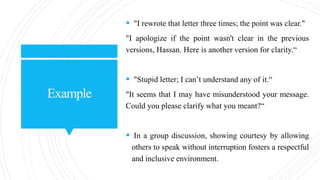
 "I rewrote that letter three times; the point was clear."
"I apologize if the point wasn't clear in the previous
versions, Hassan. Here is another version for clarity.“
 "Stupid letter; I can’t understand any of it.“
"It seems that I may have misunderstood your message.
Could you please clarify what you meant?“
 In a group discussion, showing courtesy by allowing
others to speak without interruption fosters a respectful
and inclusive environment.
7th c is
Correctness
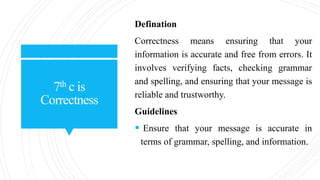
Defination
Correctness means ensuring that your
information is accurate and free from errors. It
involves verifying facts, checking grammar
and spelling, and ensuring that your message is
reliable and trustworthy.
Guidelines
 Ensure that your message is accurate in
terms of grammar, spelling, and information.
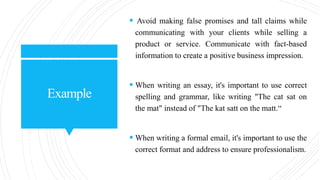
Example
 Avoid making false promises and tall claims while
communicating with your clients while selling a
product or service. Communicate with fact-based
information to create a positive business impression.
 When writing an essay, it's important to use correct
spelling and grammar, like writing "The cat sat on
the mat" instead of "The kat satt on the matt.“
 When writing a formal email, it's important to use the
correct format and address to ensure professionalism.
presentation about the 7cs effective communication.pptx

presentation about the 7cs effective communication.pptx

  • 2.
  • 3.
  • 4.
    What is 7cs The7 Cs are a set of principles for effective communication. They stand for  Completeness  Conciseness  Consideration  Concreteness  Clarity  Courtesy  Correctness These principles help ensure that your message is well-structured and easily understood by others.
  • 5.
    1st c is Completeness Defination TheInformation conveyed in the message should be complete for the communication to be effective. Your message is complete when it contains all the facts readers or listeners need for the reaction you desire. Guidelines Include all necessary information for the reader to fully understand the message. Address all relevant points or questions to prevent confusion or misunderstanding.
  • 6.
    Example  What doyou want?  When do you need it?  To whom and where is it to be sent?  How would the payment be made? "There is a person who wants to write an email to you saying, 'Sir, I'd like to visit your shopping mall. Could you please tell me where I could find your shopping mall?‘ Your reply will give them all the information, Telling them about what is available in your shopping mall, where the shopping mall is located, or where your branches are located. In this way, your message is complete, even beyond their expectations. This is the meaning of being complete."
  • 7.
    2nd c is Conciseness Defination Concisenessmeans saying things in a short, clear, and direct way, without using extra words or explanations. It's about getting straight to the point without unnecessary details. Guidelines Keep your message brief and to the point. Avoid unnecessary details or wordiness that could overwhelm the reader.
  • 8.
    Example  Report Writing:"Summarizing findings in bullet points rather than lengthy paragraphs improves report conciseness and facilitates quicker decision-making. At this time Concise: Now Due to the fact that Concise: because have need for Concise: Need On a weekly basis Concise: Weekly Until such time as Concise: Until  There are four rules that should be observed. Concise: Four rules must be observed. We wish to inform you that we have received your admission statement. Concise: Your admission statement has been received.
  • 9.
    3rd c is Consideration Defination Tocommunicate effectively, the sender should consider the perspective of the receiver. . Ensure that Self Respect of the audience is maintained and their emotions are not harm. Guidelines  Check in with your audience after communicating to ensure their needs were met.  Pay attention to the concerns and feedback of your audience.  Thank them for their input, feedback, or cooperation.
  • 10.
    Example  When workingin a group project, it's considerate to listen to everyone's ideas and not dominate the discussion with your own thoughts.  In a conversation, it's considerate to listen to the other person's ideas and not interrupt them while they're speaking.  When planning an event, it's considerate to take into account everyone's preferences and needs, not just your own.
  • 11.
    4th c is Concreteness Defination Concretenessis about making your message specific and easy to understand by using clear examples, details, and facts. It helps to make your communication more tangible and relatable to your audience. Guidelines Use specific facts and figures to make your message more tangible. Provide specific examples.
  • 12.
    Example  Please sendus the following items by the end of this month. Concreteness: The following items should reach us on or before 21 August, 2021.  "Showing a picture of the product instead of just describing it makes the information more concrete for the audience.“  We want to tell you that we've looked at the sales report for the first three months of this year. Concise with specific facts and figures: Our sales went up by 15% in the first quarter compared to last year.
  • 13.
    5th c isClarity Defination Clarity is about making your message easy to understand by using clear and simple language, avoiding confusion or ambiguity. Reader Can Understand your message clearly. Guidelines Make sure your message is clear and easy to understand. Use simple language. Be direct and avoid ambiguity.
  • 14.
    Example "When explaining aconcept, using simple language and clear examples helps the audience understand better."  When giving directions to a friend's house, saying "Go straight for two blocks, turn left at the big tree, and it's the third house on the right" is clearer than saying "It's somewhere in that area."
  • 15.
    6th c isCourtesy Defination Courtesy refers to being polite, respectful, and considerate in your communication and interactions with others. It involves showing kindness, empathy, and understanding towards others' feelings, opinions, and perspectives. Guidelines Be polite and considerate in your communication. Be respectful. Consider your audience's perspective.
  • 16.
  • 17.
    Example  "I rewrotethat letter three times; the point was clear." "I apologize if the point wasn't clear in the previous versions, Hassan. Here is another version for clarity.“  "Stupid letter; I can’t understand any of it.“ "It seems that I may have misunderstood your message. Could you please clarify what you meant?“  In a group discussion, showing courtesy by allowing others to speak without interruption fosters a respectful and inclusive environment.
  • 18.
    7th c is Correctness Defination Correctnessmeans ensuring that your information is accurate and free from errors. It involves verifying facts, checking grammar and spelling, and ensuring that your message is reliable and trustworthy. Guidelines  Ensure that your message is accurate in terms of grammar, spelling, and information.
  • 19.
    Example  Avoid makingfalse promises and tall claims while communicating with your clients while selling a product or service. Communicate with fact-based information to create a positive business impression.  When writing an essay, it's important to use correct spelling and grammar, like writing "The cat sat on the mat" instead of "The kat satt on the matt.“  When writing a formal email, it's important to use the correct format and address to ensure professionalism.