GROUP- 3
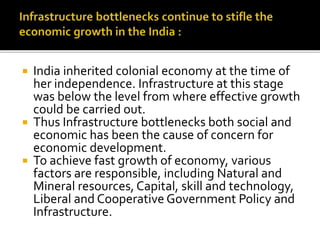
 India inherited colonial economy at the time of
her independence. Infrastructure at this stage
was below the level from where effective growth
could be carried out.
 Thus Infrastructure bottlenecks both social and
economic has been the cause of concern for
economic development.
 To achieve fast growth of economy, various
factors are responsible, including Natural and
Mineral resources, Capital, skill and technology,
Liberal and Cooperative Government Policy and
Infrastructure.
 Port and road infrastructure bottlenecks
coupled with difference in tax structure
across states are impacting India’s
competitiveness in the global market.
 It also affect the sustainability of the
competitive market and the capacity of the
potential market.
 In the late 200s, India's growth reached 7.5%, which will
double the average income in a decade. Analystssay that if
India pushed more fundamental market reforms, it could
sustain the rate and even reach the government's 2011
target of 10%. States have large responsibilities over their
economies. The annualised 1999–2008 growth rates for
Tamil Nadu (9.9), Gujarat (9.6%), Haryana (9.1%), or Delhi
(8.9%) were significantly higher than for Bihar (5.1%),
Uttar Pradesh (4.4%), or Madhya Pradesh (6.5%).India is
the tenth-largest economy in the world and the third
largest by purchasing power parity adjusted exchange
rates (PPP). On per capita basis, it ranks 140th in the world
or 129th by PPP.
 New Industrial Policy
 Abolition of Licensing
 Freedom to ImportTechnology
 Contraction of Public Sector
 Free Entry of Foreign Investment
 MRTP Restrictions Removed
 FERA Restrictions Removed
 Increase in the Importance of Small
Industries
 NewTrade Policy
 Reduction in Restrictions of Export-Import:
 Reduction in Export-ImportTax:
 Easy Procedure of Export-Import:
 Establishment of Foreign Capital Market:
 Full Convertibility on Current Account:
 Providing Incentive for Export
 Fiscal Reforms
 Gross Domestic Product (GDP):
 Monetary Reforms
Infrastructure bottlenecks & economic development in india

Infrastructure bottlenecks & economic development in india

  • 1.
  • 3.
     India inheritedcolonial economy at the time of her independence. Infrastructure at this stage was below the level from where effective growth could be carried out.  Thus Infrastructure bottlenecks both social and economic has been the cause of concern for economic development.  To achieve fast growth of economy, various factors are responsible, including Natural and Mineral resources, Capital, skill and technology, Liberal and Cooperative Government Policy and Infrastructure.
  • 4.
     Port androad infrastructure bottlenecks coupled with difference in tax structure across states are impacting India’s competitiveness in the global market.  It also affect the sustainability of the competitive market and the capacity of the potential market.
  • 5.
     In thelate 200s, India's growth reached 7.5%, which will double the average income in a decade. Analystssay that if India pushed more fundamental market reforms, it could sustain the rate and even reach the government's 2011 target of 10%. States have large responsibilities over their economies. The annualised 1999–2008 growth rates for Tamil Nadu (9.9), Gujarat (9.6%), Haryana (9.1%), or Delhi (8.9%) were significantly higher than for Bihar (5.1%), Uttar Pradesh (4.4%), or Madhya Pradesh (6.5%).India is the tenth-largest economy in the world and the third largest by purchasing power parity adjusted exchange rates (PPP). On per capita basis, it ranks 140th in the world or 129th by PPP.
  • 6.
     New IndustrialPolicy  Abolition of Licensing  Freedom to ImportTechnology  Contraction of Public Sector  Free Entry of Foreign Investment  MRTP Restrictions Removed  FERA Restrictions Removed  Increase in the Importance of Small Industries  NewTrade Policy
  • 7.
     Reduction inRestrictions of Export-Import:  Reduction in Export-ImportTax:  Easy Procedure of Export-Import:  Establishment of Foreign Capital Market:  Full Convertibility on Current Account:  Providing Incentive for Export  Fiscal Reforms  Gross Domestic Product (GDP):  Monetary Reforms