Made by:  Tarun Nayak,Lakshay Sharma and Nishant KumarJha
PRINCIPLE OF EFFECTIVE COMMUNICATION – 7C’S To compose effective written or oral messages, one must apply certain communication principles.  These principles provide guideline for choice of content and style of presentation, adapted to the purpose and receiver of your message.  To some extent the principles overlap because they are based on a common concern for the audience, whether that audience consists of listeners or readers. These principles are called “Seven C’s”
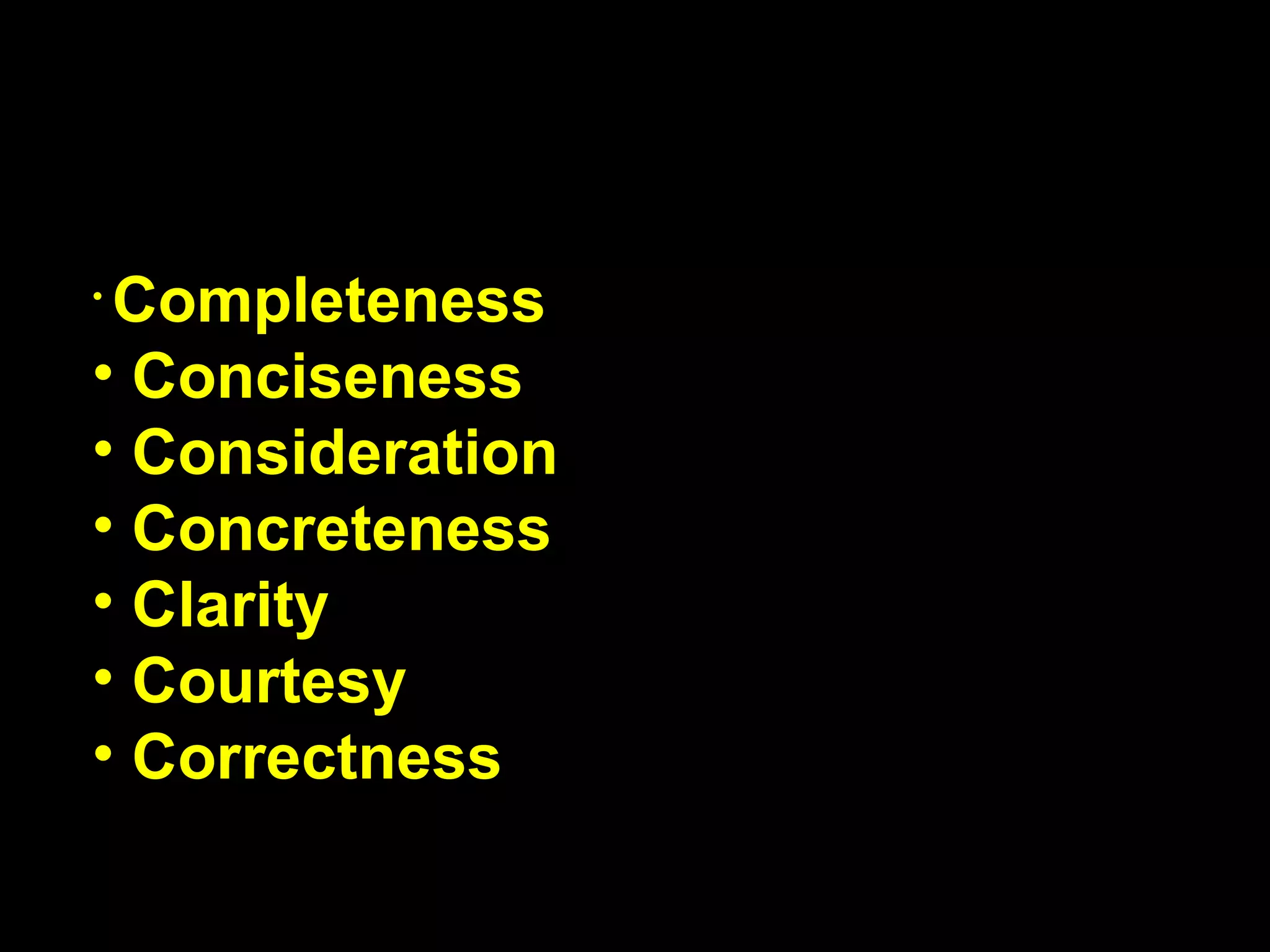
The Seven  C’s are: Completeness Conciseness Consideration Concreteness Clarity Courtesy Correctness
WHY THEY ARE CALLED – 7C’S Seven C’s are the seven most useful qualities of  effective communication starting with C.
1) Completeness Message Receiver- either listener or reader, desire complete information to their question.  One way to make your message complete is to answer the  five W’s . WHO? WHAT? WHEN? WHERE? WHY? This  method is useful when one writes requests, announcements, or other informative messages.  For instance, to order (request) merchandise, make clear  WHAT  you want,  WHEN  you need it, and  WHERE  it is to be sent.
2) Conciseness Conciseness means “convey the message by using fewest words”.  “ Conciseness is the prerequisite to effective business communication.”  A concise message saves the time and expenses for both the  parties.
How to achieve conciseness?  Avoid wordy expressions  Include only relevant materials  Avoid unnecessary repetitions
3) Consideration Consideration means – To consider the receiver’s Interest and Requirements.  While writing a message one should focus on the target  group.
Three specific ways to indicate consideration Focus on “you” instead of “I” or “We” Show audience benefit or interest of the receiver Emphasize positive, pleasant facts.  Write a message in such a way that the audience get benefited from it.
4) Concreteness It means that message should be specific instead of general.  When you talk to your client always use facts and figures instead of generic or irrelevant information.
5) Clarity Clarity means transfer of information without any ambiguity. Ideas, facts, opinions etc. which are to be communicated should be very clear to the communicator. The message should be simplified or coded in such a manner that it is comprehended by the receiver the same way as the sender intends to.
To achieve clarity: Choose specific words rather than long  statements. Choose familiar and easy words. Construct effective sentences and  paragraphs.
6) Courtesy Applying socially acceptable manners is a form of courtesy. Politeness , concern and respect for others are few components of courteous communication. To achieve this, the sender should be sincere, tactful, thoughtful and appreciative of the receiver.
7) Correctness The language of the communication must be correct in terms of grammar, punctuation ,spelling and meaning. It must be correct in terms of facts, figures and words.
C ONCLUSION These 7 C’s help a person to compose a message in such a way to get positive feedback from the receiver. That’s why it is advisable for everyone to understand and apply these 7C’s whether he is a teacher, doctor, businessman or a student.
Thank You

7cs Of communication Communicational Skills

  • 1.
    Made by: Tarun Nayak,Lakshay Sharma and Nishant KumarJha
  • 2.
    PRINCIPLE OF EFFECTIVECOMMUNICATION – 7C’S To compose effective written or oral messages, one must apply certain communication principles. These principles provide guideline for choice of content and style of presentation, adapted to the purpose and receiver of your message. To some extent the principles overlap because they are based on a common concern for the audience, whether that audience consists of listeners or readers. These principles are called “Seven C’s”
  • 3.
    The Seven C’s are: Completeness Conciseness Consideration Concreteness Clarity Courtesy Correctness
  • 4.
    WHY THEY ARECALLED – 7C’S Seven C’s are the seven most useful qualities of effective communication starting with C.
  • 5.
    1) Completeness MessageReceiver- either listener or reader, desire complete information to their question. One way to make your message complete is to answer the five W’s . WHO? WHAT? WHEN? WHERE? WHY? This method is useful when one writes requests, announcements, or other informative messages. For instance, to order (request) merchandise, make clear WHAT you want, WHEN you need it, and WHERE it is to be sent.
  • 6.
    2) Conciseness Concisenessmeans “convey the message by using fewest words”. “ Conciseness is the prerequisite to effective business communication.” A concise message saves the time and expenses for both the parties.
  • 7.
    How to achieveconciseness? Avoid wordy expressions Include only relevant materials Avoid unnecessary repetitions
  • 8.
    3) Consideration Considerationmeans – To consider the receiver’s Interest and Requirements. While writing a message one should focus on the target group.
  • 9.
    Three specific waysto indicate consideration Focus on “you” instead of “I” or “We” Show audience benefit or interest of the receiver Emphasize positive, pleasant facts. Write a message in such a way that the audience get benefited from it.
  • 10.
    4) Concreteness Itmeans that message should be specific instead of general. When you talk to your client always use facts and figures instead of generic or irrelevant information.
  • 11.
    5) Clarity Claritymeans transfer of information without any ambiguity. Ideas, facts, opinions etc. which are to be communicated should be very clear to the communicator. The message should be simplified or coded in such a manner that it is comprehended by the receiver the same way as the sender intends to.
  • 12.
    To achieve clarity:Choose specific words rather than long statements. Choose familiar and easy words. Construct effective sentences and paragraphs.
  • 13.
    6) Courtesy Applyingsocially acceptable manners is a form of courtesy. Politeness , concern and respect for others are few components of courteous communication. To achieve this, the sender should be sincere, tactful, thoughtful and appreciative of the receiver.
  • 14.
    7) Correctness Thelanguage of the communication must be correct in terms of grammar, punctuation ,spelling and meaning. It must be correct in terms of facts, figures and words.
  • 15.
    C ONCLUSION These7 C’s help a person to compose a message in such a way to get positive feedback from the receiver. That’s why it is advisable for everyone to understand and apply these 7C’s whether he is a teacher, doctor, businessman or a student.
  • 16.