The Principles ofThe Principles of
DesignDesign
What are The Principles ofWhat are The Principles of
Design?Design?
The Principles of Design areThe Principles of Design are
the ways that artiststhe ways that artists useuse thethe
Elements of Art to create goodElements of Art to create good
Compositions (artwork)Compositions (artwork)
There are 11 Principles ofThere are 11 Principles of
DesignDesign
BalanceBalance ContrastContrast
EmphasisEmphasis VarietyVariety
Unity/HarmonyUnity/Harmony ProportionProportion
RhythmRhythm MovementMovement
PatternPattern RepetitionRepetition
Balance:Balance:
This principle of design refers toThis principle of design refers to
the visual equalization of thethe visual equalization of the
elements in a work of art.elements in a work of art.
There are three major forms ofThere are three major forms of
balancebalance
The three major forms ofThe three major forms of
balance:balance:
 Asymmetrical balance:Asymmetrical balance: where equilibriumwhere equilibrium
is achieved by the balance differences in theis achieved by the balance differences in the
art elements within a composition.art elements within a composition.
 Symmetrical balance:Symmetrical balance: where the artwhere the art
elements in a composition are balanced in aelements in a composition are balanced in a
mirror-like fashion (it does not have to bemirror-like fashion (it does not have to be
exact but close).exact but close).
 Radial balance:Radial balance: a kind of balance wherea kind of balance where
the elements branch or radiate out from athe elements branch or radiate out from a
central point.central point.
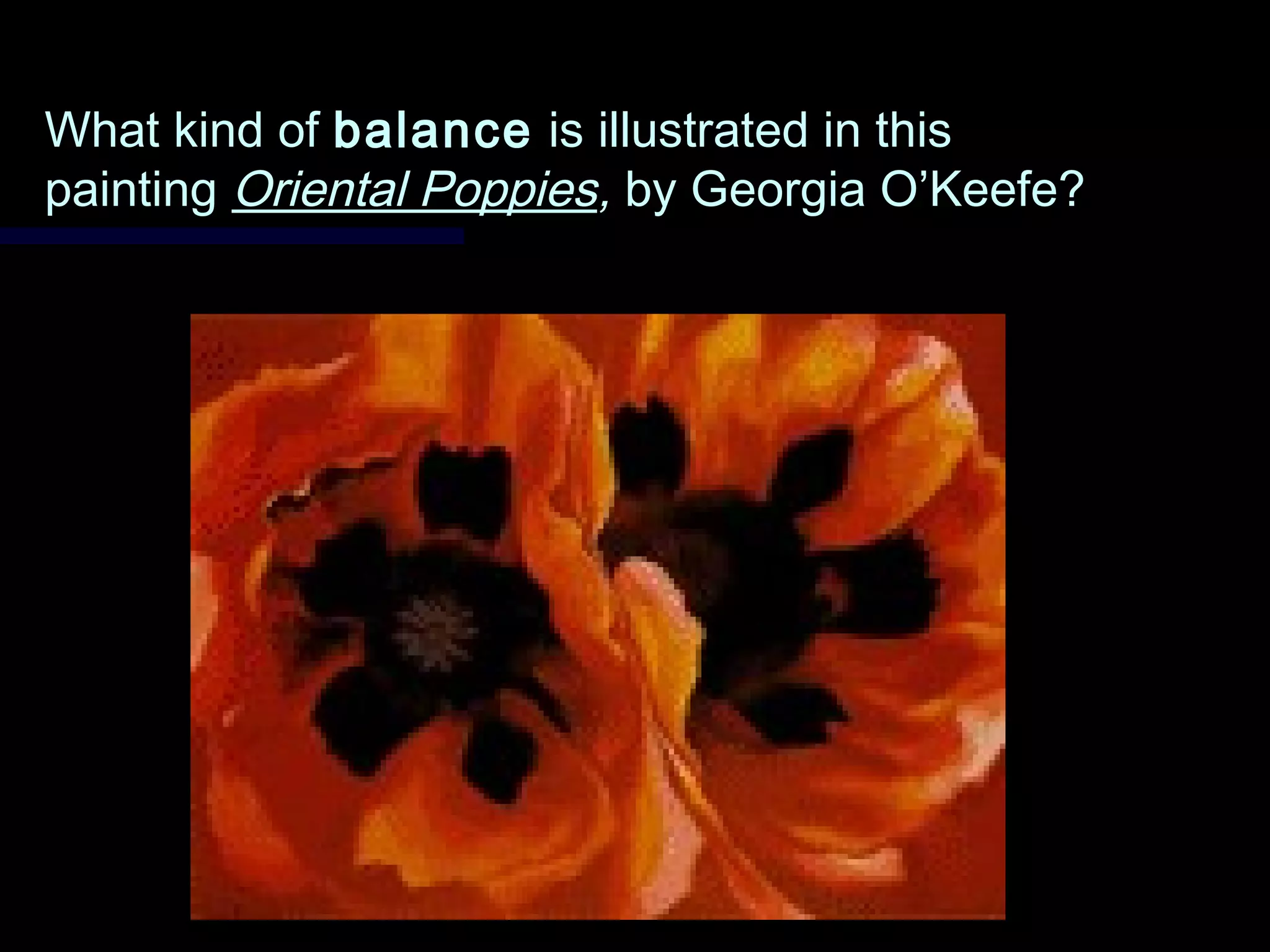
What kind ofWhat kind of balancebalance is illustrated in thisis illustrated in this
paintingpainting Oriental PoppiesOriental Poppies,, by Georgia O’Keefe?by Georgia O’Keefe?
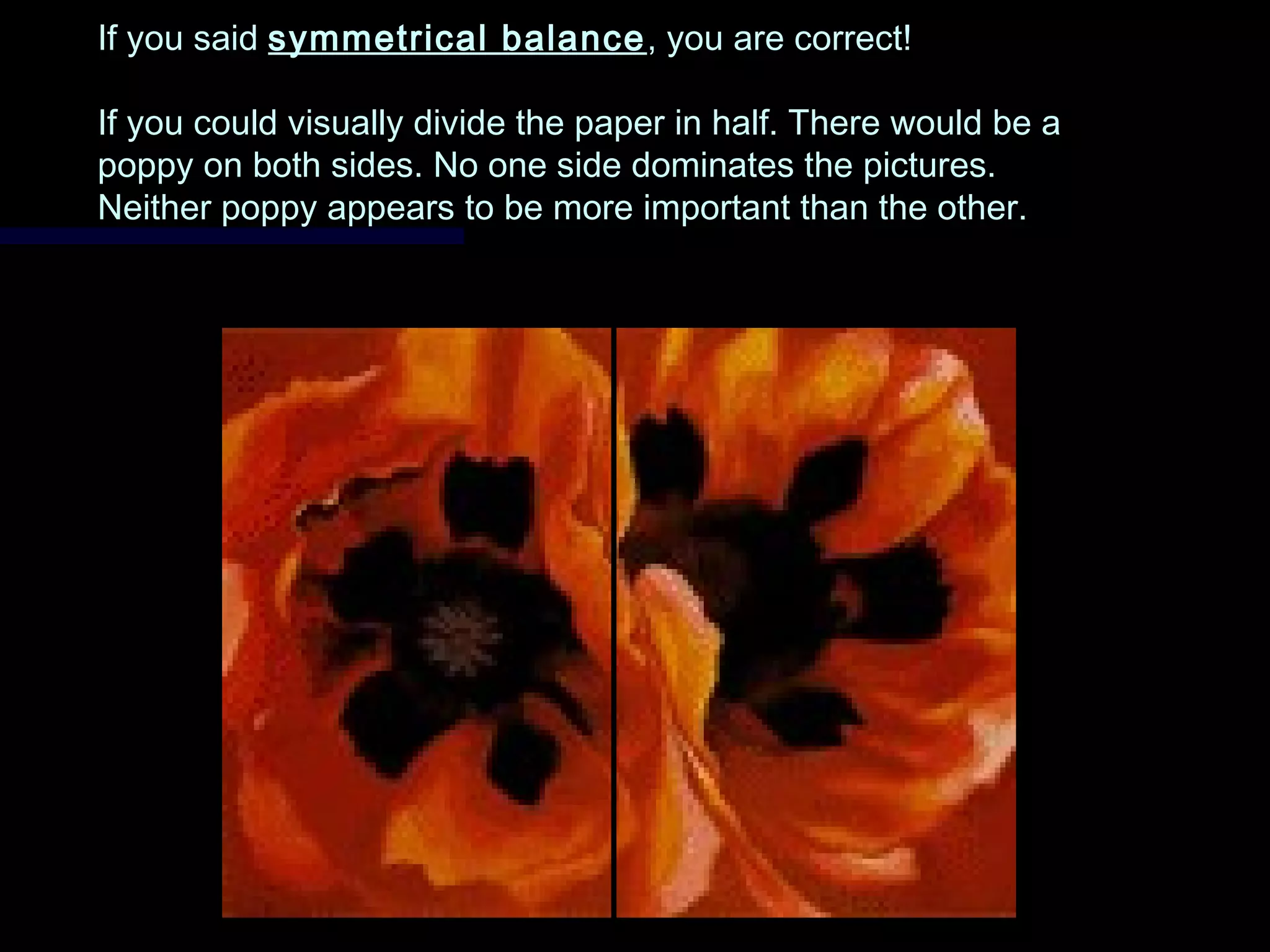
If you saidIf you said symmetrical balancesymmetrical balance , you are correct!, you are correct!
If you could visually divide the paper in half. There would be aIf you could visually divide the paper in half. There would be a
poppy on both sides. No one side dominates the pictures.poppy on both sides. No one side dominates the pictures.
Neither poppy appears to be more important than the other.Neither poppy appears to be more important than the other.
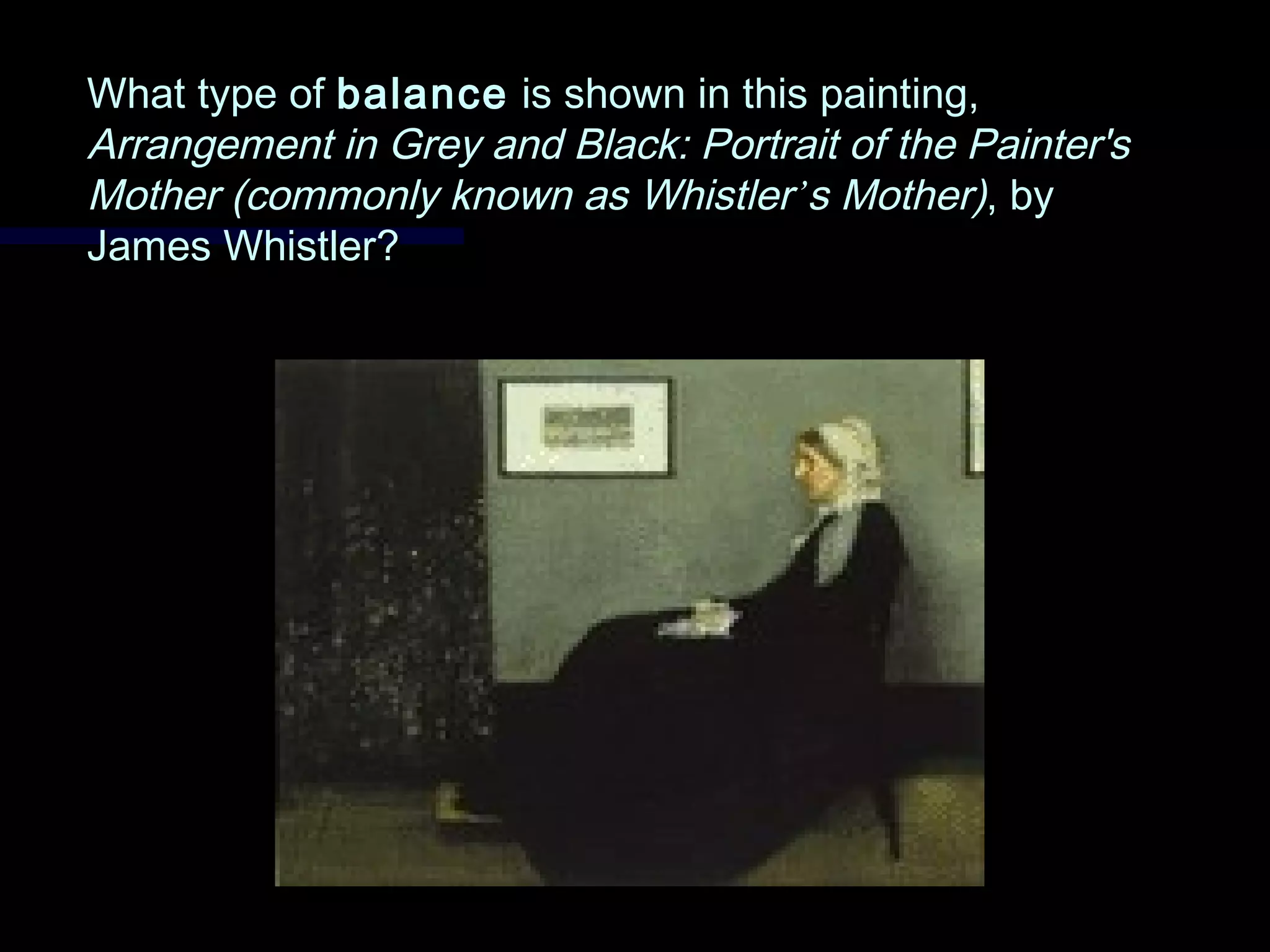
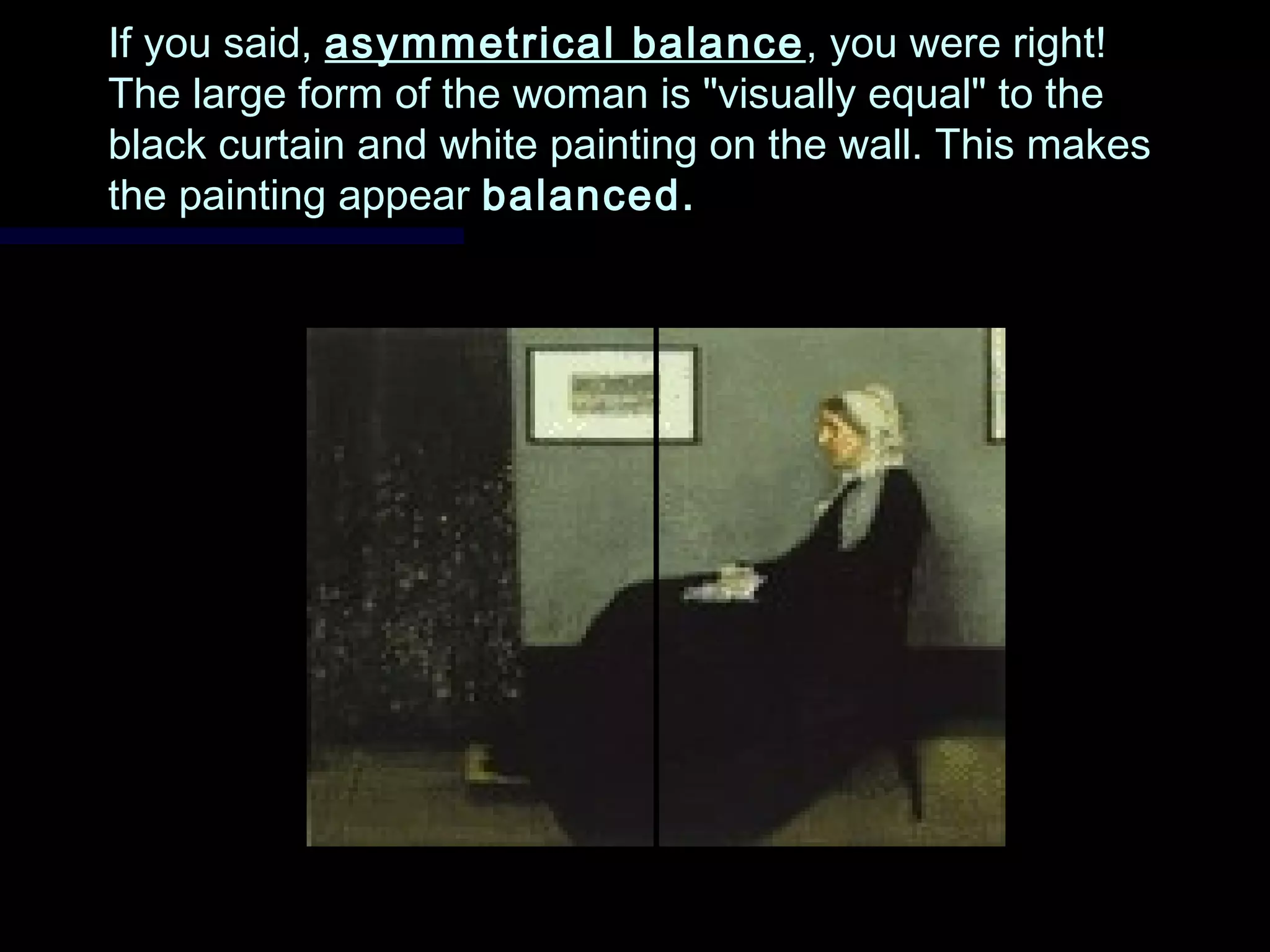
What type ofWhat type of balancebalance is shown in this painting,is shown in this painting,
Arrangement in Grey and Black: Portrait of the Painter'sArrangement in Grey and Black: Portrait of the Painter's
Mother (commonly known as WhistlerMother (commonly known as Whistler’’s Mother)s Mother), by, by
James Whistler?James Whistler?
If you said,If you said, asymmetrical balanceasymmetrical balance , you were right!, you were right!
The large form of the woman is "visually equal" to theThe large form of the woman is "visually equal" to the
black curtain and white painting on the wall. This makesblack curtain and white painting on the wall. This makes
the painting appearthe painting appear balanced.balanced.
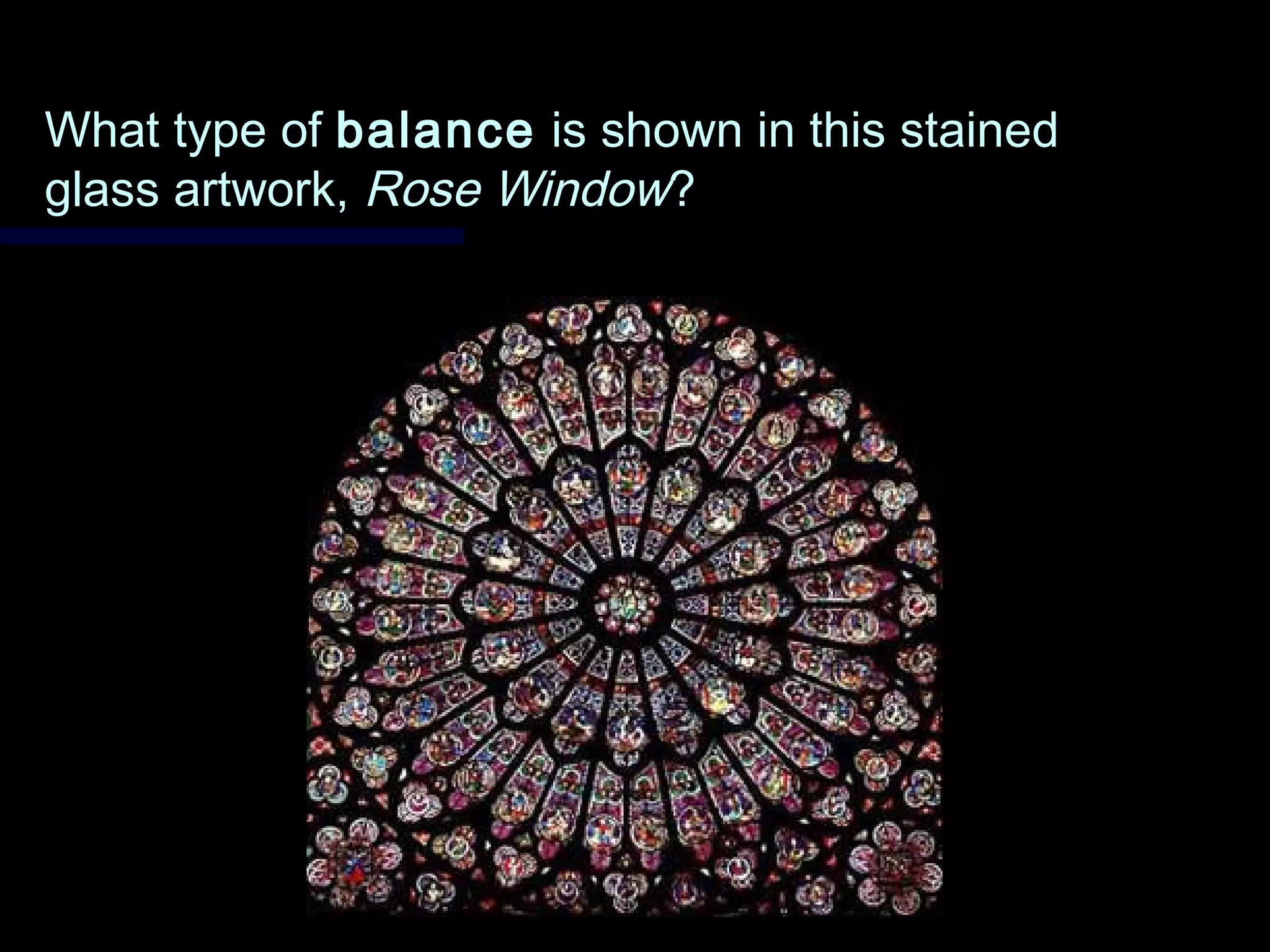
What type ofWhat type of balancebalance is shown in this stainedis shown in this stained
glass artwork,glass artwork, Rose WindowRose Window??
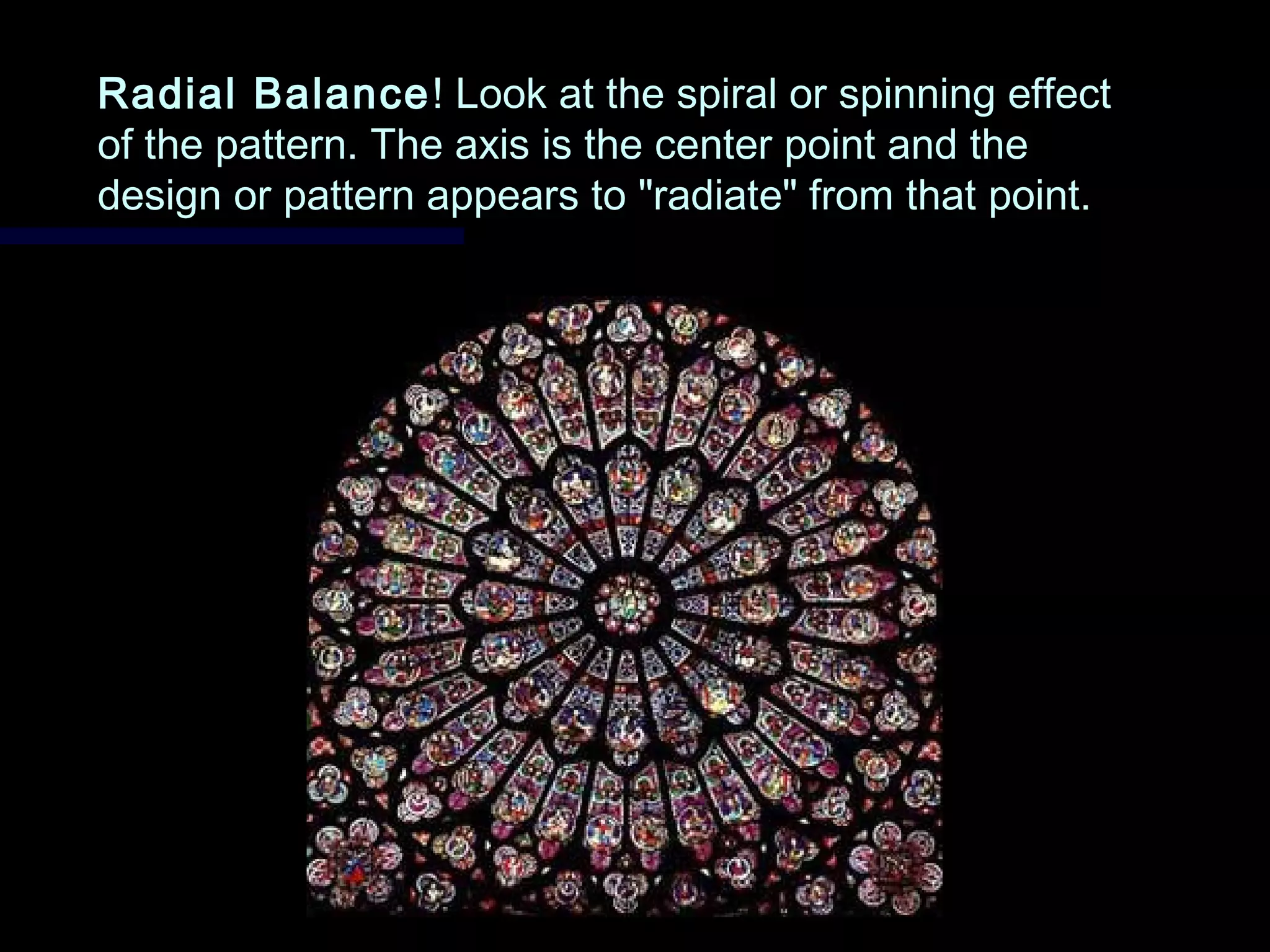
Radial BalanceRadial Balance ! Look at the spiral or spinning effect! Look at the spiral or spinning effect
of the pattern. The axis is the center point and theof the pattern. The axis is the center point and the
design or pattern appears to "radiate" from that point.design or pattern appears to "radiate" from that point.
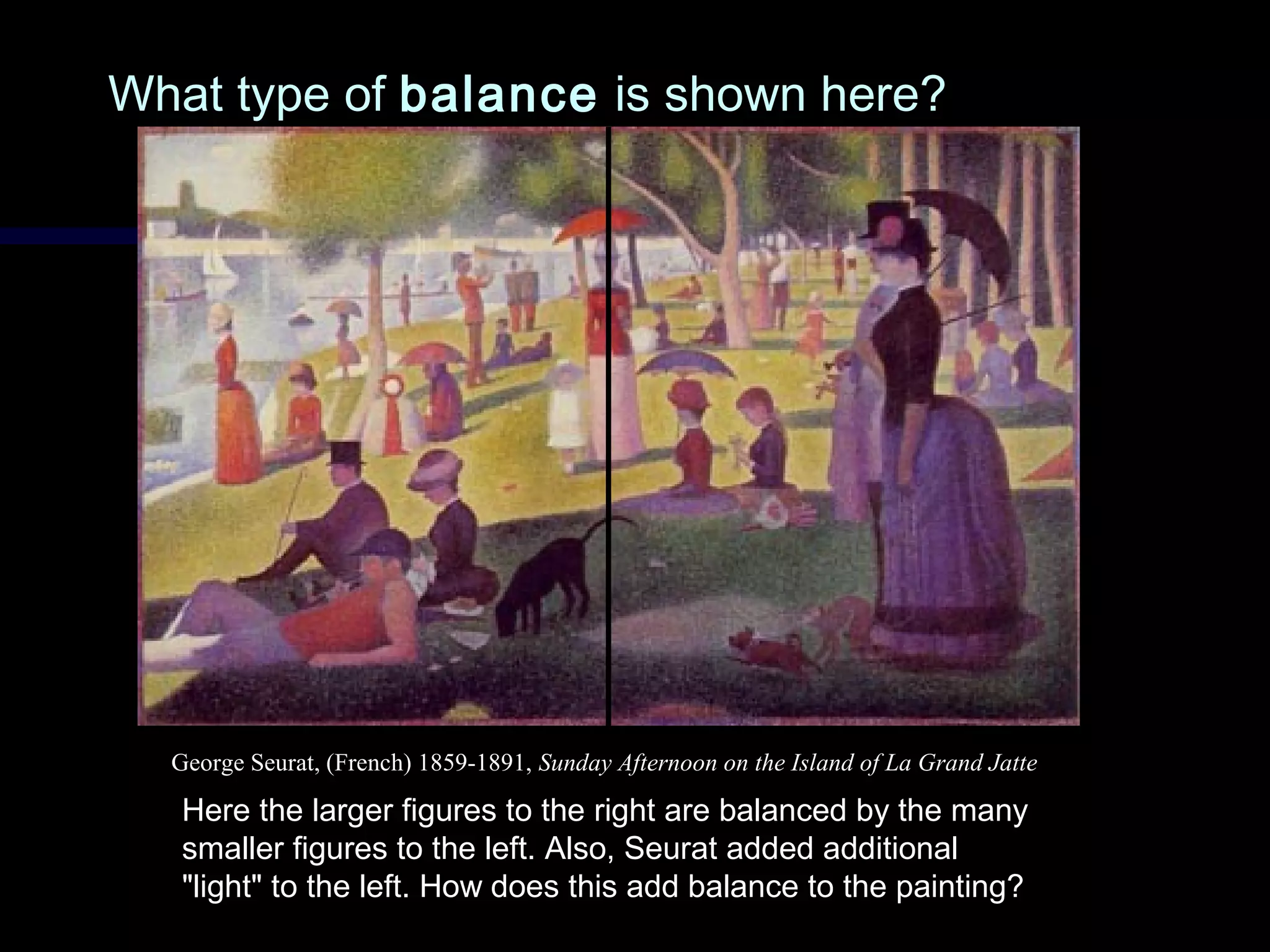
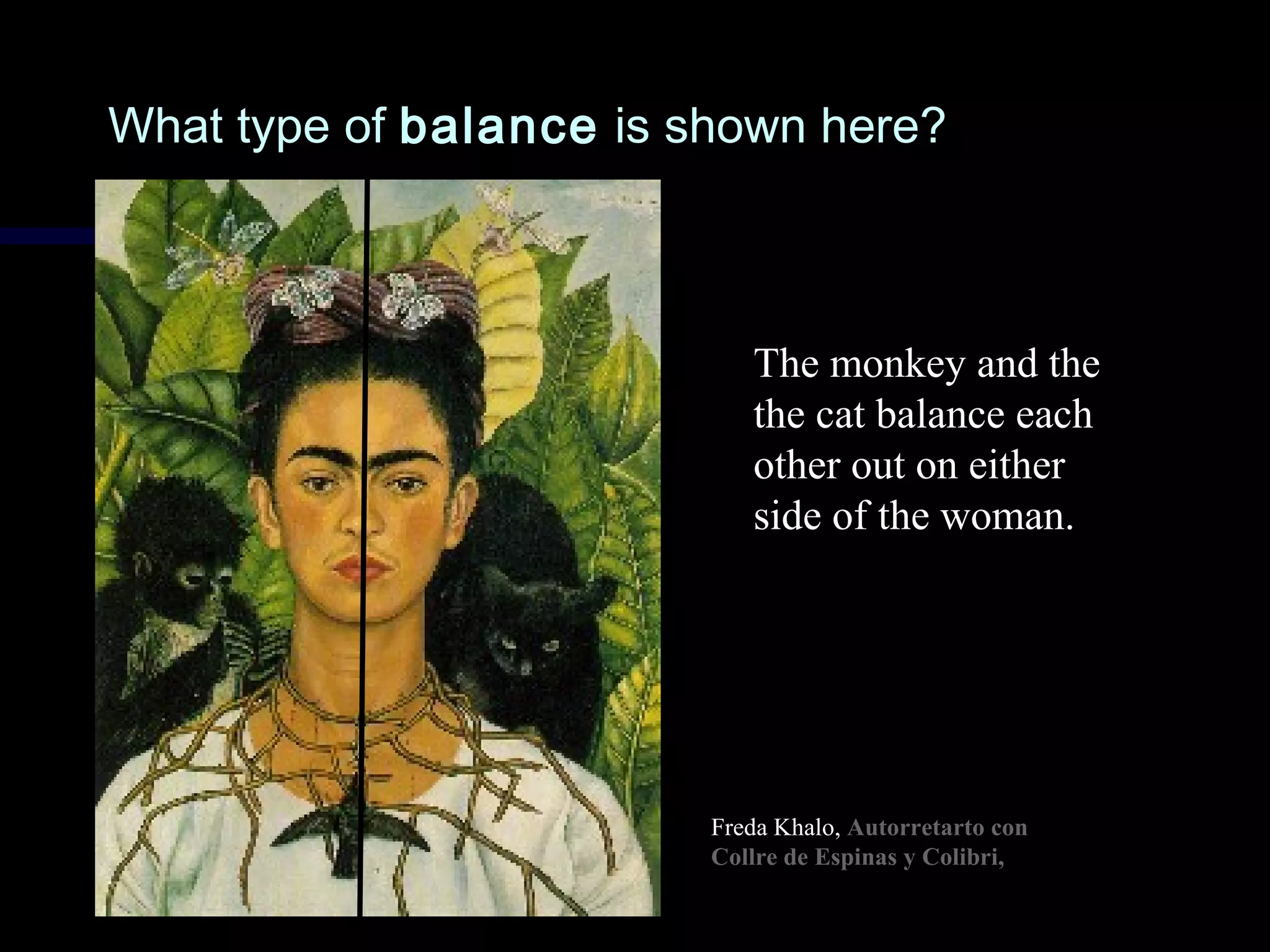
What type ofWhat type of balancebalance is shown here?is shown here?
Here the larger figures to the right are balanced by the many
smaller figures to the left. Also, Seurat added additional
"light" to the left. How does this add balance to the painting?
George Seurat, (French) 1859-1891, Sunday Afternoon on the Island of La Grand Jatte
What type ofWhat type of balancebalance is shown here?is shown here?
The monkey and the
the cat balance each
other out on either
side of the woman.
Freda Khalo, Autorretarto con
Collre de Espinas y Colibri,
ContrastContrastA design principle that emphasizes
differences between the art elements.
For example, a painting may have bright
colors that contrast with dull colors or
angular shapes that contrast with rounded
shapes.
Sharp contrast draws attention and can
direct a viewer to a focal point within a work
of art.
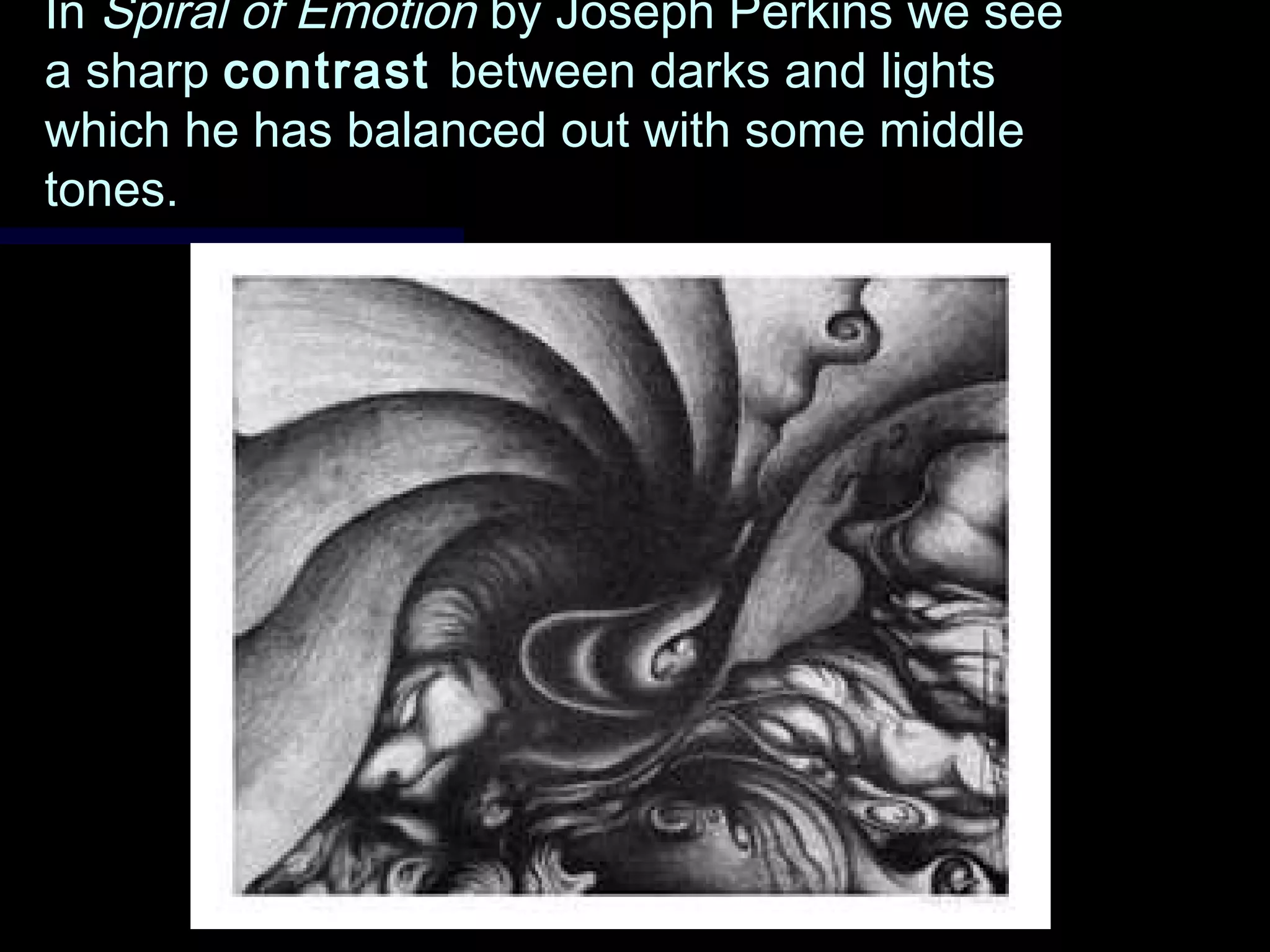
InIn Spiral of EmotionSpiral of Emotion by Joseph Perkins we seeby Joseph Perkins we see
a sharpa sharp contrastcontrast between darks and lightsbetween darks and lights
which he has balanced out with some middlewhich he has balanced out with some middle
tones.tones.
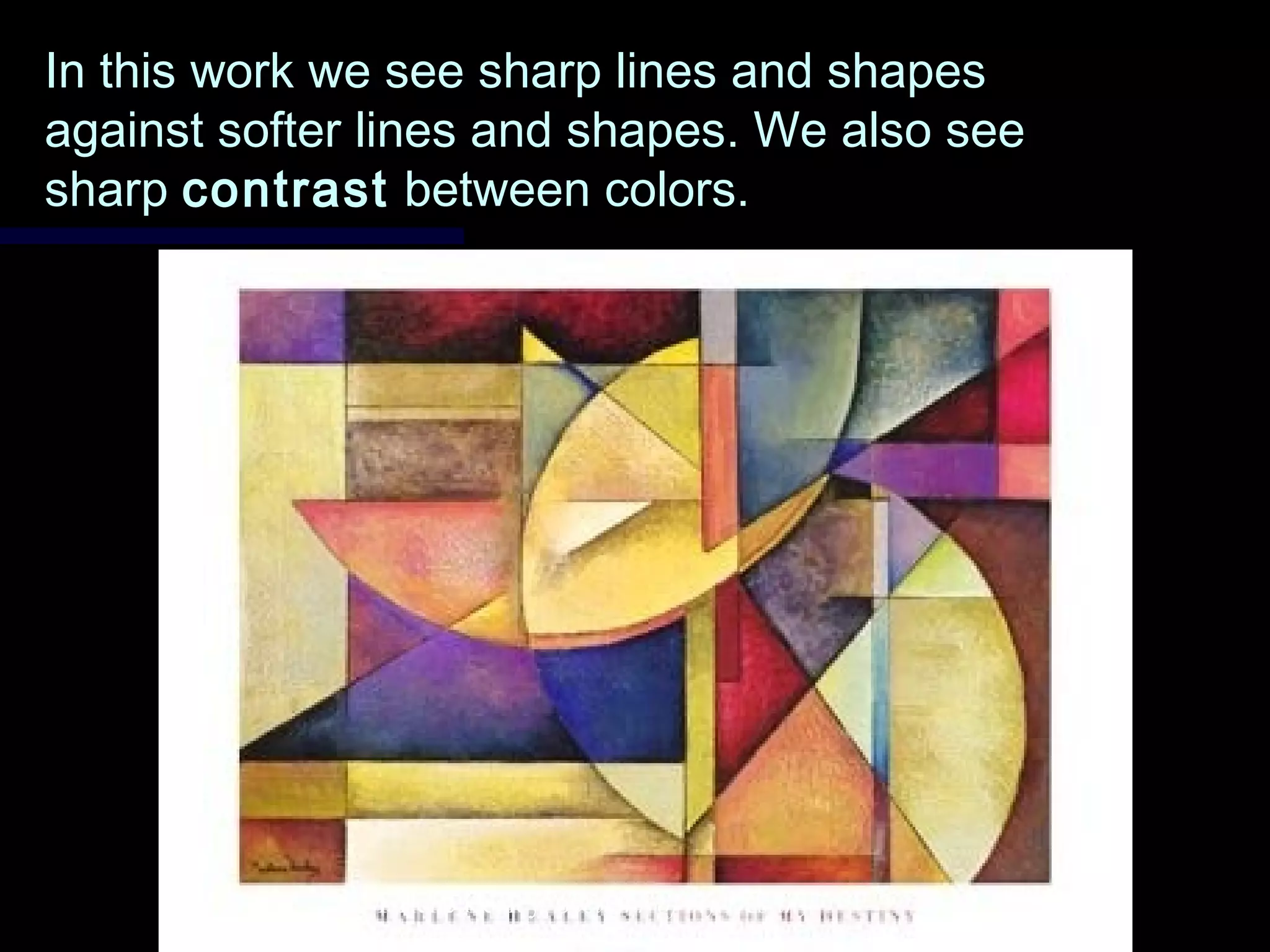
In this work we see sharp lines and shapesIn this work we see sharp lines and shapes
against softer lines and shapes. We also seeagainst softer lines and shapes. We also see
sharpsharp contrastcontrast between colors.between colors.
Marlene Healey, Sections of my Destiny
EmphasisEmphasis
The principle of design that is concerned with
dominance; the development of a main idea or
center of interest (also called focal point)
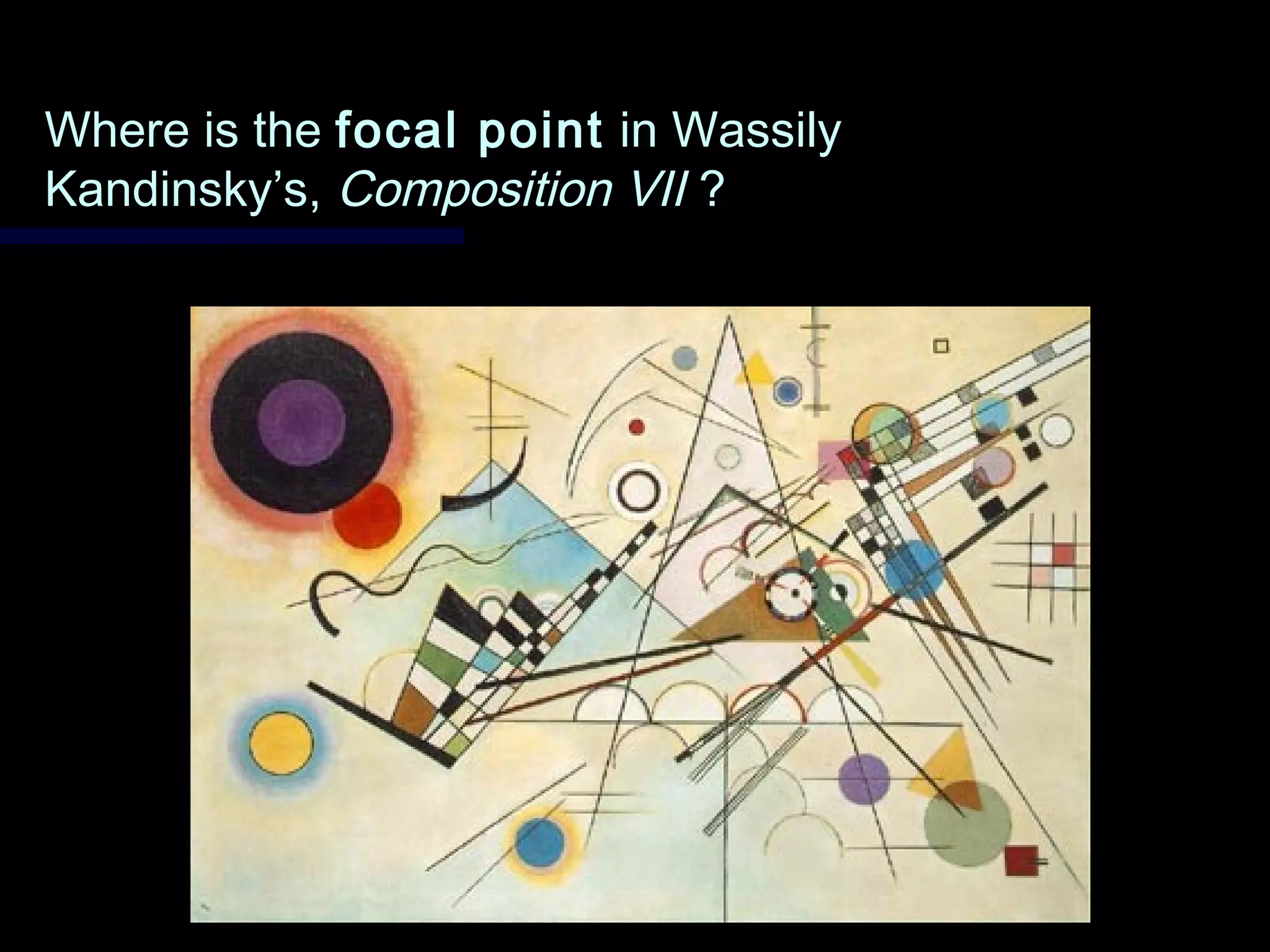
Where is theWhere is the focal pointfocal point in Wassilyin Wassily
Kandinsky’s,Kandinsky’s, Composition VIIComposition VII ??
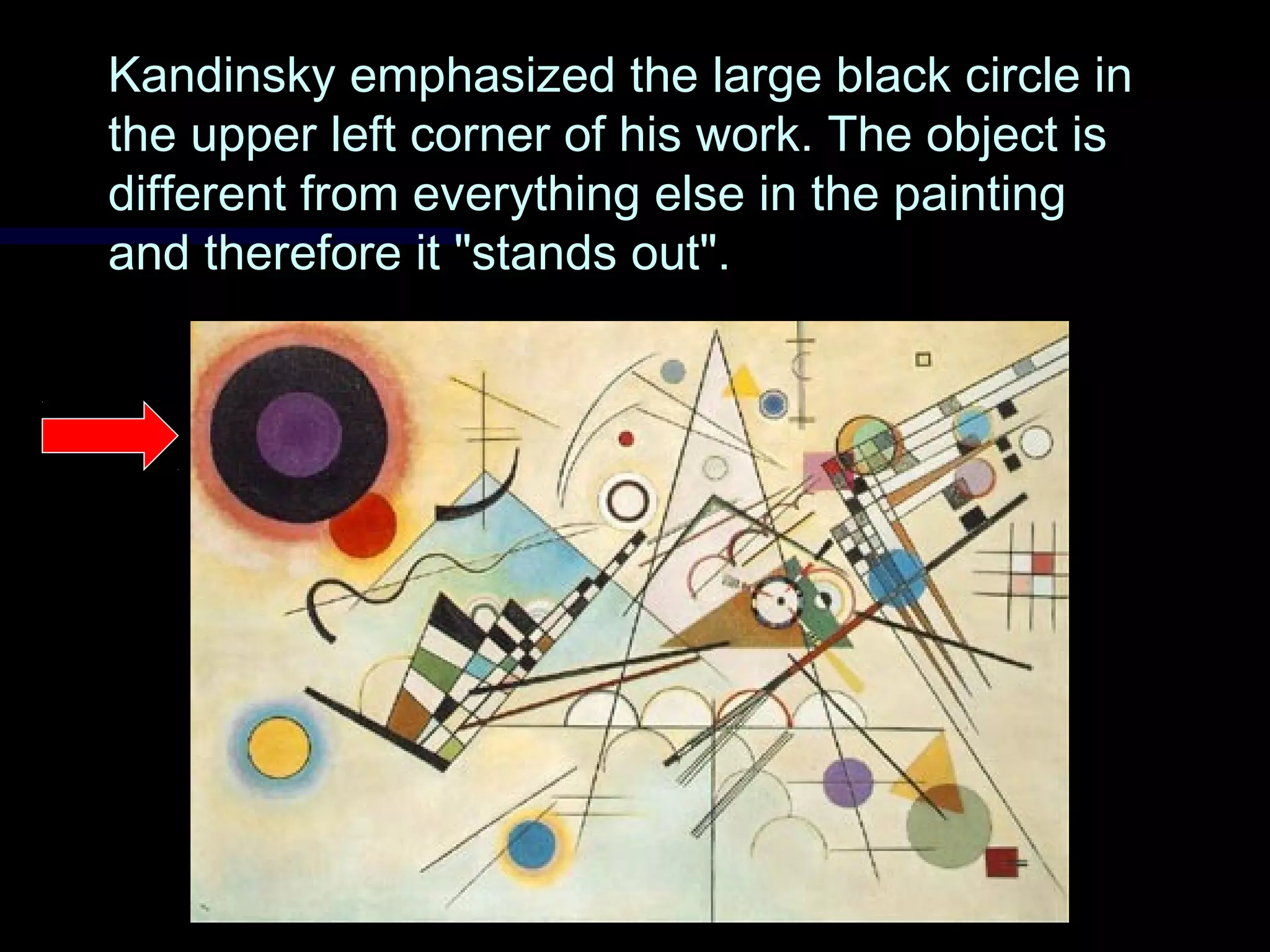
Kandinsky emphasized the large black circle inKandinsky emphasized the large black circle in
the upper left corner of his work. The object isthe upper left corner of his work. The object is
different from everything else in the paintingdifferent from everything else in the painting
and therefore it "stands out".and therefore it "stands out".
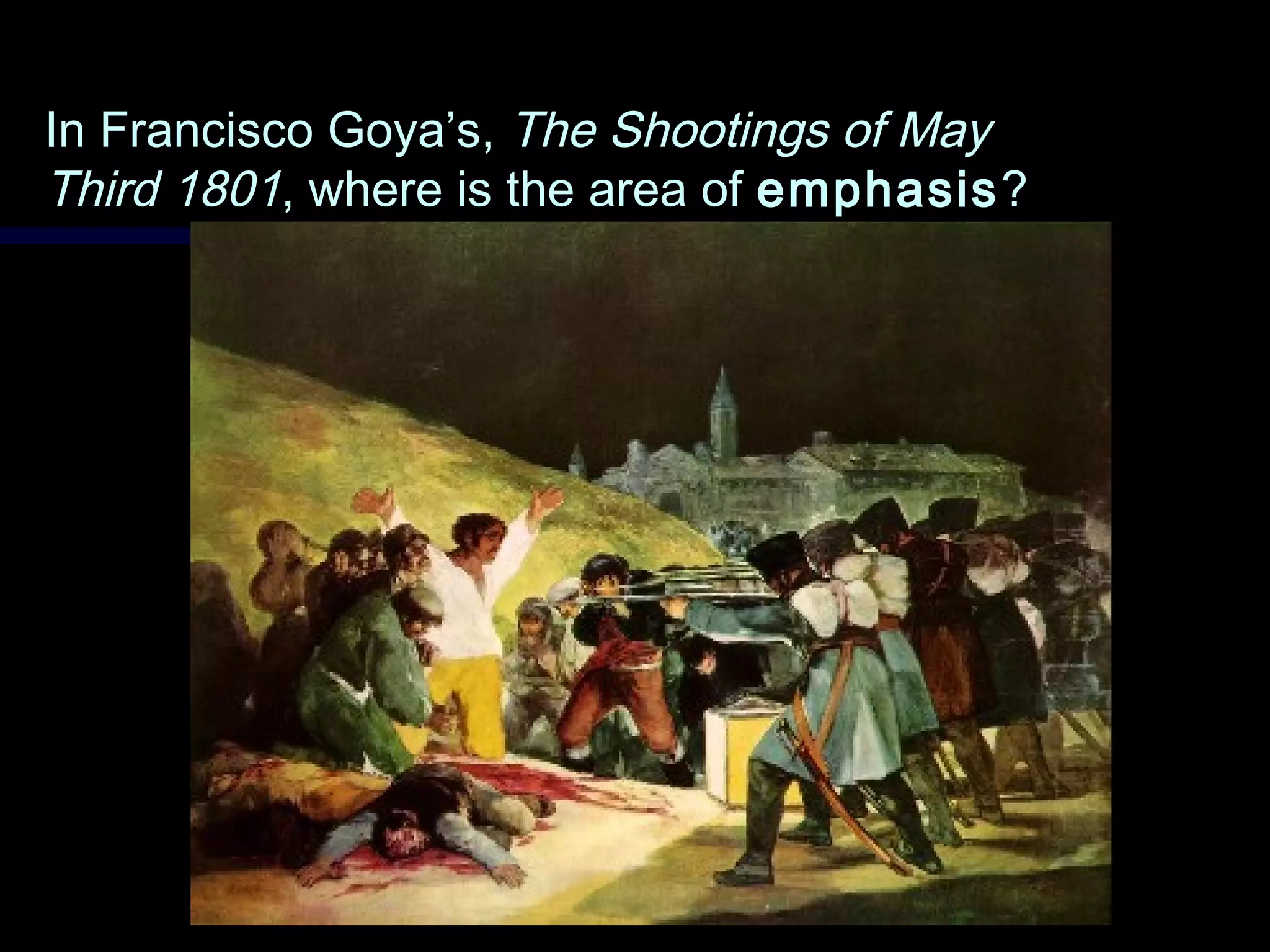
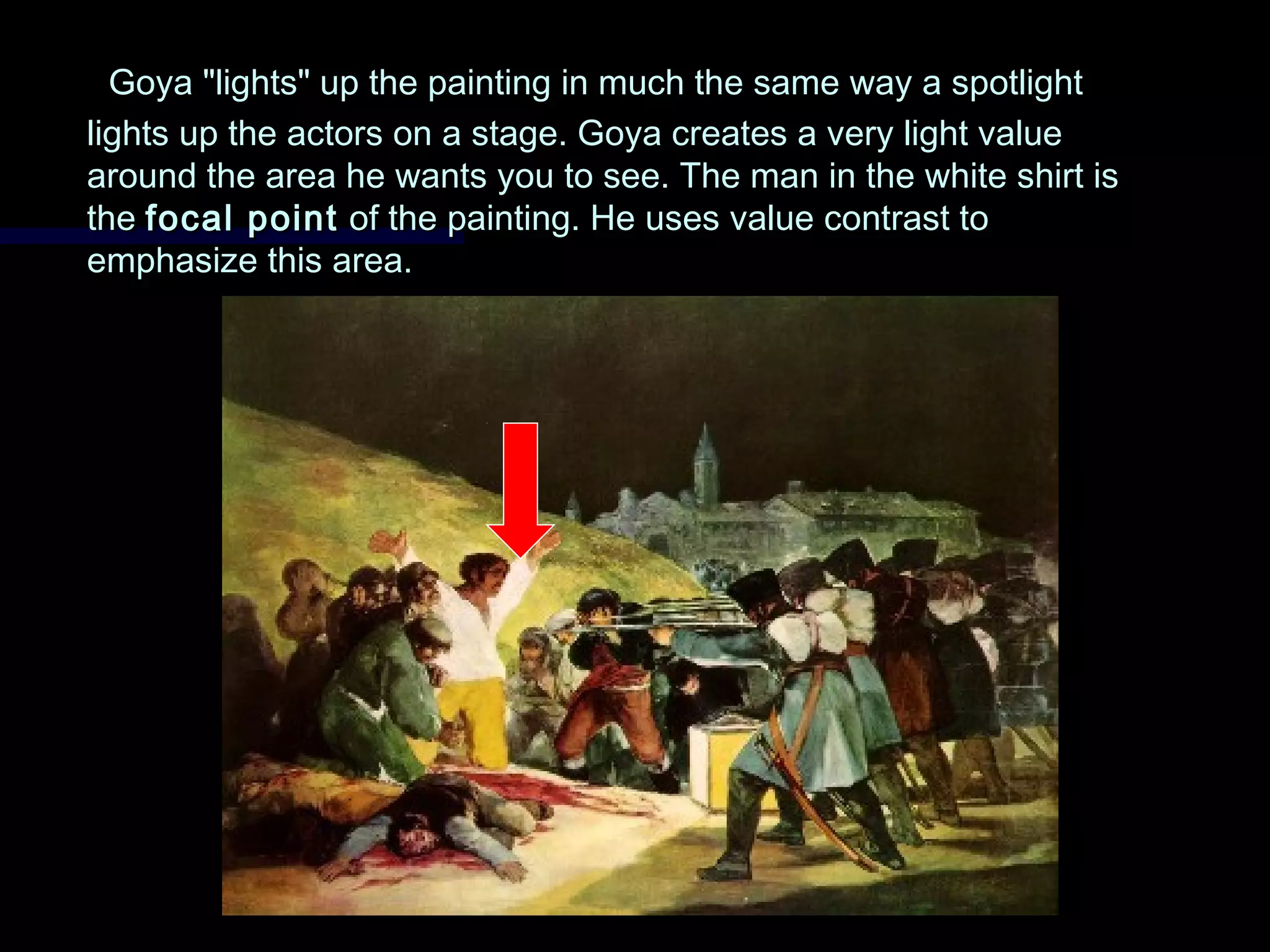
In Francisco Goya’s,In Francisco Goya’s, The Shootings of MayThe Shootings of May
Third 1801Third 1801, where is the area of, where is the area of emphasisemphasis??
Goya "lights" up the painting in much the same way a spotlightGoya "lights" up the painting in much the same way a spotlight
lights up the actors on a stage. Goya creates a very light valuelights up the actors on a stage. Goya creates a very light value
around the area he wants you to see. The man in the white shirt isaround the area he wants you to see. The man in the white shirt is
thethe focal pointfocal point of the painting. He uses value contrast toof the painting. He uses value contrast to
emphasize this area.emphasize this area.
VarietyVariety
Variety is achieved when the art elements are
combined in various ways to increase visual interest.
For instance, an assortment of shapes that are of a
variety of sizes attracts more attention than an
assortment of shapes all the same size.
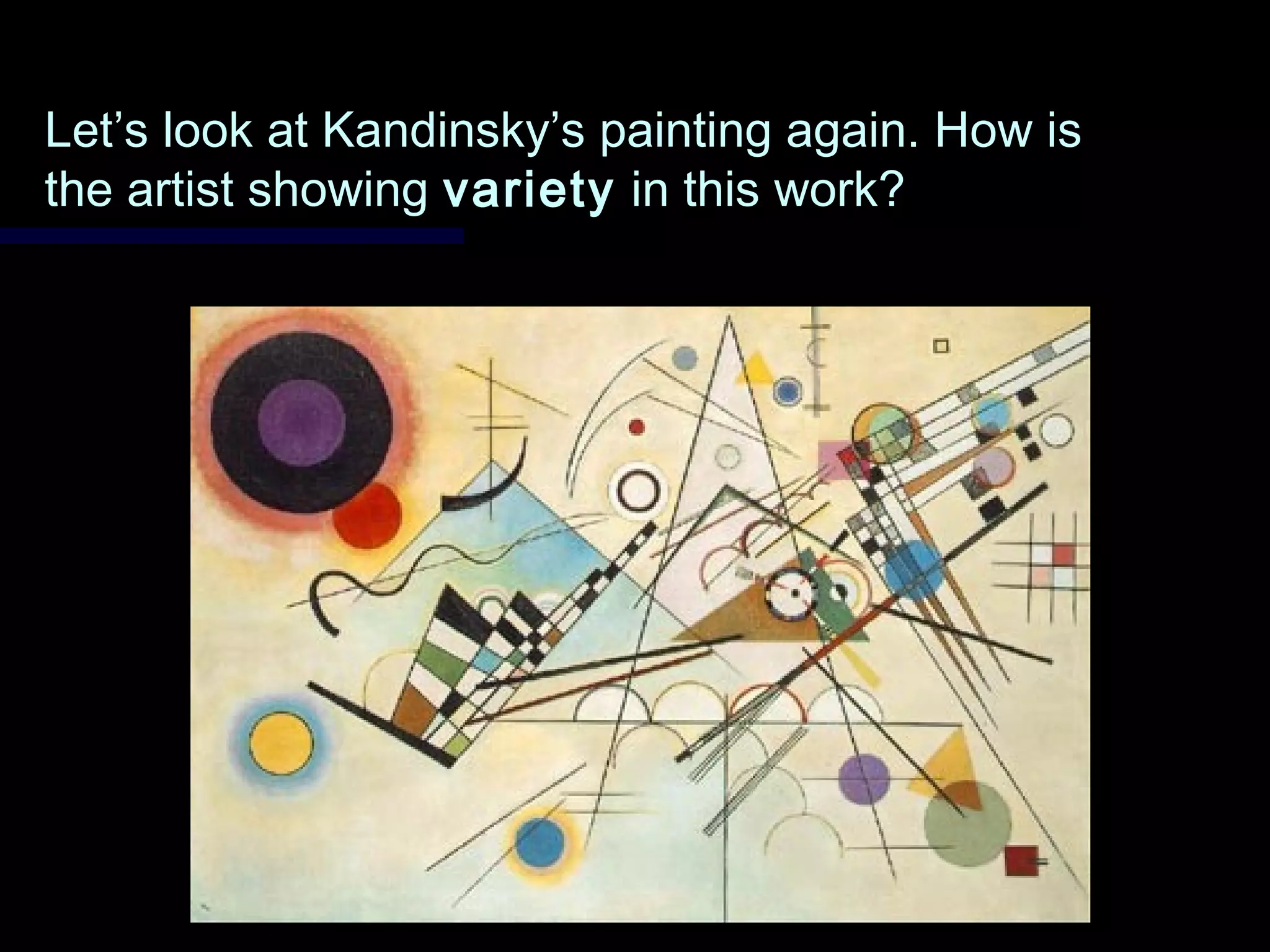
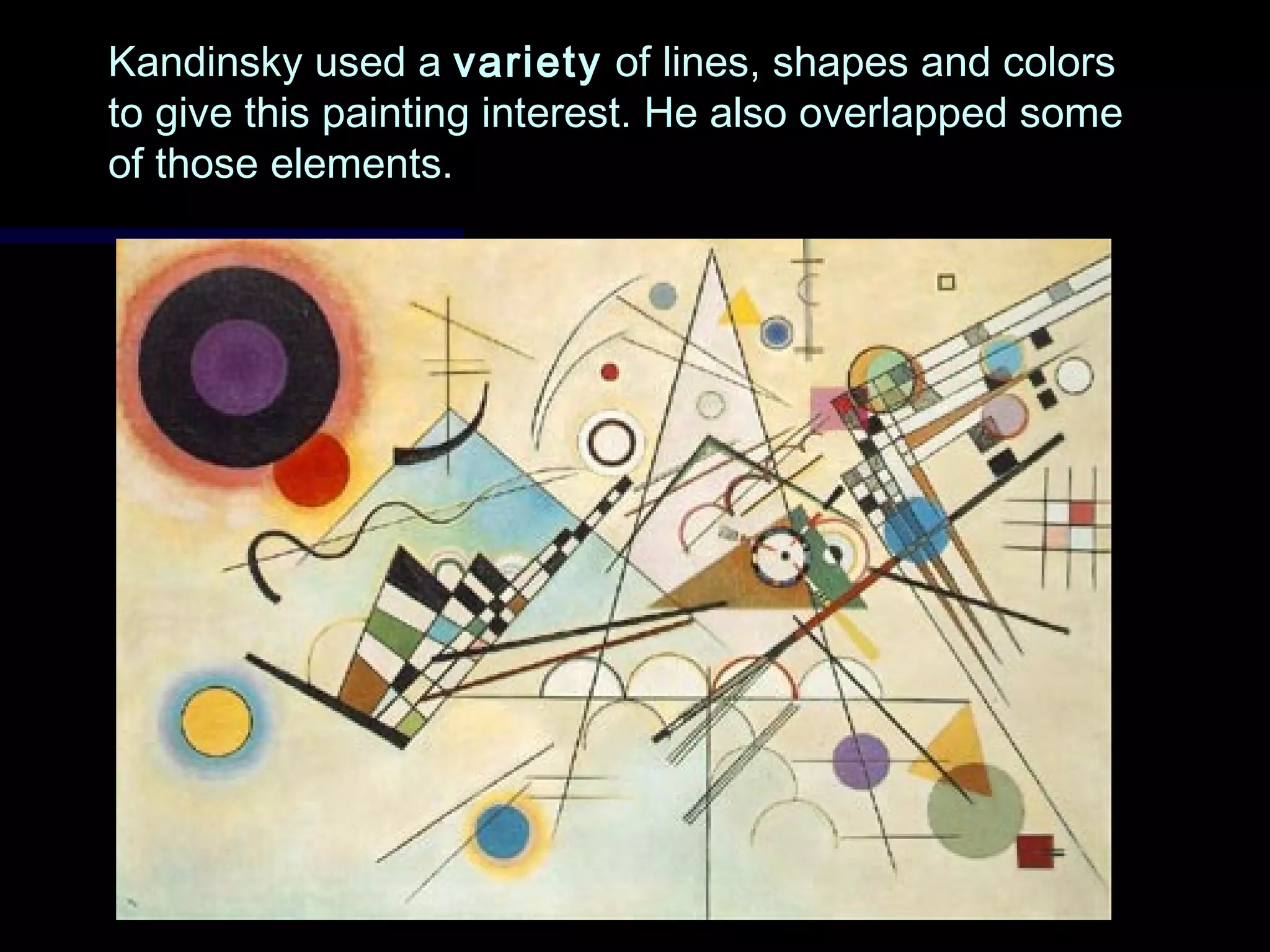
Let’s look at Kandinsky’s painting again. How isLet’s look at Kandinsky’s painting again. How is
the artist showingthe artist showing varietyvariety in this work?in this work?
Kandinsky used aKandinsky used a varietyvariety of lines, shapes and colorsof lines, shapes and colors
to give this painting interest. He also overlapped someto give this painting interest. He also overlapped some
of those elements.of those elements.
Unity/HarmonyUnity/Harmony
This principle refers to the visual quality of
wholeness or oneness that is achieved through
effective use of the elements of art and
principles of design
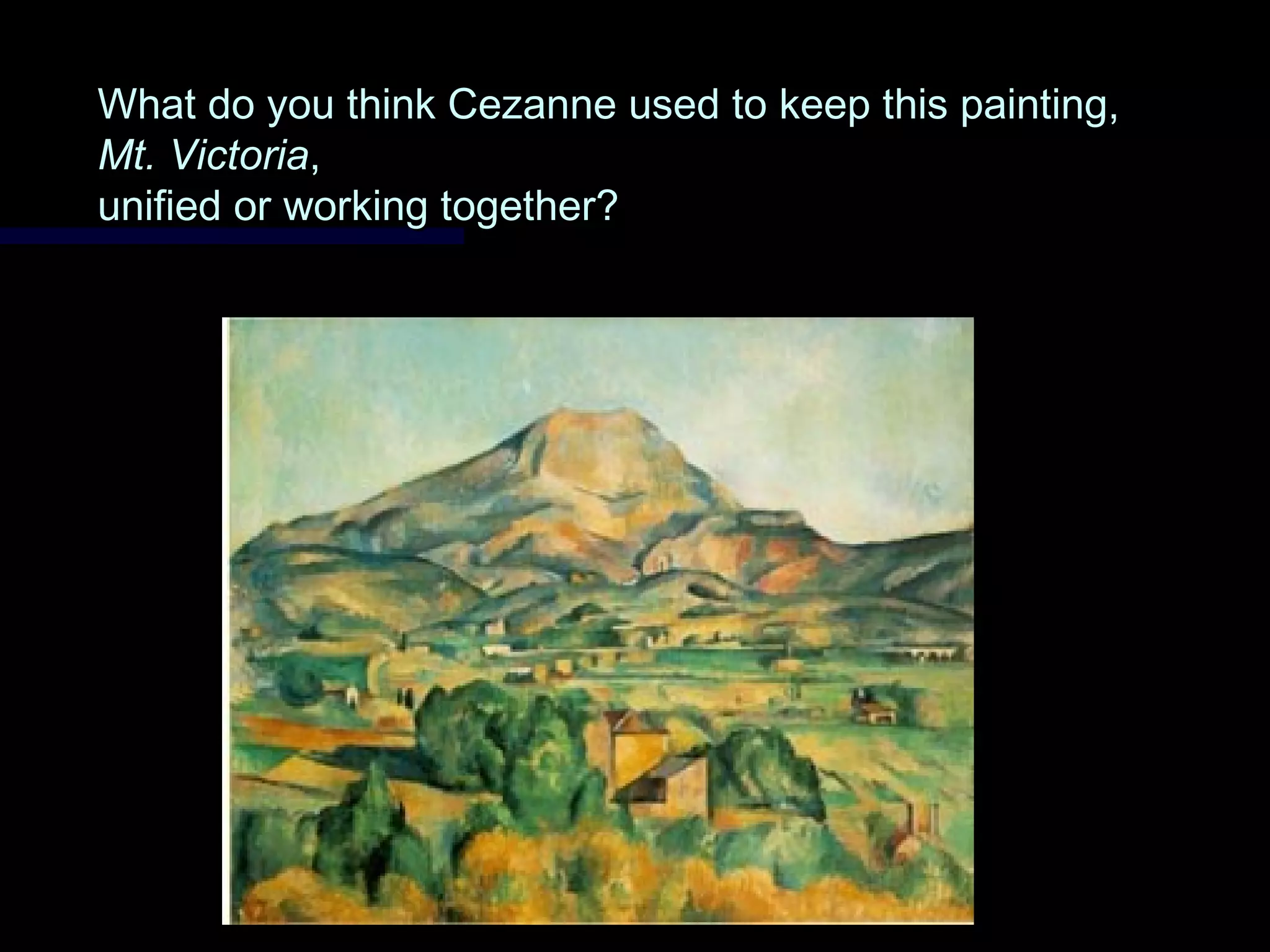
What do you think Cezanne used to keep this painting,What do you think Cezanne used to keep this painting,
Mt. VictoriaMt. Victoria,,
unified or working together?unified or working together?
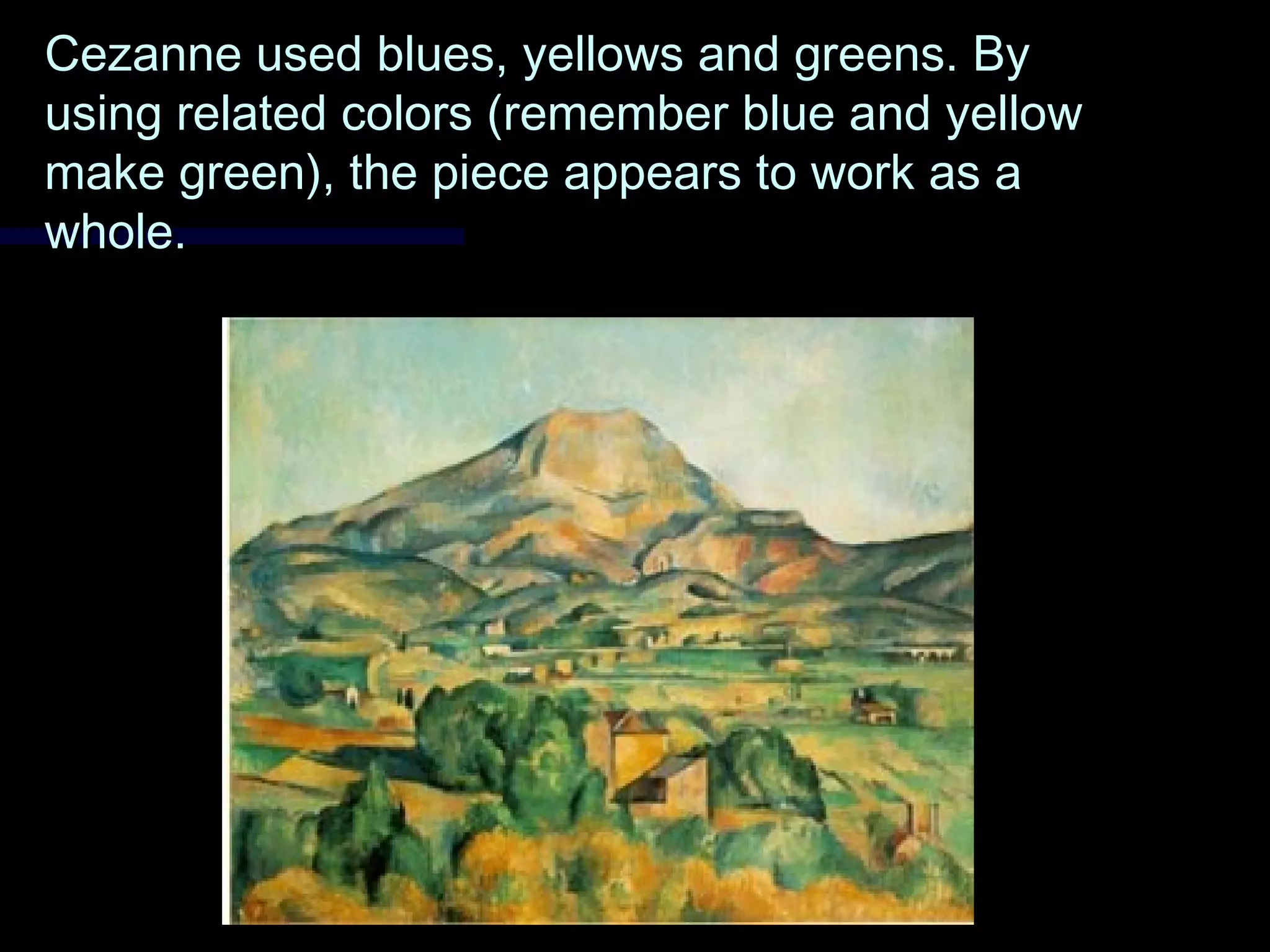
Cezanne used blues, yellows and greens. ByCezanne used blues, yellows and greens. By
using related colors (remember blue and yellowusing related colors (remember blue and yellow
make green), the piece appears to work as amake green), the piece appears to work as a
whole.whole.
ProportionProportion
The relationship in size of one
component (part) of a work of art to
another
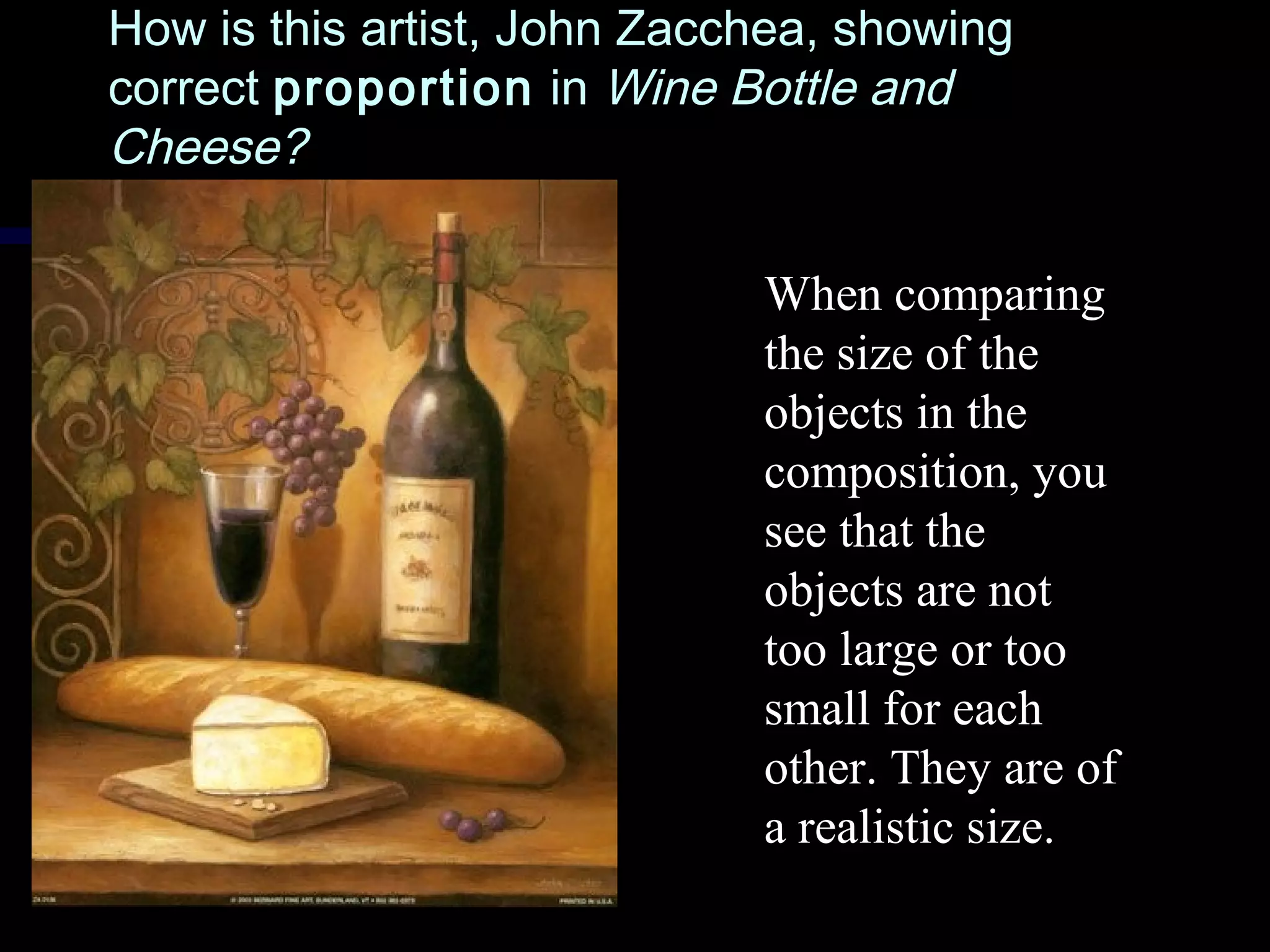
How is this artist, John Zacchea, showingHow is this artist, John Zacchea, showing
correctcorrect proportionproportion inin Wine Bottle andWine Bottle and
Cheese?Cheese?
When comparing
the size of the
objects in the
composition, you
see that the
objects are not
too large or too
small for each
other. They are of
a realistic size.
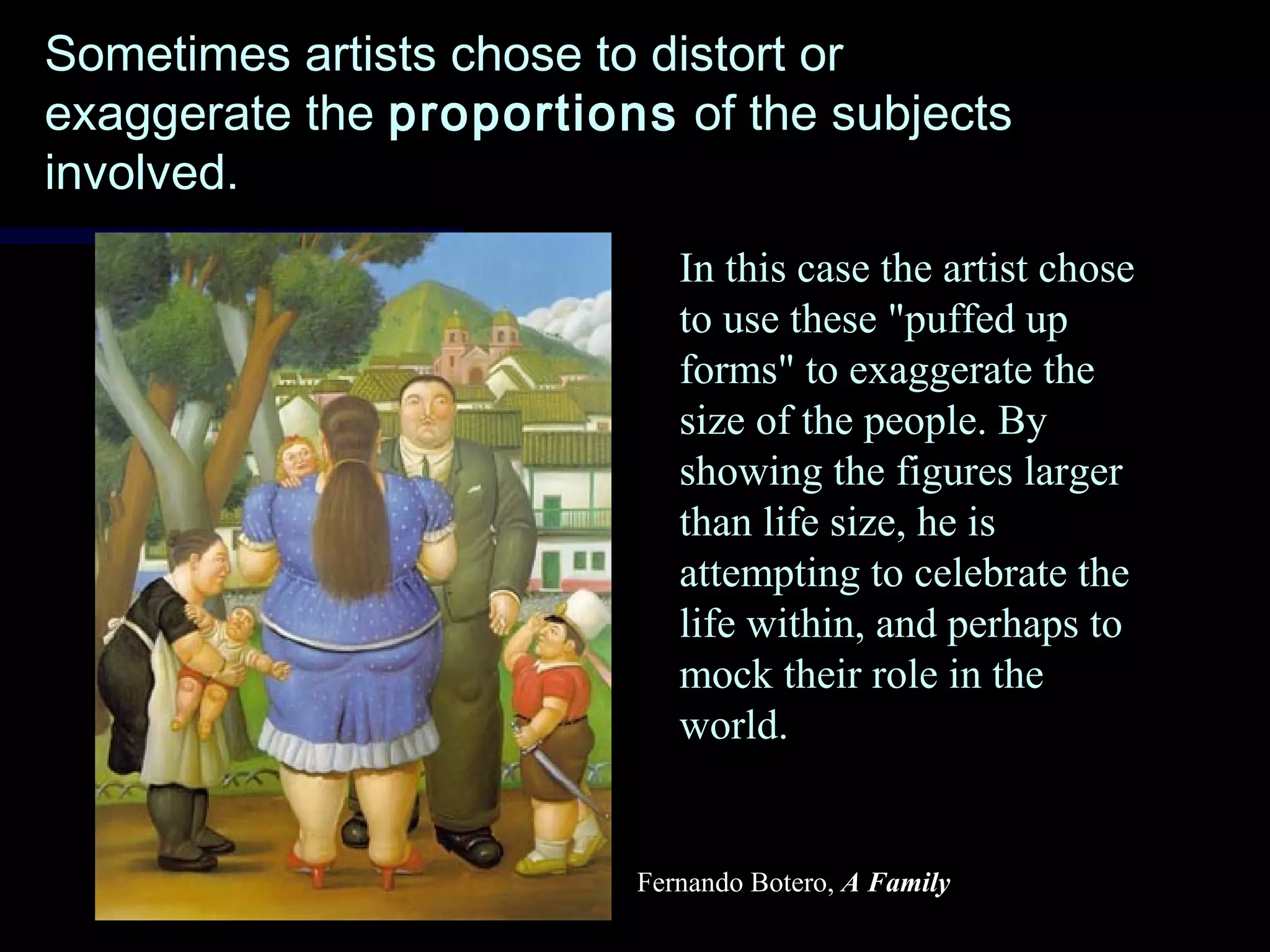
Sometimes artists chose to distort orSometimes artists chose to distort or
exaggerate theexaggerate the proportionsproportions of the subjectsof the subjects
involved.involved.
Fernando Botero, A Family
In this case the artist chose
to use these "puffed up
forms" to exaggerate the
size of the people. By
showing the figures larger
than life size, he is
attempting to celebrate the
life within, and perhaps to
mock their role in the
world.
RhythmRhythm
Rhythm refers to a way of utilizing the art
elements to produce the look and feel of rhythmic
movement with a visual tempo or beat
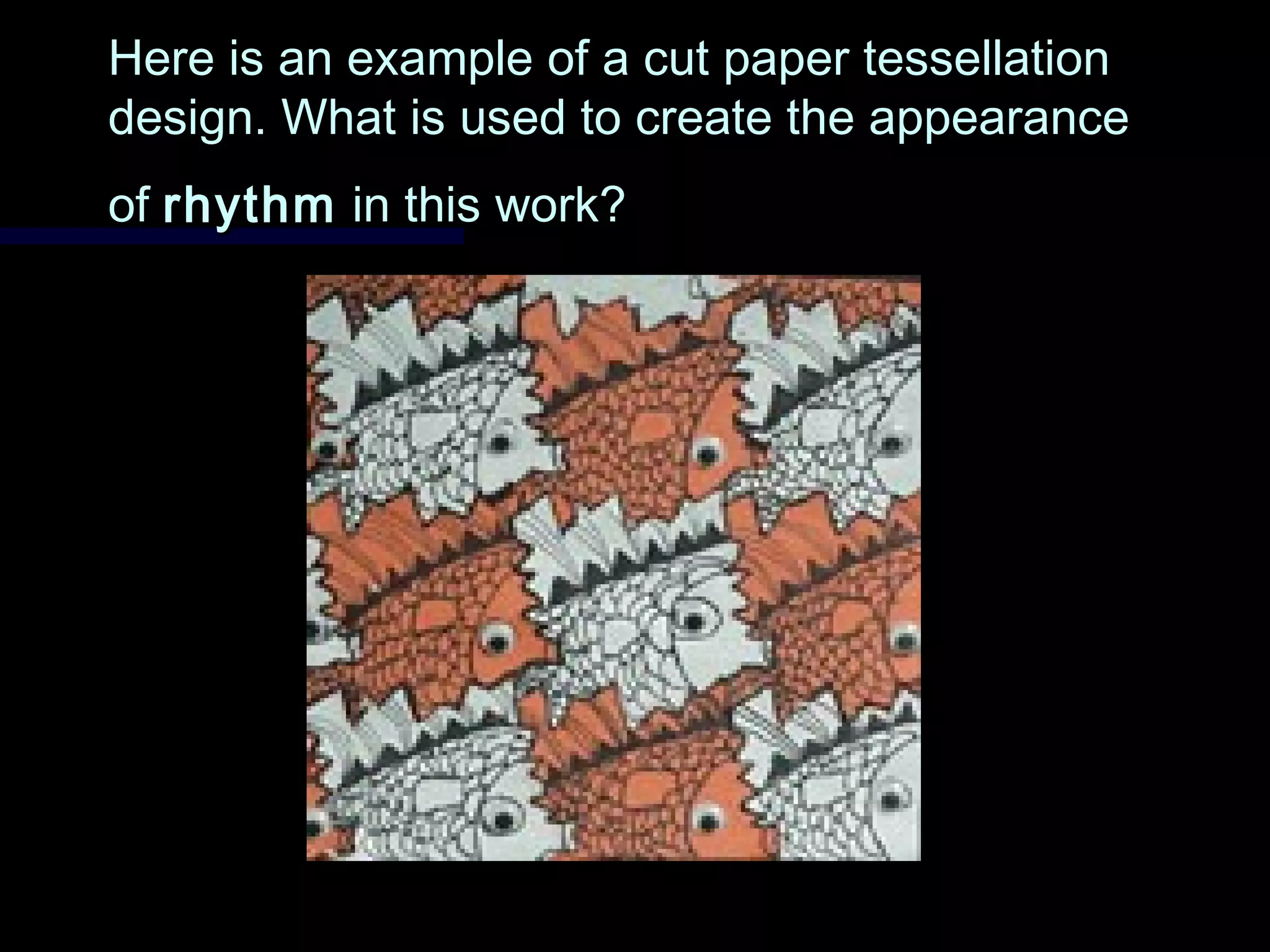
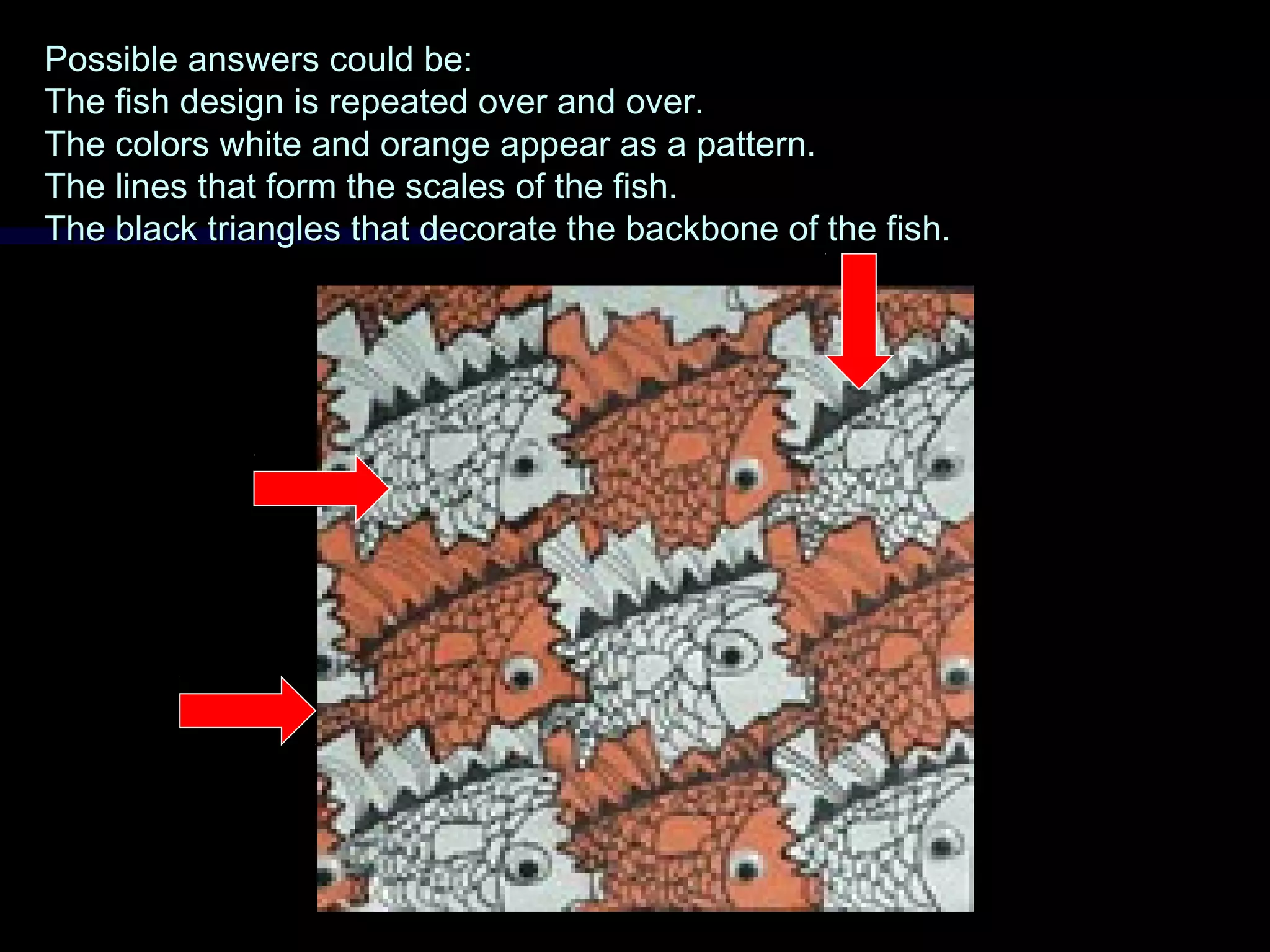
Here is an example of a cut paper tessellationHere is an example of a cut paper tessellation
design. What is used to create the appearancedesign. What is used to create the appearance
ofof rhythmrhythm in this work?in this work?
Possible answers could be:Possible answers could be:
The fish design is repeated over and over.The fish design is repeated over and over.
The colors white and orange appear as a pattern.The colors white and orange appear as a pattern.
The lines that form the scales of the fish.The lines that form the scales of the fish.
The black triangles that decorate the backbone of the fish.The black triangles that decorate the backbone of the fish.
MovementMovement
Movement is the design principle that uses some of
the elements of art to produce the look of action or
to cause the viewer’s eye to sweep over the art work
in a certain manner.
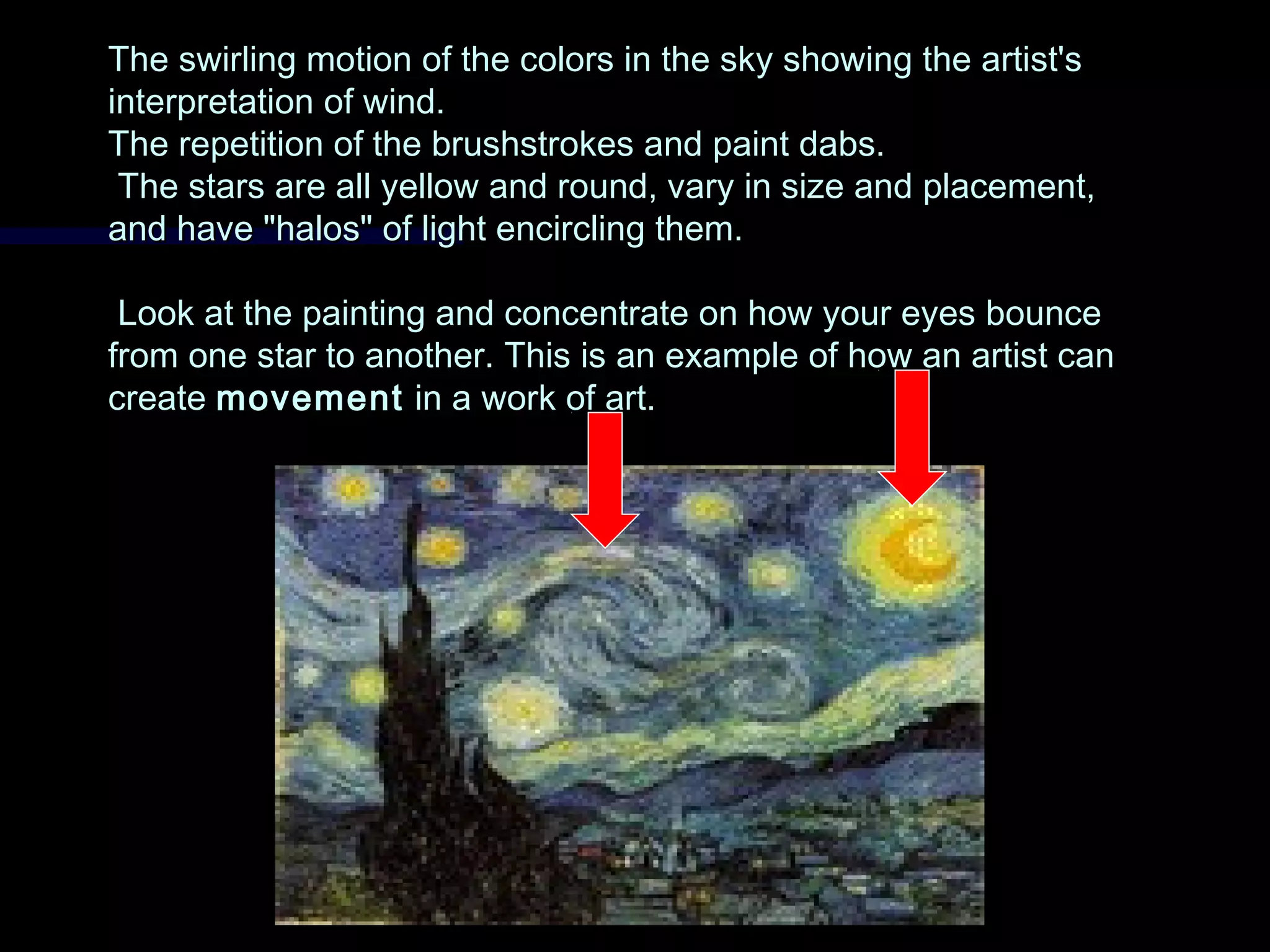
InIn Starry NightStarry Night, famed artist Vincent Van Gogh creates, famed artist Vincent Van Gogh creates
movementmovement in his sky. How does he show us this?in his sky. How does he show us this?
The swirling motion of the colors in the sky showing the artist'sThe swirling motion of the colors in the sky showing the artist's
interpretation of wind.interpretation of wind.
The repetition of the brushstrokes and paint dabs.The repetition of the brushstrokes and paint dabs.
The stars are all yellow and round, vary in size and placement,The stars are all yellow and round, vary in size and placement,
and have "halos" of light encircling them.and have "halos" of light encircling them.
Look at the painting and concentrate on how your eyes bounceLook at the painting and concentrate on how your eyes bounce
from one star to another. This is an example of how an artist canfrom one star to another. This is an example of how an artist can
createcreate movementmovement in a work of art.in a work of art.
PatternPattern
Repetition of an element of art (i.e.,
shapes, lines, or colors) to achieve
decoration or ornamentation.
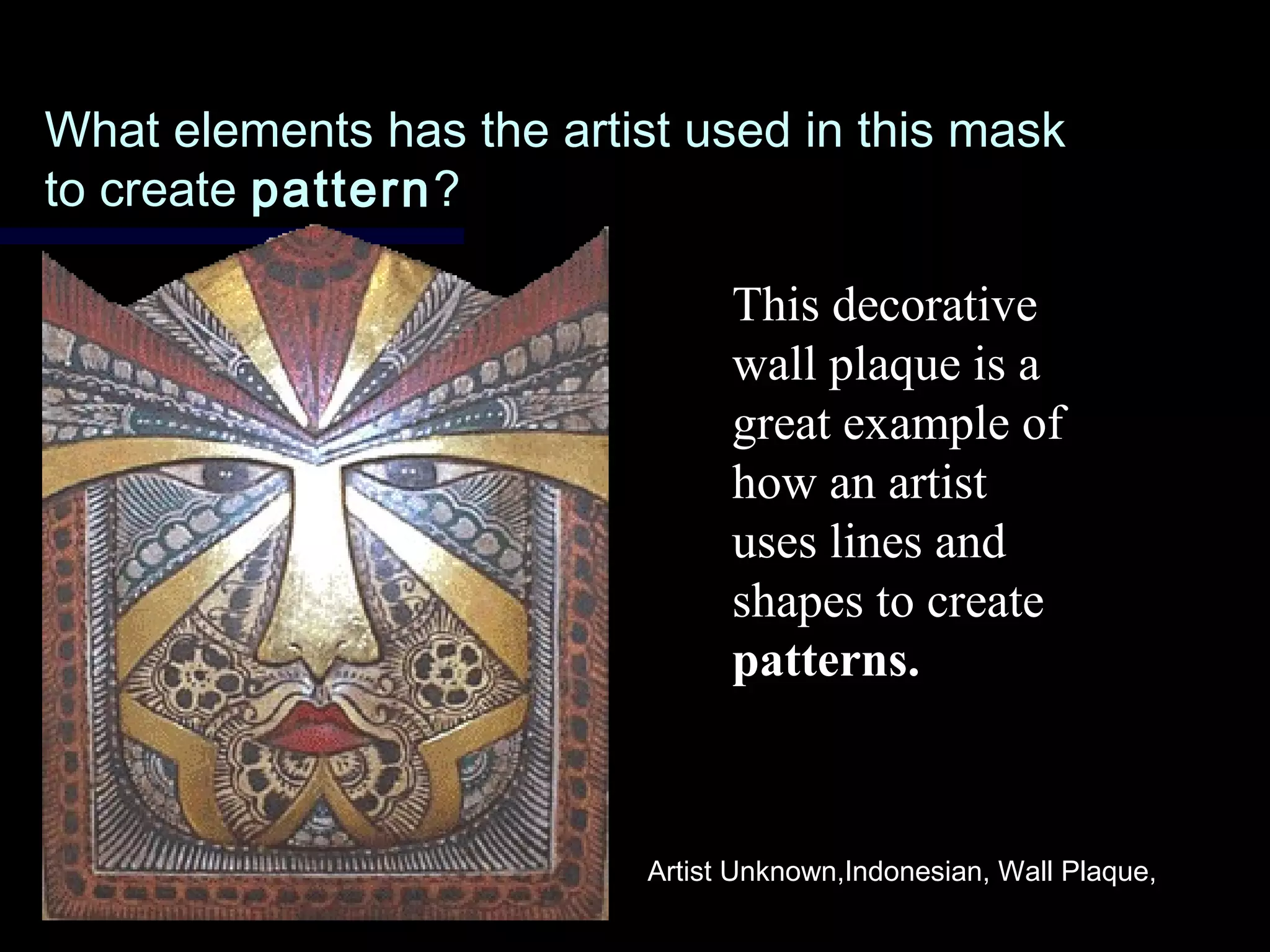
What elements has the artist used in this maskWhat elements has the artist used in this mask
to createto create patternpattern??
This decorative
wall plaque is a
great example of
how an artist
uses lines and
shapes to create
patterns.
Artist Unknown,Indonesian, Wall Plaque,
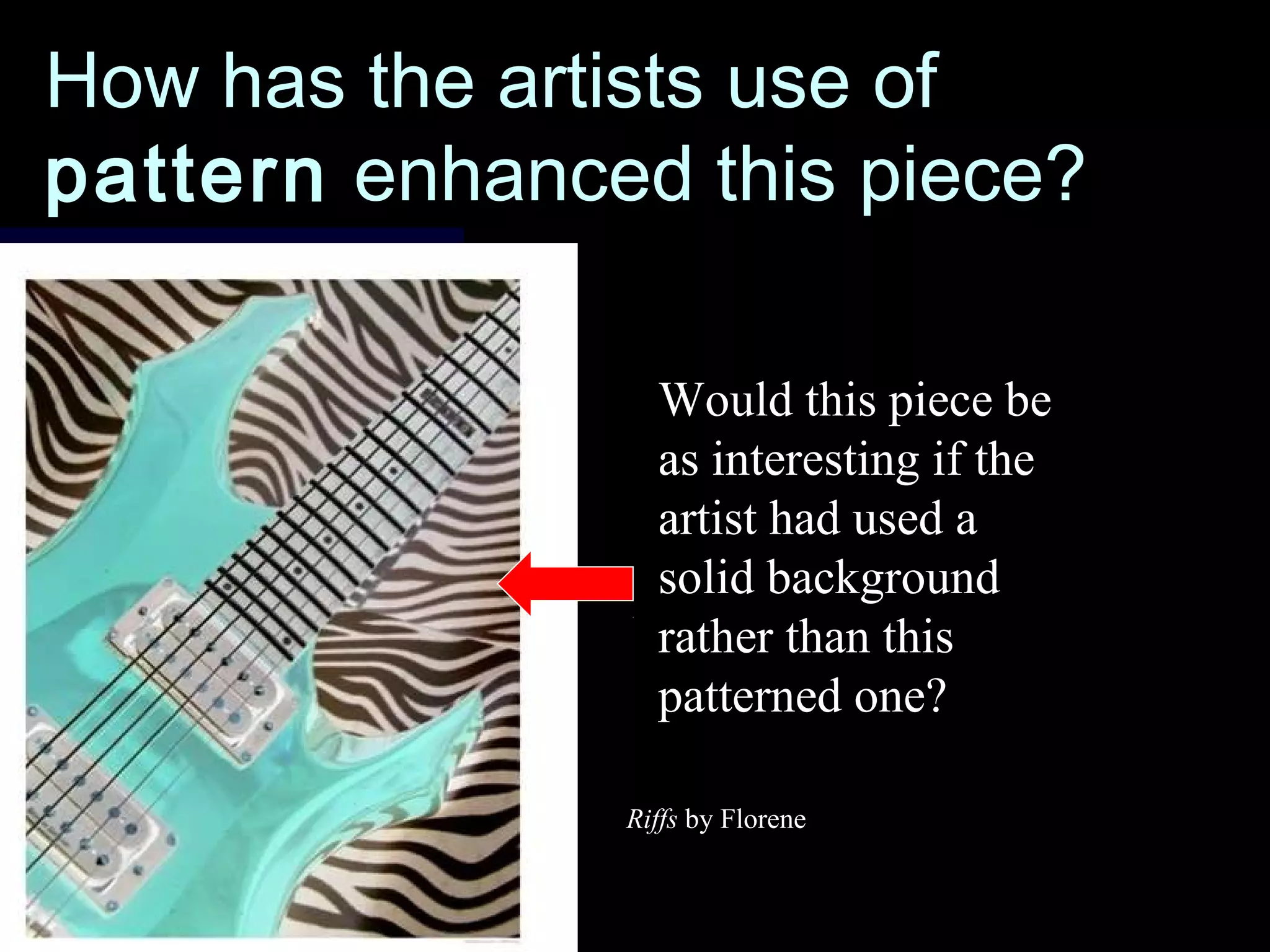
How has the artists use ofHow has the artists use of
patternpattern enhanced this piece?enhanced this piece?
Would this piece be
as interesting if the
artist had used a
solid background
rather than this
patterned one?
Riffs by Florene
RepetitionRepetition
A way of combining art elements
so that the same elements are
used over and over to achieve
balance and harmony.
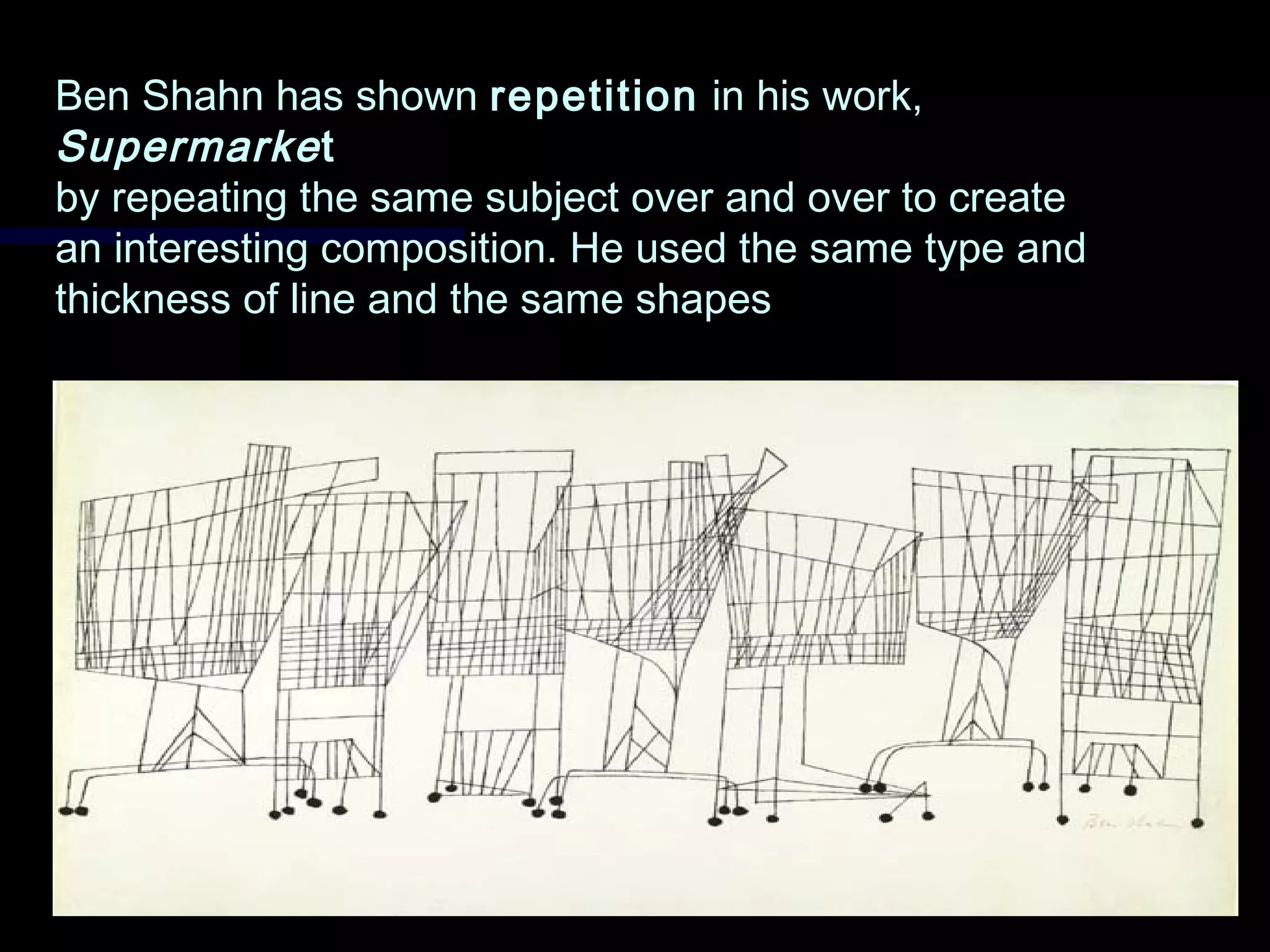
Ben Shahn has shownBen Shahn has shown repetitionrepetition in his work,in his work,
SupermarkeSupermarkett
by repeating the same subject over and over to createby repeating the same subject over and over to create
an interesting composition. He used the same type andan interesting composition. He used the same type and
thickness of line and the same shapesthickness of line and the same shapes
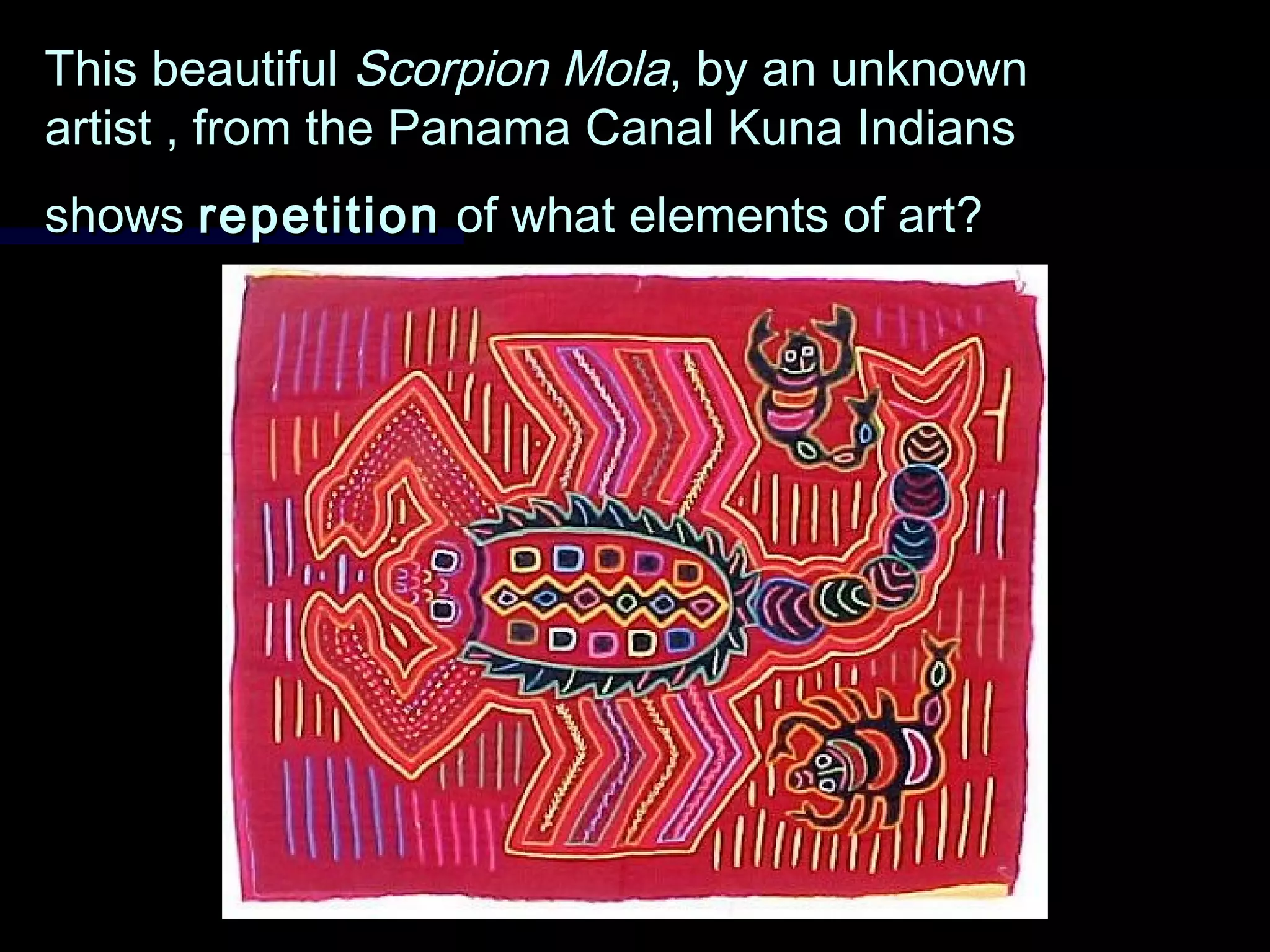
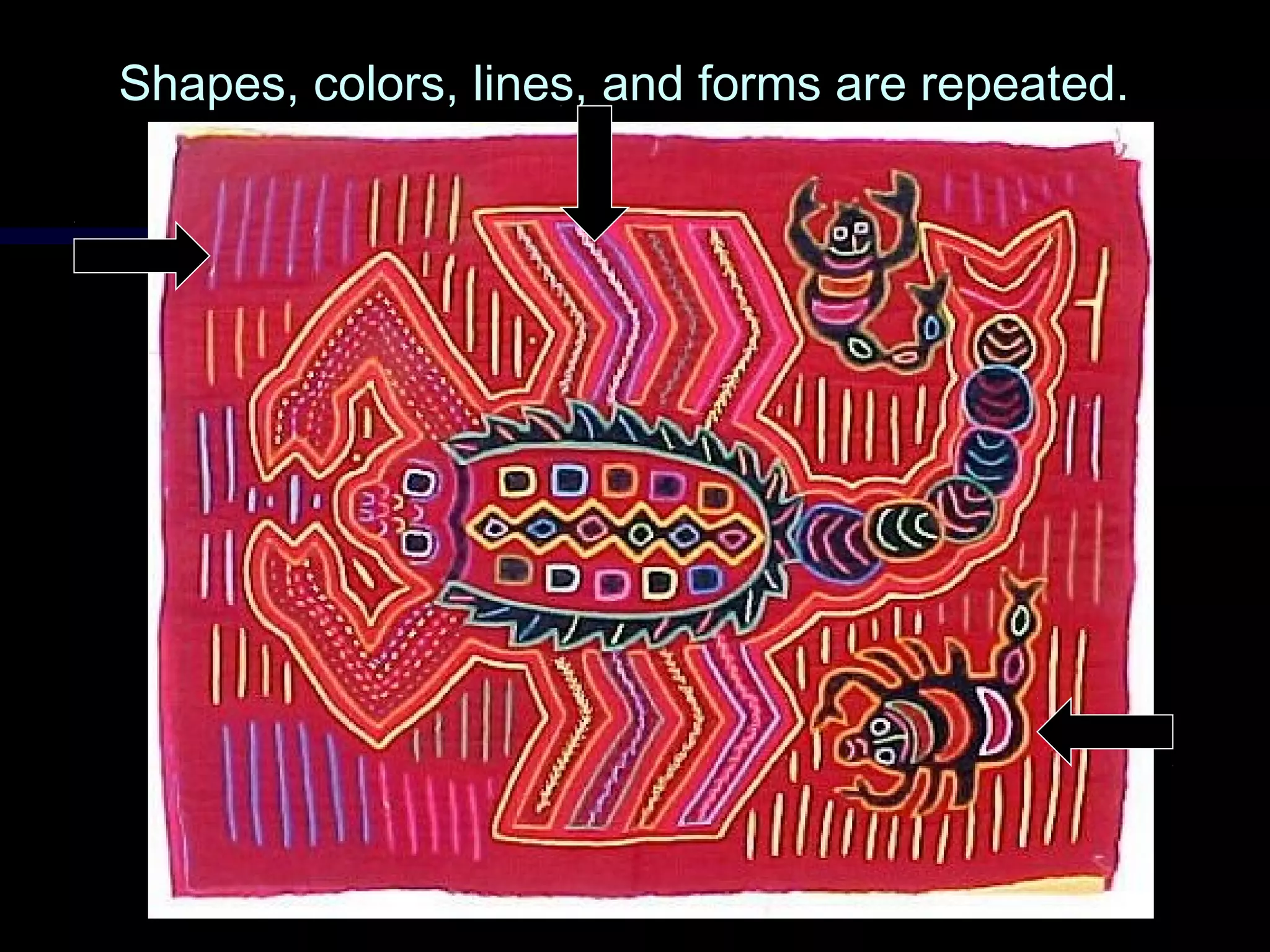
This beautifulThis beautiful Scorpion MolaScorpion Mola, by an unknown, by an unknown
artist , from the Panama Canal Kuna Indiansartist , from the Panama Canal Kuna Indians
showsshows repetitionrepetition of what elements of art?of what elements of art?
Shapes, colors, lines, and forms are repeated.Shapes, colors, lines, and forms are repeated.
The Principles of Design in ReviewThe Principles of Design in Review
The Principles of Design are the ways that artistsThe Principles of Design are the ways that artists useuse thethe
Elements of Art to create good Compositions (artwork)Elements of Art to create good Compositions (artwork)
BalanceBalance ContrastContrast
EmphasisEmphasis VarietyVariety
Unity/HarmonyUnity/Harmony ProportionProportion
RhythmRhythm MovementMovement
PatternPattern RepetitionRepetition

The Principles of Design

  • 1.
    The Principles ofThePrinciples of DesignDesign
  • 2.
    What are ThePrinciples ofWhat are The Principles of Design?Design? The Principles of Design areThe Principles of Design are the ways that artiststhe ways that artists useuse thethe Elements of Art to create goodElements of Art to create good Compositions (artwork)Compositions (artwork)
  • 3.
    There are 11Principles ofThere are 11 Principles of DesignDesign BalanceBalance ContrastContrast EmphasisEmphasis VarietyVariety Unity/HarmonyUnity/Harmony ProportionProportion RhythmRhythm MovementMovement PatternPattern RepetitionRepetition
  • 4.
    Balance:Balance: This principle ofdesign refers toThis principle of design refers to the visual equalization of thethe visual equalization of the elements in a work of art.elements in a work of art. There are three major forms ofThere are three major forms of balancebalance
  • 5.
    The three majorforms ofThe three major forms of balance:balance:  Asymmetrical balance:Asymmetrical balance: where equilibriumwhere equilibrium is achieved by the balance differences in theis achieved by the balance differences in the art elements within a composition.art elements within a composition.  Symmetrical balance:Symmetrical balance: where the artwhere the art elements in a composition are balanced in aelements in a composition are balanced in a mirror-like fashion (it does not have to bemirror-like fashion (it does not have to be exact but close).exact but close).  Radial balance:Radial balance: a kind of balance wherea kind of balance where the elements branch or radiate out from athe elements branch or radiate out from a central point.central point.
  • 6.
    What kind ofWhatkind of balancebalance is illustrated in thisis illustrated in this paintingpainting Oriental PoppiesOriental Poppies,, by Georgia O’Keefe?by Georgia O’Keefe?
  • 7.
    If you saidIfyou said symmetrical balancesymmetrical balance , you are correct!, you are correct! If you could visually divide the paper in half. There would be aIf you could visually divide the paper in half. There would be a poppy on both sides. No one side dominates the pictures.poppy on both sides. No one side dominates the pictures. Neither poppy appears to be more important than the other.Neither poppy appears to be more important than the other.
  • 8.
    What type ofWhattype of balancebalance is shown in this painting,is shown in this painting, Arrangement in Grey and Black: Portrait of the Painter'sArrangement in Grey and Black: Portrait of the Painter's Mother (commonly known as WhistlerMother (commonly known as Whistler’’s Mother)s Mother), by, by James Whistler?James Whistler?
  • 9.
    If you said,Ifyou said, asymmetrical balanceasymmetrical balance , you were right!, you were right! The large form of the woman is "visually equal" to theThe large form of the woman is "visually equal" to the black curtain and white painting on the wall. This makesblack curtain and white painting on the wall. This makes the painting appearthe painting appear balanced.balanced.
  • 10.
    What type ofWhattype of balancebalance is shown in this stainedis shown in this stained glass artwork,glass artwork, Rose WindowRose Window??
  • 11.
    Radial BalanceRadial Balance! Look at the spiral or spinning effect! Look at the spiral or spinning effect of the pattern. The axis is the center point and theof the pattern. The axis is the center point and the design or pattern appears to "radiate" from that point.design or pattern appears to "radiate" from that point.
  • 12.
    What type ofWhattype of balancebalance is shown here?is shown here? Here the larger figures to the right are balanced by the many smaller figures to the left. Also, Seurat added additional "light" to the left. How does this add balance to the painting? George Seurat, (French) 1859-1891, Sunday Afternoon on the Island of La Grand Jatte
  • 13.
    What type ofWhattype of balancebalance is shown here?is shown here? The monkey and the the cat balance each other out on either side of the woman. Freda Khalo, Autorretarto con Collre de Espinas y Colibri,
  • 14.
    ContrastContrastA design principlethat emphasizes differences between the art elements. For example, a painting may have bright colors that contrast with dull colors or angular shapes that contrast with rounded shapes. Sharp contrast draws attention and can direct a viewer to a focal point within a work of art.
  • 15.
    InIn Spiral ofEmotionSpiral of Emotion by Joseph Perkins we seeby Joseph Perkins we see a sharpa sharp contrastcontrast between darks and lightsbetween darks and lights which he has balanced out with some middlewhich he has balanced out with some middle tones.tones.
  • 16.
    In this workwe see sharp lines and shapesIn this work we see sharp lines and shapes against softer lines and shapes. We also seeagainst softer lines and shapes. We also see sharpsharp contrastcontrast between colors.between colors. Marlene Healey, Sections of my Destiny
  • 17.
    EmphasisEmphasis The principle ofdesign that is concerned with dominance; the development of a main idea or center of interest (also called focal point)
  • 18.
    Where is theWhereis the focal pointfocal point in Wassilyin Wassily Kandinsky’s,Kandinsky’s, Composition VIIComposition VII ??
  • 19.
    Kandinsky emphasized thelarge black circle inKandinsky emphasized the large black circle in the upper left corner of his work. The object isthe upper left corner of his work. The object is different from everything else in the paintingdifferent from everything else in the painting and therefore it "stands out".and therefore it "stands out".
  • 20.
    In Francisco Goya’s,InFrancisco Goya’s, The Shootings of MayThe Shootings of May Third 1801Third 1801, where is the area of, where is the area of emphasisemphasis??
  • 21.
    Goya "lights" upthe painting in much the same way a spotlightGoya "lights" up the painting in much the same way a spotlight lights up the actors on a stage. Goya creates a very light valuelights up the actors on a stage. Goya creates a very light value around the area he wants you to see. The man in the white shirt isaround the area he wants you to see. The man in the white shirt is thethe focal pointfocal point of the painting. He uses value contrast toof the painting. He uses value contrast to emphasize this area.emphasize this area.
  • 22.
    VarietyVariety Variety is achievedwhen the art elements are combined in various ways to increase visual interest. For instance, an assortment of shapes that are of a variety of sizes attracts more attention than an assortment of shapes all the same size.
  • 23.
    Let’s look atKandinsky’s painting again. How isLet’s look at Kandinsky’s painting again. How is the artist showingthe artist showing varietyvariety in this work?in this work?
  • 24.
    Kandinsky used aKandinskyused a varietyvariety of lines, shapes and colorsof lines, shapes and colors to give this painting interest. He also overlapped someto give this painting interest. He also overlapped some of those elements.of those elements.
  • 25.
    Unity/HarmonyUnity/Harmony This principle refersto the visual quality of wholeness or oneness that is achieved through effective use of the elements of art and principles of design
  • 26.
    What do youthink Cezanne used to keep this painting,What do you think Cezanne used to keep this painting, Mt. VictoriaMt. Victoria,, unified or working together?unified or working together?
  • 27.
    Cezanne used blues,yellows and greens. ByCezanne used blues, yellows and greens. By using related colors (remember blue and yellowusing related colors (remember blue and yellow make green), the piece appears to work as amake green), the piece appears to work as a whole.whole.
  • 28.
    ProportionProportion The relationship insize of one component (part) of a work of art to another
  • 29.
    How is thisartist, John Zacchea, showingHow is this artist, John Zacchea, showing correctcorrect proportionproportion inin Wine Bottle andWine Bottle and Cheese?Cheese? When comparing the size of the objects in the composition, you see that the objects are not too large or too small for each other. They are of a realistic size.
  • 30.
    Sometimes artists choseto distort orSometimes artists chose to distort or exaggerate theexaggerate the proportionsproportions of the subjectsof the subjects involved.involved. Fernando Botero, A Family In this case the artist chose to use these "puffed up forms" to exaggerate the size of the people. By showing the figures larger than life size, he is attempting to celebrate the life within, and perhaps to mock their role in the world.
  • 31.
    RhythmRhythm Rhythm refers toa way of utilizing the art elements to produce the look and feel of rhythmic movement with a visual tempo or beat
  • 32.
    Here is anexample of a cut paper tessellationHere is an example of a cut paper tessellation design. What is used to create the appearancedesign. What is used to create the appearance ofof rhythmrhythm in this work?in this work?
  • 33.
    Possible answers couldbe:Possible answers could be: The fish design is repeated over and over.The fish design is repeated over and over. The colors white and orange appear as a pattern.The colors white and orange appear as a pattern. The lines that form the scales of the fish.The lines that form the scales of the fish. The black triangles that decorate the backbone of the fish.The black triangles that decorate the backbone of the fish.
  • 34.
    MovementMovement Movement is thedesign principle that uses some of the elements of art to produce the look of action or to cause the viewer’s eye to sweep over the art work in a certain manner.
  • 35.
    InIn Starry NightStarryNight, famed artist Vincent Van Gogh creates, famed artist Vincent Van Gogh creates movementmovement in his sky. How does he show us this?in his sky. How does he show us this?
  • 36.
    The swirling motionof the colors in the sky showing the artist'sThe swirling motion of the colors in the sky showing the artist's interpretation of wind.interpretation of wind. The repetition of the brushstrokes and paint dabs.The repetition of the brushstrokes and paint dabs. The stars are all yellow and round, vary in size and placement,The stars are all yellow and round, vary in size and placement, and have "halos" of light encircling them.and have "halos" of light encircling them. Look at the painting and concentrate on how your eyes bounceLook at the painting and concentrate on how your eyes bounce from one star to another. This is an example of how an artist canfrom one star to another. This is an example of how an artist can createcreate movementmovement in a work of art.in a work of art.
  • 37.
    PatternPattern Repetition of anelement of art (i.e., shapes, lines, or colors) to achieve decoration or ornamentation.
  • 38.
    What elements hasthe artist used in this maskWhat elements has the artist used in this mask to createto create patternpattern?? This decorative wall plaque is a great example of how an artist uses lines and shapes to create patterns. Artist Unknown,Indonesian, Wall Plaque,
  • 39.
    How has theartists use ofHow has the artists use of patternpattern enhanced this piece?enhanced this piece? Would this piece be as interesting if the artist had used a solid background rather than this patterned one? Riffs by Florene
  • 40.
    RepetitionRepetition A way ofcombining art elements so that the same elements are used over and over to achieve balance and harmony.
  • 41.
    Ben Shahn hasshownBen Shahn has shown repetitionrepetition in his work,in his work, SupermarkeSupermarkett by repeating the same subject over and over to createby repeating the same subject over and over to create an interesting composition. He used the same type andan interesting composition. He used the same type and thickness of line and the same shapesthickness of line and the same shapes
  • 42.
    This beautifulThis beautifulScorpion MolaScorpion Mola, by an unknown, by an unknown artist , from the Panama Canal Kuna Indiansartist , from the Panama Canal Kuna Indians showsshows repetitionrepetition of what elements of art?of what elements of art?
  • 43.
    Shapes, colors, lines,and forms are repeated.Shapes, colors, lines, and forms are repeated.
  • 44.
    The Principles ofDesign in ReviewThe Principles of Design in Review The Principles of Design are the ways that artistsThe Principles of Design are the ways that artists useuse thethe Elements of Art to create good Compositions (artwork)Elements of Art to create good Compositions (artwork) BalanceBalance ContrastContrast EmphasisEmphasis VarietyVariety Unity/HarmonyUnity/Harmony ProportionProportion RhythmRhythm MovementMovement PatternPattern RepetitionRepetition