The Elements
and Principles
 of Design
       Presented by
       Jaikumar Ranganathan
The Elements of Design:

These 6 ingredients are used to
create a design:
    line
    Shape & form
    Space
    value
    colour
    texture
LINE
Four Basic Types of Lines

           Horizontal
Vertical


                        Curvilinear
Line:
Line An element of design that is used to
 define shape, contours, and outlines, also
 to suggest mass and volume. It may be a
 continuous mark made on a surface with
 a pointed tool or implied by the edges of
 shapes and forms.
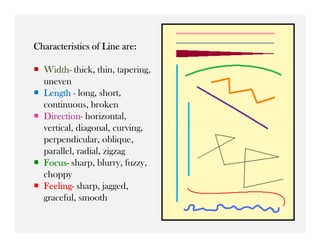
Characteristics of Line are:

  Width- thick, thin, tapering,
  Width
  uneven
  Length - long, short,
  continuous, broken
  Direction-
  Direction horizontal,
  vertical, diagonal, curving,
  perpendicular, oblique,
  parallel, radial, zigzag
  Focus-
  Focus sharp, blurry, fuzzy,
  choppy
  Feeling- sharp, jagged,
  Feeling
  graceful, smooth
Implied Line
• Implied Line is the line inside the object within in the
  art / design work. For example, an image of a soldier
  standing tall has an implied vertical line in the stance.
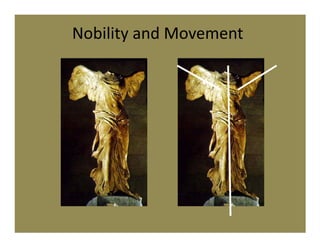
  Each of the lines imply different meanings. A vertical
  line can imply nobility. A horizontal can imply calm
  or rest. A diagonal line can imply movement. A
  curvilinear line can imply grace.
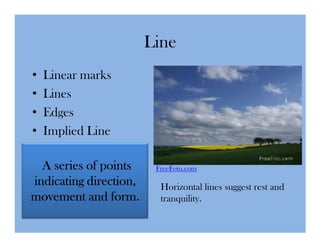
Line
•   Linear marks
•   Lines
•   Edges
•   Implied Line

  A series of points     FreeFoto.com
indicating direction,     Horizontal lines suggest rest and
movement and form.        tranquility.
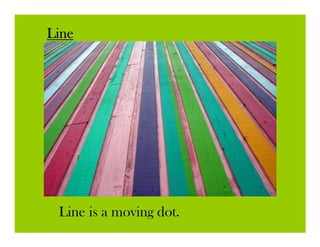
Line


 Line is a moving dot.
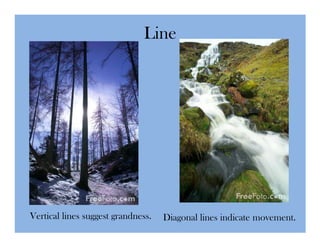
Line


Vertical lines suggest grandness.   Diagonal lines indicate movement.
Nobility and Movement
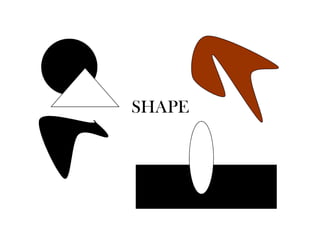
SHAPE
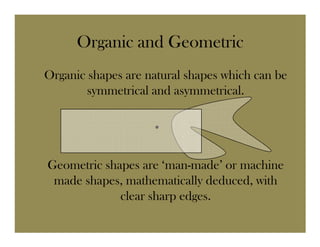
Organic and Geometric
Organic shapes are natural shapes which can be
        symmetrical and asymmetrical.

                    •

Geometric shapes are ‘man-made’ or machine
 made shapes, mathematically deduced, with
             clear sharp edges.
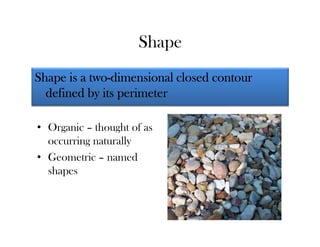
Shape
           two-
Shape is a two-dimensional closed contour
  defined by its perimeter

• Organic – thought of as
  occurring naturally
• Geometric – named
  shapes
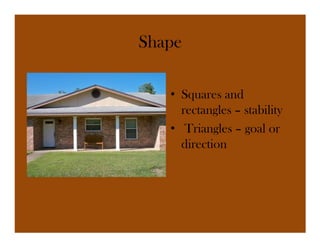
Shape

   • Squares and
     rectangles – stability
   • Triangles – goal or
     direction
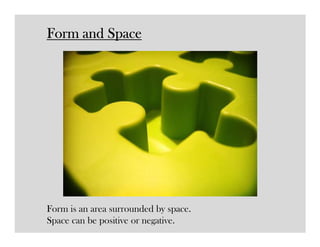
Form and Space


Form is an area surrounded by space.
Space can be positive or negative.
Form
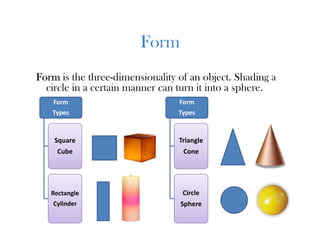
Form is the three-dimensionality of an object. Shading a
  circle in a certain manner can turn it into a sphere.
    Form                         Form
   Types                         Types


    Square                       Triangle
     Cube                         Cone


   Rectangle                      Circle
    Cylinder                     Sphere
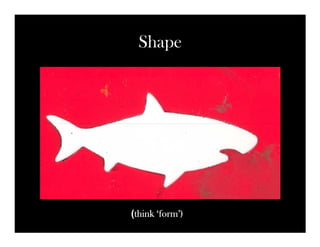
Shape


(think ‘form’)
 think
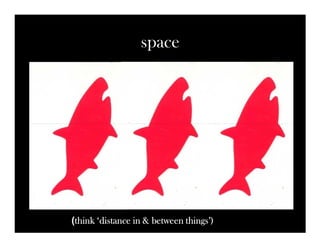
space


(think ‘distance in & between things’)
 think
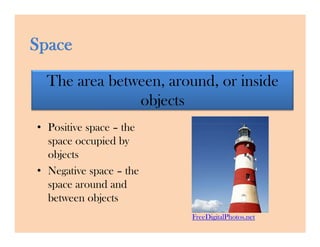
The area between, around, or inside
               objects
• Positive space – the
  space occupied by
  objects
• Negative space – the
  space around and
  between objects
                         FreeDigitalPhotos.net
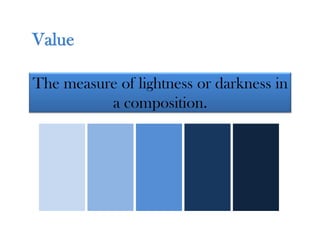
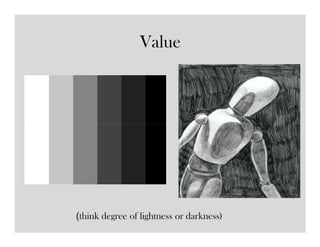
The measure of lightness or darkness in
          a composition.
Value

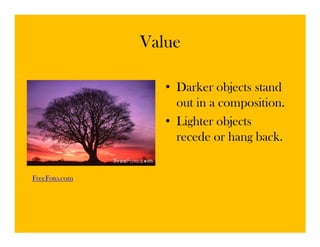
                  • Darker objects stand
                    out in a composition.
                  • Lighter objects
                    recede or hang back.


FreeFoto.com
Value


(think degree of lightness or darkness)
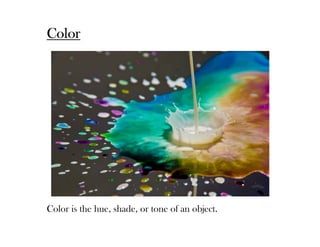
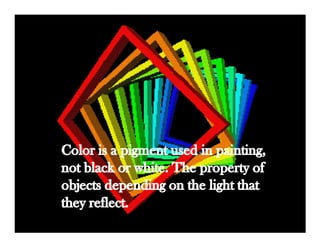
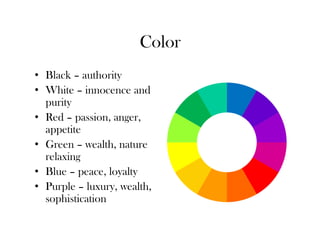
Color


Color is the hue, shade, or tone of an object.
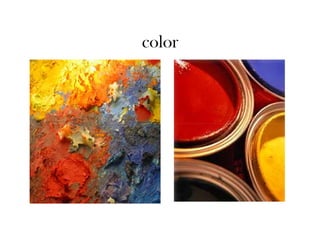
color
Color
• Black – authority
• White – innocence and
  purity
• Red – passion, anger,
  appetite
• Green – wealth, nature
  relaxing
• Blue – peace, loyalty
• Purple – luxury, wealth,
  sophistication
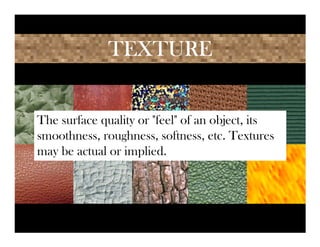
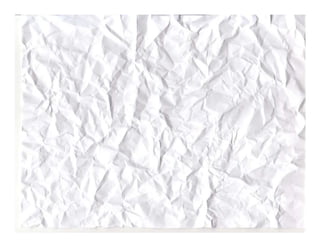
TEXTURE


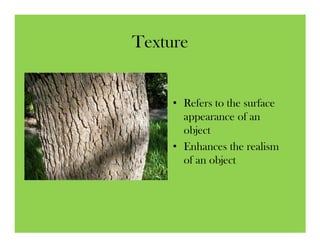
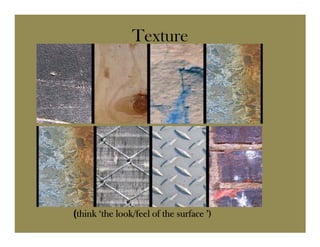
The surface quality or "feel" of an object, its
smoothness, roughness, softness, etc. Textures
may be actual or implied.
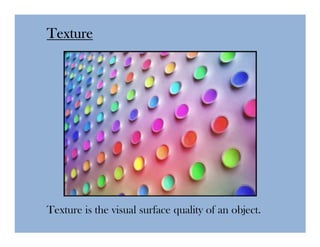
Texture


Texture is the visual surface quality of an object.
Texture


     • Refers to the surface
       appearance of an
       object
     • Enhances the realism
       of an object
Texture


(think ‘the look/feel of the surface ’)
 think
The Principles of Design
         •   Rhythm          • Emphasis
         •   Movement        • Variety
         •   Pattern
         •   Balance         • Harmony
         •   Proportion      • Unity

Note: This list is one possible list. You will
find that every book, every artist has a slightly
different list of Principles.
Balance:
 Balance is concerned with arranging art elements in an
 artwork so no one part over powers, or seems heavier
 than, any other part.

There are three types of balance:
  Formal
  Informal
  Radial
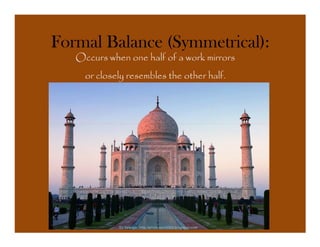
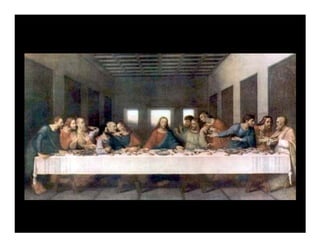
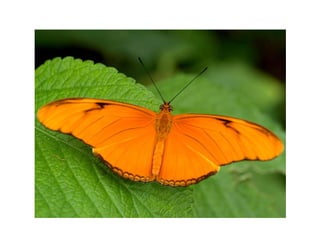
Formal Balance (Symmetrical):
   Occurs when one half of a work mirrors
     or closely resembles the other half.
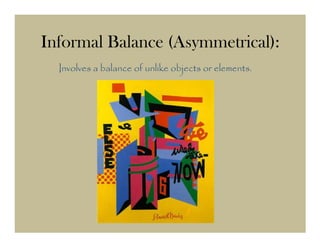
Informal Balance (Asymmetrical):
  Involves a balance of unlike objects or elements.
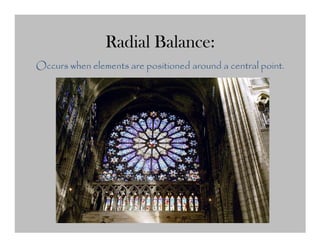
Radial Balance:
Occurs when elements are positioned around a central point.
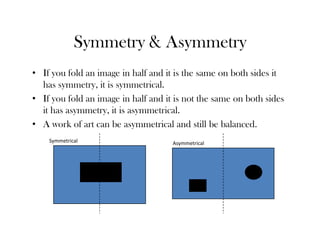
Symmetry & Asymmetry
• If you fold an image in half and it is the same on both sides it
  has symmetry, it is symmetrical.
• If you fold an image in half and it is not the same on both sides
  it has asymmetry, it is asymmetrical.
• A work of art can be asymmetrical and still be balanced.
    Symmetrical                      Asymmetrical
Balance


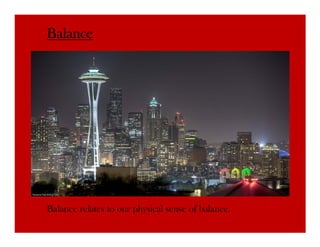
Balance relates to our physical sense of balance.
Repetition


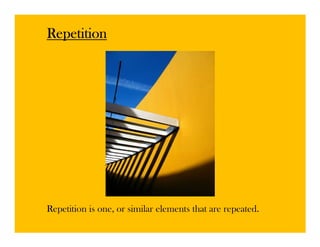
Repetition is one, or similar elements that are repeated.
Contrast


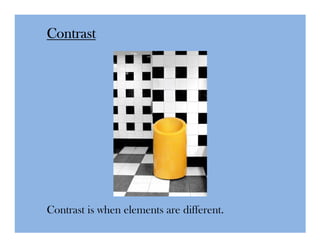
Contrast is when elements are different.
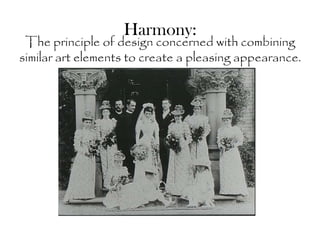
Harmony:
 The principle of design concerned with combining
similar art elements to create a pleasing appearance.
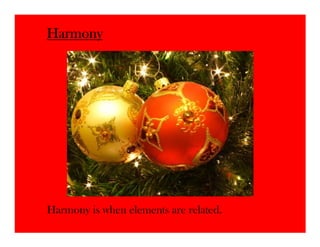
Harmony


Harmony is when elements are related.
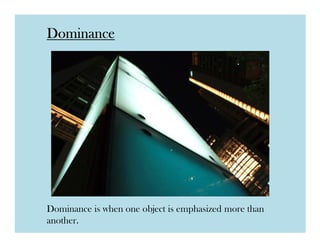
Dominance


Dominance is when one object is emphasized more than
another.
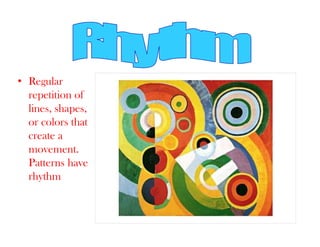
• Regular
  repetition of
  lines, shapes,
  or colors that
  create a
  movement.
  Patterns have
  rhythm
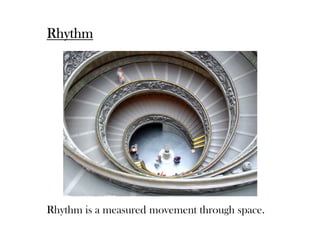
Rhythm


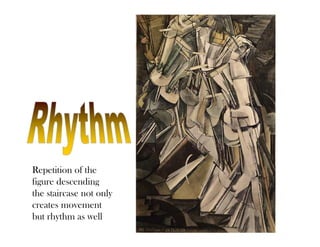
Rhythm is a measured movement through space.
Repetition of the
figure descending
the staircase not only
creates movement
but rhythm as well
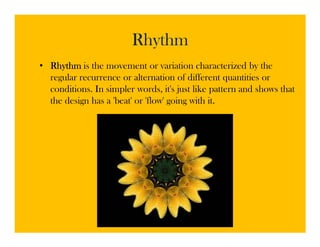
Rhythm
• Rhythm is the movement or variation characterized by the
  regular recurrence or alternation of different quantities or
  conditions. In simpler words, it's just like pattern and shows that
  the design has a 'beat' or 'flow' going with it.
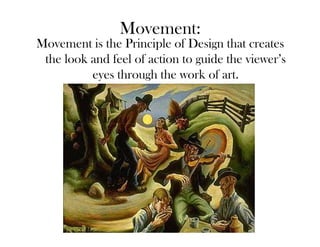
Movement:
Movement is the Principle of Design that creates
 the look and feel of action to guide the viewer’s
          eyes through the work of art.
Linear strokes cause our
eye to move back and
forth through the
painting.
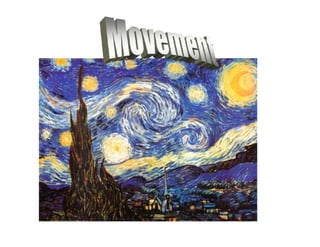
Movement


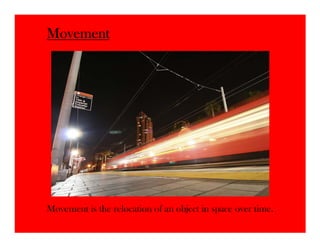
Movement is the relocation of an object in space over time.
Direction


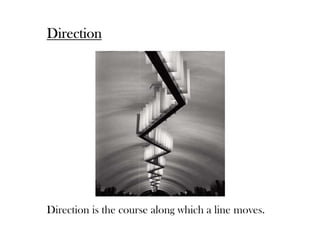
Direction is the course along which a line moves.
Unity:
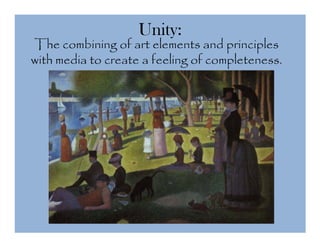
The combining of art elements and principles
with media to create a feeling of completeness.
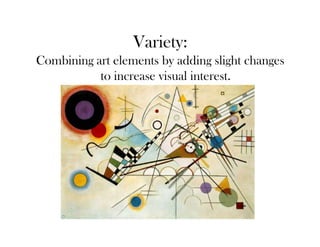
Variety:
Combining art elements by adding slight changes
           to increase visual interest.
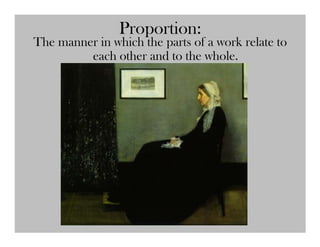
Proportion:
The manner in which the parts of a work relate to
         each other and to the whole.
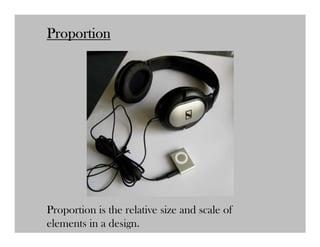
Proportion


Proportion is the relative size and scale of
elements in a design.
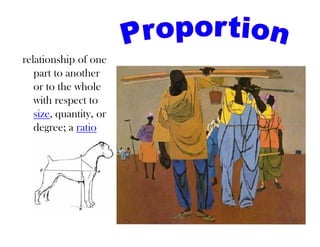
relationship of one
   part to another
   or to the whole
   with respect to
   size, quantity, or
   degree; a ratio
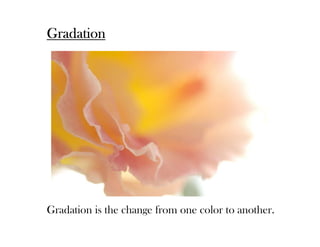
Gradation


Gradation is the change from one color to another.
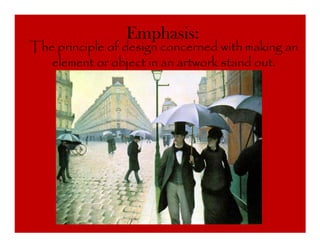
Emphasis:
The principle of design concerned with making an
   element or object in an artwork stand out.
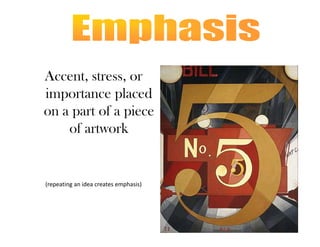
Emphasis
Accent, stress, or
importance placed
on a part of a piece
    of artwork


(repeating an idea creates emphasis)
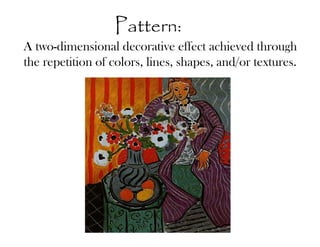
Pattern:
A two-dimensional decorative effect achieved through
the repetition of colors, lines, shapes, and/or textures.
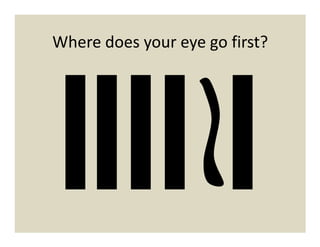
Where does your eye go first?
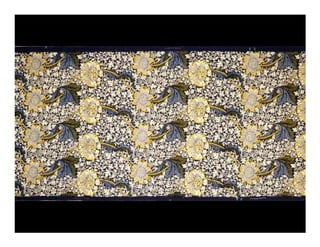
PATTERN

There is power in pattern and
impact in the variation on that
           pattern.
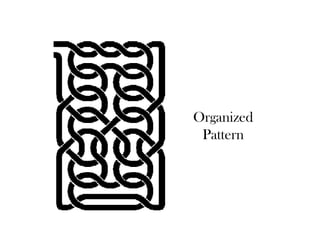
Organized
 Pattern
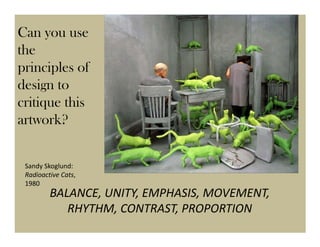
Can you use
the
principles of
design to
critique this
artwork?


 Sandy Skoglund:
 Radioactive Cats,
 1980
         BALANCE, UNITY, EMPHASIS, MOVEMENT,
            RHYTHM, CONTRAST, PROPORTION
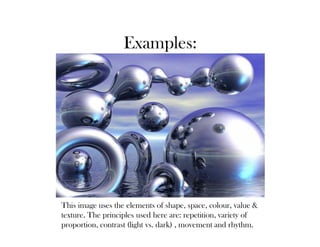
Examples:


This image uses the elements of shape, space, colour, value &
texture. The principles used here are: repetition, variety of
proportion, contrast (light vs. dark) , movement and rhythm.
Courtesy to:
  Chelsea Flattery
  Zaiba Mustafa
  Mrs. Montgomery
  Amy Landrum

  Erin Smith

E & p of design

  • 1.
    The Elements and Principles of Design Presented by Jaikumar Ranganathan
  • 2.
    The Elements ofDesign: These 6 ingredients are used to create a design: line Shape & form Space value colour texture
  • 3.
  • 4.
    Four Basic Typesof Lines Horizontal Vertical Curvilinear
  • 5.
    Line: Line An elementof design that is used to define shape, contours, and outlines, also to suggest mass and volume. It may be a continuous mark made on a surface with a pointed tool or implied by the edges of shapes and forms.
  • 6.
    Characteristics of Lineare: Width- thick, thin, tapering, Width uneven Length - long, short, continuous, broken Direction- Direction horizontal, vertical, diagonal, curving, perpendicular, oblique, parallel, radial, zigzag Focus- Focus sharp, blurry, fuzzy, choppy Feeling- sharp, jagged, Feeling graceful, smooth
  • 7.
    Implied Line • ImpliedLine is the line inside the object within in the art / design work. For example, an image of a soldier standing tall has an implied vertical line in the stance. Each of the lines imply different meanings. A vertical line can imply nobility. A horizontal can imply calm or rest. A diagonal line can imply movement. A curvilinear line can imply grace.
  • 8.
    Line • Linear marks • Lines • Edges • Implied Line A series of points FreeFoto.com indicating direction, Horizontal lines suggest rest and movement and form. tranquility.
  • 9.
    Line Line isa moving dot.
  • 10.
    Line Vertical lines suggestgrandness. Diagonal lines indicate movement.
  • 11.
  • 12.
  • 13.
    Organic and Geometric Organicshapes are natural shapes which can be symmetrical and asymmetrical. • Geometric shapes are ‘man-made’ or machine made shapes, mathematically deduced, with clear sharp edges.
  • 14.
    Shape two- Shape is a two-dimensional closed contour defined by its perimeter • Organic – thought of as occurring naturally • Geometric – named shapes
  • 15.
    Shape • Squares and rectangles – stability • Triangles – goal or direction
  • 16.
    Form and Space Formis an area surrounded by space. Space can be positive or negative.
  • 17.
    Form Form is thethree-dimensionality of an object. Shading a circle in a certain manner can turn it into a sphere. Form Form Types Types Square Triangle Cube Cone Rectangle Circle Cylinder Sphere
  • 18.
  • 19.
    space (think ‘distance in& between things’) think
  • 20.
    The area between,around, or inside objects • Positive space – the space occupied by objects • Negative space – the space around and between objects FreeDigitalPhotos.net
  • 21.
    The measure oflightness or darkness in a composition.
  • 22.
    Value • Darker objects stand out in a composition. • Lighter objects recede or hang back. FreeFoto.com
  • 23.
    Value (think degree oflightness or darkness)
  • 24.
    Color Color is thehue, shade, or tone of an object.
  • 25.
  • 27.
    Color • Black –authority • White – innocence and purity • Red – passion, anger, appetite • Green – wealth, nature relaxing • Blue – peace, loyalty • Purple – luxury, wealth, sophistication
  • 28.
    TEXTURE The surface qualityor "feel" of an object, its smoothness, roughness, softness, etc. Textures may be actual or implied.
  • 30.
    Texture Texture is thevisual surface quality of an object.
  • 31.
    Texture • Refers to the surface appearance of an object • Enhances the realism of an object
  • 32.
    Texture (think ‘the look/feelof the surface ’) think
  • 33.
    The Principles ofDesign • Rhythm • Emphasis • Movement • Variety • Pattern • Balance • Harmony • Proportion • Unity Note: This list is one possible list. You will find that every book, every artist has a slightly different list of Principles.
  • 34.
    Balance: Balance isconcerned with arranging art elements in an artwork so no one part over powers, or seems heavier than, any other part. There are three types of balance: Formal Informal Radial
  • 35.
    Formal Balance (Symmetrical): Occurs when one half of a work mirrors or closely resembles the other half.
  • 38.
    Informal Balance (Asymmetrical): Involves a balance of unlike objects or elements.
  • 40.
    Radial Balance: Occurs whenelements are positioned around a central point.
  • 42.
    Symmetry & Asymmetry •If you fold an image in half and it is the same on both sides it has symmetry, it is symmetrical. • If you fold an image in half and it is not the same on both sides it has asymmetry, it is asymmetrical. • A work of art can be asymmetrical and still be balanced. Symmetrical Asymmetrical
  • 43.
    Balance Balance relates toour physical sense of balance.
  • 44.
    Repetition Repetition is one,or similar elements that are repeated.
  • 45.
    Contrast Contrast is whenelements are different.
  • 46.
    Harmony: The principleof design concerned with combining similar art elements to create a pleasing appearance.
  • 47.
    Harmony Harmony is whenelements are related.
  • 48.
    Dominance Dominance is whenone object is emphasized more than another.
  • 49.
    • Regular repetition of lines, shapes, or colors that create a movement. Patterns have rhythm
  • 50.
    Rhythm Rhythm is ameasured movement through space.
  • 51.
    Repetition of the figuredescending the staircase not only creates movement but rhythm as well
  • 52.
    Rhythm • Rhythm isthe movement or variation characterized by the regular recurrence or alternation of different quantities or conditions. In simpler words, it's just like pattern and shows that the design has a 'beat' or 'flow' going with it.
  • 53.
    Movement: Movement is thePrinciple of Design that creates the look and feel of action to guide the viewer’s eyes through the work of art.
  • 54.
    Linear strokes causeour eye to move back and forth through the painting.
  • 55.
    Movement Movement is therelocation of an object in space over time.
  • 56.
    Direction Direction is thecourse along which a line moves.
  • 58.
    Unity: The combining ofart elements and principles with media to create a feeling of completeness.
  • 60.
    Variety: Combining art elementsby adding slight changes to increase visual interest.
  • 62.
    Proportion: The manner inwhich the parts of a work relate to each other and to the whole.
  • 63.
    Proportion Proportion is therelative size and scale of elements in a design.
  • 64.
    relationship of one part to another or to the whole with respect to size, quantity, or degree; a ratio
  • 65.
    Gradation Gradation is thechange from one color to another.
  • 66.
    Emphasis: The principle ofdesign concerned with making an element or object in an artwork stand out.
  • 67.
    Emphasis Accent, stress, or importanceplaced on a part of a piece of artwork (repeating an idea creates emphasis)
  • 68.
    Pattern: A two-dimensional decorativeeffect achieved through the repetition of colors, lines, shapes, and/or textures.
  • 70.
    Where does youreye go first?
  • 71.
    PATTERN There is powerin pattern and impact in the variation on that pattern.
  • 72.
  • 73.
    Can you use the principlesof design to critique this artwork? Sandy Skoglund: Radioactive Cats, 1980 BALANCE, UNITY, EMPHASIS, MOVEMENT, RHYTHM, CONTRAST, PROPORTION
  • 74.
    Examples: This image usesthe elements of shape, space, colour, value & texture. The principles used here are: repetition, variety of proportion, contrast (light vs. dark) , movement and rhythm.
  • 75.
    Courtesy to: Chelsea Flattery Zaiba Mustafa Mrs. Montgomery Amy Landrum Erin Smith