THE PERSUASIVETHE PERSUASIVE
SPEECHSPEECH
“Words create ripples, and ripples can come together to make
waves.” –Michael Osborn
The Definition of the PersuasiveThe Definition of the Persuasive
SpeechSpeech
The art of gaining fair
and favorable
consideration for your
point of view.
Eight Purposes of PersuasiveEight Purposes of Persuasive
Speeches:Speeches:
1. To urge a choice among
options.
2. Persuaders act as advocates
for a cause or point of view.
3. To use supporting materials as
evidence that justified advice.
4. Persuaded listeners become
Eight Purposes of PersuasiveEight Purposes of Persuasive
Speeches:Speeches:
5. Asks for audience commitment to
a cause
6. Establishes character and
commitment of speaker through
leadership
7. Makes appeals to feelings
8. Makes us confront our obligation
to believe and act in socially and
Harmful forms of persuasion:Harmful forms of persuasion:
 Argumentative persuasion
 Evil speakers can twist
evidence and disguise bad
reasoning
“The relation of the Jews to prostitution and,
even more, to the white-slave traffic, could
be studied in Vienna…When thus for the
first time I recognized the Jew as the cold-
hearted, shameless, and calculating
director of this revolting vice traffic in the
scum of the big city, a cold shudder ran
down my back.” –Adolph Hitler
Harmful forms of persuasion:Harmful forms of persuasion:
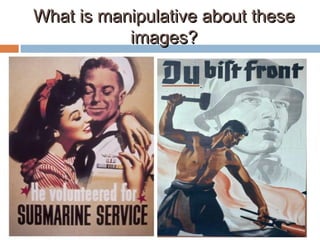
Manipulative persuasion
 Works by suggestion,
colorful images,
appealing music, and
attractive
spokespersons
What is manipulative about theseWhat is manipulative about these
images?images?
Types of Evidence to use inTypes of Evidence to use in
Persuasive Speeches:Persuasive Speeches:
Facts, figures, statistics
Use examples from“real
life”
Narratives—make your
audience witness to a
living drama
Types of Evidence to use inTypes of Evidence to use in
Persuasive Speeches:Persuasive Speeches:
 Use Expert Testimony/Witnesses
 When you quote others, you are
associating yourself with them, so
be careful whom you choose!
 Reluctant witnesses are those who
testify against their apparent self-
interest and so are often more
powerful (such as Democratic critics
of a Democratic president).
Evidence Example:Evidence Example:
“I know a child—well, she must be 13 now—I’d bettercall her
a young woman…She has memories. She has hopes. And she has
juvenile diabetes.
Like so many kids with this disease, she has adjusted
amazingly well. The insulin pump she wears—she’s decorated hers
with rhinestones. She can insert herown catheterneedle. She has
learned to sleep through the blood drawings in the wee hours of the
morning. She’s very brave. She is also quite bright and understands
full well the progress of herdisease and what the might ultimately
mean: blindness, amputation, diabetic coma. Every day, she fights to
have a future.
What excuse will we offerthis young woman should we fail her
now? What might we tell…the millions of others who suffer? That
when given an opportunity to help, we turned away? That facing
political opposition, we lost ournerve? That even though we knew
better, we did nothing?”
-Ron Reagan at the 2004 Democratic Convention urging delegates to support embryonic
stem cell research
Evidence Example:Evidence Example:
“It’s a cold, icy Decemberafternoon. You heara
distant crash, then screams, and finally the unending moan
of a carhorn fills the silence. You rush the short distance
to the scene of the crash, where you find an SUV
overturned with a young woman and two small boys inside.
The woman and one of the boys climb fromthe wreckage
unhurt; the otherboy, however, is pinned between the
dashboard and the roof of the car, unconscious and not
breathing.
Would you know what to do? Orwould you stand
there wishing you did? These events are real. Bob Flath
saved this child with the skills he acquired at his company’s
first aid workshop.”
-Kirsten Lientz, urging students to take a first aid course
offered at her university
Develop a Proof (an argument):Develop a Proof (an argument):
 Aristotle believed there were three
forms of proof:
 Pathos: appeals to personal feelings
such as fear, pity, and anger
 Ethos: audiences respond to the
speaker’s competence, character,
goodwill, and dynamism and the
credibility of the evidence
 Logos: appeals to reason (logical
arguments)
Develop a Proof (an argument):Develop a Proof (an argument):
Scholars today believe that there
is one final element to the proof:
 Mythos: appeals to the traditions
and values of your culture, legends,
and folktales
Examples of Logos and Ethos:Examples of Logos and Ethos:
"Cigarette smoke contains over 4,800
chemicals, 69 of which are known to cause
cancer." –American Lung Association
“Lady Gaga was more popular than Justin
Bieber in 2011 because Gaga's fan pages
collected ten million more Facebook fans than
Bieber's.”-Facebook
Examples of Logos and Ethos:Examples of Logos and Ethos:
"Cigarette smoke contains over 4,800
chemicals, 69 of which are known to cause
cancer." –American Lung Association
“Lady Gaga was more popular than Justin
Bieber in 2011 because Gaga's fan pages
collected ten million more Facebook fans than
Bieber's.”-Facebook
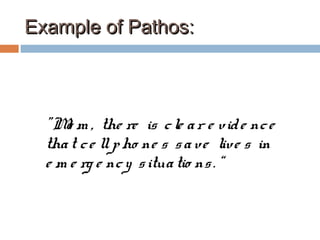
Example of Pathos:Example of Pathos:
"Mo m , the re is cle ar e vide nce
that ce llpho ne s save live s in
e m e rg e ncy situatio ns. “
Logos: The heart of anLogos: The heart of an
argumentargument
Reason froma
principle that you
believe everyone in
your audience accepts
(such as “Freedom of
Logos: The heart of anLogos: The heart of an
argumentargument
Reason fromreality
using statistics,
comparisions, and even
scientific data (Science
is a god-term---a key
word to give your data
Logos: The heart of anLogos: The heart of an
argumentargument
Reason with parallel
cases which are used
to frame an unfamiliar
concept in something
more familiar
Constructing an ArgumentConstructing an Argument
Create an Awareness of the
problem/issue
 First, make sure that the
audience knows that the issue
exists
 Make a case for the
problem/issue is an important
Constructing an ArgumentConstructing an Argument
 Create an understanding of the
issue/problem
 Use data and statistics to illustrate the
problem/issue
 Use testimony, stories, examples to
connect with your audience (Logos,
Pathos, Ethos, Mythos)
 You can also respectfully address the
“other side” of the issue/problem
Constructing an ArgumentConstructing an Argument
Offera solution/plan/action
that would address the issue
orsolve the problem:
 If you have offered a valid
argument, the audience may
accept your position and be
ready to act.
Constructing an ArgumentConstructing an Argument
Enactment:
 Get them to act on what you
say or the argument you
presented
 Have them sign a petition,
raise their hands, voice
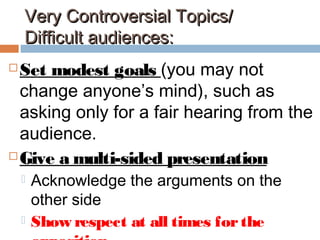
Very Controversial Topics/Very Controversial Topics/
Difficult audiences:Difficult audiences:
 Set modest goals (you may not
change anyone’s mind), such as
asking only for a fair hearing from the
audience.
 Give a multi-sided presentation
 Acknowledge the arguments on the
other side
 Show respect at all times forthe
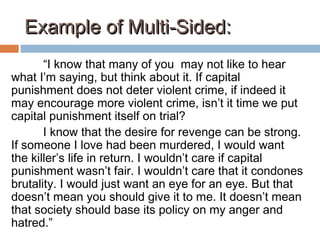
Example of Multi-Sided:Example of Multi-Sided:
“I know that many of you may not like to hear
what I’m saying, but think about it. If capital
punishment does not deter violent crime, if indeed it
may encourage more violent crime, isn’t it time we put
capital punishment itself on trial?
I know that the desire for revenge can be strong.
If someone I love had been murdered, I would want
the killer’s life in return. I wouldn’t care if capital
punishment wasn’t fair. I wouldn’t care that it condones
brutality. I would just want an eye for an eye. But that
doesn’t mean you should give it to me. It doesn’t mean
that society should base its policy on my anger and
hatred.”

The persuasive speech

  • 1.
    THE PERSUASIVETHE PERSUASIVE SPEECHSPEECH “Wordscreate ripples, and ripples can come together to make waves.” –Michael Osborn
  • 2.
    The Definition ofthe PersuasiveThe Definition of the Persuasive SpeechSpeech The art of gaining fair and favorable consideration for your point of view.
  • 3.
    Eight Purposes ofPersuasiveEight Purposes of Persuasive Speeches:Speeches: 1. To urge a choice among options. 2. Persuaders act as advocates for a cause or point of view. 3. To use supporting materials as evidence that justified advice. 4. Persuaded listeners become
  • 4.
    Eight Purposes ofPersuasiveEight Purposes of Persuasive Speeches:Speeches: 5. Asks for audience commitment to a cause 6. Establishes character and commitment of speaker through leadership 7. Makes appeals to feelings 8. Makes us confront our obligation to believe and act in socially and
  • 5.
    Harmful forms ofpersuasion:Harmful forms of persuasion:  Argumentative persuasion  Evil speakers can twist evidence and disguise bad reasoning “The relation of the Jews to prostitution and, even more, to the white-slave traffic, could be studied in Vienna…When thus for the first time I recognized the Jew as the cold- hearted, shameless, and calculating director of this revolting vice traffic in the scum of the big city, a cold shudder ran down my back.” –Adolph Hitler
  • 6.
    Harmful forms ofpersuasion:Harmful forms of persuasion: Manipulative persuasion  Works by suggestion, colorful images, appealing music, and attractive spokespersons
  • 7.
    What is manipulativeabout theseWhat is manipulative about these images?images?
  • 8.
    Types of Evidenceto use inTypes of Evidence to use in Persuasive Speeches:Persuasive Speeches: Facts, figures, statistics Use examples from“real life” Narratives—make your audience witness to a living drama
  • 9.
    Types of Evidenceto use inTypes of Evidence to use in Persuasive Speeches:Persuasive Speeches:  Use Expert Testimony/Witnesses  When you quote others, you are associating yourself with them, so be careful whom you choose!  Reluctant witnesses are those who testify against their apparent self- interest and so are often more powerful (such as Democratic critics of a Democratic president).
  • 10.
    Evidence Example:Evidence Example: “Iknow a child—well, she must be 13 now—I’d bettercall her a young woman…She has memories. She has hopes. And she has juvenile diabetes. Like so many kids with this disease, she has adjusted amazingly well. The insulin pump she wears—she’s decorated hers with rhinestones. She can insert herown catheterneedle. She has learned to sleep through the blood drawings in the wee hours of the morning. She’s very brave. She is also quite bright and understands full well the progress of herdisease and what the might ultimately mean: blindness, amputation, diabetic coma. Every day, she fights to have a future. What excuse will we offerthis young woman should we fail her now? What might we tell…the millions of others who suffer? That when given an opportunity to help, we turned away? That facing political opposition, we lost ournerve? That even though we knew better, we did nothing?” -Ron Reagan at the 2004 Democratic Convention urging delegates to support embryonic stem cell research
  • 11.
    Evidence Example:Evidence Example: “It’sa cold, icy Decemberafternoon. You heara distant crash, then screams, and finally the unending moan of a carhorn fills the silence. You rush the short distance to the scene of the crash, where you find an SUV overturned with a young woman and two small boys inside. The woman and one of the boys climb fromthe wreckage unhurt; the otherboy, however, is pinned between the dashboard and the roof of the car, unconscious and not breathing. Would you know what to do? Orwould you stand there wishing you did? These events are real. Bob Flath saved this child with the skills he acquired at his company’s first aid workshop.” -Kirsten Lientz, urging students to take a first aid course offered at her university
  • 12.
    Develop a Proof(an argument):Develop a Proof (an argument):  Aristotle believed there were three forms of proof:  Pathos: appeals to personal feelings such as fear, pity, and anger  Ethos: audiences respond to the speaker’s competence, character, goodwill, and dynamism and the credibility of the evidence  Logos: appeals to reason (logical arguments)
  • 13.
    Develop a Proof(an argument):Develop a Proof (an argument): Scholars today believe that there is one final element to the proof:  Mythos: appeals to the traditions and values of your culture, legends, and folktales
  • 14.
    Examples of Logosand Ethos:Examples of Logos and Ethos: "Cigarette smoke contains over 4,800 chemicals, 69 of which are known to cause cancer." –American Lung Association “Lady Gaga was more popular than Justin Bieber in 2011 because Gaga's fan pages collected ten million more Facebook fans than Bieber's.”-Facebook
  • 15.
    Examples of Logosand Ethos:Examples of Logos and Ethos: "Cigarette smoke contains over 4,800 chemicals, 69 of which are known to cause cancer." –American Lung Association “Lady Gaga was more popular than Justin Bieber in 2011 because Gaga's fan pages collected ten million more Facebook fans than Bieber's.”-Facebook
  • 16.
    Example of Pathos:Exampleof Pathos: "Mo m , the re is cle ar e vide nce that ce llpho ne s save live s in e m e rg e ncy situatio ns. “
  • 17.
    Logos: The heartof anLogos: The heart of an argumentargument Reason froma principle that you believe everyone in your audience accepts (such as “Freedom of
  • 18.
    Logos: The heartof anLogos: The heart of an argumentargument Reason fromreality using statistics, comparisions, and even scientific data (Science is a god-term---a key word to give your data
  • 19.
    Logos: The heartof anLogos: The heart of an argumentargument Reason with parallel cases which are used to frame an unfamiliar concept in something more familiar
  • 20.
    Constructing an ArgumentConstructingan Argument Create an Awareness of the problem/issue  First, make sure that the audience knows that the issue exists  Make a case for the problem/issue is an important
  • 21.
    Constructing an ArgumentConstructingan Argument  Create an understanding of the issue/problem  Use data and statistics to illustrate the problem/issue  Use testimony, stories, examples to connect with your audience (Logos, Pathos, Ethos, Mythos)  You can also respectfully address the “other side” of the issue/problem
  • 22.
    Constructing an ArgumentConstructingan Argument Offera solution/plan/action that would address the issue orsolve the problem:  If you have offered a valid argument, the audience may accept your position and be ready to act.
  • 23.
    Constructing an ArgumentConstructingan Argument Enactment:  Get them to act on what you say or the argument you presented  Have them sign a petition, raise their hands, voice
  • 24.
    Very Controversial Topics/VeryControversial Topics/ Difficult audiences:Difficult audiences:  Set modest goals (you may not change anyone’s mind), such as asking only for a fair hearing from the audience.  Give a multi-sided presentation  Acknowledge the arguments on the other side  Show respect at all times forthe
  • 25.
    Example of Multi-Sided:Exampleof Multi-Sided: “I know that many of you may not like to hear what I’m saying, but think about it. If capital punishment does not deter violent crime, if indeed it may encourage more violent crime, isn’t it time we put capital punishment itself on trial? I know that the desire for revenge can be strong. If someone I love had been murdered, I would want the killer’s life in return. I wouldn’t care if capital punishment wasn’t fair. I wouldn’t care that it condones brutality. I would just want an eye for an eye. But that doesn’t mean you should give it to me. It doesn’t mean that society should base its policy on my anger and hatred.”