Final Exam
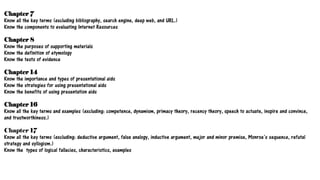
Chapter 7
Know all the key terms (excluding bibliography, search engine, deep web, and URL.)
Know the components to evaluating Internet Resources
Chapter 8
Know the purposes of supporting materials
Know the definition of etymology
Know the tests of evidence
Chapter 14
Know the importance and types of presentational aids
Know the strategies for using presentational aids
Know the benefits of using presentation aids
Chapter 16
Know all the key terms and examples (excluding: competence, dynamism, primacy theory, recency theory, speech to actuate, inspire and convince,
and trustworthiness.)
Chapter 17
Know all the key terms (excluding: deductive argument, false analogy, inductive argument, major and minor premise, Monroe’s sequence, refutal
strategy and syllogism.)
Know the types of logical fallacies, characteristics, examples
Chapter 7
Research:
Is the gathering of evidence and arguments
you will need to understand, develop and
explain your subject.
Database:
A Huge collection of information arranged for
quick retrieval by computer using Keywords
stipulated by a researcher
Evaluate Internet Resources:
Purpose… provide information, promote position, sell product/service?
Expertise.. Author background, education, explain interpretation results?
Objectivity… opposing views, bias?
Accuracy….write well, corroborate facts using other internet source?
Timeliness… Look at the publication date, site created, last updated?
Academic search Complete
Examples: Jstor & EBSCO
Chapter 8
Supporting Materials
in a speech achieve three purposes: clarity, vividness, and credibility.
Clarity helps the audience understand your ideas.
Vividness helps them remember your ideas.
Credibility makes your ideas believable.
Etymology
is the study of the origin of words and the way in which their meanings
have changed throughout history (Red Herring)
Tests of evidence
is the evidence quoted in Context? (don’t change meaning)
is the source of the evidence an Expert? (More Experienced)
Is the source of the evidence Unbiased? (No vested interest)
Is the evidence Relevant? (Ex. Trauma not same as Emergency)
Is the evidence specific? (Ex. A lot not specific)
Is the evidence Sufficient?(Enough evidence “Research” to prove point)
Is the evidence Timely? (More recent information)
Chapter 14
Importance/Benefits
presentational aids
Increases Message Clarity
Reinforces Message Impact
Increase Speaker Dynamism
Enhances Speaker Confidence
Types presentational aids
Pictures
Diagrams
Graphs: Line Graph, Bar graph, Pie or Circle Graph
Charts
Maps
Film/Video
Handouts
Audio & other aids
strategies for using
presentational aids
Before
1. Determine the information to be presented visually
2. Select the type of aid best suited to your resources and
speech
3. Ensure easy viewing by all audience members
4. Make sure the aid communicates information clearly
5. Construct an aid that is professional in appearance
6. Practice using your Aid
7. Arrange for safe transportation of your aids
8. Carry backup supplies
9. Position the aid properly
10. Test your presentational Aid
During
1. Reveal an aide only when you are ready for it
2. Talk to your audience- Not to your aide
3. Refer to your aide
4. Keep your aide in view until your audience understands
your point
Conceal the aide after you have made your point
Use handouts with caution.
Chapter 161. Persuasion: process of influencing another person’s values, beliefs, attitudes, or behaviors.
2. Ethos: speaker credibility
3. Logos: logical appeal
4. Pathos: emotional appeal
5. Credibility: degree to which listeners believe a speaker
6. Initial Credibility: a speaker’s image or reputation before speaking to a particular audience
7. Derived Credibility: the image listeners develop of a speaker as he or she speaks
8. Terminal Credibility: the image listeners develop of a speaker by the end of the speech and for a period of time after it
9. Dynamism: listeners views on the speaker’s confidence, energy, and enthusiasm for communicating
Chapter 17
NINE logical fallacies
Fallacy- “Any defect in Reasoning which destroys validity”
1. Bandwagon- Agreeing with the popular Position “Slavery”
2. Abduction to Absurd- Pushing an argument beyond logical limits “Jumping off a Bridge”
3. Begging the question-arguments that can’t be proven “Religious arguments”
4. Either-or-presenting only two arguments, ignoring the gray area and presenting black and white “If you like Obama you’re a socialist”
5. Red Herring-using irrelevant info to strength your point “So unfair-she did this and didn’t get in trouble”
6. Ad hominem- personal attacks, criticizing a person and not the issue at hand “Political commercials”
7. Appeal to Authority-a statement is considered true based on the person saying it has authority. “My Dr. told me taking 5 Ambien a night won’t
hurt and she’s a Dr. so she should know.”
8. Appeal to tradition-argument strength lies in tradition “Always been done that way”
9. Slippery slope-an event will occur as a result of a previous event, no evidence
Evidence- is the supporting material you use to prove a point
Refute- dispute another argument
Types of Arguments
Argument by Example- Use a few instances to assert a broader claim.
Argument by Analogy- links two objects or concepts and asserts that what is true of one will be true of the other.
Argument by Cause- connects two elements or events and claims that one produced the other.
Syllogism- Pattern of deductive argument
Conclusion- Argue what is true of the general class is true of the specific instance or individual. “Review main points & Call to action”
Argument by authority- Testimony from an expert source to prove a speakers claim.
Selecting Proposition (Judgement, Debatable, Proof)
Proposition is a declarative sentence expressing a judgement you want the audience to accept.
Proposition of Fact- focuses on belief.
Proposition of Value- Requires judgement on the worth of an idea or action.
Proposition of policy – Advocates a course of action.

Final exam speech

  • 1.
  • 2.
    Chapter 7 Know allthe key terms (excluding bibliography, search engine, deep web, and URL.) Know the components to evaluating Internet Resources Chapter 8 Know the purposes of supporting materials Know the definition of etymology Know the tests of evidence Chapter 14 Know the importance and types of presentational aids Know the strategies for using presentational aids Know the benefits of using presentation aids Chapter 16 Know all the key terms and examples (excluding: competence, dynamism, primacy theory, recency theory, speech to actuate, inspire and convince, and trustworthiness.) Chapter 17 Know all the key terms (excluding: deductive argument, false analogy, inductive argument, major and minor premise, Monroe’s sequence, refutal strategy and syllogism.) Know the types of logical fallacies, characteristics, examples
  • 3.
    Chapter 7 Research: Is thegathering of evidence and arguments you will need to understand, develop and explain your subject. Database: A Huge collection of information arranged for quick retrieval by computer using Keywords stipulated by a researcher Evaluate Internet Resources: Purpose… provide information, promote position, sell product/service? Expertise.. Author background, education, explain interpretation results? Objectivity… opposing views, bias? Accuracy….write well, corroborate facts using other internet source? Timeliness… Look at the publication date, site created, last updated? Academic search Complete Examples: Jstor & EBSCO
  • 4.
    Chapter 8 Supporting Materials ina speech achieve three purposes: clarity, vividness, and credibility. Clarity helps the audience understand your ideas. Vividness helps them remember your ideas. Credibility makes your ideas believable. Etymology is the study of the origin of words and the way in which their meanings have changed throughout history (Red Herring) Tests of evidence is the evidence quoted in Context? (don’t change meaning) is the source of the evidence an Expert? (More Experienced) Is the source of the evidence Unbiased? (No vested interest) Is the evidence Relevant? (Ex. Trauma not same as Emergency) Is the evidence specific? (Ex. A lot not specific) Is the evidence Sufficient?(Enough evidence “Research” to prove point) Is the evidence Timely? (More recent information)
  • 5.
    Chapter 14 Importance/Benefits presentational aids IncreasesMessage Clarity Reinforces Message Impact Increase Speaker Dynamism Enhances Speaker Confidence Types presentational aids Pictures Diagrams Graphs: Line Graph, Bar graph, Pie or Circle Graph Charts Maps Film/Video Handouts Audio & other aids
  • 6.
    strategies for using presentationalaids Before 1. Determine the information to be presented visually 2. Select the type of aid best suited to your resources and speech 3. Ensure easy viewing by all audience members 4. Make sure the aid communicates information clearly 5. Construct an aid that is professional in appearance 6. Practice using your Aid 7. Arrange for safe transportation of your aids 8. Carry backup supplies 9. Position the aid properly 10. Test your presentational Aid During 1. Reveal an aide only when you are ready for it 2. Talk to your audience- Not to your aide 3. Refer to your aide 4. Keep your aide in view until your audience understands your point Conceal the aide after you have made your point Use handouts with caution.
  • 7.
    Chapter 161. Persuasion:process of influencing another person’s values, beliefs, attitudes, or behaviors. 2. Ethos: speaker credibility 3. Logos: logical appeal 4. Pathos: emotional appeal 5. Credibility: degree to which listeners believe a speaker 6. Initial Credibility: a speaker’s image or reputation before speaking to a particular audience 7. Derived Credibility: the image listeners develop of a speaker as he or she speaks 8. Terminal Credibility: the image listeners develop of a speaker by the end of the speech and for a period of time after it 9. Dynamism: listeners views on the speaker’s confidence, energy, and enthusiasm for communicating
  • 8.
    Chapter 17 NINE logicalfallacies Fallacy- “Any defect in Reasoning which destroys validity” 1. Bandwagon- Agreeing with the popular Position “Slavery” 2. Abduction to Absurd- Pushing an argument beyond logical limits “Jumping off a Bridge” 3. Begging the question-arguments that can’t be proven “Religious arguments” 4. Either-or-presenting only two arguments, ignoring the gray area and presenting black and white “If you like Obama you’re a socialist” 5. Red Herring-using irrelevant info to strength your point “So unfair-she did this and didn’t get in trouble” 6. Ad hominem- personal attacks, criticizing a person and not the issue at hand “Political commercials” 7. Appeal to Authority-a statement is considered true based on the person saying it has authority. “My Dr. told me taking 5 Ambien a night won’t hurt and she’s a Dr. so she should know.” 8. Appeal to tradition-argument strength lies in tradition “Always been done that way” 9. Slippery slope-an event will occur as a result of a previous event, no evidence
  • 9.
    Evidence- is thesupporting material you use to prove a point Refute- dispute another argument Types of Arguments Argument by Example- Use a few instances to assert a broader claim. Argument by Analogy- links two objects or concepts and asserts that what is true of one will be true of the other. Argument by Cause- connects two elements or events and claims that one produced the other. Syllogism- Pattern of deductive argument Conclusion- Argue what is true of the general class is true of the specific instance or individual. “Review main points & Call to action” Argument by authority- Testimony from an expert source to prove a speakers claim. Selecting Proposition (Judgement, Debatable, Proof) Proposition is a declarative sentence expressing a judgement you want the audience to accept. Proposition of Fact- focuses on belief. Proposition of Value- Requires judgement on the worth of an idea or action. Proposition of policy – Advocates a course of action.