Argumentation/
persuasion
Focus
Influence others
Goal
Create a change in
attitude , belief, or behavior
Method
Rhetoric & Logic
People change for two basic
reasons:
They move either
TOWARD something they think will
be better
or
AWAY from something they can no
longer tolerate
How?
to create a change in
BEHAVIOR, ATTITUDE, BELIEF …
You must first identify
the status quo before
change can be attempted
Ultimately, you attempt to convince the audience
to
feel, think, or do something
DIFFERENTLY
Keep in mind…
We know that people change in a predictable manner:
Before they ACT (“do” something) we know that first,
They must THINK about it…
(a rational process)
But change will never last,
if it happens at all, until
They FEEL something
(an emotional process)
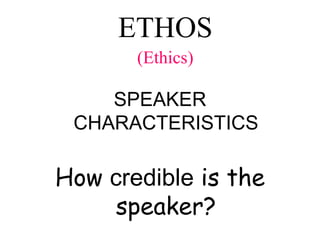
SPEAKER
CHARACTERISTICS
How credible is the
speaker?
ETHOS
(Ethics)
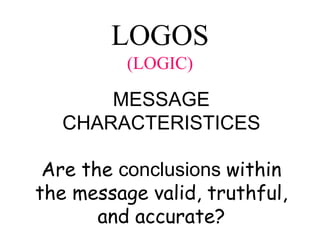
LOGOS
(LOGIC)
MESSAGE
CHARACTERISTICES
Are the conclusions within
the message valid, truthful,
and accurate?
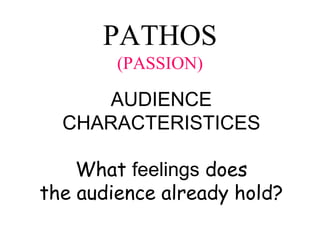
PATHOS
(PASSION)
AUDIENCE
CHARACTERISTICES
What feelings does
the audience already hold?
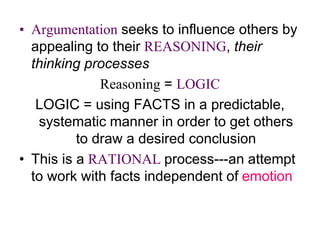
• Argumentation seeks to influence others by
appealing to their REASONING, their
thinking processes
Reasoning = LOGIC
LOGIC = using FACTS in a predictable,
systematic manner in order to get others
to draw a desired conclusion
• This is a RATIONAL process---an attempt
to work with facts independent of emotion
argumentation
• Begins with an assertion
– An observation you wish to comment on
– A speculation you wish to make a prediction
about
– An opinion you wish others to agree with
Toulmin calls this a “claim”
• Apply evidence as proof of the
merit of your assertion
Evidence = facts that are used to support
a claim in an argument
There are several types of evidence
Toulmin calls this “grounds”
evidence – facts that are used to support a
claim in an argument
anecdotal evidence – what is believed to be TRUE
based upon personal experience and/or
observation
• expert: an accepted authority’s opinion
• scholarly: a source affiliated with a university
• personal: common man observations
scientific evidence – what is subjected to the rigor
of controlled experimentation and statistical
analysis to verify the accuracy of a conclusion
literary evidence – using textual references to
support an interpretation in literary analysis
literature – 1 creative works including prose fiction,
poetry, drama 2 all that has been published in a
given field
Explain
how and why the evidence proves the
assertion you are making
This discussion reveals your thinking process and attempts to
influence the audience.
Toulmin calls this the “warrant”
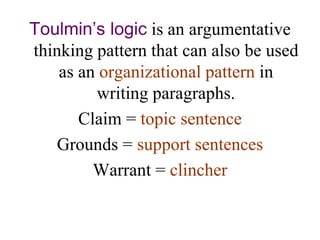
Toulmin’s logic is an argumentative
thinking pattern that can also be used
as an organizational pattern in
writing paragraphs.
Claim = topic sentence
Grounds = support sentences
Warrant = clincher
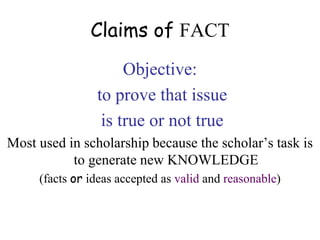
Claims of FACT
Objective:
to prove that issue
is true or not true
Most used in scholarship because the scholar’s task is
to generate new KNOWLEDGE
(facts or ideas accepted as valid and reasonable)
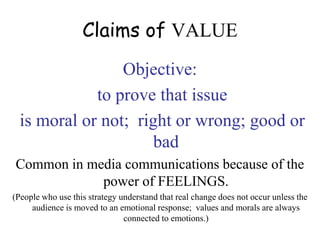
Claims of VALUE
Objective:
to prove that issue
is moral or not; right or wrong; good or
bad
Common in media communications because of the
power of FEELINGS.
(People who use this strategy understand that real change does not occur unless the
audience is moved to an emotional response; values and morals are always
connected to emotions.)
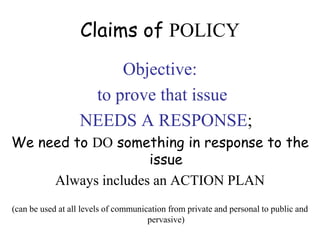
Claims of POLICY
Objective:
to prove that issue
NEEDS A RESPONSE;
We need to DO something in response to the
issue
Always includes an ACTION PLAN
(can be used at all levels of communication from private and personal to public and
pervasive)
Persuasion seeks to influence others by
appealing to their EMOTIONS.
(Facts have no moral value until a person
RESPONDS to them.)
Word choice
(loaded language)
&
rhetorical methods
(language manipulation)
dictate this process
Monroe’s
Motivated Sequence
another way to use logic/persuasion as
an organization pattern
ATTENTION STEP
Get the attention of your audience.
This can be done with a detailed story,
shocking example, dramatic statistic, quote,
etc. This is part or your introduction (in
addition to stating your thesis, giving a
preview of your main points, mentioning
your credibility, and telling your audience
why the topic is of concern to them).
NEED STEP
Show the problem exists,
that it is a significant problem,
and that it will
not go away by itself.
Document your statements with
statistics, examples, etc.
SATISFACTION STEP
Offer solutions for the problem
identified in the NEED Step.
These are solutions that the government or
society as a whole can implement.
You must satisfy the need.
VISUALIZATION STEP
Tell us what will happen if
we do not respond to
the problem.
BE GRAPHIC.
ACTION STEP
Offer alternatives to your audience that they
can personally do to help solve the problem
that you have shown exists.
Again, be extremely specific and realistic.
CONCLUSION
Motivate us to get out
and do something!
When SPEAKING: Wrap up loose ends by giving a review of points
and restating your thesis/purpose, and then conclude the speech with a
final, urgent appeal for involvement.
When WRITING: follow traditional protocol for conclusions.
AVOID RESTATEMENT; showcase your intellect by offering a
final, provocative insight about the need for attention to the
problem; connect to your intro in some way.

Ps argumentation

  • 1.
    Argumentation/ persuasion Focus Influence others Goal Create achange in attitude , belief, or behavior Method Rhetoric & Logic
  • 2.
    People change fortwo basic reasons: They move either TOWARD something they think will be better or AWAY from something they can no longer tolerate
  • 3.
    How? to create achange in BEHAVIOR, ATTITUDE, BELIEF … You must first identify the status quo before change can be attempted Ultimately, you attempt to convince the audience to feel, think, or do something DIFFERENTLY
  • 4.
    Keep in mind… Weknow that people change in a predictable manner: Before they ACT (“do” something) we know that first, They must THINK about it… (a rational process) But change will never last, if it happens at all, until They FEEL something (an emotional process)
  • 5.
    SPEAKER CHARACTERISTICS How credible isthe speaker? ETHOS (Ethics)
  • 6.
    LOGOS (LOGIC) MESSAGE CHARACTERISTICES Are the conclusionswithin the message valid, truthful, and accurate?
  • 7.
  • 8.
    • Argumentation seeksto influence others by appealing to their REASONING, their thinking processes Reasoning = LOGIC LOGIC = using FACTS in a predictable, systematic manner in order to get others to draw a desired conclusion • This is a RATIONAL process---an attempt to work with facts independent of emotion
  • 9.
    argumentation • Begins withan assertion – An observation you wish to comment on – A speculation you wish to make a prediction about – An opinion you wish others to agree with Toulmin calls this a “claim”
  • 10.
    • Apply evidenceas proof of the merit of your assertion Evidence = facts that are used to support a claim in an argument There are several types of evidence Toulmin calls this “grounds”
  • 11.
    evidence – factsthat are used to support a claim in an argument anecdotal evidence – what is believed to be TRUE based upon personal experience and/or observation • expert: an accepted authority’s opinion • scholarly: a source affiliated with a university • personal: common man observations scientific evidence – what is subjected to the rigor of controlled experimentation and statistical analysis to verify the accuracy of a conclusion literary evidence – using textual references to support an interpretation in literary analysis literature – 1 creative works including prose fiction, poetry, drama 2 all that has been published in a given field
  • 12.
    Explain how and whythe evidence proves the assertion you are making This discussion reveals your thinking process and attempts to influence the audience. Toulmin calls this the “warrant”
  • 13.
    Toulmin’s logic isan argumentative thinking pattern that can also be used as an organizational pattern in writing paragraphs. Claim = topic sentence Grounds = support sentences Warrant = clincher
  • 14.
    Claims of FACT Objective: toprove that issue is true or not true Most used in scholarship because the scholar’s task is to generate new KNOWLEDGE (facts or ideas accepted as valid and reasonable)
  • 15.
    Claims of VALUE Objective: toprove that issue is moral or not; right or wrong; good or bad Common in media communications because of the power of FEELINGS. (People who use this strategy understand that real change does not occur unless the audience is moved to an emotional response; values and morals are always connected to emotions.)
  • 16.
    Claims of POLICY Objective: toprove that issue NEEDS A RESPONSE; We need to DO something in response to the issue Always includes an ACTION PLAN (can be used at all levels of communication from private and personal to public and pervasive)
  • 17.
    Persuasion seeks toinfluence others by appealing to their EMOTIONS. (Facts have no moral value until a person RESPONDS to them.) Word choice (loaded language) & rhetorical methods (language manipulation) dictate this process
  • 18.
    Monroe’s Motivated Sequence another wayto use logic/persuasion as an organization pattern
  • 19.
    ATTENTION STEP Get theattention of your audience. This can be done with a detailed story, shocking example, dramatic statistic, quote, etc. This is part or your introduction (in addition to stating your thesis, giving a preview of your main points, mentioning your credibility, and telling your audience why the topic is of concern to them).
  • 20.
    NEED STEP Show theproblem exists, that it is a significant problem, and that it will not go away by itself. Document your statements with statistics, examples, etc.
  • 21.
    SATISFACTION STEP Offer solutionsfor the problem identified in the NEED Step. These are solutions that the government or society as a whole can implement. You must satisfy the need.
  • 22.
    VISUALIZATION STEP Tell uswhat will happen if we do not respond to the problem. BE GRAPHIC.
  • 23.
    ACTION STEP Offer alternativesto your audience that they can personally do to help solve the problem that you have shown exists. Again, be extremely specific and realistic.
  • 24.
    CONCLUSION Motivate us toget out and do something! When SPEAKING: Wrap up loose ends by giving a review of points and restating your thesis/purpose, and then conclude the speech with a final, urgent appeal for involvement. When WRITING: follow traditional protocol for conclusions. AVOID RESTATEMENT; showcase your intellect by offering a final, provocative insight about the need for attention to the problem; connect to your intro in some way.