Chapter 24 The Persuasive Speech Professor Tonya Seavers Evans
What is the persuasive speech? Goal is to: Influence an audience’s beliefs or understanding about something. Influence an audience’s behavior. Reinforce audience members’ existing attitudes, beliefs, or behavior so they will continue to possess or practice them.
Classical Persuasive Appeals Aristotle explained that persuasion could be brought about by the speaker’s use of three types of persuasive appeals, or forms of rhetorical proofs. The first is the message in the speech called logos. The second, the nature of the audience’s feelings, called pathos. The qualifications and personality of the speaker, called ethos.
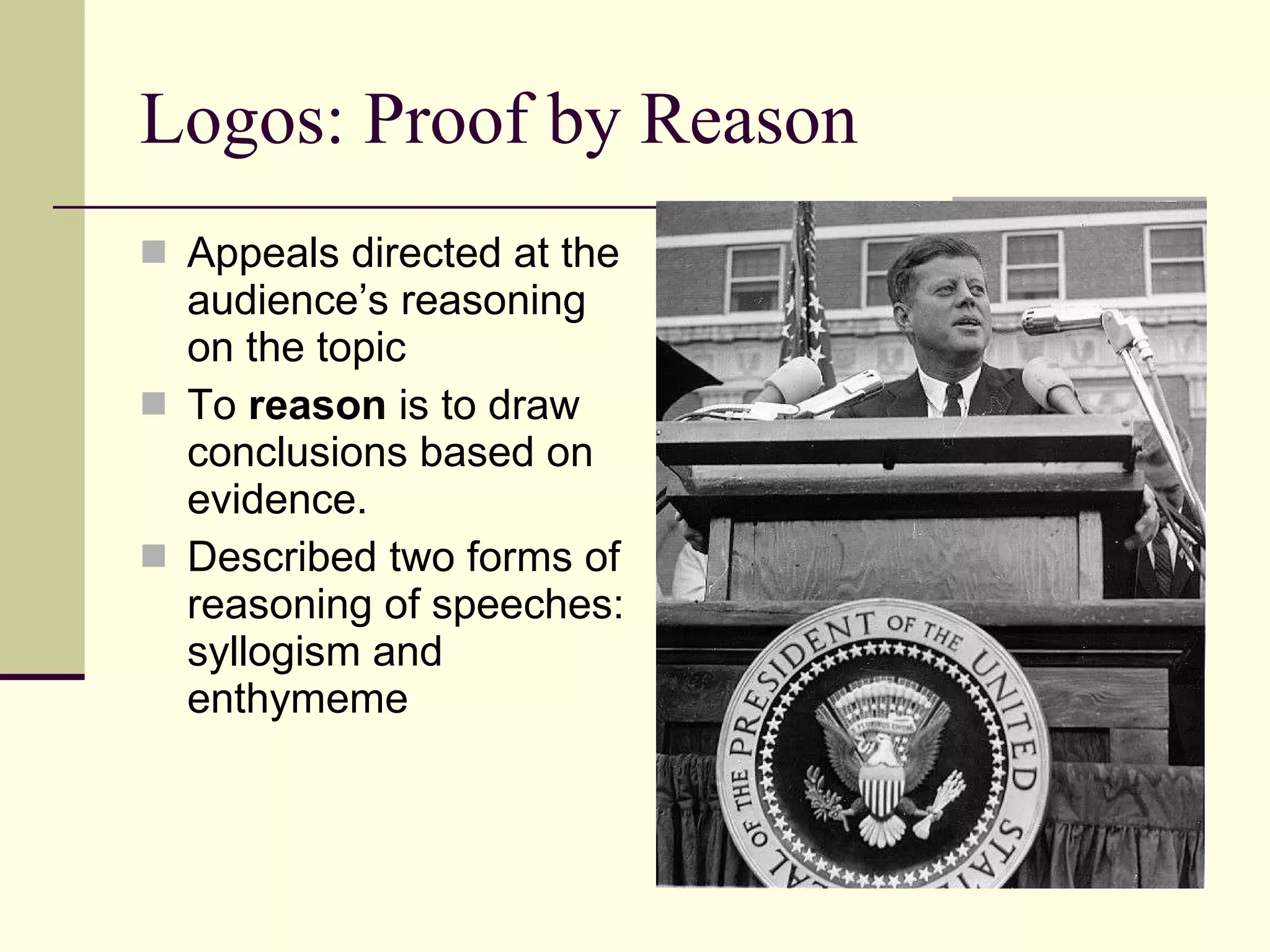
Logos: Proof by Reason Appeals directed at the audience’s reasoning on the topic To  reason  is to draw conclusions based on evidence. Described two forms of reasoning of speeches: syllogism and enthymeme
Proof by Reason Syllogism – A three part argument consisting of a general case or major premise, and a specific case or minor premise The conclusion derived from the first two steps Based on deductive reasoning or reasoning from a general condition to a specific instance Beware of hasty overgeneralizations
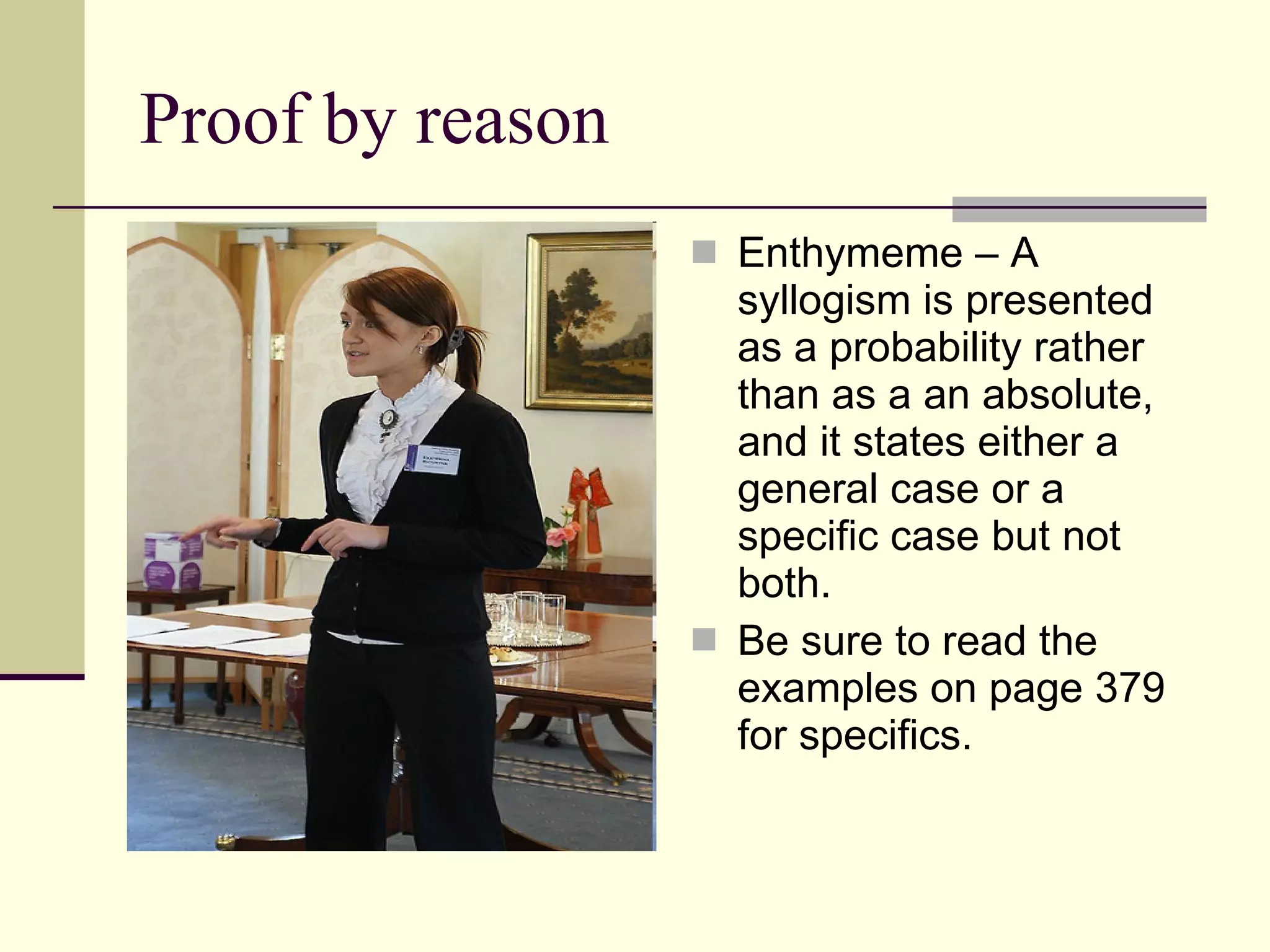
Proof by reason Enthymeme – A syllogism is presented as a probability rather than as a an absolute, and it states either a general case or a specific case but not both. Be sure to read the examples on page 379 for specifics.
Pathos: Proof by Emotion Creating a certain disposition in the audience You can evoke these emotions in a speech by using vivid descriptions and emotionally charged words Use emotion to get the audience’s attention and stimulates a desire to act on the emotion Reason is then presented as justification for the action
Ethos: Proof through Speaker’s Character Emphasizes the nature of the speaker’s character and personality Elements of persuasive appeal based on ethos: Good sense. Knowledge of and experience with the subject matter. Moral character. Reflected in the speaker’s straightforward and honest presentation of the message. Goodwill toward the audience. Demonstrate an interest in and concern for the welfare of the audience.
Bibliography O’ Hair, Dan, Stewart, Rob, Rubenstein, Hannah, A Speaker’s Guidebook, Bedford St. Martin (2009)

Chapter 24 the persuasive speech

  • 1.
    Chapter 24 ThePersuasive Speech Professor Tonya Seavers Evans
  • 2.
    What is thepersuasive speech? Goal is to: Influence an audience’s beliefs or understanding about something. Influence an audience’s behavior. Reinforce audience members’ existing attitudes, beliefs, or behavior so they will continue to possess or practice them.
  • 3.
    Classical Persuasive AppealsAristotle explained that persuasion could be brought about by the speaker’s use of three types of persuasive appeals, or forms of rhetorical proofs. The first is the message in the speech called logos. The second, the nature of the audience’s feelings, called pathos. The qualifications and personality of the speaker, called ethos.
  • 4.
    Logos: Proof byReason Appeals directed at the audience’s reasoning on the topic To reason is to draw conclusions based on evidence. Described two forms of reasoning of speeches: syllogism and enthymeme
  • 5.
    Proof by ReasonSyllogism – A three part argument consisting of a general case or major premise, and a specific case or minor premise The conclusion derived from the first two steps Based on deductive reasoning or reasoning from a general condition to a specific instance Beware of hasty overgeneralizations
  • 6.
    Proof by reasonEnthymeme – A syllogism is presented as a probability rather than as a an absolute, and it states either a general case or a specific case but not both. Be sure to read the examples on page 379 for specifics.
  • 7.
    Pathos: Proof byEmotion Creating a certain disposition in the audience You can evoke these emotions in a speech by using vivid descriptions and emotionally charged words Use emotion to get the audience’s attention and stimulates a desire to act on the emotion Reason is then presented as justification for the action
  • 8.
    Ethos: Proof throughSpeaker’s Character Emphasizes the nature of the speaker’s character and personality Elements of persuasive appeal based on ethos: Good sense. Knowledge of and experience with the subject matter. Moral character. Reflected in the speaker’s straightforward and honest presentation of the message. Goodwill toward the audience. Demonstrate an interest in and concern for the welfare of the audience.
  • 9.
    Bibliography O’ Hair,Dan, Stewart, Rob, Rubenstein, Hannah, A Speaker’s Guidebook, Bedford St. Martin (2009)