Writing a Presentation
By: Bishara Adam1
Structure of a speech
(Introduction & Conclusion)
The introduction and conclusion;
 are vitally important
 occupy less than 20% of speaking time
 help listeners form impressions early
 leave lasting impressions
Types of Introductions
 Identification with audience
 Reference to situation
 Statement of purpose
 Statement of importance of topic
 Surprise audience with claim or statistic
 Anecdotal Story
 Rhetorical Question (Why me?)
 Quotation
 Humor
Functions of Introduction
 Get Attention
 Introduce Topic
 Provide Motivation
 Establish Credibility
 Preview Speech
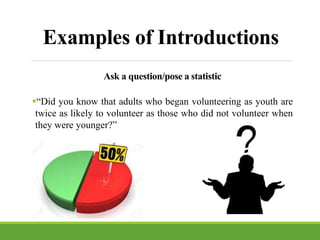
Ask a question/pose a statistic
“Did you know that adults who began volunteering as youth are
twice as likely to volunteer as those who did not volunteer when
they were younger?”
Examples of Introductions
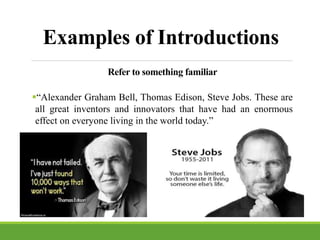
Refer to something familiar
“Alexander Graham Bell, Thomas Edison, Steve Jobs. These are
all great inventors and innovators that have had an enormous
effect on everyone living in the world today.”
Examples of Introductions
Preview
“I’ll begin with why
volunteering first and foremost
improves the lives of those
being helped, then why it
personally changes and benefits
the person volunteering, and
lastly I will convince you that
the long term impacts of
volunteering are high.”
Examples of Introductions
Preview
“To begin, I will tell you about the
early life of Steve Jobs with his
childhood and education. Then, I’ll tell
you about his professional
achievements, and lastly about his
death.”
Examples of Introductions
Preview
“First, I will tell you what
Eid is and where it came
from; Second, I will tell you
about the traditions and
customs that go along with
this holiday; and lastly, I will
tell you about the activities
that people like to participate
in during this day.”
Examples of Introductions
Experience
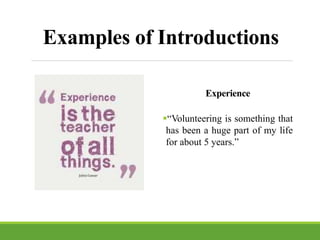
“Volunteering is something that
has been a huge part of my life
for about 5 years.”
Examples of Introductions
Reason for choosing/Authority on Topic
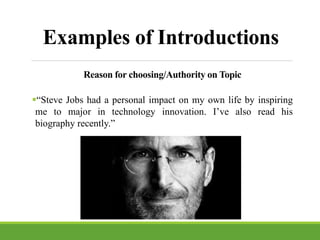
“Steve Jobs had a personal impact on my own life by inspiring
me to major in technology innovation. I’ve also read his
biography recently.”
Examples of Introductions
How many people in here have a hard time balancing school
work, working, family, and personal time?
For many of you in here, time management can be a major
struggle, but it doesn’t have to be.
I’ve been effectively using time management strategies for years
now, and it has made my life much easier to balance.
First, I’ll discuss how to manage your school time, then work
time, and lastly family and personal time.
Examples of Introductions
Types of Conclusions
Summary
Quotation
Personal reference
Challenge to audience
Offer vision of the future
Functions of Conclusions
Summarize speech
Reemphasize main idea
Motivate response
Provide closure
Examples of Conclusions
Transition statement
“With that in mind, let me conclude.”
Examples of Conclusions
Recap
“First, I told you about the
positive impact it has on the
person being helped, then I told
you about how it affects the
volunteer and lastly I told you
about the long term benefits of
volunteering.”
Examples of Conclusions
Call to Action
I hope this inspires all of you to begin volunteering today!
Examples of Conclusions
Memorable thought
This is our time—let’s make a difference.”
Group Task
Choose a topic.
Discuss and write an introduction
and a conclusion for the given
type. ( 10 to 15 minutes to discuss)
Present the written introduction
and conclusion.

Structure of a Speech (Introduction & Conclusion)

  • 1.
  • 2.
    Structure of aspeech (Introduction & Conclusion) The introduction and conclusion;  are vitally important  occupy less than 20% of speaking time  help listeners form impressions early  leave lasting impressions
  • 3.
    Types of Introductions Identification with audience  Reference to situation  Statement of purpose  Statement of importance of topic  Surprise audience with claim or statistic  Anecdotal Story  Rhetorical Question (Why me?)  Quotation  Humor
  • 4.
    Functions of Introduction Get Attention  Introduce Topic  Provide Motivation  Establish Credibility  Preview Speech
  • 5.
    Ask a question/posea statistic “Did you know that adults who began volunteering as youth are twice as likely to volunteer as those who did not volunteer when they were younger?” Examples of Introductions
  • 6.
    Refer to somethingfamiliar “Alexander Graham Bell, Thomas Edison, Steve Jobs. These are all great inventors and innovators that have had an enormous effect on everyone living in the world today.” Examples of Introductions
  • 7.
    Preview “I’ll begin withwhy volunteering first and foremost improves the lives of those being helped, then why it personally changes and benefits the person volunteering, and lastly I will convince you that the long term impacts of volunteering are high.” Examples of Introductions
  • 8.
    Preview “To begin, Iwill tell you about the early life of Steve Jobs with his childhood and education. Then, I’ll tell you about his professional achievements, and lastly about his death.” Examples of Introductions
  • 9.
    Preview “First, I willtell you what Eid is and where it came from; Second, I will tell you about the traditions and customs that go along with this holiday; and lastly, I will tell you about the activities that people like to participate in during this day.” Examples of Introductions
  • 10.
    Experience “Volunteering is somethingthat has been a huge part of my life for about 5 years.” Examples of Introductions
  • 11.
    Reason for choosing/Authorityon Topic “Steve Jobs had a personal impact on my own life by inspiring me to major in technology innovation. I’ve also read his biography recently.” Examples of Introductions
  • 12.
    How many peoplein here have a hard time balancing school work, working, family, and personal time? For many of you in here, time management can be a major struggle, but it doesn’t have to be. I’ve been effectively using time management strategies for years now, and it has made my life much easier to balance. First, I’ll discuss how to manage your school time, then work time, and lastly family and personal time. Examples of Introductions
  • 13.
    Types of Conclusions Summary Quotation Personalreference Challenge to audience Offer vision of the future
  • 14.
    Functions of Conclusions Summarizespeech Reemphasize main idea Motivate response Provide closure
  • 15.
    Examples of Conclusions Transitionstatement “With that in mind, let me conclude.”
  • 16.
    Examples of Conclusions Recap “First,I told you about the positive impact it has on the person being helped, then I told you about how it affects the volunteer and lastly I told you about the long term benefits of volunteering.”
  • 17.
    Examples of Conclusions Callto Action I hope this inspires all of you to begin volunteering today!
  • 18.
    Examples of Conclusions Memorablethought This is our time—let’s make a difference.”
  • 19.
    Group Task Choose atopic. Discuss and write an introduction and a conclusion for the given type. ( 10 to 15 minutes to discuss) Present the written introduction and conclusion.