

METHODS OF
PERSUASION
By: Wijdan Alwidyani
Outline






Building Credibility
Using Evidence
Reasoning
Appealing to Emotions
Introduction
“The day when you could yell and scream and
beat people into good performance is over.
Today you have to appeal to them by helping
them see how they can get from here to there,
by establishing some credibility, and by giving
them some reason and help to get there. Do all
those things, and they’ll knock down doors.”
1998)

(Johnson,
Introduction
What are the oral presentation objectives ?
Why do you want to persuade your
audience?
Why are we discussing this issue?
How can you do so? (4 steps)

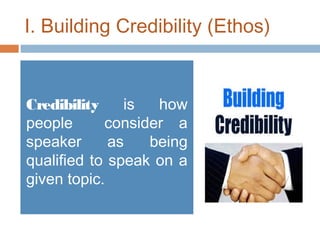
I. Building Credibility (Ethos)

Credibility
is
how
people
consider a
speaker
as
being
qualified to speak on a
given topic.
I. Building Credibility (Ethos)
Factors :
I. Competence : expert, knowledgeable,
intelligent
II. Character : sincere, trustworthy, concerned


Types :
I. Initial : before speech
II. Derived : during the speech
III.Terminal : at the end

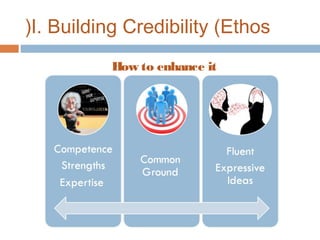
(I. Building Credibility (Ethos
How to enhance it
II. Using evidence

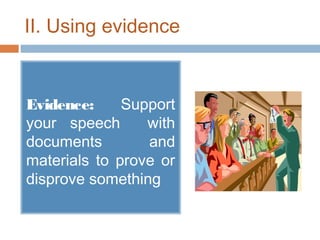
Evidence:
Support
your speech
with
documents
and
materials to prove or
disprove something
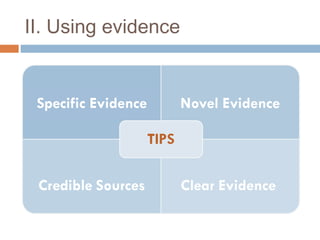
II. Using evidence
III. Reasoning

Reasoning
:
drawing
a
conclusion on the
basis of evidence
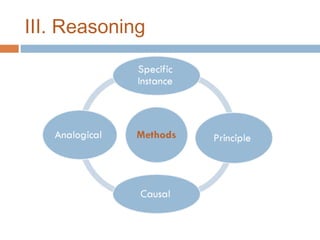
III. Reasoning
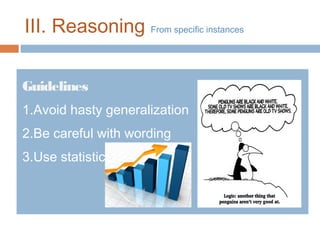
III. Reasoning From specific instances
Guidelines
1.Avoid hasty generalization
2.Be careful with wording
3.Use statistics
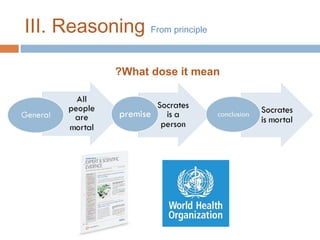
III. Reasoning From principle
?What dose it mean
III. Reasoning Causal
Seeks to establish the relationship between
causes and effects
Errors to avoid:
I. The fallacy of false cause
II. Assuming that events have only one cause
False cause:
An error in causal reasoning in which a
speaker mistakenly assumes that because
one event follows another, the first event is
the cause of another
III. Reasoning Analogical
Analogical reasoning:
Reasoning in which a speaker compares two
similar cases and infers that what is true for
the first is also true for the other
 Invalid analogy:
An analogy in which the two cases been
compared are not essentially alike

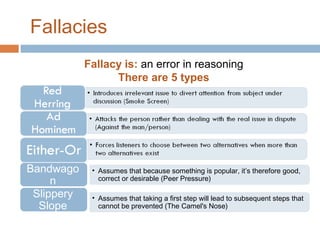
Fallacies
Fallacy is: an error in reasoning
There are 5 types

Bandwago
n
Slippery
Slope

• Assumes that because something is popular, it’s therefore good,
correct or desirable (Peer Pressure)
• Assumes that taking a first step will lead to subsequent steps that
cannot be prevented (The Camel's Nose)
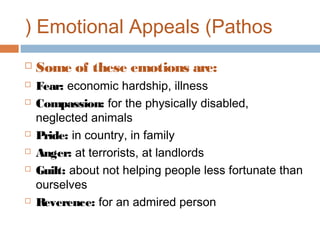
( Emotional Appeals (Pathos










Some of these emotions are:
Fear: economic hardship, illness
Compassion: for the physically disabled,
neglected animals
Pride: in country, in family
Anger: at terrorists, at landlords
Guilt: about not helping people less fortunate than
ourselves
Reverence: for an admired person
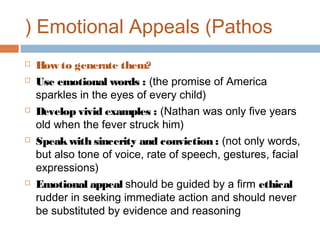
( Emotional Appeals (Pathos









How to generate them?
Use emotional words : (the promise of America
sparkles in the eyes of every child)
Develop vivid examples : (Nathan was only five years
old when the fever struck him)
Speak with sincerity and conviction : (not only words,
but also tone of voice, rate of speech, gestures, facial
expressions)
Emotional appeal should be guided by a firm ethical
rudder in seeking immediate action and should never
be substituted by evidence and reasoning
SPEAKING ON
SPECIAL OCCASIONS
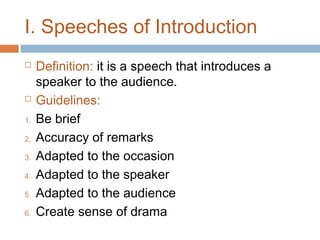
I. Speeches of Introduction



1.
2.
3.
4.
5.
6.

Definition: it is a speech that introduces a
speaker to the audience.
Guidelines:
Be brief
Accuracy of remarks
Adapted to the occasion
Adapted to the speaker
Adapted to the audience
Create sense of drama
II. Speeches of Presentation







Definition: it is a speech that presents
someone a gift, an award, a medal or some
other form of public recognition
Characteristics: Brief, (4-5 min) in length
Purpose: to tell the audience why the recipient
received the award
Matters to be discussed: (the award, the
losers)
III. Speeches of Acceptance







Definition: a speech that gives thanks to a gift,
an award, or other form of public recognition.
Characteristics: brevity, humility, and
graciousness
Purpose: to give thanks for a gift
Matters to be discussed: people who are
bestowing the award, people who helped you
IV. Commemorative Speeches







Definition: they are the speeches of praise or
celebration
Examples: Forth of July
Purpose: to pay tribute to/inspire a person,
group of people, an institution, or an idea
Matters to be discussed: information about the
subject, why the subject is praiseworthy,
examples and statistics to illustrate the
achievement of the subject.
References


Lucas, 2009: The art of public speaking (10th edit.)



http://www.egs.edu/library/ferdinand-de-saussure/biography/



http://www.nizkor.org/features/fallacies/red-herring.html



http://www.nizkor.org/features/fallacies/ad-hominem.html



http://ksuweb.kennesaw.edu/~shagin/logfal-pbc-eitheror.htm



http://www.nizkor.org/features/fallacies/bandwagon.html



http://www.nizkor.org/features/fallacies/slippery-slope.html



http://www.usa.gov/Topics/Independence-Day.shtml
Thank You


C

  • 1.
  • 2.
  • 3.
    Introduction “The day whenyou could yell and scream and beat people into good performance is over. Today you have to appeal to them by helping them see how they can get from here to there, by establishing some credibility, and by giving them some reason and help to get there. Do all those things, and they’ll knock down doors.” 1998) (Johnson,
  • 4.
    Introduction What are theoral presentation objectives ? Why do you want to persuade your audience? Why are we discussing this issue? How can you do so? (4 steps) 
  • 5.
    I. Building Credibility(Ethos) Credibility is how people consider a speaker as being qualified to speak on a given topic.
  • 6.
    I. Building Credibility(Ethos) Factors : I. Competence : expert, knowledgeable, intelligent II. Character : sincere, trustworthy, concerned  Types : I. Initial : before speech II. Derived : during the speech III.Terminal : at the end 
  • 7.
    (I. Building Credibility(Ethos How to enhance it
  • 8.
    II. Using evidence Evidence: Support yourspeech with documents and materials to prove or disprove something
  • 9.
  • 10.
  • 11.
  • 12.
    III. Reasoning Fromspecific instances Guidelines 1.Avoid hasty generalization 2.Be careful with wording 3.Use statistics
  • 13.
    III. Reasoning Fromprinciple ?What dose it mean
  • 14.
    III. Reasoning Causal Seeksto establish the relationship between causes and effects Errors to avoid: I. The fallacy of false cause II. Assuming that events have only one cause False cause: An error in causal reasoning in which a speaker mistakenly assumes that because one event follows another, the first event is the cause of another
  • 15.
    III. Reasoning Analogical Analogicalreasoning: Reasoning in which a speaker compares two similar cases and infers that what is true for the first is also true for the other  Invalid analogy: An analogy in which the two cases been compared are not essentially alike 
  • 16.
    Fallacies Fallacy is: anerror in reasoning There are 5 types Bandwago n Slippery Slope • Assumes that because something is popular, it’s therefore good, correct or desirable (Peer Pressure) • Assumes that taking a first step will lead to subsequent steps that cannot be prevented (The Camel's Nose)
  • 17.
    ( Emotional Appeals(Pathos        Some of these emotions are: Fear: economic hardship, illness Compassion: for the physically disabled, neglected animals Pride: in country, in family Anger: at terrorists, at landlords Guilt: about not helping people less fortunate than ourselves Reverence: for an admired person
  • 18.
    ( Emotional Appeals(Pathos      How to generate them? Use emotional words : (the promise of America sparkles in the eyes of every child) Develop vivid examples : (Nathan was only five years old when the fever struck him) Speak with sincerity and conviction : (not only words, but also tone of voice, rate of speech, gestures, facial expressions) Emotional appeal should be guided by a firm ethical rudder in seeking immediate action and should never be substituted by evidence and reasoning
  • 19.
  • 20.
    I. Speeches ofIntroduction   1. 2. 3. 4. 5. 6. Definition: it is a speech that introduces a speaker to the audience. Guidelines: Be brief Accuracy of remarks Adapted to the occasion Adapted to the speaker Adapted to the audience Create sense of drama
  • 21.
    II. Speeches ofPresentation     Definition: it is a speech that presents someone a gift, an award, a medal or some other form of public recognition Characteristics: Brief, (4-5 min) in length Purpose: to tell the audience why the recipient received the award Matters to be discussed: (the award, the losers)
  • 22.
    III. Speeches ofAcceptance     Definition: a speech that gives thanks to a gift, an award, or other form of public recognition. Characteristics: brevity, humility, and graciousness Purpose: to give thanks for a gift Matters to be discussed: people who are bestowing the award, people who helped you
  • 23.
    IV. Commemorative Speeches     Definition:they are the speeches of praise or celebration Examples: Forth of July Purpose: to pay tribute to/inspire a person, group of people, an institution, or an idea Matters to be discussed: information about the subject, why the subject is praiseworthy, examples and statistics to illustrate the achievement of the subject.
  • 24.
    References  Lucas, 2009: Theart of public speaking (10th edit.)  http://www.egs.edu/library/ferdinand-de-saussure/biography/  http://www.nizkor.org/features/fallacies/red-herring.html  http://www.nizkor.org/features/fallacies/ad-hominem.html  http://ksuweb.kennesaw.edu/~shagin/logfal-pbc-eitheror.htm  http://www.nizkor.org/features/fallacies/bandwagon.html  http://www.nizkor.org/features/fallacies/slippery-slope.html  http://www.usa.gov/Topics/Independence-Day.shtml
  • 25.