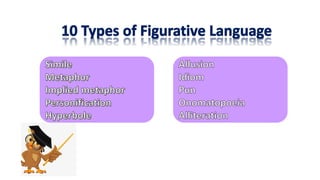
Creative Writing
Figurative Language and Imagery
Presentation Prepared by
ERNA B. SAGNOY, LPT
 Objectives
At the end of the session, the students will be able to:
• identify the different types of figurative language and kinds of imagery
• use figurative language and imagery in creative writing
• value the significance of figurative language and imagery in creative
writing
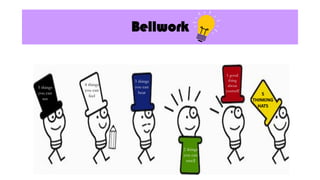
Bellwork
5 things
you can
see
4 things
you can
feel
3 things
you can
hear
2 things
you can
smell
1 good
thing
about
yourself
5
THINKING
HATS
What is
Figurative
Language?
Source: www.masterclass.com
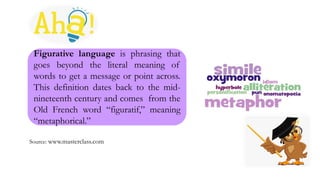
Figurative language is phrasing that
goes beyond the literal meaning of
words to get a message or point across.
This definition dates back to the mid-
nineteenth century and comes from the
Old French word “figuratif,” meaning
“metaphorical.”
Simile
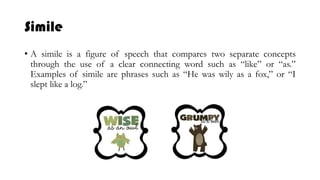
• A simile is a figure of speech that compares two separate concepts
through the use of a clear connecting word such as “like” or “as.”
Examples of simile are phrases such as “He was wily as a fox,” or “I
slept like a log.”
Metaphor
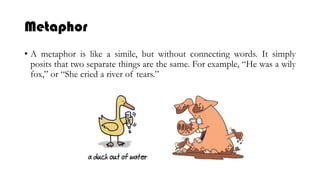
• A metaphor is like a simile, but without connecting words. It simply
posits that two separate things are the same. For example, “He was a wily
fox,” or “She cried a river of tears.”
Implied Metaphor
• Metaphor takes a few different forms. Sometimes the object of
comparison is purely implied rather than directly referenced, such as in
the phrase, “He barked commands at the team,” which implies
comparison to a dog.
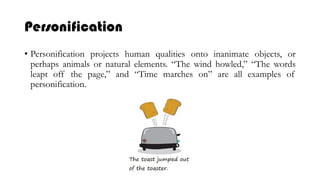
Personification
• Personification projects human qualities onto inanimate objects, or
perhaps animals or natural elements. “The wind howled,” “The words
leapt off the page,” and “Time marches on” are all examples of
personification.
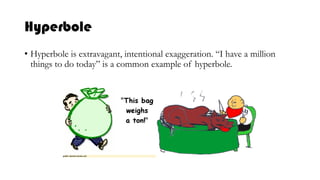
Hyperbole
• Hyperbole is extravagant, intentional exaggeration. “I have a million
things to do today” is a common example of hyperbole.
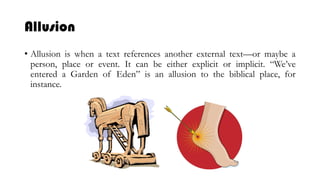
Allusion
• Allusion is when a text references another external text—or maybe a
person, place or event. It can be either explicit or implicit. “We’ve
entered a Garden of Eden” is an allusion to the biblical place, for
instance.
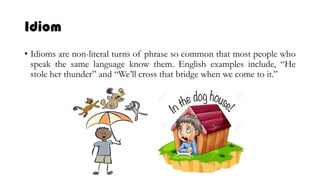
Idiom
• Idioms are non-literal turns of phrase so common that most people who
speak the same language know them. English examples include, “He
stole her thunder” and “We’ll cross that bridge when we come to it.”
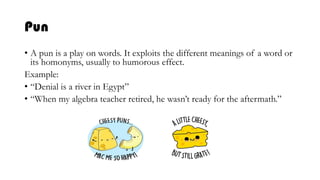
Pun
• A pun is a play on words. It exploits the different meanings of a word or
its homonyms, usually to humorous effect.
Example:
• “Denial is a river in Egypt”
• “When my algebra teacher retired, he wasn’t ready for the aftermath.”
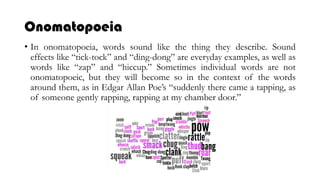
Onomatopoeia
• In onomatopoeia, words sound like the thing they describe. Sound
effects like “tick-tock” and “ding-dong” are everyday examples, as well as
words like “zap” and “hiccup.” Sometimes individual words are not
onomatopoeic, but they will become so in the context of the words
around them, as in Edgar Allan Poe’s “suddenly there came a tapping, as
of someone gently rapping, rapping at my chamber door.”
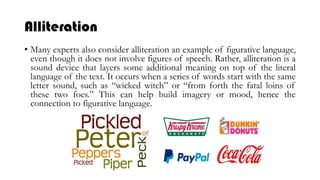
Alliteration
• Many experts also consider alliteration an example of figurative language,
even though it does not involve figures of speech. Rather, alliteration is a
sound device that layers some additional meaning on top of the literal
language of the text. It occurs when a series of words start with the same
letter sound, such as “wicked witch” or “from forth the fatal loins of
these two foes.” This can help build imagery or mood, hence the
connection to figurative language.
• The chief function of figurative language is to communicate the writer’s
message as clearly as possible.
• That might be by putting a foreign concept into familiar terms that a
reader or listener can easily grasp, or it might be by creating imagery
that’s vivid and visceral.
• Some types of figurative language also have other uses unrelated to their
role in creating imagery. For example, writers use alliteration, consonance
and assonance alongside rhyme to give words rhythm and musicality.
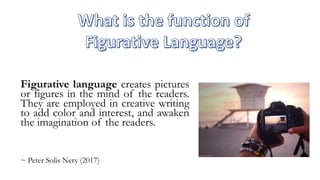
Figurative language creates pictures
or figures in the mind of the readers.
They are employed in creative writing
to add color and interest, and awaken
the imagination of the readers.
~ Peter Solis Nery (2017)
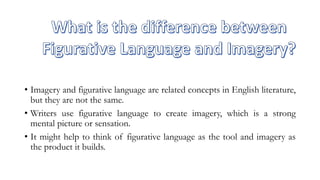
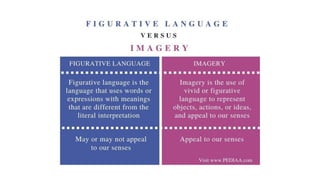
• Imagery and figurative language are related concepts in English literature,
but they are not the same.
• Writers use figurative language to create imagery, which is a strong
mental picture or sensation.
• It might help to think of figurative language as the tool and imagery as
the product it builds.
Imagery
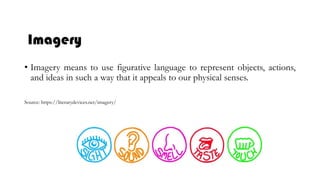
• Imagery means to use figurative language to represent objects, actions,
and ideas in such a way that it appeals to our physical senses.
Source: https://literarydevices.net/imagery/
Examples of Imagery
• Usually it is thought that imagery
makes use of particular words that
create visual representation of ideas
in our minds. The word “imagery” is
associated with mental pictures.
However, this idea is but partially
correct. Imagery, to be realistic,
turns out to be more complex than
just a picture.
Visual
• is a picture in words; something that is concrete and can be seen
Example:
• Broken hulahoops, hollow blocks, and tires are crowded atop a thatched
roof.
Auditory
• is something that you can hear through your mind’s ears.
Example:
• The pattering of the rain is heard against the window pane.
• The screeching wheels of reckless taxi cabs and vehicles plagued my ears.
Olfactory
• is something that you can smell through your mind’s nose
Example:
• The aroma of freshly-brewed Colombian coffee wafted into the entire
room.
• The stench of body odor in a crowded LRT train seeped through the
fabric of my shirt.
Gustatory
• is something that you can taste through your mind’s tongue.
Example:
• Mouth-watering ripe mangoes, tender melons, and luscious cherries are
served on a tray.
• I endured the pungent taste of unripe bananas.
Tactile
• is something that you can touch through your mind’s skin.
Example:
• The soft velvety feel of silk and stain caressed my skin.
• His corned working hands were brought out by years of hard work and
toil.
Thermal
• is something that depicts temperature
Example:
• The scorching heat of a midday topical sun made my eyes squint.
• A sudden gush of December wind breezed against my face, reminding
me of Christmas.
Erotic
• is something that suggests sensation and feeling
Example:
• His eyes follow her wherever she goes, like a blind servant following his
omnipresent master.
• I shuddered and felt a tingling sensation as his warm breath heaved
through my nape.
Name as many figurative languages as you can
What is the difference between figurative language and imagery?
Why do authors need to use figurative languages and imagery?
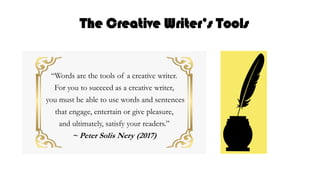
The Creative Writer’s Tools
“Words are the tools of a creative writer.
For you to succeed as a creative writer,
you must be able to use words and sentences
that engage, entertain or give pleasure,
and ultimately, satisfy your readers.”
~ Peter Solis Nery (2017)
THANK YOU!
Book Sources:
• Aguila, Augusto Antonio, et al. Wording the World: The Art of Creative Writing. C & E
Publishing, Inc., Quezon, 2017
• Nery, Peter S. Creative Writing. Diwa Learning Systems Inc., Makati, 2017
Internet Source/s:
https://www.masterclass.com/articles/writing-101-what-is-figurative-language-learn-
about-10-types-of-figurative-language-with-examples#what-is-the-difference-between-
figurative-language-and-imagery
Photo credits to Google Images

Lesson 2 (Figurative Language and Imagery)

  • 1.
    Creative Writing Figurative Languageand Imagery Presentation Prepared by ERNA B. SAGNOY, LPT
  • 2.
     Objectives At theend of the session, the students will be able to: • identify the different types of figurative language and kinds of imagery • use figurative language and imagery in creative writing • value the significance of figurative language and imagery in creative writing
  • 3.
    Bellwork 5 things you can see 4things you can feel 3 things you can hear 2 things you can smell 1 good thing about yourself 5 THINKING HATS
  • 4.
  • 5.
    Source: www.masterclass.com Figurative languageis phrasing that goes beyond the literal meaning of words to get a message or point across. This definition dates back to the mid- nineteenth century and comes from the Old French word “figuratif,” meaning “metaphorical.”
  • 7.
    Simile • A simileis a figure of speech that compares two separate concepts through the use of a clear connecting word such as “like” or “as.” Examples of simile are phrases such as “He was wily as a fox,” or “I slept like a log.”
  • 8.
    Metaphor • A metaphoris like a simile, but without connecting words. It simply posits that two separate things are the same. For example, “He was a wily fox,” or “She cried a river of tears.”
  • 9.
    Implied Metaphor • Metaphortakes a few different forms. Sometimes the object of comparison is purely implied rather than directly referenced, such as in the phrase, “He barked commands at the team,” which implies comparison to a dog.
  • 10.
    Personification • Personification projectshuman qualities onto inanimate objects, or perhaps animals or natural elements. “The wind howled,” “The words leapt off the page,” and “Time marches on” are all examples of personification.
  • 11.
    Hyperbole • Hyperbole isextravagant, intentional exaggeration. “I have a million things to do today” is a common example of hyperbole.
  • 12.
    Allusion • Allusion iswhen a text references another external text—or maybe a person, place or event. It can be either explicit or implicit. “We’ve entered a Garden of Eden” is an allusion to the biblical place, for instance.
  • 13.
    Idiom • Idioms arenon-literal turns of phrase so common that most people who speak the same language know them. English examples include, “He stole her thunder” and “We’ll cross that bridge when we come to it.”
  • 14.
    Pun • A punis a play on words. It exploits the different meanings of a word or its homonyms, usually to humorous effect. Example: • “Denial is a river in Egypt” • “When my algebra teacher retired, he wasn’t ready for the aftermath.”
  • 15.
    Onomatopoeia • In onomatopoeia,words sound like the thing they describe. Sound effects like “tick-tock” and “ding-dong” are everyday examples, as well as words like “zap” and “hiccup.” Sometimes individual words are not onomatopoeic, but they will become so in the context of the words around them, as in Edgar Allan Poe’s “suddenly there came a tapping, as of someone gently rapping, rapping at my chamber door.”
  • 16.
    Alliteration • Many expertsalso consider alliteration an example of figurative language, even though it does not involve figures of speech. Rather, alliteration is a sound device that layers some additional meaning on top of the literal language of the text. It occurs when a series of words start with the same letter sound, such as “wicked witch” or “from forth the fatal loins of these two foes.” This can help build imagery or mood, hence the connection to figurative language.
  • 17.
    • The chieffunction of figurative language is to communicate the writer’s message as clearly as possible. • That might be by putting a foreign concept into familiar terms that a reader or listener can easily grasp, or it might be by creating imagery that’s vivid and visceral. • Some types of figurative language also have other uses unrelated to their role in creating imagery. For example, writers use alliteration, consonance and assonance alongside rhyme to give words rhythm and musicality.
  • 18.
    Figurative language createspictures or figures in the mind of the readers. They are employed in creative writing to add color and interest, and awaken the imagination of the readers. ~ Peter Solis Nery (2017)
  • 20.
    • Imagery andfigurative language are related concepts in English literature, but they are not the same. • Writers use figurative language to create imagery, which is a strong mental picture or sensation. • It might help to think of figurative language as the tool and imagery as the product it builds.
  • 22.
    Imagery • Imagery meansto use figurative language to represent objects, actions, and ideas in such a way that it appeals to our physical senses. Source: https://literarydevices.net/imagery/
  • 23.
    Examples of Imagery •Usually it is thought that imagery makes use of particular words that create visual representation of ideas in our minds. The word “imagery” is associated with mental pictures. However, this idea is but partially correct. Imagery, to be realistic, turns out to be more complex than just a picture.
  • 24.
    Visual • is apicture in words; something that is concrete and can be seen Example: • Broken hulahoops, hollow blocks, and tires are crowded atop a thatched roof.
  • 25.
    Auditory • is somethingthat you can hear through your mind’s ears. Example: • The pattering of the rain is heard against the window pane. • The screeching wheels of reckless taxi cabs and vehicles plagued my ears.
  • 26.
    Olfactory • is somethingthat you can smell through your mind’s nose Example: • The aroma of freshly-brewed Colombian coffee wafted into the entire room. • The stench of body odor in a crowded LRT train seeped through the fabric of my shirt.
  • 27.
    Gustatory • is somethingthat you can taste through your mind’s tongue. Example: • Mouth-watering ripe mangoes, tender melons, and luscious cherries are served on a tray. • I endured the pungent taste of unripe bananas.
  • 28.
    Tactile • is somethingthat you can touch through your mind’s skin. Example: • The soft velvety feel of silk and stain caressed my skin. • His corned working hands were brought out by years of hard work and toil.
  • 29.
    Thermal • is somethingthat depicts temperature Example: • The scorching heat of a midday topical sun made my eyes squint. • A sudden gush of December wind breezed against my face, reminding me of Christmas.
  • 30.
    Erotic • is somethingthat suggests sensation and feeling Example: • His eyes follow her wherever she goes, like a blind servant following his omnipresent master. • I shuddered and felt a tingling sensation as his warm breath heaved through my nape.
  • 31.
    Name as manyfigurative languages as you can What is the difference between figurative language and imagery? Why do authors need to use figurative languages and imagery?
  • 32.
    The Creative Writer’sTools “Words are the tools of a creative writer. For you to succeed as a creative writer, you must be able to use words and sentences that engage, entertain or give pleasure, and ultimately, satisfy your readers.” ~ Peter Solis Nery (2017)
  • 33.
    THANK YOU! Book Sources: •Aguila, Augusto Antonio, et al. Wording the World: The Art of Creative Writing. C & E Publishing, Inc., Quezon, 2017 • Nery, Peter S. Creative Writing. Diwa Learning Systems Inc., Makati, 2017 Internet Source/s: https://www.masterclass.com/articles/writing-101-what-is-figurative-language-learn- about-10-types-of-figurative-language-with-examples#what-is-the-difference-between- figurative-language-and-imagery Photo credits to Google Images