TYPES OF
LESSON 3
REIMUEL M. BISNAR
Strategy
Communicative
1. NOMINATION
When you employ this strategy, you try to open a
topic with the people you are talking to.
When beginning a topic, you may start off with news
inquiries and news announcements as they promise
extended talk.
2. RESTRICTION
Any limitation you may have a speaker.
When communicating in the classroom, in a
meeting, or while hanging out with your
friends, you are typically given specific
instructions that you must follow
For example, in your class, you
might be asked by your teacher to
brainstorm on peer pressure or
deliver a speech on digital natives.
In these cases, cannot
decide to talk about
something else.
Remember to always be on point
and avoid sideswiping from the
topic during the conversation to
avoid communication breakdown.
3. TURN-TAKING
The process by which people decide who
takes the conversation floor.
The primary idea is to give all
communicators a chance to speak.
Remember to keep your words
relevant and reasonably short
enough to express your views or
feelings.
To acknowledge others, you may employ
visual signals like a nod, a look, or a step
back. Accompanied with spoken cues such
as
“What do you think?” or “You
wanted to say something?”
4. TOPIC CONTROL
Covers how procedural formality or informality affects the
development of topic in conversations.
For example, in meetings, you may only have a turn to
speak after the chairperson directs you to do so.
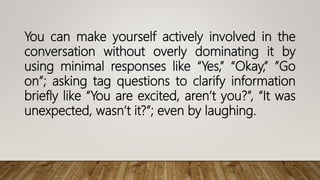
You can make yourself actively involved in the
conversation without overly dominating it by
using minimal responses like “Yes,” “Okay,” ”Go
on”; asking tag questions to clarify information
briefly like “You are excited, aren’t you?”, “It was
unexpected, wasn’t it?”; even by laughing.
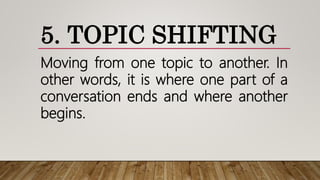
5. TOPIC SHIFTING
Moving from one topic to another. In
other words, it is where one part of a
conversation ends and where another
begins.
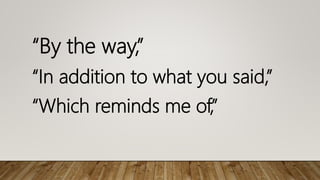
“By the way,”
“In addition to what you said,”
“Which reminds me of,”
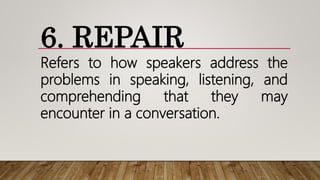
6. REPAIR
Refers to how speakers address the
problems in speaking, listening, and
comprehending that they may
encounter in a conversation.
Speakers will always try to
address and correct if there is a
problem in understanding the
conversation.
7. TERMINATION
Close-initiating
expressions that end a
topic in a conversation.
Most of the time, the topic
initiator takes responsibility
to signal the end of the
discussion as well.
www.facebook.com/reimuel.bisnar.71
www.instagram.com/reimuelb24
www.youtube.com/channel/UCakHxn3NGR2IYr360Sx-A4Q
reimuelb@gmail.com or reimuel.bisnar@deped.gov.ph
FOLLOW ME IN
www.linkedin.com/in/reimuel-bisnar-23995b167/

Types of Communicative Strategy

  • 1.
    TYPES OF LESSON 3 REIMUELM. BISNAR Strategy Communicative
  • 2.
    1. NOMINATION When youemploy this strategy, you try to open a topic with the people you are talking to. When beginning a topic, you may start off with news inquiries and news announcements as they promise extended talk.
  • 3.
    2. RESTRICTION Any limitationyou may have a speaker. When communicating in the classroom, in a meeting, or while hanging out with your friends, you are typically given specific instructions that you must follow
  • 4.
    For example, inyour class, you might be asked by your teacher to brainstorm on peer pressure or deliver a speech on digital natives.
  • 5.
    In these cases,cannot decide to talk about something else.
  • 6.
    Remember to alwaysbe on point and avoid sideswiping from the topic during the conversation to avoid communication breakdown.
  • 7.
    3. TURN-TAKING The processby which people decide who takes the conversation floor. The primary idea is to give all communicators a chance to speak.
  • 8.
    Remember to keepyour words relevant and reasonably short enough to express your views or feelings.
  • 9.
    To acknowledge others,you may employ visual signals like a nod, a look, or a step back. Accompanied with spoken cues such as “What do you think?” or “You wanted to say something?”
  • 10.
    4. TOPIC CONTROL Covershow procedural formality or informality affects the development of topic in conversations. For example, in meetings, you may only have a turn to speak after the chairperson directs you to do so.
  • 11.
    You can makeyourself actively involved in the conversation without overly dominating it by using minimal responses like “Yes,” “Okay,” ”Go on”; asking tag questions to clarify information briefly like “You are excited, aren’t you?”, “It was unexpected, wasn’t it?”; even by laughing.
  • 12.
    5. TOPIC SHIFTING Movingfrom one topic to another. In other words, it is where one part of a conversation ends and where another begins.
  • 13.
    “By the way,” “Inaddition to what you said,” “Which reminds me of,”
  • 14.
    6. REPAIR Refers tohow speakers address the problems in speaking, listening, and comprehending that they may encounter in a conversation.
  • 15.
    Speakers will alwaystry to address and correct if there is a problem in understanding the conversation.
  • 16.
  • 17.
    Most of thetime, the topic initiator takes responsibility to signal the end of the discussion as well.
  • 18.

Editor's Notes