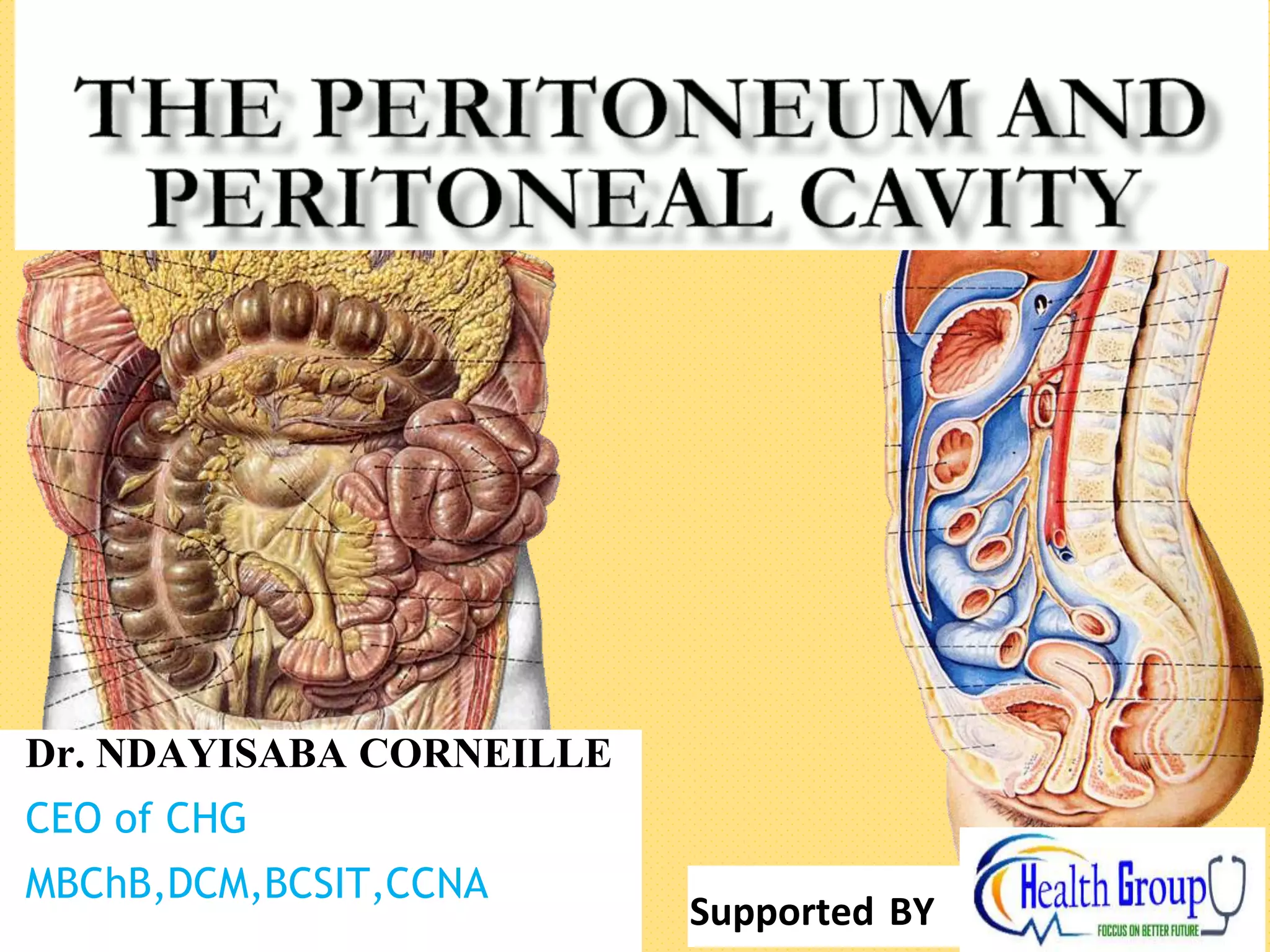
Dr. NDAYISABA CORNEILLE
CEO of CHG
MBChB,DCM,BCSIT,CCNA
Supported BY
Dr Ndayisaba Corneille
Relationship between the organs and
peritoneum
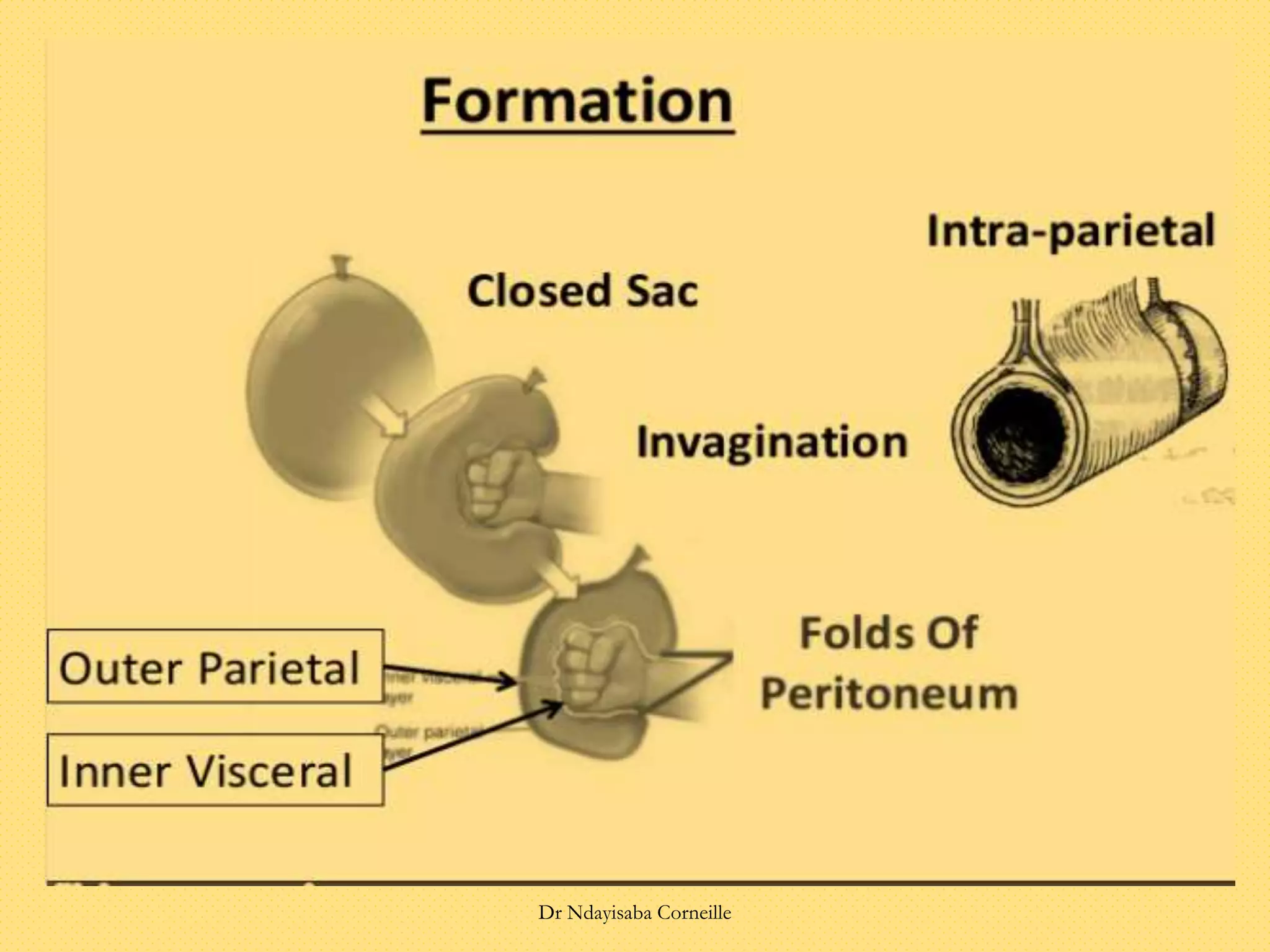
Due to intraembryonal processes the organs have different
relationship with the peritoneum.
1. Intraperitoneal organs are entirely covered with peritoneum.
They are connected to the abdominal wall with ligaments or
meso, which ensures greater mobility.
2. Extraperitoneal organs are partially or entirely devoid of
peritoneum. They are slightly movable or immovable. According
to their position these are:
а) retroperitoneal – on the posterior abdominal wall
b) subperitoneal – in the lesser pelvis
c) preperitoneal – at the anterior abdominal wall.
Dr Ndayisaba Corneille
The relationship between viscera and peritoneum
 Intraperitoneal viscera -viscera completely surrounded by peritoneum, example,
stomach, superior part of duodenum, jejunum, ileum, cecum, vermiform appendix,
transverse and sigmoid colons, spleen and ovary
 Interperitoneal viscera -most part of viscera surrounded by peritoneum,
example, liver, gallbladder, ascending and descending colon, upper part of rectum,
urinary bladder and uterus
 Retroperitoneal viscera -some organs lie on the posterior abdominal wall and
are covered by peritoneum on their anterior surfaces only, example, kidney,
suprarenal gland, pancreas, descending and horizontal parts of duodenum, middle
and lower parts of rectum, and ureter
Intraperitoneal viscera
Interperitoneal viscera
Retroperitoneal viscera
Dr Ndayisaba Corneille
 PERITONEAL LIGAMENTSS
= 2 folds of peritoneum connecting viscera to
abdominal wall
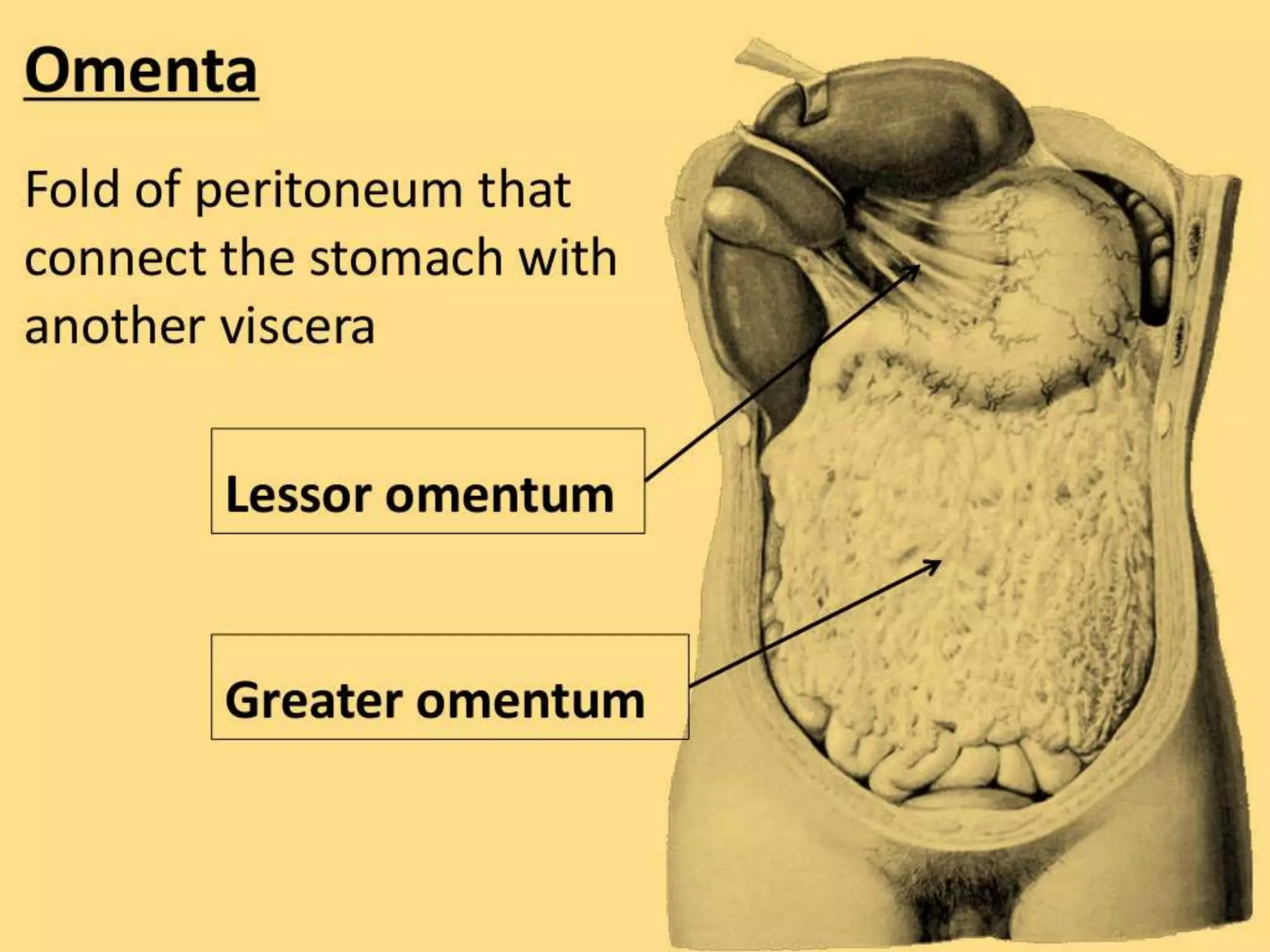
 OMENTUM
= 2 folds of peritoneum connecting stomach to
another viscus e.g. greater & lesser omenta
 MESENTERY
= 2 folds of peritoneum connecting intestines to
post abdominal wall in adults. For children it
is post and anterior
Definitions - ligs, omenta & mes
Dr Ndayisaba Corneille
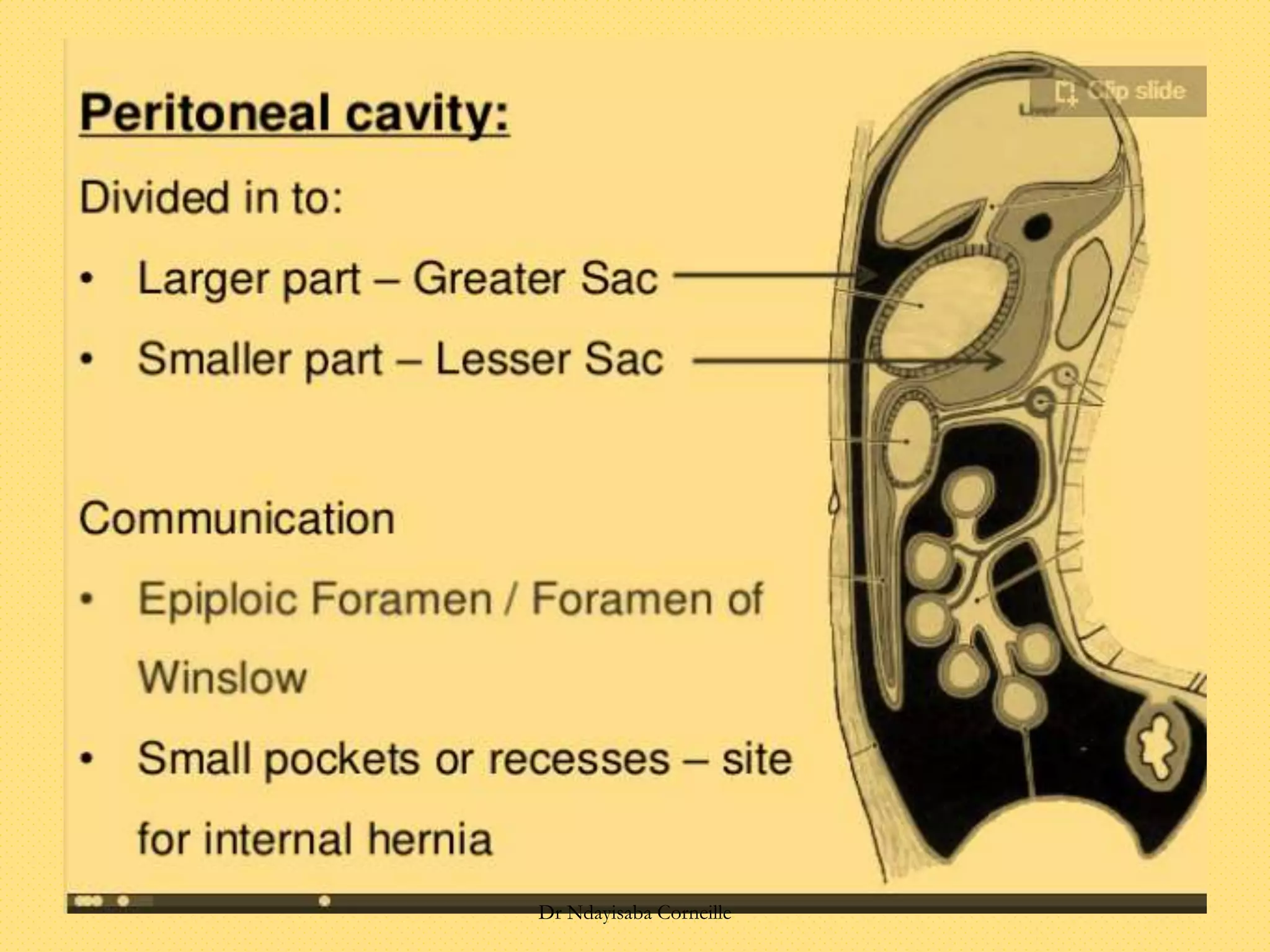
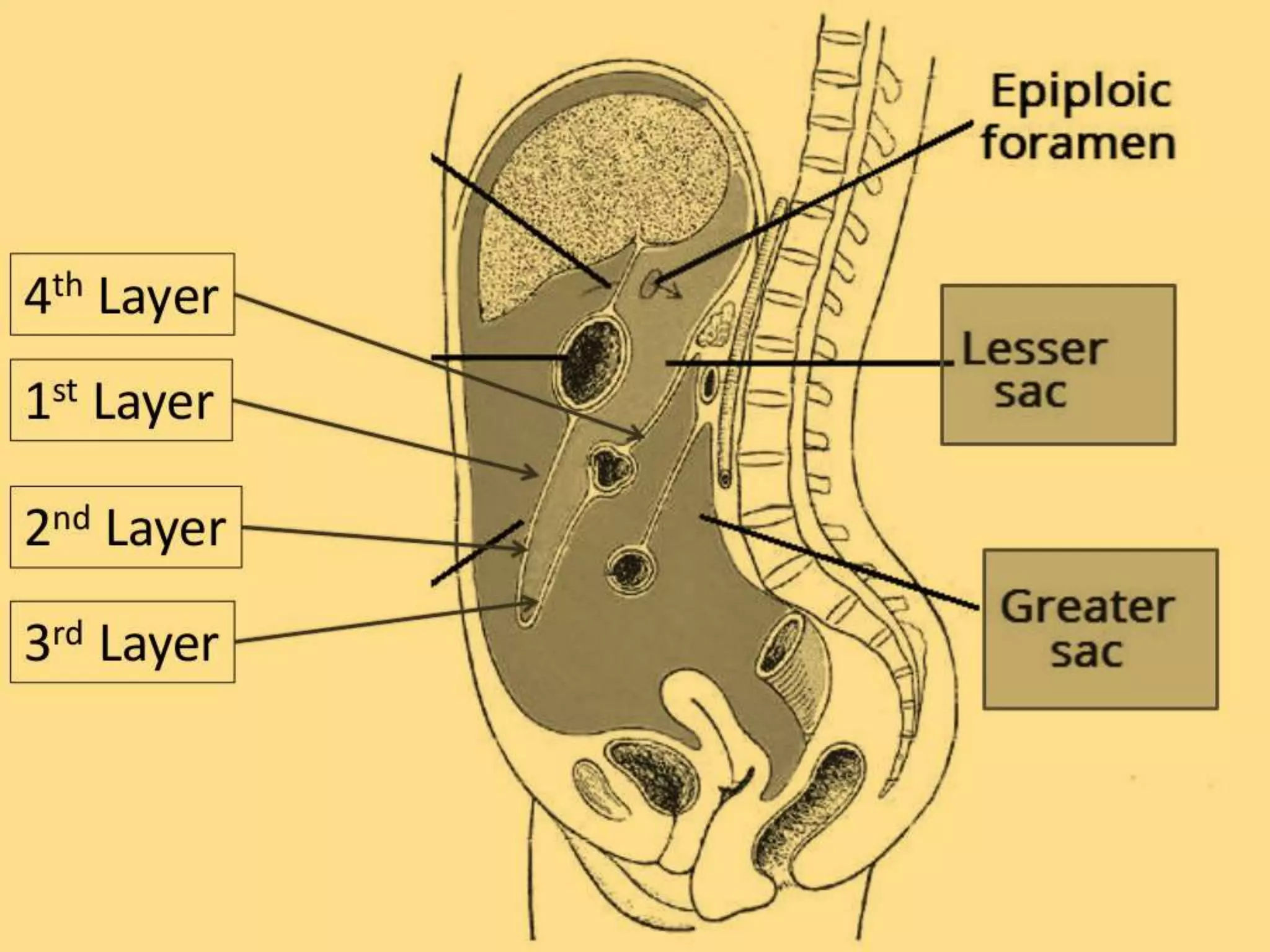
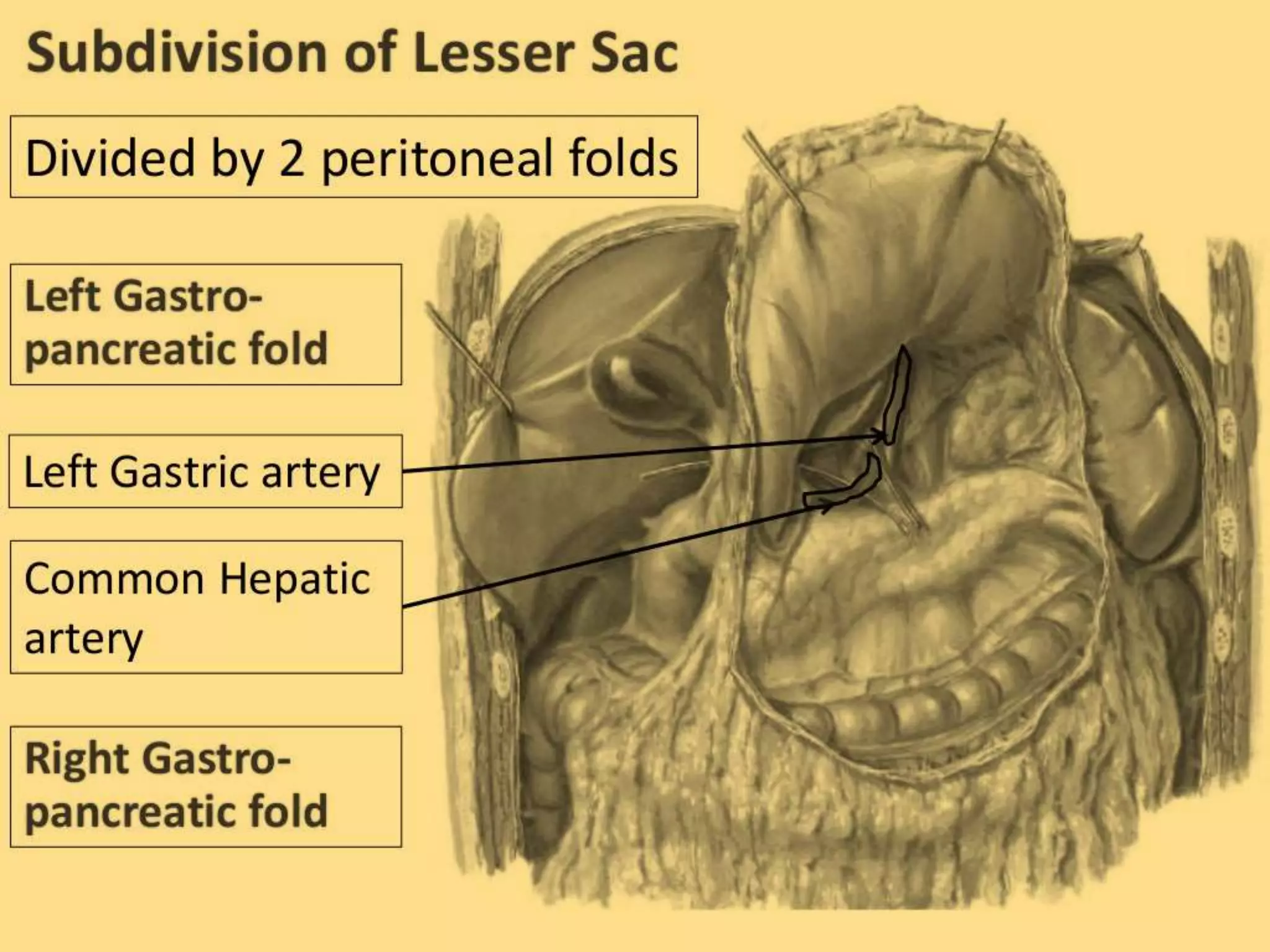
 Lesser sac
 A peritoneal pouch lies
behind stomach & lesser
omentum
 It projects upwards as far as
the diaphragm.
 Inferiorly it lies within the
folding of the greater
omentum.
 Its lower part is usually
obliterated due to fusion of
the anterior & post layers of
the greater omentum.
Dr Ndayisaba Corneille
 Greater sac
 It is the part of peritoneal
cavity which lies behind
the anterior abdominal
wall.
 Peritoneum lines the
anterior abdominal wall
then the under surface of
diaphragm, from where it
is reflected on to superior
surface of liver forming
the upper layer of
coronary ligament
Dr Ndayisaba Corneille
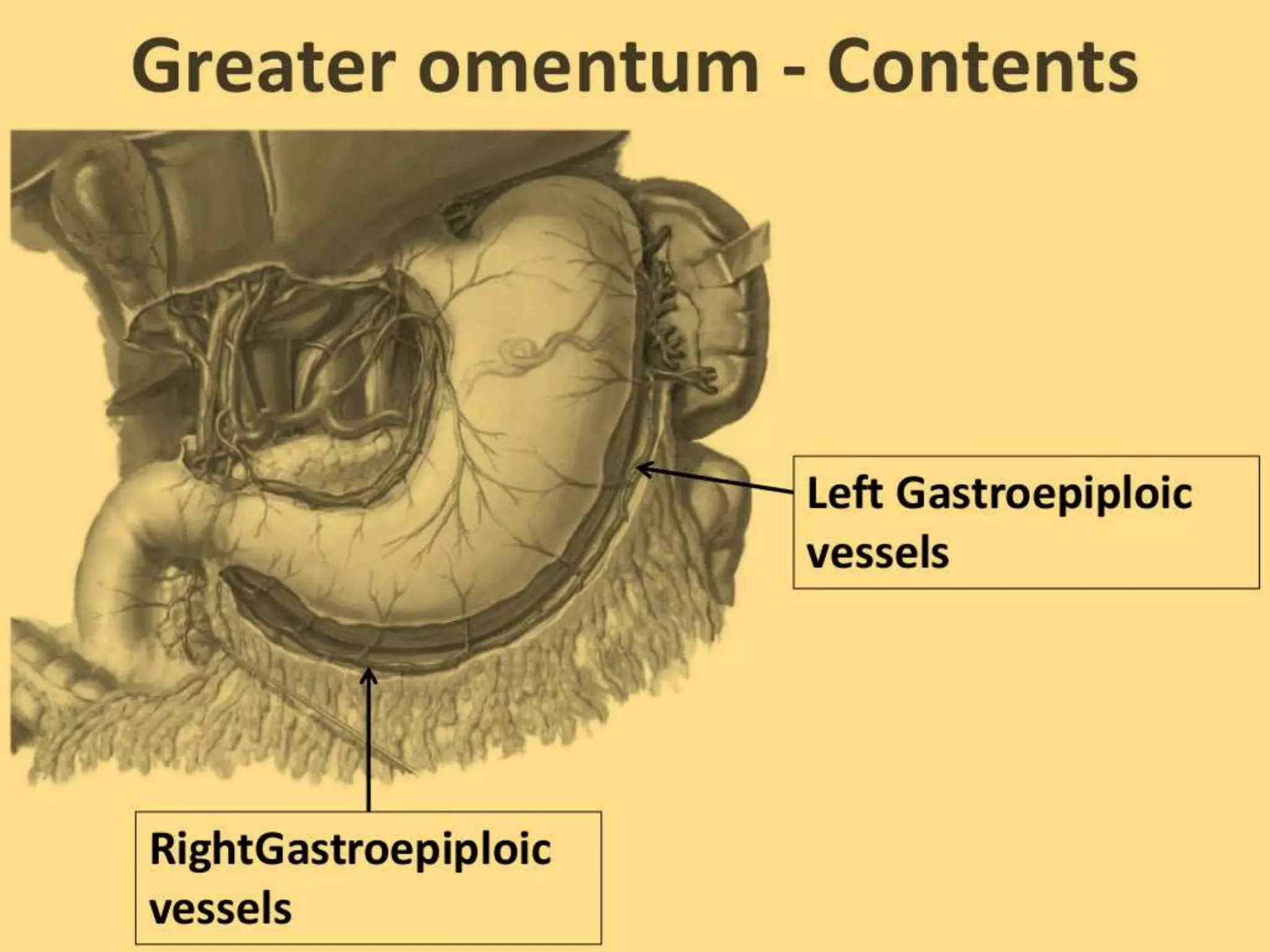
Structures which are formed by peritoneum
Omentum
-two-layered
fold of peritoneum that
extends from stomach
to adjacent organs
Dr Ndayisaba Corneille
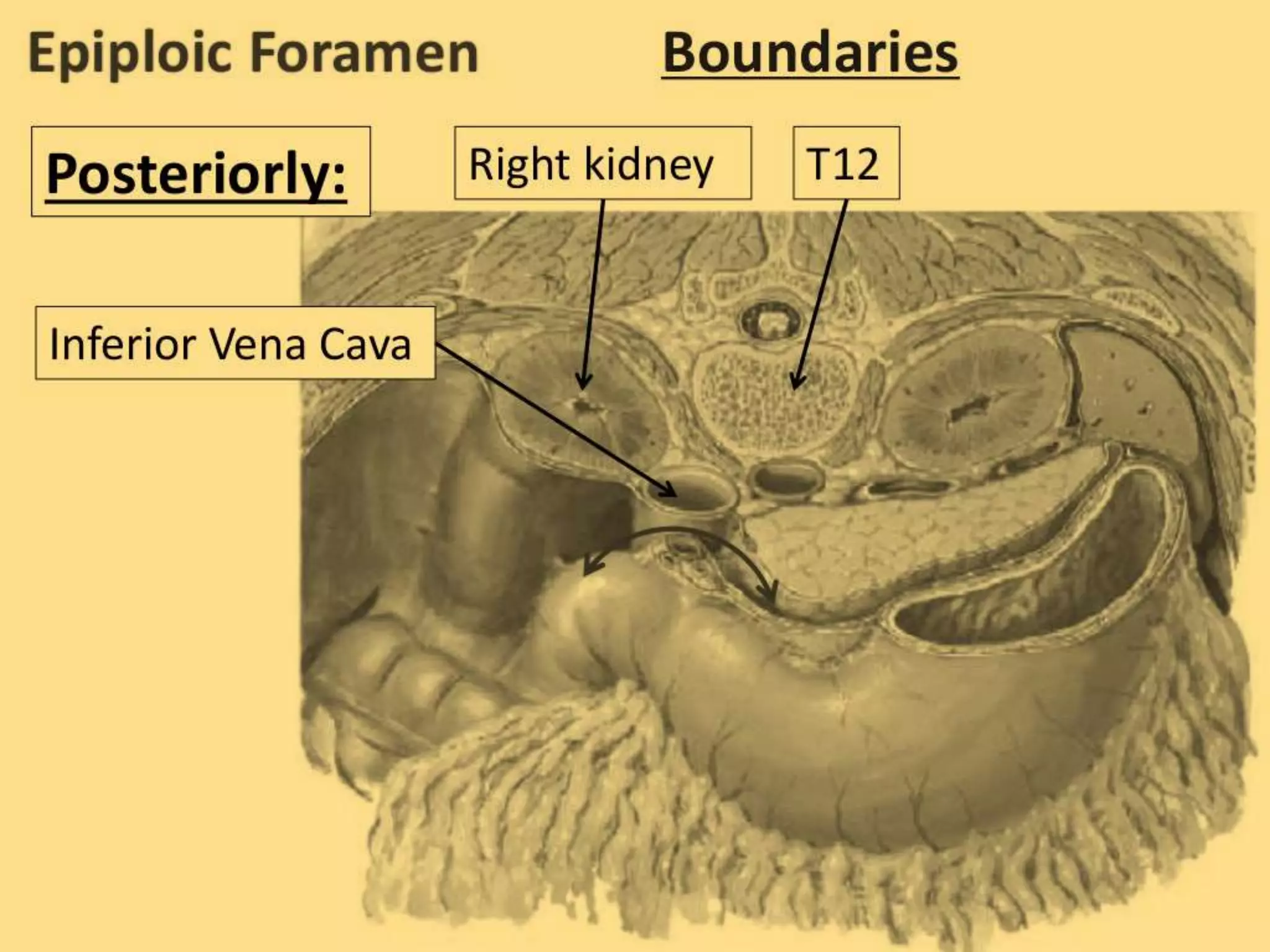
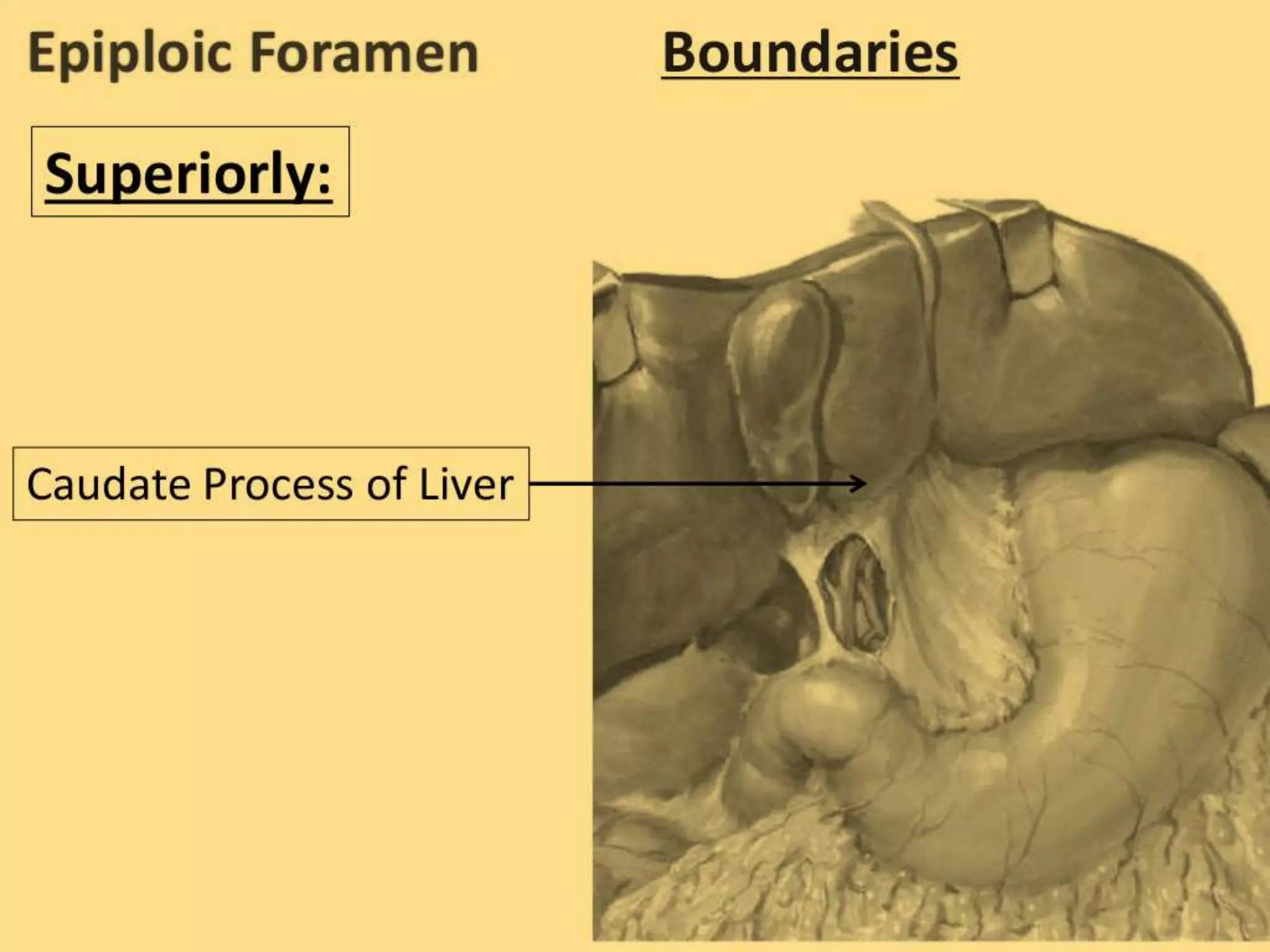
Epiploic Foramen: Boundaries
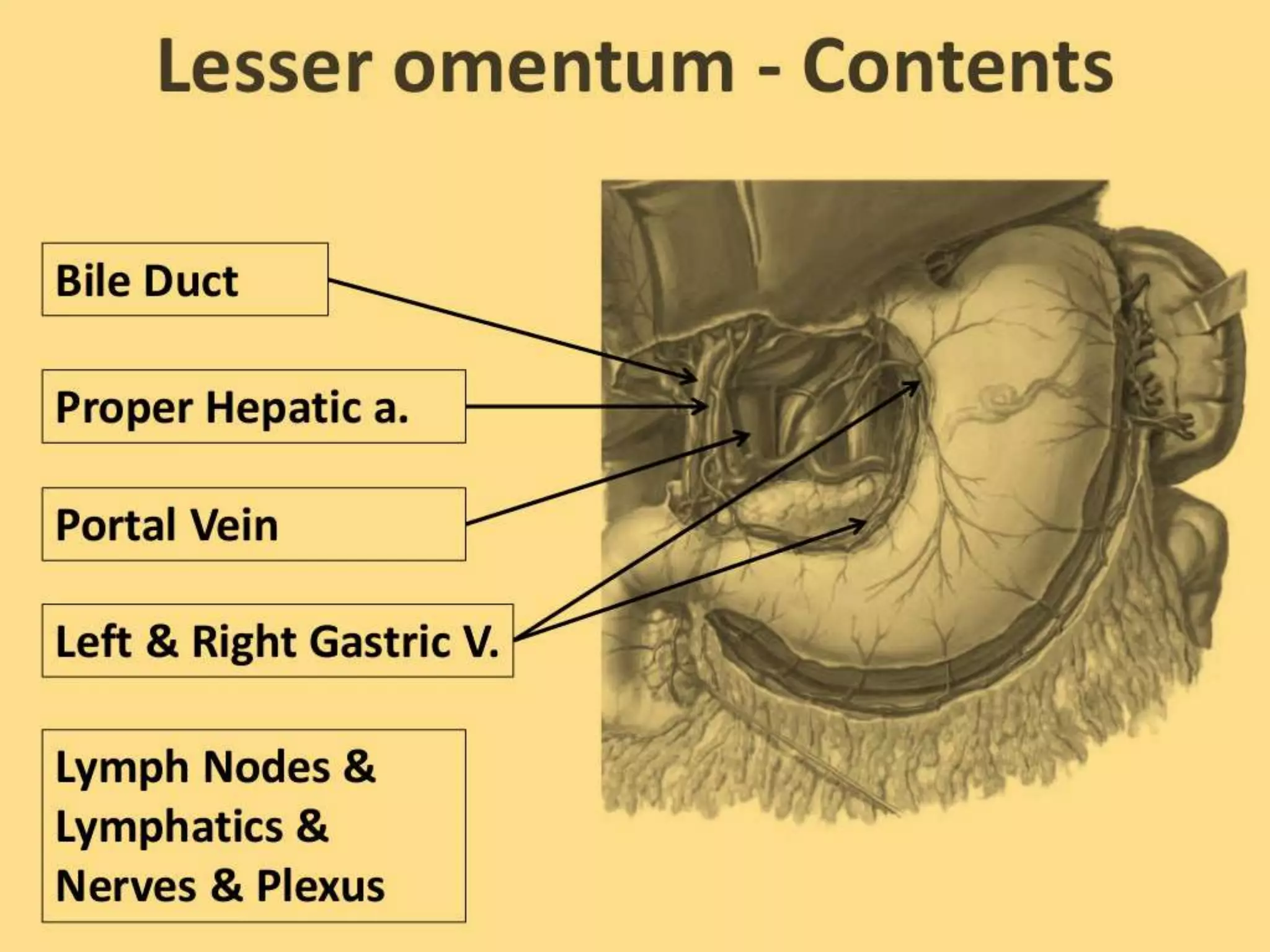
Anterior: free margin of lesser omentum, containing (hepatic
artery, bile duct and portal vein)
Posterior: peritoneum covering Inferior Venacava.
Superior: Caudate process of the caudate lobe of the liver.
Inferior: 1st inch of the1st part of duodenum.
Dr Ndayisaba Corneille
Omental bursa
Position-situated behind the lesser
omentum and stomach
Walls
 Superior-peritoneum which covers the
caudate lobe of liver and diaphragm
 Anterior-formed by lesser omentum,
peritoneum of posterior wall of stomach,
and anterior two layers of greater
omentum
 Inferior-conjunctive area of anterior
and posterior two layers of greater
omentum
 Posterior-formed by posterior two
layers of greater omentum, transverse
colon and transverse mesocolon,
peritoneum covering pancreas, left
kidney and suprarenal gland
Dr Ndayisaba Corneille
 Left-formed by the
spleen, gastrosplenic
ligament and
splenorenal ligament
 Right-formed by
omental foramen
The Omental bursa (lesser
sac) communicates with
the greater sac through
the omental foramen.
Dr Ndayisaba Corneille
Mesenteries or mesocolons
This are two-layered fold of
peritoneum that attach part of
the intestines to the posterior
abdominal wall
Dr Ndayisaba Corneille
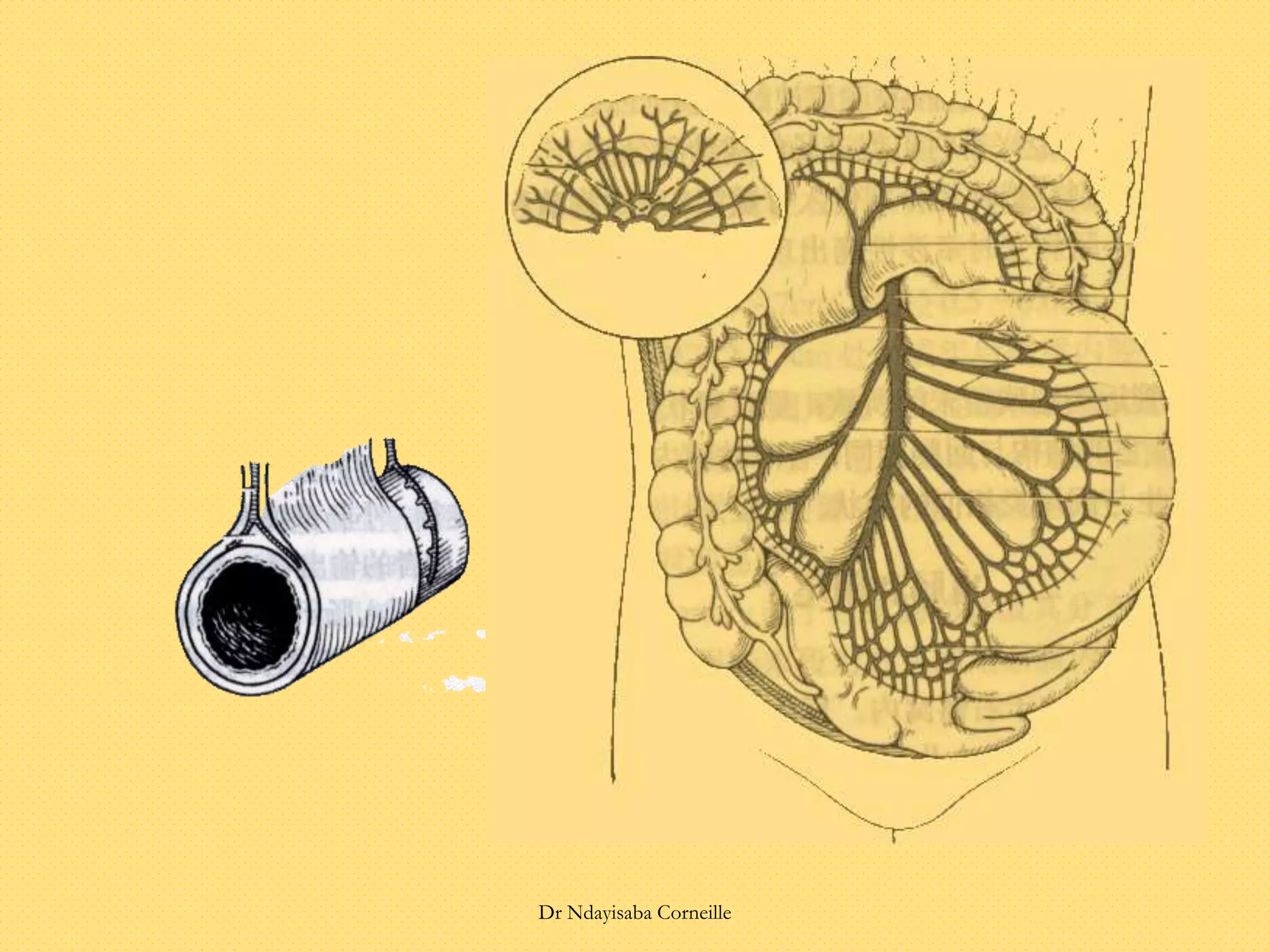
-suspends the small intestine
from the posterior
abdominal wall
 Broad and a fan-shaped
 Consists of two peritoneal
layers
 Intestinal border-folded, 7
m long
 Radix of mesentery
 15 cm long
 Directed obliquely from left
side of L2 to in front of right
sacroiliac joint
Mesentery
Dr Ndayisaba Corneille
Mesoappendix
 Triangular mesentery-
extends from terminal part
of ileum to appendix
 Appendicular artery runs
in free margin of the
mesoappendix
Dr Ndayisaba Corneille
Transverse mesocolon
-a double fold of
peritoneum which connects
the transverse colon to the
posterior abdominal wall
Sigmoid mesocolon
-inverted V-shaped, with
apex located in front of left
ureter and division of
common iliac artery
Dr Ndayisaba Corneille
Ligaments
Two-layered folds of peritoneum that attached the
lesser mobile solid visera to the abdominal wall.
Dr Ndayisaba Corneille
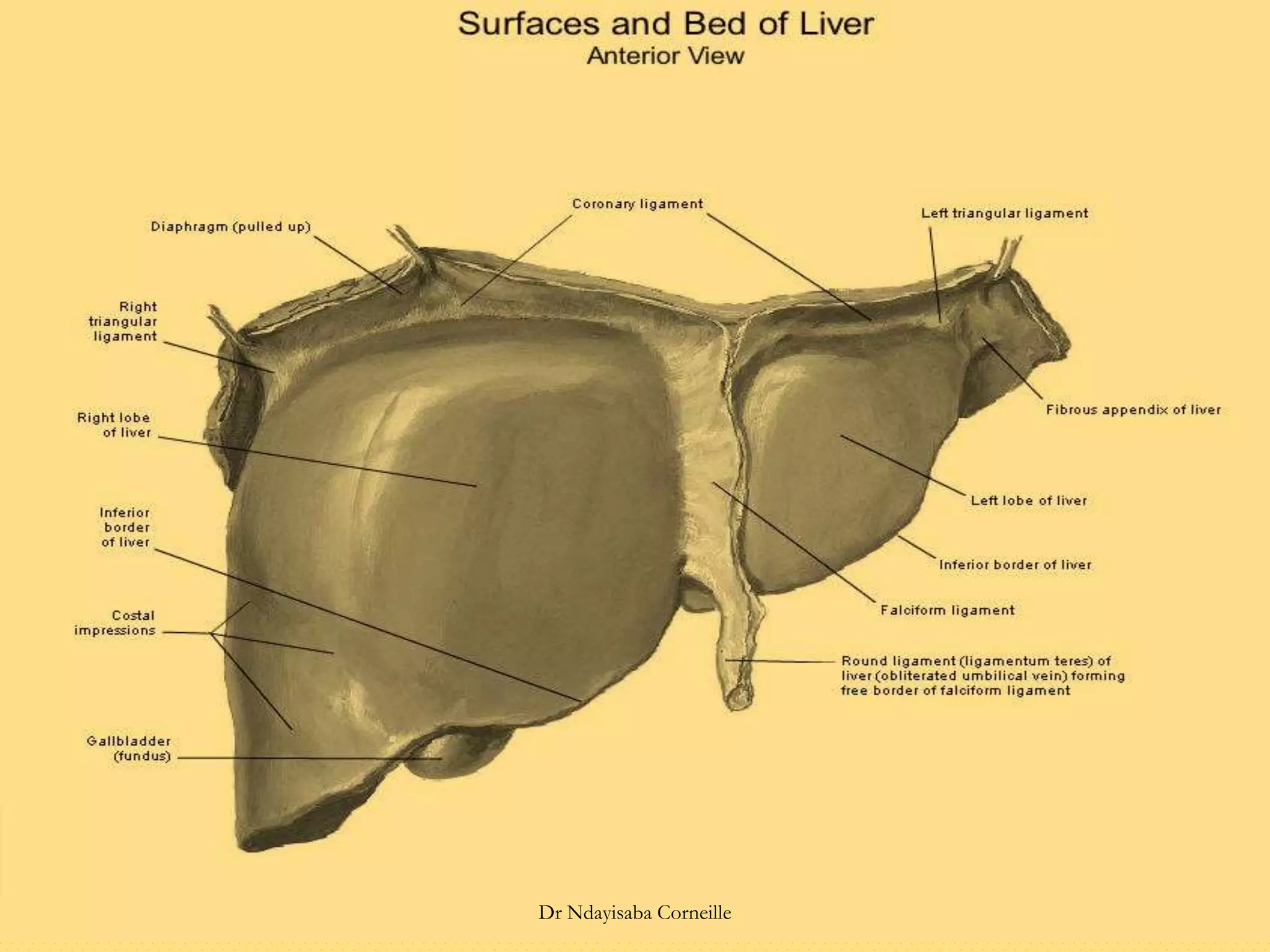
1. The ligaments of the liver
① The falciform ligament of liver
② The ligamentum teres hepatis
③ The coronary ligament
④ The right triangular ligament
⑤ The left triangular ligament
⑥ The hepatogastric ligament
⑦ The hepatoduonedenal ligament
Dr Ndayisaba Corneille
Falciform ligament of
liver
 Consists of double
peritoneal layer
 Sickeleshape
 Extends from anterior
abdominal wall
(umbilicus) to liver
 Free border of the
ligament contains
Ligamentum teres
(obliterated umbilical
vein)
Dr Ndayisaba Corneille
 Coronary ligament
the area between upper
and lower layer of the
coronary ligament is the
bare area of liver which
contract with the
diaphragm;
 Left and right
triangular ligaments
formed by left and right
extremity of coronary
ligament
Dr Ndayisaba Corneille
 Hepatogastric
ligament
 Hepatoduodenal
ligament
Dr Ndayisaba Corneille
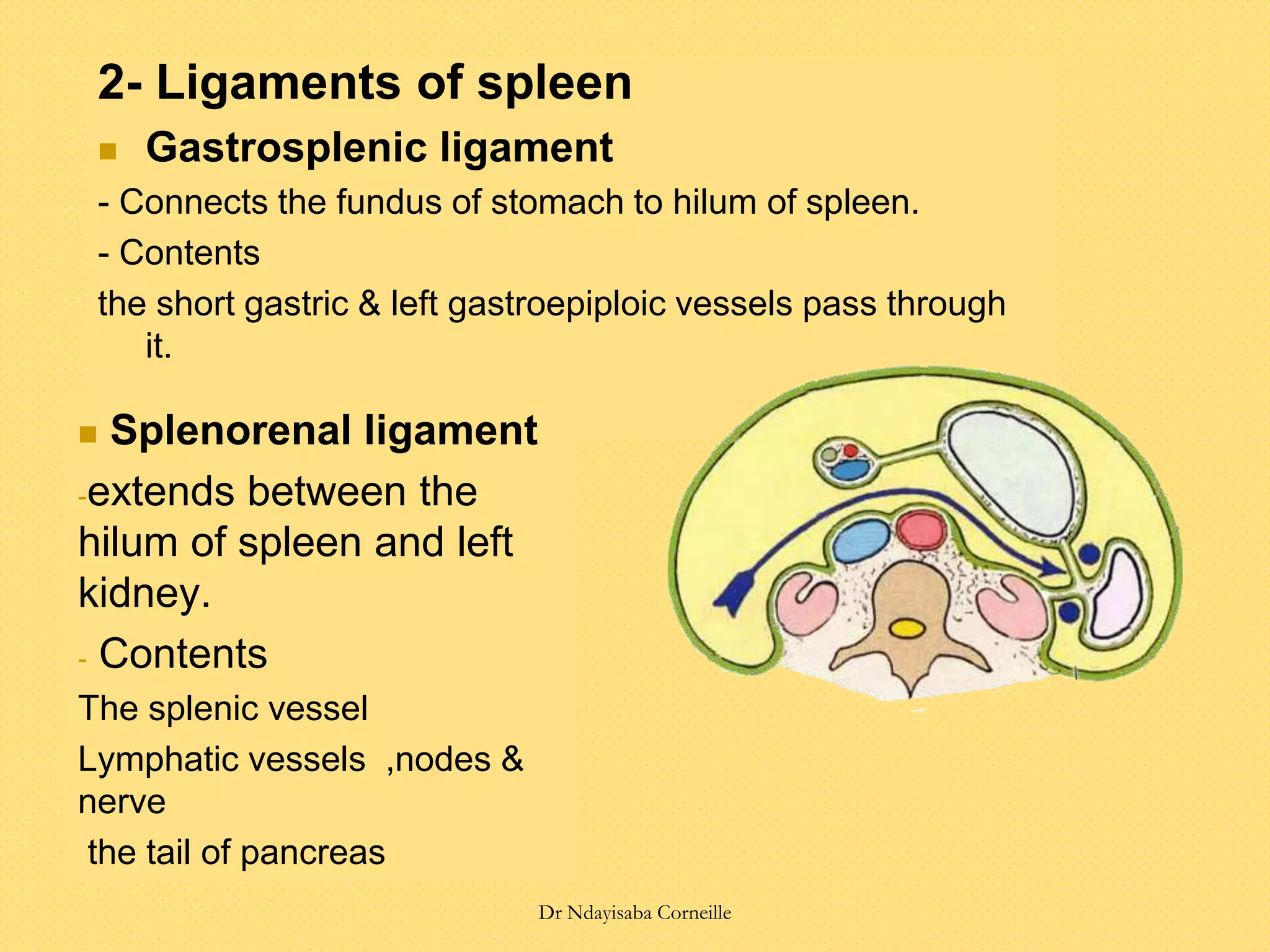
2- Ligaments of spleen
 Gastrosplenic ligament
- Connects the fundus of stomach to hilum of spleen.
- Contents
the short gastric & left gastroepiploic vessels pass through
it.
 Splenorenal ligament
-extends between the
hilum of spleen and left
kidney.
- Contents
The splenic vessel
Lymphatic vessels ,nodes &
nerve
the tail of pancreas
Dr Ndayisaba Corneille
Ligaments of spleen
 Phrenicosplenic ligament
 Splenocolic ligament
Dr Ndayisaba Corneille
3- Ligaments of stomach
 Hepatogastric ligament
 Gastrosplenic ligament
 Gastrophrenic ligament
 Gastrocolic ligament
 Gastropancrestic ligament
Dr Ndayisaba Corneille
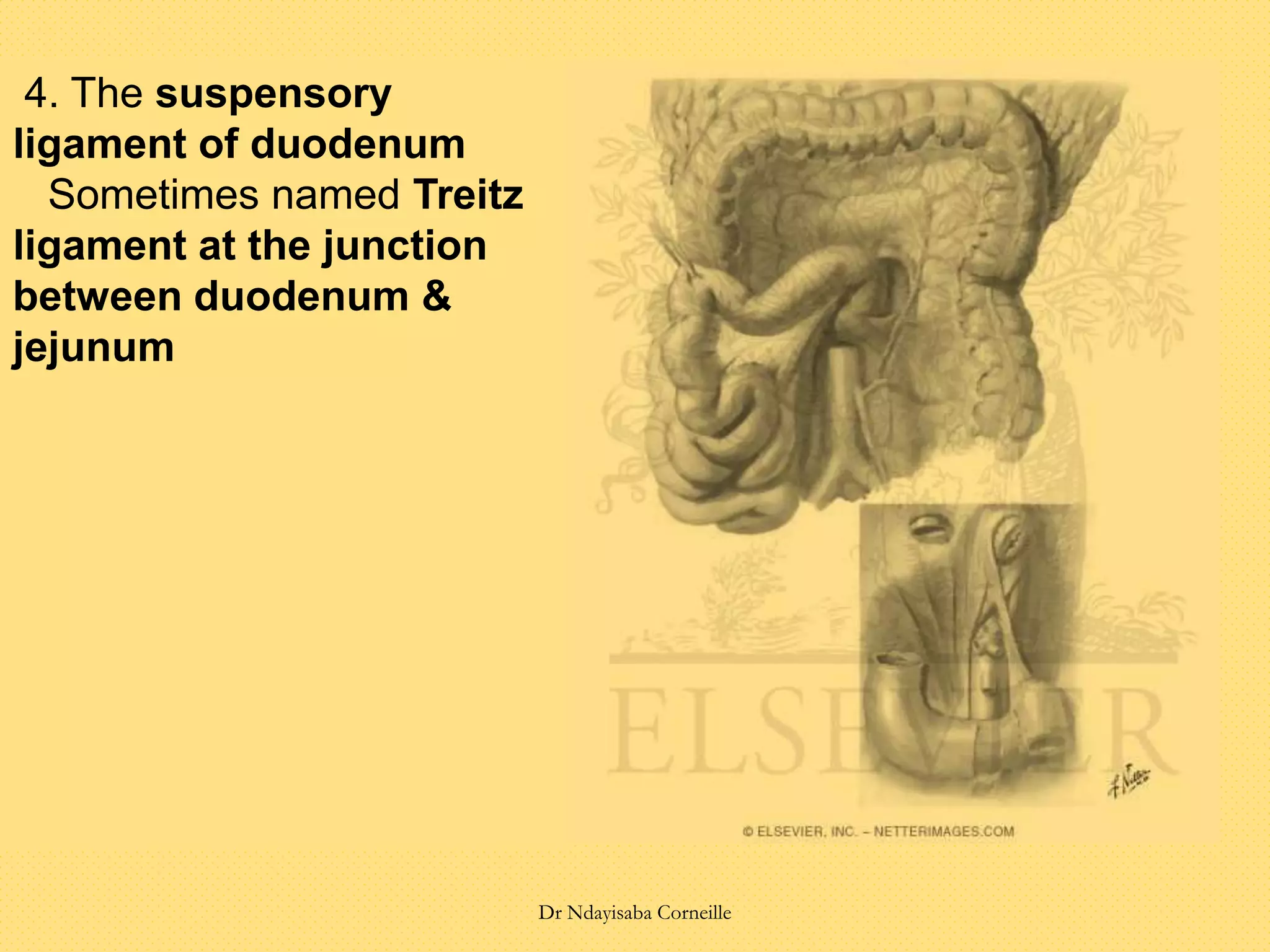
4. The suspensory
ligament of duodenum
Sometimes named Treitz
ligament at the junction
between duodenum &
jejunum
Dr Ndayisaba Corneille
5. The phrenicocolic ligament
It is a fold of peritoneum which is continued
from the left colic flexure to the diaphragm
opposite the 10th and 12th ribs.
Dr Ndayisaba Corneille
Folds and recesses of posterior abdominal wall
 Superior duodenal
fold and recess
 Inferior duodenal fold
and recess
 Intersigmoid recess
-formed by the
inverted V attachment
of sigmoid mesocolon
Dr Ndayisaba Corneille
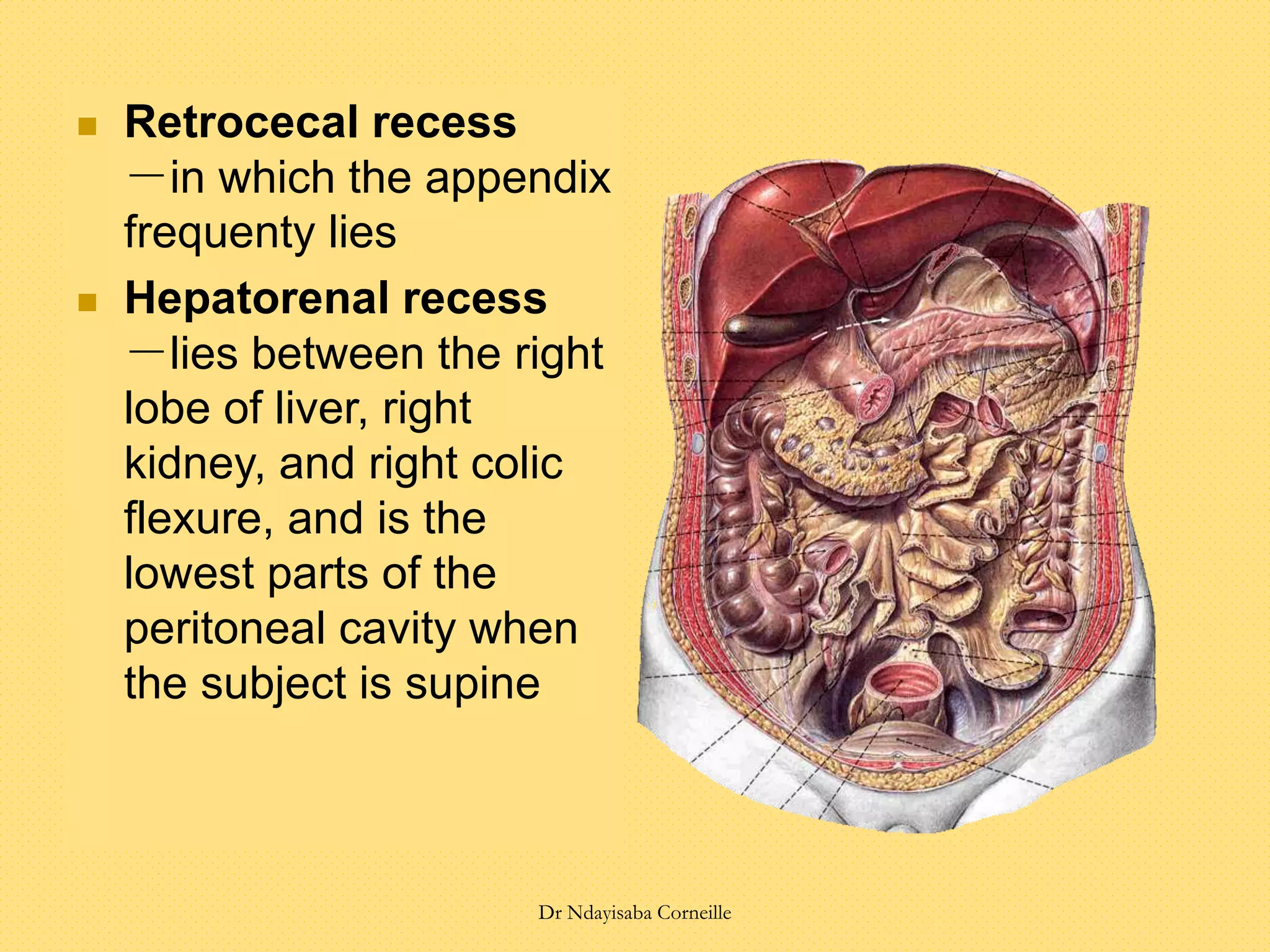
 Retrocecal recess
-in which the appendix
frequenty lies
 Hepatorenal recess
-lies between the right
lobe of liver, right
kidney, and right colic
flexure, and is the
lowest parts of the
peritoneal cavity when
the subject is supine
Dr Ndayisaba Corneille
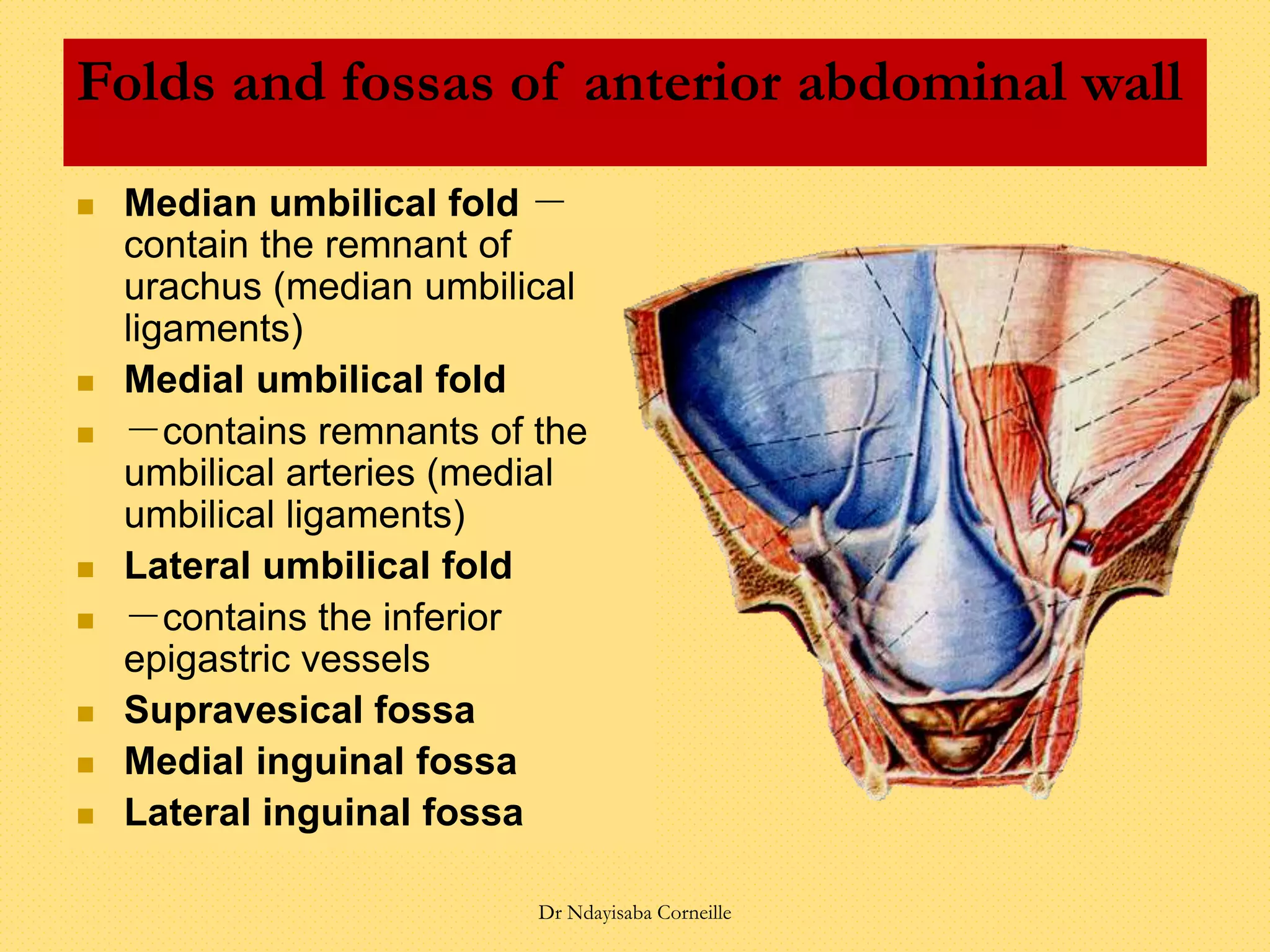
Folds and fossas of anterior abdominal wall
 Median umbilical fold -
contain the remnant of
urachus (median umbilical
ligaments)
 Medial umbilical fold
 -contains remnants of the
umbilical arteries (medial
umbilical ligaments)
 Lateral umbilical fold
 -contains the inferior
epigastric vessels
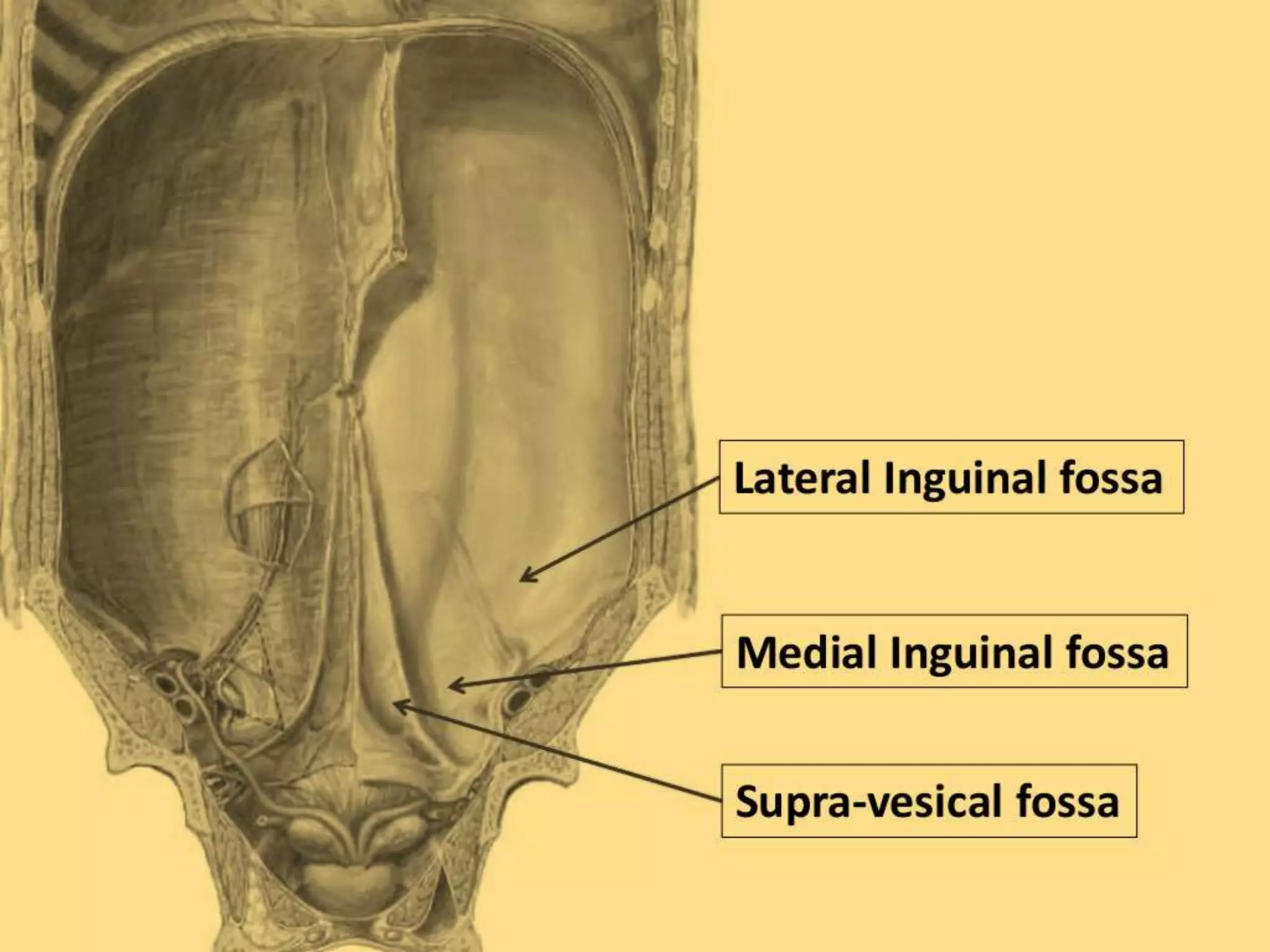
 Supravesical fossa
 Medial inguinal fossa
 Lateral inguinal fossa
Dr Ndayisaba Corneille
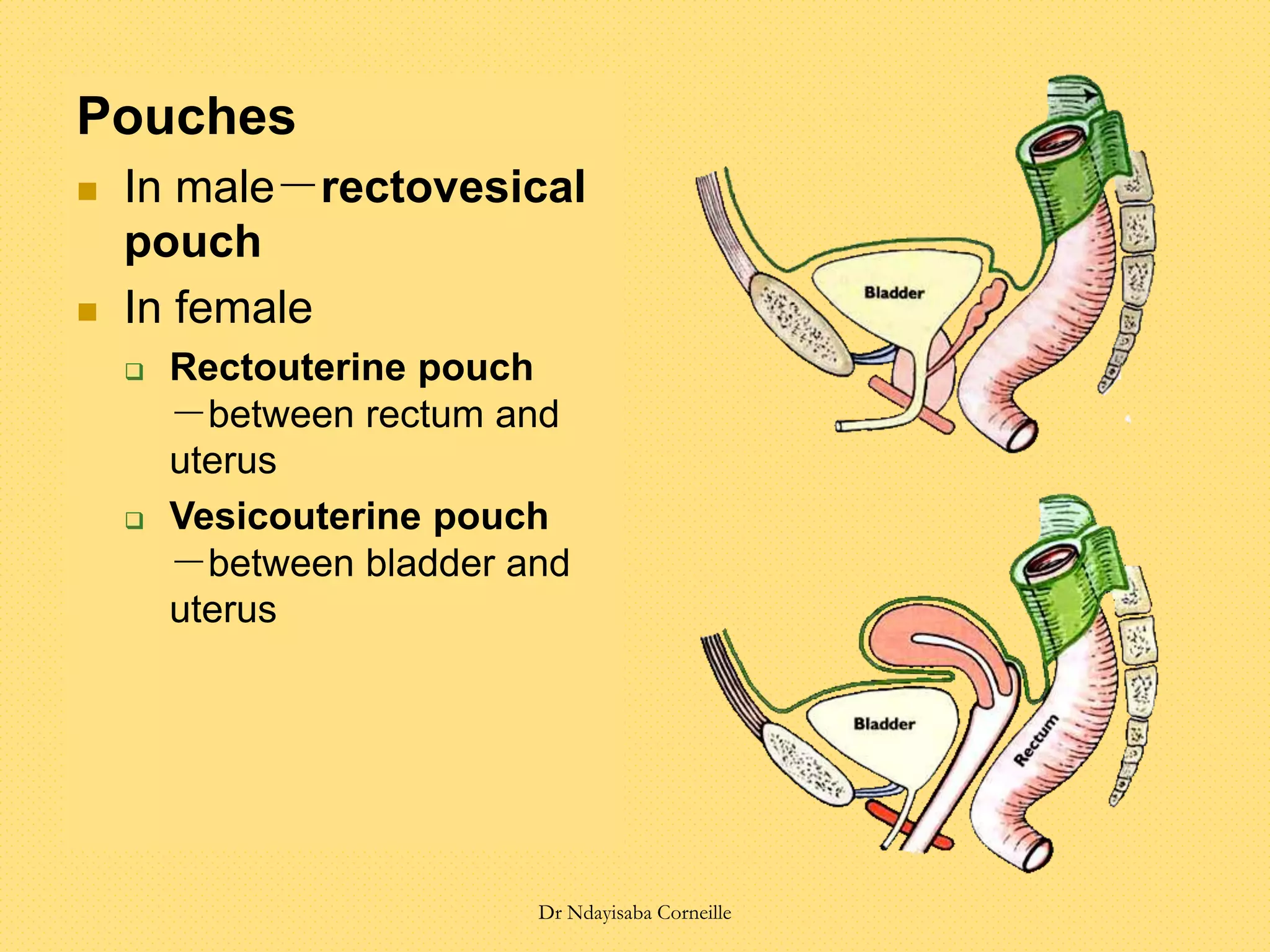
Pouches
 In male-rectovesical
pouch
 In female
 Rectouterine pouch
-between rectum and
uterus
 Vesicouterine pouch
-between bladder and
uterus
Dr Ndayisaba Corneille
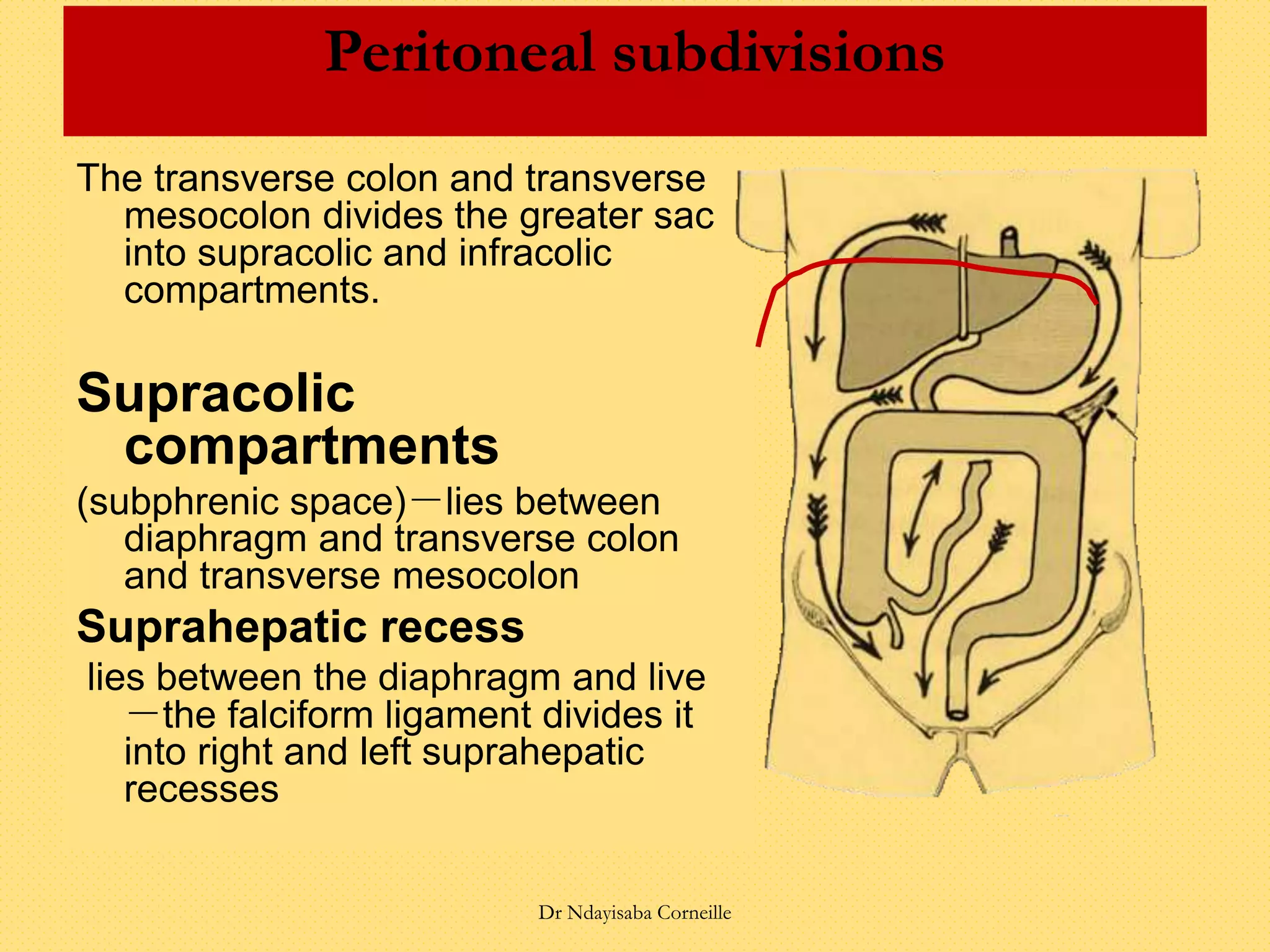
Peritoneal subdivisions
The transverse colon and transverse
mesocolon divides the greater sac
into supracolic and infracolic
compartments.
Supracolic
compartments
(subphrenic space)-lies between
diaphragm and transverse colon
and transverse mesocolon
Suprahepatic recess
lies between the diaphragm and live
-the falciform ligament divides it
into right and left suprahepatic
recesses
Dr Ndayisaba Corneille
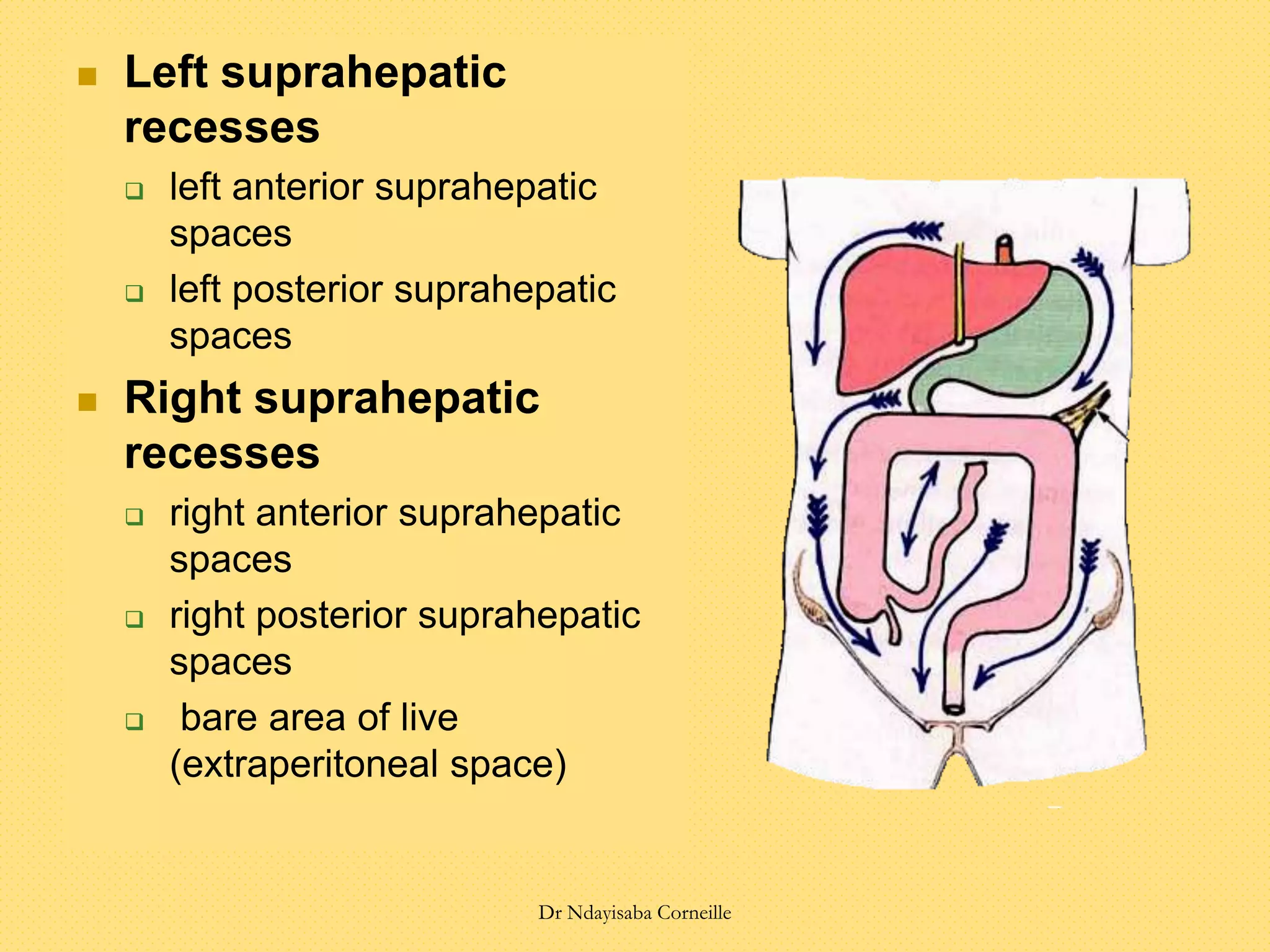
 Left suprahepatic
recesses
 left anterior suprahepatic
spaces
 left posterior suprahepatic
spaces
 Right suprahepatic
recesses
 right anterior suprahepatic
spaces
 right posterior suprahepatic
spaces
 bare area of live
(extraperitoneal space)
Dr Ndayisaba Corneille
Infrahepatic recess
lies between the liver and
transverse colon and
transverse mesocolon-the
ligamentum teres hepatic
divides it into right and left
infrahepatic recesses
 Right infrahepatic
recesses (hepatorenal
recess)
 Left infrahepatic recesses
 left anterior infrahepatic space
 left posterior infrahepatic space
Dr Ndayisaba Corneille
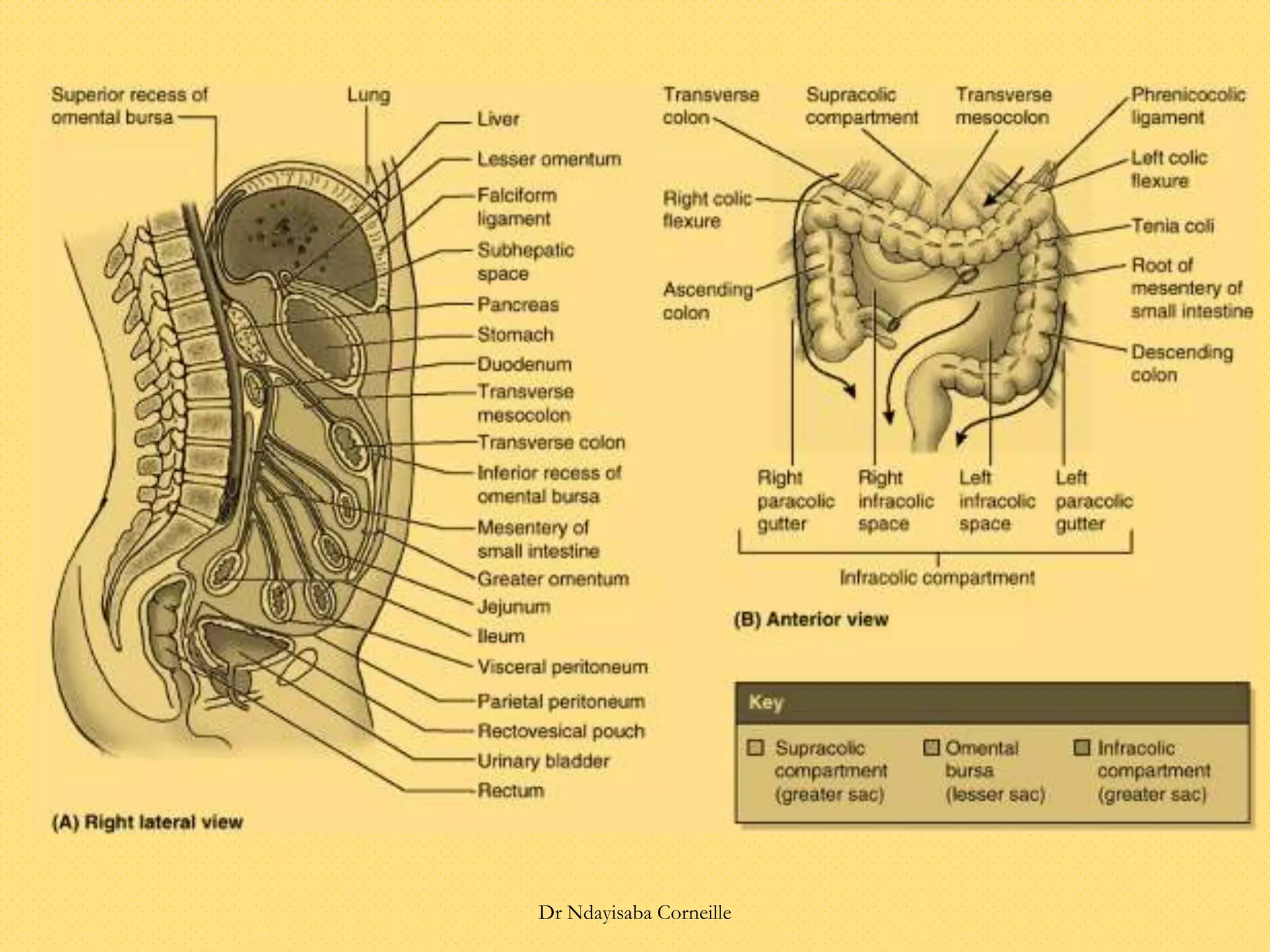
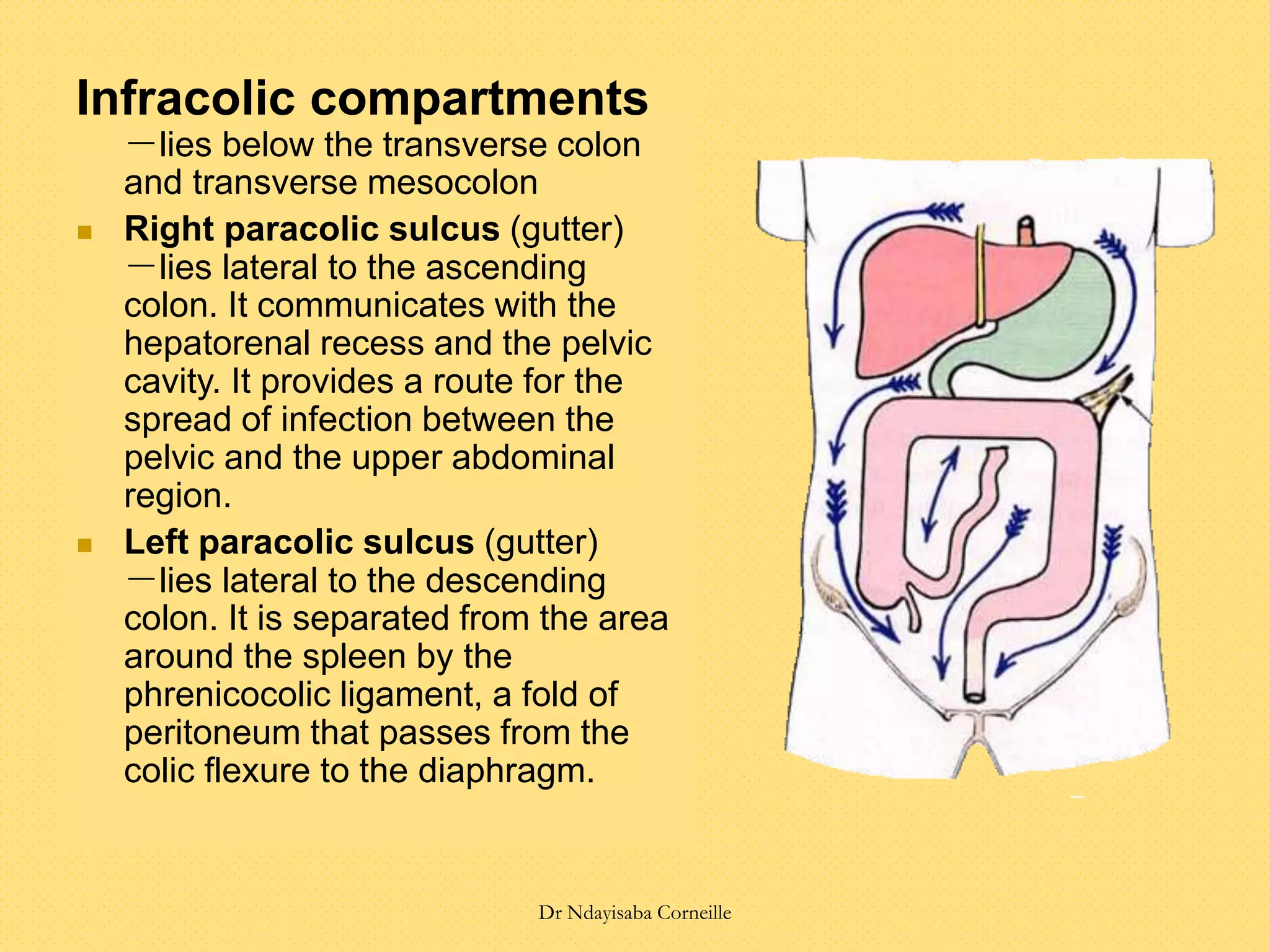
Infracolic compartments
-lies below the transverse colon
and transverse mesocolon
 Right paracolic sulcus (gutter)
-lies lateral to the ascending
colon. It communicates with the
hepatorenal recess and the pelvic
cavity. It provides a route for the
spread of infection between the
pelvic and the upper abdominal
region.
 Left paracolic sulcus (gutter)
-lies lateral to the descending
colon. It is separated from the area
around the spleen by the
phrenicocolic ligament, a fold of
peritoneum that passes from the
colic flexure to the diaphragm.
Dr Ndayisaba Corneille
 Right mesenteric sinus
-triangular space, lies between root
of mesentery, ascending colon, right
2/3 of transverse colon and
transverse mesocolon
 Left mesenteric sinus
-lies between root of mesentery,
descending colon, right 1/3 of
transverse colon and transverse
mesocolon, its widens below where
it is continuous with the cavity of the
pelvis
Dr Ndayisaba Corneille
 Ascites: Is the excessive accumulation of the peritoneal fluid within
the peritoneal cavity.
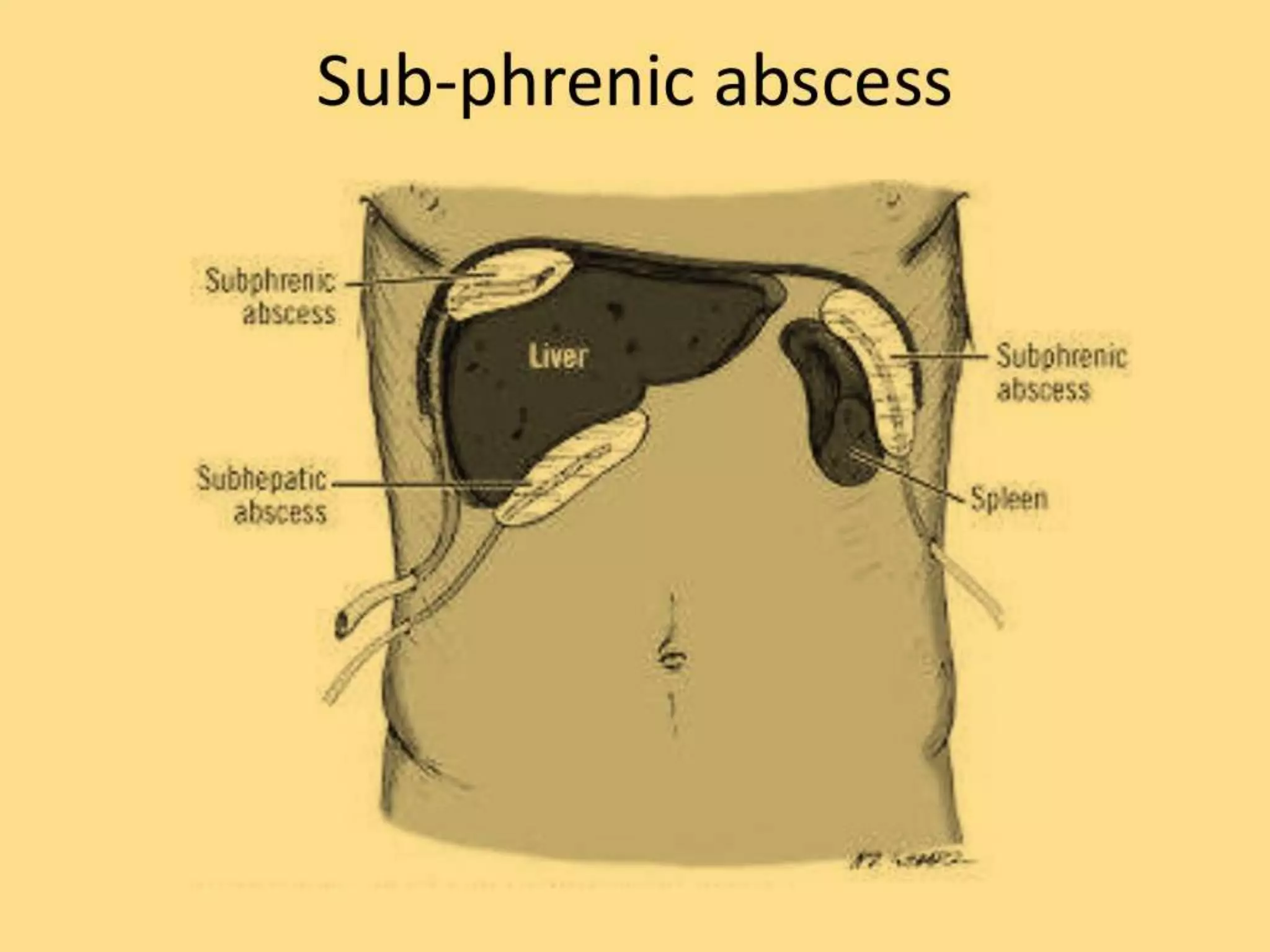
 . The infection may spread into the peritoneal cavity and cause
inflammation of the peritoneum which is called as peritonitis. The
infected fluid may tend to collect in the most dependent area of the
peritoneal cavity in supine position, these areas are pelvis and the
right subphrenic space. In such condition the patient complains of
pain in the shoulder.
 Peritoneal Pain: abdominal pain arising due to the parietal
peritoneum can be localised as it is supplied by the somatic nerves
T7-T12 and L1. An inflamed parietal peritoneum is extremely
sensitive to stretching. This fact is made use of clinically in
diagnosing peritonitis. Pressure is applied to the abdominal wall with
a single finger over the site of the inflammation. The pressure is then
removed by suddenly withdrawing the finger. The abdominal wall
rebounds, resulting in extreme local pain, which is known as
rebound tenderness
Applied anatomy
Dr Ndayisaba Corneille
 Pain arising from the visceral peritoneum is dull and
poorly localized as the visceral peritoneum is supplied by
the autonomic nerves.
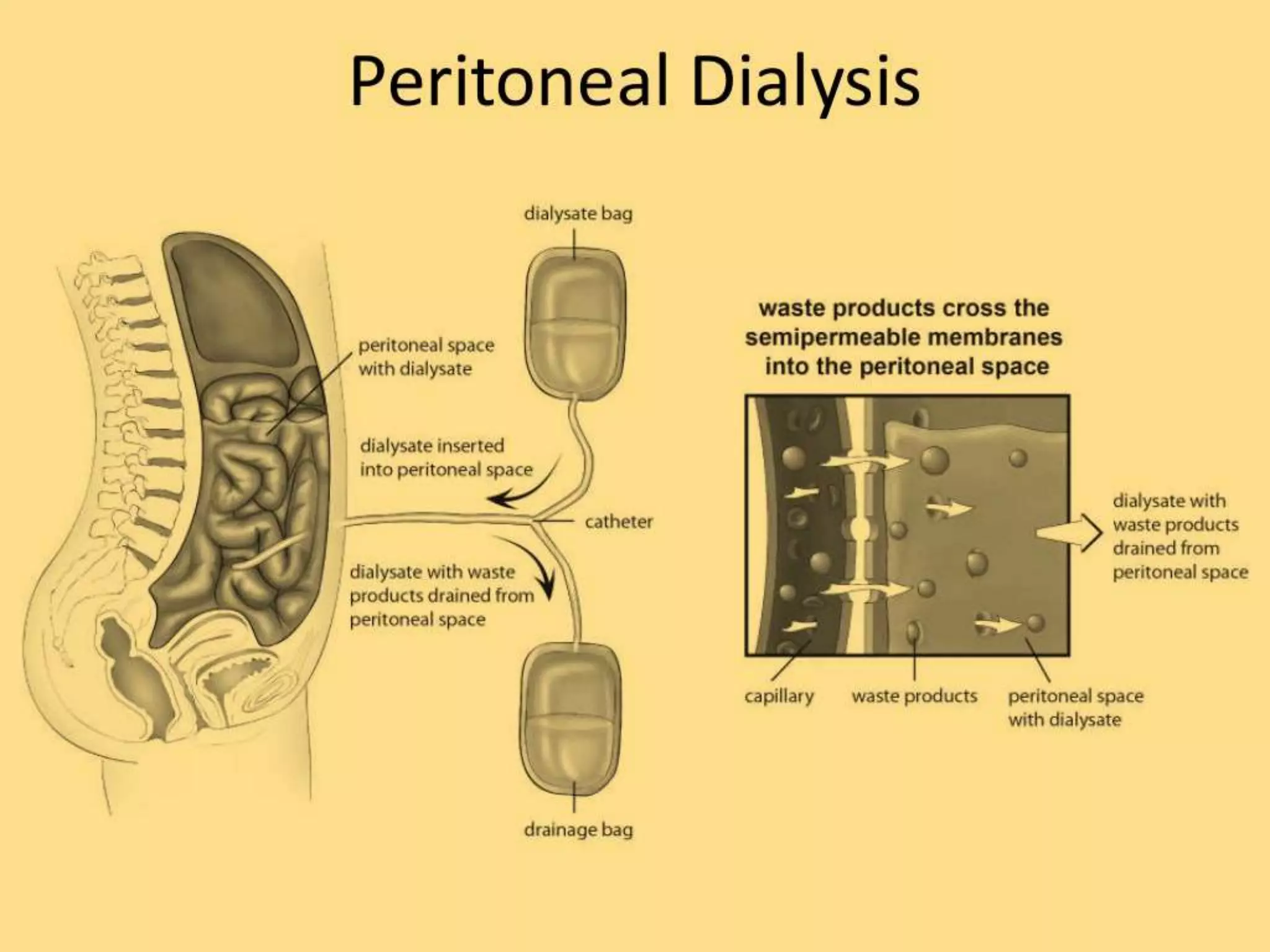
 Peritoneal Dialysis: Because the peritoneum is a semi
permeable membrane, it allows rapid bidirectional
transfer of substances across itself. Because the surface
area of the peritoneum is enormous, this transfer
property has been made use of in patients with acute
renal insufficiency.
 Internal abdominal hernia: occasionally a loop of
intestine may enter into the peritoneal pouch or recesses
and gets strangulated, this is called as internal
abdominal hernia.
Dr Ndayisaba Corneille
END
Dr Ndayisaba Corneille
THANKS FOR LISTENING
By
DR NDAYISABA CORNEILLE
MBChB,DCM,BCSIT,CCNA
Contact us:
amentalhealths@gmail.com/
ndayicoll@gmail.com
whatsaps :+256772497591
/+250788958241

The peritoneum and peritoneal cavity.pptx

  • 1.
    Dr. NDAYISABA CORNEILLE CEOof CHG MBChB,DCM,BCSIT,CCNA Supported BY
  • 2.
  • 3.
  • 4.
  • 5.
  • 6.
  • 7.
  • 8.
    Relationship between theorgans and peritoneum Due to intraembryonal processes the organs have different relationship with the peritoneum. 1. Intraperitoneal organs are entirely covered with peritoneum. They are connected to the abdominal wall with ligaments or meso, which ensures greater mobility. 2. Extraperitoneal organs are partially or entirely devoid of peritoneum. They are slightly movable or immovable. According to their position these are: а) retroperitoneal – on the posterior abdominal wall b) subperitoneal – in the lesser pelvis c) preperitoneal – at the anterior abdominal wall. Dr Ndayisaba Corneille
  • 9.
    The relationship betweenviscera and peritoneum  Intraperitoneal viscera -viscera completely surrounded by peritoneum, example, stomach, superior part of duodenum, jejunum, ileum, cecum, vermiform appendix, transverse and sigmoid colons, spleen and ovary  Interperitoneal viscera -most part of viscera surrounded by peritoneum, example, liver, gallbladder, ascending and descending colon, upper part of rectum, urinary bladder and uterus  Retroperitoneal viscera -some organs lie on the posterior abdominal wall and are covered by peritoneum on their anterior surfaces only, example, kidney, suprarenal gland, pancreas, descending and horizontal parts of duodenum, middle and lower parts of rectum, and ureter Intraperitoneal viscera Interperitoneal viscera Retroperitoneal viscera Dr Ndayisaba Corneille
  • 13.
     PERITONEAL LIGAMENTSS =2 folds of peritoneum connecting viscera to abdominal wall  OMENTUM = 2 folds of peritoneum connecting stomach to another viscus e.g. greater & lesser omenta  MESENTERY = 2 folds of peritoneum connecting intestines to post abdominal wall in adults. For children it is post and anterior Definitions - ligs, omenta & mes Dr Ndayisaba Corneille
  • 14.
     Lesser sac A peritoneal pouch lies behind stomach & lesser omentum  It projects upwards as far as the diaphragm.  Inferiorly it lies within the folding of the greater omentum.  Its lower part is usually obliterated due to fusion of the anterior & post layers of the greater omentum. Dr Ndayisaba Corneille
  • 15.
  • 16.
     Greater sac It is the part of peritoneal cavity which lies behind the anterior abdominal wall.  Peritoneum lines the anterior abdominal wall then the under surface of diaphragm, from where it is reflected on to superior surface of liver forming the upper layer of coronary ligament Dr Ndayisaba Corneille
  • 17.
    Structures which areformed by peritoneum Omentum -two-layered fold of peritoneum that extends from stomach to adjacent organs Dr Ndayisaba Corneille
  • 29.
    Epiploic Foramen: Boundaries Anterior:free margin of lesser omentum, containing (hepatic artery, bile duct and portal vein) Posterior: peritoneum covering Inferior Venacava. Superior: Caudate process of the caudate lobe of the liver. Inferior: 1st inch of the1st part of duodenum. Dr Ndayisaba Corneille
  • 36.
    Omental bursa Position-situated behindthe lesser omentum and stomach Walls  Superior-peritoneum which covers the caudate lobe of liver and diaphragm  Anterior-formed by lesser omentum, peritoneum of posterior wall of stomach, and anterior two layers of greater omentum  Inferior-conjunctive area of anterior and posterior two layers of greater omentum  Posterior-formed by posterior two layers of greater omentum, transverse colon and transverse mesocolon, peritoneum covering pancreas, left kidney and suprarenal gland Dr Ndayisaba Corneille
  • 37.
     Left-formed bythe spleen, gastrosplenic ligament and splenorenal ligament  Right-formed by omental foramen The Omental bursa (lesser sac) communicates with the greater sac through the omental foramen. Dr Ndayisaba Corneille
  • 38.
    Mesenteries or mesocolons Thisare two-layered fold of peritoneum that attach part of the intestines to the posterior abdominal wall Dr Ndayisaba Corneille
  • 39.
    -suspends the smallintestine from the posterior abdominal wall  Broad and a fan-shaped  Consists of two peritoneal layers  Intestinal border-folded, 7 m long  Radix of mesentery  15 cm long  Directed obliquely from left side of L2 to in front of right sacroiliac joint Mesentery Dr Ndayisaba Corneille
  • 40.
  • 41.
    Mesoappendix  Triangular mesentery- extendsfrom terminal part of ileum to appendix  Appendicular artery runs in free margin of the mesoappendix Dr Ndayisaba Corneille
  • 42.
    Transverse mesocolon -a doublefold of peritoneum which connects the transverse colon to the posterior abdominal wall Sigmoid mesocolon -inverted V-shaped, with apex located in front of left ureter and division of common iliac artery Dr Ndayisaba Corneille
  • 43.
    Ligaments Two-layered folds ofperitoneum that attached the lesser mobile solid visera to the abdominal wall. Dr Ndayisaba Corneille
  • 44.
    1. The ligamentsof the liver ① The falciform ligament of liver ② The ligamentum teres hepatis ③ The coronary ligament ④ The right triangular ligament ⑤ The left triangular ligament ⑥ The hepatogastric ligament ⑦ The hepatoduonedenal ligament Dr Ndayisaba Corneille
  • 45.
  • 46.
    Falciform ligament of liver Consists of double peritoneal layer  Sickeleshape  Extends from anterior abdominal wall (umbilicus) to liver  Free border of the ligament contains Ligamentum teres (obliterated umbilical vein) Dr Ndayisaba Corneille
  • 47.
     Coronary ligament thearea between upper and lower layer of the coronary ligament is the bare area of liver which contract with the diaphragm;  Left and right triangular ligaments formed by left and right extremity of coronary ligament Dr Ndayisaba Corneille
  • 48.
  • 49.
    2- Ligaments ofspleen  Gastrosplenic ligament - Connects the fundus of stomach to hilum of spleen. - Contents the short gastric & left gastroepiploic vessels pass through it.  Splenorenal ligament -extends between the hilum of spleen and left kidney. - Contents The splenic vessel Lymphatic vessels ,nodes & nerve the tail of pancreas Dr Ndayisaba Corneille
  • 50.
    Ligaments of spleen Phrenicosplenic ligament  Splenocolic ligament Dr Ndayisaba Corneille
  • 51.
    3- Ligaments ofstomach  Hepatogastric ligament  Gastrosplenic ligament  Gastrophrenic ligament  Gastrocolic ligament  Gastropancrestic ligament Dr Ndayisaba Corneille
  • 52.
    4. The suspensory ligamentof duodenum Sometimes named Treitz ligament at the junction between duodenum & jejunum Dr Ndayisaba Corneille
  • 53.
    5. The phrenicocolicligament It is a fold of peritoneum which is continued from the left colic flexure to the diaphragm opposite the 10th and 12th ribs. Dr Ndayisaba Corneille
  • 54.
    Folds and recessesof posterior abdominal wall  Superior duodenal fold and recess  Inferior duodenal fold and recess  Intersigmoid recess -formed by the inverted V attachment of sigmoid mesocolon Dr Ndayisaba Corneille
  • 55.
     Retrocecal recess -inwhich the appendix frequenty lies  Hepatorenal recess -lies between the right lobe of liver, right kidney, and right colic flexure, and is the lowest parts of the peritoneal cavity when the subject is supine Dr Ndayisaba Corneille
  • 56.
    Folds and fossasof anterior abdominal wall  Median umbilical fold - contain the remnant of urachus (median umbilical ligaments)  Medial umbilical fold  -contains remnants of the umbilical arteries (medial umbilical ligaments)  Lateral umbilical fold  -contains the inferior epigastric vessels  Supravesical fossa  Medial inguinal fossa  Lateral inguinal fossa Dr Ndayisaba Corneille
  • 59.
    Pouches  In male-rectovesical pouch In female  Rectouterine pouch -between rectum and uterus  Vesicouterine pouch -between bladder and uterus Dr Ndayisaba Corneille
  • 60.
    Peritoneal subdivisions The transversecolon and transverse mesocolon divides the greater sac into supracolic and infracolic compartments. Supracolic compartments (subphrenic space)-lies between diaphragm and transverse colon and transverse mesocolon Suprahepatic recess lies between the diaphragm and live -the falciform ligament divides it into right and left suprahepatic recesses Dr Ndayisaba Corneille
  • 61.
  • 62.
  • 63.
     Left suprahepatic recesses left anterior suprahepatic spaces  left posterior suprahepatic spaces  Right suprahepatic recesses  right anterior suprahepatic spaces  right posterior suprahepatic spaces  bare area of live (extraperitoneal space) Dr Ndayisaba Corneille
  • 64.
    Infrahepatic recess lies betweenthe liver and transverse colon and transverse mesocolon-the ligamentum teres hepatic divides it into right and left infrahepatic recesses  Right infrahepatic recesses (hepatorenal recess)  Left infrahepatic recesses  left anterior infrahepatic space  left posterior infrahepatic space Dr Ndayisaba Corneille
  • 65.
    Infracolic compartments -lies belowthe transverse colon and transverse mesocolon  Right paracolic sulcus (gutter) -lies lateral to the ascending colon. It communicates with the hepatorenal recess and the pelvic cavity. It provides a route for the spread of infection between the pelvic and the upper abdominal region.  Left paracolic sulcus (gutter) -lies lateral to the descending colon. It is separated from the area around the spleen by the phrenicocolic ligament, a fold of peritoneum that passes from the colic flexure to the diaphragm. Dr Ndayisaba Corneille
  • 66.
     Right mesentericsinus -triangular space, lies between root of mesentery, ascending colon, right 2/3 of transverse colon and transverse mesocolon  Left mesenteric sinus -lies between root of mesentery, descending colon, right 1/3 of transverse colon and transverse mesocolon, its widens below where it is continuous with the cavity of the pelvis Dr Ndayisaba Corneille
  • 67.
     Ascites: Isthe excessive accumulation of the peritoneal fluid within the peritoneal cavity.  . The infection may spread into the peritoneal cavity and cause inflammation of the peritoneum which is called as peritonitis. The infected fluid may tend to collect in the most dependent area of the peritoneal cavity in supine position, these areas are pelvis and the right subphrenic space. In such condition the patient complains of pain in the shoulder.  Peritoneal Pain: abdominal pain arising due to the parietal peritoneum can be localised as it is supplied by the somatic nerves T7-T12 and L1. An inflamed parietal peritoneum is extremely sensitive to stretching. This fact is made use of clinically in diagnosing peritonitis. Pressure is applied to the abdominal wall with a single finger over the site of the inflammation. The pressure is then removed by suddenly withdrawing the finger. The abdominal wall rebounds, resulting in extreme local pain, which is known as rebound tenderness Applied anatomy Dr Ndayisaba Corneille
  • 68.
     Pain arisingfrom the visceral peritoneum is dull and poorly localized as the visceral peritoneum is supplied by the autonomic nerves.  Peritoneal Dialysis: Because the peritoneum is a semi permeable membrane, it allows rapid bidirectional transfer of substances across itself. Because the surface area of the peritoneum is enormous, this transfer property has been made use of in patients with acute renal insufficiency.  Internal abdominal hernia: occasionally a loop of intestine may enter into the peritoneal pouch or recesses and gets strangulated, this is called as internal abdominal hernia. Dr Ndayisaba Corneille
  • 71.
    END Dr Ndayisaba Corneille THANKSFOR LISTENING By DR NDAYISABA CORNEILLE MBChB,DCM,BCSIT,CCNA Contact us: amentalhealths@gmail.com/ ndayicoll@gmail.com whatsaps :+256772497591 /+250788958241