Dr. NDAYISABA CORNEILLE
CEO of CHG
MBChB,DCM,BCSIT,CCNA
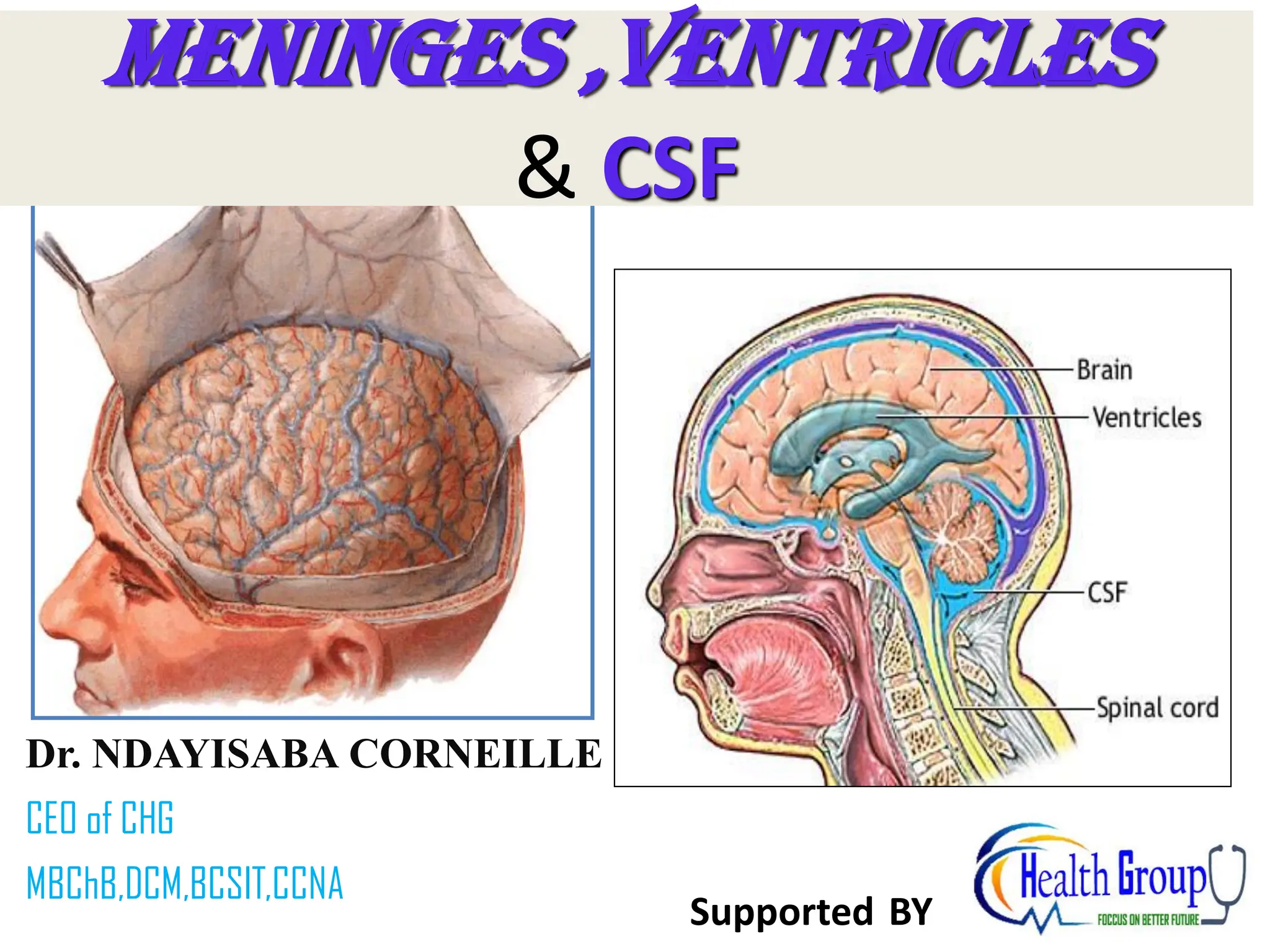
Meninges ,ventricles
& CSF
Supported BY
OBJECTIVES
• By the end of thepresentation we should
be able to:
• Describe the cerebral meninges & list the main dural
folds.
• Describe the spinal meninges & locate the level of the
termination of each of them.
• Describe the importance of the subarachnoid space.
• List the Ventricular system of the CNS and locate the
site of each of them.
• Describe the formation, circulation, drainage, and
functions of the CSF.
• Know some clinical point about the CSF
29/12/1444 Dr Ndayisaba Corneille 2
MENINGES
• The brain and spinal cord are invested by
three concentric membranes ;
• The outermost layer is the dura matter.
• The middle layer is the arachnoid matter.
• The innermost layer is the pia matter.
29/12/1444 Dr Ndayisaba Corneille 3
DURA MATER
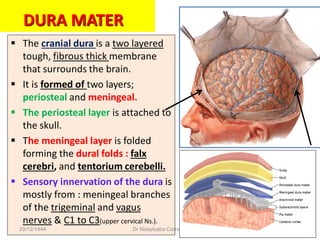
 The cranial dura is a two layered
tough, fibrous thick membrane
that surrounds the brain.
 It is formed of two layers;
periosteal and meningeal.
 The periosteal layer is attached to
the skull.
 The meningeal layer is folded
forming the dural folds : falx
cerebri, and tentorium cerebelli.
 Sensory innervation of the dura is
mostly from : meningeal branches
of the trigeminal and vagus
nerves & C1 to C3(upper cervical Ns.).
29/12/1444 Dr Ndayisaba Corneille 4
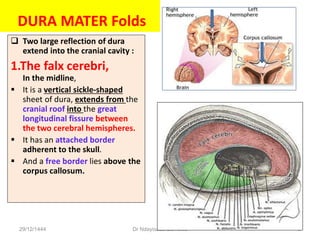
DURA MATER Folds
 Two large reflection of dura
extend into the cranial cavity :
1.The falx cerebri,
In the midline,
 It is a vertical sickle-shaped
sheet of dura, extends from the
cranial roof into the great
longitudinal fissure between
the two cerebral hemispheres.
 It has an attached border
adherent to the skull.
 And a free border lies above the
corpus callosum.
29/12/1444 Dr Ndayisaba Corneille 5
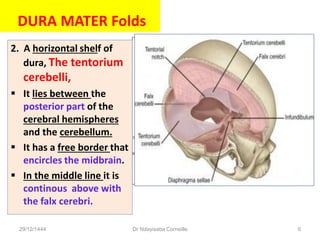
2. A horizontal shelf of
dura, The tentorium
cerebelli,
 It lies between the
posterior part of the
cerebral hemispheres
and the cerebellum.
 It has a free border that
encircles the midbrain.
 In the middle line it is
continous above with
the falx cerebri.
29/12/1444 Dr Ndayisaba Corneille 6
DURA MATER Folds
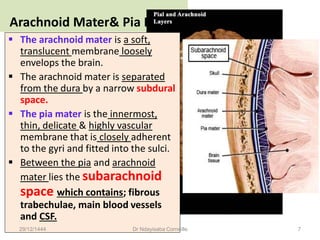
Arachnoid Mater& Pia Mater
 The arachnoid mater is a soft,
translucent membrane loosely
envelops the brain.
 The arachnoid mater is separated
from the dura by a narrow subdural
space.
 The pia mater is the innermost,
thin, delicate & highly vascular
membrane that is closely adherent
to the gyri and fitted into the sulci.
 Between the pia and arachnoid
mater lies the subarachnoid
space which contains; fibrous
trabechulae, main blood vessels
and CSF.
29/12/1444 Dr Ndayisaba Corneille 7
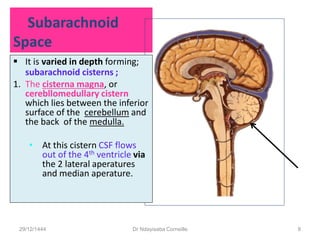
Subarachnoid
Space
 It is varied in depth forming;
subarachnoid cisterns ;
1. The cisterna magna, or
cerebllomedullary cistern
which lies between the inferior
surface of the cerebellum and
the back of the medulla.
• At this cistern CSF flows
out of the 4th ventricle via
the 2 lateral aperatures
and median aperature.
29/12/1444 Dr Ndayisaba Corneille 8
Subarachnoid
Space
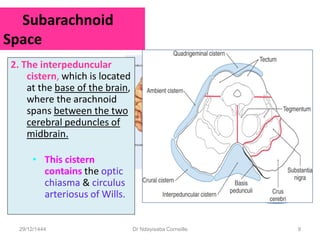
2. The interpeduncular
cistern, which is located
at the base of the brain,
where the arachnoid
spans between the two
cerebral peduncles of
midbrain.
• This cistern
contains the optic
chiasma & circulus
arteriosus of Wills.
29/12/1444 Dr Ndayisaba Corneille 9
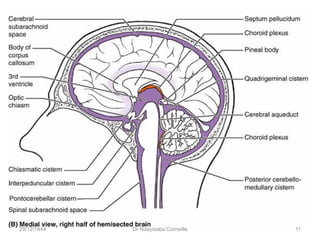
Major intracranial subarachnoid
cisterns
 Cerebellomedullary cistern: The largest, located between
the cerebellum and the medulla. It is divided into the
posterior cerebellomedullary and the lateral
cerebellomedullary cistern.
 Pontocerebellar (pontine cistern)
 Interpeduncular cistern (basal cistern)
 Chiasmatic cistern: Inferior and anterior to optic chiasm,
the point of crossing or decussation of optic nerve fibers.
 Quadrigeminal cistern (cistern of the great cerebral vein):
Located between the posterior part of the corpus callosum
and the superior surface of the cerebellum. It contains parts
of the great cerebral vein.
 Ambient cistern Located on the lateral aspect of the
midbrain and continuous posteriorly with the
quadrigeminal cistern
29/12/1444 Dr Ndayisaba Corneille 10
29/12/1444 Dr Ndayisaba Corneille 11
Spinal meninges
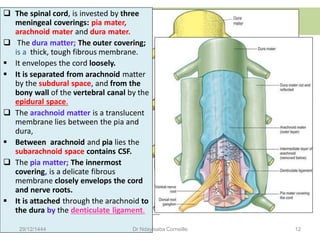
 The spinal cord, is invested by three
meningeal coverings: pia mater,
arachnoid mater and dura mater.
 The dura matter; The outer covering;
is a thick, tough fibrous membrane.
 It envelopes the cord loosely.
 It is separated from arachnoid matter
by the subdural space, and from the
bony wall of the vertebral canal by the
epidural space.
 The arachnoid matter is a translucent
membrane lies between the pia and
dura,
 Between arachnoid and pia lies the
subarachnoid space contains CSF.
 The pia matter; The innermost
covering, is a delicate fibrous
membrane closely envelops the cord
and nerve roots.
 It is attached through the arachnoid to
the dura by the denticulate ligament.
29/12/1444 Dr Ndayisaba Corneille 12
Spinal meninges
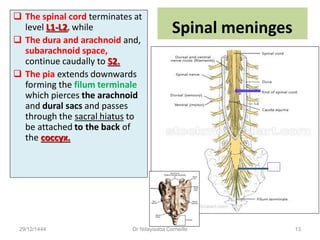
 The spinal cord terminates at
level L1-L2, while
 The dura and arachnoid and,
subarachnoid space,
continue caudally to S2.
 The pia extends downwards
forming the filum terminale
which pierces the arachnoid
and dural sacs and passes
through the sacral hiatus to
be attached to the back of
the coccyx.
29/12/1444 Dr Ndayisaba Corneille 13
VENTRICULAR SYSTEM
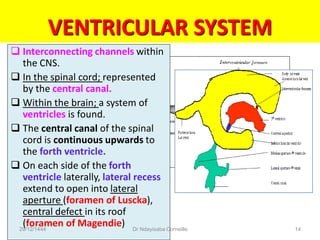
 Interconnecting channels within
the CNS.
 In the spinal cord; represented
by the central canal.
 Within the brain; a system of
ventricles is found.
 The central canal of the spinal
cord is continuous upwards to
the forth ventricle.
 On each side of the forth
ventricle laterally, lateral recess
extend to open into lateral
aperture (foramen of Luscka),
central defect in its roof
(foramen of Magendie)
29/12/1444 Dr Ndayisaba Corneille 14
VENTRICULAR SYSTEM
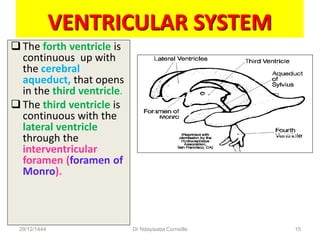
 The forth ventricle is
continuous up with
the cerebral
aqueduct, that opens
in the third ventricle.
 The third ventricle is
continuous with the
lateral ventricle
through the
interventricular
foramen (foramen of
Monro).
29/12/1444 Dr Ndayisaba Corneille 15
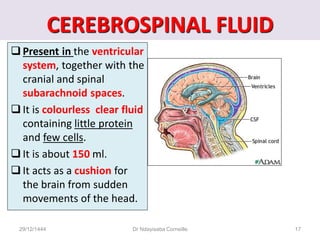
CEREBROSPINAL FLUID
CSF is found in the ventricles of the brain and
in the subarachnoid space around the brain &
spinal cord
It is a clear, colourless fluid
It possesses, in solution, inorganic salts similar
to those in the blood plasma
The glucose content is about half of blood, &
there is only a trace of protein
The pressure of CSF may be raised by
straining, coughing, or compressing the internal
jugular veins in the neck.
CEREBROSPINAL FLUID
 Present in the ventricular
system, together with the
cranial and spinal
subarachnoid spaces.
 It is colourless clear fluid
containing little protein
and few cells.
 It is about 150 ml.
 It acts as a cushion for
the brain from sudden
movements of the head.
29/12/1444 Dr Ndayisaba Corneille 17
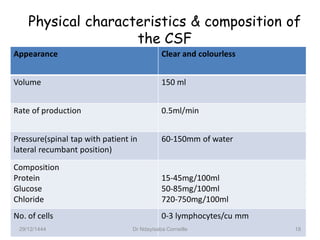
Physical characteristics & composition of
the CSF
Appearance Clear and colourless
Volume 150 ml
Rate of production 0.5ml/min
Pressure(spinal tap with patient in
lateral recumbant position)
60-150mm of water
Composition
Protein
Glucose
Chloride
15-45mg/100ml
50-85mg/100ml
720-750mg/100ml
No. of cells 0-3 lymphocytes/cu mm
29/12/1444 Dr Ndayisaba Corneille 18
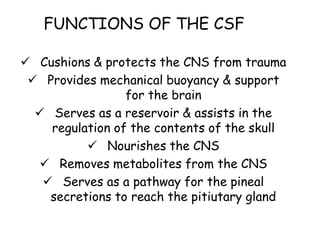
FUNCTIONS OF THE CSF
 Cushions & protects the CNS from trauma
 Provides mechanical buoyancy & support
for the brain
 Serves as a reservoir & assists in the
regulation of the contents of the skull
 Nourishes the CNS
 Removes metabolites from the CNS
 Serves as a pathway for the pineal
secretions to reach the pitiutary gland
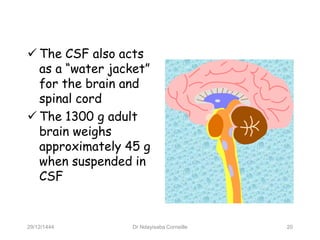
 The CSF also acts
as a “water jacket”
for the brain and
spinal cord
 The 1300 g adult
brain weighs
approximately 45 g
when suspended in
CSF
29/12/1444 Dr Ndayisaba Corneille 20
CEREBROSPINAL FLUID
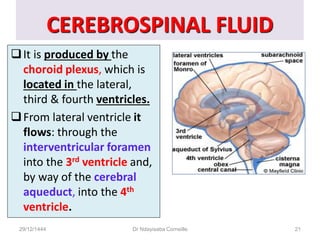
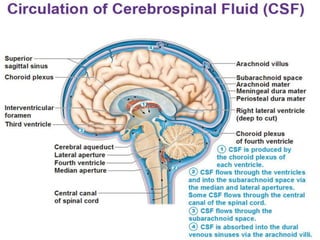
It is produced by the
choroid plexus, which is
located in the lateral,
third & fourth ventricles.
From lateral ventricle it
flows: through the
interventricular foramen
into the 3rd ventricle and,
by way of the cerebral
aqueduct, into the 4th
ventricle.
29/12/1444 Dr Ndayisaba Corneille 21
CEREBROSPINAL FLUID
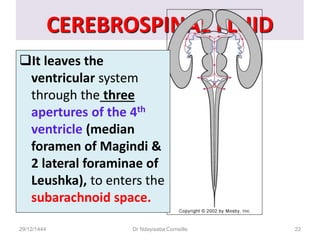
It leaves the
ventricular system
through the three
apertures of the 4th
ventricle (median
foramen of Magindi &
2 lateral foraminae of
Leushka), to enters the
subarachnoid space.
29/12/1444 Dr Ndayisaba Corneille 22
CEREBROSPINAL FLUID
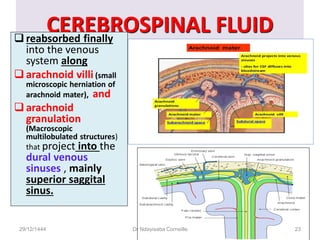
 reabsorbed finally
into the venous
system along
 arachnoid villi (small
microscopic herniation of
arachnoid mater), and
 arachnoid
granulation
(Macroscopic
multilobulated structures)
that project into the
dural venous
sinuses , mainly
superior saggital
sinus.
29/12/1444 Dr Ndayisaba Corneille 23
29/12/1444 Dr Ndayisaba Corneille 24
CEREBROSPINAL FLUID
clinical point
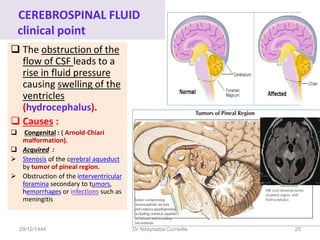
 The obstruction of the
flow of CSF leads to a
rise in fluid pressure
causing swelling of the
ventricles
(hydrocephalus).
 Causes :
 Congenital : ( Arnold-Chiari
malformation).
 Acquired :
 Stenosis of the cerebral aqueduct
by tumor of pineal region.
 Obstruction of the interventricular
foramina secondary to tumors,
hemorrhages or infections such as
meningitis
29/12/1444 Dr Ndayisaba Corneille 25
CEREBROSPINAL FLUID
clinical point
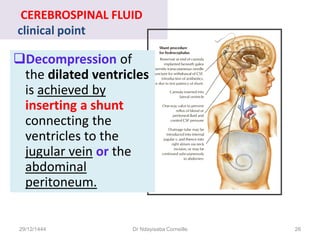
Decompression of
the dilated ventricles
is achieved by
inserting a shunt
connecting the
ventricles to the
jugular vein or the
abdominal
peritoneum.
29/12/1444 Dr Ndayisaba Corneille 26
Summary
• The brain & spinal cord are covered by 3 layers of
meninges : dura, arachnoid & pia mater.
• The important dural folds inside the brain are the
falax cerebri & tentorium cerebelli.
• CSF is produced by the choroid plexuses of the
ventricles of the brain : lateral ,3rd & 4th ventricles.
• CSF circulates in the subarachnoid space.
• CSF is drained into the dural venous sinuses
principally superior saggital sinus.
• The subarachnoid space in the spinal cord
terminates at the 2nd sacral vertebra.
• Obstruction of the flow of CSF as in tumors of the
brain leads to hydrocephalus.
29/12/1444 Dr Ndayisaba Corneille 27
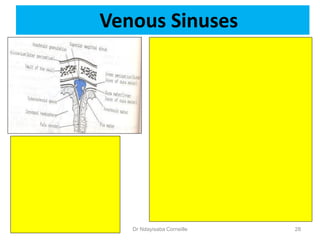
Venous Sinuses
29/12/1444 Dr Ndayisaba Corneille 28
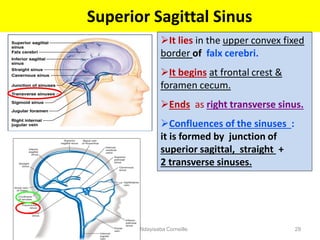
Superior Sagittal Sinus
29/12/1444 Dr Ndayisaba Corneille 29
It lies in the upper convex fixed
border of falx cerebri.
It begins at frontal crest &
foramen cecum.
Ends as right transverse sinus.
Confluences of the sinuses :
it is formed by junction of
superior sagittal, straight +
2 transverse sinuses.
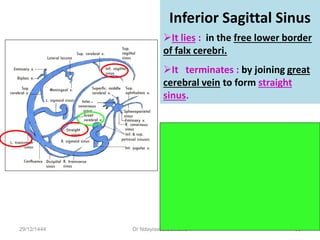
Inferior Sagittal Sinus
29/12/1444 Dr Ndayisaba Corneille 30
It lies : in the free lower border
of falx cerebri.
It terminates : by joining great
cerebral vein to form straight
sinus.
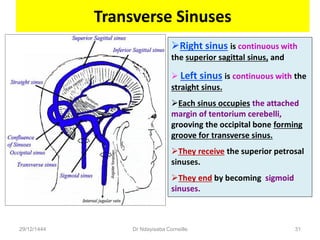
Transverse Sinuses
29/12/1444 Dr Ndayisaba Corneille 31
Right sinus is continuous with
the superior sagittal sinus, and
 Left sinus is continuous with the
straight sinus.
Each sinus occupies the attached
margin of tentorium cerebelli,
grooving the occipital bone forming
groove for transverse sinus.
They receive the superior petrosal
sinuses.
They end by becoming sigmoid
sinuses.
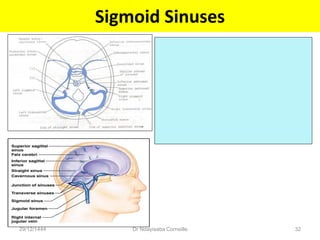
Sigmoid Sinuses
29/12/1444 Dr Ndayisaba Corneille 32
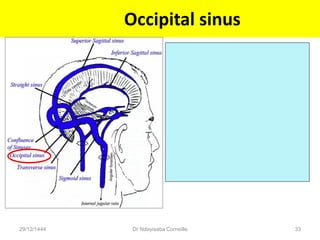
Occipital sinus
29/12/1444 Dr Ndayisaba Corneille 33
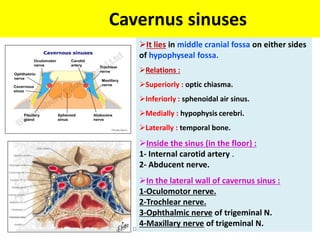
Cavernus sinuses
29/12/1444 Dr Ndayisaba Corneille 34
It lies in middle cranial fossa on either sides
of hypophyseal fossa.
Relations :
Superiorly : optic chiasma.
Inferiorly : sphenoidal air sinus.
Medially : hypophysis cerebri.
Laterally : temporal bone.
Inside the sinus (in the floor) :
1- Internal carotid artery .
2- Abducent nerve.
In the lateral wall of cavernus sinus :
1-Oculomotor nerve.
2-Trochlear nerve.
3-Ophthalmic nerve of trigeminal N.
4-Maxillary nerve of trigeminal N.
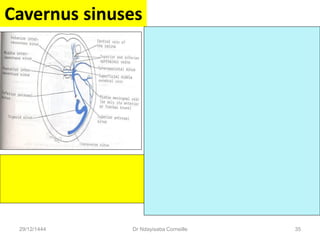
Cavernus sinuses
29/12/1444 Dr Ndayisaba Corneille 35
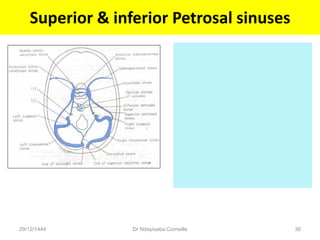
Superior & inferior Petrosal sinuses
29/12/1444 Dr Ndayisaba Corneille 36
END
29/12/1444
Dr Ndayisaba
Corneille
37
THANKS FOR LISTENING
By
DR NDAYISABA CORNEILLE
MBChB,DCM,BCSIT,CCNA
Contact us: amentalhealths@gmail.com/
ndayicoll@gmail.com
whatsaps :+256772497591
/+250788958241

Cerebral Spinal Fluid (csf) AND VENTRICLES

  • 1.
    Dr. NDAYISABA CORNEILLE CEOof CHG MBChB,DCM,BCSIT,CCNA Meninges ,ventricles & CSF Supported BY
  • 2.
    OBJECTIVES • By theend of thepresentation we should be able to: • Describe the cerebral meninges & list the main dural folds. • Describe the spinal meninges & locate the level of the termination of each of them. • Describe the importance of the subarachnoid space. • List the Ventricular system of the CNS and locate the site of each of them. • Describe the formation, circulation, drainage, and functions of the CSF. • Know some clinical point about the CSF 29/12/1444 Dr Ndayisaba Corneille 2
  • 3.
    MENINGES • The brainand spinal cord are invested by three concentric membranes ; • The outermost layer is the dura matter. • The middle layer is the arachnoid matter. • The innermost layer is the pia matter. 29/12/1444 Dr Ndayisaba Corneille 3
  • 4.
    DURA MATER  Thecranial dura is a two layered tough, fibrous thick membrane that surrounds the brain.  It is formed of two layers; periosteal and meningeal.  The periosteal layer is attached to the skull.  The meningeal layer is folded forming the dural folds : falx cerebri, and tentorium cerebelli.  Sensory innervation of the dura is mostly from : meningeal branches of the trigeminal and vagus nerves & C1 to C3(upper cervical Ns.). 29/12/1444 Dr Ndayisaba Corneille 4
  • 5.
    DURA MATER Folds Two large reflection of dura extend into the cranial cavity : 1.The falx cerebri, In the midline,  It is a vertical sickle-shaped sheet of dura, extends from the cranial roof into the great longitudinal fissure between the two cerebral hemispheres.  It has an attached border adherent to the skull.  And a free border lies above the corpus callosum. 29/12/1444 Dr Ndayisaba Corneille 5
  • 6.
    2. A horizontalshelf of dura, The tentorium cerebelli,  It lies between the posterior part of the cerebral hemispheres and the cerebellum.  It has a free border that encircles the midbrain.  In the middle line it is continous above with the falx cerebri. 29/12/1444 Dr Ndayisaba Corneille 6 DURA MATER Folds
  • 7.
    Arachnoid Mater& PiaMater  The arachnoid mater is a soft, translucent membrane loosely envelops the brain.  The arachnoid mater is separated from the dura by a narrow subdural space.  The pia mater is the innermost, thin, delicate & highly vascular membrane that is closely adherent to the gyri and fitted into the sulci.  Between the pia and arachnoid mater lies the subarachnoid space which contains; fibrous trabechulae, main blood vessels and CSF. 29/12/1444 Dr Ndayisaba Corneille 7
  • 8.
    Subarachnoid Space  It isvaried in depth forming; subarachnoid cisterns ; 1. The cisterna magna, or cerebllomedullary cistern which lies between the inferior surface of the cerebellum and the back of the medulla. • At this cistern CSF flows out of the 4th ventricle via the 2 lateral aperatures and median aperature. 29/12/1444 Dr Ndayisaba Corneille 8
  • 9.
    Subarachnoid Space 2. The interpeduncular cistern,which is located at the base of the brain, where the arachnoid spans between the two cerebral peduncles of midbrain. • This cistern contains the optic chiasma & circulus arteriosus of Wills. 29/12/1444 Dr Ndayisaba Corneille 9
  • 10.
    Major intracranial subarachnoid cisterns Cerebellomedullary cistern: The largest, located between the cerebellum and the medulla. It is divided into the posterior cerebellomedullary and the lateral cerebellomedullary cistern.  Pontocerebellar (pontine cistern)  Interpeduncular cistern (basal cistern)  Chiasmatic cistern: Inferior and anterior to optic chiasm, the point of crossing or decussation of optic nerve fibers.  Quadrigeminal cistern (cistern of the great cerebral vein): Located between the posterior part of the corpus callosum and the superior surface of the cerebellum. It contains parts of the great cerebral vein.  Ambient cistern Located on the lateral aspect of the midbrain and continuous posteriorly with the quadrigeminal cistern 29/12/1444 Dr Ndayisaba Corneille 10
  • 11.
  • 12.
    Spinal meninges  Thespinal cord, is invested by three meningeal coverings: pia mater, arachnoid mater and dura mater.  The dura matter; The outer covering; is a thick, tough fibrous membrane.  It envelopes the cord loosely.  It is separated from arachnoid matter by the subdural space, and from the bony wall of the vertebral canal by the epidural space.  The arachnoid matter is a translucent membrane lies between the pia and dura,  Between arachnoid and pia lies the subarachnoid space contains CSF.  The pia matter; The innermost covering, is a delicate fibrous membrane closely envelops the cord and nerve roots.  It is attached through the arachnoid to the dura by the denticulate ligament. 29/12/1444 Dr Ndayisaba Corneille 12
  • 13.
    Spinal meninges  Thespinal cord terminates at level L1-L2, while  The dura and arachnoid and, subarachnoid space, continue caudally to S2.  The pia extends downwards forming the filum terminale which pierces the arachnoid and dural sacs and passes through the sacral hiatus to be attached to the back of the coccyx. 29/12/1444 Dr Ndayisaba Corneille 13
  • 14.
    VENTRICULAR SYSTEM  Interconnectingchannels within the CNS.  In the spinal cord; represented by the central canal.  Within the brain; a system of ventricles is found.  The central canal of the spinal cord is continuous upwards to the forth ventricle.  On each side of the forth ventricle laterally, lateral recess extend to open into lateral aperture (foramen of Luscka), central defect in its roof (foramen of Magendie) 29/12/1444 Dr Ndayisaba Corneille 14
  • 15.
    VENTRICULAR SYSTEM  Theforth ventricle is continuous up with the cerebral aqueduct, that opens in the third ventricle.  The third ventricle is continuous with the lateral ventricle through the interventricular foramen (foramen of Monro). 29/12/1444 Dr Ndayisaba Corneille 15
  • 16.
    CEREBROSPINAL FLUID CSF isfound in the ventricles of the brain and in the subarachnoid space around the brain & spinal cord It is a clear, colourless fluid It possesses, in solution, inorganic salts similar to those in the blood plasma The glucose content is about half of blood, & there is only a trace of protein The pressure of CSF may be raised by straining, coughing, or compressing the internal jugular veins in the neck.
  • 17.
    CEREBROSPINAL FLUID  Presentin the ventricular system, together with the cranial and spinal subarachnoid spaces.  It is colourless clear fluid containing little protein and few cells.  It is about 150 ml.  It acts as a cushion for the brain from sudden movements of the head. 29/12/1444 Dr Ndayisaba Corneille 17
  • 18.
    Physical characteristics &composition of the CSF Appearance Clear and colourless Volume 150 ml Rate of production 0.5ml/min Pressure(spinal tap with patient in lateral recumbant position) 60-150mm of water Composition Protein Glucose Chloride 15-45mg/100ml 50-85mg/100ml 720-750mg/100ml No. of cells 0-3 lymphocytes/cu mm 29/12/1444 Dr Ndayisaba Corneille 18
  • 19.
    FUNCTIONS OF THECSF  Cushions & protects the CNS from trauma  Provides mechanical buoyancy & support for the brain  Serves as a reservoir & assists in the regulation of the contents of the skull  Nourishes the CNS  Removes metabolites from the CNS  Serves as a pathway for the pineal secretions to reach the pitiutary gland
  • 20.
     The CSFalso acts as a “water jacket” for the brain and spinal cord  The 1300 g adult brain weighs approximately 45 g when suspended in CSF 29/12/1444 Dr Ndayisaba Corneille 20
  • 21.
    CEREBROSPINAL FLUID It isproduced by the choroid plexus, which is located in the lateral, third & fourth ventricles. From lateral ventricle it flows: through the interventricular foramen into the 3rd ventricle and, by way of the cerebral aqueduct, into the 4th ventricle. 29/12/1444 Dr Ndayisaba Corneille 21
  • 22.
    CEREBROSPINAL FLUID It leavesthe ventricular system through the three apertures of the 4th ventricle (median foramen of Magindi & 2 lateral foraminae of Leushka), to enters the subarachnoid space. 29/12/1444 Dr Ndayisaba Corneille 22
  • 23.
    CEREBROSPINAL FLUID  reabsorbedfinally into the venous system along  arachnoid villi (small microscopic herniation of arachnoid mater), and  arachnoid granulation (Macroscopic multilobulated structures) that project into the dural venous sinuses , mainly superior saggital sinus. 29/12/1444 Dr Ndayisaba Corneille 23
  • 24.
  • 25.
    CEREBROSPINAL FLUID clinical point The obstruction of the flow of CSF leads to a rise in fluid pressure causing swelling of the ventricles (hydrocephalus).  Causes :  Congenital : ( Arnold-Chiari malformation).  Acquired :  Stenosis of the cerebral aqueduct by tumor of pineal region.  Obstruction of the interventricular foramina secondary to tumors, hemorrhages or infections such as meningitis 29/12/1444 Dr Ndayisaba Corneille 25
  • 26.
    CEREBROSPINAL FLUID clinical point Decompressionof the dilated ventricles is achieved by inserting a shunt connecting the ventricles to the jugular vein or the abdominal peritoneum. 29/12/1444 Dr Ndayisaba Corneille 26
  • 27.
    Summary • The brain& spinal cord are covered by 3 layers of meninges : dura, arachnoid & pia mater. • The important dural folds inside the brain are the falax cerebri & tentorium cerebelli. • CSF is produced by the choroid plexuses of the ventricles of the brain : lateral ,3rd & 4th ventricles. • CSF circulates in the subarachnoid space. • CSF is drained into the dural venous sinuses principally superior saggital sinus. • The subarachnoid space in the spinal cord terminates at the 2nd sacral vertebra. • Obstruction of the flow of CSF as in tumors of the brain leads to hydrocephalus. 29/12/1444 Dr Ndayisaba Corneille 27
  • 28.
    Venous Sinuses 29/12/1444 DrNdayisaba Corneille 28
  • 29.
    Superior Sagittal Sinus 29/12/1444Dr Ndayisaba Corneille 29 It lies in the upper convex fixed border of falx cerebri. It begins at frontal crest & foramen cecum. Ends as right transverse sinus. Confluences of the sinuses : it is formed by junction of superior sagittal, straight + 2 transverse sinuses.
  • 30.
    Inferior Sagittal Sinus 29/12/1444Dr Ndayisaba Corneille 30 It lies : in the free lower border of falx cerebri. It terminates : by joining great cerebral vein to form straight sinus.
  • 31.
    Transverse Sinuses 29/12/1444 DrNdayisaba Corneille 31 Right sinus is continuous with the superior sagittal sinus, and  Left sinus is continuous with the straight sinus. Each sinus occupies the attached margin of tentorium cerebelli, grooving the occipital bone forming groove for transverse sinus. They receive the superior petrosal sinuses. They end by becoming sigmoid sinuses.
  • 32.
    Sigmoid Sinuses 29/12/1444 DrNdayisaba Corneille 32
  • 33.
    Occipital sinus 29/12/1444 DrNdayisaba Corneille 33
  • 34.
    Cavernus sinuses 29/12/1444 DrNdayisaba Corneille 34 It lies in middle cranial fossa on either sides of hypophyseal fossa. Relations : Superiorly : optic chiasma. Inferiorly : sphenoidal air sinus. Medially : hypophysis cerebri. Laterally : temporal bone. Inside the sinus (in the floor) : 1- Internal carotid artery . 2- Abducent nerve. In the lateral wall of cavernus sinus : 1-Oculomotor nerve. 2-Trochlear nerve. 3-Ophthalmic nerve of trigeminal N. 4-Maxillary nerve of trigeminal N.
  • 35.
    Cavernus sinuses 29/12/1444 DrNdayisaba Corneille 35
  • 36.
    Superior & inferiorPetrosal sinuses 29/12/1444 Dr Ndayisaba Corneille 36
  • 37.
    END 29/12/1444 Dr Ndayisaba Corneille 37 THANKS FORLISTENING By DR NDAYISABA CORNEILLE MBChB,DCM,BCSIT,CCNA Contact us: amentalhealths@gmail.com/ ndayicoll@gmail.com whatsaps :+256772497591 /+250788958241