Nerves of the Anterior
Abdominal Wall
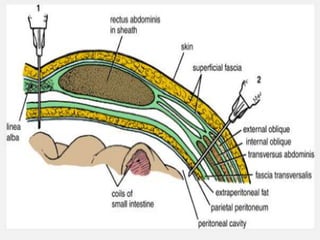
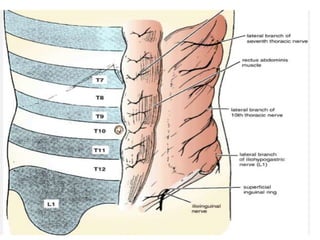
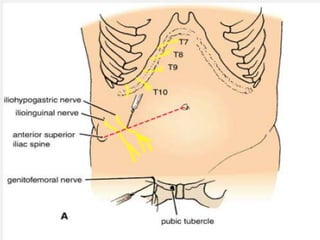
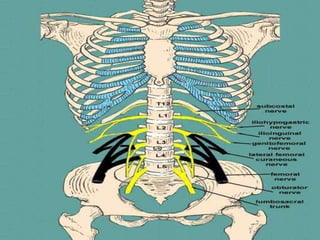
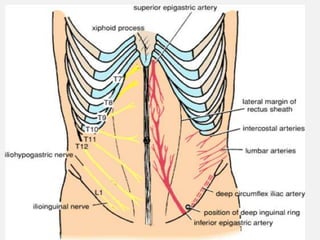
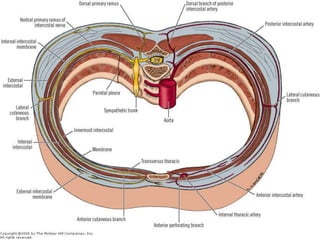
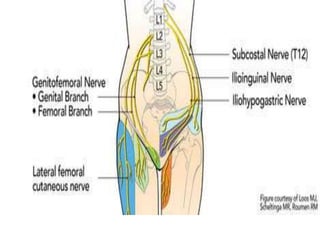
• The nerves of the anterior abdominal wall are
the anterior rami of the lower six thoracic and
the first lumbar nerves.

• They supply the skin of the anterior abdominal
wall, the muscles, and the parietal peritoneum.
• The first lumbar nerve does not enter the
rectus sheath.
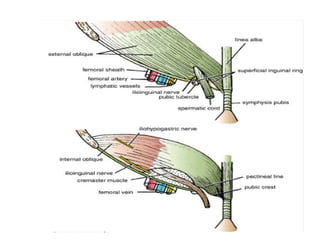
• It is represented by the iliohypogastric nerve,
which pierces the external oblique aponeurosis
above the superficial inguinal ring, and the
ilioinguinal nerve, which emerges through the
ring.
Arteries of the Anterior Abdominal Wall
• The superior epigastric artery, one of the
terminal branches of the internal thoracic
artery.

• It descends behind the rectus muscle and
anastomoses with the inferior epigastric
artery.
• The inferior epigastric artery is a branch of
the external iliac artery just above the inguinal
ligament.
• It ascends behind the rectus muscle,
supplying the lower central part of the anterior
abdominal wall, and anastomoses with the
superior epigastric artery.
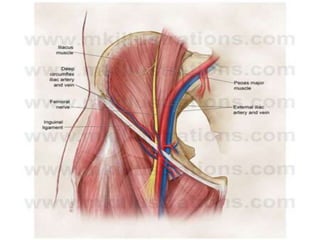
• The deep circumflex iliac artery is a branch
of the external iliac artery just above the
inguinal ligament.
• It supplies the lower lateral part of the
abdominal wall.
• The lower two posterior intercostal arteries,
branches of the descending thoracic aorta,
• The four lumbar arteries, branches of the
abdominal aorta, pass forward between the
muscle layers and supply the lateral part of the
abdominal wall.
Veins of the Anterior Abdominal Wall
• Superficial Veins
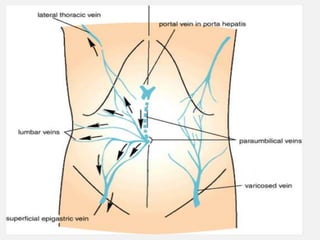
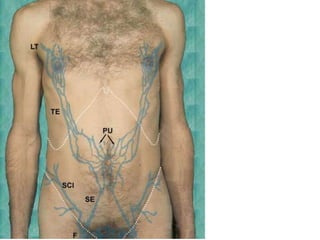
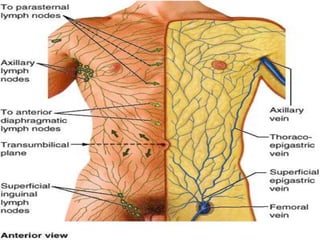
• The superficial veins form a network that
radiates out from the umbilicus.
• Above, the network is drained into the axillary
vein via the lateral thoracic vein and, below,
into the femoral vein via the superficial
epigastric and great saphenous veins.
• A few small veins, the paraumbilical veins,
connect the network through the umbilicus and
along the ligamentum teres to the portal vein.

• This forms an important portal systemic
venous anastomosis.
• Deep Veins
• The deep veins of the abdominal wall
1. Superior epigastric vein
2. Inferior epigastric vein
3. Deep circumflex iliac vein

• They follow the arteries of the same name and
drain into the internal thoracic and external
iliac veins.
• The posterior intercostal veins drain into the
azygos veins.
• The lumbar veins drain into the inferior vena
cava.
Lymph Drainage of the Anterior Abdominal Wall
• Superficial Lymph Vessels
• The lymph drainage of the skin of the anterior
abdominal wall above the level of the
umbilicus is upward to the anterior axillary
(pectoral) group of nodes, which can be
palpated just beneath the lower border of the
pectoralis major muscle.
• Below the level of the umbilicus, the lymph
drains downward and laterally to the
superficial inguinal nodes
• The lymph of the skin of the back above the
level of the iliac crests is drained upward to the
posterior axillary group of nodes, palpated on
the posterior wall of the axilla;
• Below the level of the iliac crests, it drains
downward to the superficial inguinal nodes.
• Deep Lymph Vessels
• The deep lymph vessels follow the arteries and
drain into the
1.
2.
3.
4.

Internal thoracic nodes
External iliac nodes
Posterior mediastinal nodes
Para-aortic (lumbar) nodes
Inguinal Canal
• The inguinal canal is an oblique passage
through the lower part of the anterior
abdominal wall.

• In the males, it allows structures to pass to
and from the testis to the abdomen.
• In females it allows the round ligament of the
uterus to pass from the uterus to the labium
majus.
• The canal is about 1.5 in. (4 cm) long in the
adult and extends from the deep inguinal ring,
a hole in the fascia transversalis downward and
medially to the superficial inguinal ring, a hole
in the aponeurosis of the external oblique
muscle.
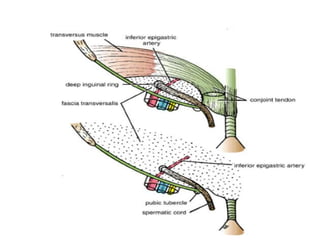
• The deep inguinal ring, an oval opening in
the fascia transversalis, lies about 0.5 in. (1.3
cm) above the inguinal ligament midway
between the anterior superior iliac spine and
the symphysis pubis.
• Related to it medially are the inferior
epigastric vessels, which pass upward from the
external iliac vessels.

• The margins of the ring give attachment to the
internal spermatic fascia (or the internal
covering of the round ligament of the uterus).
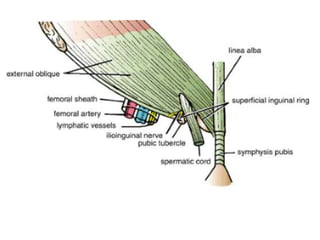
• The superficial inguinal ring is a triangularshaped defect in the aponeurosis of the
external oblique muscle and lies immediately
above and medial to the pubic tubercle.
• The margins of the ring, sometimes called the
crura, give attachment to the external
spermatic fascia.
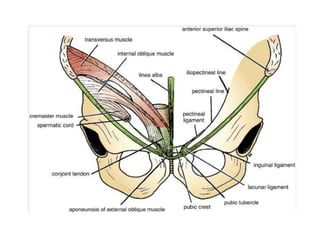
Walls of the Inguinal Canal
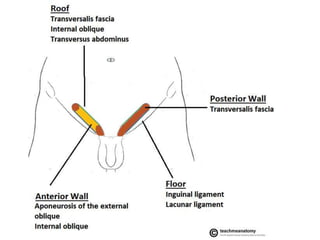
• Anterior wall: External oblique aponeurosis,
reinforced laterally by the origin of the internal
oblique from the inguinal ligament.

• This wall is therefore strongest where it lies
opposite the weakest part of the posterior wall,
namely, the deep inguinal ring.
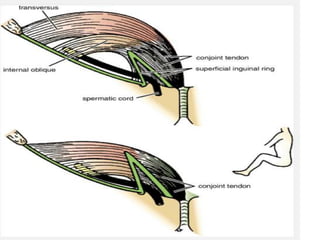
• Posterior wall: Conjoint tendon medially,
fascia transversalis laterally.
• This wall is therefore strongest where it lies
opposite the weakest part of the anterior wall,
namely, the superficial inguinal ring.
• Roof or superior wall: Arching lowest fibers of
the internal oblique and transversus abdominis
muscles.
• Floor or inferior wall: Upturned lower edge of
the inguinal ligament and, at its medial end,
the lacunar ligament.
Function of the Inguinal Canal
• The inguinal canal allows structures of the
spermatic cord to pass to and from the testis to
the abdomen in the male.
•
In the female, the smaller canal permits the
passage of the round ligament of the uterus
from the uterus to the labium majus.
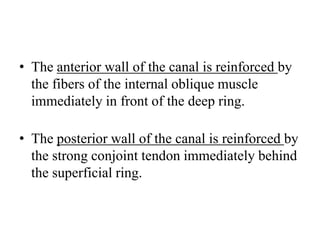
• The anterior wall of the canal is reinforced by
the fibers of the internal oblique muscle
immediately in front of the deep ring.

• The posterior wall of the canal is reinforced by
the strong conjoint tendon immediately behind
the superficial ring.
Spermatic Cord
Spermatic Cord
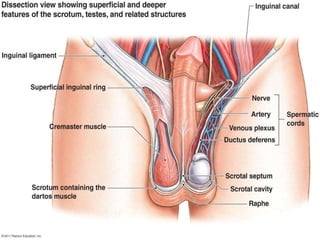
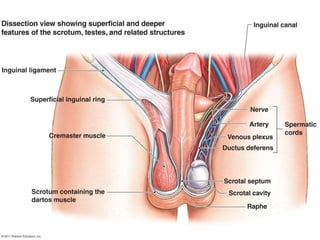
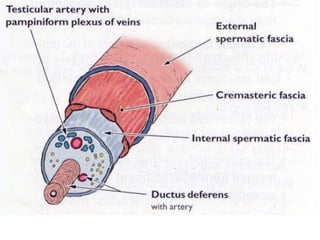
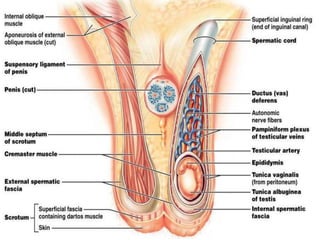
• The spermatic cord is a collection of structures
that pass through the inguinal canal to and
from the testis.

• It begins at the deep inguinal ring lateral to the
inferior epigastric artery and ends at the testis.
Structures of the Spermatic Cord
• The structures are as follows:
1. Vas deferens
2. Testicular artery
3. Testicular veins (pampiniform plexus)
4. Testicular lymph vessels
5. Autonomic nerves
6. Remains of the processus vaginalis
7. Genital branch of the genitofemoral nerve,
which supplies the cremaster muscle
1. Vas Deferens (Ductus Deferens)
The vas deferens is a cordlike structure that can be
palpated between finger and thumb in the upper
part of the scrotum.
It is a thick-walled muscular duct that transports
spermatozoa from the epididymis to the urethra.
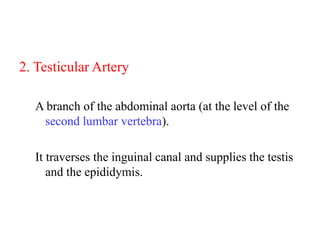
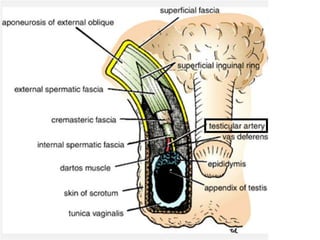
2. Testicular Artery
A branch of the abdominal aorta (at the level of the
second lumbar vertebra).
It traverses the inguinal canal and supplies the testis
and the epididymis.
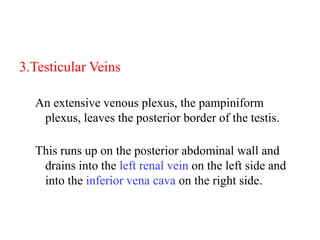
3.Testicular Veins
An extensive venous plexus, the pampiniform
plexus, leaves the posterior border of the testis.
This runs up on the posterior abdominal wall and
drains into the left renal vein on the left side and
into the inferior vena cava on the right side.
4. Lymph Vessels
The testicular lymph vessels ascend through the
inguinal canal and pass up over the posterior
abdominal wall to reach the lumbar (para-aortic)
lymph nodes on the side of the aorta at the level of
the first lumbar vertebra.
5. Autonomic Nerves
Sympathetic fibers run with the testicular artery
from the renal or aortic sympathetic plexuses.
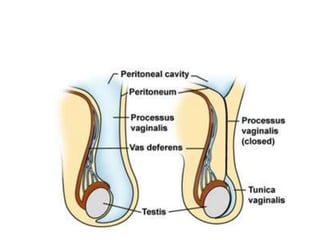
6. Processus Vaginalis
The remains of the processus vaginalis are present
within the cord.
7. Genital Branch of the Genitofemoral Nerve
This nerve supplies the cremaster muscle.
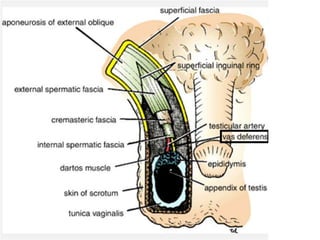
Coverings of the Spermatic Cord
• The coverings of the spermatic cord are three
concentric layers of fascia derived from the
layers of the anterior abdominal wall.
• External spermatic fascia derived from the
external oblique aponeurosis and attached to
the margins of the superficial inguinal ring
• Cremasteric fascia derived from the internal
oblique muscle
• Internal spermatic fascia derived from the
fascia transversalis and attached to the margins
of the deep inguinal ring
Structure of the Posterior
Abdominal Wall
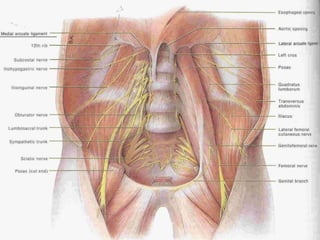
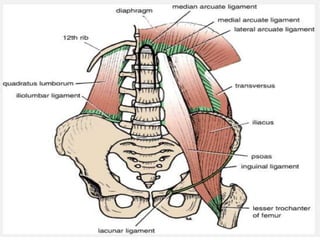
Posterior abdominal wall
– Midline by the five lumbar vertebrae and their
intervertebral discs
– Laterally by the
•
•
•
•
•

12th rib,
The upper part of the bony pelvis,
The psoas muscles,
The quadratus lumborum muscles, and
The aponeuroses of origin of the transversus abdominis
muscles.
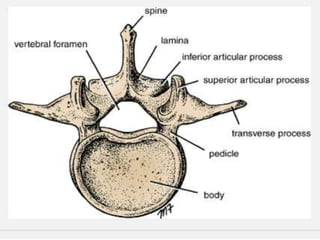
Lumbar Vertebrae
• The body of each vertebra is massive and
kidney shaped, and it has to bear the greater
part of the body weight.

• The fifth lumbar vertebra articulates with the
base of the sacrum at the lumbosacral joint.
• Twelfth Pair of Ribs
• It should be noted that the head of the 12th rib
has a single facet for articulation with the body
of the 12th thoracic vertebra.
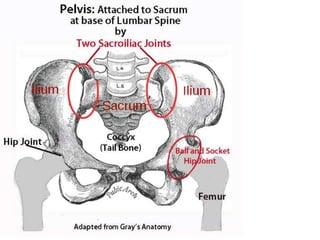
• Ilium
• The ilium, together with the ischium and
pubis, forms the hip bone, they meet one
another at the acetabulum.
• The medial surface of the ilium is divided into
two parts by the arcuate line.
• It should be noted that the arcuate line of the
ilium forms the posterior part of the
iliopectineal line, and the pectineal line forms
the anterior part of the iliopectineal line.
• The iliopectineal line runs forward and
demarcates the false from the true pelvis.
Muscles of the Posterior Abdominal
Wall
Psoas Major
• Origin : roots of the transverse processes, the
sides of the vertebral bodies, and the
intervertebral discs, from the 12th thoracic to
the 5th lumbar vertebrae.
• Insertion : lesser trochanter of the femur.
• Nerve supply : lumbar plexus.
• Action : The psoas flexes the thigh at the hip
joint on the trunk, or if the thigh is fixed, it
flexes the trunk on the thigh
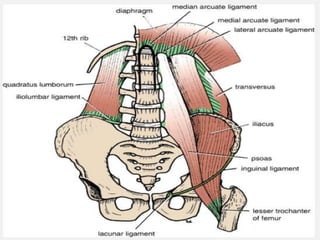
Quadratus Lumborum
• Origen : iliolumbar ligament, the adjoining part
of the iliac crest, and the tips of the transverse
processes of the lower lumbar vertebrae.
• Insertion : lower border of the 12th rib and the
transverse processes of the upper four lumbar
vertebrae.
• Nerve supply: lumbar plexus.
• Action: It fixes or depresses the 12th rib during
respiration and laterally flexes the vertebral
column to the same side
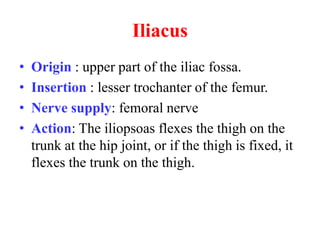
Iliacus
•
•
•
•

Origin : upper part of the iliac fossa.
Insertion : lesser trochanter of the femur.
Nerve supply: femoral nerve
Action: The iliopsoas flexes the thigh on the
trunk at the hip joint, or if the thigh is fixed, it
flexes the trunk on the thigh.
Questions
Q1
• The following structures form the walls of the
inguinal canal except which?
(a) The conjoint tendon
(b) The aponeurosis of the external oblique muscle
(c) The internal oblique muscle
(d) The lacunar ligament
(e) The fascia transversalis
• The following structures form the walls of the
inguinal canal except which?
(a) The conjoint tendon
(b) The aponeurosis of the external oblique muscle
(c) The internal oblique muscle
(d) The lacunar ligament
(e) The fascia transversalis
Q2
• In the female, the inguinal canal contains the
following structures except which?
(a) Ilioinguinal nerve
(b) Remnant of the processus vaginalis
(c) Round ligament of the uterus
(d) Inferior epigastric artery
(e) Lymph vessels from the fundus of the uterus
• In the female, the inguinal canal contains the
following structures except which?
(a) Ilioinguinal nerve
(b) Remnant of the processus vaginalis
(c) Round ligament of the uterus
(d) Inferior epigastric artery
(e) Lymph vessels from the fundus of the uterus
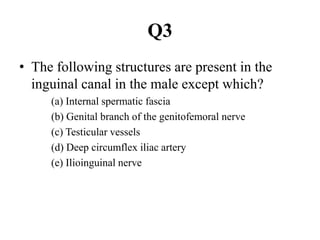
Q3
• The following structures are present in the
inguinal canal in the male except which?
(a) Internal spermatic fascia
(b) Genital branch of the genitofemoral nerve
(c) Testicular vessels
(d) Deep circumflex iliac artery
(e) Ilioinguinal nerve
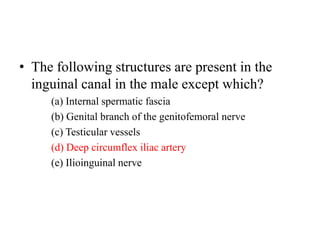
• The following structures are present in the
inguinal canal in the male except which?
(a) Internal spermatic fascia
(b) Genital branch of the genitofemoral nerve
(c) Testicular vessels
(d) Deep circumflex iliac artery
(e) Ilioinguinal nerve
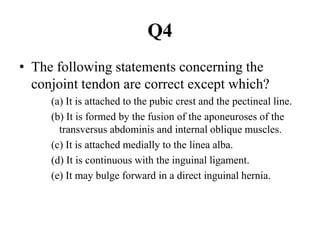
Q4
• The following statements concerning the
conjoint tendon are correct except which?
(a) It is attached to the pubic crest and the pectineal line.
(b) It is formed by the fusion of the aponeuroses of the
transversus abdominis and internal oblique muscles.
(c) It is attached medially to the linea alba.
(d) It is continuous with the inguinal ligament.
(e) It may bulge forward in a direct inguinal hernia.
• The following statements concerning the
conjoint tendon are correct except which?
(a) It is attached to the pubic crest and the pectineal line.
(b) It is formed by the fusion of the aponeuroses of the
transversus abdominis and internal oblique muscles.
(c) It is attached medially to the linea alba.
(d) It is continuous with the inguinal ligament.
(e) It may bulge forward in a direct inguinal hernia.
Q5
• A 30-year-old man was seen in the emergency
department with a stab wound in the right
inguinal region.
Which of the following nerves supplies the
skin of the inguinal region?
(a) The 11th thoracic nerve
(b) The 10th thoracic nerve
(c) The 12th thoracic nerve
(d) The first lumbar nerve
(e) The femoral nerve
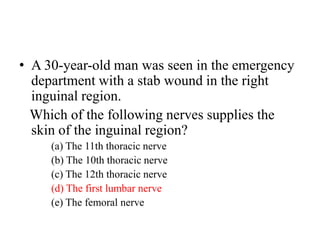
• A 30-year-old man was seen in the emergency
department with a stab wound in the right
inguinal region.
Which of the following nerves supplies the
skin of the inguinal region?
(a) The 11th thoracic nerve
(b) The 10th thoracic nerve
(c) The 12th thoracic nerve
(d) The first lumbar nerve
(e) The femoral nerve
Thanks

Lect 2 anterior abdominal wall

  • 1.
    Nerves of theAnterior Abdominal Wall
  • 3.
    • The nervesof the anterior abdominal wall are the anterior rami of the lower six thoracic and the first lumbar nerves. • They supply the skin of the anterior abdominal wall, the muscles, and the parietal peritoneum.
  • 6.
    • The firstlumbar nerve does not enter the rectus sheath. • It is represented by the iliohypogastric nerve, which pierces the external oblique aponeurosis above the superficial inguinal ring, and the ilioinguinal nerve, which emerges through the ring.
  • 8.
    Arteries of theAnterior Abdominal Wall
  • 9.
    • The superiorepigastric artery, one of the terminal branches of the internal thoracic artery. • It descends behind the rectus muscle and anastomoses with the inferior epigastric artery.
  • 10.
    • The inferiorepigastric artery is a branch of the external iliac artery just above the inguinal ligament.
  • 11.
    • It ascendsbehind the rectus muscle, supplying the lower central part of the anterior abdominal wall, and anastomoses with the superior epigastric artery.
  • 13.
    • The deepcircumflex iliac artery is a branch of the external iliac artery just above the inguinal ligament. • It supplies the lower lateral part of the abdominal wall.
  • 15.
    • The lowertwo posterior intercostal arteries, branches of the descending thoracic aorta,
  • 17.
    • The fourlumbar arteries, branches of the abdominal aorta, pass forward between the muscle layers and supply the lateral part of the abdominal wall.
  • 19.
    Veins of theAnterior Abdominal Wall
  • 20.
    • Superficial Veins •The superficial veins form a network that radiates out from the umbilicus.
  • 21.
    • Above, thenetwork is drained into the axillary vein via the lateral thoracic vein and, below, into the femoral vein via the superficial epigastric and great saphenous veins.
  • 22.
    • A fewsmall veins, the paraumbilical veins, connect the network through the umbilicus and along the ligamentum teres to the portal vein. • This forms an important portal systemic venous anastomosis.
  • 25.
    • Deep Veins •The deep veins of the abdominal wall 1. Superior epigastric vein 2. Inferior epigastric vein 3. Deep circumflex iliac vein • They follow the arteries of the same name and drain into the internal thoracic and external iliac veins.
  • 26.
    • The posteriorintercostal veins drain into the azygos veins. • The lumbar veins drain into the inferior vena cava.
  • 27.
    Lymph Drainage ofthe Anterior Abdominal Wall
  • 28.
    • Superficial LymphVessels • The lymph drainage of the skin of the anterior abdominal wall above the level of the umbilicus is upward to the anterior axillary (pectoral) group of nodes, which can be palpated just beneath the lower border of the pectoralis major muscle.
  • 29.
    • Below thelevel of the umbilicus, the lymph drains downward and laterally to the superficial inguinal nodes
  • 31.
    • The lymphof the skin of the back above the level of the iliac crests is drained upward to the posterior axillary group of nodes, palpated on the posterior wall of the axilla; • Below the level of the iliac crests, it drains downward to the superficial inguinal nodes.
  • 32.
    • Deep LymphVessels • The deep lymph vessels follow the arteries and drain into the 1. 2. 3. 4. Internal thoracic nodes External iliac nodes Posterior mediastinal nodes Para-aortic (lumbar) nodes
  • 33.
  • 34.
    • The inguinalcanal is an oblique passage through the lower part of the anterior abdominal wall. • In the males, it allows structures to pass to and from the testis to the abdomen. • In females it allows the round ligament of the uterus to pass from the uterus to the labium majus.
  • 35.
    • The canalis about 1.5 in. (4 cm) long in the adult and extends from the deep inguinal ring, a hole in the fascia transversalis downward and medially to the superficial inguinal ring, a hole in the aponeurosis of the external oblique muscle.
  • 37.
    • The deepinguinal ring, an oval opening in the fascia transversalis, lies about 0.5 in. (1.3 cm) above the inguinal ligament midway between the anterior superior iliac spine and the symphysis pubis.
  • 38.
    • Related toit medially are the inferior epigastric vessels, which pass upward from the external iliac vessels. • The margins of the ring give attachment to the internal spermatic fascia (or the internal covering of the round ligament of the uterus).
  • 39.
    • The superficialinguinal ring is a triangularshaped defect in the aponeurosis of the external oblique muscle and lies immediately above and medial to the pubic tubercle. • The margins of the ring, sometimes called the crura, give attachment to the external spermatic fascia.
  • 40.
    Walls of theInguinal Canal • Anterior wall: External oblique aponeurosis, reinforced laterally by the origin of the internal oblique from the inguinal ligament. • This wall is therefore strongest where it lies opposite the weakest part of the posterior wall, namely, the deep inguinal ring.
  • 41.
    • Posterior wall:Conjoint tendon medially, fascia transversalis laterally. • This wall is therefore strongest where it lies opposite the weakest part of the anterior wall, namely, the superficial inguinal ring.
  • 42.
    • Roof orsuperior wall: Arching lowest fibers of the internal oblique and transversus abdominis muscles.
  • 43.
    • Floor orinferior wall: Upturned lower edge of the inguinal ligament and, at its medial end, the lacunar ligament.
  • 44.
    Function of theInguinal Canal • The inguinal canal allows structures of the spermatic cord to pass to and from the testis to the abdomen in the male. • In the female, the smaller canal permits the passage of the round ligament of the uterus from the uterus to the labium majus.
  • 45.
    • The anteriorwall of the canal is reinforced by the fibers of the internal oblique muscle immediately in front of the deep ring. • The posterior wall of the canal is reinforced by the strong conjoint tendon immediately behind the superficial ring.
  • 51.
  • 52.
    Spermatic Cord • Thespermatic cord is a collection of structures that pass through the inguinal canal to and from the testis. • It begins at the deep inguinal ring lateral to the inferior epigastric artery and ends at the testis.
  • 53.
    Structures of theSpermatic Cord • The structures are as follows: 1. Vas deferens 2. Testicular artery 3. Testicular veins (pampiniform plexus) 4. Testicular lymph vessels 5. Autonomic nerves 6. Remains of the processus vaginalis 7. Genital branch of the genitofemoral nerve, which supplies the cremaster muscle
  • 55.
    1. Vas Deferens(Ductus Deferens) The vas deferens is a cordlike structure that can be palpated between finger and thumb in the upper part of the scrotum. It is a thick-walled muscular duct that transports spermatozoa from the epididymis to the urethra.
  • 57.
    2. Testicular Artery Abranch of the abdominal aorta (at the level of the second lumbar vertebra). It traverses the inguinal canal and supplies the testis and the epididymis.
  • 59.
    3.Testicular Veins An extensivevenous plexus, the pampiniform plexus, leaves the posterior border of the testis. This runs up on the posterior abdominal wall and drains into the left renal vein on the left side and into the inferior vena cava on the right side.
  • 61.
    4. Lymph Vessels Thetesticular lymph vessels ascend through the inguinal canal and pass up over the posterior abdominal wall to reach the lumbar (para-aortic) lymph nodes on the side of the aorta at the level of the first lumbar vertebra.
  • 62.
    5. Autonomic Nerves Sympatheticfibers run with the testicular artery from the renal or aortic sympathetic plexuses.
  • 63.
    6. Processus Vaginalis Theremains of the processus vaginalis are present within the cord.
  • 65.
    7. Genital Branchof the Genitofemoral Nerve This nerve supplies the cremaster muscle.
  • 67.
    Coverings of theSpermatic Cord • The coverings of the spermatic cord are three concentric layers of fascia derived from the layers of the anterior abdominal wall.
  • 68.
    • External spermaticfascia derived from the external oblique aponeurosis and attached to the margins of the superficial inguinal ring
  • 71.
    • Cremasteric fasciaderived from the internal oblique muscle
  • 72.
    • Internal spermaticfascia derived from the fascia transversalis and attached to the margins of the deep inguinal ring
  • 73.
    Structure of thePosterior Abdominal Wall
  • 74.
    Posterior abdominal wall –Midline by the five lumbar vertebrae and their intervertebral discs – Laterally by the • • • • • 12th rib, The upper part of the bony pelvis, The psoas muscles, The quadratus lumborum muscles, and The aponeuroses of origin of the transversus abdominis muscles.
  • 76.
    Lumbar Vertebrae • Thebody of each vertebra is massive and kidney shaped, and it has to bear the greater part of the body weight. • The fifth lumbar vertebra articulates with the base of the sacrum at the lumbosacral joint.
  • 79.
    • Twelfth Pairof Ribs • It should be noted that the head of the 12th rib has a single facet for articulation with the body of the 12th thoracic vertebra.
  • 80.
    • Ilium • Theilium, together with the ischium and pubis, forms the hip bone, they meet one another at the acetabulum. • The medial surface of the ilium is divided into two parts by the arcuate line.
  • 81.
    • It shouldbe noted that the arcuate line of the ilium forms the posterior part of the iliopectineal line, and the pectineal line forms the anterior part of the iliopectineal line. • The iliopectineal line runs forward and demarcates the false from the true pelvis.
  • 82.
    Muscles of thePosterior Abdominal Wall
  • 83.
    Psoas Major • Origin: roots of the transverse processes, the sides of the vertebral bodies, and the intervertebral discs, from the 12th thoracic to the 5th lumbar vertebrae. • Insertion : lesser trochanter of the femur. • Nerve supply : lumbar plexus. • Action : The psoas flexes the thigh at the hip joint on the trunk, or if the thigh is fixed, it flexes the trunk on the thigh
  • 85.
    Quadratus Lumborum • Origen: iliolumbar ligament, the adjoining part of the iliac crest, and the tips of the transverse processes of the lower lumbar vertebrae. • Insertion : lower border of the 12th rib and the transverse processes of the upper four lumbar vertebrae. • Nerve supply: lumbar plexus. • Action: It fixes or depresses the 12th rib during respiration and laterally flexes the vertebral column to the same side
  • 87.
    Iliacus • • • • Origin : upperpart of the iliac fossa. Insertion : lesser trochanter of the femur. Nerve supply: femoral nerve Action: The iliopsoas flexes the thigh on the trunk at the hip joint, or if the thigh is fixed, it flexes the trunk on the thigh.
  • 89.
  • 90.
    Q1 • The followingstructures form the walls of the inguinal canal except which? (a) The conjoint tendon (b) The aponeurosis of the external oblique muscle (c) The internal oblique muscle (d) The lacunar ligament (e) The fascia transversalis
  • 91.
    • The followingstructures form the walls of the inguinal canal except which? (a) The conjoint tendon (b) The aponeurosis of the external oblique muscle (c) The internal oblique muscle (d) The lacunar ligament (e) The fascia transversalis
  • 92.
    Q2 • In thefemale, the inguinal canal contains the following structures except which? (a) Ilioinguinal nerve (b) Remnant of the processus vaginalis (c) Round ligament of the uterus (d) Inferior epigastric artery (e) Lymph vessels from the fundus of the uterus
  • 93.
    • In thefemale, the inguinal canal contains the following structures except which? (a) Ilioinguinal nerve (b) Remnant of the processus vaginalis (c) Round ligament of the uterus (d) Inferior epigastric artery (e) Lymph vessels from the fundus of the uterus
  • 94.
    Q3 • The followingstructures are present in the inguinal canal in the male except which? (a) Internal spermatic fascia (b) Genital branch of the genitofemoral nerve (c) Testicular vessels (d) Deep circumflex iliac artery (e) Ilioinguinal nerve
  • 95.
    • The followingstructures are present in the inguinal canal in the male except which? (a) Internal spermatic fascia (b) Genital branch of the genitofemoral nerve (c) Testicular vessels (d) Deep circumflex iliac artery (e) Ilioinguinal nerve
  • 96.
    Q4 • The followingstatements concerning the conjoint tendon are correct except which? (a) It is attached to the pubic crest and the pectineal line. (b) It is formed by the fusion of the aponeuroses of the transversus abdominis and internal oblique muscles. (c) It is attached medially to the linea alba. (d) It is continuous with the inguinal ligament. (e) It may bulge forward in a direct inguinal hernia.
  • 97.
    • The followingstatements concerning the conjoint tendon are correct except which? (a) It is attached to the pubic crest and the pectineal line. (b) It is formed by the fusion of the aponeuroses of the transversus abdominis and internal oblique muscles. (c) It is attached medially to the linea alba. (d) It is continuous with the inguinal ligament. (e) It may bulge forward in a direct inguinal hernia.
  • 98.
    Q5 • A 30-year-oldman was seen in the emergency department with a stab wound in the right inguinal region. Which of the following nerves supplies the skin of the inguinal region? (a) The 11th thoracic nerve (b) The 10th thoracic nerve (c) The 12th thoracic nerve (d) The first lumbar nerve (e) The femoral nerve
  • 99.
    • A 30-year-oldman was seen in the emergency department with a stab wound in the right inguinal region. Which of the following nerves supplies the skin of the inguinal region? (a) The 11th thoracic nerve (b) The 10th thoracic nerve (c) The 12th thoracic nerve (d) The first lumbar nerve (e) The femoral nerve
  • 100.