2
Changes After Death
EarlyPost-Mortem Changes
– Skin changes
– Eye changes
– Post-mortem staining/hypostasis/lividity
– Cadaveric changes in muscle: -
• Primary relaxation
• Rigor mortis
• Secondary relaxation
– Cooling of the body
3.
• Changes inSkin
– Loss of elasticity
– Pale and ash-white colour
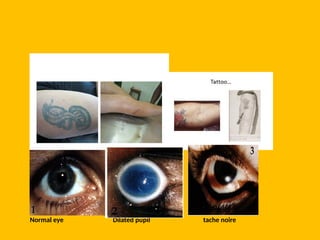
– Tattoo marks not affected
– Ante-mortem wounds not affected
• Changes in the Eyes
– Loss of reflexes (corneal and pupillary)
– Corneal opacity and clouding (2 hours).
– Taches noires sclerotiques (3 hours).
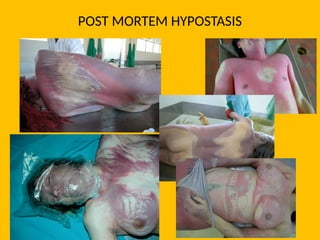
Post-Mortem Staining (Hypostasis)/Livor mortis
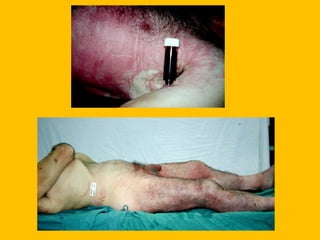
– Reddish purple or bluish discoloration of skin and organs due
to accumulation of blood in toneless capillaries and small
veins in dependent parts due to gravity.
– It is the purple-red discoloration that results from settling of
blood to the dependent portions of the body
– Mottled patches appear ½ to 1 hour
– Patches gradually increase in size and fuse in about 3 hours
– Fully developed (6-12 hours) and relatively fixed (6-8 hours)
– Absent in areas of contact flattening.
– Blood is pushed out of the areas of the body that are lying
on the ground or on other objects, resulting in patches of
contact pallor
6.
• Once livoris fully developed, it becomes fixed and
will no longer blanche with pressure
• If the body is moved between the time of visible livor
and fixed livor, two different patterns of livor and
contact pallor may develop.
• Different patterns of livor in the same body are proof
that the body has been moved
7.
• Factors affectingdevelopment of post mortem
lividity
– Heat , sepsis , heart failure may accelerate fixation
of lividity
– Fixation of lividity is delayed by internal /external
hemorrhage and cold
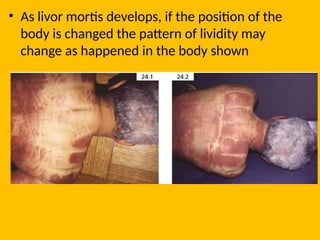
• As livormortis develops, if the position of the
body is changed the pattern of lividity may
change as happened in the body shown
10.
Medico-Legal Importance ofPost-Mortem Staining
– Position of body – change in position
– Time since death ( staining is fixed or not)
– Its distribution may suggest manner of death
– Inappropriate lividity patterns or locations may
suggest a body has been moved after death
–Colour of PM staining may suggest cause of death
– Carbon monoxide poisoning( Cherry Red).
– Cyanide poisoning (Brick Red).
– Exposure to cold (Cherry red).
12.
12
Cooling of theBody (Algor Mortis)
• Body loses heat until it reaches temperature
of its surroundings.
• Temperature recorded by inserting a chemical
thermometer (25cm long) into rectum or
under liver for 2-3 minutes.
• Estimation of time of death from cooling of
the body
• Body temperature reaches atmospheric
temperature in about 12-18 hours.
13.
13
Estimation of timesince death from cooling
of the body
• Moritz’s formula ( 98.6˚ F- rectal temp) divided
by 1.5 hrs= hours since death
• Alternate formula:--
a body cools at 1.5˚F/hour for first 12 hours
after death , then 1˚F/hour for next 12-18
hours.
14.
14
Factors Modifying Coolingof Body
• Difference in temperature between body and
surrounding
• Build/Physique of cadaver
• Environmental temperature of body
• Temperature of body at the time of death
and Post-mortem caloricity
• Amount of clothing /bedding
15.
15
Post-mortem Caloricity
• Temperaturerise observed for the first two
hours or so in bodies after death from: -
– Excessive bacterial activity
– Regulation of heat production disturbed before
death
– Great increase in heat production in muscles
before death.
16.
Rigor mortis
• Thelack of oxygen means that energy cannot be
obtained from glycogen via glucose using oxidative
phosphorylation and so adenosine triphosphate
(ATP) production from this process ceases and the
secondary anoxic process takes over for a short time
• This leads to lactic acid production making the cells
more acidic
• The low ATP and high acidity makes the actin and
myosin fibres bind together and form a gel hence
making the muscles become stiff
17.
Mechanism of RigorMortis
• Cessation of oxygen supply and metabolism
After death, circulation and respiration stop. This halts oxygen
delivery to tissues and prevents oxidative phosphorylation in
mitochondria. The cells switch briefly to anaerobic glycolysis,
producing lactic acid and lowering intracellular pH.
• Depletion of ATP
ATP is essential for muscle contraction and relaxation. Under
normal conditions:
– ATP binds to myosin heads and allows them to detach from actin
filaments after contraction.
– ATP is also required to pump calcium ions back into the sarcoplasmic
reticulum.
After death, ATP production ceases, and existing ATP reserves are
rapidly consumed.
18.
• Calcium ionaccumulation
With no ATP available, calcium pumps in the sarcoplasmic reticulum fail,
leading to leakage of calcium into the sarcoplasm. This sustained rise in
calcium keeps binding sites on actin exposed, allowing myosin heads to
attach.
• Permanent actin–myosin cross-bridge formation
Myosin heads bind to actin, but without ATP, they cannot detach. This
results in a sustained contraction of muscle fibers and the stiffening
characteristic of rigor mortis.
• Resolution of rigor mortis
After 24–48 hours (variable with temperature and environment), autolysis
and putrefaction cause proteolytic breakdown of muscle proteins,
including actin and myosin, leading to loss of rigidity and eventual
flaccidity
19.
Rigor mortis
• Stiffeningof muscle fibres.
• Physico-chemical process (ATP reduction).
• Involves voluntary and involuntary muscles.
• First appears in involuntary muscles –
myocardium (1 hour).
• In voluntary muscles – sequence is
proximodistal.
• Disappears in the same order in which it appeared.
• Testing of rigor mortis: Bending of joints.
20.
20
Chronology of RigorMortis
– Onset after 2-3 hours of death
– Whole body stiff in about 12 hours
– Persists for another 12 hours
– Disappears in about 24-48 hours
Effects of Rigor Mortis
– Joints fixed markedly
– Goose skin
– Discharge of semen
21.
Conditions affecting rigormortis development
• Delayed by
– Cold
– Diminished musculature
• Accelerated by
– Activity
– Hyperthermia
– Drugs and poisons
22.
22
Medico-Legal Importance ofRigor Mortis
– Estimation of time of death.
– Position of body at time of death (if body is
already in rigor mortis and is moved from scene
of death, it will remain so).
– Inappropriate rigor may indicate a body was
moved several hours after death.
• Cold Stiffening(Freezing)
– Exposure to freezing temperatures, tissues become
frozen and stiff due to solidification of body fats and
fluids.
• Heat Stiffening (Heat rigidity)
– Coagulation of muscle proteins due to exposure to
temperature above 65°C
– Rigor mortis does not develop
– Body in pugilistic attitude
– Stiffening persist until decomposition sets in.
25.
25
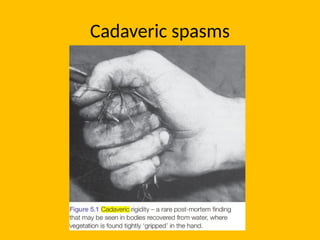
Cadaveric Spasms
• Itis also known as postmortem
spasm, instantaneous rigor mortis, cataleptic
rigidity, or instantaneous rigidity, is a rare form
of muscular stiffening that occurs at the
moment of death and persists into the period
of rigor mortis
• The cause is unknown but is usually associated
with violent deaths under extreme physical
circumstances with intense emotion
26.
Cadaveric Spasm
• Onlyvoluntary muscles are involved
– Can not be produced artificially
• Cadaveric spasm records last act of life and
may be helpful in indicating manner of death
(accident/suicide/homicide).
Late post mortemchanges
• Decomposition
• Starts at cellular level soon after death, usually
follows rigor mortis.
• Caused by a combination of autolysis and
putrefaction
1. Autolysis ( digestion of cells and tissues due to
intrinsic enzymes and proteins)
2. Putrefaction ( tissue breakdown as a result of
bacterial action )
(In most environments, putrefaction dominates)
29.
• Autolysis
• Enzymesreleased from tissues cause auto
digestion and disintegration of organs.
• Commences after 3-4 hours after death and
continues steadily for about 2-3 days.
• Prevented by freezing
30.
• Bacterial Action(Putrefaction)
• Clostridium welchii and other organisms like
staphylococci, B Proteus, release enzymes,
which cause breakdown of various body
tissues and gas formation.
• Lecithinase enzyme produced by C. Welchii
dissolves cell membranes.
• C Welchii forms gas (H2S)
31.
• Decomposition resultsin liquefaction of the
soft tissues over a period of time
• Decomposition is affected by temperature
• The warmer the temperature, the earlier the
decomposition process starts and the faster it
progresses.
• The process is usually first visible 3-4 day as a
green discoloration of the right iliac fossa
32.
• This ‘greening’is the result of the extension of the
commensal gut bacteria through the bowel wall
and into the skin, where they decompose
haemoglobin, resulting in the green colour.
• Bacteria travel through the blood vessels and
spread throughout the body
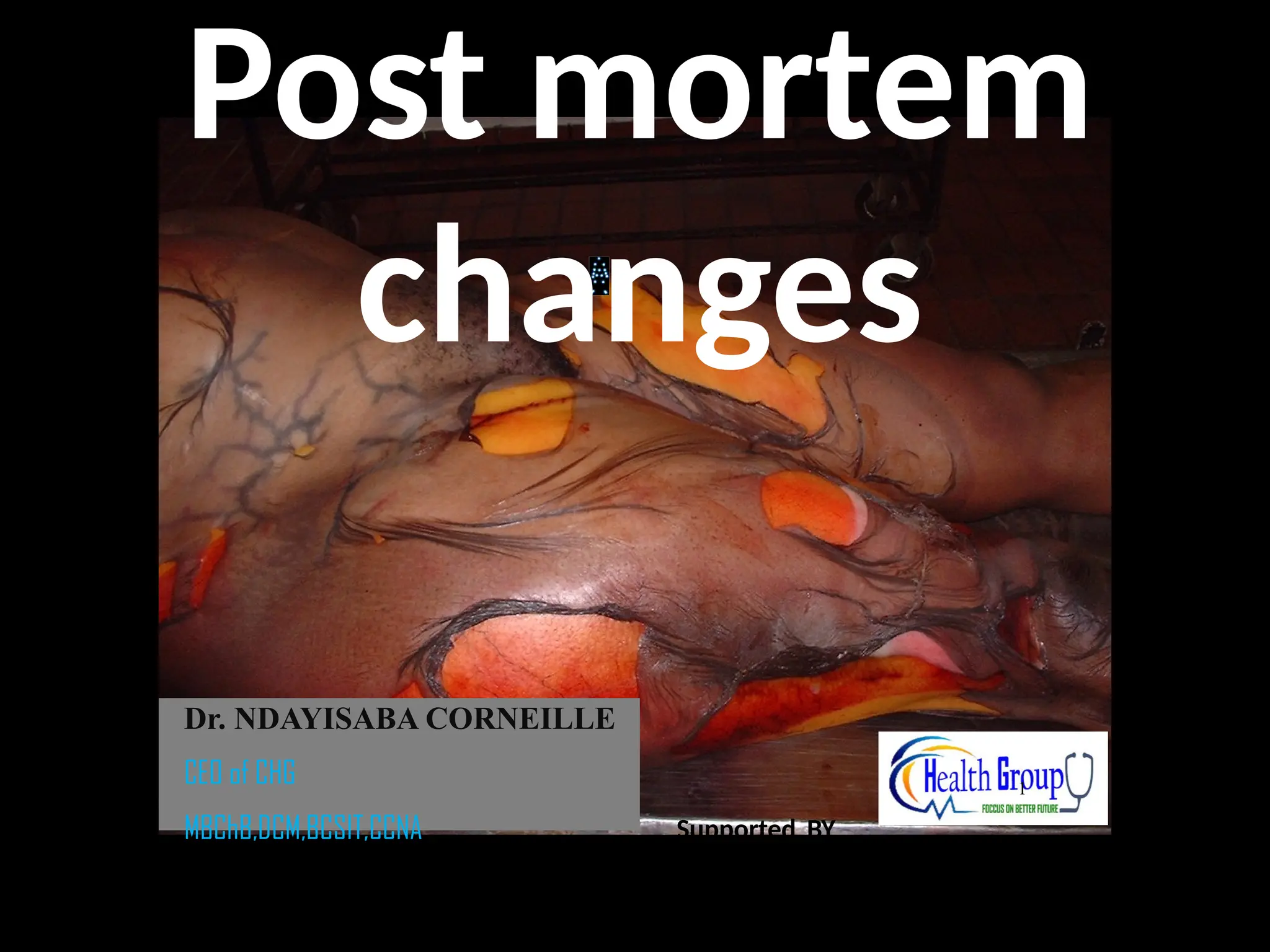
• This results in linear branching patterns of variable
discoloration of the skin that is called marbling
33.
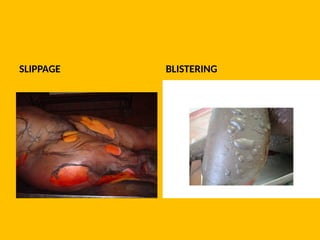
• Over time,generalized skin discoloration occurs and
blisters containing red or brown fluid form in many
areas.
• When the blisters burst, the skin sloughs off
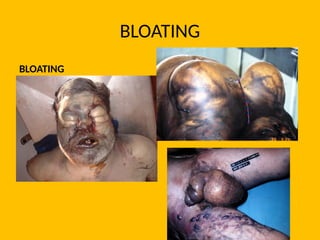
• Gas formation in soft tissues and body cavities causes
bloating of the face, abdomen, breasts and genitals
• The increased internal pressure causes the eyes and
tongue to protrude and forces blood-stained fluid up
from the lungs which often ‘leaks out’ of the mouth
and nose as ‘purge fluid’
34.
Time frame forchanges in decomposition
• Greenish discoloration at the right iliac fossa
(18-24 hours in summer).
• Discoloration spreads all over the body (24-28 hours).
• Greenish brown or purple red vein: marbling of veins (36-
38 hours).
• Body emits foul, unpleasant odor due to gases
formation (H2S, CO2, methane, etc.)
• Distension of abdomen – 18 -24 hours
35.
Time frame forchanges in decomposition
• Bloating of features (36-48 hours).
• Shifting of post-mortem staining
• Skin blisters (36-48 hours) and skin spillage ,
loose hair/nails (48-72 hours).
• Female genitalia pendulous (36-48 hours).
• Expulsion of fetus (48-72 hours).
36.
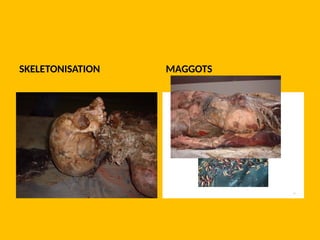
• Flies ormaggots may also be seen in a decomposing body
depending on the stage of development and the type of insect
• 24 h 4-5 days 10-20 days
Eggs Maggots Pupae Adult flies
Advanced ( over 4 to 5 days PM)
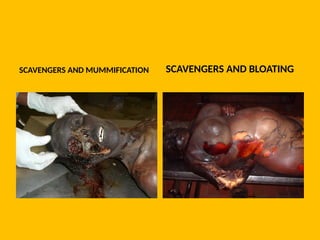
• Hot and dry climate: mummification due to tissue desiccation
• Cold and wet climates: adipocere formation due to conversion
of free fatty acids into soaps by the action of Clostridium
species
• Skeletonization : occurs over weeks to months
41
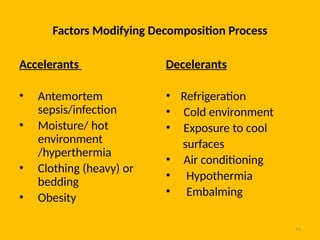
Factors Modifying DecompositionProcess
Accelerants
• Antemortem
sepsis/infection
• Moisture/ hot
environment
/hyperthermia
• Clothing (heavy) or
bedding
• Obesity
Decelerants
• Refrigeration
• Cold environment
• Exposure to cool
surfaces
• Air conditioning
• Hypothermia
• Embalming
42.
42
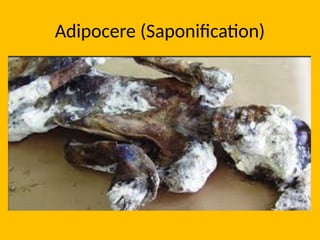
Adipocere (Saponification)
1. Dueto hydrolysis and hydrogenation of body
fats into substance, Adipocere, under
influence of bacterial enzyme (lipase).
2. Adipocere (yellowish, white greasy wax-like).
3. Moisture/warm temperature – essential.
4. Time required 3 weeks to 12 months
(variable).
44
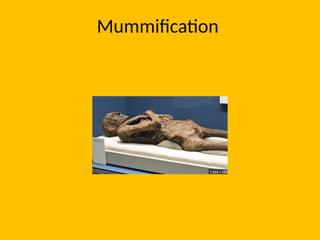
Mummification
1. Dehydration/desiccation oftissues.
2. Body becomes thin, brownish black and
brittle.
3. Hot dry climate and absence of moisture
essential.
4. Process takes about 1 – 2 months.
47
Maceration
1. Death in-utero results in maceration
(systemic autolysis ) rather than
decomposition due to the sterile intra-
uterine environment..
2. Bacterial putrefaction plays no role in the
process.
3. The changes of maceration are only seen
when a still-born fetus has been dead for
several days before delivery.
48.
Late post mortemchanges
• Decomposition
• Adipocere formation
• Mumfication
• skeletonisation