Adjectives
An adjective is a word that accompanies a
noun to describe or point out the noun’s
quality, quantity or number. Hence it is a
word that adds something for the meaning of
a noun. An Adjective is generally placed
immediately before the noun.
E.g.: It is a sweet cake.
Kinds of Adjectives
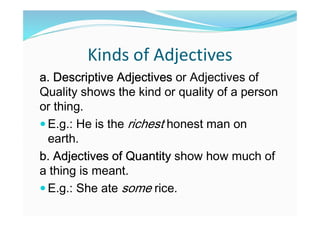
a. Descriptive Adjectives or Adjectives of
Quality shows the kind or quality of a person
or thing.
 E.g.: He is the richest honest man on
earth.
b. Adjectives of Quantity show how much of
a thing is meant.
 E.g.: She ate some rice.
Kinds of Adjectives
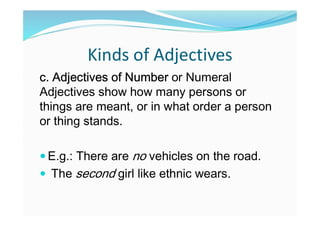
c. Adjectives of Number or Numeral
Adjectives show how many persons or
things are meant, or in what order a person
or thing stands.
 E.g.: There are no vehicles on the road.
 The second girl like ethnic wears.
Kinds of Adjectives
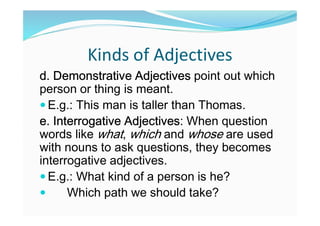
d. Demonstrative Adjectives point out which
person or thing is meant.
 E.g.: This man is taller than Thomas.
e. Interrogative Adjectives: When question
words like what, which and whose are used
with nouns to ask questions, they becomes
interrogative adjectives.
 E.g.: What kind of a person is he?
 Which path we should take?
Degrees of Comparison
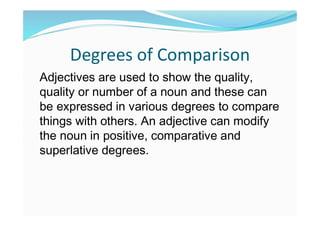
Adjectives are used to show the quality,
quality or number of a noun and these can
be expressed in various degrees to compare
things with others. An adjective can modify
the noun in positive, comparative and
superlative degrees.
Degrees of Comparison
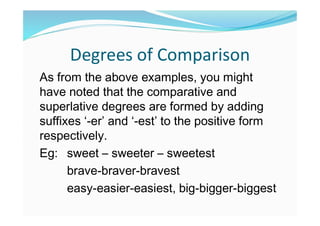
As from the above examples, you might
have noted that the comparative and
superlative degrees are formed by adding
suffixes ‘-er’ and ‘-est’ to the positive form
respectively.
Eg: sweet – sweeter – sweetest
brave-braver-bravest
easy-easier-easiest, big-bigger-biggest
Degrees of Comparison
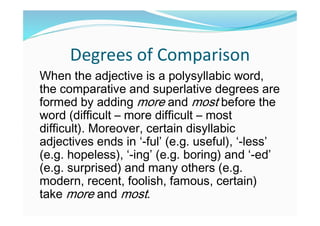
When the adjective is a polysyllabic word,
the comparative and superlative degrees are
formed by adding more and most before the
word (difficult – more difficult – most
difficult). Moreover, certain disyllabic
adjectives ends in ‘-ful’ (e.g. useful), ‘-less’
(e.g. hopeless), ‘-ing’ (e.g. boring) and ‘-ed’
(e.g. surprised) and many others (e.g.
modern, recent, foolish, famous, certain)
take more and most.
Phrasal Verbs
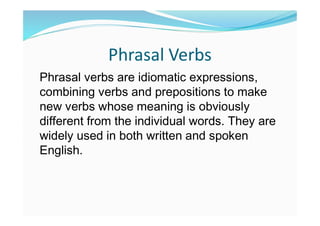
Phrasal verbs are idiomatic expressions,
combining verbs and prepositions to make
new verbs whose meaning is obviously
different from the individual words. They are
widely used in both written and spoken
English.
Phrasal Verbs
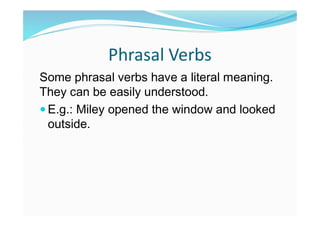
Some phrasal verbs have a literal meaning.
They can be easily understood.
 E.g.: Miley opened the window and looked
outside.
Phrasal Verbs
Some are separable and we can add the
object of the sentence in between; but some
are inseparable.
 E.g.: Please take the hat off.
 I came across your childhood photos in the
album.
Phrasal Verbs
But many of the phrasal verbs have a
figurative meaning which makes them
difficult to understand.
 E.g.: The workers called off the strike.
(withdraw)
Prepositions
The literal meaning of preposition is
“something that is placed before”. It is a
word placed before a noun or a pronoun to
show in what relation the person or thing
denoted by it stands in regard to something
else.
Prepositions
A Preposition is usually placed before its
object, but sometimes it follows it.
 E.g.: This is the hat that you asked for.
 What are you looking for?
Kinds of Prepositions
Prepositions may be arranged in the
following categories:-
a. Simple Prepositions: at, by, for, from, in,
of, off, on, out, through, till, to, up, with.
Kinds of Prepositions
b. Compound Prepositions are generally
formed by prefixing a Preposition (usually a
= on or be = by) to a Noun, an Adjective or
an Adverb. They include – about, above,
across, along, amidst, among, amongst,
around, before, behind, below, beneath,
beside, between, beyond, inside, outside,
underneath, within, without etc.
Kinds of Prepositions
c. Phrase Prepositions: Groups of words
used with the force of a single preposition.
They include – according to, in accordance
with, in addition to, along with, on behalf of
in case of, in spite of etc.
Kinds of Prepositions
d. Participial Prepositions: If present
participles like Barring, concerning,
considering, during, notwithstanding,
pending, regarding, respecting, touching,
and a few similar words are used as such
without any noun or pronoun being attached
to them, they behave like prepositions.
These are distinguished as Participial
Prepositions.
The following Prepositions require special
notice:-
(1) We can use ‘in’ or ‘at’ with the names of
cities, towns or villages. In most cases ‘in’ is
used. We use ‘in’ when we are talking about
a place as an area; we use ‘at’ when we see
it as a point.
 E.g.: We stayed in London for two weeks.
 Our plane stopped at London on the way
to USA.
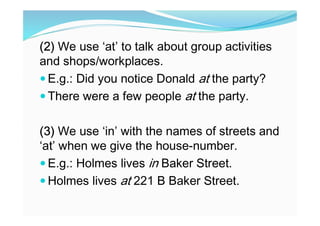
(2) We use ‘at’ to talk about group activities
and shops/workplaces.
 E.g.: Did you notice Donald at the party?
 There were a few people at the party.
(3) We use ‘in’ with the names of streets and
‘at’ when we give the house-number.
 E.g.: Holmes lives in Baker Street.
 Holmes lives at 221 B Baker Street.
(4) We use ‘on’ when we think of a place as
a surface.
 E.g.: The cat is lying on the floor.
 Take that picture on the wall.
(5) ‘Till’ is used of time and ‘to’ is used of
place; as
 E.g.: Watson slept till eight O’clock.
 Holmes walked to the end of the street.
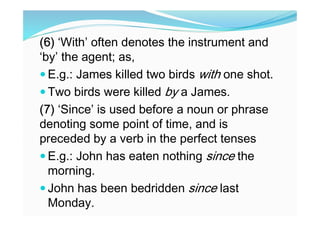
(6) ‘With’ often denotes the instrument and
‘by’ the agent; as,
 E.g.: James killed two birds with one shot.
 Two birds were killed by a James.
(7) ‘Since’ is used before a noun or phrase
denoting some point of time, and is
preceded by a verb in the perfect tenses
 E.g.: John has eaten nothing since the
morning.
 John has been bedridden since last
Monday.
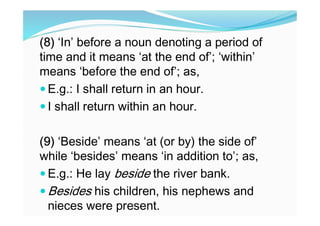
(8) ‘In’ before a noun denoting a period of
time and it means ‘at the end of’; ‘within’
means ‘before the end of’; as,
 E.g.: I shall return in an hour.
 I shall return within an hour.
(9) ‘Beside’ means ‘at (or by) the side of’
while ‘besides’ means ‘in addition to’; as,
 E.g.: He lay beside the river bank.
 Besides his children, his nephews and
nieces were present.

Adjectives, Phrasal Verbs, and Prepositions

  • 1.
    Adjectives An adjective isa word that accompanies a noun to describe or point out the noun’s quality, quantity or number. Hence it is a word that adds something for the meaning of a noun. An Adjective is generally placed immediately before the noun. E.g.: It is a sweet cake.
  • 2.
    Kinds of Adjectives a.Descriptive Adjectives or Adjectives of Quality shows the kind or quality of a person or thing.  E.g.: He is the richest honest man on earth. b. Adjectives of Quantity show how much of a thing is meant.  E.g.: She ate some rice.
  • 3.
    Kinds of Adjectives c.Adjectives of Number or Numeral Adjectives show how many persons or things are meant, or in what order a person or thing stands.  E.g.: There are no vehicles on the road.  The second girl like ethnic wears.
  • 4.
    Kinds of Adjectives d.Demonstrative Adjectives point out which person or thing is meant.  E.g.: This man is taller than Thomas. e. Interrogative Adjectives: When question words like what, which and whose are used with nouns to ask questions, they becomes interrogative adjectives.  E.g.: What kind of a person is he?  Which path we should take?
  • 5.
    Degrees of Comparison Adjectivesare used to show the quality, quality or number of a noun and these can be expressed in various degrees to compare things with others. An adjective can modify the noun in positive, comparative and superlative degrees.
  • 6.
    Degrees of Comparison Asfrom the above examples, you might have noted that the comparative and superlative degrees are formed by adding suffixes ‘-er’ and ‘-est’ to the positive form respectively. Eg: sweet – sweeter – sweetest brave-braver-bravest easy-easier-easiest, big-bigger-biggest
  • 7.
    Degrees of Comparison Whenthe adjective is a polysyllabic word, the comparative and superlative degrees are formed by adding more and most before the word (difficult – more difficult – most difficult). Moreover, certain disyllabic adjectives ends in ‘-ful’ (e.g. useful), ‘-less’ (e.g. hopeless), ‘-ing’ (e.g. boring) and ‘-ed’ (e.g. surprised) and many others (e.g. modern, recent, foolish, famous, certain) take more and most.
  • 8.
    Phrasal Verbs Phrasal verbsare idiomatic expressions, combining verbs and prepositions to make new verbs whose meaning is obviously different from the individual words. They are widely used in both written and spoken English.
  • 9.
    Phrasal Verbs Some phrasalverbs have a literal meaning. They can be easily understood.  E.g.: Miley opened the window and looked outside.
  • 10.
    Phrasal Verbs Some areseparable and we can add the object of the sentence in between; but some are inseparable.  E.g.: Please take the hat off.  I came across your childhood photos in the album.
  • 11.
    Phrasal Verbs But manyof the phrasal verbs have a figurative meaning which makes them difficult to understand.  E.g.: The workers called off the strike. (withdraw)
  • 12.
    Prepositions The literal meaningof preposition is “something that is placed before”. It is a word placed before a noun or a pronoun to show in what relation the person or thing denoted by it stands in regard to something else.
  • 13.
    Prepositions A Preposition isusually placed before its object, but sometimes it follows it.  E.g.: This is the hat that you asked for.  What are you looking for?
  • 14.
    Kinds of Prepositions Prepositionsmay be arranged in the following categories:- a. Simple Prepositions: at, by, for, from, in, of, off, on, out, through, till, to, up, with.
  • 15.
    Kinds of Prepositions b.Compound Prepositions are generally formed by prefixing a Preposition (usually a = on or be = by) to a Noun, an Adjective or an Adverb. They include – about, above, across, along, amidst, among, amongst, around, before, behind, below, beneath, beside, between, beyond, inside, outside, underneath, within, without etc.
  • 16.
    Kinds of Prepositions c.Phrase Prepositions: Groups of words used with the force of a single preposition. They include – according to, in accordance with, in addition to, along with, on behalf of in case of, in spite of etc.
  • 17.
    Kinds of Prepositions d.Participial Prepositions: If present participles like Barring, concerning, considering, during, notwithstanding, pending, regarding, respecting, touching, and a few similar words are used as such without any noun or pronoun being attached to them, they behave like prepositions. These are distinguished as Participial Prepositions.
  • 18.
    The following Prepositionsrequire special notice:- (1) We can use ‘in’ or ‘at’ with the names of cities, towns or villages. In most cases ‘in’ is used. We use ‘in’ when we are talking about a place as an area; we use ‘at’ when we see it as a point.  E.g.: We stayed in London for two weeks.  Our plane stopped at London on the way to USA.
  • 19.
    (2) We use‘at’ to talk about group activities and shops/workplaces.  E.g.: Did you notice Donald at the party?  There were a few people at the party. (3) We use ‘in’ with the names of streets and ‘at’ when we give the house-number.  E.g.: Holmes lives in Baker Street.  Holmes lives at 221 B Baker Street.
  • 20.
    (4) We use‘on’ when we think of a place as a surface.  E.g.: The cat is lying on the floor.  Take that picture on the wall. (5) ‘Till’ is used of time and ‘to’ is used of place; as  E.g.: Watson slept till eight O’clock.  Holmes walked to the end of the street.
  • 21.
    (6) ‘With’ oftendenotes the instrument and ‘by’ the agent; as,  E.g.: James killed two birds with one shot.  Two birds were killed by a James. (7) ‘Since’ is used before a noun or phrase denoting some point of time, and is preceded by a verb in the perfect tenses  E.g.: John has eaten nothing since the morning.  John has been bedridden since last Monday.
  • 22.
    (8) ‘In’ beforea noun denoting a period of time and it means ‘at the end of’; ‘within’ means ‘before the end of’; as,  E.g.: I shall return in an hour.  I shall return within an hour. (9) ‘Beside’ means ‘at (or by) the side of’ while ‘besides’ means ‘in addition to’; as,  E.g.: He lay beside the river bank.  Besides his children, his nephews and nieces were present.