Grammar Boot Camp


     Building Muscle:
   Phrases and Clauses
    (click mouse to proceed)
Your Mission:
  To Study Phrases
  To Study Clauses
  To Exercise your Writing Muscles


 This presentation is enhanced with “Question
  and Answer” slides. To access, simply click
  on the words that are highlighted and
  underlined.
What is a Phrase?
 A phrase is a group of related words that
  does not contain a subject and a verb.

 Common Phrases:
   Prepositional Phrases
   Infinitive Phrases
   Participial Phrases
   Gerund Phrases
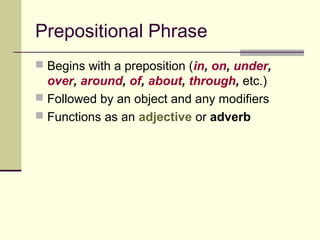
Prepositional Phrase
 Begins with a preposition (in, on, under,
  over, around, of, about, through, etc.)
 Followed by an object and any modifiers
 Functions as an adjective or adverb
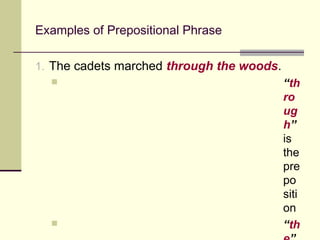
Examples of Prepositional Phrase

1. The cadets marched through the woods.
                                          “th
                                           ro
                                           ug
                                           h”
                                           is
                                           the
                                           pre
                                           po
                                           siti
                                           on
                                          “th
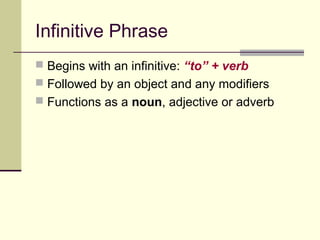
Infinitive Phrase
 Begins with an infinitive: “to” + verb
 Followed by an object and any modifiers
 Functions as a noun, adjective or adverb
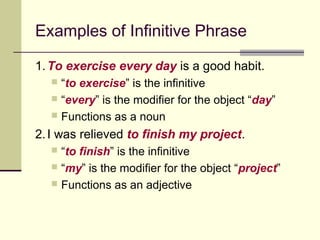
Examples of Infinitive Phrase

1. To exercise every day is a good habit.
   “to exercise” is the infinitive
   “every” is the modifier for the object “day”
   Functions as a noun

2. I was relieved to finish my project.
   “to finish” is the infinitive
   “my” is the modifier for the object “project”
   Functions as an adjective
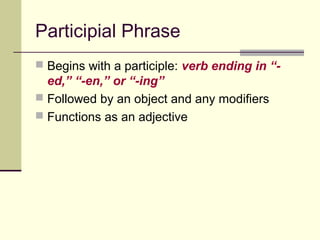
Participial Phrase
 Begins with a participle: verb ending in “-
  ed,” “-en,” or “-ing”
 Followed by an object and any modifiers
 Functions as an adjective
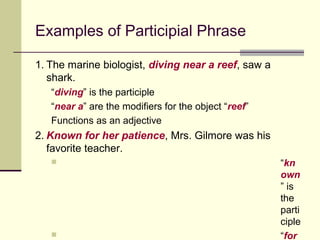
Examples of Participial Phrase

1. The marine biologist, diving near a reef, saw a
   shark.
   “diving” is the participle
   “near a” are the modifiers for the object “reef”
   Functions as an adjective
2. Known for her patience, Mrs. Gilmore was his
   favorite teacher.
                                                     “kn
                                                      own
                                                      ” is
                                                      the
                                                      parti
                                                      ciple
                                                     “for
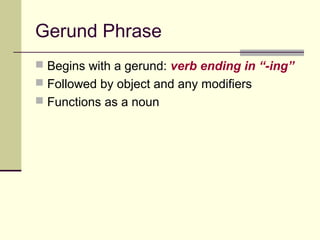
Gerund Phrase
 Begins with a gerund: verb ending in “-ing”
 Followed by object and any modifiers
 Functions as a noun
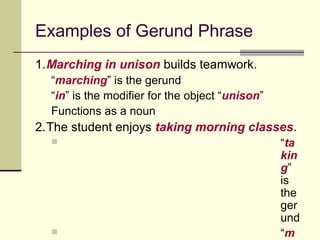
Examples of Gerund Phrase
1.Marching in unison builds teamwork.
  “marching” is the gerund
  “in” is the modifier for the object “unison”
  Functions as a noun
2.The student enjoys taking morning classes.
                                                “ta
                                                 kin
                                                 g”
                                                 is
                                                 the
                                                 ger
                                                 und
                                                “m
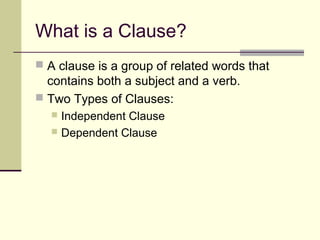
What is a Clause?
 A clause is a group of related words that
  contains both a subject and a verb.
 Two Types of Clauses:
   Independent Clause
   Dependent Clause
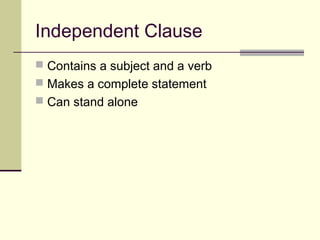
Independent Clause
 Contains a subject and a verb
 Makes a complete statement
 Can stand alone
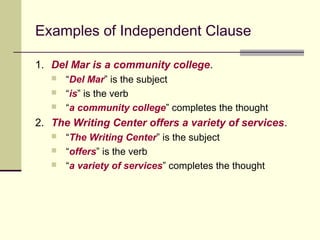
Examples of Independent Clause

1. Del Mar is a community college.
      “Del Mar” is the subject
      “is” is the verb
      “a community college” completes the thought
2. The Writing Center offers a variety of services.
      “The Writing Center” is the subject
      “offers” is the verb
      “a variety of services” completes the thought
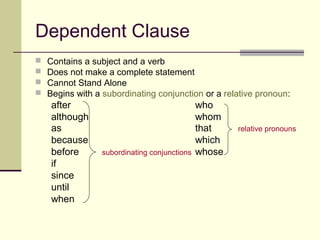
Dependent Clause
   Contains a subject and a verb
   Does not make a complete statement
   Cannot Stand Alone
   Begins with a subordinating conjunction or a relative pronoun:
     after                                    who
     although                                 whom
     as                                       that    relative pronouns
     because                                  which
     before      subordinating conjunctions   whose
     if
     since
     until
     when
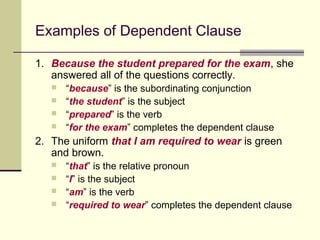
Examples of Dependent Clause

1. Because the student prepared for the exam, she
   answered all of the questions correctly.
      “because” is the subordinating conjunction
      “the student” is the subject
      “prepared” is the verb
      “for the exam” completes the dependent clause
2. The uniform that I am required to wear is green
   and brown.
      “that” is the relative pronoun
      “I” is the subject
      “am” is the verb
      “required to wear” completes the dependent clause
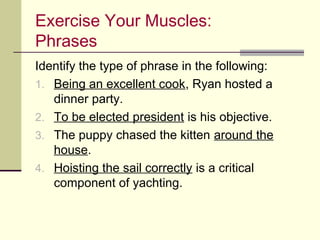
Exercise Your Muscles:
Phrases
Identify the type of phrase in the following:
1. Being an excellent cook, Ryan hosted a
   dinner party.
2. To be elected president is his objective.
3. The puppy chased the kitten around the
   house.
4. Hoisting the sail correctly is a critical
   component of yachting.
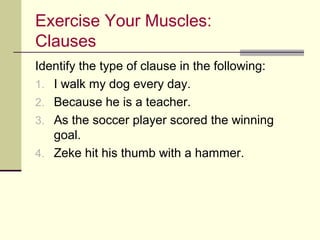
Exercise Your Muscles:
Clauses
Identify the type of clause in the following:
1. I walk my dog every day.
2. Because he is a teacher.
3. As the soccer player scored the winning
   goal.
4. Zeke hit his thumb with a hammer.
Congratulations!
You have successfully completed Building
  Muscle: Phrases and Clauses of Grammar
  Boot Camp.
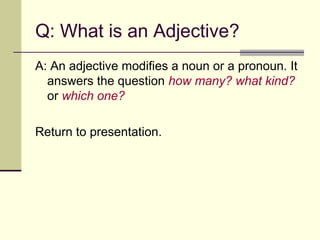
Q: What is an Adjective?
A: An adjective modifies a noun or a pronoun. It
  answers the question how many? what kind?
  or which one?

Return to presentation.
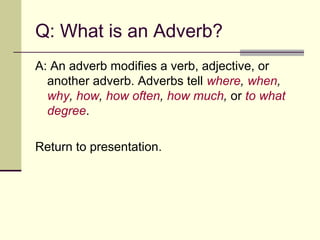
Q: What is an Adverb?
A: An adverb modifies a verb, adjective, or
  another adverb. Adverbs tell where, when,
  why, how, how often, how much, or to what
  degree.

Return to presentation.
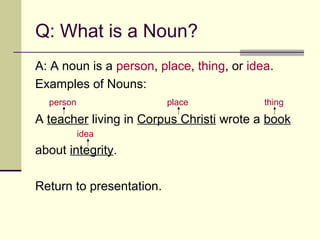
Q: What is a Noun?
A: A noun is a person, place, thing, or idea.
Examples of Nouns:
  person                  place            thing

A teacher living in Corpus Christi wrote a book
           idea
about integrity.

Return to presentation.
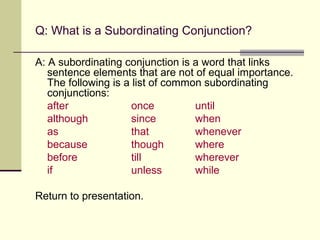
Q: What is a Subordinating Conjunction?

A: A subordinating conjunction is a word that links
   sentence elements that are not of equal importance.
   The following is a list of common subordinating
   conjunctions:
   after              once         until
   although           since        when
   as                 that         whenever
   because            though       where
   before             till         wherever
   if                 unless       while

Return to presentation.
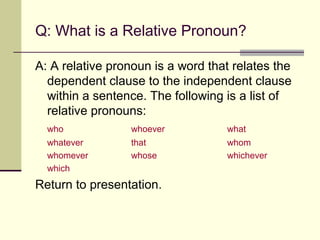
Q: What is a Relative Pronoun?

A: A relative pronoun is a word that relates the
  dependent clause to the independent clause
  within a sentence. The following is a list of
  relative pronouns:
  who            whoever           what
  whatever       that              whom
  whomever       whose             whichever
  which
Return to presentation.

Grammar boot camp #2

  • 1.
    Grammar Boot Camp Building Muscle: Phrases and Clauses (click mouse to proceed)
  • 2.
    Your Mission: To Study Phrases  To Study Clauses  To Exercise your Writing Muscles This presentation is enhanced with “Question and Answer” slides. To access, simply click on the words that are highlighted and underlined.
  • 3.
    What is aPhrase?  A phrase is a group of related words that does not contain a subject and a verb.  Common Phrases:  Prepositional Phrases  Infinitive Phrases  Participial Phrases  Gerund Phrases
  • 4.
    Prepositional Phrase  Beginswith a preposition (in, on, under, over, around, of, about, through, etc.)  Followed by an object and any modifiers  Functions as an adjective or adverb
  • 5.
    Examples of PrepositionalPhrase 1. The cadets marched through the woods.  “th ro ug h” is the pre po siti on  “th
  • 6.
    Infinitive Phrase  Beginswith an infinitive: “to” + verb  Followed by an object and any modifiers  Functions as a noun, adjective or adverb
  • 7.
    Examples of InfinitivePhrase 1. To exercise every day is a good habit.  “to exercise” is the infinitive  “every” is the modifier for the object “day”  Functions as a noun 2. I was relieved to finish my project.  “to finish” is the infinitive  “my” is the modifier for the object “project”  Functions as an adjective
  • 8.
    Participial Phrase  Beginswith a participle: verb ending in “- ed,” “-en,” or “-ing”  Followed by an object and any modifiers  Functions as an adjective
  • 9.
    Examples of ParticipialPhrase 1. The marine biologist, diving near a reef, saw a shark. “diving” is the participle “near a” are the modifiers for the object “reef” Functions as an adjective 2. Known for her patience, Mrs. Gilmore was his favorite teacher.  “kn own ” is the parti ciple  “for
  • 10.
    Gerund Phrase  Beginswith a gerund: verb ending in “-ing”  Followed by object and any modifiers  Functions as a noun
  • 11.
    Examples of GerundPhrase 1.Marching in unison builds teamwork. “marching” is the gerund “in” is the modifier for the object “unison” Functions as a noun 2.The student enjoys taking morning classes.  “ta kin g” is the ger und  “m
  • 12.
    What is aClause?  A clause is a group of related words that contains both a subject and a verb.  Two Types of Clauses:  Independent Clause  Dependent Clause
  • 13.
    Independent Clause  Containsa subject and a verb  Makes a complete statement  Can stand alone
  • 14.
    Examples of IndependentClause 1. Del Mar is a community college.  “Del Mar” is the subject  “is” is the verb  “a community college” completes the thought 2. The Writing Center offers a variety of services.  “The Writing Center” is the subject  “offers” is the verb  “a variety of services” completes the thought
  • 15.
    Dependent Clause  Contains a subject and a verb  Does not make a complete statement  Cannot Stand Alone  Begins with a subordinating conjunction or a relative pronoun: after who although whom as that relative pronouns because which before subordinating conjunctions whose if since until when
  • 16.
    Examples of DependentClause 1. Because the student prepared for the exam, she answered all of the questions correctly.  “because” is the subordinating conjunction  “the student” is the subject  “prepared” is the verb  “for the exam” completes the dependent clause 2. The uniform that I am required to wear is green and brown.  “that” is the relative pronoun  “I” is the subject  “am” is the verb  “required to wear” completes the dependent clause
  • 17.
    Exercise Your Muscles: Phrases Identifythe type of phrase in the following: 1. Being an excellent cook, Ryan hosted a dinner party. 2. To be elected president is his objective. 3. The puppy chased the kitten around the house. 4. Hoisting the sail correctly is a critical component of yachting.
  • 18.
    Exercise Your Muscles: Clauses Identifythe type of clause in the following: 1. I walk my dog every day. 2. Because he is a teacher. 3. As the soccer player scored the winning goal. 4. Zeke hit his thumb with a hammer.
  • 19.
    Congratulations! You have successfullycompleted Building Muscle: Phrases and Clauses of Grammar Boot Camp.
  • 20.
    Q: What isan Adjective? A: An adjective modifies a noun or a pronoun. It answers the question how many? what kind? or which one? Return to presentation.
  • 21.
    Q: What isan Adverb? A: An adverb modifies a verb, adjective, or another adverb. Adverbs tell where, when, why, how, how often, how much, or to what degree. Return to presentation.
  • 22.
    Q: What isa Noun? A: A noun is a person, place, thing, or idea. Examples of Nouns: person place thing A teacher living in Corpus Christi wrote a book idea about integrity. Return to presentation.
  • 23.
    Q: What isa Subordinating Conjunction? A: A subordinating conjunction is a word that links sentence elements that are not of equal importance. The following is a list of common subordinating conjunctions: after once until although since when as that whenever because though where before till wherever if unless while Return to presentation.
  • 24.
    Q: What isa Relative Pronoun? A: A relative pronoun is a word that relates the dependent clause to the independent clause within a sentence. The following is a list of relative pronouns: who whoever what whatever that whom whomever whose whichever which Return to presentation.