Noun Phrases
From: Grammar for IELTS
By Cambridge University Press
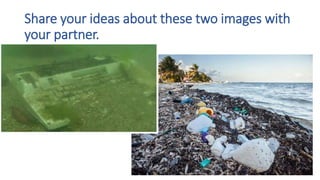
Share your ideas about these two images with
your partner.
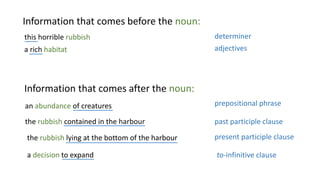
Information that comes before the noun:
this horrible rubbish determiner
adjectives
Information that comes after the noun:
an abundance of creatures
a rich habitat
prepositional phrase
the rubbish contained in the harbour past participle clause
the rubbish lying at the bottom of the harbour present participle clause
a decision to expand to-infinitive clause
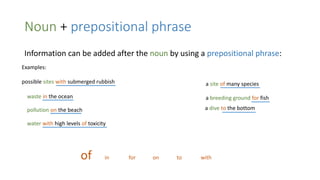
Noun + prepositional phrase
Information can be added after the noun by using a prepositional phrase:
of in for on to with
Examples:
possible sites with submerged rubbish a site of many species
waste in the ocean a breeding ground for fish
pollution on the beach a dive to the bottom
water with high levels of toxicity
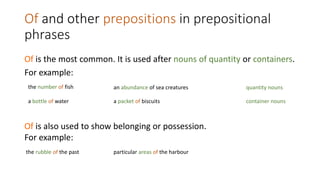
Of and other prepositions in prepositional
phrases
Of is the most common. It is used after nouns of quantity or containers.
For example:
the number of fish an abundance of sea creatures quantity nouns
a bottle of water a packet of biscuits container nouns
Of is also used to show belonging or possession.
For example:
the rubble of the past particular areas of the harbour
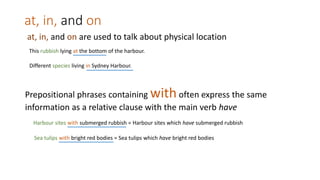
at, in, and on
at, in, and on are used to talk about physical location
This rubbish lying at the bottom of the harbour.
Different species living in Sydney Harbour.
Prepositional phrases containing withoften express the same
information as a relative clause with the main verb have
Harbour sites with submerged rubbish = Harbour sites which have submerged rubbish
Sea tulips with bright red bodies = Sea tulips which have bright red bodies
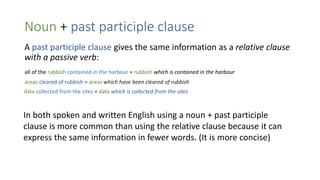
Noun + past participle clause
A past participle clause gives the same information as a relative clause
with a passive verb:
all of the rubbish contained in the harbour = rubbish which is contained in the harbour
areas cleared of rubbish = areas which have been cleared of rubbish
data collected from the sites = data which is collected from the sites
In both spoken and written English using a noun + past participle
clause is more common than using the relative clause because it can
express the same information in fewer words. (It is more concise)
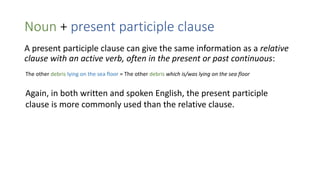
Noun + present participle clause
A present participle clause can give the same information as a relative
clause with an active verb, often in the present or past continuous:
The other debris lying on the sea floor = The other debris which is/was lying on the sea floor
Again, in both written and spoken English, the present participle
clause is more commonly used than the relative clause.
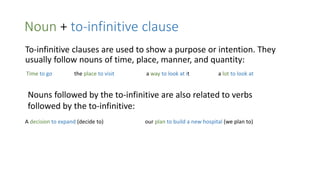
Noun + to-infinitive clause
To-infinitive clauses are used to show a purpose or intention. They
usually follow nouns of time, place, manner, and quantity:
Time to go the place to visit a way to look at it a lot to look at
Nouns followed by the to-infinitive are also related to verbs
followed by the to-infinitive:
A decision to expand (decide to) our plan to build a new hospital (we plan to)

Noun phrases powerpoint

  • 1.
    Noun Phrases From: Grammarfor IELTS By Cambridge University Press
  • 2.
    Share your ideasabout these two images with your partner.
  • 3.
    Information that comesbefore the noun: this horrible rubbish determiner adjectives Information that comes after the noun: an abundance of creatures a rich habitat prepositional phrase the rubbish contained in the harbour past participle clause the rubbish lying at the bottom of the harbour present participle clause a decision to expand to-infinitive clause
  • 4.
    Noun + prepositionalphrase Information can be added after the noun by using a prepositional phrase: of in for on to with Examples: possible sites with submerged rubbish a site of many species waste in the ocean a breeding ground for fish pollution on the beach a dive to the bottom water with high levels of toxicity
  • 5.
    Of and otherprepositions in prepositional phrases Of is the most common. It is used after nouns of quantity or containers. For example: the number of fish an abundance of sea creatures quantity nouns a bottle of water a packet of biscuits container nouns Of is also used to show belonging or possession. For example: the rubble of the past particular areas of the harbour
  • 6.
    at, in, andon at, in, and on are used to talk about physical location This rubbish lying at the bottom of the harbour. Different species living in Sydney Harbour. Prepositional phrases containing withoften express the same information as a relative clause with the main verb have Harbour sites with submerged rubbish = Harbour sites which have submerged rubbish Sea tulips with bright red bodies = Sea tulips which have bright red bodies
  • 7.
    Noun + pastparticiple clause A past participle clause gives the same information as a relative clause with a passive verb: all of the rubbish contained in the harbour = rubbish which is contained in the harbour areas cleared of rubbish = areas which have been cleared of rubbish data collected from the sites = data which is collected from the sites In both spoken and written English using a noun + past participle clause is more common than using the relative clause because it can express the same information in fewer words. (It is more concise)
  • 8.
    Noun + presentparticiple clause A present participle clause can give the same information as a relative clause with an active verb, often in the present or past continuous: The other debris lying on the sea floor = The other debris which is/was lying on the sea floor Again, in both written and spoken English, the present participle clause is more commonly used than the relative clause.
  • 9.
    Noun + to-infinitiveclause To-infinitive clauses are used to show a purpose or intention. They usually follow nouns of time, place, manner, and quantity: Time to go the place to visit a way to look at it a lot to look at Nouns followed by the to-infinitive are also related to verbs followed by the to-infinitive: A decision to expand (decide to) our plan to build a new hospital (we plan to)