The Nature Of
Reference In Text
And In Discourse
Content:
▫ What Is Text?
▫ Types Of Co-reference Relation
▫ Subtitution
▫ Discourse Reference
▫ Referring Expressions
▫ Pronoun In Discourse
▫ Interpreting Pronominal Reference
In Discourse
▫ CONCLUSION
2
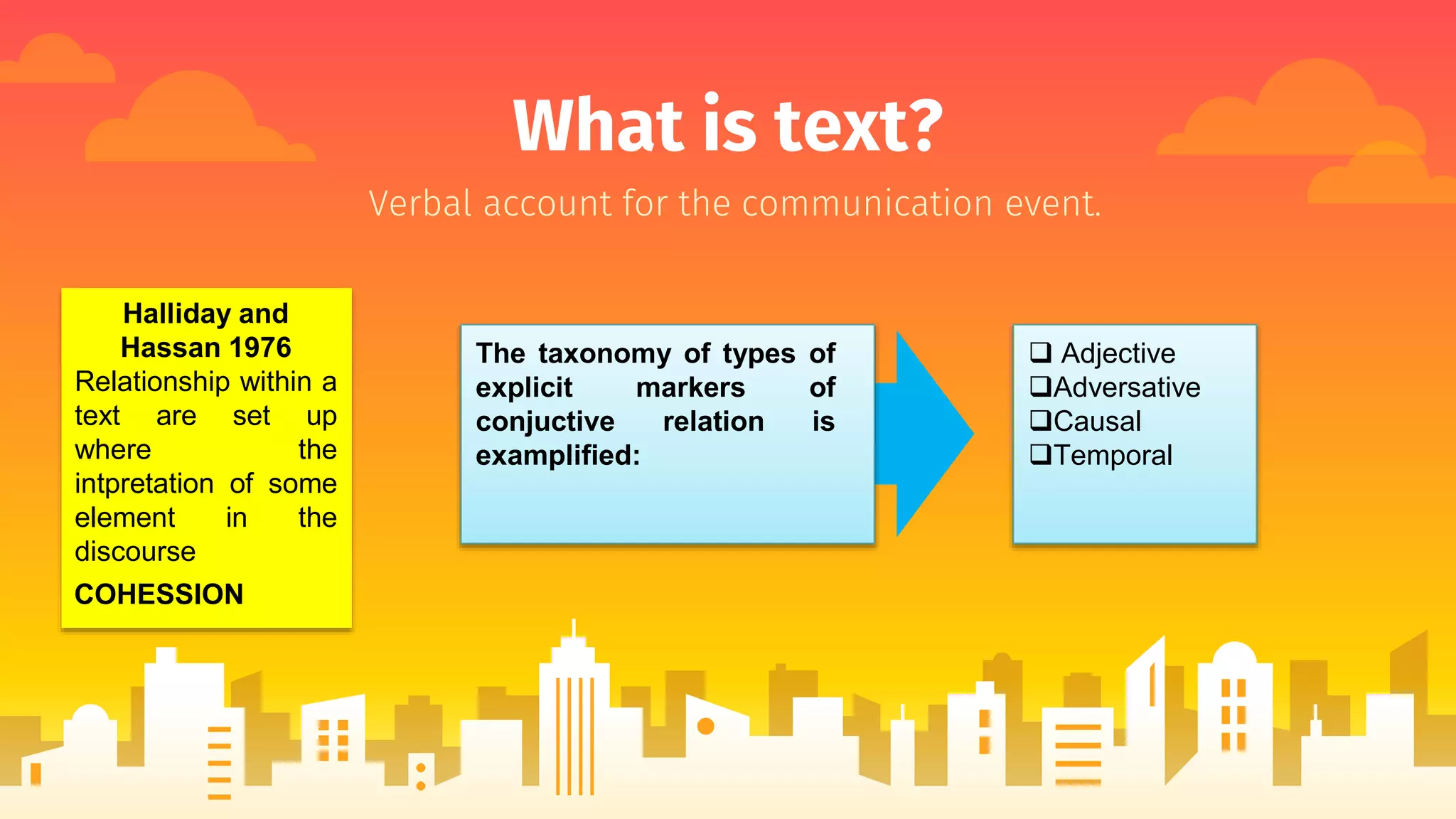
What is text?
Verbal account for the communication event.
Halliday and
Hassan 1976
Relationship within a
text are set up
where the
intpretation of some
element in the
discourse
COHESSION
The taxonomy of types of
explicit markers of
conjuctive relation is
examplified:
 Adjective
Adversative
Causal
Temporal
“
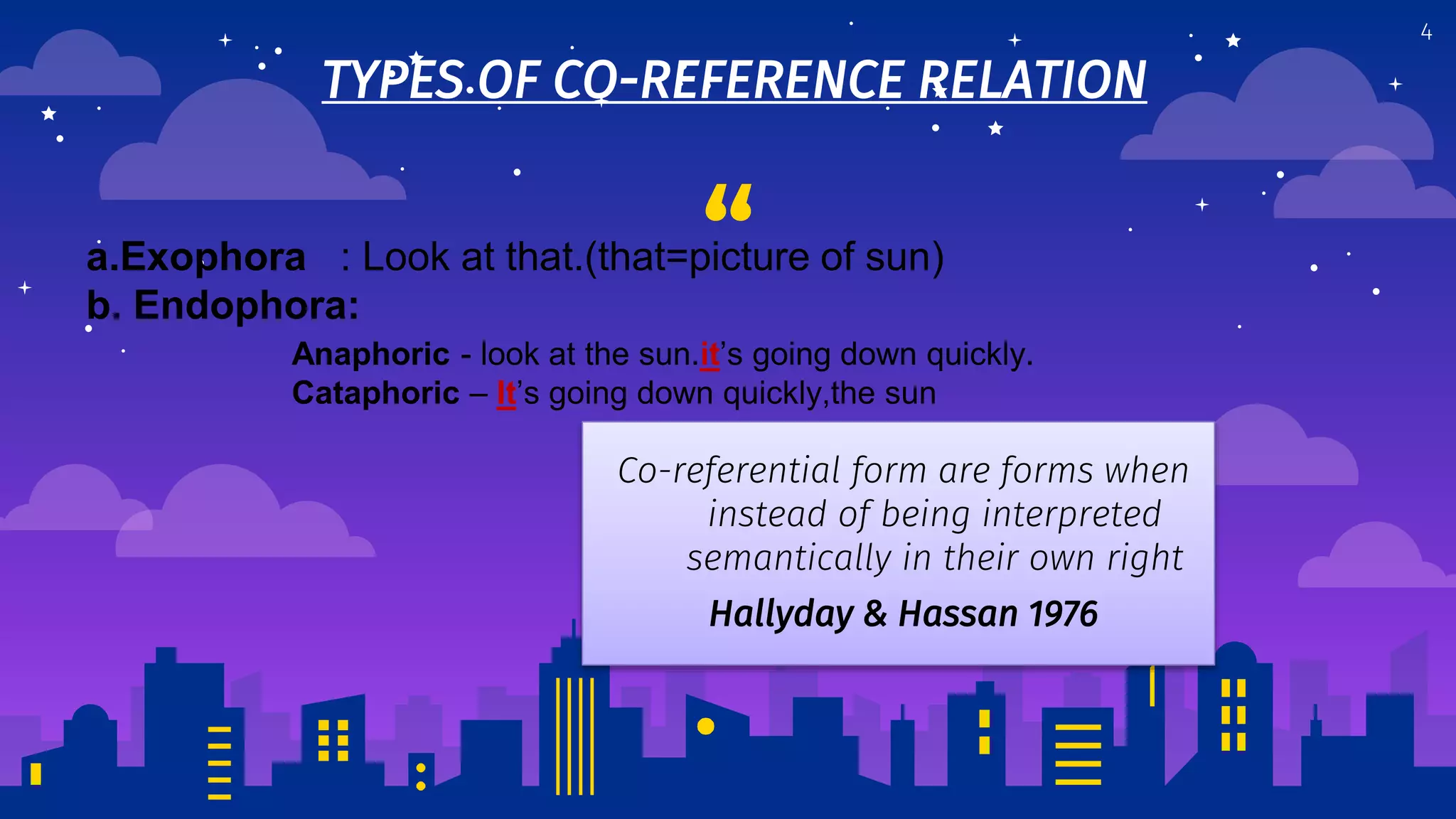
TYPES OF CO-REFERENCE RELATION
4
Co-referential form are forms when
instead of being interpreted
semantically in their own right
Hallyday & Hassan 1976
a.Exophora : Look at that.(that=picture of sun)
b. Endophora:
Anaphoric - look at the sun.it’s going down quickly.
Cataphoric – It’s going down quickly,the sun
Co-herence relationship
5
Co-herence
relationship
examplified
here is
anaphoric,henc
e endophoric
Repeated form :The Prime Minister recorded her thanks to foreign
secretary,
The Prime Minister was most eloquent.
Partially repeated form: Dr.E.C.R. Reeve chaired the meeting.
Dr.Reeve invited Mr.Philips to report on the state of the
gardens
Lexical replacement : Ro’s daughter is ill again.The child to the doctor.
Pronominal form : Ro said she would have take Sophie to the doctor.
Subtitutional form : Jules has a birthday next month.Elspeth has one too.
Ellided form : Jules has a birthday next month.Elspeth has too.
Halliday and Hasan
A simple subtitution view where an
expression may simply be replaced
by another in the text.
Harwerg,1978
A general approach to the analysis
of text which called ‘subtitutional
text linguistics’,consider comment
on text.
SUBTITUTION
 Wash and core six cooking apples. Put them
into fireproof dish.
 Kill an active,plump chicken.Prepare it for the
oven,cut it four pieces and roast it with thym
1 hour.
 Brown in the butter and then place in a small
dish.
 Now add the chicken
 When the liquid has almost evaporated
 STOP BUS VANDALS by reporting it at once to
the driver conductor
6
Discourse Reference
Lyons,1977
The term reference
can be taken out of
discussion of lexical
meaning and reverved
for that function
whereby speaker
(writers) indicate,via
the use of a linguistic
expression,the entities
they are talking
(writing) about.
Reference And Discourse Representation
Webber 1987
Specific representation,or model,arising from a particular
discourse,we can characterise as the individual’s discourse
representation.
 Writer
 Speaker/speaker version
 reader and hearer
 situation
▫ .e.g
▫ My uncles’s coming home from Canada.
7
Referring expressions
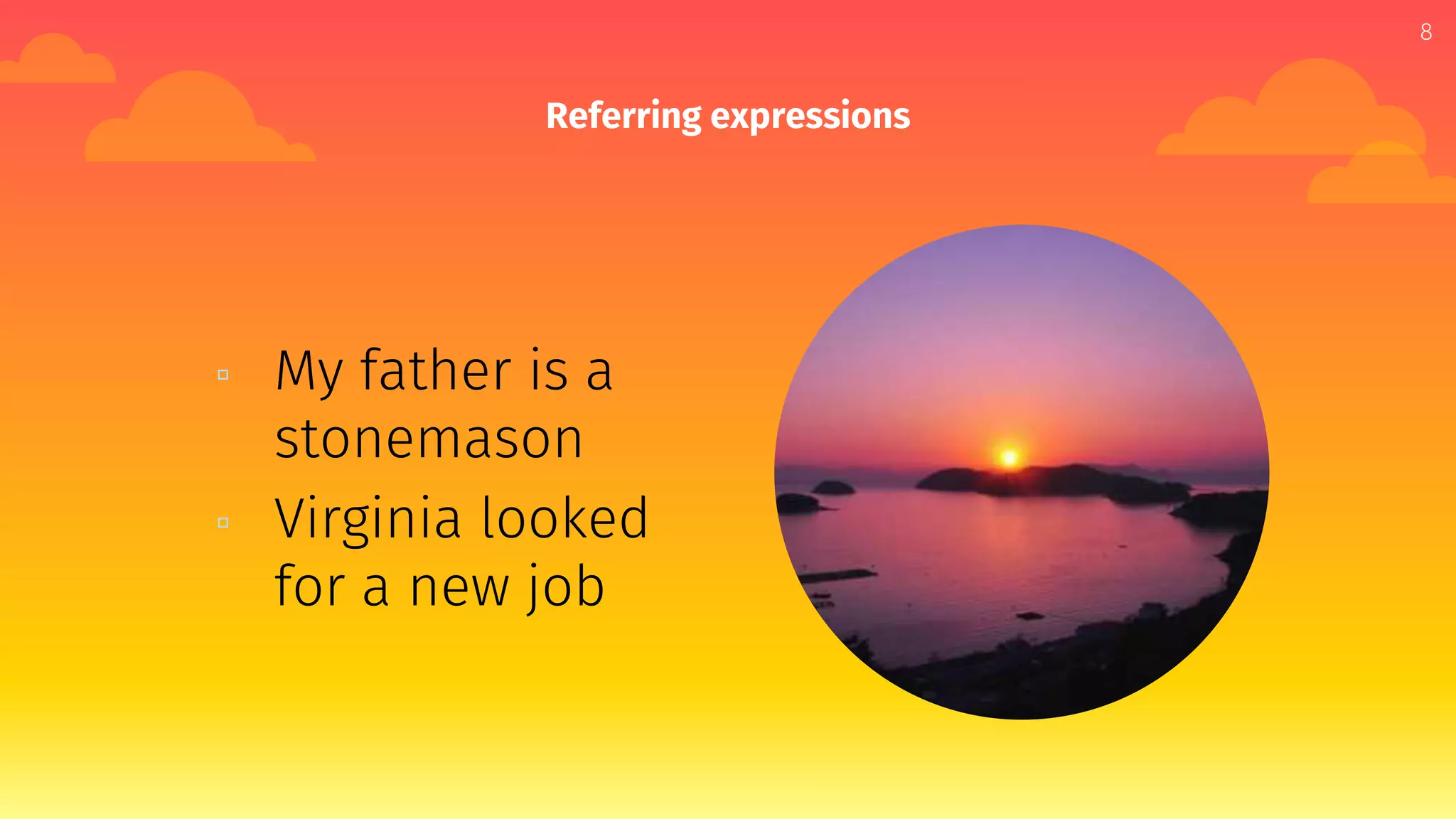
▫ My father is a
stonemason
▫ Virginia looked
for a new job
8
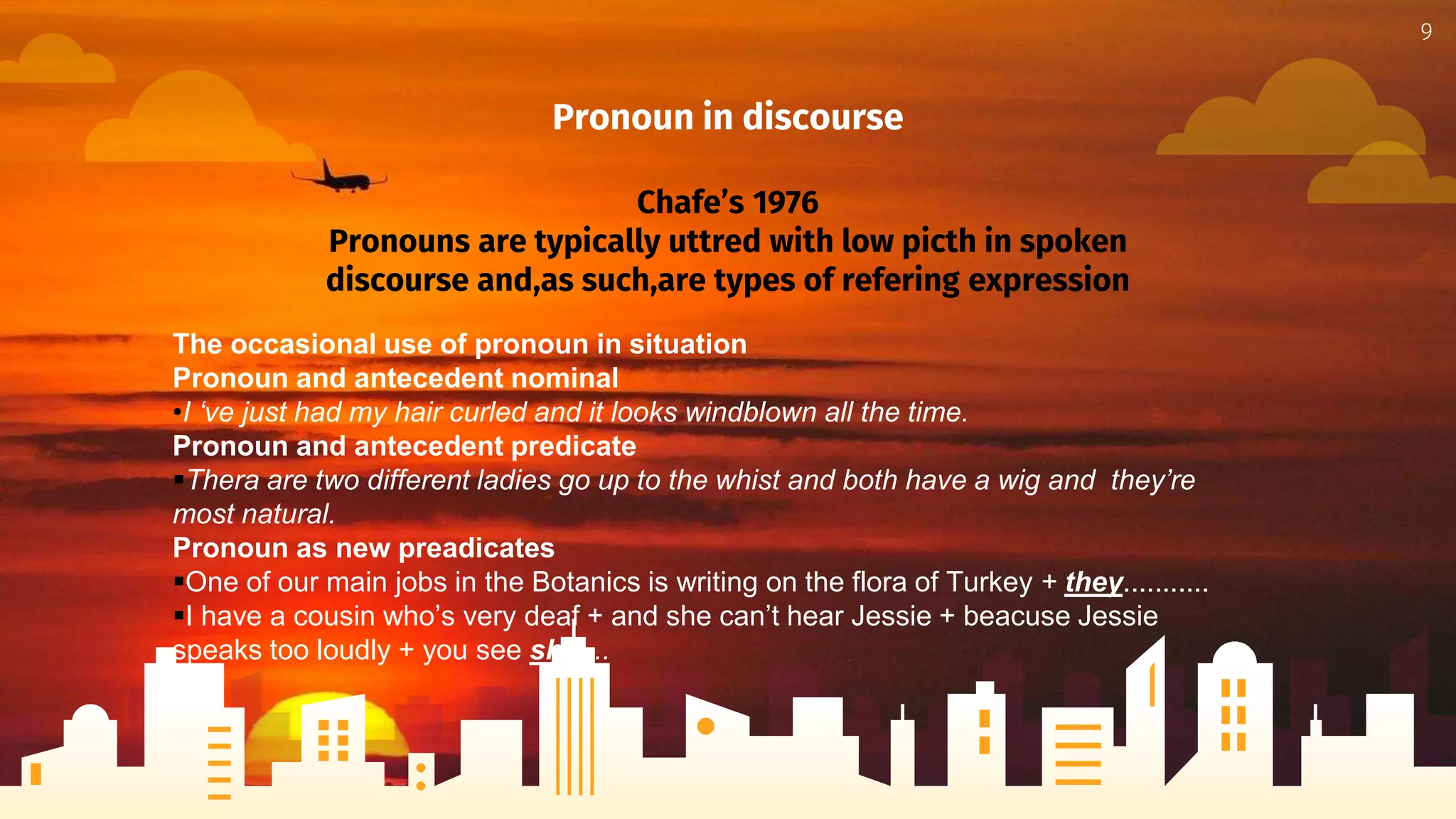
Pronoun in discourse
Chafe’s 1976
Pronouns are typically uttred with low picth in spoken
discourse and,as such,are types of refering expression
9
The occasional use of pronoun in situation
Pronoun and antecedent nominal
•I ‘ve just had my hair curled and it looks windblown all the time.
Pronoun and antecedent predicate
Thera are two different ladies go up to the whist and both have a wig and they’re
most natural.
Pronoun as new preadicates
One of our main jobs in the Botanics is writing on the flora of Turkey + they...........
I have a cousin who’s very deaf + and she can’t hear Jessie + beacuse Jessie
speaks too loudly + you see she....
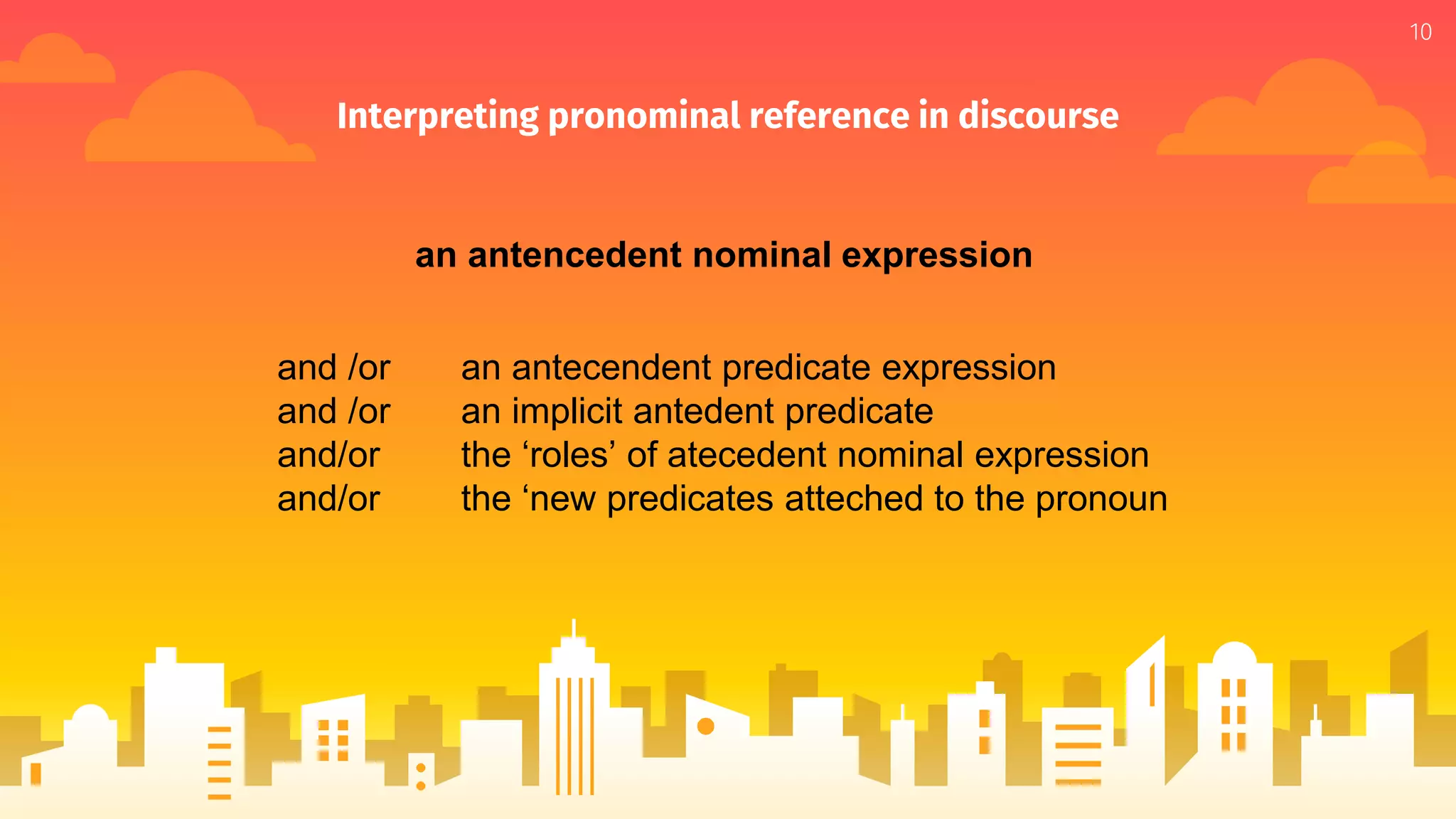
Interpreting pronominal reference in discourse
10
and /or an antecendent predicate expression
and /or an implicit antedent predicate
and/or the ‘roles’ of atecedent nominal expression
and/or the ‘new predicates atteched to the pronoun
an antencedent nominal expression
11
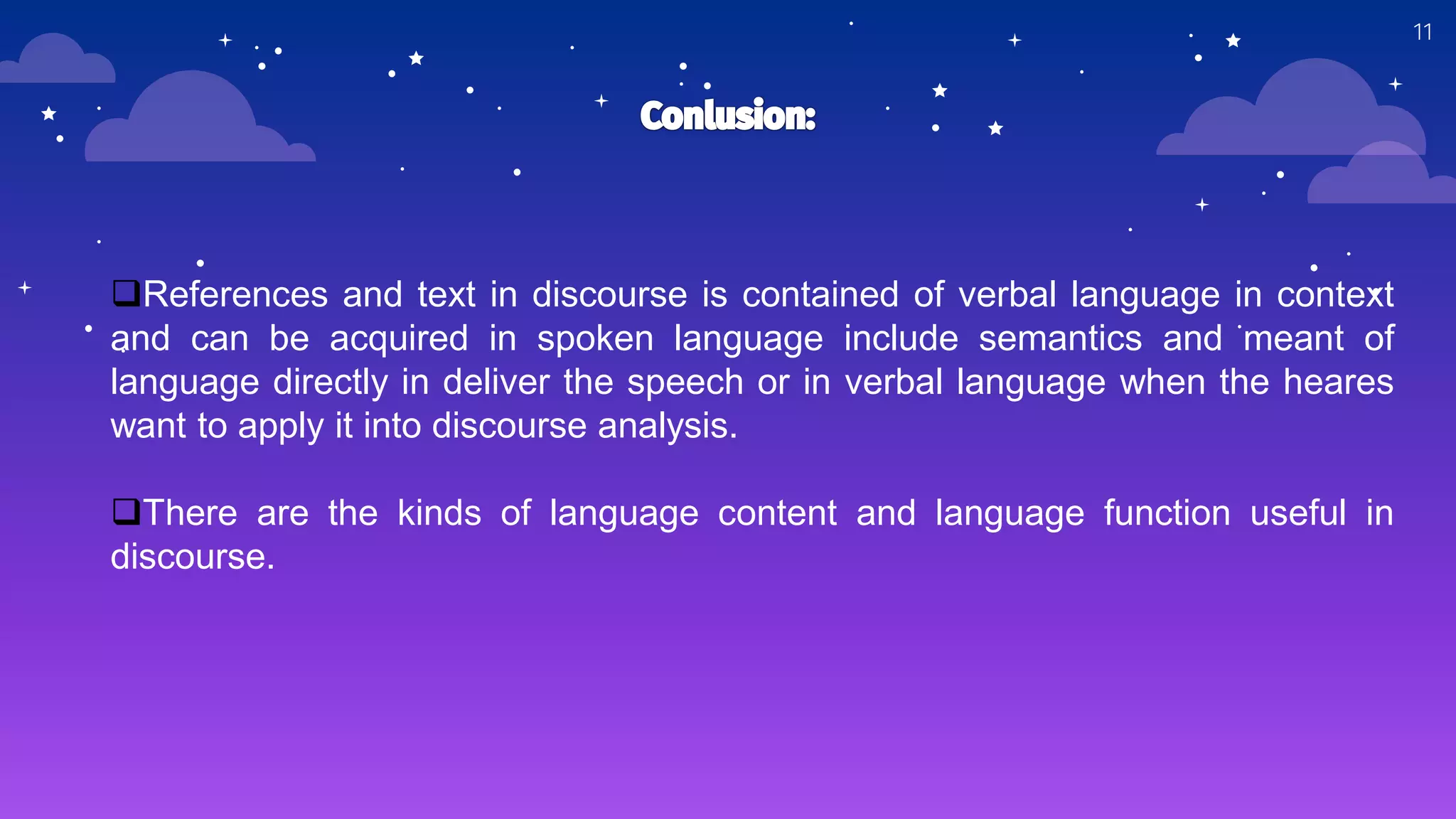
References and text in discourse is contained of verbal language in context
and can be acquired in spoken language include semantics and meant of
language directly in deliver the speech or in verbal language when the heares
want to apply it into discourse analysis.
There are the kinds of language content and language function useful in
discourse.
12
Thanks!

The nature of reference in text and in discourse

  • 1.
    The Nature Of ReferenceIn Text And In Discourse
  • 2.
    Content: ▫ What IsText? ▫ Types Of Co-reference Relation ▫ Subtitution ▫ Discourse Reference ▫ Referring Expressions ▫ Pronoun In Discourse ▫ Interpreting Pronominal Reference In Discourse ▫ CONCLUSION 2
  • 3.
    What is text? Verbalaccount for the communication event. Halliday and Hassan 1976 Relationship within a text are set up where the intpretation of some element in the discourse COHESSION The taxonomy of types of explicit markers of conjuctive relation is examplified:  Adjective Adversative Causal Temporal
  • 4.
    “ TYPES OF CO-REFERENCERELATION 4 Co-referential form are forms when instead of being interpreted semantically in their own right Hallyday & Hassan 1976 a.Exophora : Look at that.(that=picture of sun) b. Endophora: Anaphoric - look at the sun.it’s going down quickly. Cataphoric – It’s going down quickly,the sun
  • 5.
    Co-herence relationship 5 Co-herence relationship examplified here is anaphoric,henc eendophoric Repeated form :The Prime Minister recorded her thanks to foreign secretary, The Prime Minister was most eloquent. Partially repeated form: Dr.E.C.R. Reeve chaired the meeting. Dr.Reeve invited Mr.Philips to report on the state of the gardens Lexical replacement : Ro’s daughter is ill again.The child to the doctor. Pronominal form : Ro said she would have take Sophie to the doctor. Subtitutional form : Jules has a birthday next month.Elspeth has one too. Ellided form : Jules has a birthday next month.Elspeth has too.
  • 6.
    Halliday and Hasan Asimple subtitution view where an expression may simply be replaced by another in the text. Harwerg,1978 A general approach to the analysis of text which called ‘subtitutional text linguistics’,consider comment on text. SUBTITUTION  Wash and core six cooking apples. Put them into fireproof dish.  Kill an active,plump chicken.Prepare it for the oven,cut it four pieces and roast it with thym 1 hour.  Brown in the butter and then place in a small dish.  Now add the chicken  When the liquid has almost evaporated  STOP BUS VANDALS by reporting it at once to the driver conductor 6
  • 7.
    Discourse Reference Lyons,1977 The termreference can be taken out of discussion of lexical meaning and reverved for that function whereby speaker (writers) indicate,via the use of a linguistic expression,the entities they are talking (writing) about. Reference And Discourse Representation Webber 1987 Specific representation,or model,arising from a particular discourse,we can characterise as the individual’s discourse representation.  Writer  Speaker/speaker version  reader and hearer  situation ▫ .e.g ▫ My uncles’s coming home from Canada. 7
  • 8.
    Referring expressions ▫ Myfather is a stonemason ▫ Virginia looked for a new job 8
  • 9.
    Pronoun in discourse Chafe’s1976 Pronouns are typically uttred with low picth in spoken discourse and,as such,are types of refering expression 9 The occasional use of pronoun in situation Pronoun and antecedent nominal •I ‘ve just had my hair curled and it looks windblown all the time. Pronoun and antecedent predicate Thera are two different ladies go up to the whist and both have a wig and they’re most natural. Pronoun as new preadicates One of our main jobs in the Botanics is writing on the flora of Turkey + they........... I have a cousin who’s very deaf + and she can’t hear Jessie + beacuse Jessie speaks too loudly + you see she....
  • 10.
    Interpreting pronominal referencein discourse 10 and /or an antecendent predicate expression and /or an implicit antedent predicate and/or the ‘roles’ of atecedent nominal expression and/or the ‘new predicates atteched to the pronoun an antencedent nominal expression
  • 11.
    11 References and textin discourse is contained of verbal language in context and can be acquired in spoken language include semantics and meant of language directly in deliver the speech or in verbal language when the heares want to apply it into discourse analysis. There are the kinds of language content and language function useful in discourse.
  • 12.