Reference in
Linguistics
Reference isa fundamental concept in linguistics, referring to the
way in which words and phrases in a text connect to their
referents, the entities or concepts they stand for. These referents
can be individuals, objects, places, times, or even abstract ideas.
This concept is crucial for understanding how language conveys
meaning and allows us to understand the world around us.
by Shirlyn Lauronal
2.
Types of Reference
EndophoricReference
This type of reference occurs within the text itself, where a
reference item connects to a referent within the same text.
Endophoric reference can be further divided into anaphoric
and cataphoric reference.
Exophoric Reference
This type of reference points to something outside the text,
often relying on shared knowledge or context. It links to
referents that are not explicitly mentioned in the text but are
part of the surrounding environment or situation.
3.
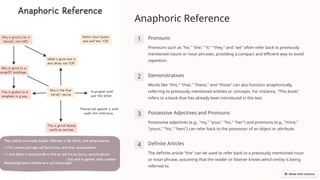
Anaphoric Reference
1 Pronouns
Pronounssuch as "he," "she," "it," "they," and "we" often refer back to previously
mentioned nouns or noun phrases, providing a compact and efficient way to avoid
repetition.
2 Demonstratives
Words like "this," "that," "these," and "those" can also function anaphorically,
referring to previously mentioned entities or concepts. For instance, "This book"
refers to a book that has already been introduced in the text.
3 Possessive Adjectives and Pronouns
Possessive adjectives (e.g., "my," "your," "his," "her") and pronouns (e.g., "mine,"
"yours," "his," "hers") can refer back to the possessor of an object or attribute.
4 Definite Articles
The definite article "the" can be used to refer back to a previously mentioned noun
or noun phrase, assuming that the reader or listener knows which entity is being
referred to.
4.
Cataphoric Reference
Forward Reference
Cataphoricreference refers forward in the text, introducing a referent before it is fully identified. This can create suspense or intrigue, as the
reader is left to anticipate the identity of the referent.
Examples
Sentences like "Remember this: Never trust a stranger" or "The following are the winners: Susan, Christopher, and Ali" illustrate cataphoric
reference, where the referent is introduced before it is fully explained.
Colons and Semicolons
Cataphoric reference often occurs after punctuation marks such as colons, semicolons, or dashes, creating a clear visual cue that the referent
will be introduced in the following text.
5.
Exophoric Reference andContext
Shared Knowledge
Exophoric reference relies on
shared knowledge or context
between the speaker/writer and
the listener/reader. This shared
knowledge could be cultural,
social, or situational.
Context of Situation
The context of situation plays a
vital role in exophoric reference,
as it helps to determine the
referents of words and phrases.
For instance, saying "That picture
is beautiful" would be
understood based on the picture
visible in the immediate
environment.
No Cohesion
While exophoric reference
interacts with the system of
cohesion, it is not considered part
of it. This is because exophoric
reference does not bind elements
within the text itself. However, it
contributes to the overall
coherence and understanding of
a text.
6.
Reference and Cohesion
1Cohesion
Cohesion refers to the grammatical and lexical relationships between
words and phrases within a text, creating a sense of unity and flow.
Reference is a key aspect of cohesion, as it helps to connect different parts
of a text.
2 Coherence
While cohesion is about the internal connections within a text, coherence
refers to the overall meaning and understanding of the text. Reference,
along with other factors, contributes to the coherence of a text, making it
meaningful and comprehensible.
3 Communication
The ability to use reference effectively is crucial for clear and effective
communication. By understanding and employing the different types of
reference, we can create texts that are cohesive, coherent, and easily
understood.
7.
Reference in DifferentLanguages
Cross-Linguistic Variation
Different languages may have different systems of reference. For instance, some languages rely
heavily on pronouns for anaphoric reference, while others may use demonstratives or definite
articles more frequently.
Translation Challenges
Translating texts across languages can pose challenges when it comes to reference. The
appropriate choice of reference items may vary depending on the target language and its specific
grammatical and lexical conventions.
Understanding Cultural Differences
Reference systems can also reflect cultural differences. For example, the use of honorifics or other
forms of address in certain languages can reflect social hierarchies and norms that are specific to
that culture.
8.
Applications of Reference
TextAnalysis Understanding reference patterns
in texts can help researchers
analyze language use, identify
themes, and gain insights into the
writer's perspective.
Machine Translation Reference plays a crucial role in
machine translation, as it is
essential for accurately translating
the relationships between words
and phrases across languages.
Natural Language Processing Reference analysis is an important
component of natural language
processing (NLP), enabling
computers to understand and
interpret human language.