UNIVERSIDAD JUÁREZ AUTÓNOMA DE TABASCO
DIVISIÓN ACADÉMICA DE EDUCACIÓN Y ARTES
SEMANTICS AND PRAGMATICS
PROFESSOR: Monserrat Angulo
LONG TERM: MARCH – SEPTEMBER 2021
REFERENCES
Words stand in a relationship to the world, or our mental
classification of it: they allow us to identify parts of the world,
and make statements about them. Thus if a speaker says He
saw Paul or She bought a dog, the underlined nominals allow
her to identify, pick out, or refer to specific entities in the world.
However, words also derive their value from their position
within the language system. The relationship by which language
hooks onto the world is usually called reference. The semantic
links between elements within the vocabulary system is an
aspect of their sense or meaning.
DEFINITION
Reference is used to describe the different ways in which
entities- things, people, events- are referred to within texts.
There are range of linguistic features, which enables speakers
and writers to make such references, for example
pronouns….may refer to entities already mentioned or about to
be mentioned.
“Doctor Faustus went to Gloucester in a shower of rain. He
stepped in puddle right up to his middle and never went there
again”
'He' and 'There' show that information about them is retrieved
elsewhere within the text. It characterizes a particular type of
cohesion which is called reference. The relationship of
reference is on semantic level. The reference items must not
match the grammatical item it refers to.
Example of Reference
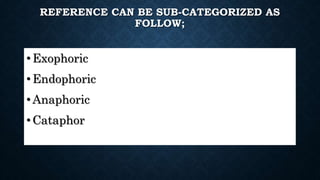
REFERENCE CAN BE SUB-CATEGORIZED AS
FOLLOW;
• Exophoric
• Endophoric
• Anaphoric
• Cataphor
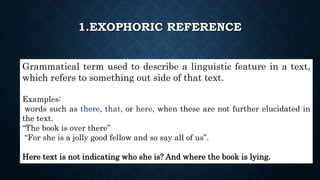
1.EXOPHORIC REFERENCE
Grammatical term used to describe a linguistic feature in a text,
which refers to something out side of that text.
Examples:
words such as there, that, or here, when these are not further elucidated in
the text.
“The book is over there”
“For she is a jolly good fellow and so say all of us”.
Here text is not indicating who she is? And where the book is lying.
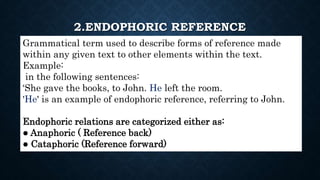
2.ENDOPHORIC REFERENCE
Grammatical term used to describe forms of reference made
within any given text to other elements within the text.
Example:
in the following sentences:
‘She gave the books, to John. He left the room.
'He' is an example of endophoric reference, referring to John.
Endophoric relations are categorized either as:
● Anaphoric ( Reference back)
● Cataphoric (Reference forward)
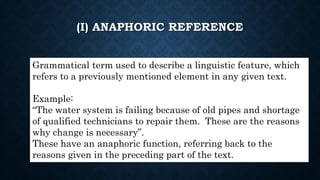
(I) ANAPHORIC REFERENCE
Grammatical term used to describe a linguistic feature, which
refers to a previously mentioned element in any given text.
Example:
“The water system is failing because of old pipes and shortage
of qualified technicians to repair them. These are the reasons
why change is necessary”.
These have an anaphoric function, referring back to the
reasons given in the preceding part of the text.
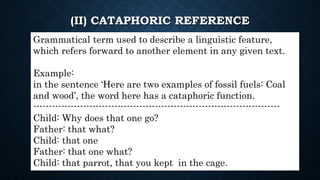
(II) CATAPHORIC REFERENCE
Grammatical term used to describe a linguistic feature,
which refers forward to another element in any given text.
Example:
in the sentence ‘Here are two examples of fossil fuels: Coal
and wood’, the word here has a cataphoric function.
-------------------------------------------------------------------------------
Child: Why does that one go?
Father: that what?
Child: that one
Father: that one what?
Child: that parrot, that you kept in the cage.
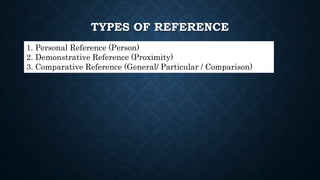
TYPES OF REFERENCE
1. Personal Reference (Person)
2. Demonstrative Reference (Proximity)
3. Comparative Reference (General/ Particular / Comparison)
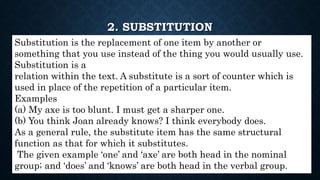
2. SUBSTITUTION
Substitution is the replacement of one item by another or
something that you use instead of the thing you would usually use.
Substitution is a
relation within the text. A substitute is a sort of counter which is
used in place of the repetition of a particular item.
Examples
(a) My axe is too blunt. I must get a sharper one.
(b) You think Joan already knows? I think everybody does.
As a general rule, the substitute item has the same structural
function as that for which it substitutes.
The given example ‘one’ and ‘axe’ are both head in the nominal
group; and ‘does’ and ‘knows’ are both head in the verbal group.
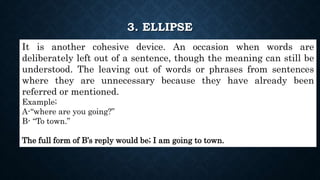
3. ELLIPSE
It is another cohesive device. An occasion when words are
deliberately left out of a sentence, though the meaning can still be
understood. The leaving out of words or phrases from sentences
where they are unnecessary because they have already been
referred or mentioned.
Example;
A-“where are you going?”
B- “To town.”
The full form of B’s reply would be; I am going to town.

Reference types

  • 1.
    UNIVERSIDAD JUÁREZ AUTÓNOMADE TABASCO DIVISIÓN ACADÉMICA DE EDUCACIÓN Y ARTES SEMANTICS AND PRAGMATICS PROFESSOR: Monserrat Angulo LONG TERM: MARCH – SEPTEMBER 2021
  • 2.
    REFERENCES Words stand ina relationship to the world, or our mental classification of it: they allow us to identify parts of the world, and make statements about them. Thus if a speaker says He saw Paul or She bought a dog, the underlined nominals allow her to identify, pick out, or refer to specific entities in the world. However, words also derive their value from their position within the language system. The relationship by which language hooks onto the world is usually called reference. The semantic links between elements within the vocabulary system is an aspect of their sense or meaning.
  • 3.
    DEFINITION Reference is usedto describe the different ways in which entities- things, people, events- are referred to within texts. There are range of linguistic features, which enables speakers and writers to make such references, for example pronouns….may refer to entities already mentioned or about to be mentioned.
  • 4.
    “Doctor Faustus wentto Gloucester in a shower of rain. He stepped in puddle right up to his middle and never went there again” 'He' and 'There' show that information about them is retrieved elsewhere within the text. It characterizes a particular type of cohesion which is called reference. The relationship of reference is on semantic level. The reference items must not match the grammatical item it refers to. Example of Reference
  • 5.
    REFERENCE CAN BESUB-CATEGORIZED AS FOLLOW; • Exophoric • Endophoric • Anaphoric • Cataphor
  • 6.
    1.EXOPHORIC REFERENCE Grammatical termused to describe a linguistic feature in a text, which refers to something out side of that text. Examples: words such as there, that, or here, when these are not further elucidated in the text. “The book is over there” “For she is a jolly good fellow and so say all of us”. Here text is not indicating who she is? And where the book is lying.
  • 7.
    2.ENDOPHORIC REFERENCE Grammatical termused to describe forms of reference made within any given text to other elements within the text. Example: in the following sentences: ‘She gave the books, to John. He left the room. 'He' is an example of endophoric reference, referring to John. Endophoric relations are categorized either as: ● Anaphoric ( Reference back) ● Cataphoric (Reference forward)
  • 8.
    (I) ANAPHORIC REFERENCE Grammaticalterm used to describe a linguistic feature, which refers to a previously mentioned element in any given text. Example: “The water system is failing because of old pipes and shortage of qualified technicians to repair them. These are the reasons why change is necessary”. These have an anaphoric function, referring back to the reasons given in the preceding part of the text.
  • 9.
    (II) CATAPHORIC REFERENCE Grammaticalterm used to describe a linguistic feature, which refers forward to another element in any given text. Example: in the sentence ‘Here are two examples of fossil fuels: Coal and wood’, the word here has a cataphoric function. ------------------------------------------------------------------------------- Child: Why does that one go? Father: that what? Child: that one Father: that one what? Child: that parrot, that you kept in the cage.
  • 10.
    TYPES OF REFERENCE 1.Personal Reference (Person) 2. Demonstrative Reference (Proximity) 3. Comparative Reference (General/ Particular / Comparison)
  • 11.
    2. SUBSTITUTION Substitution isthe replacement of one item by another or something that you use instead of the thing you would usually use. Substitution is a relation within the text. A substitute is a sort of counter which is used in place of the repetition of a particular item. Examples (a) My axe is too blunt. I must get a sharper one. (b) You think Joan already knows? I think everybody does. As a general rule, the substitute item has the same structural function as that for which it substitutes. The given example ‘one’ and ‘axe’ are both head in the nominal group; and ‘does’ and ‘knows’ are both head in the verbal group.
  • 12.
    3. ELLIPSE It isanother cohesive device. An occasion when words are deliberately left out of a sentence, though the meaning can still be understood. The leaving out of words or phrases from sentences where they are unnecessary because they have already been referred or mentioned. Example; A-“where are you going?” B- “To town.” The full form of B’s reply would be; I am going to town.