Language and
Gender
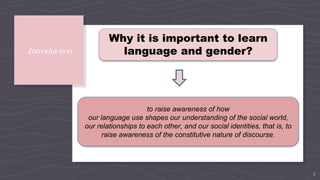
Introduction
2
Why it is important to learn
language and gender?
to raise awareness of how
our language use shapes our understanding of the social world,
our relationships to each other, and our social identities, that is, to
raise awareness of the constitutive nature of discourse.
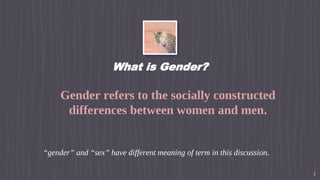
What is Gender?
▹ Gender refers to the socially constructed
differences between women and men.
▹ “gender” and “sex” have different meaning of term in this discussion.
3
Gender-based
Ideologies
 Gender ideology refers to attitudes regarding the appropriate
roles, rights and responsibilities of men and women in society.
 Gender ideology also refers to societal beliefs that legitimate
gender inequality.
 Through language that relationships with others are negotiated
and social identities constructed
 Ideology or cultural values and belief systems, are closely
linked to power.
4
Naming
Convention
and Form of
Address
5
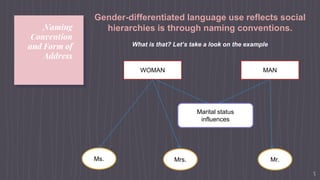
Gender-differentiated language use reflects social
hierarchies is through naming conventions.
What is that? Let’s take a look on the example
WOMAN MAN
Marital status
influences
Ms. Mrs. Mr.
“There is a case based on the study by Wolfson (2006) about “When men and women
in similar positions are addressed differently”.
“a study by Wolfson (2006) with sociolinguistic students in Northeastern University
which gathered data about the way male and female professors were referred to by
secretaries and other staff. The study found that all females and the younger male
faculty tended to be referred to by first name whereas older male faculty was referred
to by title and last name.”
6
Gender
Differentiatio
n in Lexical
Choice
7
This part of the discussion deal with term he/man approach to
language.
Read this sentences:
"The average student is worried about his grades."
"We will hire the best-qualified person regardless of his sex."
"Each student can select his own topic."
Means that, the generic he can be used to refer to human beings in
general, and men in particular.
There are also several
strategies suggested for
avoiding the uses of
the generic masculine
pronoun are:
1. Drop the masculine pronoun.
The average student is worried
about grades.
We will hire the best person
regardless of sex.
2. Rewrite the sentence in the
plural rather than the singular.
Students can select their own topics.
3. Substitute the pronouns one
or one's for he or his.
One should do one's best.
4. Use he or she, his or her (in
speech or writing) or s/he (in
writing).
8
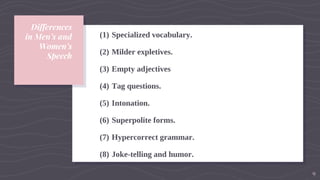
(1) Specialized vocabulary.
(2) Milder expletives.
(3) Empty adjectives
(4) Tag questions.
(5) Intonation.
(6) Superpolite forms.
(7) Hypercorrect grammar.
(8) Joke-telling and humor.
Differences
in Men’s and
Women’s
Speech
9
CONCLUSION
▹ The importance of
knowing this topic is
to raise awareness of
how our language use
shapes our
understanding of the
social world, our
relationships to each
other, and our social
identities.
▹ It is very helpful for us
to know all-round
knowledge of gender
and language in this
field of sociolinguistics
because language is an
important
communicative tool in
human society and it
evolves with the
development of the
society.
10
Thanks!
11

Language and gender part 1

  • 1.
  • 2.
    Introduction 2 Why it isimportant to learn language and gender? to raise awareness of how our language use shapes our understanding of the social world, our relationships to each other, and our social identities, that is, to raise awareness of the constitutive nature of discourse.
  • 3.
    What is Gender? ▹Gender refers to the socially constructed differences between women and men. ▹ “gender” and “sex” have different meaning of term in this discussion. 3
  • 4.
    Gender-based Ideologies  Gender ideologyrefers to attitudes regarding the appropriate roles, rights and responsibilities of men and women in society.  Gender ideology also refers to societal beliefs that legitimate gender inequality.  Through language that relationships with others are negotiated and social identities constructed  Ideology or cultural values and belief systems, are closely linked to power. 4
  • 5.
    Naming Convention and Form of Address 5 Gender-differentiatedlanguage use reflects social hierarchies is through naming conventions. What is that? Let’s take a look on the example WOMAN MAN Marital status influences Ms. Mrs. Mr.
  • 6.
    “There is acase based on the study by Wolfson (2006) about “When men and women in similar positions are addressed differently”. “a study by Wolfson (2006) with sociolinguistic students in Northeastern University which gathered data about the way male and female professors were referred to by secretaries and other staff. The study found that all females and the younger male faculty tended to be referred to by first name whereas older male faculty was referred to by title and last name.” 6
  • 7.
    Gender Differentiatio n in Lexical Choice 7 Thispart of the discussion deal with term he/man approach to language. Read this sentences: "The average student is worried about his grades." "We will hire the best-qualified person regardless of his sex." "Each student can select his own topic." Means that, the generic he can be used to refer to human beings in general, and men in particular.
  • 8.
    There are alsoseveral strategies suggested for avoiding the uses of the generic masculine pronoun are: 1. Drop the masculine pronoun. The average student is worried about grades. We will hire the best person regardless of sex. 2. Rewrite the sentence in the plural rather than the singular. Students can select their own topics. 3. Substitute the pronouns one or one's for he or his. One should do one's best. 4. Use he or she, his or her (in speech or writing) or s/he (in writing). 8
  • 9.
    (1) Specialized vocabulary. (2)Milder expletives. (3) Empty adjectives (4) Tag questions. (5) Intonation. (6) Superpolite forms. (7) Hypercorrect grammar. (8) Joke-telling and humor. Differences in Men’s and Women’s Speech 9
  • 10.
    CONCLUSION ▹ The importanceof knowing this topic is to raise awareness of how our language use shapes our understanding of the social world, our relationships to each other, and our social identities. ▹ It is very helpful for us to know all-round knowledge of gender and language in this field of sociolinguistics because language is an important communicative tool in human society and it evolves with the development of the society. 10
  • 11.