THE ROLE OF
CONTEXT IN
INTERPRETATION
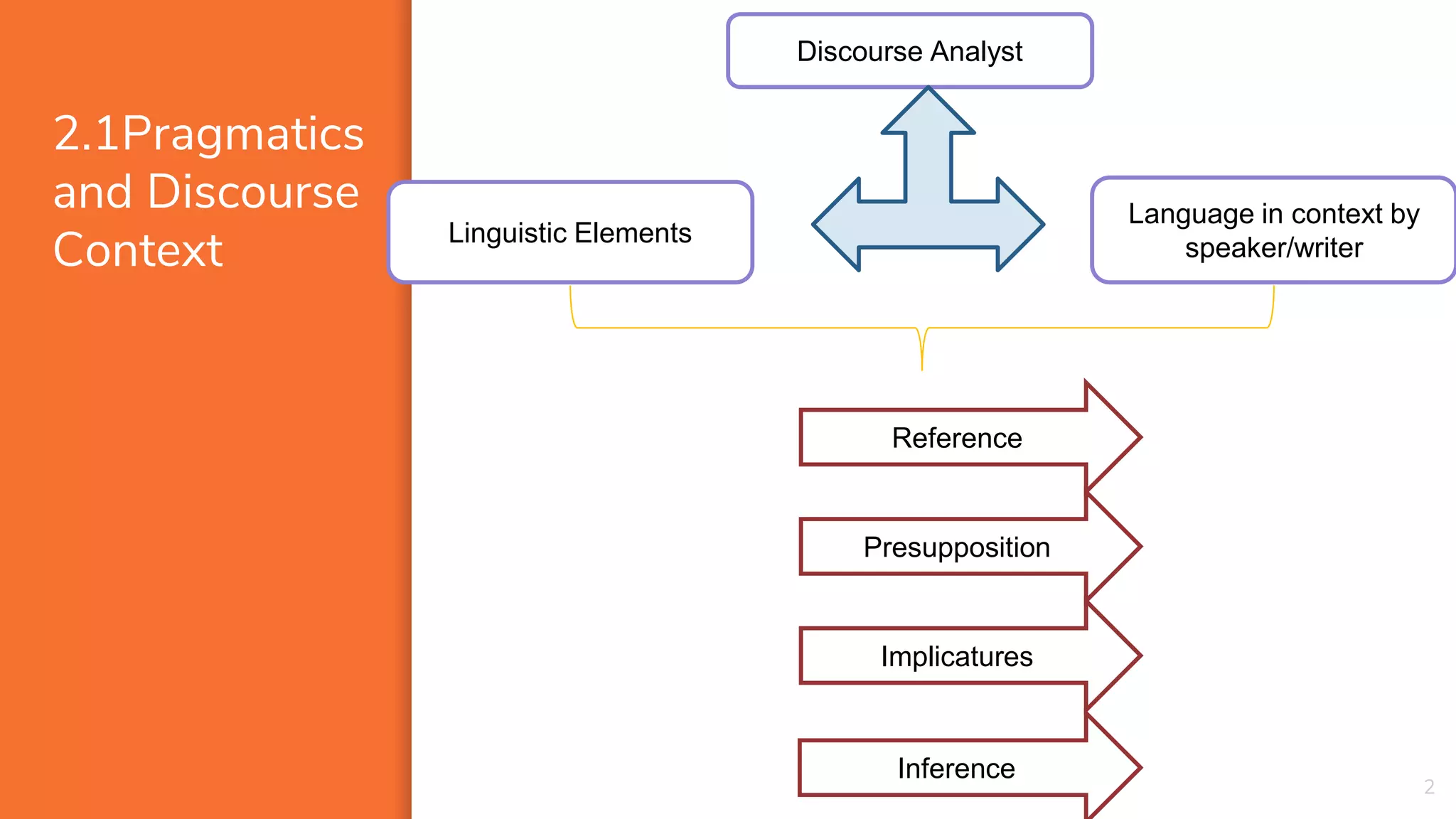
2.1Pragmatics
and Discourse
Context
2
Discourse Analyst
Linguistic Elements
Language in context by
speaker/writer
Reference
Presupposition
Implicatures
Inference
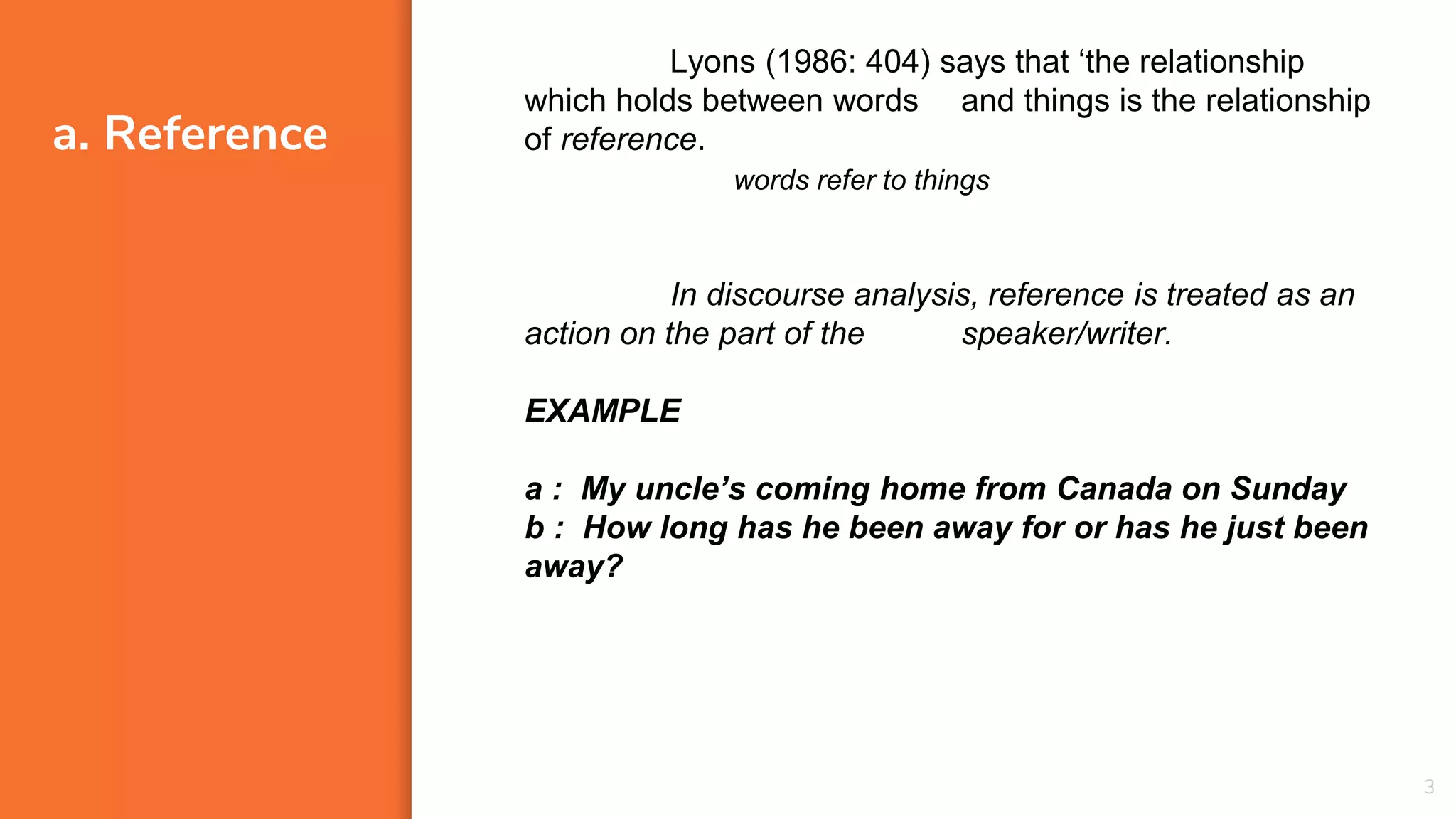
a. Reference
3
Lyons (1986: 404) says that ‘the relationship
which holds between words and things is the relationship
of reference.
In discourse analysis, reference is treated as an
action on the part of the speaker/writer.
EXAMPLE
a : My uncle’s coming home from Canada on Sunday
b : How long has he been away for or has he just been
away?
words refer to things
“
4
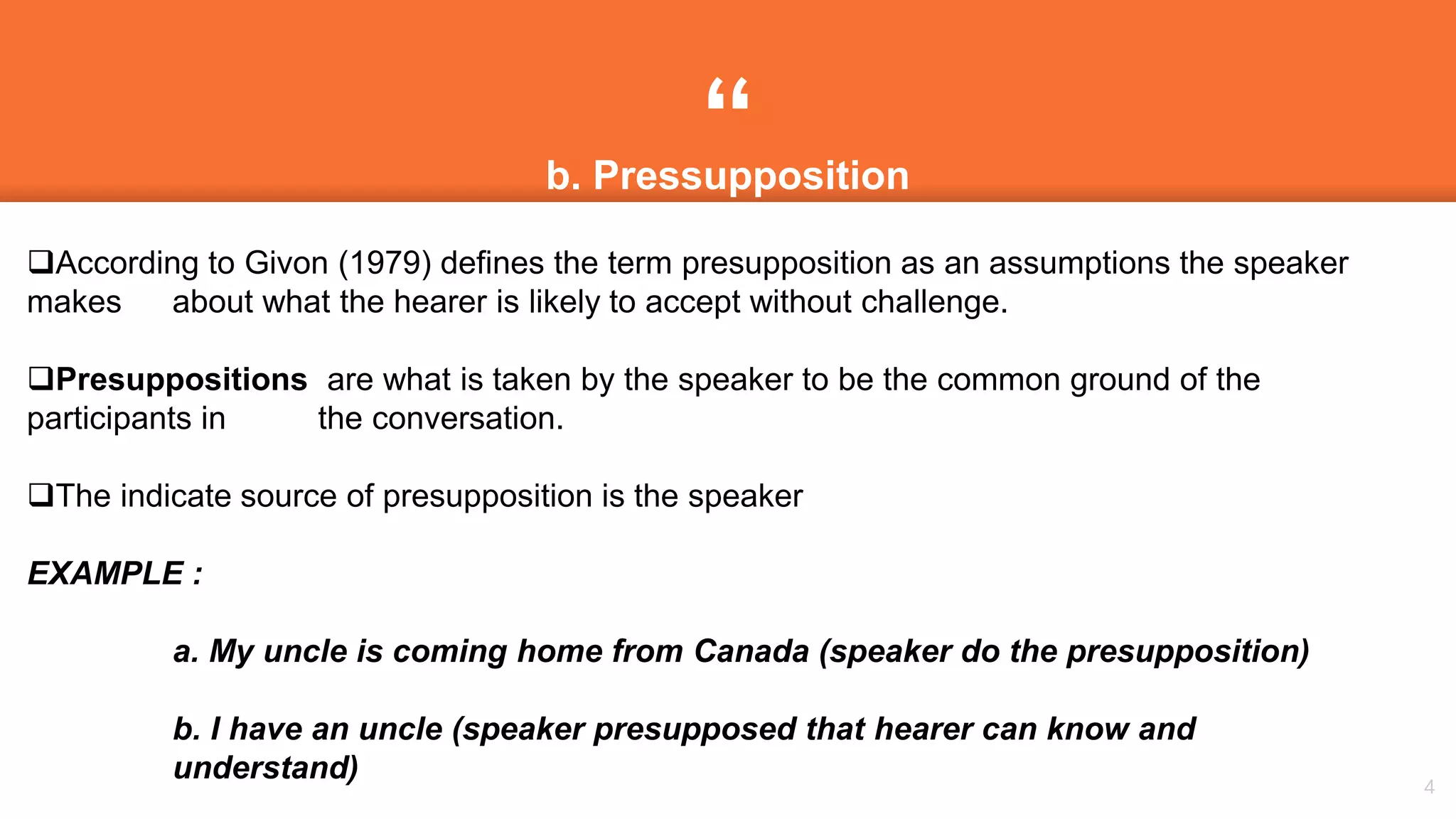
b. Pressupposition
According to Givon (1979) defines the term presupposition as an assumptions the speaker
makes about what the hearer is likely to accept without challenge.
Presuppositions are what is taken by the speaker to be the common ground of the
participants in the conversation.
The indicate source of presupposition is the speaker
EXAMPLE :
a. My uncle is coming home from Canada (speaker do the presupposition)
b. I have an uncle (speaker presupposed that hearer can know and
understand)
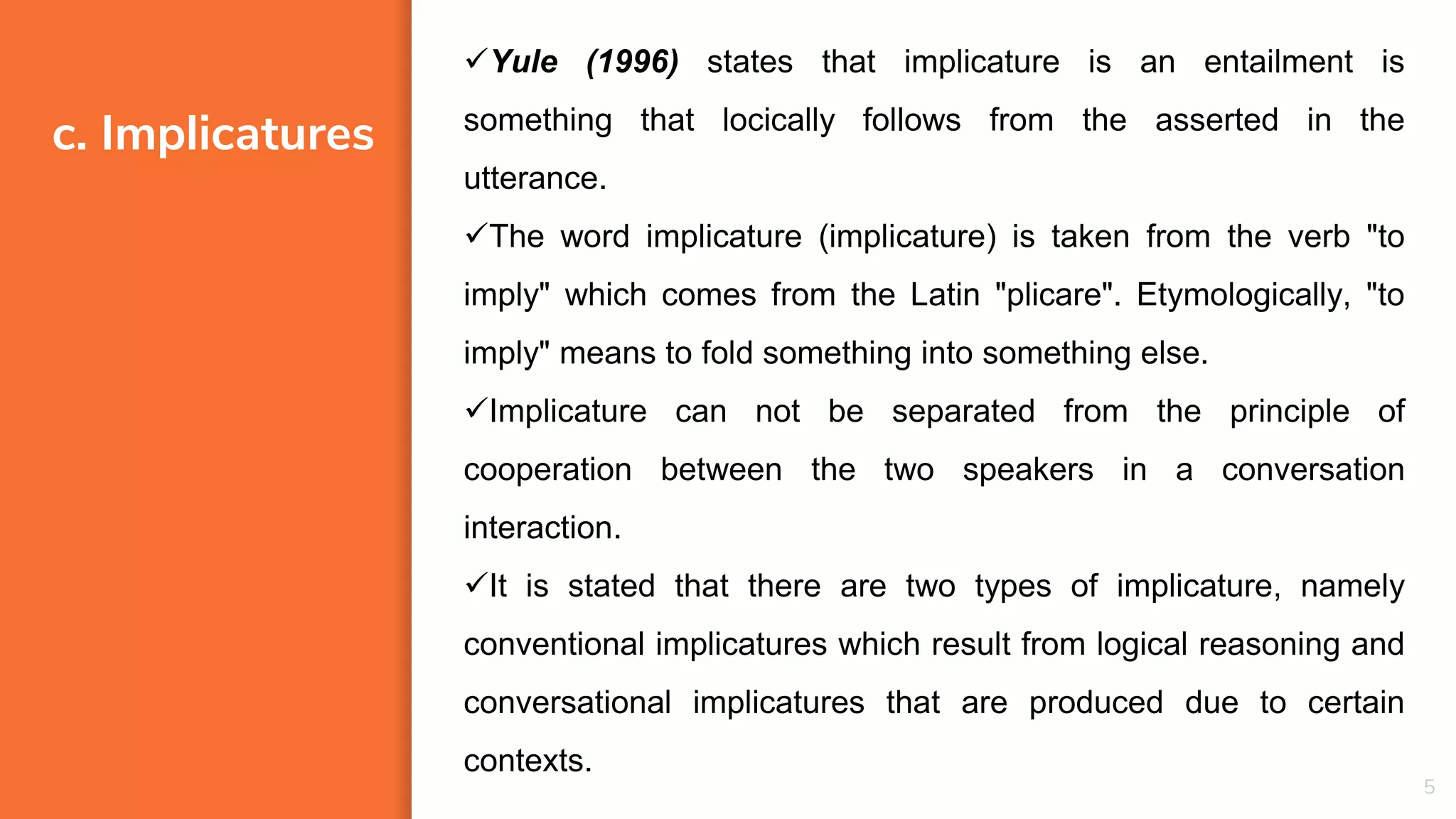
c. Implicatures
5
Yule (1996) states that implicature is an entailment is
something that locically follows from the asserted in the
utterance.
The word implicature (implicature) is taken from the verb "to
imply" which comes from the Latin "plicare". Etymologically, "to
imply" means to fold something into something else.
Implicature can not be separated from the principle of
cooperation between the two speakers in a conversation
interaction.
It is stated that there are two types of implicature, namely
conventional implicatures which result from logical reasoning and
conversational implicatures that are produced due to certain
contexts.
EXAMPLE
 Conversational Implicature
This type of implication is generated because of the
demands of a particular context of conversation.
Implications of this conversation have more varied
meanings and meanings. The reason,
understanding of things "intended: is very dependent
on the context of the conversation.
Mother: Ani, your sister hasn't eaten.
Ani: Yes, ma'am. What side dish?
6
 Conventional Implicature
Conventional implicature, that is,
implicature, is determined by "the
conventional meaning of the words
used".
A : Marcy is from a solo, of
course she's graceful
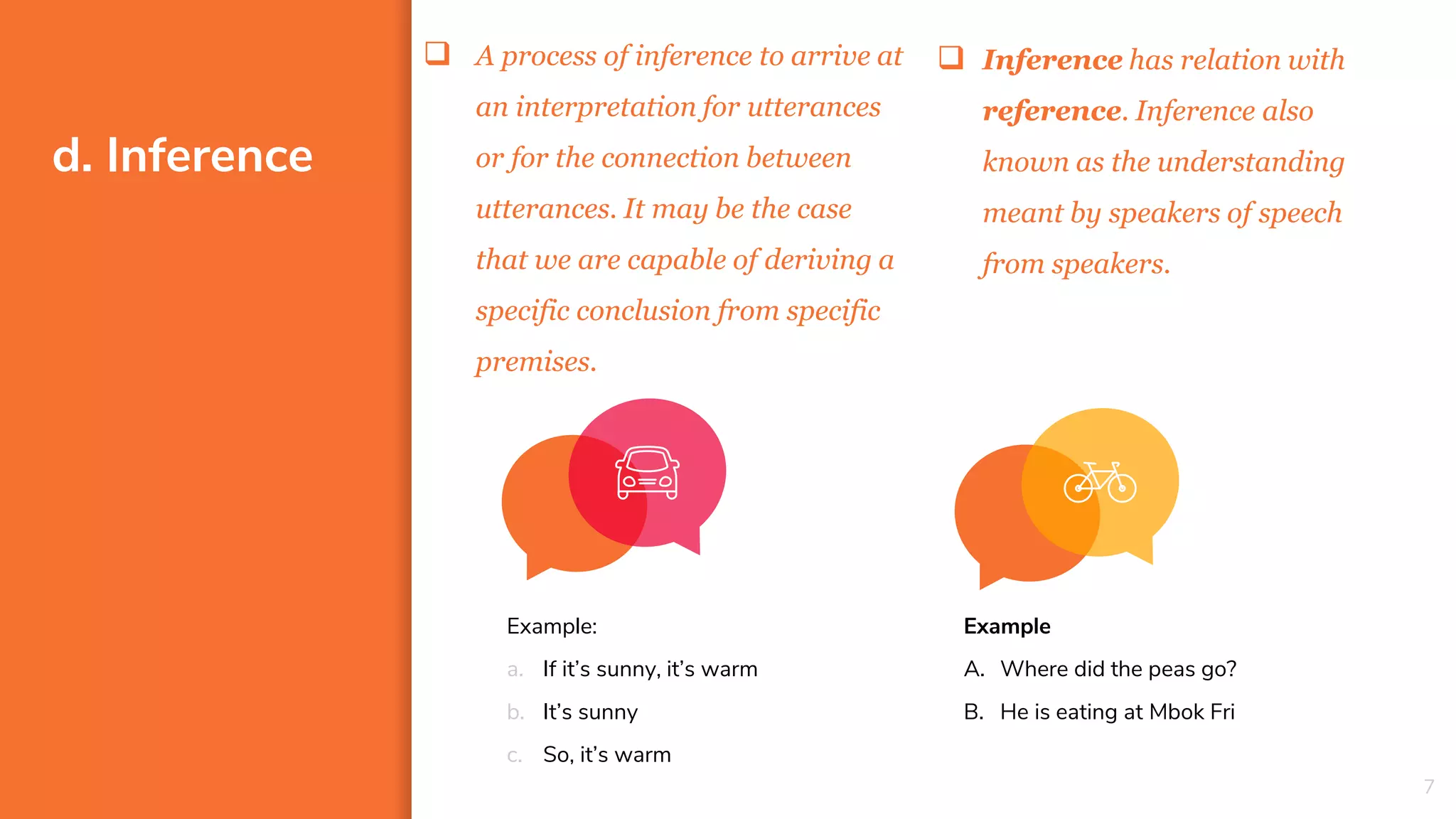
 A process of inference to arrive at
an interpretation for utterances
or for the connection between
utterances. It may be the case
that we are capable of deriving a
specific conclusion from specific
premises.
d. Inference
Example:
a. If it’s sunny, it’s warm
b. It’s sunny
c. So, it’s warm
7
Example
A. Where did the peas go?
B. He is eating at Mbok Fri
 Inference has relation with
reference. Inference also
known as the understanding
meant by speakers of speech
from speakers.
THE CONTEXT OF
SITUATION
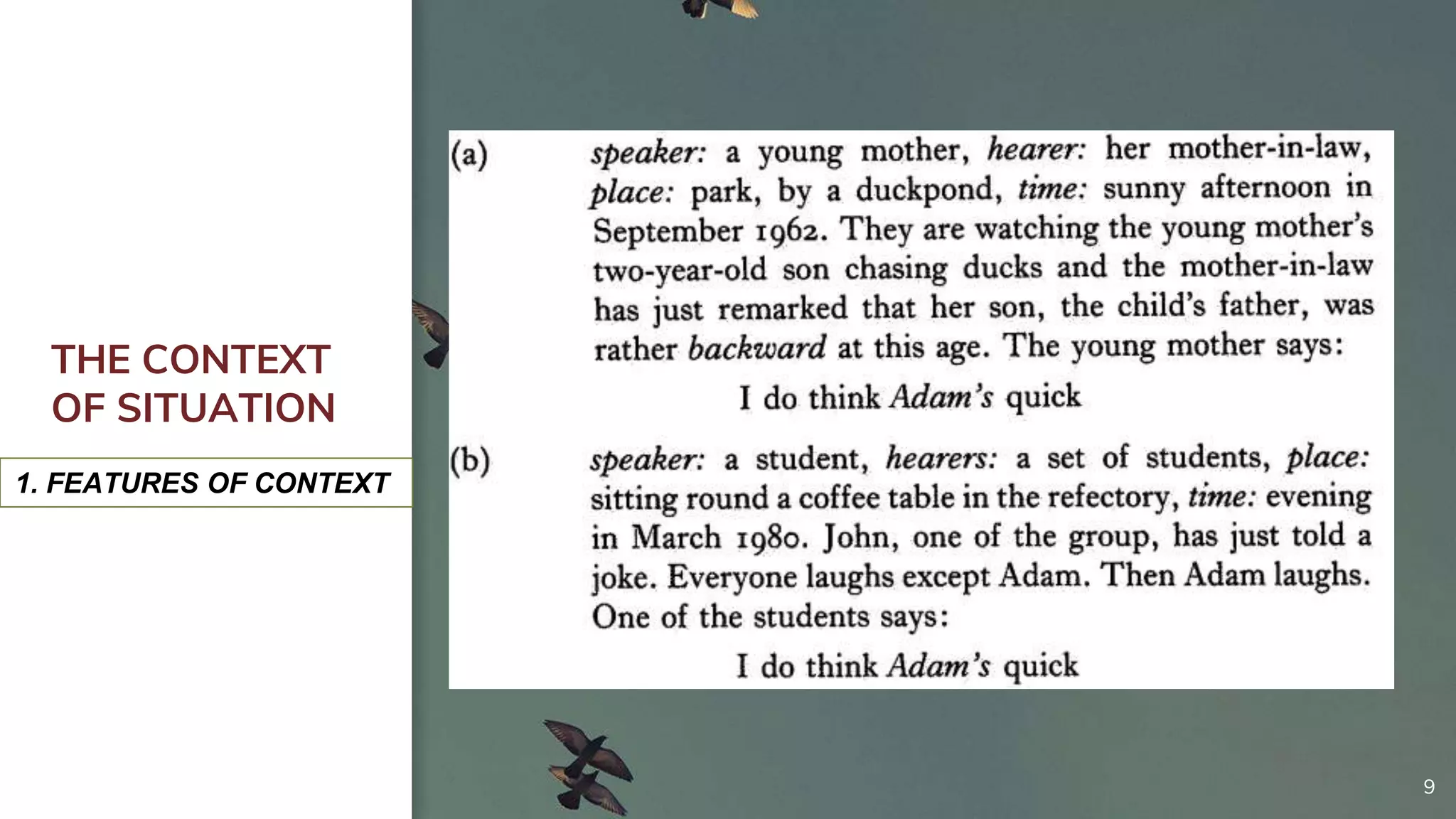
Since the beginning of the 1970s liinguist have become
increasingly aware of the importance of context in the
interpretation of sentences. The implication of taking context into
account are well expressed by Sadock (1978 : 281)
8
THE CONTEXT
OF SITUATION
9
1. FEATURES OF CONTEXT
In addition to the long-term identity of
speakers (speaker identity) which can be
indicated by how they produce language,
there are factors in the contexts in which
language is used that affect both how
we use language and how it is received.
10
11
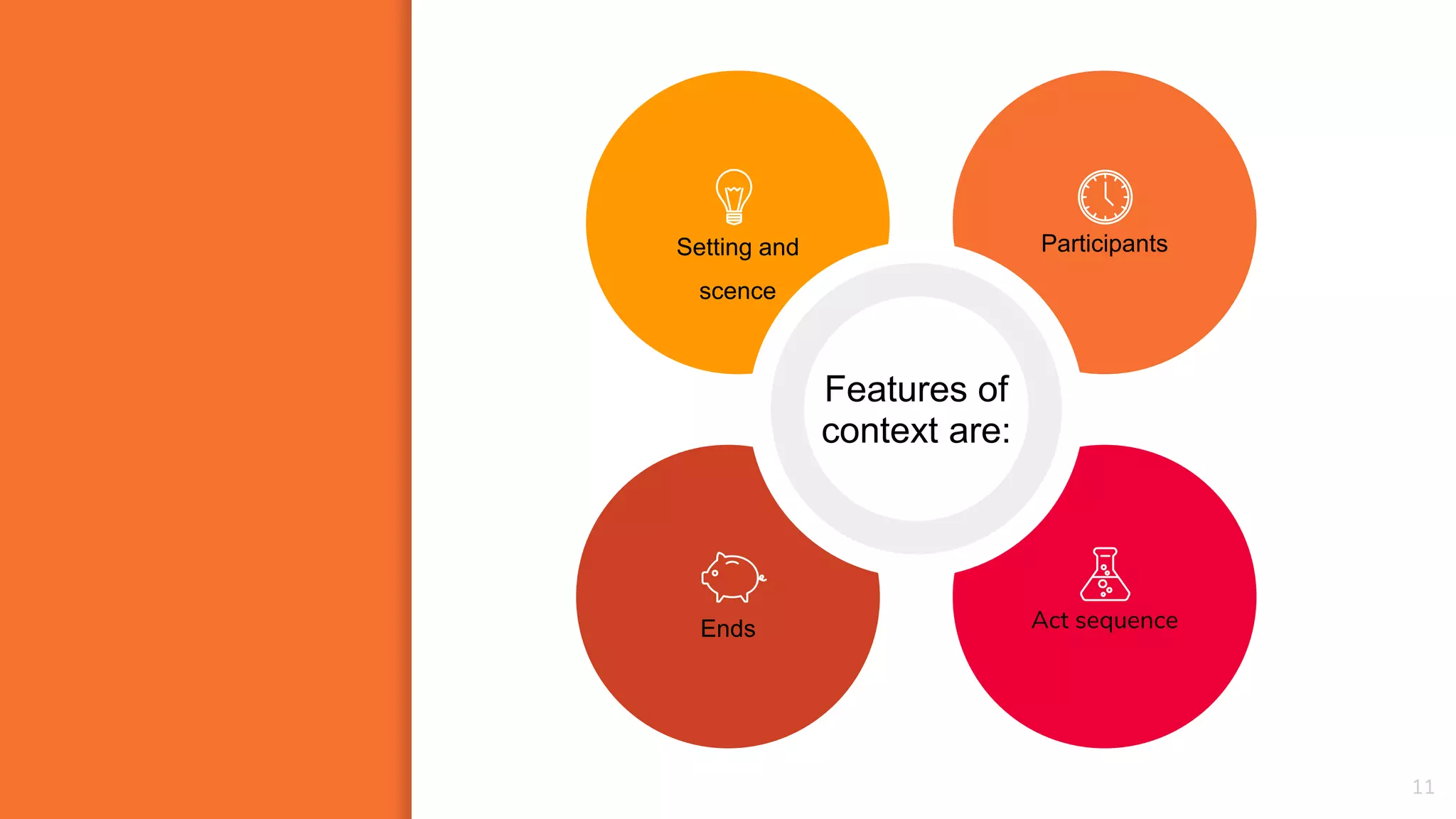
Setting and
scence
Participants
Ends Act sequence
Features of
context are:
2. CO - TEXT
12
Concentrated particularly on the
physical context in which single
utterances are embedded and we
have paid rather little attention to the
previous discourse co-ordinate. Lewis
introduced this co-ordinate to take
account of sentences which include
specific reference to the
aforementioned.
The
Expanding
Context
We have been
concerned to
impose some sort
of analytic
structure on the
lumpen mass
context.
It is relevant to be
identification of a
speech event as being
of a particular kind, to
the ability of the hearer
to predict what sort of
thing the speaker is
likely to say in a given
type of context, and to
the constraining of
interpretation.
13
Problem of Discourse Analyst
When a particular feature is relevant to the
specification of a particular context and what
degree of specification is required.
14
15
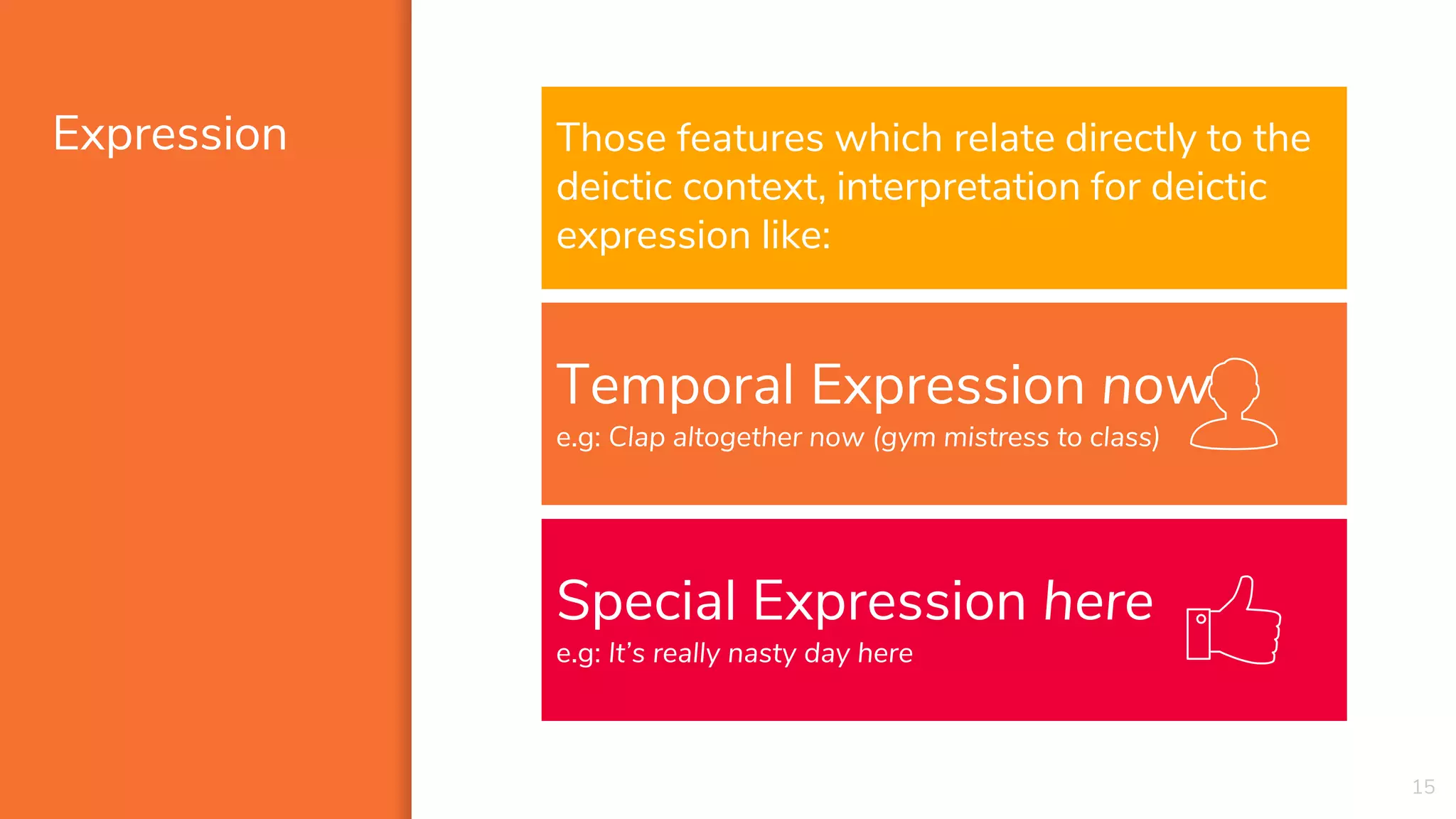
Expression Those features which relate directly to the
deictic context, interpretation for deictic
expression like:
Temporal Expression now
e.g: Clap altogether now (gym mistress to class)
Special Expression here
e.g: It’s really nasty day here
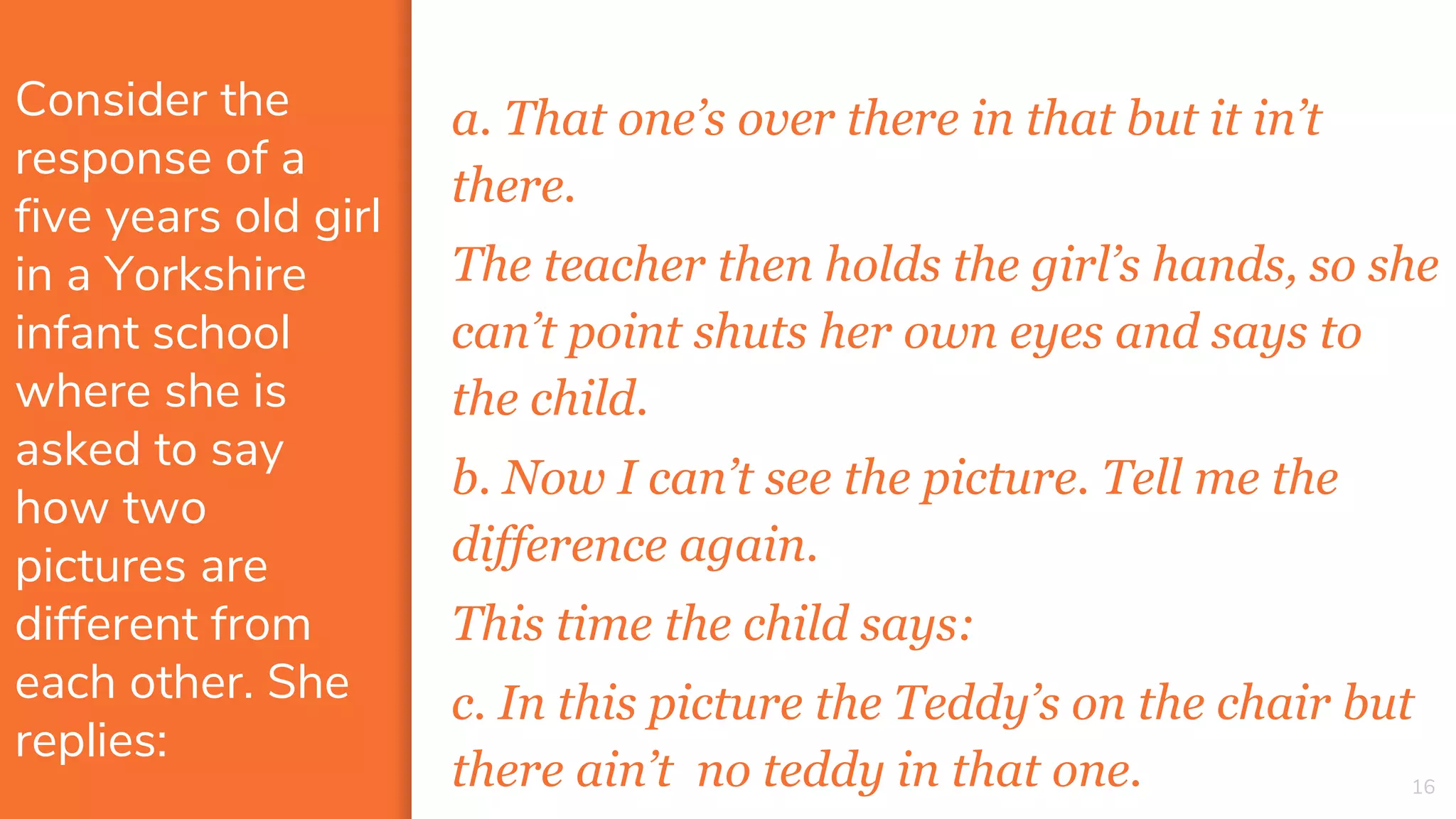
Consider the
response of a
five years old girl
in a Yorkshire
infant school
where she is
asked to say
how two
pictures are
different from
each other. She
replies:
a. That one’s over there in that but it in’t
there.
The teacher then holds the girl’s hands, so she
can’t point shuts her own eyes and says to
the child.
b. Now I can’t see the picture. Tell me the
difference again.
This time the child says:
c. In this picture the Teddy’s on the chair but
there ain’t no teddy in that one. 16
17
The
Principles of
‘local
interpretation
’ of ‘analogy’
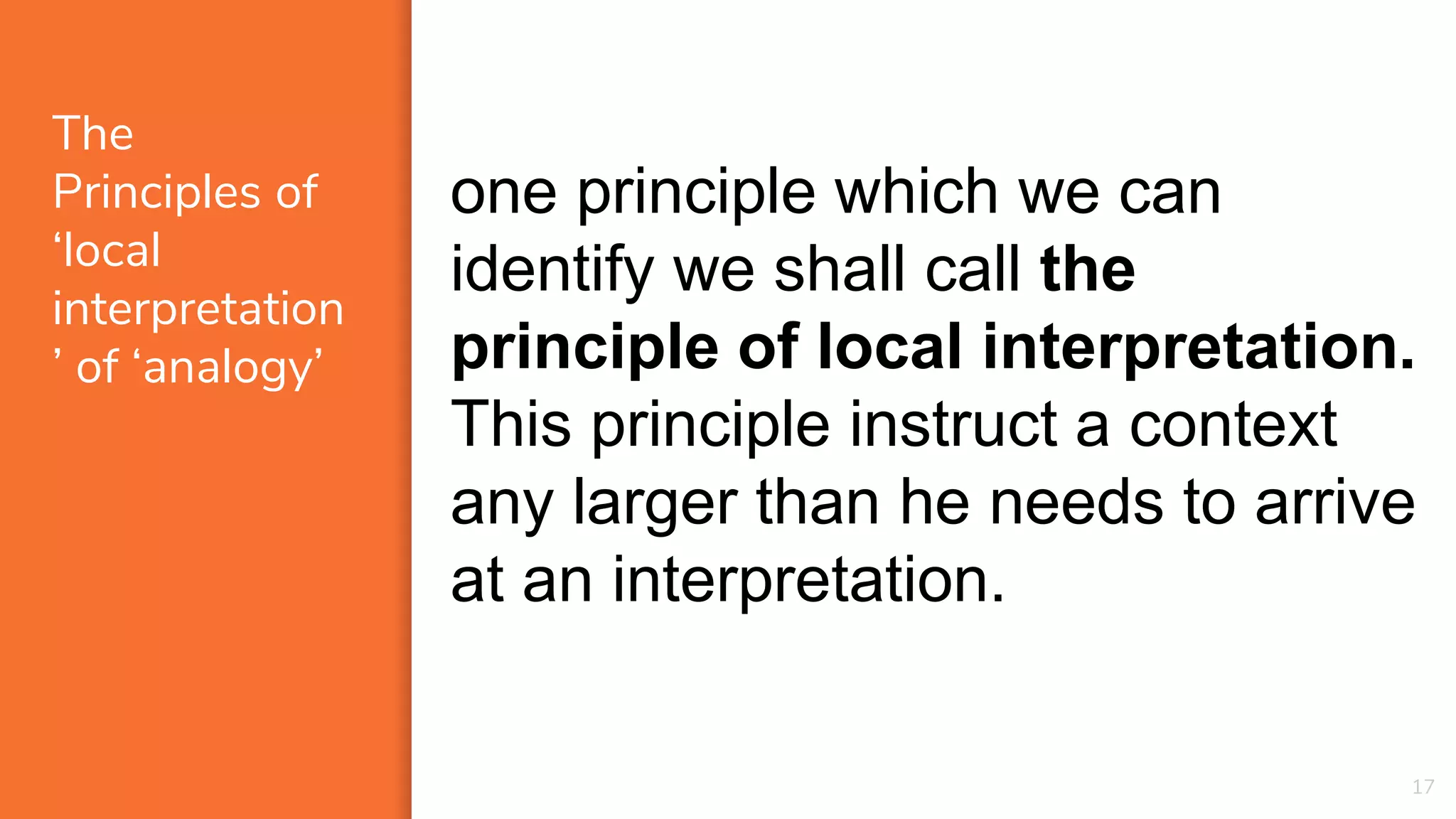
one principle which we can
identify we shall call the
principle of local interpretation.
This principle instruct a context
any larger than he needs to arrive
at an interpretation.
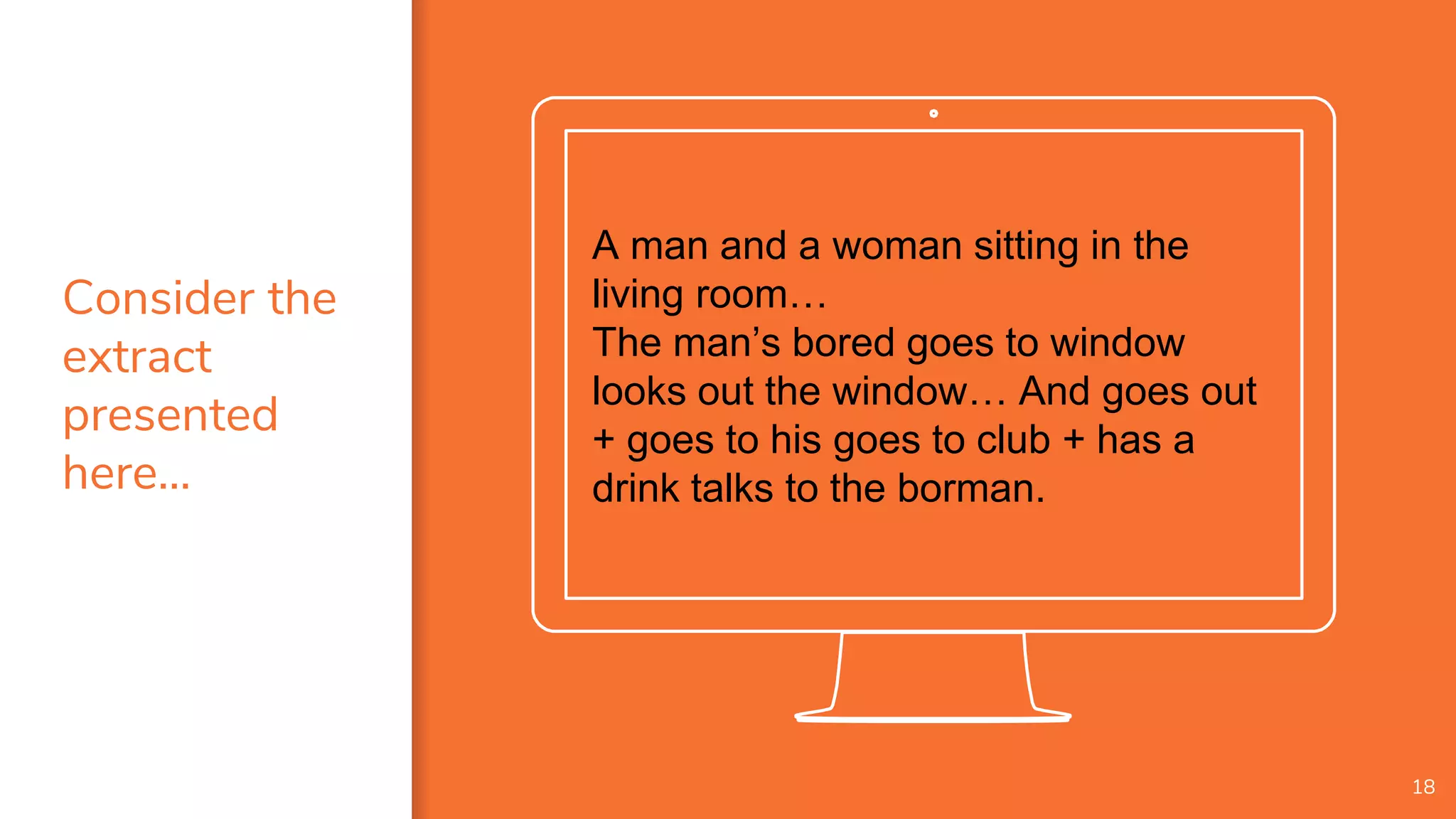
A man and a woman sitting in the
living room…
The man’s bored goes to window
looks out the window… And goes out
+ goes to his goes to club + has a
drink talks to the borman.
18
Consider the
extract
presented
here…
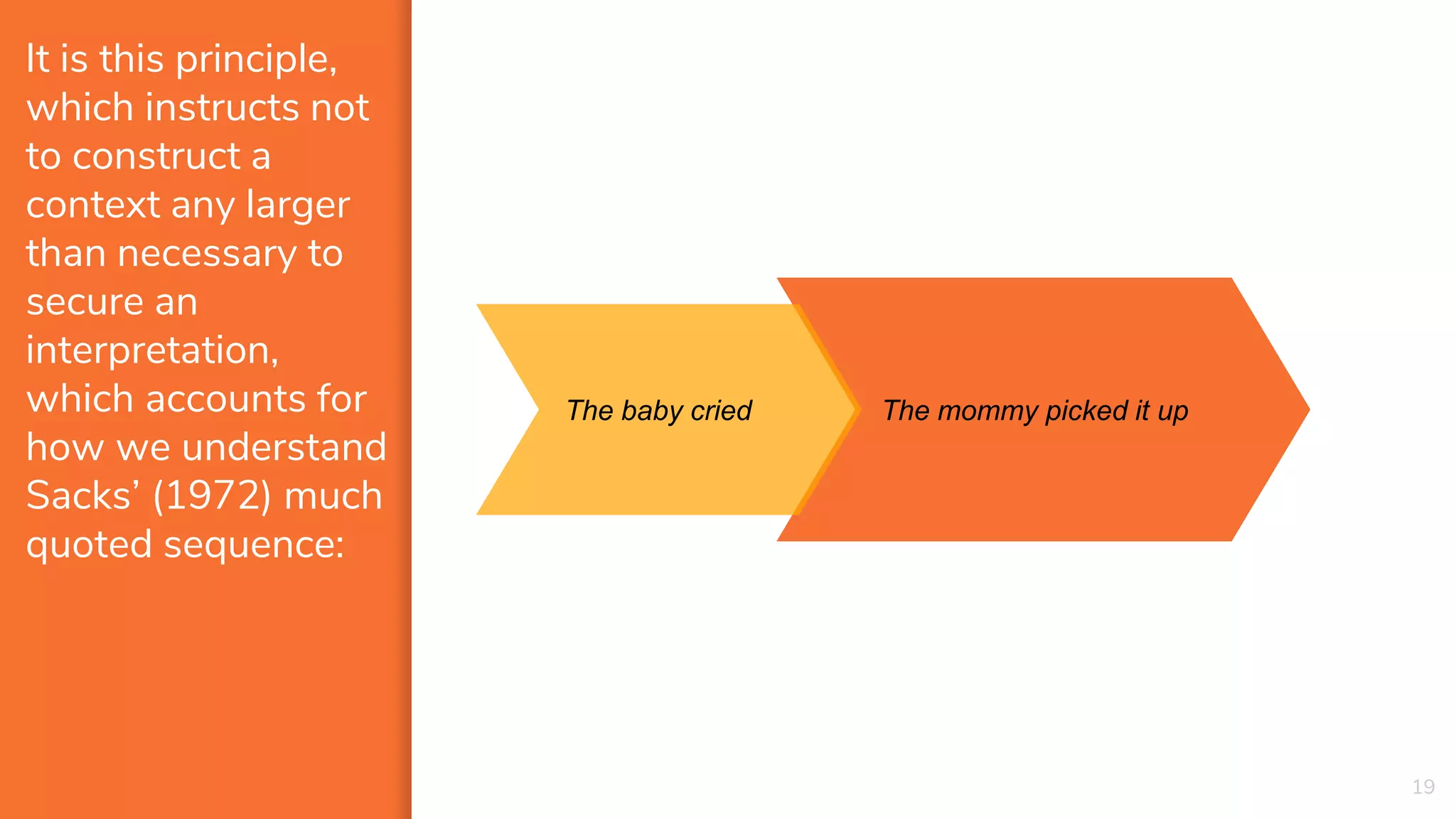
It is this principle,
which instructs not
to construct a
context any larger
than necessary to
secure an
interpretation,
which accounts for
how we understand
Sacks’ (1972) much
quoted sequence:
The mommy picked it up
19
The baby cried
20
Experience similar events which enables him to judge
what the purpose of an utterance might be. It is his
knowledge of the world which constrains his local
interpretation.
Consider the extract presented here,
A man and a woman sitting in the living room…
The man’s bored goes to the window... goes out… goes
to a.
The principle
of analogy
provide a reasonably secure framework for
interpretation for the hearer and for the analyst
most of the time, things will indeed conform to
our expectation.
Discourse is interpreted in the light of past
experience of similar discourse, by analogy with
previous similar texts.
21
In order to interpret the
deictic elements in a piece
of discourse, it is necessary
to know (at least) who the
speaker and hearer are, and
time and place of the
production of the discourse.
Because the analyst is
investigating the use of
language in context by
speaker/writer, he is more
concerned with the relation
between the speaker and
the utterance, on the
particular situation.
22
Conclusion
Thank you very much
for your time
23

The role of context in interpretation

  • 1.
    THE ROLE OF CONTEXTIN INTERPRETATION
  • 2.
    2.1Pragmatics and Discourse Context 2 Discourse Analyst LinguisticElements Language in context by speaker/writer Reference Presupposition Implicatures Inference
  • 3.
    a. Reference 3 Lyons (1986:404) says that ‘the relationship which holds between words and things is the relationship of reference. In discourse analysis, reference is treated as an action on the part of the speaker/writer. EXAMPLE a : My uncle’s coming home from Canada on Sunday b : How long has he been away for or has he just been away? words refer to things
  • 4.
    “ 4 b. Pressupposition According toGivon (1979) defines the term presupposition as an assumptions the speaker makes about what the hearer is likely to accept without challenge. Presuppositions are what is taken by the speaker to be the common ground of the participants in the conversation. The indicate source of presupposition is the speaker EXAMPLE : a. My uncle is coming home from Canada (speaker do the presupposition) b. I have an uncle (speaker presupposed that hearer can know and understand)
  • 5.
    c. Implicatures 5 Yule (1996)states that implicature is an entailment is something that locically follows from the asserted in the utterance. The word implicature (implicature) is taken from the verb "to imply" which comes from the Latin "plicare". Etymologically, "to imply" means to fold something into something else. Implicature can not be separated from the principle of cooperation between the two speakers in a conversation interaction. It is stated that there are two types of implicature, namely conventional implicatures which result from logical reasoning and conversational implicatures that are produced due to certain contexts.
  • 6.
    EXAMPLE  Conversational Implicature Thistype of implication is generated because of the demands of a particular context of conversation. Implications of this conversation have more varied meanings and meanings. The reason, understanding of things "intended: is very dependent on the context of the conversation. Mother: Ani, your sister hasn't eaten. Ani: Yes, ma'am. What side dish? 6  Conventional Implicature Conventional implicature, that is, implicature, is determined by "the conventional meaning of the words used". A : Marcy is from a solo, of course she's graceful
  • 7.
     A processof inference to arrive at an interpretation for utterances or for the connection between utterances. It may be the case that we are capable of deriving a specific conclusion from specific premises. d. Inference Example: a. If it’s sunny, it’s warm b. It’s sunny c. So, it’s warm 7 Example A. Where did the peas go? B. He is eating at Mbok Fri  Inference has relation with reference. Inference also known as the understanding meant by speakers of speech from speakers.
  • 8.
    THE CONTEXT OF SITUATION Sincethe beginning of the 1970s liinguist have become increasingly aware of the importance of context in the interpretation of sentences. The implication of taking context into account are well expressed by Sadock (1978 : 281) 8
  • 9.
    THE CONTEXT OF SITUATION 9 1.FEATURES OF CONTEXT
  • 10.
    In addition tothe long-term identity of speakers (speaker identity) which can be indicated by how they produce language, there are factors in the contexts in which language is used that affect both how we use language and how it is received. 10
  • 11.
    11 Setting and scence Participants Ends Actsequence Features of context are:
  • 12.
    2. CO -TEXT 12 Concentrated particularly on the physical context in which single utterances are embedded and we have paid rather little attention to the previous discourse co-ordinate. Lewis introduced this co-ordinate to take account of sentences which include specific reference to the aforementioned.
  • 13.
    The Expanding Context We have been concernedto impose some sort of analytic structure on the lumpen mass context. It is relevant to be identification of a speech event as being of a particular kind, to the ability of the hearer to predict what sort of thing the speaker is likely to say in a given type of context, and to the constraining of interpretation. 13
  • 14.
    Problem of DiscourseAnalyst When a particular feature is relevant to the specification of a particular context and what degree of specification is required. 14
  • 15.
    15 Expression Those featureswhich relate directly to the deictic context, interpretation for deictic expression like: Temporal Expression now e.g: Clap altogether now (gym mistress to class) Special Expression here e.g: It’s really nasty day here
  • 16.
    Consider the response ofa five years old girl in a Yorkshire infant school where she is asked to say how two pictures are different from each other. She replies: a. That one’s over there in that but it in’t there. The teacher then holds the girl’s hands, so she can’t point shuts her own eyes and says to the child. b. Now I can’t see the picture. Tell me the difference again. This time the child says: c. In this picture the Teddy’s on the chair but there ain’t no teddy in that one. 16
  • 17.
    17 The Principles of ‘local interpretation ’ of‘analogy’ one principle which we can identify we shall call the principle of local interpretation. This principle instruct a context any larger than he needs to arrive at an interpretation.
  • 18.
    A man anda woman sitting in the living room… The man’s bored goes to window looks out the window… And goes out + goes to his goes to club + has a drink talks to the borman. 18 Consider the extract presented here…
  • 19.
    It is thisprinciple, which instructs not to construct a context any larger than necessary to secure an interpretation, which accounts for how we understand Sacks’ (1972) much quoted sequence: The mommy picked it up 19 The baby cried
  • 20.
    20 Experience similar eventswhich enables him to judge what the purpose of an utterance might be. It is his knowledge of the world which constrains his local interpretation. Consider the extract presented here, A man and a woman sitting in the living room… The man’s bored goes to the window... goes out… goes to a.
  • 21.
    The principle of analogy providea reasonably secure framework for interpretation for the hearer and for the analyst most of the time, things will indeed conform to our expectation. Discourse is interpreted in the light of past experience of similar discourse, by analogy with previous similar texts. 21
  • 22.
    In order tointerpret the deictic elements in a piece of discourse, it is necessary to know (at least) who the speaker and hearer are, and time and place of the production of the discourse. Because the analyst is investigating the use of language in context by speaker/writer, he is more concerned with the relation between the speaker and the utterance, on the particular situation. 22 Conclusion
  • 23.
    Thank you verymuch for your time 23