Discourse Analysis
What is “discourse”?
• Discourse is any stretch of language that is meaningful and unified. It is any
stretch of language that has coherence and cohesion.
Common Features
• It is meaningful, coherent.
• It is unified, cohesive.
• It maybe spoken or written
• "Novels, as well as short conversation or might be equally rightfully named
discourses."
What is discourse analysis?
• Discourse analysis examines how stretches of language become
meaningful and unified for language users. It examines cohesion and
coherence in discourse.
Examples of Discourse
• Spoken Discourse
 Conversations
 Lectures
 Sermons
 Interviews
 Jokes
 Speeches
• Written Discourse
 Reports
 Political texts
 Legal texts
 Literature
 Newspaper articles
 Newspaper headlines
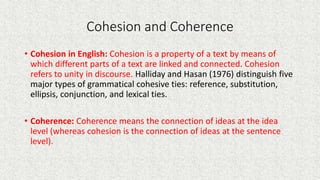
Cohesion and Coherence
• Cohesion in English: Cohesion is a property of a text by means of
which different parts of a text are linked and connected. Cohesion
refers to unity in discourse. Halliday and Hasan (1976) distinguish five
major types of grammatical cohesive ties: reference, substitution,
ellipsis, conjunction, and lexical ties.
• Coherence: Coherence means the connection of ideas at the idea
level (whereas cohesion is the connection of ideas at the sentence
level).
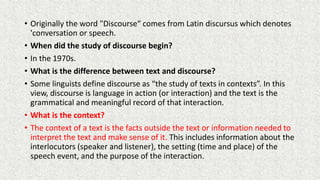
• Originally the word "Discourse“ comes from Latin discursus which denotes
'conversation or speech.
• When did the study of discourse begin?
• In the 1970s.
• What is the difference between text and discourse?
• Some linguists define discourse as “the study of texts in contexts”. In this
view, discourse is language in action (or interaction) and the text is the
grammatical and meaningful record of that interaction.
• What is the context?
• The context of a text is the facts outside the text or information needed to
interpret the text and make sense of it. This includes information about the
interlocutors (speaker and listener), the setting (time and place) of the
speech event, and the purpose of the interaction.
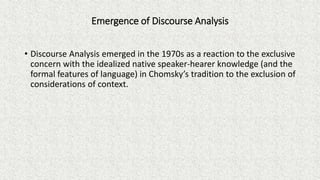
Emergence of Discourse Analysis
• Discourse Analysis emerged in the 1970s as a reaction to the exclusive
concern with the idealized native speaker-hearer knowledge (and the
formal features of language) in Chomsky’s tradition to the exclusion of
considerations of context.
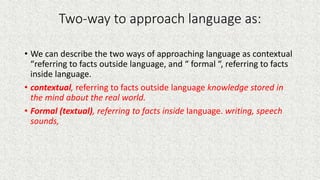
Two-way to approach language as:
• We can describe the two ways of approaching language as contextual
“referring to facts outside language, and “ formal “, referring to facts
inside language.
• contextual, referring to facts outside language knowledge stored in
the mind about the real world.
• Formal (textual), referring to facts inside language. writing, speech
sounds,
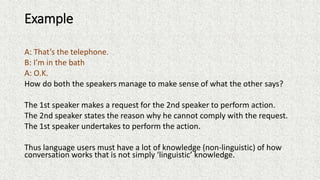
Example
A: That’s the telephone.
B: I’m in the bath
A: O.K.
How do both the speakers manage to make sense of what the other says?
The 1st speaker makes a request for the 2nd speaker to perform action.
The 2nd speaker states the reason why he cannot comply with the request.
The 1st speaker undertakes to perform the action.
Thus language users must have a lot of knowledge (non-linguistic) of how
conversation works that is not simply ‘linguistic’ knowledge.
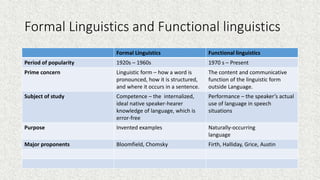
Formal Linguistics and Functional linguistics
Formal Linguistics Functional linguistics
Period of popularity 1920s – 1960s 1970 s – Present
Prime concern Linguistic form – how a word is
pronounced, how it is structured,
and where it occurs in a sentence.
The content and communicative
function of the linguistic form
outside Language.
Subject of study Competence – the internalized,
ideal native speaker-hearer
knowledge of language, which is
error-free
Performance – the speaker’s actual
use of language in speech
situations
Purpose Invented examples Naturally-occurring
language
Major proponents Bloomfield, Chomsky Firth, Halliday, Grice, Austin
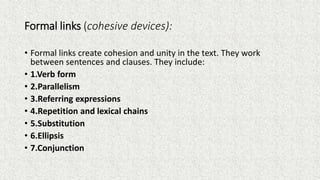
Formal links (cohesive devices):
• Formal links create cohesion and unity in the text. They work
between sentences and clauses. They include:
• 1.Verb form
• 2.Parallelism
• 3.Referring expressions
• 4.Repetition and lexical chains
• 5.Substitution
• 6.Ellipsis
• 7.Conjunction
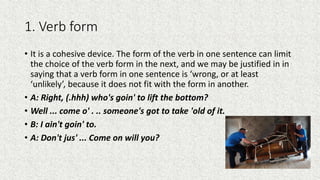
1. Verb form
• It is a cohesive device. The form of the verb in one sentence can limit
the choice of the verb form in the next, and we may be justified in in
saying that a verb form in one sentence is ‘wrong, or at least
‘unlikely’, because it does not fit with the form in another.
• A: Right, (.hhh) who's goin' to lift the bottom?
• Well ... come o' . .. someone's got to take 'old of it.
• B: I ain't goin' to.
• A: Don't jus' ... Come on will you?
Explain how verb form creates cohesion in discourse:
• The form of the verb in one sentence can limit the choice of the verb
form in the next, and we may be justified in in saying that a verb form
in one sentence is ‘wrong, or at least ‘unlikely’, because it does not fit
with the form in another.
• I will visit Mecca next week. I will visit Al-haram, and I will perform
Umrah.
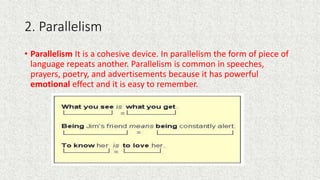
2. Parallelism
• Parallelism It is a cohesive device. In parallelism the form of piece of
language repeats another. Parallelism is common in speeches,
prayers, poetry, and advertisements because it has powerful
emotional effect and it is easy to remember.
Parallelism
• Parallelism is often used in speeches, prayers, poetry, and
advertisements because it can have a powerful emotional effect and
it is easy to remember.
• 'Le General de Gaulle est mort. La France est veuve.'
• (General de Gaulle is dead. France is a widow.)
• Parallelism can be used as aide-memoire
2. Parallelism
• We may have also a sound parallelism: as in the rhyme, rhythm, and other sound
effects of verse.
• "...and that government of the people, by the people, for the people, shall not
perish from the earth."
• --Abraham Lincoln
• One might even extend the idea and talk of semantic parallelism where two
sentences are linked because they mean the same thing.
• Comic duos often exploit this for humorous effect. The first comedian says
something in a high-flown style, and the other repeats the same information in a
colloquial one:
• A: The Good Lord, in his wisdom, has taken her away from us.
• B: You mean the old girl's snuffed it.
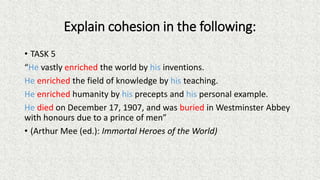
Explain cohesion in the following:
• TASK 5
“He vastly enriched the world by his inventions.
He enriched the field of knowledge by his teaching.
He enriched humanity by his precepts and his personal example.
He died on December 17, 1907, and was buried in Westminster Abbey
with honours due to a prince of men”
• (Arthur Mee (ed.): Immortal Heroes of the World)
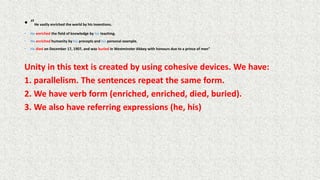
• “He vastly enriched the world by his inventions.
• He enriched the field of knowledge by his teaching.
• He enriched humanity by his precepts and his personal example.
• He died on December 17, 1907, and was buried in Westminster Abbey with honours due to a prince of men”
Unity in this text is created by using cohesive devices. We have:
1. parallelism. The sentences repeat the same form.
2. We have verb form (enriched, enriched, died, buried).
3. We also have referring expressions (he, his)
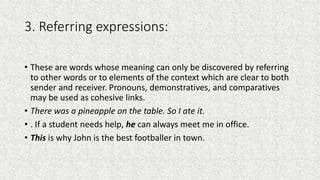
3. Referring expressions:
• These are words whose meaning can only be discovered by referring
to other words or to elements of the context which are clear to both
sender and receiver. Pronouns, demonstratives, and comparatives
may be used as cohesive links.
• There was a pineapple on the table. So I ate it.
• . If a student needs help, he can always meet me in office.
• This is why John is the best footballer in town.
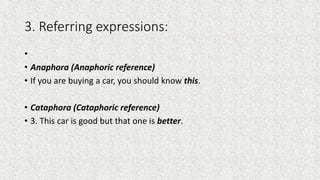
3. Referring expressions:
•
• Anaphora (Anaphoric reference)
• If you are buying a car, you should know this.
• Cataphora (Cataphoric reference)
• 3. This car is good but that one is better.
3. Referring expressions:
Anaphora
the identity of someone or something to be given once at the beginning, and
thereafter referred to as she, he, or it.
This makes a kind of chain, running through the discourse, in which each
expression is linked to another:
a pineapple... it... it... it. ..
Foreign language teachers, assuming that comprehension difficulties arise
from new vocabulary, can overlook the difficulties students can have in
interpreting the meaning of referring expressions within discourse.
3. Referring expressions
Cataphora
• When we are given the pronoun first, and then kept in suspense as to its
identity, which is revealed later.
TASK 7
• Here is another chapter opening from the same children's book. What is
different about the use of the pronouns?
• Nobody seemed to know where they came from, but there they were in the
Forest: Kangaand BabyRoo.
(A. A. Milne: Winnie-the-Pooh, Chapter 7)
3. Referring expressions
• Referring expressions fulfil a dual purpose of unifying the text (they
depend upon some of the subject matter remaining the same) and of
economy, because they save us from having to repeat the identity of
what we are talking about again and again.
Repetition: Lexical Ties
This involves the use of lexical items to link different parts
of the text via repetition, synonymy, superordinate, and
general words.
Repetition Sue is in the race. I believe Sue will win the race.
Synonymy I saw a young boy. The lad was wearing a T-shirt.
Super-ordinates I bough carrot. It’s my favorite vegetable.
General word She’s a single mom but a great parent indeed.
Repetition and Lexical Chains
• elegant repetition, a device where synonymous or more general
words or phrases are used.
• The pineapple ... the pineapple ... the pineapple ... the pineapple
• The pineapple ... the juicy fruit ... our meal ... the tropical luxury
4. Repetition and Lexical Chains
• TASK 9
• In the following, is it possible or desirable to replace repetitions with
referring expressions
• replace referring expressions by repetitions. replace either by elegant
repetition and, if so, could this affect the meaning, the style, or both?
What does all this refer to in the third sentence?
5. Substitution
• Substitution is a cohesive device. In substitution you replace a lexical item
with another. For example words like do or so replace a word or group of
words which have appeared in an earlier sentence.
Do you like mangoes?
• Yes I like mangoes
• Yes I think I like mangoes.
It is much quicker, and it means the same, if we say
• Yes I do
• Yes I think so.
5. Substitution
Substitution can occur at nominal, verbal and clausal levels.
Examples
Nominal Do you want the apples? Yes, I’ll take one.
Verbal Did you go? Yes, I did.
Clausal I think that the apples are getting black. I think so.
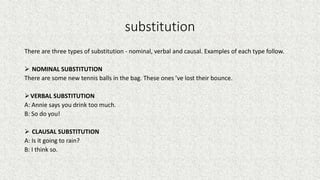
substitution
There are three types of substitution - nominal, verbal and causal. Examples of each type follow.
 NOMINAL SUBSTITUTION
There are some new tennis balls in the bag. These ones ’ve lost their bounce.
VERBAL SUBSTITUTION
A: Annie says you drink too much.
B: So do you!
 CLAUSAL SUBSTITUTION
A: Is it going to rain?
B: I think so.
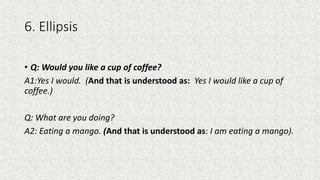
6. Ellipsis
• Q: Would you like a cup of coffee?
A1:Yes I would. (And that is understood as: Yes I would like a cup of
coffee.)
Q: What are you doing?
A2: Eating a mango. (And that is understood as: I am eating a mango).
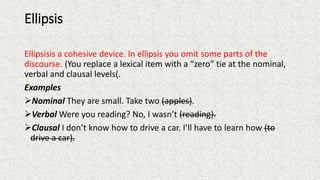
Ellipsis
Ellipsisis a cohesive device. In ellipsis you omit some parts of the
discourse. (You replace a lexical item with a “zero” tie at the nominal,
verbal and clausal levels(.
Examples
Nominal They are small. Take two (apples).
Verbal Were you reading? No, I wasn’t (reading).
Clausal I don’t know how to drive a car. I’ll have to learn how (to
drive a car).
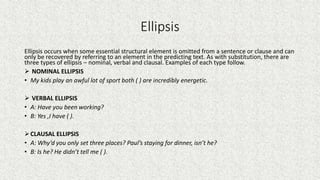
Ellipsis
Ellipsis occurs when some essential structural element is omitted from a sentence or clause and can
only be recovered by referring to an element in the predicting text. As with substitution, there are
three types of ellipsis – nominal, verbal and clausal. Examples of each type follow.
 NOMINAL ELLIPSIS
• My kids play an awful lot of sport both ( ) are incredibly energetic.
 VERBAL ELLIPSIS
• A: Have you been working?
• B: Yes ,I have ( ).
CLAUSAL ELLIPSIS
• A: Why’d you only set three places? Paul’s staying for dinner, isn’t he?
• B: Is he? He didn’t tell me ( ).
7. Conjunctions
the type of relationship which exists between one sentence or clause and
another. These words may simply: add more information to what has
already been said (and, furthermore, add to that) elaborate or exemplify it
(for instance, thus, in other words}. Contrast new information with old
information, or put another side to the argument (or, on the other hand,
however, conversely).
Relate new information to what has already been given in terms of
causes(so, consequently, because, for this reason) or time(formerly, then, in
the end, next) or they may indicate a new departure
summary(by the way, well, to sum up, anyway).
Conjunction
These are linkers used to indicate a relationship between
sentences or parts of a sentence.
Examples
Contrast I bought ten apples. However, I didn’t eat any.
Causal Her work was finished, so she turned off the laptop.
Temporal After the prayer, we went home.
Logical sequence I lost all my money. Then, I sold my house.
Language functions
• Utterance vs. sentence
• Utterance for a unit of language used by somebody in context to do
something-to communicate.
• Sentence for grammatically complete units regarded purely formally,
in isolation from their context and their function.
Explain Roman Jacobson's communication
model:
• According to Roman Jacobson, the addresser sends a message to the
addressee about a particular topic. In order to understand the
message, there must be a common code between the addresser and
the addressee.
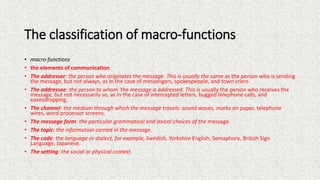
The classification of macro-functions
• macro-functions
• the elements of communication
• The addresser: the person who originates the message. This is usually the same as the person who is sending
the message, but not always, as in the case of messengers, spokespeople, and town criers.
• The addressee: the person to whom 'the message is addressed. This is usually the person who receives the
message, but not necessarily so, as in the case of intercepted letters, bugged telephone calls, and
eavesdropping.
• The channel: the medium through which the message travels: sound waves, marks on paper, telephone
wires, word processor screens.
• The message form: the particular grammatical and lexical choices of the message.
• The topic: the information carried in the message.
• The code: the language or dialect, for example, Swedish, Yorkshire English, Semaphore, British Sign
Language, Japanese.
• The setting: the social or physical context.
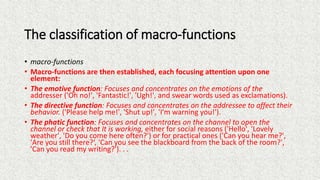
The classification of macro-functions
• macro-functions
• Macro-functions are then established, each focusing attention upon one
element:
• The emotive function: Focuses and concentrates on the emotions of the
addresser ('Oh no!', 'Fantastic!', 'Ugh!', and swear words used as exclamations).
• The directive function: Focuses and concentrates on the addressee to affect their
behavior. ('Please help me!', 'Shut up!', 'I'm warning you!').
• The phatic function: Focuses and concentrates on the channel to open the
channel or check that It is working, either for social reasons ('Hello', 'Lovely
weather', 'Do you come here often?') or for practical ones ('Can you hear me?',
'Are you still there?‘, 'Can you see the blackboard from the back of the room?',
'Can you read my writing?'). . .
The classification of macro-functions
• macro-functions
• Macro-functions are then established, each focusing attention upon one element:
• The poetic function: Focuses and concentrates on the message form and structure. (The
advertising slogan BEANZ MEANZ HEINZ would lose its point if it were paraphrased as 'If
you are buying beans, you will naturally buy Heinz.')
• The referential function: Focuses and concentrates on carrying information. .
• The metalinguistic function: focuses and concentrates on the code itself, to clarify it or
renegotiate it ('What does this word here mean?', 'This bone is known as the "femur"',
'"Will" and "shall" mean the same thing nowadays'). This book has a largely
metalinguistic function.
• The contextual function: Focuses and concentrates on a particular kind of
communication ('Right, let's start the lecture', 'It's just a game).
The classification of macro-functions
• TASK 14
• What do you consider to be the most likely functions of the following?
• Dear Sir or Madam ...
• Fred Astaire's dead.
• Workers of the World, Unite!
• You make me sick.
• The court is now in session.
• What do you mean by this?
• Well, I'll be damned!
• Here's Miss Julie.
• Is it possible to assign one function to each, or are some of mixed function?
How might the function of each utterance vary according to context?

discourse analysis0 1.pptx

  • 1.
  • 2.
    What is “discourse”? •Discourse is any stretch of language that is meaningful and unified. It is any stretch of language that has coherence and cohesion. Common Features • It is meaningful, coherent. • It is unified, cohesive. • It maybe spoken or written • "Novels, as well as short conversation or might be equally rightfully named discourses."
  • 3.
    What is discourseanalysis? • Discourse analysis examines how stretches of language become meaningful and unified for language users. It examines cohesion and coherence in discourse.
  • 4.
    Examples of Discourse •Spoken Discourse  Conversations  Lectures  Sermons  Interviews  Jokes  Speeches • Written Discourse  Reports  Political texts  Legal texts  Literature  Newspaper articles  Newspaper headlines
  • 5.
    Cohesion and Coherence •Cohesion in English: Cohesion is a property of a text by means of which different parts of a text are linked and connected. Cohesion refers to unity in discourse. Halliday and Hasan (1976) distinguish five major types of grammatical cohesive ties: reference, substitution, ellipsis, conjunction, and lexical ties. • Coherence: Coherence means the connection of ideas at the idea level (whereas cohesion is the connection of ideas at the sentence level).
  • 6.
    • Originally theword "Discourse“ comes from Latin discursus which denotes 'conversation or speech. • When did the study of discourse begin? • In the 1970s. • What is the difference between text and discourse? • Some linguists define discourse as “the study of texts in contexts”. In this view, discourse is language in action (or interaction) and the text is the grammatical and meaningful record of that interaction. • What is the context? • The context of a text is the facts outside the text or information needed to interpret the text and make sense of it. This includes information about the interlocutors (speaker and listener), the setting (time and place) of the speech event, and the purpose of the interaction.
  • 7.
    Emergence of DiscourseAnalysis • Discourse Analysis emerged in the 1970s as a reaction to the exclusive concern with the idealized native speaker-hearer knowledge (and the formal features of language) in Chomsky’s tradition to the exclusion of considerations of context.
  • 8.
    Two-way to approachlanguage as: • We can describe the two ways of approaching language as contextual “referring to facts outside language, and “ formal “, referring to facts inside language. • contextual, referring to facts outside language knowledge stored in the mind about the real world. • Formal (textual), referring to facts inside language. writing, speech sounds,
  • 9.
    Example A: That’s thetelephone. B: I’m in the bath A: O.K. How do both the speakers manage to make sense of what the other says? The 1st speaker makes a request for the 2nd speaker to perform action. The 2nd speaker states the reason why he cannot comply with the request. The 1st speaker undertakes to perform the action. Thus language users must have a lot of knowledge (non-linguistic) of how conversation works that is not simply ‘linguistic’ knowledge.
  • 10.
    Formal Linguistics andFunctional linguistics Formal Linguistics Functional linguistics Period of popularity 1920s – 1960s 1970 s – Present Prime concern Linguistic form – how a word is pronounced, how it is structured, and where it occurs in a sentence. The content and communicative function of the linguistic form outside Language. Subject of study Competence – the internalized, ideal native speaker-hearer knowledge of language, which is error-free Performance – the speaker’s actual use of language in speech situations Purpose Invented examples Naturally-occurring language Major proponents Bloomfield, Chomsky Firth, Halliday, Grice, Austin
  • 11.
    Formal links (cohesivedevices): • Formal links create cohesion and unity in the text. They work between sentences and clauses. They include: • 1.Verb form • 2.Parallelism • 3.Referring expressions • 4.Repetition and lexical chains • 5.Substitution • 6.Ellipsis • 7.Conjunction
  • 12.
    1. Verb form •It is a cohesive device. The form of the verb in one sentence can limit the choice of the verb form in the next, and we may be justified in in saying that a verb form in one sentence is ‘wrong, or at least ‘unlikely’, because it does not fit with the form in another. • A: Right, (.hhh) who's goin' to lift the bottom? • Well ... come o' . .. someone's got to take 'old of it. • B: I ain't goin' to. • A: Don't jus' ... Come on will you?
  • 13.
    Explain how verbform creates cohesion in discourse: • The form of the verb in one sentence can limit the choice of the verb form in the next, and we may be justified in in saying that a verb form in one sentence is ‘wrong, or at least ‘unlikely’, because it does not fit with the form in another. • I will visit Mecca next week. I will visit Al-haram, and I will perform Umrah.
  • 14.
    2. Parallelism • ParallelismIt is a cohesive device. In parallelism the form of piece of language repeats another. Parallelism is common in speeches, prayers, poetry, and advertisements because it has powerful emotional effect and it is easy to remember.
  • 15.
    Parallelism • Parallelism isoften used in speeches, prayers, poetry, and advertisements because it can have a powerful emotional effect and it is easy to remember. • 'Le General de Gaulle est mort. La France est veuve.' • (General de Gaulle is dead. France is a widow.) • Parallelism can be used as aide-memoire
  • 16.
    2. Parallelism • Wemay have also a sound parallelism: as in the rhyme, rhythm, and other sound effects of verse. • "...and that government of the people, by the people, for the people, shall not perish from the earth." • --Abraham Lincoln • One might even extend the idea and talk of semantic parallelism where two sentences are linked because they mean the same thing. • Comic duos often exploit this for humorous effect. The first comedian says something in a high-flown style, and the other repeats the same information in a colloquial one: • A: The Good Lord, in his wisdom, has taken her away from us. • B: You mean the old girl's snuffed it.
  • 17.
    Explain cohesion inthe following: • TASK 5 “He vastly enriched the world by his inventions. He enriched the field of knowledge by his teaching. He enriched humanity by his precepts and his personal example. He died on December 17, 1907, and was buried in Westminster Abbey with honours due to a prince of men” • (Arthur Mee (ed.): Immortal Heroes of the World)
  • 18.
    • “He vastlyenriched the world by his inventions. • He enriched the field of knowledge by his teaching. • He enriched humanity by his precepts and his personal example. • He died on December 17, 1907, and was buried in Westminster Abbey with honours due to a prince of men” Unity in this text is created by using cohesive devices. We have: 1. parallelism. The sentences repeat the same form. 2. We have verb form (enriched, enriched, died, buried). 3. We also have referring expressions (he, his)
  • 19.
    3. Referring expressions: •These are words whose meaning can only be discovered by referring to other words or to elements of the context which are clear to both sender and receiver. Pronouns, demonstratives, and comparatives may be used as cohesive links. • There was a pineapple on the table. So I ate it. • . If a student needs help, he can always meet me in office. • This is why John is the best footballer in town.
  • 20.
    3. Referring expressions: • •Anaphora (Anaphoric reference) • If you are buying a car, you should know this. • Cataphora (Cataphoric reference) • 3. This car is good but that one is better.
  • 21.
    3. Referring expressions: Anaphora theidentity of someone or something to be given once at the beginning, and thereafter referred to as she, he, or it. This makes a kind of chain, running through the discourse, in which each expression is linked to another: a pineapple... it... it... it. .. Foreign language teachers, assuming that comprehension difficulties arise from new vocabulary, can overlook the difficulties students can have in interpreting the meaning of referring expressions within discourse.
  • 22.
    3. Referring expressions Cataphora •When we are given the pronoun first, and then kept in suspense as to its identity, which is revealed later. TASK 7 • Here is another chapter opening from the same children's book. What is different about the use of the pronouns? • Nobody seemed to know where they came from, but there they were in the Forest: Kangaand BabyRoo. (A. A. Milne: Winnie-the-Pooh, Chapter 7)
  • 23.
    3. Referring expressions •Referring expressions fulfil a dual purpose of unifying the text (they depend upon some of the subject matter remaining the same) and of economy, because they save us from having to repeat the identity of what we are talking about again and again.
  • 24.
    Repetition: Lexical Ties Thisinvolves the use of lexical items to link different parts of the text via repetition, synonymy, superordinate, and general words. Repetition Sue is in the race. I believe Sue will win the race. Synonymy I saw a young boy. The lad was wearing a T-shirt. Super-ordinates I bough carrot. It’s my favorite vegetable. General word She’s a single mom but a great parent indeed.
  • 25.
    Repetition and LexicalChains • elegant repetition, a device where synonymous or more general words or phrases are used. • The pineapple ... the pineapple ... the pineapple ... the pineapple • The pineapple ... the juicy fruit ... our meal ... the tropical luxury
  • 26.
    4. Repetition andLexical Chains • TASK 9 • In the following, is it possible or desirable to replace repetitions with referring expressions • replace referring expressions by repetitions. replace either by elegant repetition and, if so, could this affect the meaning, the style, or both? What does all this refer to in the third sentence?
  • 27.
    5. Substitution • Substitutionis a cohesive device. In substitution you replace a lexical item with another. For example words like do or so replace a word or group of words which have appeared in an earlier sentence. Do you like mangoes? • Yes I like mangoes • Yes I think I like mangoes. It is much quicker, and it means the same, if we say • Yes I do • Yes I think so.
  • 28.
    5. Substitution Substitution canoccur at nominal, verbal and clausal levels. Examples Nominal Do you want the apples? Yes, I’ll take one. Verbal Did you go? Yes, I did. Clausal I think that the apples are getting black. I think so.
  • 29.
    substitution There are threetypes of substitution - nominal, verbal and causal. Examples of each type follow.  NOMINAL SUBSTITUTION There are some new tennis balls in the bag. These ones ’ve lost their bounce. VERBAL SUBSTITUTION A: Annie says you drink too much. B: So do you!  CLAUSAL SUBSTITUTION A: Is it going to rain? B: I think so.
  • 30.
    6. Ellipsis • Q:Would you like a cup of coffee? A1:Yes I would. (And that is understood as: Yes I would like a cup of coffee.) Q: What are you doing? A2: Eating a mango. (And that is understood as: I am eating a mango).
  • 31.
    Ellipsis Ellipsisis a cohesivedevice. In ellipsis you omit some parts of the discourse. (You replace a lexical item with a “zero” tie at the nominal, verbal and clausal levels(. Examples Nominal They are small. Take two (apples). Verbal Were you reading? No, I wasn’t (reading). Clausal I don’t know how to drive a car. I’ll have to learn how (to drive a car).
  • 32.
    Ellipsis Ellipsis occurs whensome essential structural element is omitted from a sentence or clause and can only be recovered by referring to an element in the predicting text. As with substitution, there are three types of ellipsis – nominal, verbal and clausal. Examples of each type follow.  NOMINAL ELLIPSIS • My kids play an awful lot of sport both ( ) are incredibly energetic.  VERBAL ELLIPSIS • A: Have you been working? • B: Yes ,I have ( ). CLAUSAL ELLIPSIS • A: Why’d you only set three places? Paul’s staying for dinner, isn’t he? • B: Is he? He didn’t tell me ( ).
  • 33.
    7. Conjunctions the typeof relationship which exists between one sentence or clause and another. These words may simply: add more information to what has already been said (and, furthermore, add to that) elaborate or exemplify it (for instance, thus, in other words}. Contrast new information with old information, or put another side to the argument (or, on the other hand, however, conversely). Relate new information to what has already been given in terms of causes(so, consequently, because, for this reason) or time(formerly, then, in the end, next) or they may indicate a new departure summary(by the way, well, to sum up, anyway).
  • 34.
    Conjunction These are linkersused to indicate a relationship between sentences or parts of a sentence. Examples Contrast I bought ten apples. However, I didn’t eat any. Causal Her work was finished, so she turned off the laptop. Temporal After the prayer, we went home. Logical sequence I lost all my money. Then, I sold my house.
  • 35.
    Language functions • Utterancevs. sentence • Utterance for a unit of language used by somebody in context to do something-to communicate. • Sentence for grammatically complete units regarded purely formally, in isolation from their context and their function.
  • 36.
    Explain Roman Jacobson'scommunication model: • According to Roman Jacobson, the addresser sends a message to the addressee about a particular topic. In order to understand the message, there must be a common code between the addresser and the addressee.
  • 37.
    The classification ofmacro-functions • macro-functions • the elements of communication • The addresser: the person who originates the message. This is usually the same as the person who is sending the message, but not always, as in the case of messengers, spokespeople, and town criers. • The addressee: the person to whom 'the message is addressed. This is usually the person who receives the message, but not necessarily so, as in the case of intercepted letters, bugged telephone calls, and eavesdropping. • The channel: the medium through which the message travels: sound waves, marks on paper, telephone wires, word processor screens. • The message form: the particular grammatical and lexical choices of the message. • The topic: the information carried in the message. • The code: the language or dialect, for example, Swedish, Yorkshire English, Semaphore, British Sign Language, Japanese. • The setting: the social or physical context.
  • 38.
    The classification ofmacro-functions • macro-functions • Macro-functions are then established, each focusing attention upon one element: • The emotive function: Focuses and concentrates on the emotions of the addresser ('Oh no!', 'Fantastic!', 'Ugh!', and swear words used as exclamations). • The directive function: Focuses and concentrates on the addressee to affect their behavior. ('Please help me!', 'Shut up!', 'I'm warning you!'). • The phatic function: Focuses and concentrates on the channel to open the channel or check that It is working, either for social reasons ('Hello', 'Lovely weather', 'Do you come here often?') or for practical ones ('Can you hear me?', 'Are you still there?‘, 'Can you see the blackboard from the back of the room?', 'Can you read my writing?'). . .
  • 39.
    The classification ofmacro-functions • macro-functions • Macro-functions are then established, each focusing attention upon one element: • The poetic function: Focuses and concentrates on the message form and structure. (The advertising slogan BEANZ MEANZ HEINZ would lose its point if it were paraphrased as 'If you are buying beans, you will naturally buy Heinz.') • The referential function: Focuses and concentrates on carrying information. . • The metalinguistic function: focuses and concentrates on the code itself, to clarify it or renegotiate it ('What does this word here mean?', 'This bone is known as the "femur"', '"Will" and "shall" mean the same thing nowadays'). This book has a largely metalinguistic function. • The contextual function: Focuses and concentrates on a particular kind of communication ('Right, let's start the lecture', 'It's just a game).
  • 40.
    The classification ofmacro-functions • TASK 14 • What do you consider to be the most likely functions of the following? • Dear Sir or Madam ... • Fred Astaire's dead. • Workers of the World, Unite! • You make me sick. • The court is now in session. • What do you mean by this? • Well, I'll be damned! • Here's Miss Julie. • Is it possible to assign one function to each, or are some of mixed function? How might the function of each utterance vary according to context?