The Classical Era
1750 - 1825
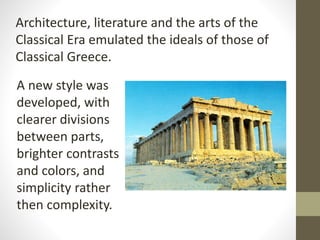
Architecture, literature and the arts of the
Classical Era emulated the ideals of those of
Classical Greece.
A new style was
developed, with
clearer divisions
between parts,
brighter contrasts
and colors, and
simplicity rather
then complexity.
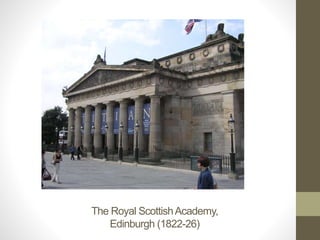
The Royal ScottishAcademy,
Edinburgh (1822-26)
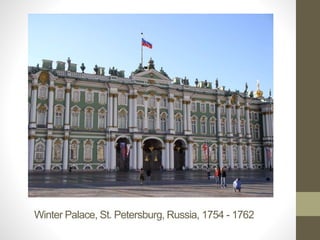
Winter Palace, St. Petersburg, Russia, 1754 - 1762
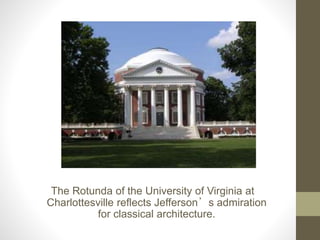
The Rotunda of the University of Virginia at
Charlottesville reflects Jefferson’s admiration
for classical architecture.
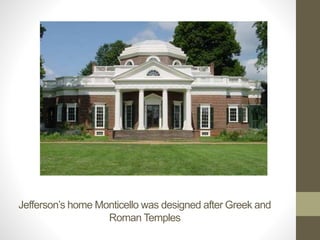
Jefferson’s home Monticello was designed after Greek and
Roman Temples
Important Historical Events
• The American Revolution (1775 – 83)
• Declaration of Independence.
• Washington D.C. was established as a the U. S.
capital, 1800
• Louisiana was purchased, 1803
• The French Revolution (1789 – 99)
• Power was transferred from the aristocracy to
the middle class.
• Rapidly expanding capitalism.
Scientific Discoveries
• James Watts introduced steam engine,
1760.
• First editions of the French Encyclodedie
(1751-52) and Encyclopaedia Britannica
(1771).
• Edward Jenner introduced vaccination,
1796.
• Benjamin Franklin experimented with
electricity.
• Joseph Priestley discovered oxygen.
Characteristics of the Classical
Style in Music
• Mainly homophonic texture; polyphony was not
the main focus of music.
• All parts were written, no figured bass.
• Melodies based on clear-cut phrases and clearly
marked cadences.
• Diatonic harmony.
• Rhythmic regularity – meters within movements
did not change.
• Sonata Allegro form was developed and was used
in the first movements of multi-movement works.
Mozart, Divertimento No. 1, K. 136
http://www.youtube.com/watch?v=dPBL-kPQzkc
Sonata Allegro Form
Please study the presentation on the Sonata Allegro Form
included in this week’s assignments list.
Please take a look at this example as well.
http://www.teoria.com/tutorials/forms/sonata02.php
The Classical Symphony
I. Allegro in sonata-allegro form, sometimes
preceded by a slow introduction.
II. A slow movement in A-B-A or theme and
variations form.
III. Menuet and trio in triple meter.
IV. Finale, a vivacious Allegro molto or Presto in
rondo or sonata-allegro form.
W. A. Mozart, Symphony No. 34 in C
http://content.thespco.org/music/compositions/symphony-no-34-
in-c-wolfgang-amadeus-mozart/
http://javanese.imslp.info/files/imglnks/usimg/7/7f/IMSLP00066-
Mozart_-_Symphony_No_34_in_C_Major__K338.pdf
The Classical Orchestra
The classical orchestra is considerably smaller than the modern
symphony orchestra: less strings, not more than two same
instruments in woodwind and brass sections could be used, and
percussion section contains only a very few instruments.
Haydn, Symphony No. 95
http://www.youtube.com/watch?v=syOFv4iAxMw
The Classical Orchestra
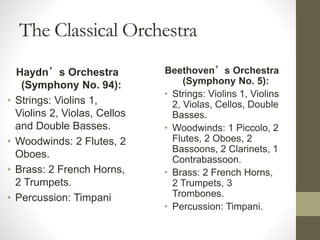
Haydn’s Orchestra
(Symphony No. 94):
• Strings: Violins 1,
Violins 2, Violas, Cellos
and Double Basses.
• Woodwinds: 2 Flutes, 2
Oboes.
• Brass: 2 French Horns,
2 Trumpets.
• Percussion: Timpani
Beethoven’s Orchestra
(Symphony No. 5):
• Strings: Violins 1, Violins
2, Violas, Cellos, Double
Basses.
• Woodwinds: 1 Piccolo, 2
Flutes, 2 Oboes, 2
Bassoons, 2 Clarinets, 1
Contrabassoon.
• Brass: 2 French Horns,
2 Trumpets, 3
Trombones.
• Percussion: Timpani.
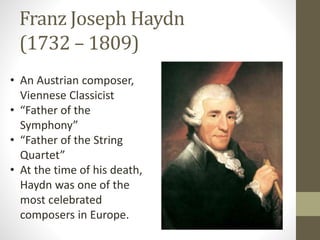
Franz Joseph Haydn
(1732 – 1809)
• An Austrian composer,
Viennese Classicist
• “Father of the
Symphony”
• “Father of the String
Quartet”
• At the time of his death,
Haydn was one of the
most celebrated
composers in Europe.
Early Life
• Was born in Rohrau,
Austira, a village near the
border with Hungary.
• Father – a wheelwright,
mother – a former cook.
Neither could read music.
• Parents noticed Haydn’s
talent and at the age of six,
he left them to train as a
musician.
• 1740 – moved to Vienna to
work as a chorister and
study school subjects and
music.
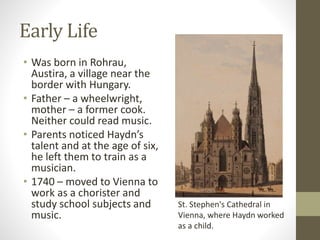
St. Stephen's Cathedral in
Vienna, where Haydn worked
as a child.
Freelance Career in Vienna
• Haydn matured physically and was no longer
able to sing high choral parts.
• 1749 – worked as a music teacher, a street
serenader, accompanist.
• Composed and opera.
• 1754 – worked freelance for the court of Vienna.
• Obtained aristocratic patronage under Count
Morzin, for whom he worked as a music director.
• Married.
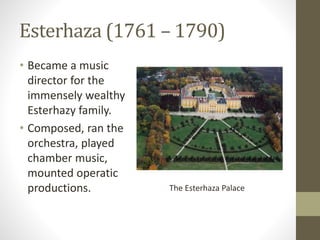
Esterhaza (1761 – 1790)
• Became a music
director for the
immensely wealthy
Esterhazy family.
• Composed, ran the
orchestra, played
chamber music,
mounted operatic
productions. The Esterhaza Palace
London
1791 – 92 and 1794 – 95 – Haydn visited London.
Conducted new symphonies with a large
orchestra.
Symphony No. 104, “London”
http://content.thespco.org/music/compositions/s
ymphony-no-104-in-d-london-franz-joseph-haydn/
Symphony No. 100, “Military”
http://content.thespco.org/music/compositions/s
ymphony-no-100-military-franz-joseph-haydn/
Last Years
• 1795 – returned to Vienna.
• Worked part-time for the Esterhazy as a music director.
• Wrote works for public performances.
• Composed oratorios “Creation” (1798) and “The
Seasons” (1801).
• Composed instrumental music.
http://content.thespco.org/music/compositions/symphony
-no-104-in-d-london-franz-joseph-haydn/
• Died at the age of 77.
Important Compositions
• Operas:
• 20 were composed, some of the first being lost. Some
of the extant 15 include: La Canterina (1766); Lo
Speziale (1768); Le Pescatrici (1769); L'infedeltà delusa
(1773); L'incontro improvviso (1775); etc.
• Concertos for instruments and orchestra:
• 2 Concertos for Cello
• 3 Concertos for Klavier
• 3 Concertos for Violin
• Concerto for Organ, etc.
Important Compositions
• For orchestra:
• 104 Symphonies
• For choir and orchestra:
• 13 Masses
• Stabat Mater (1767)
• Die sieben letzten Worte unseres Erlösers am Kreuz (The Seven
Last Words of Our Saviour on the Cross, 1st version (str. qt.) 1785,
choral version 1795-6)
• Instrumental Music:
• 68 String Quartets
Video Assignment
Please watch this video and take notes. You will be asked to
reflect on the composer’s life and legacy.
http://digital.films.com.ezproxy.vccs.edu:2048/PortalViewVideo.
aspx?xtid=44001&psid=0&sid=0&State=&title=Franz%20Joseph
%20Haydn:%20A%20Concise%20Biography&IsSearch=N&parent
SeriesID=#
Required Readings:
• http://en.wikipedia.org/wiki/Classical_era_music
• http://en.wikipedia.org/wiki/Joseph_Haydn
• http://library.thinkquest.org/22673/

The Classical Era

  • 1.
  • 2.
    Architecture, literature andthe arts of the Classical Era emulated the ideals of those of Classical Greece. A new style was developed, with clearer divisions between parts, brighter contrasts and colors, and simplicity rather then complexity.
  • 3.
  • 4.
    Winter Palace, St.Petersburg, Russia, 1754 - 1762
  • 5.
    The Rotunda ofthe University of Virginia at Charlottesville reflects Jefferson’s admiration for classical architecture.
  • 6.
    Jefferson’s home Monticellowas designed after Greek and Roman Temples
  • 7.
    Important Historical Events •The American Revolution (1775 – 83) • Declaration of Independence. • Washington D.C. was established as a the U. S. capital, 1800 • Louisiana was purchased, 1803 • The French Revolution (1789 – 99) • Power was transferred from the aristocracy to the middle class. • Rapidly expanding capitalism.
  • 8.
    Scientific Discoveries • JamesWatts introduced steam engine, 1760. • First editions of the French Encyclodedie (1751-52) and Encyclopaedia Britannica (1771). • Edward Jenner introduced vaccination, 1796. • Benjamin Franklin experimented with electricity. • Joseph Priestley discovered oxygen.
  • 9.
    Characteristics of theClassical Style in Music • Mainly homophonic texture; polyphony was not the main focus of music. • All parts were written, no figured bass. • Melodies based on clear-cut phrases and clearly marked cadences. • Diatonic harmony. • Rhythmic regularity – meters within movements did not change. • Sonata Allegro form was developed and was used in the first movements of multi-movement works. Mozart, Divertimento No. 1, K. 136 http://www.youtube.com/watch?v=dPBL-kPQzkc
  • 10.
    Sonata Allegro Form Pleasestudy the presentation on the Sonata Allegro Form included in this week’s assignments list. Please take a look at this example as well. http://www.teoria.com/tutorials/forms/sonata02.php
  • 11.
    The Classical Symphony I.Allegro in sonata-allegro form, sometimes preceded by a slow introduction. II. A slow movement in A-B-A or theme and variations form. III. Menuet and trio in triple meter. IV. Finale, a vivacious Allegro molto or Presto in rondo or sonata-allegro form. W. A. Mozart, Symphony No. 34 in C http://content.thespco.org/music/compositions/symphony-no-34- in-c-wolfgang-amadeus-mozart/ http://javanese.imslp.info/files/imglnks/usimg/7/7f/IMSLP00066- Mozart_-_Symphony_No_34_in_C_Major__K338.pdf
  • 12.
    The Classical Orchestra Theclassical orchestra is considerably smaller than the modern symphony orchestra: less strings, not more than two same instruments in woodwind and brass sections could be used, and percussion section contains only a very few instruments. Haydn, Symphony No. 95 http://www.youtube.com/watch?v=syOFv4iAxMw
  • 13.
    The Classical Orchestra Haydn’sOrchestra (Symphony No. 94): • Strings: Violins 1, Violins 2, Violas, Cellos and Double Basses. • Woodwinds: 2 Flutes, 2 Oboes. • Brass: 2 French Horns, 2 Trumpets. • Percussion: Timpani Beethoven’s Orchestra (Symphony No. 5): • Strings: Violins 1, Violins 2, Violas, Cellos, Double Basses. • Woodwinds: 1 Piccolo, 2 Flutes, 2 Oboes, 2 Bassoons, 2 Clarinets, 1 Contrabassoon. • Brass: 2 French Horns, 2 Trumpets, 3 Trombones. • Percussion: Timpani.
  • 14.
    Franz Joseph Haydn (1732– 1809) • An Austrian composer, Viennese Classicist • “Father of the Symphony” • “Father of the String Quartet” • At the time of his death, Haydn was one of the most celebrated composers in Europe.
  • 15.
    Early Life • Wasborn in Rohrau, Austira, a village near the border with Hungary. • Father – a wheelwright, mother – a former cook. Neither could read music. • Parents noticed Haydn’s talent and at the age of six, he left them to train as a musician. • 1740 – moved to Vienna to work as a chorister and study school subjects and music. St. Stephen's Cathedral in Vienna, where Haydn worked as a child.
  • 16.
    Freelance Career inVienna • Haydn matured physically and was no longer able to sing high choral parts. • 1749 – worked as a music teacher, a street serenader, accompanist. • Composed and opera. • 1754 – worked freelance for the court of Vienna. • Obtained aristocratic patronage under Count Morzin, for whom he worked as a music director. • Married.
  • 17.
    Esterhaza (1761 –1790) • Became a music director for the immensely wealthy Esterhazy family. • Composed, ran the orchestra, played chamber music, mounted operatic productions. The Esterhaza Palace
  • 18.
    London 1791 – 92and 1794 – 95 – Haydn visited London. Conducted new symphonies with a large orchestra. Symphony No. 104, “London” http://content.thespco.org/music/compositions/s ymphony-no-104-in-d-london-franz-joseph-haydn/ Symphony No. 100, “Military” http://content.thespco.org/music/compositions/s ymphony-no-100-military-franz-joseph-haydn/
  • 19.
    Last Years • 1795– returned to Vienna. • Worked part-time for the Esterhazy as a music director. • Wrote works for public performances. • Composed oratorios “Creation” (1798) and “The Seasons” (1801). • Composed instrumental music. http://content.thespco.org/music/compositions/symphony -no-104-in-d-london-franz-joseph-haydn/ • Died at the age of 77.
  • 20.
    Important Compositions • Operas: •20 were composed, some of the first being lost. Some of the extant 15 include: La Canterina (1766); Lo Speziale (1768); Le Pescatrici (1769); L'infedeltà delusa (1773); L'incontro improvviso (1775); etc. • Concertos for instruments and orchestra: • 2 Concertos for Cello • 3 Concertos for Klavier • 3 Concertos for Violin • Concerto for Organ, etc.
  • 21.
    Important Compositions • Fororchestra: • 104 Symphonies • For choir and orchestra: • 13 Masses • Stabat Mater (1767) • Die sieben letzten Worte unseres Erlösers am Kreuz (The Seven Last Words of Our Saviour on the Cross, 1st version (str. qt.) 1785, choral version 1795-6) • Instrumental Music: • 68 String Quartets
  • 22.
    Video Assignment Please watchthis video and take notes. You will be asked to reflect on the composer’s life and legacy. http://digital.films.com.ezproxy.vccs.edu:2048/PortalViewVideo. aspx?xtid=44001&psid=0&sid=0&State=&title=Franz%20Joseph %20Haydn:%20A%20Concise%20Biography&IsSearch=N&parent SeriesID=#
  • 23.
    Required Readings: • http://en.wikipedia.org/wiki/Classical_era_music •http://en.wikipedia.org/wiki/Joseph_Haydn • http://library.thinkquest.org/22673/