Music in the ancient
       times
    By: Teresa Ares, Manuela
  Benítez, Sofía de la Cruz, Pilar
  Faria, María Fernández y Bea
             Melitón
HISTORIC CONTEXT
• The Ancient Age began with the invention
  of writing and goes until the fall of the
  Roman Empire at the hands of the
  barbarians, in the V century AD, in 476.
  In this era developed advanced cultures in
  Asia Minor (Mesopotamia, Egypt, Palestine)
  as well as in Greece and Rome.
CHARACTERISTICS OF THE MUSIC
• In Greece, the first symptoms appeared and
  written decipherable music are now preserved
  in manuscripts. It is from the Greek word from
  which comes the music (mousike) which
  includes both poetry and dance
  and music. They felt that the music comes
  from many Greek gods
  and Plato regarded as the basis of education.
OTHER CHARACTERISTICS
    In the Classical antiquity the general
   concepts of beauty were the harmony,
 order and proportion. Greek music is also
         known through the writings
  of Plato, Aristotle and Pythagoras.There
       were also found brief fragments
of papyrus alphabetical notation and stone
inscriptions. In theaters, the choir and the
  instrumentalists were placed in front of
 the stage, in a space called the orchestra.
THE FUNCTIONS OF THE MUSIC
• In Greece, the music
  had an educational character, as it was
  thought that it helped the social order. It was
  also credited an ethical value, it was
  thought that hearing a certain type of
  music influenced in the behavior. The
  music was closely associated with poetry and
  dance, especially in Greek tragedy.
MUSICAL MODES
        The Greeks invented the musical modes:
•   Doric: from d to D: Finalis: Re, Tenor:
    La, tessitura: re
•   Phrygian:from e to E. Finalis: I, Tenor:
    C, tessitura: mi
•   Lydian:from f to F: Finalis: Fa, Tenor:
    C, tessitura: Fa
•   Mixolydian: from g to G: Finalis:
    Sol, Tenor: Re tessitura: Sol
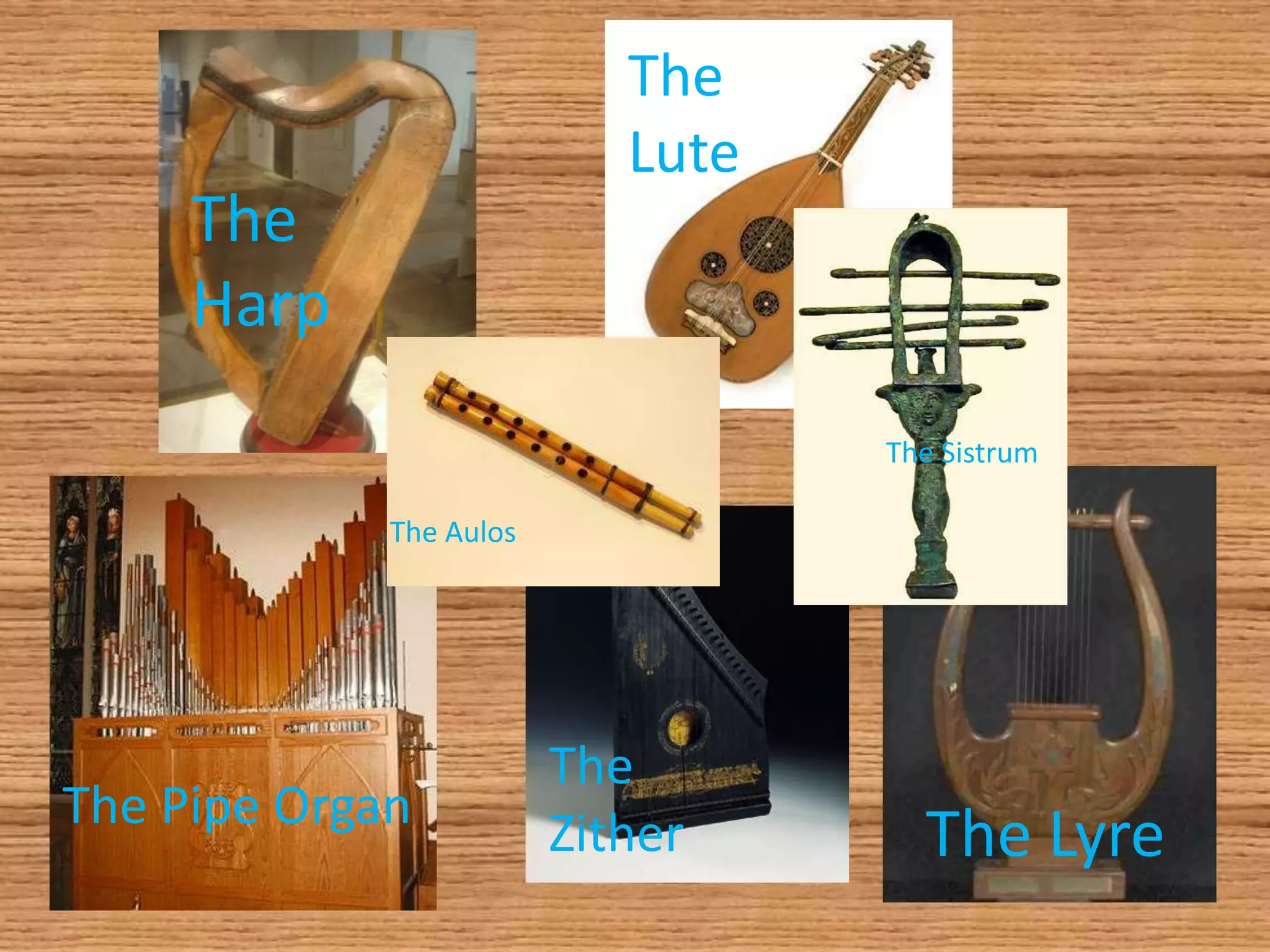
The
                            Lute
     The
     Harp
                                   The Sistrum

             The Aulos


                         The
The Pipe Organ           Zither      The Lyre
Video explicativo

•http://www.youtube.co
 m/watch?v=Nzt7oATna1
 Q

Music in the Ancient Times

  • 1.
    Music in theancient times By: Teresa Ares, Manuela Benítez, Sofía de la Cruz, Pilar Faria, María Fernández y Bea Melitón
  • 2.
    HISTORIC CONTEXT • TheAncient Age began with the invention of writing and goes until the fall of the Roman Empire at the hands of the barbarians, in the V century AD, in 476. In this era developed advanced cultures in Asia Minor (Mesopotamia, Egypt, Palestine) as well as in Greece and Rome.
  • 3.
    CHARACTERISTICS OF THEMUSIC • In Greece, the first symptoms appeared and written decipherable music are now preserved in manuscripts. It is from the Greek word from which comes the music (mousike) which includes both poetry and dance and music. They felt that the music comes from many Greek gods and Plato regarded as the basis of education.
  • 4.
    OTHER CHARACTERISTICS In the Classical antiquity the general concepts of beauty were the harmony, order and proportion. Greek music is also known through the writings of Plato, Aristotle and Pythagoras.There were also found brief fragments of papyrus alphabetical notation and stone inscriptions. In theaters, the choir and the instrumentalists were placed in front of the stage, in a space called the orchestra.
  • 5.
    THE FUNCTIONS OFTHE MUSIC • In Greece, the music had an educational character, as it was thought that it helped the social order. It was also credited an ethical value, it was thought that hearing a certain type of music influenced in the behavior. The music was closely associated with poetry and dance, especially in Greek tragedy.
  • 6.
    MUSICAL MODES The Greeks invented the musical modes: • Doric: from d to D: Finalis: Re, Tenor: La, tessitura: re • Phrygian:from e to E. Finalis: I, Tenor: C, tessitura: mi • Lydian:from f to F: Finalis: Fa, Tenor: C, tessitura: Fa • Mixolydian: from g to G: Finalis: Sol, Tenor: Re tessitura: Sol
  • 8.
    The Lute The Harp The Sistrum The Aulos The The Pipe Organ Zither The Lyre
  • 9.