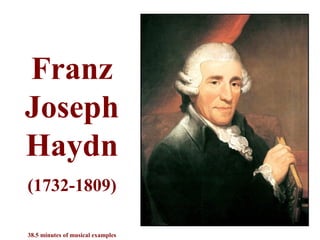
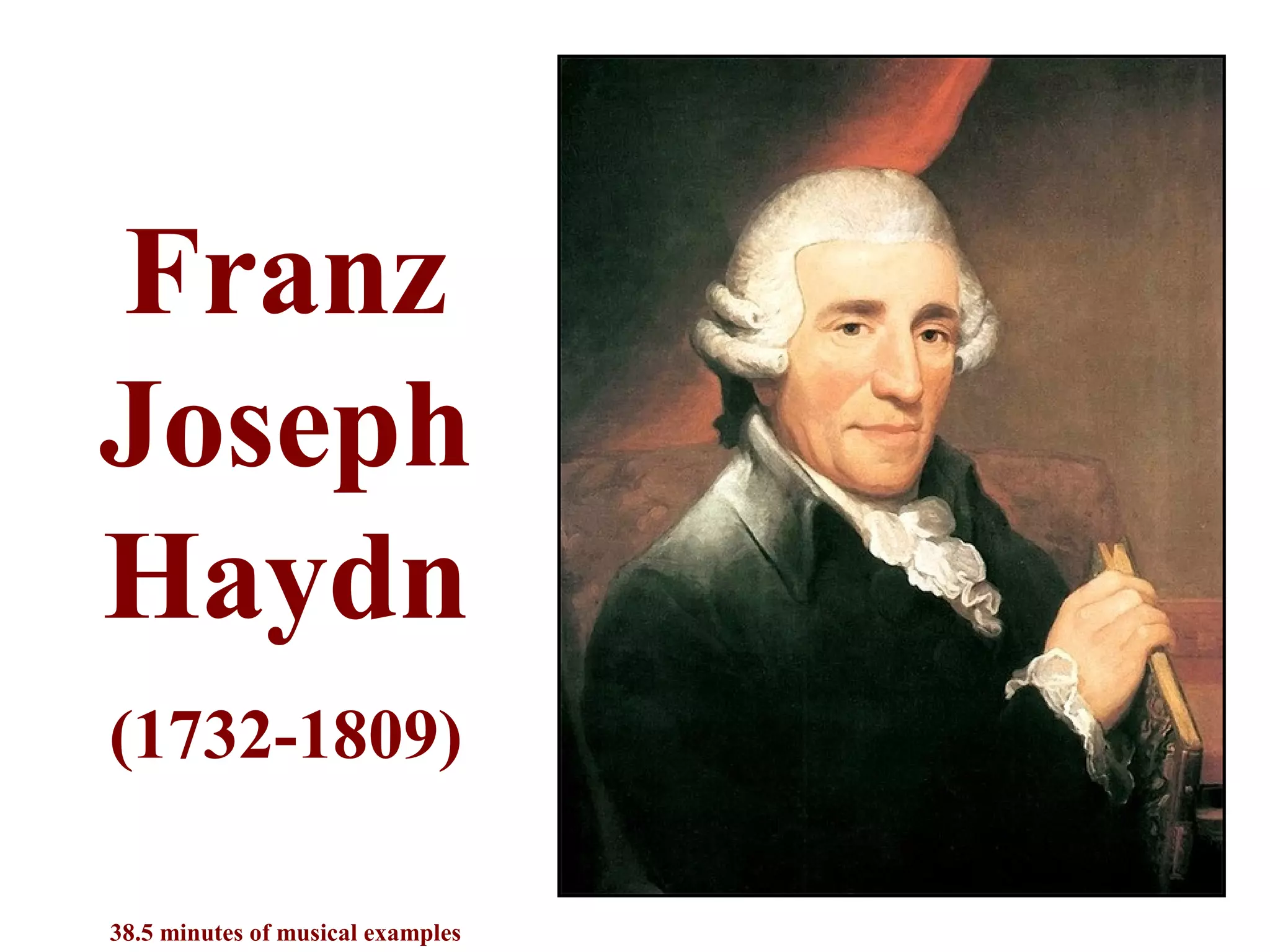
Franz
Joseph
Haydn
(1732-1809)

38.5 minutes of musical examples
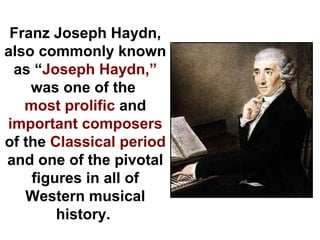
Franz Joseph Haydn,
also commonly known
 as “Joseph Haydn,”
    was one of the
   most prolific and
important composers
of the Classical period
and one of the pivotal
    figures in all of
   Western musical
        history.
Haydn is often called the "Father
of the Symphony” because of the
    extraordinary work he did in
  developing the musical form of
the Symphony, and perhaps even
more significantly, for his work in
developing the musical ensemble
   that came to be known as the
       Symphony Orchestra.
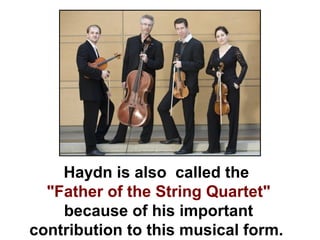
Haydn is also called the
  "Father of the String Quartet"
    because of his important
contribution to this musical form.
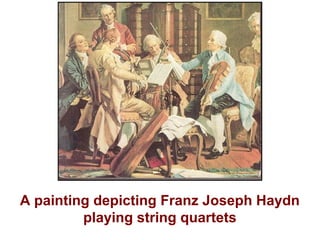
A painting depicting Franz Joseph Haydn
         playing string quartets
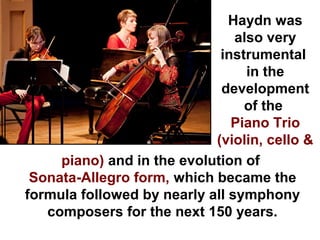
Haydn was
                                also very
                             instrumental
                                  in the
                             development
                                 of the
                               Piano Trio
                            (violin, cello &
     piano) and in the evolution of
 Sonata-Allegro form, which became the
formula followed by nearly all symphony
   composers for the next 150 years.
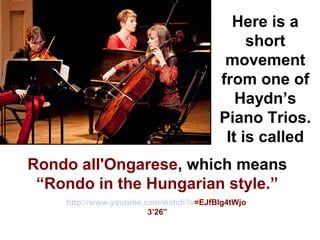
Here is a
                                            short
                                        movement
                                       from one of
                                          Haydn’s
                                       Piano Trios.
                                        It is called
Rondo all'Ongarese, which means
 “Rondo in the Hungarian style.”
    http://www.youtube.com/watch?v=EJfBIg4tWjo
                        3’26”
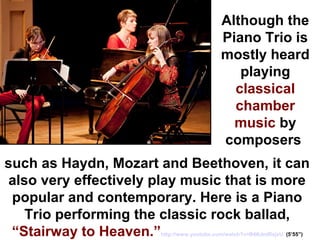
Although the
                                            Piano Trio is
                                            mostly heard
                                               playing
                                              classical
                                              chamber
                                              music by
                                            composers
such as Haydn, Mozart and Beethoven, it can
also very effectively play music that is more
 popular and contemporary. Here is a Piano
   Trio performing the classic rock ballad,
 “Stairway to Heaven.” http://www.youtube.com/watch?v=B4KdntRxjvU (5’55”)
Franz Joseph Haydn was born in
 Rohrau, Austria, a small village
 near the border of Austria and
Hungary. As a boy, his talent for
  music was apparent, but his
  parents did not have enough
money to provide him with music
  lessons, or even any sort of
           education.
There were, of course, no public
 schools in 18th century Europe,
 so if a child from a poor family
   showed talent or intellectual
  promise, it was not uncommon
 for the parents to give the child
 over to a guardian who had the
resources to help the child obtain
    an education. This is what
       happened to Haydn.
Haydn’s parents realized that there
  was no opportunity for their son to
become educated in their tiny village.
 When he was 6 years old, they gave
 him to a choirmaster named Johann
Matthias Frankh, who took the young
 boy to the town of Hainburg, 7 miles
  away. For the next 2 years, Haydn
 was trained there as a boy soprano
and sang as a soloist and in a church
  choir. From the age of 6 on, Haydn
never returned to live with his family.
Life in the Frankh household was
  not easy for Haydn, who later
       remembered the he has
    frequently hungry and was
 continuously humiliated by the
     filthy state of his clothing.
     However, he did begin his
musical training there, and soon
         was able to play both
       harpsichord and violin.
Haydn's singing impressed those
     who heard him and he was
 eventually brought to the attention
 of Georg von Reutter, the director
of music in St. Stephen's Cathedral
   in Vienna, who happened to be
  visiting Hainburg. Haydn passed
  his audition with Reutter, and in
1740 (when Haydn was 8) he moved
to Vienna, where he worked for the
next nine years as a member of the
           cathedral choir.
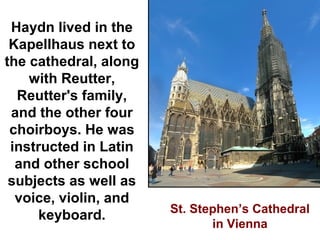
Haydn lived in the
 Kapellhaus next to
the cathedral, along
    with Reutter,
  Reutter's family,
 and the other four
 choirboys. He was
 instructed in Latin
  and other school
 subjects as well as
  voice, violin, and
                       St. Stephen’s Cathedral
      keyboard.
                              in Vienna
Reutter was of little help to Haydn
 in the areas of music theory and
composition, giving him only two
  lessons in his entire time as a
   chorister. However, since St.
Stephen's was one of the leading
musical centers in Europe, Haydn
   was able to learn a great deal
      simply by serving as a
   professional musician there.
Like Frankh before him, Reutter
  did not always bother to make
  sure Haydn was properly fed.
As Haydn later told his biographer
  Albert Christoph Dies, he was
  motivated to sing very well in
hopes of gaining more invitations
  to perform before aristocratic
  audiences—where the singers
    were usually served food.
By 1750, Haydn had matured physically
 to the point that he was no longer able
to sing high choral parts. The Empress
herself complained to Reutter about his
     singing, calling it "crowing." In
November of 1749, when Haydn was 17
   years old, he carried out one of his
many pranks - snipping off the pigtail of
a fellow chorister. This was enough for
  Reutter: Haydn was first beaten then
sent into the streets with no home to go
    to, even though it was November.
Penniless and homeless, Haydn
  spent a period of time living on the
streets in Vienna. (Some sources say
 this period of time was one day, but
 that seems unlikely.) As a teenager,
   Haydn did whatever he could to
  scrape together a living, including
     playing the violin as a street
              musician.
Eventually, Haydn was taken in by an
     older friend, Johann Michael
   Spangler, who for a few months
 shared with Haydn his family's one-
room garret apartment. (A garret is an
  attic room, usually unfinished and
unheated, with low, sloping ceilings.)
  Despite these difficult conditions,
 Haydn was able to begin his pursuit
 of a career as a freelance musician.
By the end of the winter, Haydn
  had saved up enough money to
 rent his own place in a tenement
building in Vienna. He stayed there
for the next 18 months, practicing
 on a very worn out Clavichord he
 acquired and studying music day
and night. It was during this period
   that Haydn began to seriously
    study musical composition.
When he had earned enough money, he
  purchased a printed edition of the
          keyboard sonatas of
Carl Philipp Emanuel Bach, (one of the
    sons of J.S. Bach and a leading
 composer of the very early Classical
period) which he practiced until he had
 mastered them. Here is one of those
sonatas, played in a modern recording
 on harpsichord: http://www.youtube.com/watch?v
                =yRzwv3vKCxQ (4’58”)
Unlike his successor Mozart, Haydn did
    not have immediate success as a
composer. Haydn’s success came only
   after many years of hard work. He
  composer his first symphony in 1759
        when he was 27 years old.
 (Mozart composed his first symphony
 when he was 8.) Here is a recording of
the 1st movement of Haydn’s Symphony
                 No. 1:
     http://www.youtube.com/watch?v=V19ZZCwFVAk (5’10”)
With the increase in his reputation,
 Haydn eventually was able to obtain
 aristocratic patronage, crucial for the
    career of a composer in his day.
  Countess Thun, having seen one of
Haydn's compositions, summoned him
 and engaged him as her singing and
           keyboard teacher.
In 1756, Baron Carl Josef Fürnberg
employed Haydn at his country estate,
Weinzierl, where Haydn composed his
  first string quartets. Fürnberg later
recommended Haydn to Count Morzin,
who, in 1757, became Haydn’s first full
              time employer.
The
European Patronage
     System
From the ancient world onward,
  patronage of the arts was important in
 art history. It is known in greatest detail
in reference to pre-modern medieval and
           Renaissance Europe.
 Rulers, nobles and very wealthy people
  used patronage of the arts to endorse
their political ambitions, social positions,
 and prestige. That is, patrons operated
                as sponsors.
Some patrons, such as the Medici of
  Florence, used artistic patronage to
"cleanse" wealth that was perceived as
       ill-gotten through usury.
Art patronage was especially important
  in the creation of religious art. The
   Roman Catholic Church and later
 Protestant groups sponsored art and
  architecture, as seen in churches,
  cathedrals, painting, sculpture and
              handicrafts.
While sponsorship of artists and the
 commissioning of artwork is the best-
known aspect of the patronage system,
 other disciplines also benefited from
patronage, including those who studied
    natural philosophy (pre-modern
     science), musicians, writers,
philosophers, alchemists, astrologers,
          and other scholars.
Artists and scientists as diverse and
important as Leonardo da Vinci and
 Michelangelo, Galileo and William
Shakespeare all sought and enjoyed
       the support of noble or
        ecclesiastical patrons.
Figures as late as Mozart and Beethoven
    also participated in the patronage
system to some degree; it was only with
   the rise of bourgeois and capitalist
  social forms in the 19th century that
 European culture moved away from its
      patronage system to the more
publicly-supported system of museums,
  theaters, mass audiences and mass
   consumption that is familiar in the
           contemporary world.
In 1761 when he was 29, Haydn was
  offered a position as Kapellmeister
(music director) by Prince Paul Anton
  Esterházy, head of the immensely
 wealthy Esterházy family. Haydn was
given charge of most of the Esterházy
musical establishment, which included
   an orchestra and an opera house.
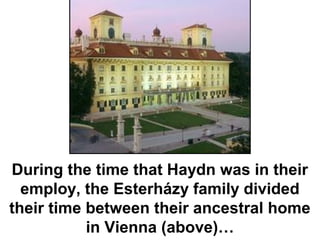
During the time that Haydn was in their
  employ, the Esterházy family divided
their time between their ancestral home
           in Vienna (above)…
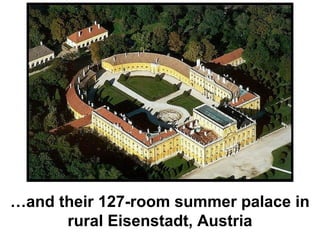
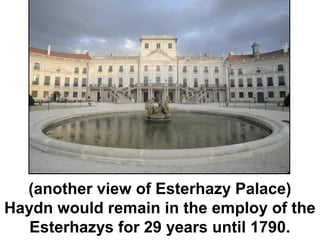
…and their 127-room summer palace in
      rural Eisenstadt, Austria
(another view of Esterhazy Palace)
Haydn would remain in the employ of the
   Esterhazys for 29 years until 1790.
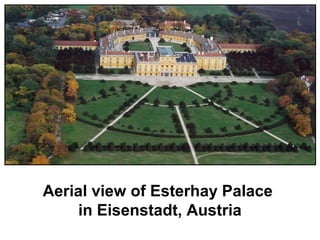
Aerial view of Esterhay Palace
    in Eisenstadt, Austria
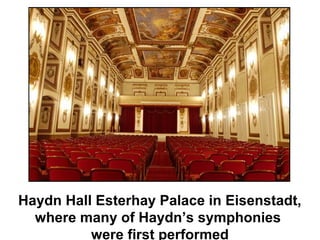
Haydn Hall Esterhay Palace in Eisenstadt,
  where many of Haydn’s symphonies
          were first performed
Beginning in 1791, when Haydn
  was 59 years old, he spent four
years in London composing music
 and experiencing life outside the
royal court. His time in London was
   the high point of his career. He
  earned nearly 24,000 gulden in a
     single year (the sum of his
combined salary of nearly 20 years
         as Kapellmeister).
While he was in London, Haydn
   composed his last 12 symphonies,
which are among his greatest and most
famous works. Many of the symphonies
      from his London period have
          nicknames, such as
   the “Surprise Symphony,” (No. 94)
   the “Military Symphony,” (No. 100)
 the “Clock Symphony,” (No. 101) and
  the “Drumroll Symphony,” (No. 103).
Haydn spent the last years of his
  life in Vienna composing only
choral/vocal works such as masses
and oratorios. Haydn passed away
    from old age when he was
            77 years old.
 Mozart’s Requiem was performed
           at his funeral.
In all, Haydn composed:
• 104 symphonies
• 83 string quartets
• 31 concertos
• 62 piano sonatas
• 40 piano trios
• 21 string trios
• 41 divertimentos
• 14 operas
• 14 masses
and hundreds of other works.
Musical Examples of Haydn’s Music

Haydn Concerto for Trumpet in Eb Major (6’49”)
http://www.youtube.com/watch?v=V7TGwEbXXP0

Wynton Marsalis: Cherokee (Jazz Song - 4'24”)
http://www.youtube.com/watch?v=9OtZrIjQuwA&NR=1

Haydn:
Oratorio: The Heavens Are Telling from The Creation (3'42”)
http://www.youtube.com/watch?v=p4lSauxyFWo

Haydn: Lord Nelson Mass
Kyrie (4'26”)
http://www.youtube.com/watch?v=Y8lps0aVEdM
String Quartet
      String Quartet - "The Lark" Op.69 No.5,
                   4th movement
                  http://www.youtube.com/watch?
v=DLTTs2kC4Yw&feature=results_video&playnext=1&list=PL5F8DC27DBC3
                              C787C

        Serenade - 3'41" (mention pizzicato)
       String Quartet in F Major, Op. 3, No. 5
                Andante Cantabile
            http://www.youtube.com/watch?v=2SiR82ZgRsU

Franz Joseph Haydn

  • 1.
  • 2.
    Franz Joseph Haydn, alsocommonly known as “Joseph Haydn,” was one of the most prolific and important composers of the Classical period and one of the pivotal figures in all of Western musical history.
  • 3.
    Haydn is oftencalled the "Father of the Symphony” because of the extraordinary work he did in developing the musical form of the Symphony, and perhaps even more significantly, for his work in developing the musical ensemble that came to be known as the Symphony Orchestra.
  • 4.
    Haydn is alsocalled the "Father of the String Quartet" because of his important contribution to this musical form.
  • 5.
    A painting depictingFranz Joseph Haydn playing string quartets
  • 6.
    Haydn was also very instrumental in the development of the Piano Trio (violin, cello & piano) and in the evolution of Sonata-Allegro form, which became the formula followed by nearly all symphony composers for the next 150 years.
  • 7.
    Here is a short movement from one of Haydn’s Piano Trios. It is called Rondo all'Ongarese, which means “Rondo in the Hungarian style.” http://www.youtube.com/watch?v=EJfBIg4tWjo 3’26”
  • 8.
    Although the Piano Trio is mostly heard playing classical chamber music by composers such as Haydn, Mozart and Beethoven, it can also very effectively play music that is more popular and contemporary. Here is a Piano Trio performing the classic rock ballad, “Stairway to Heaven.” http://www.youtube.com/watch?v=B4KdntRxjvU (5’55”)
  • 9.
    Franz Joseph Haydnwas born in Rohrau, Austria, a small village near the border of Austria and Hungary. As a boy, his talent for music was apparent, but his parents did not have enough money to provide him with music lessons, or even any sort of education.
  • 10.
    There were, ofcourse, no public schools in 18th century Europe, so if a child from a poor family showed talent or intellectual promise, it was not uncommon for the parents to give the child over to a guardian who had the resources to help the child obtain an education. This is what happened to Haydn.
  • 11.
    Haydn’s parents realizedthat there was no opportunity for their son to become educated in their tiny village. When he was 6 years old, they gave him to a choirmaster named Johann Matthias Frankh, who took the young boy to the town of Hainburg, 7 miles away. For the next 2 years, Haydn was trained there as a boy soprano and sang as a soloist and in a church choir. From the age of 6 on, Haydn never returned to live with his family.
  • 12.
    Life in theFrankh household was not easy for Haydn, who later remembered the he has frequently hungry and was continuously humiliated by the filthy state of his clothing. However, he did begin his musical training there, and soon was able to play both harpsichord and violin.
  • 13.
    Haydn's singing impressedthose who heard him and he was eventually brought to the attention of Georg von Reutter, the director of music in St. Stephen's Cathedral in Vienna, who happened to be visiting Hainburg. Haydn passed his audition with Reutter, and in 1740 (when Haydn was 8) he moved to Vienna, where he worked for the next nine years as a member of the cathedral choir.
  • 14.
    Haydn lived inthe Kapellhaus next to the cathedral, along with Reutter, Reutter's family, and the other four choirboys. He was instructed in Latin and other school subjects as well as voice, violin, and St. Stephen’s Cathedral keyboard. in Vienna
  • 15.
    Reutter was oflittle help to Haydn in the areas of music theory and composition, giving him only two lessons in his entire time as a chorister. However, since St. Stephen's was one of the leading musical centers in Europe, Haydn was able to learn a great deal simply by serving as a professional musician there.
  • 16.
    Like Frankh beforehim, Reutter did not always bother to make sure Haydn was properly fed. As Haydn later told his biographer Albert Christoph Dies, he was motivated to sing very well in hopes of gaining more invitations to perform before aristocratic audiences—where the singers were usually served food.
  • 17.
    By 1750, Haydnhad matured physically to the point that he was no longer able to sing high choral parts. The Empress herself complained to Reutter about his singing, calling it "crowing." In November of 1749, when Haydn was 17 years old, he carried out one of his many pranks - snipping off the pigtail of a fellow chorister. This was enough for Reutter: Haydn was first beaten then sent into the streets with no home to go to, even though it was November.
  • 18.
    Penniless and homeless,Haydn spent a period of time living on the streets in Vienna. (Some sources say this period of time was one day, but that seems unlikely.) As a teenager, Haydn did whatever he could to scrape together a living, including playing the violin as a street musician.
  • 19.
    Eventually, Haydn wastaken in by an older friend, Johann Michael Spangler, who for a few months shared with Haydn his family's one- room garret apartment. (A garret is an attic room, usually unfinished and unheated, with low, sloping ceilings.) Despite these difficult conditions, Haydn was able to begin his pursuit of a career as a freelance musician.
  • 20.
    By the endof the winter, Haydn had saved up enough money to rent his own place in a tenement building in Vienna. He stayed there for the next 18 months, practicing on a very worn out Clavichord he acquired and studying music day and night. It was during this period that Haydn began to seriously study musical composition.
  • 21.
    When he hadearned enough money, he purchased a printed edition of the keyboard sonatas of Carl Philipp Emanuel Bach, (one of the sons of J.S. Bach and a leading composer of the very early Classical period) which he practiced until he had mastered them. Here is one of those sonatas, played in a modern recording on harpsichord: http://www.youtube.com/watch?v =yRzwv3vKCxQ (4’58”)
  • 22.
    Unlike his successorMozart, Haydn did not have immediate success as a composer. Haydn’s success came only after many years of hard work. He composer his first symphony in 1759 when he was 27 years old. (Mozart composed his first symphony when he was 8.) Here is a recording of the 1st movement of Haydn’s Symphony No. 1: http://www.youtube.com/watch?v=V19ZZCwFVAk (5’10”)
  • 23.
    With the increasein his reputation, Haydn eventually was able to obtain aristocratic patronage, crucial for the career of a composer in his day. Countess Thun, having seen one of Haydn's compositions, summoned him and engaged him as her singing and keyboard teacher.
  • 24.
    In 1756, BaronCarl Josef Fürnberg employed Haydn at his country estate, Weinzierl, where Haydn composed his first string quartets. Fürnberg later recommended Haydn to Count Morzin, who, in 1757, became Haydn’s first full time employer.
  • 25.
  • 26.
    From the ancientworld onward, patronage of the arts was important in art history. It is known in greatest detail in reference to pre-modern medieval and Renaissance Europe. Rulers, nobles and very wealthy people used patronage of the arts to endorse their political ambitions, social positions, and prestige. That is, patrons operated as sponsors.
  • 27.
    Some patrons, suchas the Medici of Florence, used artistic patronage to "cleanse" wealth that was perceived as ill-gotten through usury. Art patronage was especially important in the creation of religious art. The Roman Catholic Church and later Protestant groups sponsored art and architecture, as seen in churches, cathedrals, painting, sculpture and handicrafts.
  • 28.
    While sponsorship ofartists and the commissioning of artwork is the best- known aspect of the patronage system, other disciplines also benefited from patronage, including those who studied natural philosophy (pre-modern science), musicians, writers, philosophers, alchemists, astrologers, and other scholars.
  • 29.
    Artists and scientistsas diverse and important as Leonardo da Vinci and Michelangelo, Galileo and William Shakespeare all sought and enjoyed the support of noble or ecclesiastical patrons.
  • 30.
    Figures as lateas Mozart and Beethoven also participated in the patronage system to some degree; it was only with the rise of bourgeois and capitalist social forms in the 19th century that European culture moved away from its patronage system to the more publicly-supported system of museums, theaters, mass audiences and mass consumption that is familiar in the contemporary world.
  • 31.
    In 1761 whenhe was 29, Haydn was offered a position as Kapellmeister (music director) by Prince Paul Anton Esterházy, head of the immensely wealthy Esterházy family. Haydn was given charge of most of the Esterházy musical establishment, which included an orchestra and an opera house.
  • 32.
    During the timethat Haydn was in their employ, the Esterházy family divided their time between their ancestral home in Vienna (above)…
  • 33.
    …and their 127-roomsummer palace in rural Eisenstadt, Austria
  • 34.
    (another view ofEsterhazy Palace) Haydn would remain in the employ of the Esterhazys for 29 years until 1790.
  • 35.
    Aerial view ofEsterhay Palace in Eisenstadt, Austria
  • 36.
    Haydn Hall EsterhayPalace in Eisenstadt, where many of Haydn’s symphonies were first performed
  • 37.
    Beginning in 1791,when Haydn was 59 years old, he spent four years in London composing music and experiencing life outside the royal court. His time in London was the high point of his career. He earned nearly 24,000 gulden in a single year (the sum of his combined salary of nearly 20 years as Kapellmeister).
  • 38.
    While he wasin London, Haydn composed his last 12 symphonies, which are among his greatest and most famous works. Many of the symphonies from his London period have nicknames, such as the “Surprise Symphony,” (No. 94) the “Military Symphony,” (No. 100) the “Clock Symphony,” (No. 101) and the “Drumroll Symphony,” (No. 103).
  • 39.
    Haydn spent thelast years of his life in Vienna composing only choral/vocal works such as masses and oratorios. Haydn passed away from old age when he was 77 years old. Mozart’s Requiem was performed at his funeral.
  • 40.
    In all, Haydncomposed: • 104 symphonies • 83 string quartets • 31 concertos • 62 piano sonatas • 40 piano trios • 21 string trios • 41 divertimentos • 14 operas • 14 masses and hundreds of other works.
  • 41.
    Musical Examples ofHaydn’s Music Haydn Concerto for Trumpet in Eb Major (6’49”) http://www.youtube.com/watch?v=V7TGwEbXXP0 Wynton Marsalis: Cherokee (Jazz Song - 4'24”) http://www.youtube.com/watch?v=9OtZrIjQuwA&NR=1 Haydn: Oratorio: The Heavens Are Telling from The Creation (3'42”) http://www.youtube.com/watch?v=p4lSauxyFWo Haydn: Lord Nelson Mass Kyrie (4'26”) http://www.youtube.com/watch?v=Y8lps0aVEdM
  • 42.
    String Quartet String Quartet - "The Lark" Op.69 No.5, 4th movement http://www.youtube.com/watch? v=DLTTs2kC4Yw&feature=results_video&playnext=1&list=PL5F8DC27DBC3 C787C Serenade - 3'41" (mention pizzicato) String Quartet in F Major, Op. 3, No. 5 Andante Cantabile http://www.youtube.com/watch?v=2SiR82ZgRsU