
CLASSICAL MUSIC CAN BE FUN! BREAK DOWN NEGATIVE PERCEPTIONS AMONGST YOUNG PEOPLE HISTORY IS RICH WITH EXAMPLES THAT CAN ENHANCE THE TEACHING AND UNDERSTANDING OF HISTORICAL EVENTS PUPILS TODAY EXPECT AND RESPOND BETTER TO VISUAL,AURAL AND KINETIC LESSONS. PASSIVE LISTENERS ARE A THING OF THE PAST!  MUSIC IS ,HOWEVER ,ONE PASSIVE ACTIVITY THAT CAN STIMULATE A BETTER UNDERSTANDING AND APPRECIATION OF AN ASPECT OF HISTORY THAT  IS BEING STUDIED. MUSIC CHOSEN MUST HAVE A DIRECT LINK TO WHAT YOU ARE STUDYING. CLASSICAL MUSIC CAN ALSO PROVIDE FOR A CALMING ATMOSPHERE IN A CLASS WHEN THEY ARE DOING INDIVIDUAL WORK IN CLASS . EG: BAROQUE MUSIC – BACH AND VIVALDI MOZART IS ALSO VERY GOOD TO USE AS BACKGROUND MUSIC.
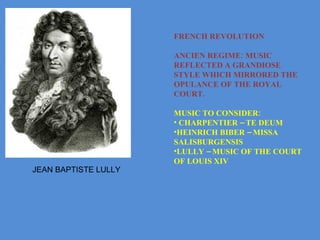
FRENCH REVOLUTION ANCIEN REGIME: MUSIC REFLECTED A GRANDIOSE STYLE WHICH MIRRORED THE OPULANCE OF THE ROYAL COURT. MUSIC TO CONSIDER:  CHARPENTIER – TE DEUM HEINRICH BIBER – MISSA SALISBURGENSIS LULLY – MUSIC OF THE COURT OF LOUIS XIV JEAN BAPTISTE LULLY
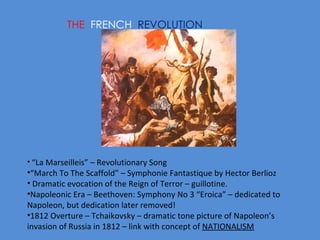
THE  FRENCH  REVOLUTION “ La Marseilleis” – Revolutionary Song “ March To The Scaffold” – Symphonie Fantastique by Hector Berlioz Dramatic evocation of the Reign of Terror – guillotine. Napoleonic Era – Beethoven: Symphony No 3 “Eroica” – dedicated to  Napoleon, but dedication later removed! 1812 Overture – Tchaikovsky – dramatic tone picture of Napoleon’s invasion of Russia in 1812 – link with concept of  NATIONALISM
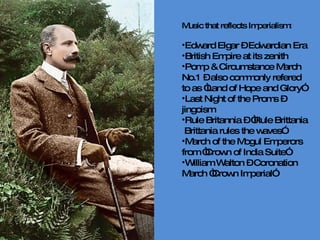
Music that reflects Imperialism: Edward Elgar – Edwardian Era British Empire at its zenith Pomp & Circumstance March No.1 – also commonly refered to as “Land of Hope and Glory” Last Night of the Proms – jingoism Rule Britannia – “Rule Brittania  Brittania rules the waves” March of the Mogul Emperors from “Crown of India Suite” William Walton – Coronation March “Crown Imperial”
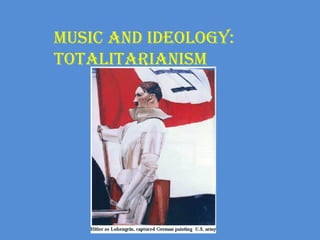
music and ideology: totalitarianism
“ … only one thing can redeem you (Jews) from the burden of your curse: the redemption of  Ahasverus  - total destruction” RICHARD WAGNER: German composer in the 19 th  Century According to National Socialism there were THREE master composers that represented good Germanic music: Ludwig van Beethoven Richard Wagner Anton Bruckner Beethoven – possessing “ heroic German spirit” Wagner – virulent Anti-Semite – Hitler’s favourite composer! Bruckner – genuine love of the “great German Fatherland”
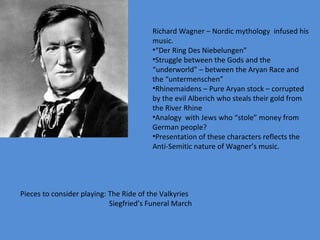
Richard Wagner – Nordic mythology  infused his music. “ Der Ring Des Niebelungen” Struggle between the Gods and the “underworld” – between the Aryan Race and the “untermenschen” Rhinemaidens – Pure Aryan stock – corrupted by the evil Alberich who steals their gold from the River Rhine Analogy  with Jews who “stole” money from German people? Presentation of these characters reflects the Anti-Semitic nature of Wagner’s music.  Pieces to consider playing: The Ride of the Valkyries Siegfried’s Funeral March
“ The Valkyries” – note the Viking/Nordic influences! Alberich – anti-Semitic features “ Alberich, the greedy merchant Jew, who becomes the power-crazed goblin-demon lusting after Aryan maidens”  (Richard Wagner)
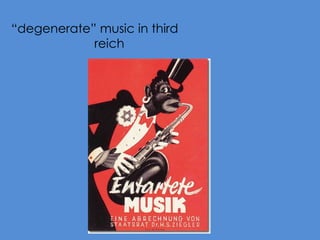
“ degenerate” music in third reich
The words “JEWISH”  “DEGENERATE” and “BOLSHEVIK”  were commonly used to describe any art or music not acceptable to the Third Reich. Reich Music Chamber (Reichsmusikkammer) required a registry of all German musicians. Music of composers such as Mendelssohn, Schoenberg and Mahler were banned from  being played or performed. Jazz was also considered as degenerate  as its origins were traced back to Afro-American roots. Examples: Gustav Mahler – 1 st  Movement from Symphony No.6 – listen to the rhythm  - Nazi jackboot march! – prophetic vision from a composer who died in 1911!
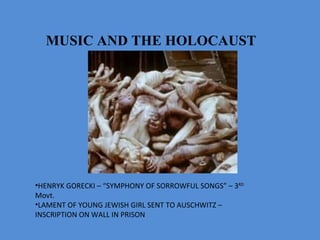
MUSIC AND THE HOLOCAUST   HENRYK GORECKI – “SYMPHONY OF SORROWFUL SONGS” – 3 RD   Movt. LAMENT OF YOUNG JEWISH GIRL SENT TO AUSCHWITZ – INSCRIPTION ON WALL IN PRISON
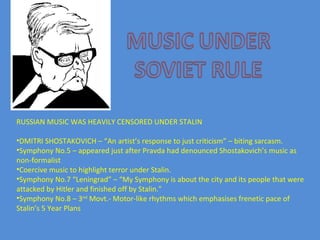
RUSSIAN MUSIC WAS HEAVILY CENSORED UNDER STALIN DMITRI SHOSTAKOVICH – “An artist’s response to just criticism” – biting sarcasm.  Symphony No.5 – appeared just after Pravda had denounced Shostakovich’s music as non-formalist Coercive music to highlight terror under Stalin. Symphony No.7 “Leningrad” – “My Symphony is about the city and its people that were attacked by Hitler and finished off by Stalin.”  Symphony No.8 – 3 nd  Movt.- Motor-like rhythms which emphasises frenetic pace of Stalin’s 5 Year Plans
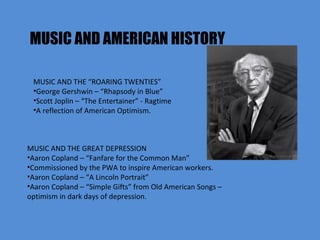
MUSIC AND AMERICAN HISTORY MUSIC AND THE “ROARING TWENTIES” George Gershwin – “Rhapsody in Blue” Scott Joplin – “The Entertainer” - Ragtime A reflection of American Optimism. MUSIC AND THE GREAT DEPRESSION Aaron Copland – “Fanfare for the Common Man” Commissioned by the PWA to inspire American workers. Aaron Copland – “A Lincoln Portrait” Aaron Copland – “Simple Gifts” from Old American Songs – optimism in dark days of depression.
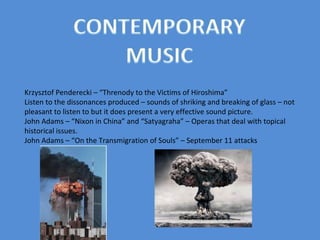
Krzysztof Penderecki – “Threnody to the Victims of Hiroshima” Listen to the dissonances produced – sounds of shriking and breaking of glass – not pleasant to listen to but it does present a very effective sound picture. John Adams – “Nixon in China” and “Satyagraha” – Operas that deal with topical historical issues. John Adams – “On the Transmigration of Souls” – September 11 attacks
WHERE TO ACQUIRE MUSIC? LOOK & LISTEN MUSICA MUSIC DOWNLOADS WWW.AMAZON.CO.UK WWW.ARKIVMUSIK.COM NAXOS – INEXPENSIVE MUSIC LABEL

Classical Music & History Teaching

  • 1.
  • 2.
    CLASSICAL MUSIC CANBE FUN! BREAK DOWN NEGATIVE PERCEPTIONS AMONGST YOUNG PEOPLE HISTORY IS RICH WITH EXAMPLES THAT CAN ENHANCE THE TEACHING AND UNDERSTANDING OF HISTORICAL EVENTS PUPILS TODAY EXPECT AND RESPOND BETTER TO VISUAL,AURAL AND KINETIC LESSONS. PASSIVE LISTENERS ARE A THING OF THE PAST! MUSIC IS ,HOWEVER ,ONE PASSIVE ACTIVITY THAT CAN STIMULATE A BETTER UNDERSTANDING AND APPRECIATION OF AN ASPECT OF HISTORY THAT IS BEING STUDIED. MUSIC CHOSEN MUST HAVE A DIRECT LINK TO WHAT YOU ARE STUDYING. CLASSICAL MUSIC CAN ALSO PROVIDE FOR A CALMING ATMOSPHERE IN A CLASS WHEN THEY ARE DOING INDIVIDUAL WORK IN CLASS . EG: BAROQUE MUSIC – BACH AND VIVALDI MOZART IS ALSO VERY GOOD TO USE AS BACKGROUND MUSIC.
  • 3.
    FRENCH REVOLUTION ANCIENREGIME: MUSIC REFLECTED A GRANDIOSE STYLE WHICH MIRRORED THE OPULANCE OF THE ROYAL COURT. MUSIC TO CONSIDER: CHARPENTIER – TE DEUM HEINRICH BIBER – MISSA SALISBURGENSIS LULLY – MUSIC OF THE COURT OF LOUIS XIV JEAN BAPTISTE LULLY
  • 4.
    THE FRENCH REVOLUTION “ La Marseilleis” – Revolutionary Song “ March To The Scaffold” – Symphonie Fantastique by Hector Berlioz Dramatic evocation of the Reign of Terror – guillotine. Napoleonic Era – Beethoven: Symphony No 3 “Eroica” – dedicated to Napoleon, but dedication later removed! 1812 Overture – Tchaikovsky – dramatic tone picture of Napoleon’s invasion of Russia in 1812 – link with concept of NATIONALISM
  • 5.
    Music that reflectsImperialism: Edward Elgar – Edwardian Era British Empire at its zenith Pomp & Circumstance March No.1 – also commonly refered to as “Land of Hope and Glory” Last Night of the Proms – jingoism Rule Britannia – “Rule Brittania Brittania rules the waves” March of the Mogul Emperors from “Crown of India Suite” William Walton – Coronation March “Crown Imperial”
  • 6.
    music and ideology:totalitarianism
  • 7.
    “ … onlyone thing can redeem you (Jews) from the burden of your curse: the redemption of Ahasverus - total destruction” RICHARD WAGNER: German composer in the 19 th Century According to National Socialism there were THREE master composers that represented good Germanic music: Ludwig van Beethoven Richard Wagner Anton Bruckner Beethoven – possessing “ heroic German spirit” Wagner – virulent Anti-Semite – Hitler’s favourite composer! Bruckner – genuine love of the “great German Fatherland”
  • 8.
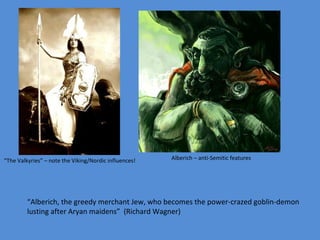
    Richard Wagner –Nordic mythology infused his music. “ Der Ring Des Niebelungen” Struggle between the Gods and the “underworld” – between the Aryan Race and the “untermenschen” Rhinemaidens – Pure Aryan stock – corrupted by the evil Alberich who steals their gold from the River Rhine Analogy with Jews who “stole” money from German people? Presentation of these characters reflects the Anti-Semitic nature of Wagner’s music. Pieces to consider playing: The Ride of the Valkyries Siegfried’s Funeral March
  • 9.
    “ The Valkyries”– note the Viking/Nordic influences! Alberich – anti-Semitic features “ Alberich, the greedy merchant Jew, who becomes the power-crazed goblin-demon lusting after Aryan maidens” (Richard Wagner)
  • 10.
  • 11.
    The words “JEWISH” “DEGENERATE” and “BOLSHEVIK” were commonly used to describe any art or music not acceptable to the Third Reich. Reich Music Chamber (Reichsmusikkammer) required a registry of all German musicians. Music of composers such as Mendelssohn, Schoenberg and Mahler were banned from being played or performed. Jazz was also considered as degenerate as its origins were traced back to Afro-American roots. Examples: Gustav Mahler – 1 st Movement from Symphony No.6 – listen to the rhythm - Nazi jackboot march! – prophetic vision from a composer who died in 1911!
  • 12.
    MUSIC AND THEHOLOCAUST HENRYK GORECKI – “SYMPHONY OF SORROWFUL SONGS” – 3 RD Movt. LAMENT OF YOUNG JEWISH GIRL SENT TO AUSCHWITZ – INSCRIPTION ON WALL IN PRISON
  • 13.
    RUSSIAN MUSIC WASHEAVILY CENSORED UNDER STALIN DMITRI SHOSTAKOVICH – “An artist’s response to just criticism” – biting sarcasm. Symphony No.5 – appeared just after Pravda had denounced Shostakovich’s music as non-formalist Coercive music to highlight terror under Stalin. Symphony No.7 “Leningrad” – “My Symphony is about the city and its people that were attacked by Hitler and finished off by Stalin.” Symphony No.8 – 3 nd Movt.- Motor-like rhythms which emphasises frenetic pace of Stalin’s 5 Year Plans
  • 14.
    MUSIC AND AMERICANHISTORY MUSIC AND THE “ROARING TWENTIES” George Gershwin – “Rhapsody in Blue” Scott Joplin – “The Entertainer” - Ragtime A reflection of American Optimism. MUSIC AND THE GREAT DEPRESSION Aaron Copland – “Fanfare for the Common Man” Commissioned by the PWA to inspire American workers. Aaron Copland – “A Lincoln Portrait” Aaron Copland – “Simple Gifts” from Old American Songs – optimism in dark days of depression.
  • 15.
    Krzysztof Penderecki –“Threnody to the Victims of Hiroshima” Listen to the dissonances produced – sounds of shriking and breaking of glass – not pleasant to listen to but it does present a very effective sound picture. John Adams – “Nixon in China” and “Satyagraha” – Operas that deal with topical historical issues. John Adams – “On the Transmigration of Souls” – September 11 attacks
  • 16.
    WHERE TO ACQUIREMUSIC? LOOK & LISTEN MUSICA MUSIC DOWNLOADS WWW.AMAZON.CO.UK WWW.ARKIVMUSIK.COM NAXOS – INEXPENSIVE MUSIC LABEL