Medieval   Period 800-1400
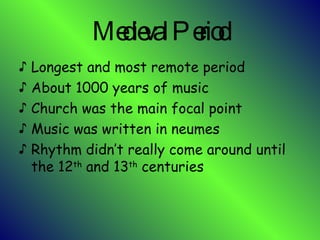
Medieval   Period Longest and most remote period About 1000 years of music Church was the main focal point Music was written in neumes Rhythm didn’t really come around until the 12 th  and 13 th  centuries
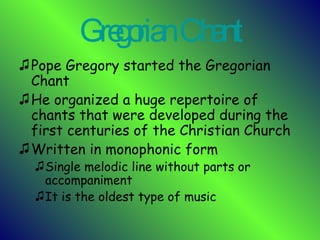
Gregorian Chant Pope Gregory started the Gregorian Chant He organized a huge repertoire of chants that were developed during the first centuries of the Christian Church Written in monophonic form Single melodic line without parts or accompaniment It is the oldest type of music
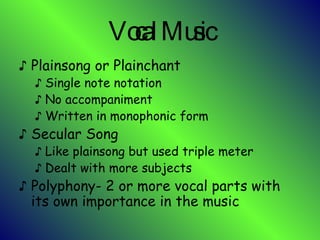
Vocal Music Plainsong or Plainchant Single note notation No accompaniment Written in monophonic form Secular Song Like plainsong but used triple meter Dealt with more subjects Polyphony- 2 or more vocal parts with its own importance in the music
Vocal Music Motet Has specific musical guidelines Plainsong sung by tenor Above it two other parts were sung in faster moving notes Hocket Form of polyphony Rests interrupted the melody line that altered between two voices Madrigal Written in two vocal parts First appeared in Italy
Instrumental Bowed Vielles- forerunner of viol Rebec- pear shaped Plucked Lute- most important  Winds Recorders Trumpets Horns Shawm
Instrumental Organs Organette-small and able to move around Positive- very important, first organ that polyphonic music was composed for, couldn’t be moved 1300’s larger organs started to appear in churches Some had more than 2,500 or more pipes
Instrumental Percussion Drums- used mainly for military and dance Kettledrums Cylindrical drum Bells  Cymbals
Instrumental Five ways instruments were used Vocal music was occasionally played entirely by instruments Used to double one or more vocal parts Textless music was probably intended for instruments Instrumental music was mainly for dances Substitutes for voices in music with text
Composers Guillaume Dufay- (1400-1474)  very calm and smoothing music, helped move Medieval music into the Renaissance period Phillipe de Vitry- (1291-1361)  one of the main composers of the motet Guillaume de  Machaut -  (1300-1377)  known for  Mass of Notre Dame

Medieval Period

  • 1.
    Medieval Period 800-1400
  • 2.
    Medieval Period Longest and most remote period About 1000 years of music Church was the main focal point Music was written in neumes Rhythm didn’t really come around until the 12 th and 13 th centuries
  • 3.
    Gregorian Chant PopeGregory started the Gregorian Chant He organized a huge repertoire of chants that were developed during the first centuries of the Christian Church Written in monophonic form Single melodic line without parts or accompaniment It is the oldest type of music
  • 4.
    Vocal Music Plainsongor Plainchant Single note notation No accompaniment Written in monophonic form Secular Song Like plainsong but used triple meter Dealt with more subjects Polyphony- 2 or more vocal parts with its own importance in the music
  • 5.
    Vocal Music MotetHas specific musical guidelines Plainsong sung by tenor Above it two other parts were sung in faster moving notes Hocket Form of polyphony Rests interrupted the melody line that altered between two voices Madrigal Written in two vocal parts First appeared in Italy
  • 6.
    Instrumental Bowed Vielles-forerunner of viol Rebec- pear shaped Plucked Lute- most important Winds Recorders Trumpets Horns Shawm
  • 7.
    Instrumental Organs Organette-smalland able to move around Positive- very important, first organ that polyphonic music was composed for, couldn’t be moved 1300’s larger organs started to appear in churches Some had more than 2,500 or more pipes
  • 8.
    Instrumental Percussion Drums-used mainly for military and dance Kettledrums Cylindrical drum Bells Cymbals
  • 9.
    Instrumental Five waysinstruments were used Vocal music was occasionally played entirely by instruments Used to double one or more vocal parts Textless music was probably intended for instruments Instrumental music was mainly for dances Substitutes for voices in music with text
  • 10.
    Composers Guillaume Dufay-(1400-1474) very calm and smoothing music, helped move Medieval music into the Renaissance period Phillipe de Vitry- (1291-1361) one of the main composers of the motet Guillaume de Machaut - (1300-1377) known for Mass of Notre Dame