History of Western Music
Mohar A. Bantas
Thean Jay Raffinan
Objectives:
At the end of the lesson, student must
be able to:
1. determine the distinct musical
characteristics of each period of
Western music
2. describe the characteristics of
Western music.
3. Identify the history of western
Presentation title 2
• The first three periods of Western Music History are classified as Medieval, Renaissance, and
Baroque. Each period has its distinctive characteristics, historical and cultural background.
A type of music from the Medieval Era is Gregorian Chant, which was mainly used in the early
Christian church.
Music during the Renaissance Period became an important leisure activity. Members of the
upper class were expected to have received musical training. Imitative polyphony is the
distinctive characteristic of Renaissance music.
• The Baroque Period is characterized by grand and elaborate ornamentation of
sculptures, theaters, arts and music. The music genres which flourished during
the Baroque Period were the Concerto, the Fugue, the Oratorio, and the
Chorale.
Music evolved alongside with man’s constant quest for growth and
development.
Music of Medieval Period
At around 500 to 1400 A.D, the traditions of Western
music can be traced back to the social and religious
developments that took place in Europe during the Middle
Ages,. Because of the domination of the early Catholic
Church during this period, sacred music was the most
prevalent. Beginning with Gregorian Chant, sacred music
slowly developed into a polyphonic music called organum
performed at Notre Dame in Paris by the twelfth century.
Presentation title 6
Music had been a part of
the world's civilizations for
hundreds of years before
the Middle Ages. Primitive
cave drawings, stories
from the Bible, and
Egyptian hieroglyphs all
attest to the fact that
people had created
instruments and had been
making music for
centuries.
Presentation title
Because of the slow
emergence of European
society from the dark
ages, dozens of "mini
kingdoms" were
established all over
Europe, each presided
over by a lord who had
fought for and won the
land. Mostly through
superstitious fear, early
Catholic leaders were
able to claim absolute
power over these feudal
lords.
The word music derives
from the ancient Greek
muses, the nine goddesses
of art and science. The first
study of music as an art
form dates from around
500 B.C., when Pythagoras
experimented with
acoustics and the
mathematical relationships
of tones. In doing so,
Pythagoras and others
established the Greek
modes: scales comprised
of whole tones and half
steps.
The early Christian church derived their music from
existing Jewish and Byzantine religious chant. Like
all music in the Western world up to this time,
plainchant was monophonic: that is, it comprised a
single melody without any harmonic support or
accompaniment. The many hundreds of melodies
are defined by one of the eight Greek modes, some
of which sound very different from the major/minor
scales our ears are used to today.
The melodies are free in tempo and seem to
wander melodically, dictated by the Latin liturgical
texts to which they are set. These chants were
embellished and developed along many different
lines in various regions and according to various
sects. It was believed that Pope Gregory I
(reigned 590-604) codified them during the sixth
century, establishing uniform usage throughout the
Western Catholic Church, and his name has been
applied to this music, and it is known as Gregorian
Chant.
Presentation title 9
Gregorian Chant
Notre Dame and the Ars Antiqua
10
• During the ninth century, music theorists in the Church began
experimenting with the idea of singing two melodic lines
simultaneously at parallel intervals, usually at the fourth, fifth, or
octave. By the eleventh century, one, two (and much later, even
three) added melodic lines were no longer moving in parallel
motion, but contrary to each other, sometimes even crossing. The
original chant melody was then sung very slowly on long held notes
called the tenor (from the Latin tenere, meaning “to hold”) and the
added melodies wove about and embellished the resulting drone.
Presentation title 11
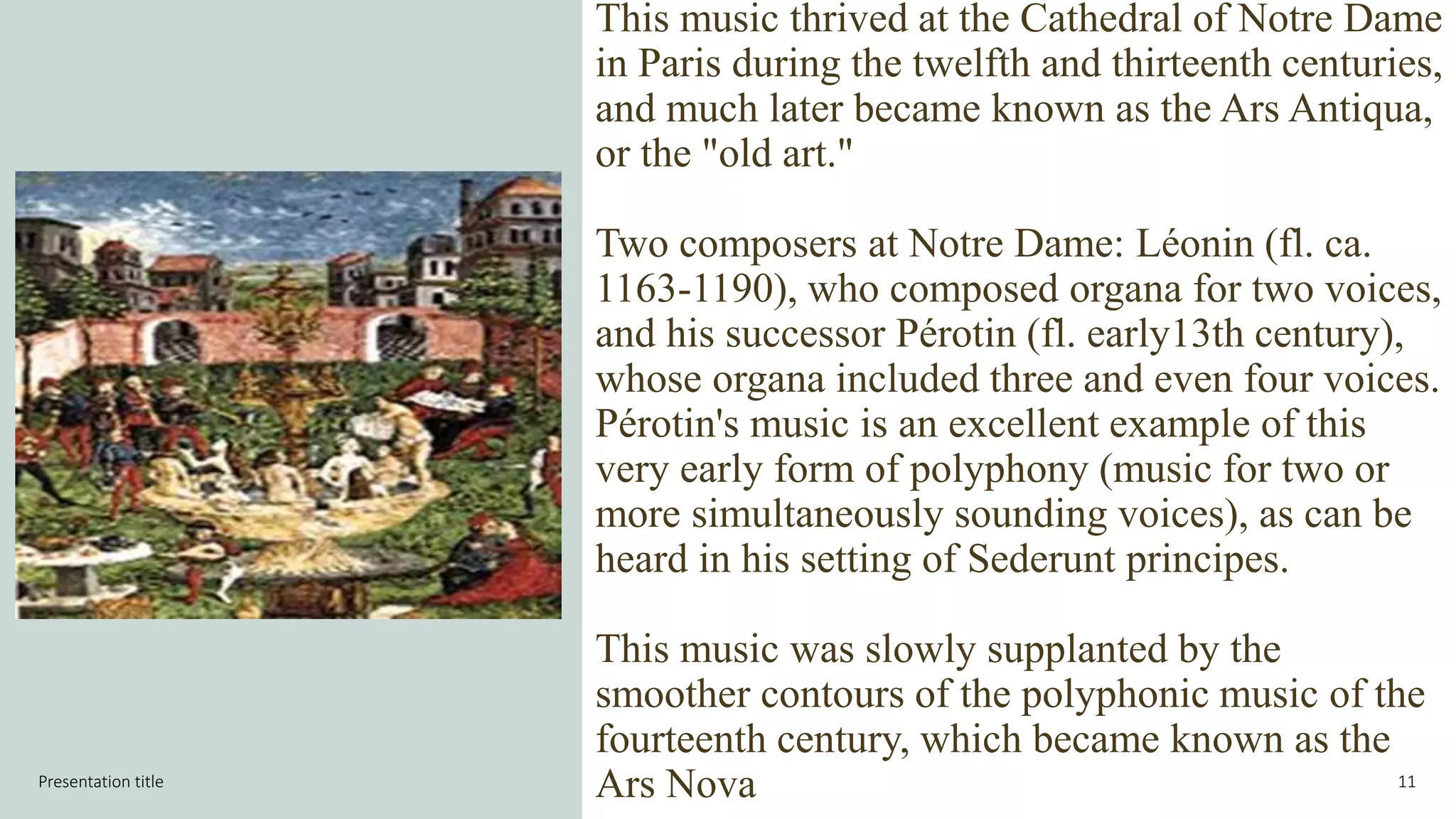
This music thrived at the Cathedral of Notre Dame
in Paris during the twelfth and thirteenth centuries,
and much later became known as the Ars Antiqua,
or the "old art."
Two composers at Notre Dame: Léonin (fl. ca.
1163-1190), who composed organa for two voices,
and his successor Pérotin (fl. early13th century),
whose organa included three and even four voices.
Pérotin's music is an excellent example of this
very early form of polyphony (music for two or
more simultaneously sounding voices), as can be
heard in his setting of Sederunt principes.
This music was slowly supplanted by the
smoother contours of the polyphonic music of the
fourteenth century, which became known as the
Ars Nova
The Trouvères and the Troubadours
One of the most famous of these trouvères known to us (the great bulk of these
melodies are by the ubiquitous "Anonymous") is Adam de la Halle (ca. 1237-
ca. 1286). Adam is the composer of one of the oldest secular music theater
pieces known in the West, Le Jeu de Robin et Marion. He has also been
identified as the writer of a good many songs and verses, some of which take
the form of the motet, a piece in which two or more different verses (usually of
greatly contrasted content and meter) are fit together simultaneously, without
regard to what we now consider conventional harmonies. Such a piece is De ma
dame vent by this famous trouvère.
Presentation title 12
Famous Composer of
the Medieval Period:
Presentation title 13
Guillaume de Machaut and
the Ars Nova
Born: Champagne region
of France, ca. 1300
Died: Rheims, 1377
Machaut's career as a poet and composer took flight when he joined the
court of John, Duke of Luxembourg, and King of Bohemia around 1323,
serving as the king's secretary until that monarch's death in battle at
Crécy in 1346.
His poetry was known throughout Europe and his admirers included
Geoffrey Chaucer. Machaut is probably best remembered for being the
first composer to create a polyphonic setting of the Ordinary of the
Catholic Mass (the Ordinary being those parts of the liturgy that do not
change, including the Kyrie, Gloria, Credo, Sanctus, and Agnus Dei). This
new polyphonic style caught on with composers and paved the way for
the flowering of choral music in the Renaissance.
14
These songs epitomize the courtly love found in the previous
century's vocal art, and capture all the joy, hope, pain and
heartbreak of courtly romance. The secular motets of the Middle
Ages eventually evolved into the great outpouring of lovesick
lyricism embodied in the music of the great Renaissance
Madrigalists.
Guillaume de Machaut is the first composer in Western music
history who seemed to be conscious of his artistic achievements
and of his place in history. To assure that place, Machaut saw to
it that his work was painstakingly copied and artfully illustrated,
the first known example of a composer thus preserving his own
work for posterity
Presentation title 15
Adam de la Halle was also known as
Adam le Bossu (Adam the
Hunchback). He was the son of a well –
known citizen of Arras, Henri de la Halle.
He received his education at the
Cistercian Abbey of Vaucelles, near
Cambral. Adam was destined for the
church, but he eventually married. His
patrons were Robert II, Count of Artois,
and Charles of Anjou, brother of Louis
IX.
Presentation title 16
Adam was one of the oldest secular
composers whose literary and musical
works include chansons and poetic debates.
He was a French-born trouvére, poet and
musician, whose literary and musical works
include chansons and jeux-partis (poetic
debates) in the style of the trouveres,
polyphonic rondel and motets in the style of
early liturgical polyphony. His musical play,
―Jeu de Robin et Marion‖ was considered
the earliest surviving secular French play
with music
Presentation title 17
His work includes :
1. Le Jeu de Robin et de Marion
2. La Chanson du roi de Sicile
Presentation title 18
History-of-Western-Music-reporting.pptx

History-of-Western-Music-reporting.pptx

  • 1.
    History of WesternMusic Mohar A. Bantas Thean Jay Raffinan
  • 2.
    Objectives: At the endof the lesson, student must be able to: 1. determine the distinct musical characteristics of each period of Western music 2. describe the characteristics of Western music. 3. Identify the history of western Presentation title 2
  • 4.
    • The firstthree periods of Western Music History are classified as Medieval, Renaissance, and Baroque. Each period has its distinctive characteristics, historical and cultural background. A type of music from the Medieval Era is Gregorian Chant, which was mainly used in the early Christian church. Music during the Renaissance Period became an important leisure activity. Members of the upper class were expected to have received musical training. Imitative polyphony is the distinctive characteristic of Renaissance music.
  • 5.
    • The BaroquePeriod is characterized by grand and elaborate ornamentation of sculptures, theaters, arts and music. The music genres which flourished during the Baroque Period were the Concerto, the Fugue, the Oratorio, and the Chorale. Music evolved alongside with man’s constant quest for growth and development.
  • 6.
    Music of MedievalPeriod At around 500 to 1400 A.D, the traditions of Western music can be traced back to the social and religious developments that took place in Europe during the Middle Ages,. Because of the domination of the early Catholic Church during this period, sacred music was the most prevalent. Beginning with Gregorian Chant, sacred music slowly developed into a polyphonic music called organum performed at Notre Dame in Paris by the twelfth century. Presentation title 6
  • 7.
    Music had beena part of the world's civilizations for hundreds of years before the Middle Ages. Primitive cave drawings, stories from the Bible, and Egyptian hieroglyphs all attest to the fact that people had created instruments and had been making music for centuries. Presentation title
  • 8.
    Because of theslow emergence of European society from the dark ages, dozens of "mini kingdoms" were established all over Europe, each presided over by a lord who had fought for and won the land. Mostly through superstitious fear, early Catholic leaders were able to claim absolute power over these feudal lords. The word music derives from the ancient Greek muses, the nine goddesses of art and science. The first study of music as an art form dates from around 500 B.C., when Pythagoras experimented with acoustics and the mathematical relationships of tones. In doing so, Pythagoras and others established the Greek modes: scales comprised of whole tones and half steps.
  • 9.
    The early Christianchurch derived their music from existing Jewish and Byzantine religious chant. Like all music in the Western world up to this time, plainchant was monophonic: that is, it comprised a single melody without any harmonic support or accompaniment. The many hundreds of melodies are defined by one of the eight Greek modes, some of which sound very different from the major/minor scales our ears are used to today. The melodies are free in tempo and seem to wander melodically, dictated by the Latin liturgical texts to which they are set. These chants were embellished and developed along many different lines in various regions and according to various sects. It was believed that Pope Gregory I (reigned 590-604) codified them during the sixth century, establishing uniform usage throughout the Western Catholic Church, and his name has been applied to this music, and it is known as Gregorian Chant. Presentation title 9 Gregorian Chant
  • 10.
    Notre Dame andthe Ars Antiqua 10 • During the ninth century, music theorists in the Church began experimenting with the idea of singing two melodic lines simultaneously at parallel intervals, usually at the fourth, fifth, or octave. By the eleventh century, one, two (and much later, even three) added melodic lines were no longer moving in parallel motion, but contrary to each other, sometimes even crossing. The original chant melody was then sung very slowly on long held notes called the tenor (from the Latin tenere, meaning “to hold”) and the added melodies wove about and embellished the resulting drone.
  • 11.
    Presentation title 11 Thismusic thrived at the Cathedral of Notre Dame in Paris during the twelfth and thirteenth centuries, and much later became known as the Ars Antiqua, or the "old art." Two composers at Notre Dame: Léonin (fl. ca. 1163-1190), who composed organa for two voices, and his successor Pérotin (fl. early13th century), whose organa included three and even four voices. Pérotin's music is an excellent example of this very early form of polyphony (music for two or more simultaneously sounding voices), as can be heard in his setting of Sederunt principes. This music was slowly supplanted by the smoother contours of the polyphonic music of the fourteenth century, which became known as the Ars Nova
  • 12.
    The Trouvères andthe Troubadours One of the most famous of these trouvères known to us (the great bulk of these melodies are by the ubiquitous "Anonymous") is Adam de la Halle (ca. 1237- ca. 1286). Adam is the composer of one of the oldest secular music theater pieces known in the West, Le Jeu de Robin et Marion. He has also been identified as the writer of a good many songs and verses, some of which take the form of the motet, a piece in which two or more different verses (usually of greatly contrasted content and meter) are fit together simultaneously, without regard to what we now consider conventional harmonies. Such a piece is De ma dame vent by this famous trouvère. Presentation title 12
  • 13.
    Famous Composer of theMedieval Period: Presentation title 13 Guillaume de Machaut and the Ars Nova Born: Champagne region of France, ca. 1300 Died: Rheims, 1377
  • 14.
    Machaut's career asa poet and composer took flight when he joined the court of John, Duke of Luxembourg, and King of Bohemia around 1323, serving as the king's secretary until that monarch's death in battle at Crécy in 1346. His poetry was known throughout Europe and his admirers included Geoffrey Chaucer. Machaut is probably best remembered for being the first composer to create a polyphonic setting of the Ordinary of the Catholic Mass (the Ordinary being those parts of the liturgy that do not change, including the Kyrie, Gloria, Credo, Sanctus, and Agnus Dei). This new polyphonic style caught on with composers and paved the way for the flowering of choral music in the Renaissance. 14
  • 15.
    These songs epitomizethe courtly love found in the previous century's vocal art, and capture all the joy, hope, pain and heartbreak of courtly romance. The secular motets of the Middle Ages eventually evolved into the great outpouring of lovesick lyricism embodied in the music of the great Renaissance Madrigalists. Guillaume de Machaut is the first composer in Western music history who seemed to be conscious of his artistic achievements and of his place in history. To assure that place, Machaut saw to it that his work was painstakingly copied and artfully illustrated, the first known example of a composer thus preserving his own work for posterity Presentation title 15
  • 16.
    Adam de laHalle was also known as Adam le Bossu (Adam the Hunchback). He was the son of a well – known citizen of Arras, Henri de la Halle. He received his education at the Cistercian Abbey of Vaucelles, near Cambral. Adam was destined for the church, but he eventually married. His patrons were Robert II, Count of Artois, and Charles of Anjou, brother of Louis IX. Presentation title 16
  • 17.
    Adam was oneof the oldest secular composers whose literary and musical works include chansons and poetic debates. He was a French-born trouvére, poet and musician, whose literary and musical works include chansons and jeux-partis (poetic debates) in the style of the trouveres, polyphonic rondel and motets in the style of early liturgical polyphony. His musical play, ―Jeu de Robin et Marion‖ was considered the earliest surviving secular French play with music Presentation title 17
  • 18.
    His work includes: 1. Le Jeu de Robin et de Marion 2. La Chanson du roi de Sicile Presentation title 18