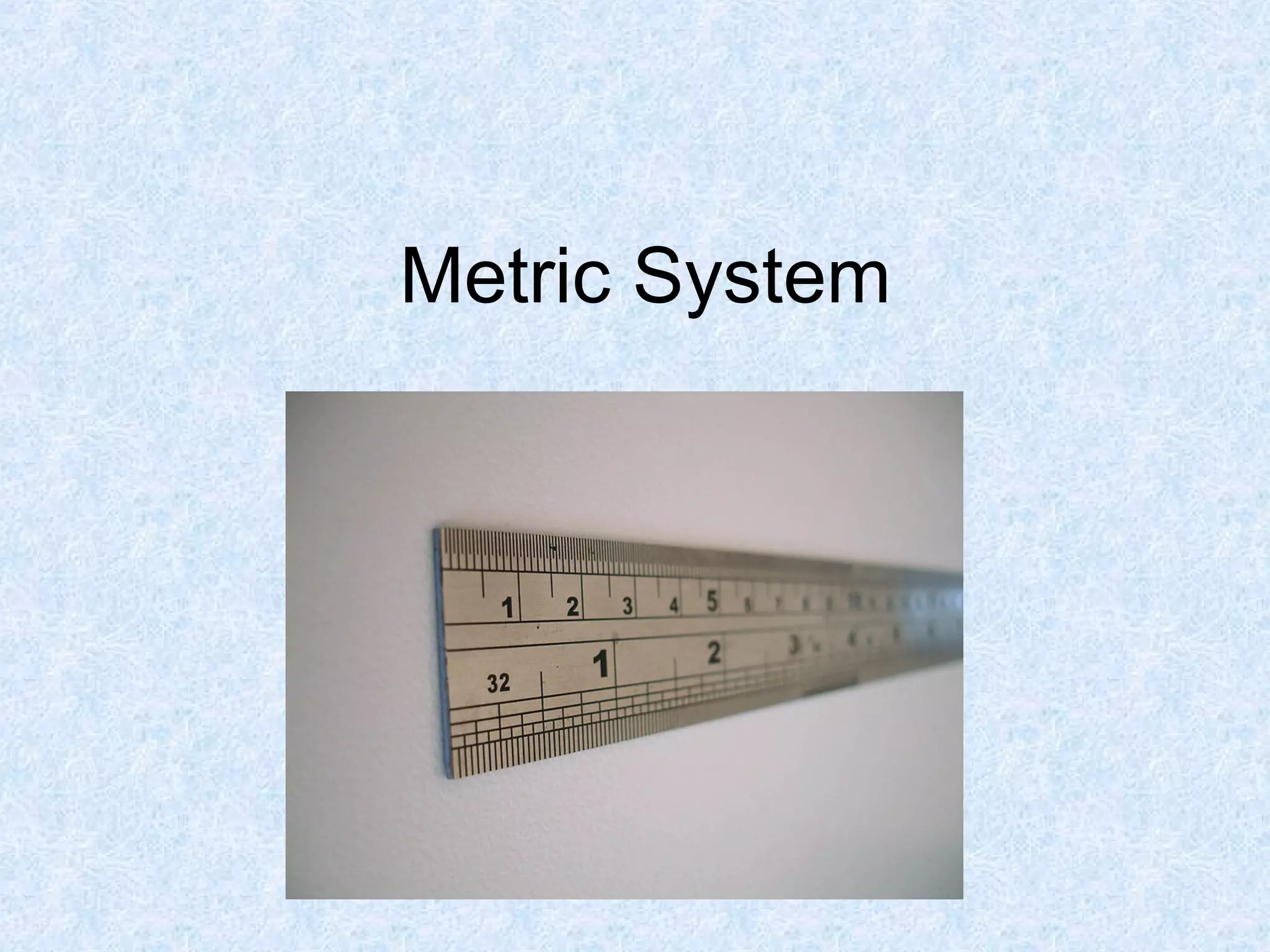
Metric System
First measurements
• Based on the human body
Example: foot, hand
• Standards evolved but not constant
• Lack of common units a problem
Solution
• 1791 French Academy of Sciences
devised metric system
– Metric means measure in French
– Based on unit of 10
• Easy to make conversions between units
– Widely adapted
• 1960 renamed International System of
Units (SI)
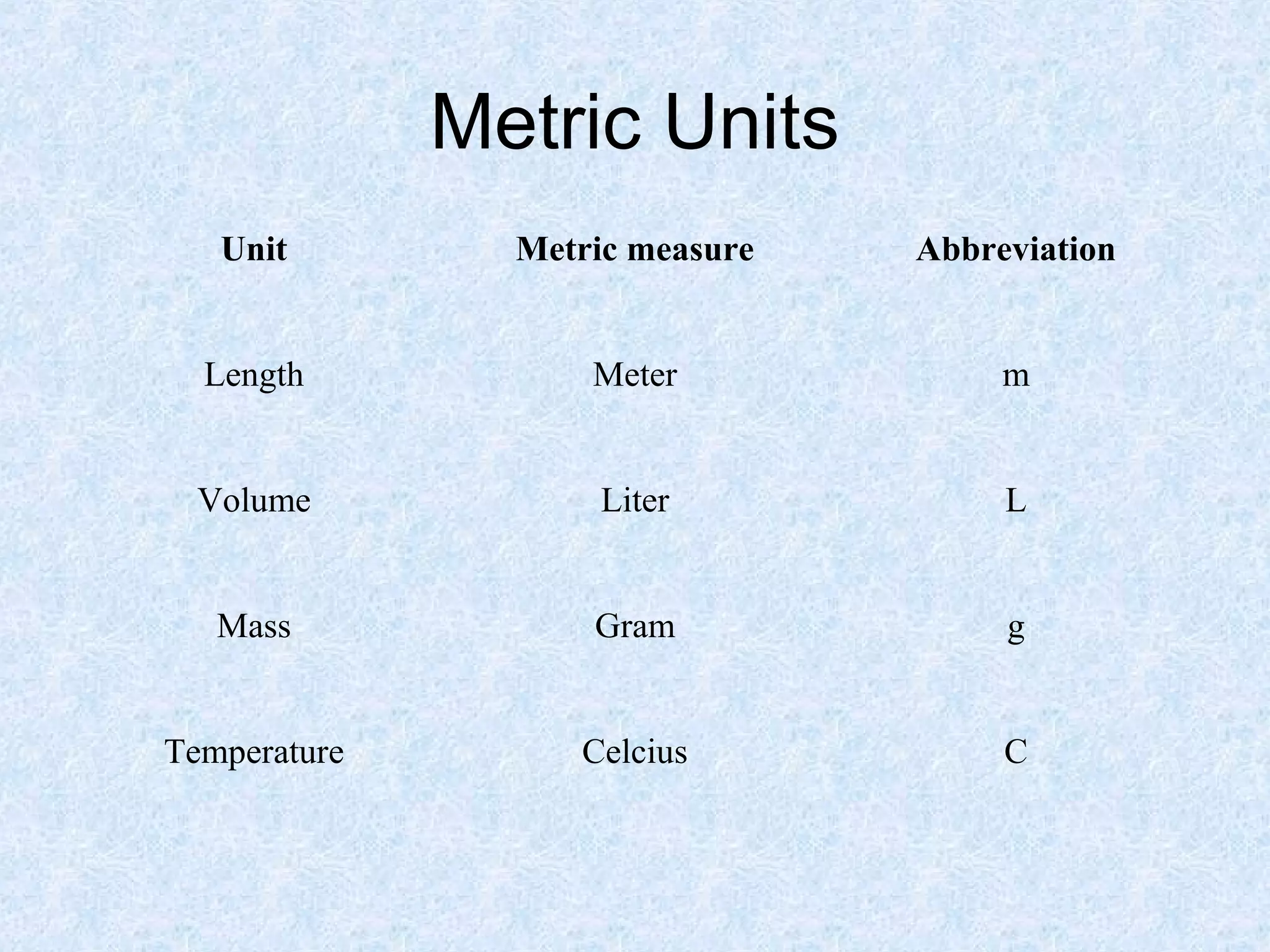
Metric Units
Unit Metric measure Abbreviation
Length Meter m
Volume Liter L
Mass Gram g
Temperature Celcius C
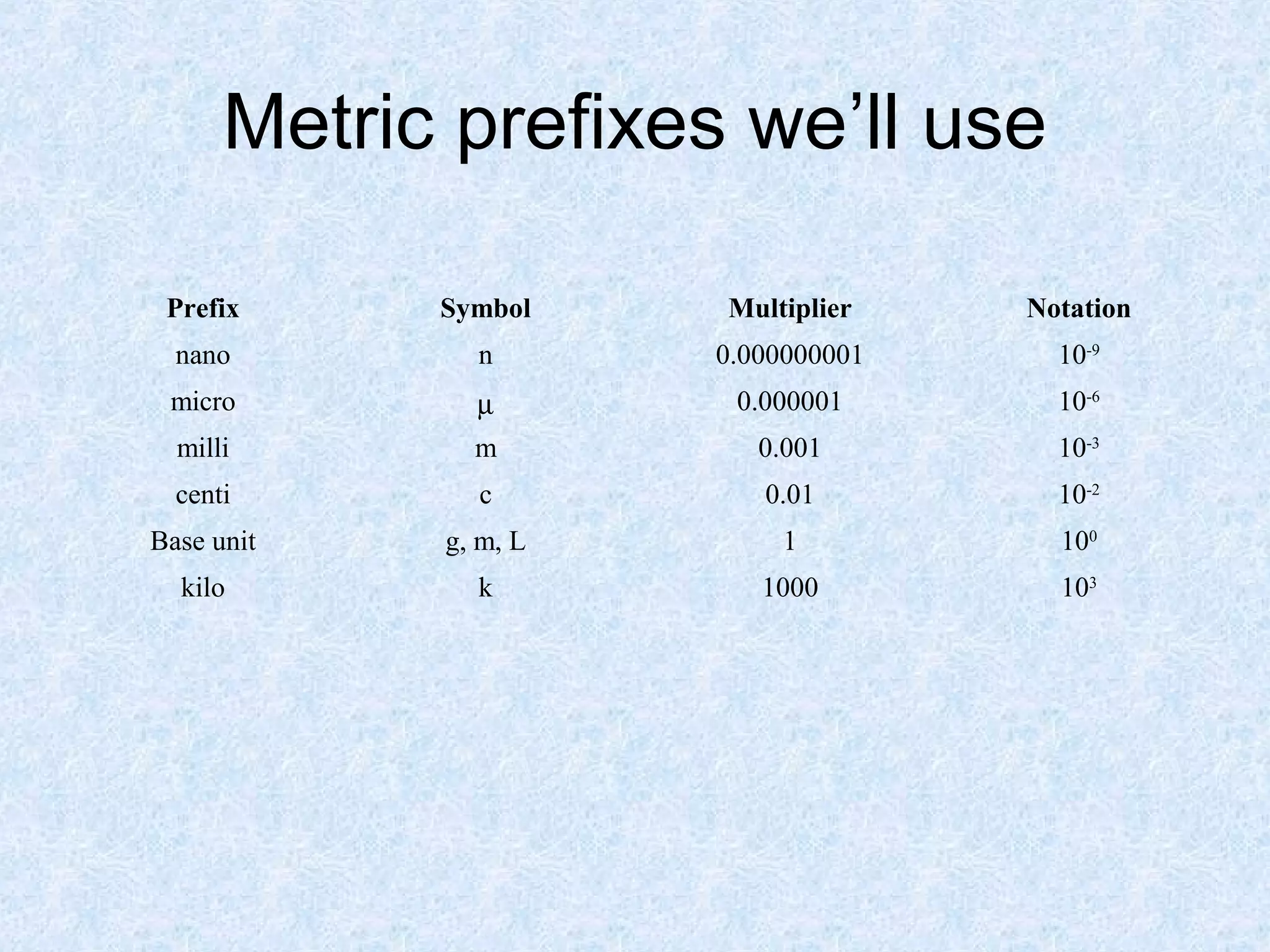
Metric prefixes we’ll use
Prefix Symbol Multiplier Notation
nano n 0.000000001 10-9
micro µ 0.000001 10-6
milli m 0.001 10-3
centi c 0.01 10-2
Base unit g, m, L 1 100
kilo k 1000 103
Metric System
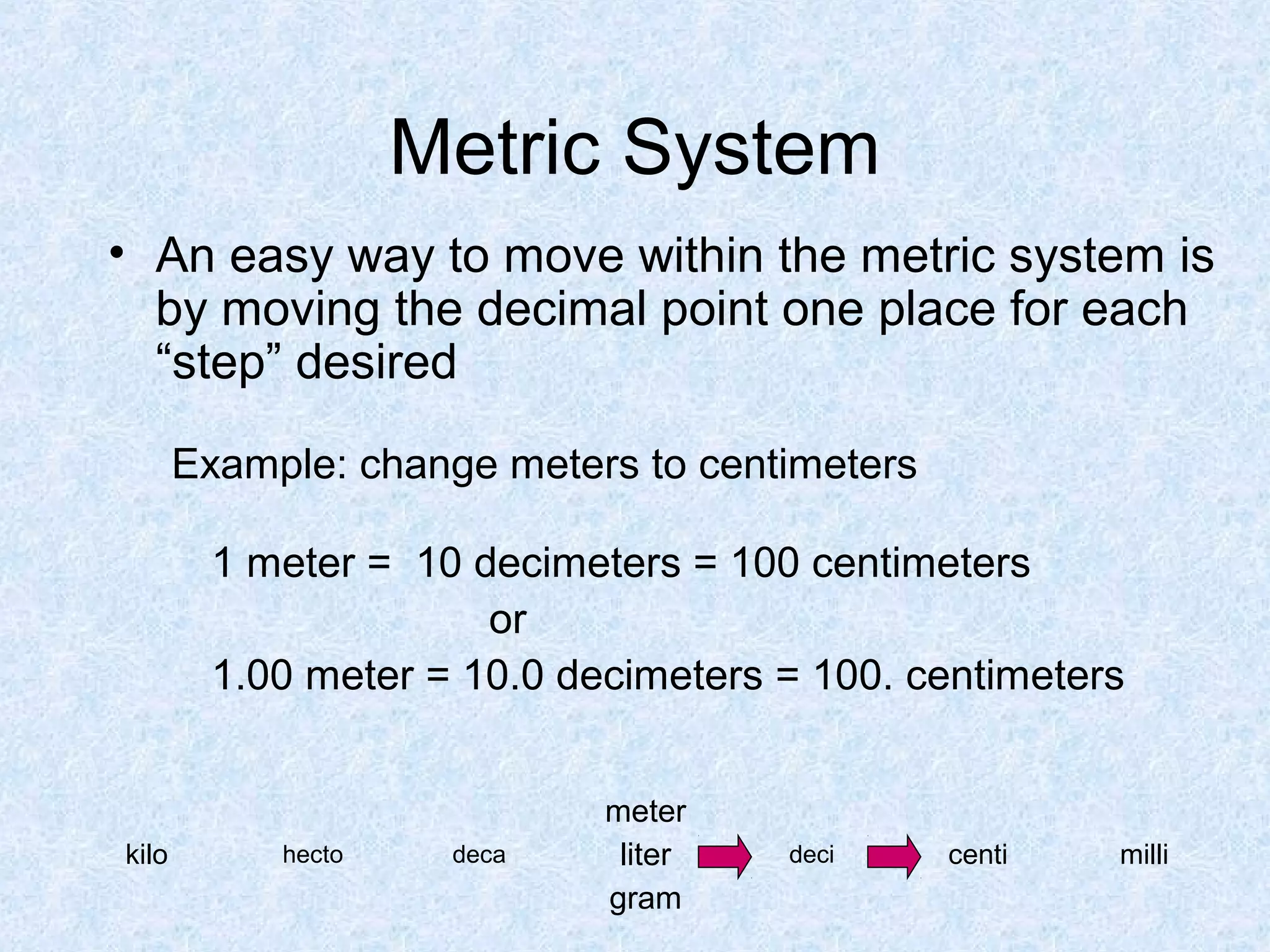
• An easy way to move within the metric system is
by moving the decimal point one place for each
“step” desired
Example: change meters to centimeters
1 meter = 10 decimeters = 100 centimeters
or
1.00 meter = 10.0 decimeters = 100. centimeters
kilo hecto deca
meter
liter
gram
deci centi milli
Metric System
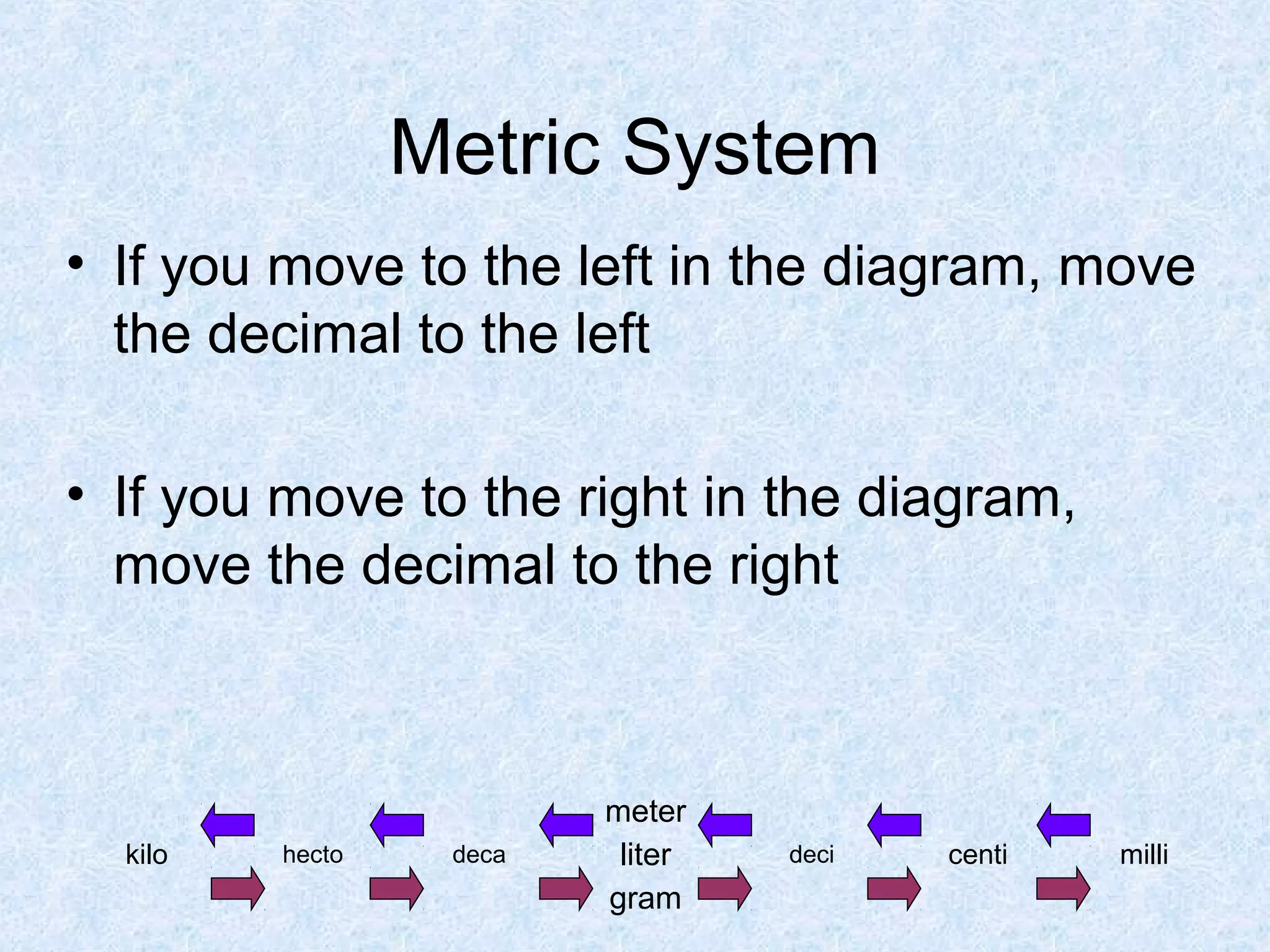
• If you move to the left in the diagram, move
the decimal to the left
• If you move to the right in the diagram,
move the decimal to the right
kilo hecto deca
meter
liter
gram
deci centi milli
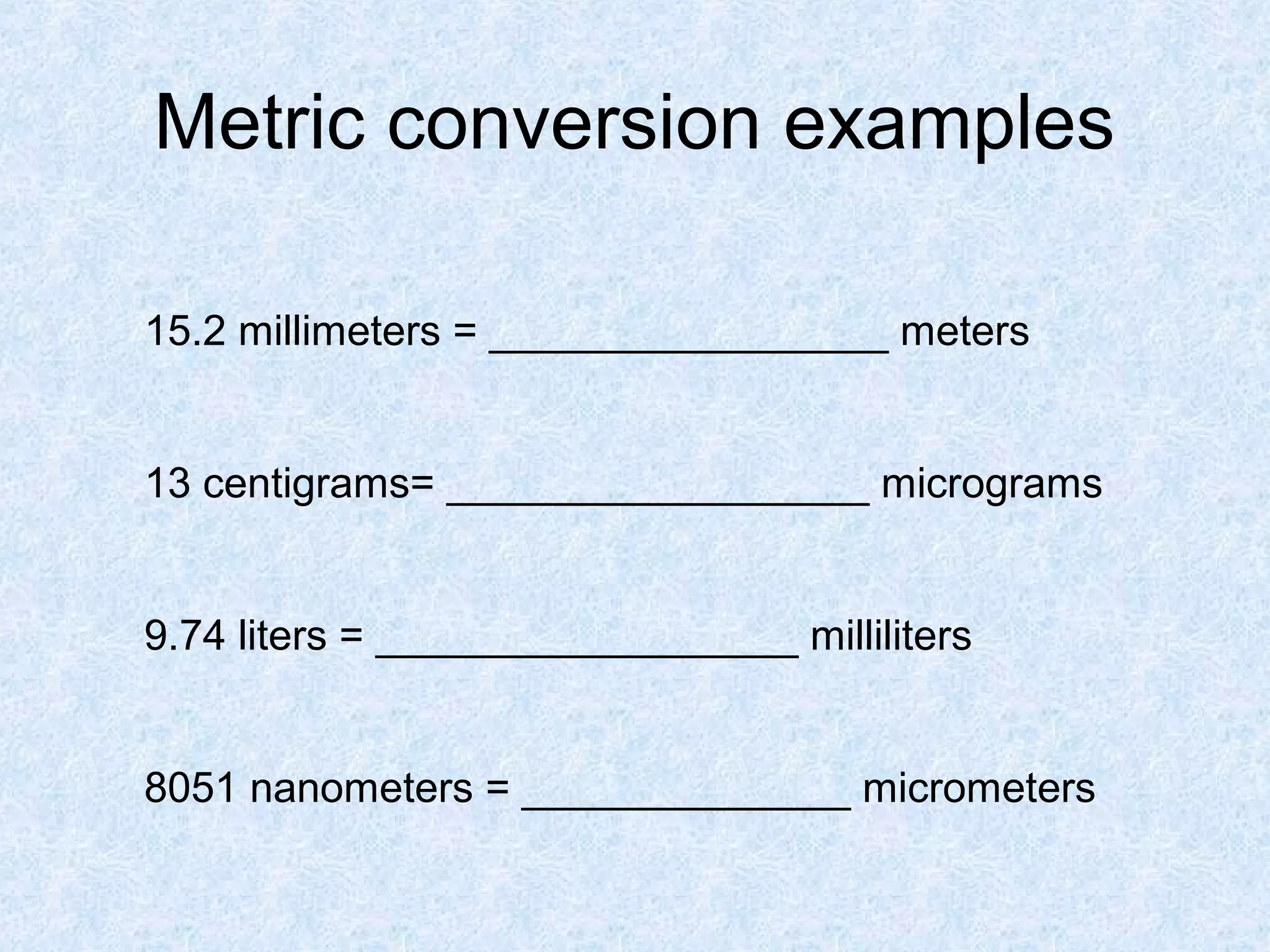
Metric conversion examples
15.2 millimeters = _________________ meters
13 centigrams= __________________ micrograms
9.74 liters = __________________ milliliters
8051 nanometers = ______________ micrometers
Scientific Notation
• You can work backwards from scientific
notation
– The number in the superscript position of the
10 tells you how many places to move the
decimal and in what direction
1 x 103
= 1000
4.7 x 105
= 470000
3.2 x 10-3
= 0.0032
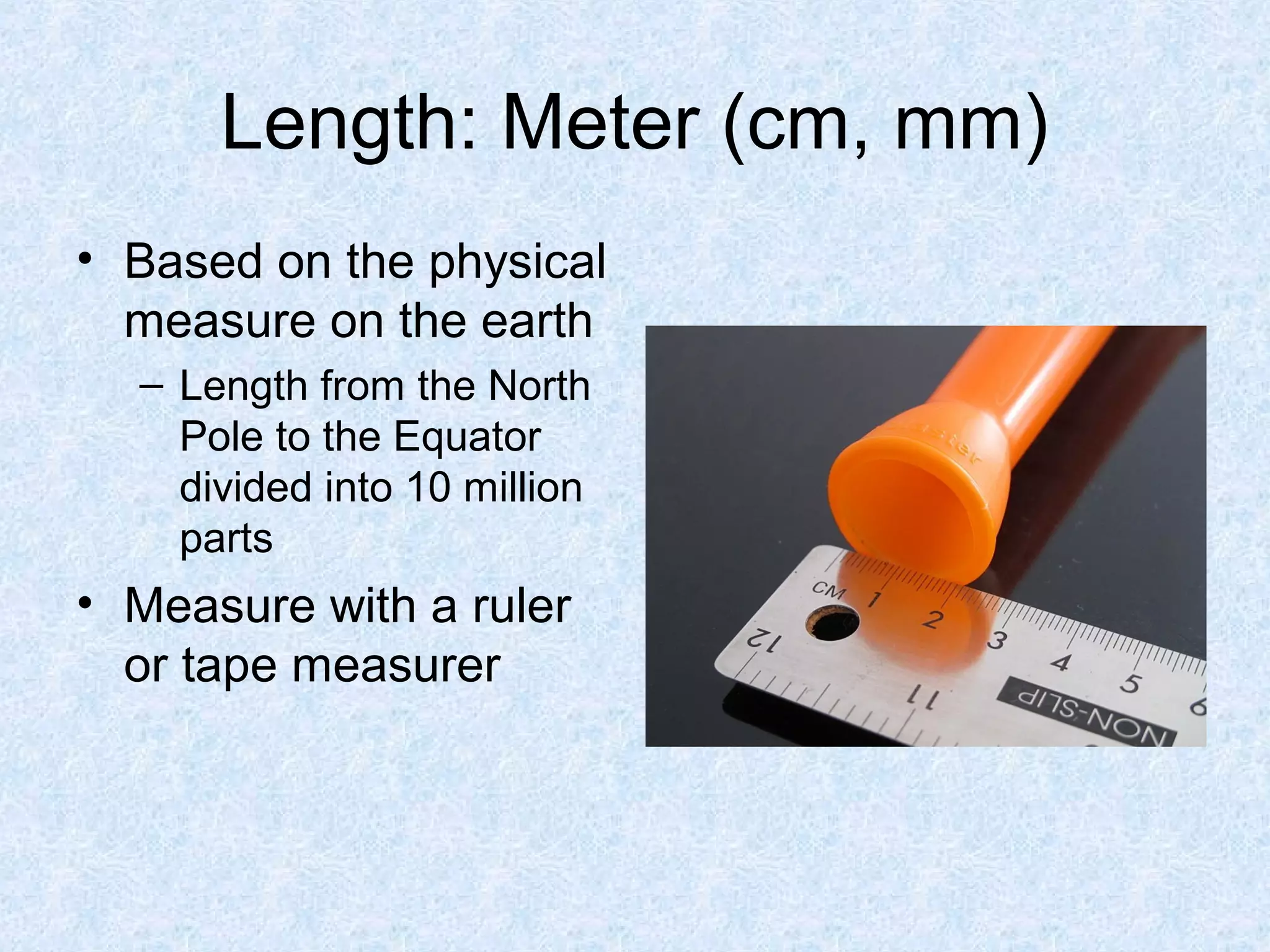
Length: Meter (cm, mm)
• Based on the physical
measure on the earth
– Length from the North
Pole to the Equator
divided into 10 million
parts
• Measure with a ruler
or tape measurer
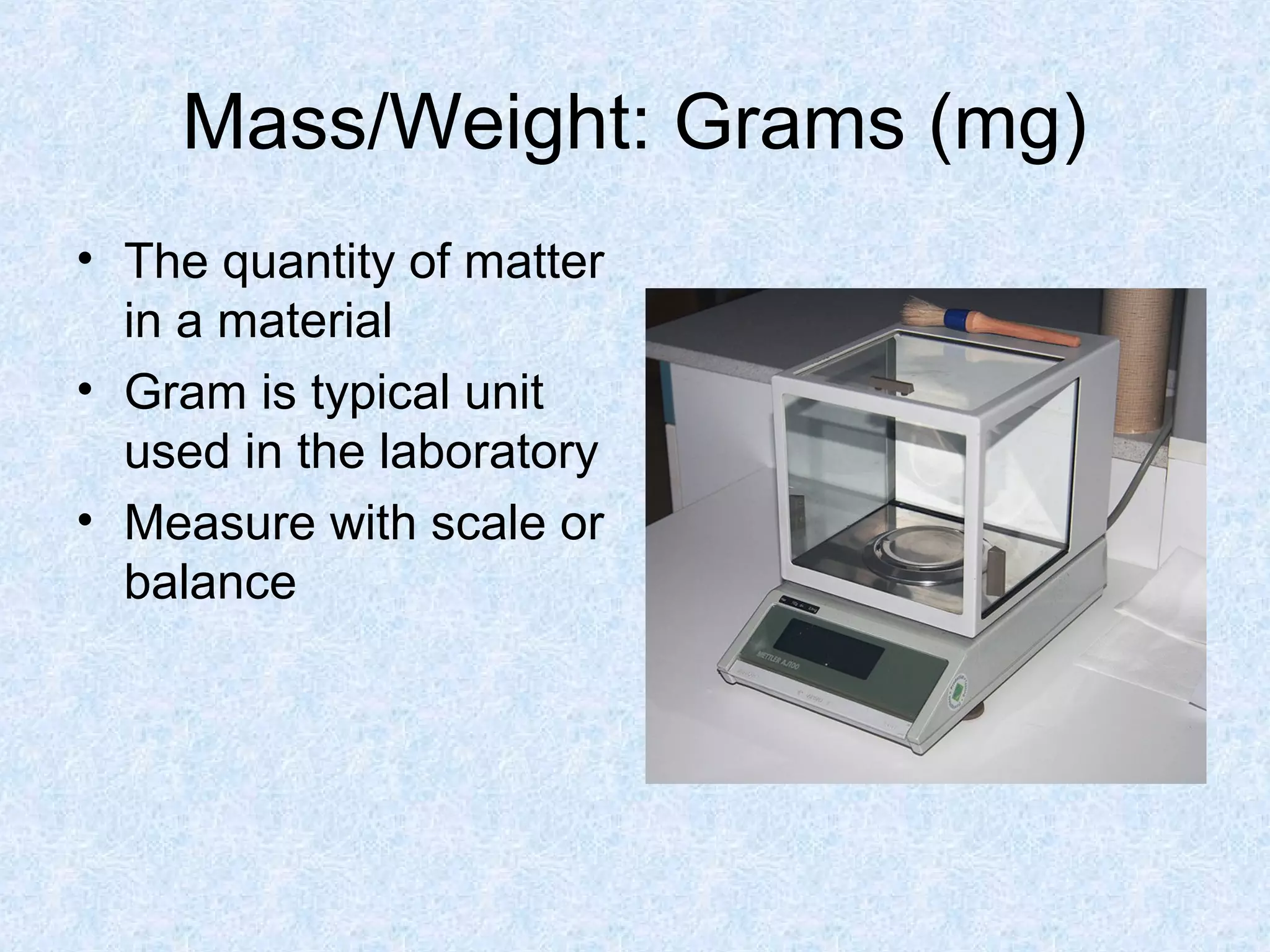
Mass/Weight: Grams (mg)
• The quantity of matter
in a material
• Gram is typical unit
used in the laboratory
• Measure with scale or
balance
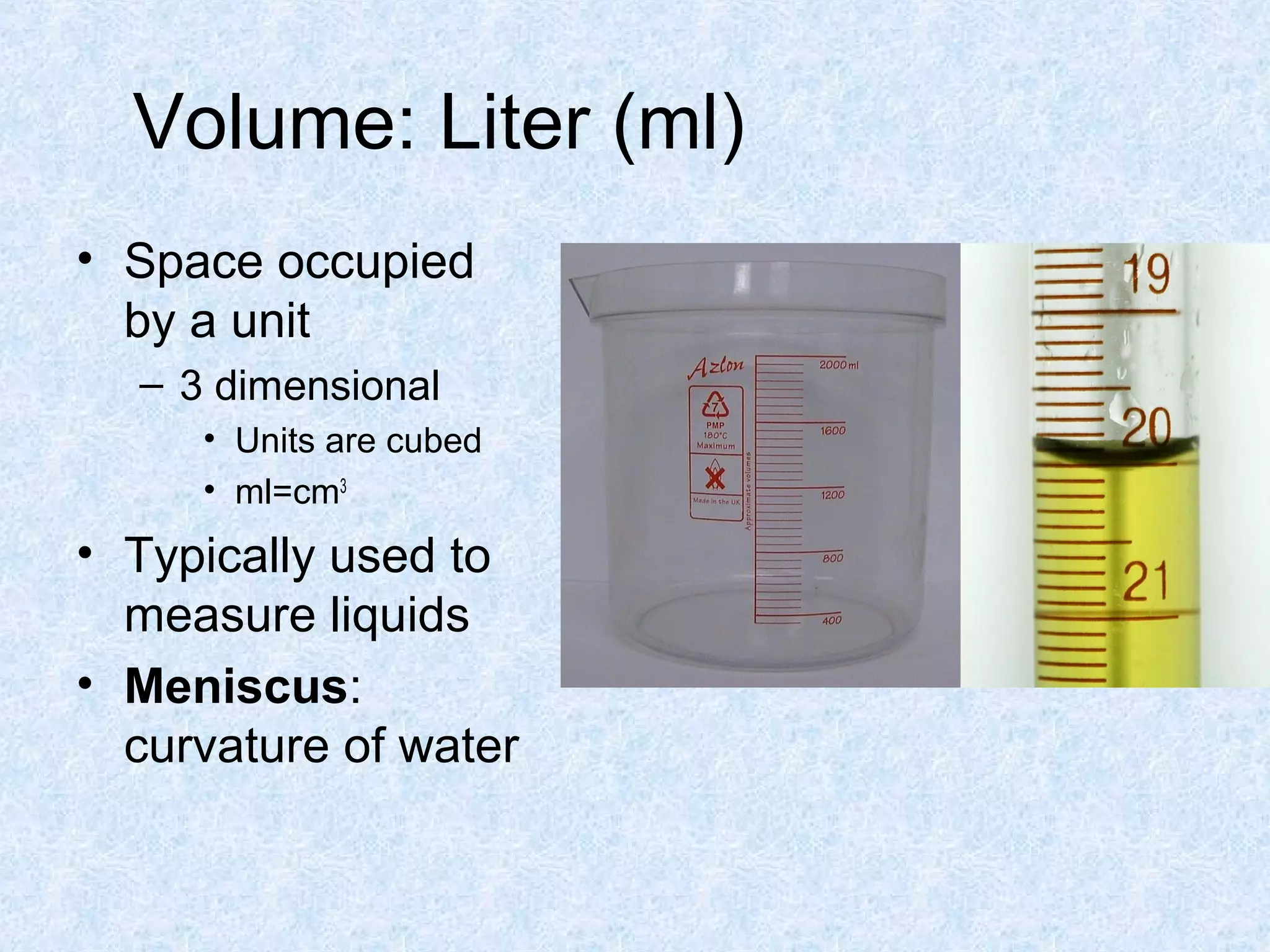
Volume: Liter (ml)
• Space occupied
by a unit
– 3 dimensional
• Units are cubed
• ml=cm3
• Typically used to
measure liquids
• Meniscus:
curvature of water
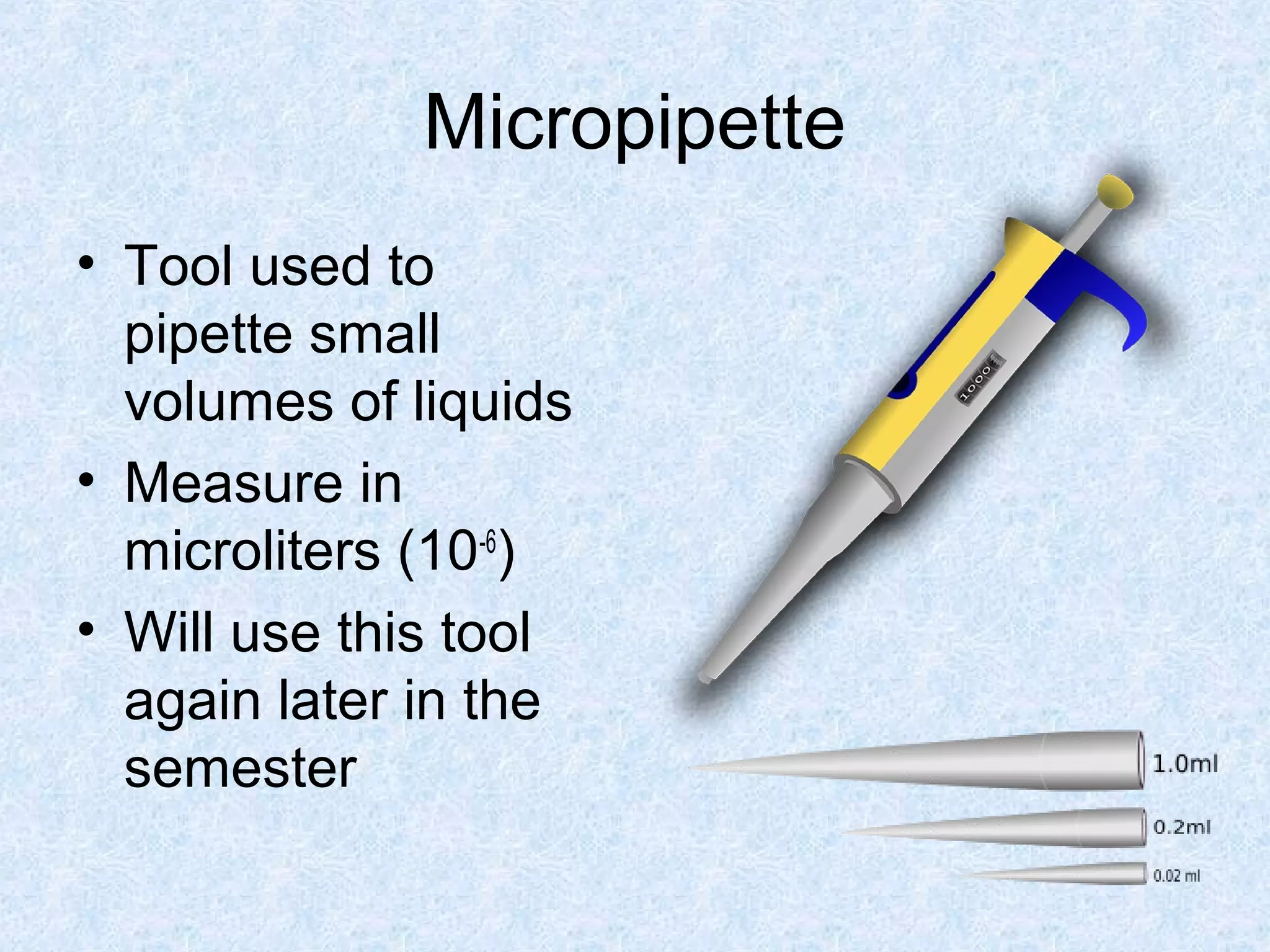
Micropipette
• Tool used to
pipette small
volumes of liquids
• Measure in
microliters (10-6
)
• Will use this tool
again later in the
semester
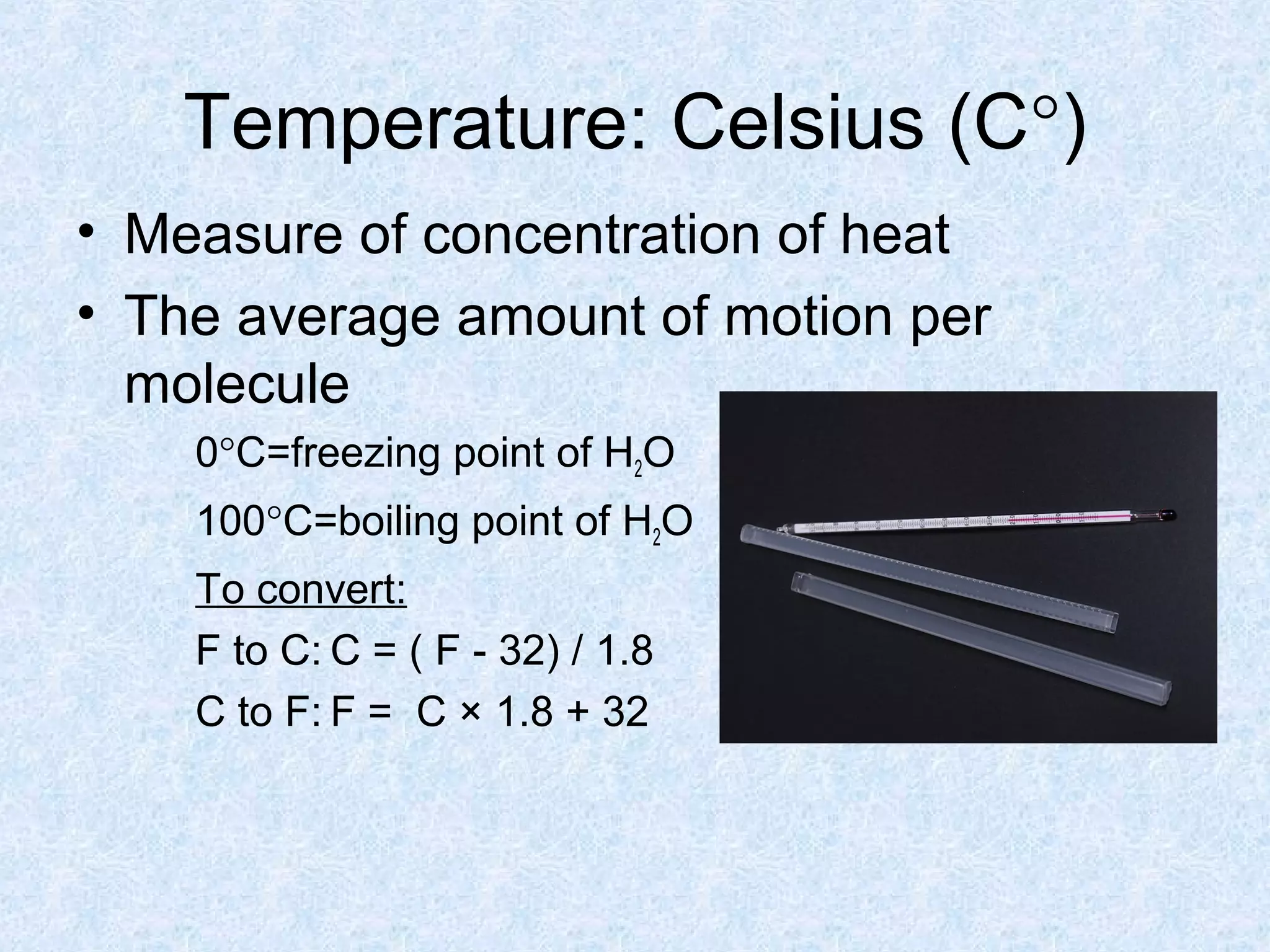
Temperature: Celsius (C°)
• Measure of concentration of heat
• The average amount of motion per
molecule
0°C=freezing point of H2O
100°C=boiling point of H2O
To convert:
F to C: C = ( F - 32) / 1.8
C to F: F = C × 1.8 + 32

Metric System

  • 1.
  • 2.
    First measurements • Basedon the human body Example: foot, hand • Standards evolved but not constant • Lack of common units a problem
  • 3.
    Solution • 1791 FrenchAcademy of Sciences devised metric system – Metric means measure in French – Based on unit of 10 • Easy to make conversions between units – Widely adapted • 1960 renamed International System of Units (SI)
  • 4.
    Metric Units Unit Metricmeasure Abbreviation Length Meter m Volume Liter L Mass Gram g Temperature Celcius C
  • 5.
    Metric prefixes we’lluse Prefix Symbol Multiplier Notation nano n 0.000000001 10-9 micro µ 0.000001 10-6 milli m 0.001 10-3 centi c 0.01 10-2 Base unit g, m, L 1 100 kilo k 1000 103
  • 6.
    Metric System • Aneasy way to move within the metric system is by moving the decimal point one place for each “step” desired Example: change meters to centimeters 1 meter = 10 decimeters = 100 centimeters or 1.00 meter = 10.0 decimeters = 100. centimeters kilo hecto deca meter liter gram deci centi milli
  • 7.
    Metric System • Ifyou move to the left in the diagram, move the decimal to the left • If you move to the right in the diagram, move the decimal to the right kilo hecto deca meter liter gram deci centi milli
  • 8.
    Metric conversion examples 15.2millimeters = _________________ meters 13 centigrams= __________________ micrograms 9.74 liters = __________________ milliliters 8051 nanometers = ______________ micrometers
  • 9.
    Scientific Notation • Youcan work backwards from scientific notation – The number in the superscript position of the 10 tells you how many places to move the decimal and in what direction 1 x 103 = 1000 4.7 x 105 = 470000 3.2 x 10-3 = 0.0032
  • 10.
    Length: Meter (cm,mm) • Based on the physical measure on the earth – Length from the North Pole to the Equator divided into 10 million parts • Measure with a ruler or tape measurer
  • 11.
    Mass/Weight: Grams (mg) •The quantity of matter in a material • Gram is typical unit used in the laboratory • Measure with scale or balance
  • 12.
    Volume: Liter (ml) •Space occupied by a unit – 3 dimensional • Units are cubed • ml=cm3 • Typically used to measure liquids • Meniscus: curvature of water
  • 13.
    Micropipette • Tool usedto pipette small volumes of liquids • Measure in microliters (10-6 ) • Will use this tool again later in the semester
  • 14.
    Temperature: Celsius (C°) •Measure of concentration of heat • The average amount of motion per molecule 0°C=freezing point of H2O 100°C=boiling point of H2O To convert: F to C: C = ( F - 32) / 1.8 C to F: F = C × 1.8 + 32

Editor's Notes

  • #2 “Steel ruler closeup,” by Ejay, https://commons.wikimedia.org/wiki/File:Steel_ruler_closeup.jpg. Licensed under a CC BY-SA license.
  • #11 “Vuvuzela mouthpiece 4 with ruler,” by DisillusionedBitterAndKnackered, https://commons.wikimedia.org/wiki/File:Vuvuzela_mouthpiece_4_with_ruler.jpg. Licensed under a CC BY-SA license.
  • #12 Balance Mettler AJ100. Authored by: Karelj. Located at: https://commons.wikimedia.org/wiki/File:Balance_Mettler_AJ100.jpg. License: Public Domain
  • #13 PMP beaker. Authored by: Cjp24. Located at: https://commons.wikimedia.org/wiki/File:PMP_beaker.jpg. License: CC BY-SA Meniscus. Authored by: PRHaney. Located at: https://commons.wikimedia.org/wiki/File:Meniscus.jpg. License: CC BY-SA
  • #14 Micro-pipette. Provided by: Openclipart. Located at: https://openclipart.org/detail/128059/micropipette. License: Public Domain. Micro pipette Tips. Provided by: Openclipart. Located at: https://openclipart.org/detail/127069/micro-pipette-tips. License: Public Domain.
  • #15 Laboratory thermometer. Authored by: Lilly_M. Located at: https://commons.wikimedia.org/wiki/File:Laboratory_thermometer-01.jpg. License: CC BY-SA